Market Snapshot
Key Takeaways
Market Overview & Analysis
Report Summary
This analysis sizes the global out-of-warranty electric vehicle salvage and scrap material floor-value market as the aggregate net realizable value of end-of-life and total-loss EV traction battery packs, e-axles, and structural components entering formal dismantling, cascade reuse, and hydrometallurgical recycling streams. The market is built from three empirical foundations: global EV fleet retirement data from the International Energy Agency and Eurostat, floor-value calibration grounded in black mass payable formulas and net scrap values by cathode chemistry, and a forecast horizon accounting for fleet aging curves and insurance collision total-loss write-off rates of 9.5% to 11.5%. The market is sized in USD across a 2020-2024 historical period and a 2025-2030 forecast period, with 2024 as the base year.
The global out-of-warranty EV salvage and scrap material floor-value market grew from USD 0.87 billion in 2020 to USD 2.88 billion in 2024, and is projected to reach USD 12.77 billion by 2030, a 28.21% compound annual growth rate. This growth masks a structural bifurcation the market's own chemistry data discloses clearly: high-nickel NMC and NCA packs retain strongly positive scrap floor values even as their share of retirement volume declines, while LFP packs, growing toward 58% of global volume by 2030, generate negative net floor values in Western markets, meaning the market's headline dollar growth is increasingly driven by a shrinking, high-value chemistry share rather than the majority of physical volume passing through the system.
The base-case 2030 forecast of USD 12.77 billion assumes continued fleet aging past the 8-year OEM warranty threshold, insurance collision total-loss write-off rates holding between 9.5% and 11.5%, and a rising LFP volume share reaching 58% of global retirement stock by 2030. The binding upside condition, reflected in the source material's own Accelerated Closed-Loop Compliance scenario, is whether strict enforcement of the EU Battery Regulation's 2027 recovery targets and China's MIIT Order No. 73 reduces informal recycling leakage below 15% while lithium carbonate prices rise above USD 22,000 per metric tonne, eliminating LFP gate fees entirely. The binding downside condition, reflected in the source material's Fragmented Trade Protectionism scenario, is whether Basel Convention COP-17 formally classifies all black mass as hazardous waste, slowing transboundary shipments and capping formal scrap intake at 245.0 GWh by 2030 as informal export-channel leakage persists.
Market Dynamics
Key Drivers
- Whole-vehicle salvage auction pricing consistently exceeds intrinsic metallurgical scrap value: through platforms including Copart and IAA, a damaged EV with a theoretical scrap value of USD 1,000 to USD 2,000 frequently hammers at auction for USD 5,000 to USD 12,000, a spread sustained by automotive dismantlers, cross-border rebuilders, and second-life energy storage builders who value the vehicle for parts and modules rather than raw material content alone.
- China's National Traceability Management Platform, now enforced through MIIT Order No. 73's vehicle-and-battery-together scrapping mandate, redirects retired battery volume away from unlicensed workshops that had historically outbid compliant recyclers by 10% to 20%, expanding the formal feedstock available to China's 156 whitelisted recycling enterprises, whose aggregate 4.23 million tonne annual capacity operated below 16% utilization in 2024.
- Second-life energy storage demand provides a genuine value floor for batteries retaining 75% to 90% State of Health after collision total loss, with modules trading between USD 40 and USD 70 per kWh in off-grid solar, agricultural, and residential storage applications, well above the sub-USD-30-per-kWh yield from direct hydrometallurgical black mass processing.
- China's structural cost advantage sustains positive LFP scrap floor values domestically even as Western markets impose disposal gate fees: Chinese dismantling labor is modeled at roughly USD 7.50 per hour against USD 50.00 per hour in the United States, allowing LFP scrap to trade at USD 1,300 to USD 1,400 per tonne in mainland China even as Western facilities charge USD 500 to USD 2,000 to accept a complete undamaged LFP pack.
- Regulatory extension of battery warranty coverage, including CARB Advanced Clean Cars II mandates requiring 2026 and later model-year zero-emission vehicles to carry at least 10-year or 150,000-mile coverage with a 70% capacity floor, sustains a growing out-of-warranty fleet population that will progressively enter salvage and scrap channels as vehicles age past their original coverage terms.
Key Restraints
- Lithium iron phosphate battery packs generate a negative net scrap floor value across North American and European hydrometallurgical facilities, with recyclers charging gate fees of USD 1.50 to USD 4.00 per kilogram of cells because extracted lithium revenue fails to cover the USD 15 to USD 35 per kWh in fixed transport, discharge, disassembly, and chemical processing costs, a structural cost burden that will intensify as LFP grows toward 58% of global retired volume by 2030.
- Manual battery pack disassembly remains a major cost driver across Western recycling facilities: unstandardized pack architectures using structural potting compounds and high-tensile fasteners require three to six labor hours per pack at roughly USD 50.00 per hour in the United States, compared to an estimated USD 7.50 per hour in Chinese dismantling facilities, a wage disparity that directly explains why LFP scrap trades positively in Asia while requiring disposal fees in North America and Europe.
- Basel Convention Prior Informed Consent procedures create four-to-nine-month delays for cross-border shipments of spent batteries and unrefined black mass, exposing inventory to commodity market fluctuations, demurrage costs, and port storage fees, while a fundamental regulatory divergence between the European Union, which classifies black mass as hazardous waste, and China, which permits high-purity processed black mass as a non-waste mineral raw material, complicates international circular trade flows.
- Regulatory friction from hazardous waste shipment controls contributes to informal leakage: damaged electric vehicles are frequently exported under clean or repairable used-car titles to developing markets in Eastern Europe, West Africa, and Southeast Asia, where usable modules are stripped in workshops lacking hazardous material containment, while damaged cells are open-burned or acid-leached without wastewater treatment, generating local environmental contamination.
Key Trends
- The market's cathode-chemistry bifurcation represents the single most consequential structural dynamic shaping the global salvage economy: as LFP chemistry expands from 38% to a projected 58% of retired volume by 2030, the market's dollar value growth increasingly depends on a shrinking share of high-nickel packs, while the majority of physical battery mass entering the system generates negative or marginal recovery economics in Western markets specifically.
- China's regulatory enforcement through MIIT Order No. 73 addresses a genuinely severe informal-market problem rather than a marginal compliance gap: an estimated 80% of China's retired batteries historically flowed outside official channels, and the policy's vehicle-deregistration mechanism represents a structurally different enforcement approach than incentive-based recycling programs used elsewhere.
- The persistent gap between whole-vehicle salvage auction pricing and intrinsic metallurgical scrap value demonstrates that component harvesting and second-life module reuse, not raw material recycling, currently capture the majority of economic value from out-of-warranty and total-loss EVs, a pattern likely to persist as long as OEM replacement parts remain expensive and slow to source.
- Western hydrometallurgical recyclers face a genuine long-term profitability constraint distinct from Asian competitors: without the labor cost advantage, industrial clustering, and processing scale China has developed, North American and European facilities cannot rely on high-cobalt chemistries to subsidize LFP processing indefinitely as the retirement stream's chemistry mix shifts unfavorably.
- Two structurally different regulatory pathways, a Basel Convention hazardous-waste classification for black mass versus China's non-waste mineral raw material classification, are on a collision course that will materially determine whether transboundary circular supply chains can scale efficiently or remain constrained by Prior Informed Consent procedural delays.
Strategic Implications
For a Property and Casualty insurer, claims adjusting protocols must adapt specifically to the economics of low-cobalt battery packs, since insurers can no longer assume salvage auctions will recover value from intact battery scrap; integrating specialized diagnostic screening capable of assessing internal pack health into total-loss determinations can prevent premature write-offs driven solely by minor casing damage, directly reducing exposure to the 29% to 33% claims severity premium BEVs already carry over comparable internal combustion vehicles.
For an automotive dismantler or salvage auction platform, capital investment in isolated high-voltage staging areas, fire-suppression infrastructure, and UN 3480 and ADR P911 certified packaging is now a genuine operational requirement rather than an optional upgrade; dismantlers should prioritize battery remanufacturing capability, following the precedent of LKQ's acquisition of Green Bean Battery, to capture USD 40 to USD 70 per kWh secondary-market module margins while avoiding low-margin or fee-bearing bulk recycling routes.
For a hydrometallurgical recycler, particularly one operating in North America or Europe, long-term profitability depends on developing automated pre-treatment and disassembly systems specifically to reduce the current USD 50-per-hour manual labor penalty, since Western facilities cannot depend on high-cobalt chemistry margins to subsidize LFP processing as retirement volumes shift toward LFP; Chinese processors should focus on redirecting feedstock away from unlicensed workshops toward the 4.23 million tonne whitelisted capacity currently operating below 16% utilization.
Outlook
Base case: USD 12.77 billion by 2030 (28.21% six-year value CAGR), on 265.0 GWh of formal retired and salvage battery volume. This trajectory assumes continued fleet aging past the 8-year OEM warranty threshold, insurance collision total-loss write-off rates holding between 9.5% and 11.5%, and LFP chemistry expanding to 58% of global retirement volume as the global weighted-average net floor value falls from USD 68.50 to USD 48.20 per kWh.
Upside case (Accelerated Closed-Loop Compliance and Hydrometallurgical Scarcity): USD 14.62 billion by 2030 (31.08% six-year value CAGR), on 280.0 GWh of formal scrap intake. The specific trigger is strict enforcement of the EU Battery Regulation's 2027 recovery targets alongside the Digital Battery Passport's February 2027 introduction, combined with effective enforcement of China's MIIT Order No. 73 reducing informal recycling leakage below 15% while battery-grade lithium carbonate prices rise above USD 22,000 per metric tonne, eliminating LFP gate fees entirely.
Downside case (Fragmented Trade Protectionism and LFP Chemistry Deflation): USD 9.85 billion by 2030 (22.75% six-year value CAGR), on 245.0 GWh of formal scrap intake. The specific trigger is Basel Convention COP-17 formally classifying all black mass as hazardous waste under code A1181, slowing transboundary shipments through Prior Informed Consent delays while LFP chemistry grows to 70% of global retired volume and persistent lithium mining surpluses keep carbonate prices below USD 11,000 per metric tonne, pushing net realizable floor value down to USD 40.20 per kWh.
Market Segmentation
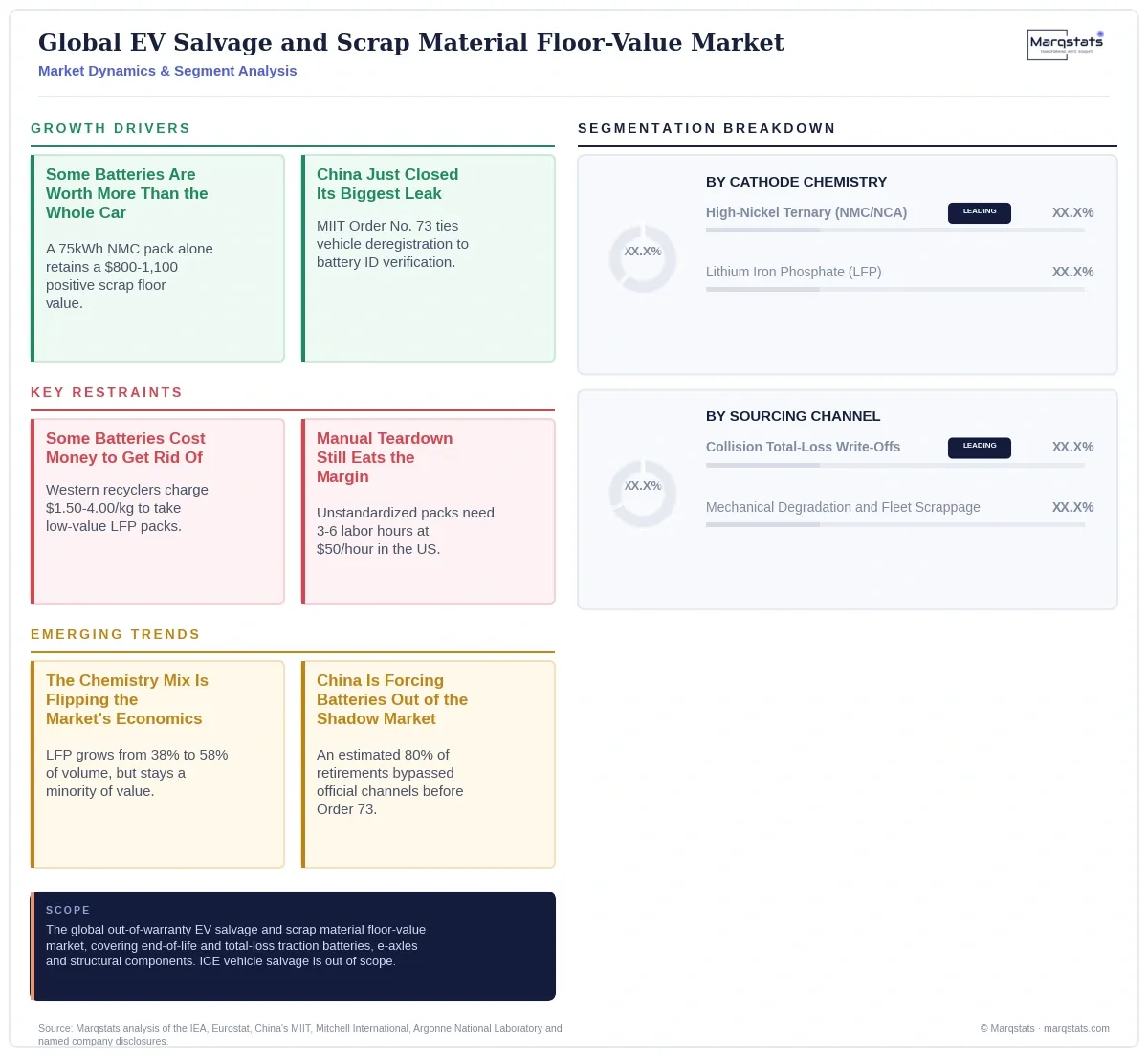
High-nickel ternary chemistries accounted for 62% of 2024 market value (USD 1.79 billion) despite representing a declining share of new EV production in entry segments, because they dominate the current out-of-warranty retirement stream reflecting historical manufacturing profiles; by 2030, NMC/NCA will fall to 42% of scrapped volume but retain 66% of total market value (USD 8.43 billion) due to high cobalt and nickel recovery yields.
LFP held 38% of 2024 salvage volume and generated USD 1.09 billion in floor value, heavily weighted toward Chinese domestic transit and fleet vehicles; by 2030, LFP is projected to represent 58% of physical scrapped volume but only 34% of market value (USD 4.34 billion), constrained by the chemistry's low chemical extraction margins and the disposal gate fees Western recyclers charge to process it.
Collision total-loss write-offs accounted for 68% of 2024 salvage volume (USD 1.96 billion), passing through auction platforms including Copart and IAA and entering the stream primarily due to structural battery pack integration into vehicle chassis and proprietary diagnostic restrictions that prevent independent verification of internal module integrity after minor casing damage.
Mechanical degradation and commercial fleet scrappage contributed the remaining 32% of 2024 volume (USD 0.92 billion), composed of high-mileage taxis, urban delivery vans, and municipal buses retired after exceeding warranty limits, typically retaining 12 to 15 years of operational viability before pack capacity drops below the 70% State of Health threshold.
Direct mechanical shredding and hydrometallurgical recycling accounted for 54% of 2024 volume, absorbing non-repairable write-offs and packs with compromised structural integrity that cannot legally or safely be redirected into parts harvesting or second-life reuse channels.
Cascading second-life deployment and salvage parts harvesting accounted for 46% of 2024 volume, supported by demand from battery energy storage system providers and auto parts recyclers such as LKQ Corporation, which established internal battery remanufacturing capability through its 2021 acquisition of Green Bean Battery.
By Geography
Asia-Pacific
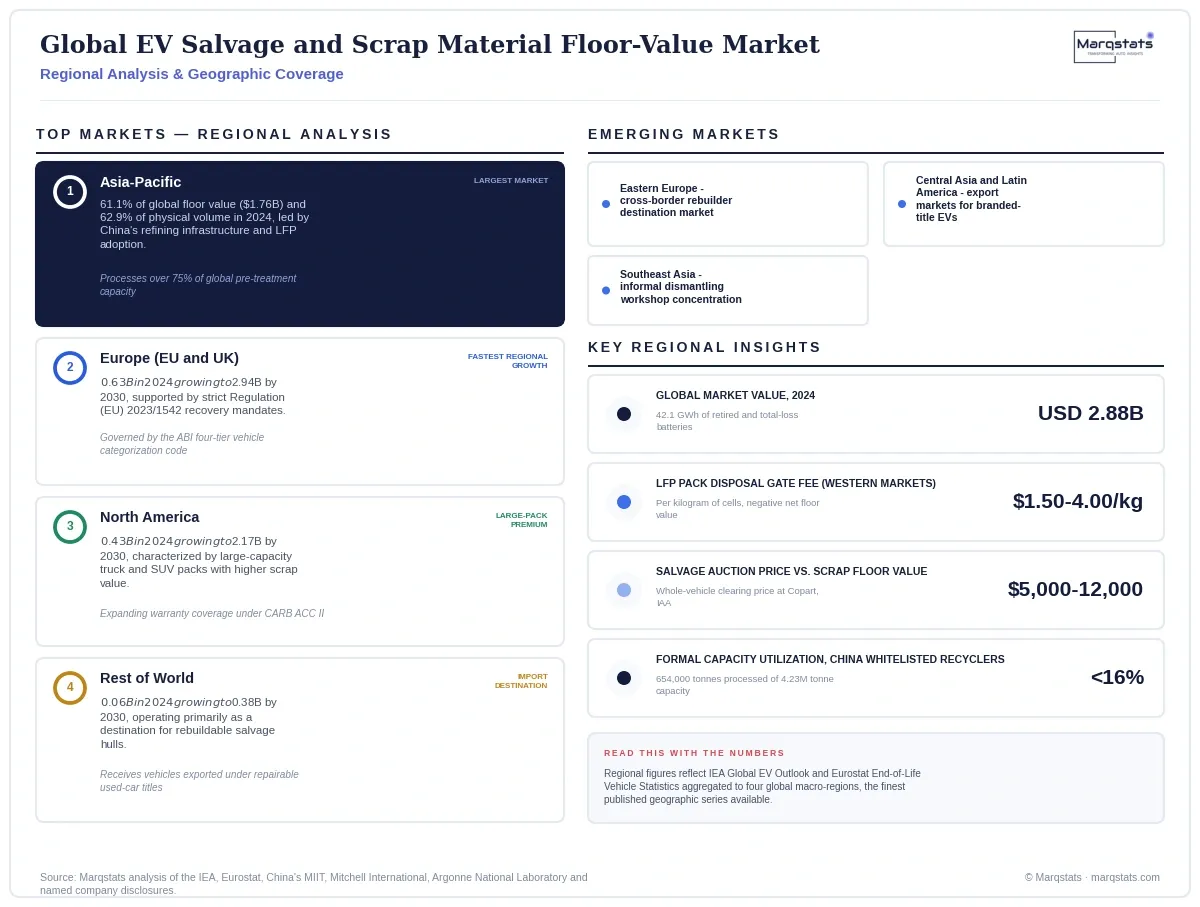
Asia-Pacific dominates the market, accounting for 61.1% of global floor value (USD 1.76 billion) and 62.9% of physical volume (26.5 GWh) in 2024, led by mainland China's early commercial electrification, high domestic LFP adoption, and extensive refining infrastructure processing more than 75% of global pre-treatment capacity; the region is projected to reach USD 7.28 billion across 159.0 GWh by 2030.
Europe (EU and UK)
Europe generated USD 0.63 billion (8.8 GWh) in 2024, growing to USD 2.94 billion (58.3 GWh) by 2030, supported by strict recovery mandates under Regulation (EU) 2023/1542 and the ABI Code of Practice's four-tier vehicle categorization framework that determines whether damaged battery packs can be resold for road use or must enter industrial recycling channels.
North America
North America accounted for USD 0.43 billion (6.1 GWh) in 2024 and is projected to reach USD 2.17 billion (42.4 GWh) by 2030, characterized by large-capacity battery packs on pickup trucks and SUVs that carry proportionally higher metallurgical scrap value alongside expanding warranty requirements under CARB Advanced Clean Cars II.
Rest of World
The Rest of World region accounted for USD 0.06 billion (0.7 GWh) in 2024 and is projected to expand to USD 0.38 billion (5.3 GWh) by 2030, operating primarily as an import destination for rebuildable salvage hulls exported from Western markets under repairable used-car titles that exploit the Basel Convention's repair exemption.
How Competition Is Evolving
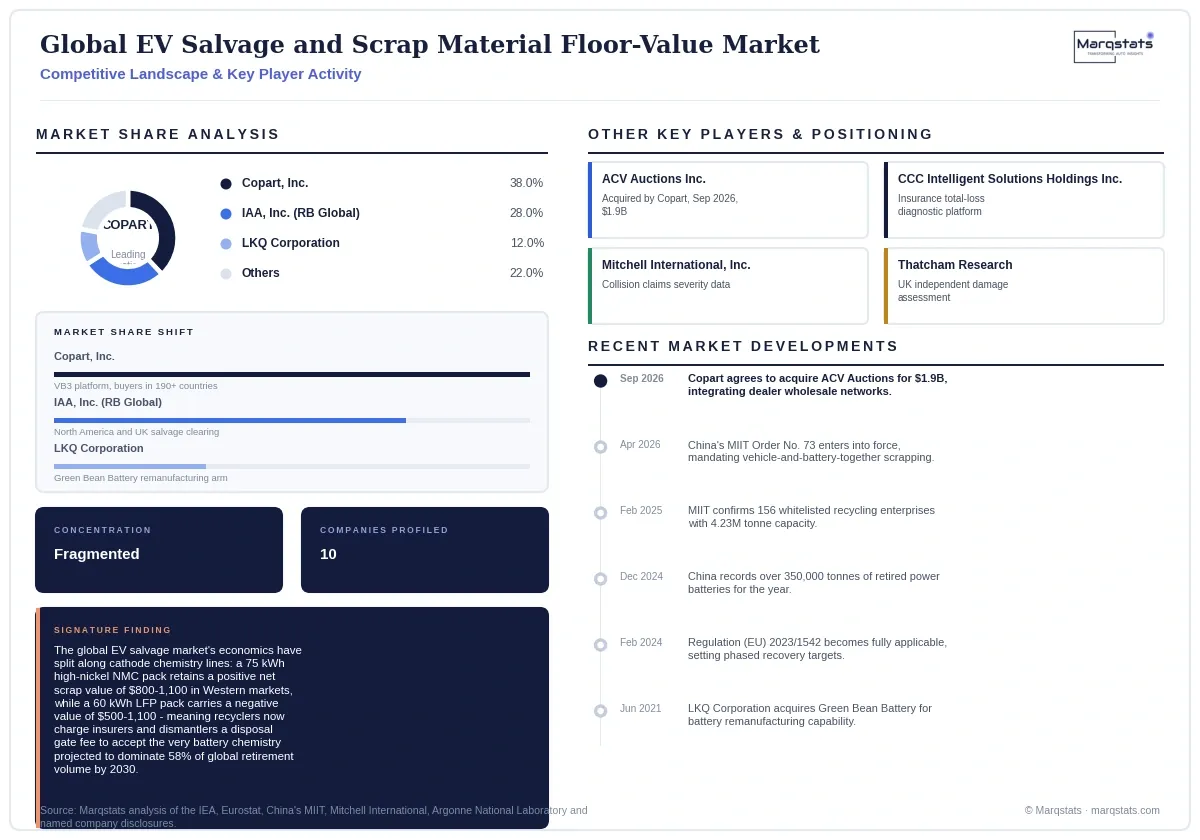
The global out-of-warranty EV salvage market spans a fragmented set of adjacent competitive layers rather than a single concentrated industry: salvage auction intermediation is moderately concentrated around two major platforms, Copart and IAA, which together clear the majority of insurer-liquidated electric vehicles across North America and the United Kingdom, while downstream hydrometallurgical recycling and parts-harvesting remain considerably more fragmented across regional specialists.
Firms compete differently at each layer of the value chain: auction platforms compete on buyer network reach, with Copart's VB3 digital system linking regional yards to buyers across more than 190 countries; automotive dismantlers compete on parts-harvesting speed and remanufacturing capability, exemplified by LKQ Corporation's acquisition of dedicated battery remanufacturing capacity; and hydrometallurgical recyclers compete on processing scale and labor cost structure, a dimension where Chinese facilities hold a durable structural advantage over Western counterparts.
The most significant recent competitive-landscape shift is Copart's September 2026 agreement to acquire ACV Auctions for USD 1.9 billion in cash, integrating ACV's dealer-to-dealer wholesale network and vehicle inspection software with Copart's physical salvage yards, a transaction that demonstrates the growing convergence between dedicated salvage platforms and general vehicle remarketing channels.
Companies Covered
The report profiles 10+ companies with full strategy and financials analysis, including:
Recent Market Activity
Table of Contents
Coverage & Segmentation
Coverage spans the global out-of-warranty electric vehicle salvage and scrap material floor-value market, encompassing the aggregate net realizable value of end-of-life and total-loss EV traction battery packs, e-axles, and structural components entering formal dismantling, cascade reuse, and hydrometallurgical recycling streams. The market is sized in USD across a 2020-2024 historical period and a 2025-2030 forecast period, with 2024 as the base year given the most recent complete annual dataset available. Three segmentation dimensions are quantified: cathode chemistry, sourcing channel, and downstream material flow.
Excluded from scope: internal combustion engine vehicle salvage and scrap, which follows a fundamentally different valuation model without battery chemistry economics; new battery cell and pack manufacturing, covered by separate Marqstats studies; and informal, unlicensed recycling volume that by definition falls outside verifiable statistical reporting, though its estimated scale is discussed qualitatively. A separate Marqstats study addresses the global second-life EV battery storage market on a comparable basis.