Market Snapshot
Key Takeaways
Market Overview & Analysis
Report Summary
This analysis sizes the global out-of-warranty EV battery cell-swap and remanufacturing market as the aggregate value of all physical intervention performed on traction battery packs operating beyond standard factory warranty coverage, spanning non-invasive software diagnostics, electromechanical component repair, module-level swapping, and complete industrial pack remanufacturing. The market is built from a three-step sizing chain: a primary fleet anchor from International Energy Agency global EV registration data, an out-of-warranty servicing incidence rate calibrated against Recurrent Auto and Geotab connected-vehicle telemetry, and a sales-weighted average service ticket price blended across four intervention depths. The market is sized in USD across a 2020-2024 historical period and a 2025-2029 forecast period, with 2024 as the base year.
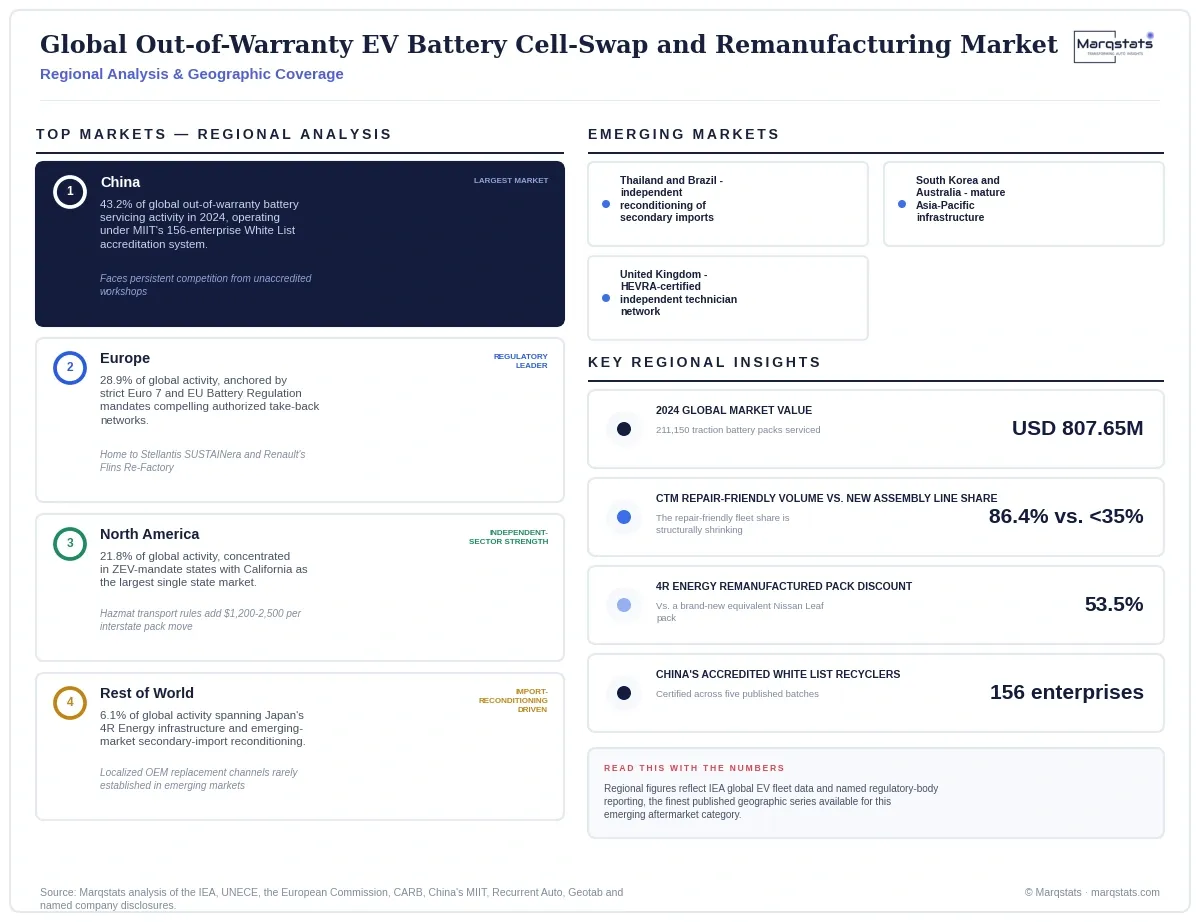
The global out-of-warranty EV battery cell-swap and remanufacturing market grew from USD 206.89 million in 2020 to USD 807.65 million in 2024, a compound annual growth rate exceeding 40%, and is projected to reach USD 2.585 billion by 2029 under the market's base case, a 26.19% compound annual growth rate. This growth reflects a structural transition rather than simple volume expansion: as Cell-to-Pack and Cell-to-Chassis architectures using non-reworkable structural adhesives displace the modular Cell-to-Module designs that still dominate current repair volume, the market's own composition will shift decisively toward high-value OEM industrial remanufacturing and away from lower-cost independent module swapping.
The market's own scenario framework identifies two genuinely distinct five-year trajectories rather than a single point forecast. The base case, an OEM-Dominated Closed-Loop Ecosystem, assumes continued enforcement of the EU Battery Passport from February 2027 and Euro 7 durability monitoring, alongside expanding automaker core-deposit exchange programs, reaching 809,200 serviced units and USD 2.585 billion by 2029. The binding upside condition, reflected in the market's own Open Aftermarket Ecosystem scenario, is whether the United States passes a federal REPAIR Act following the Massachusetts and Maine legal precedents, combined with strict European enforcement of Article 14's open-telematics mandate and automaker adoption of standardized debondable structural adhesives, which would lift servicing incidence to 4.8% of the aged fleet and expand the market to USD 3.450 billion; the binding downside condition is whether automakers accelerate Cell-to-Chassis structural potting adoption faster than debondable adhesive chemistries mature, locking independent repairers out of an increasing share of the aged fleet.
Market Dynamics
Key Drivers
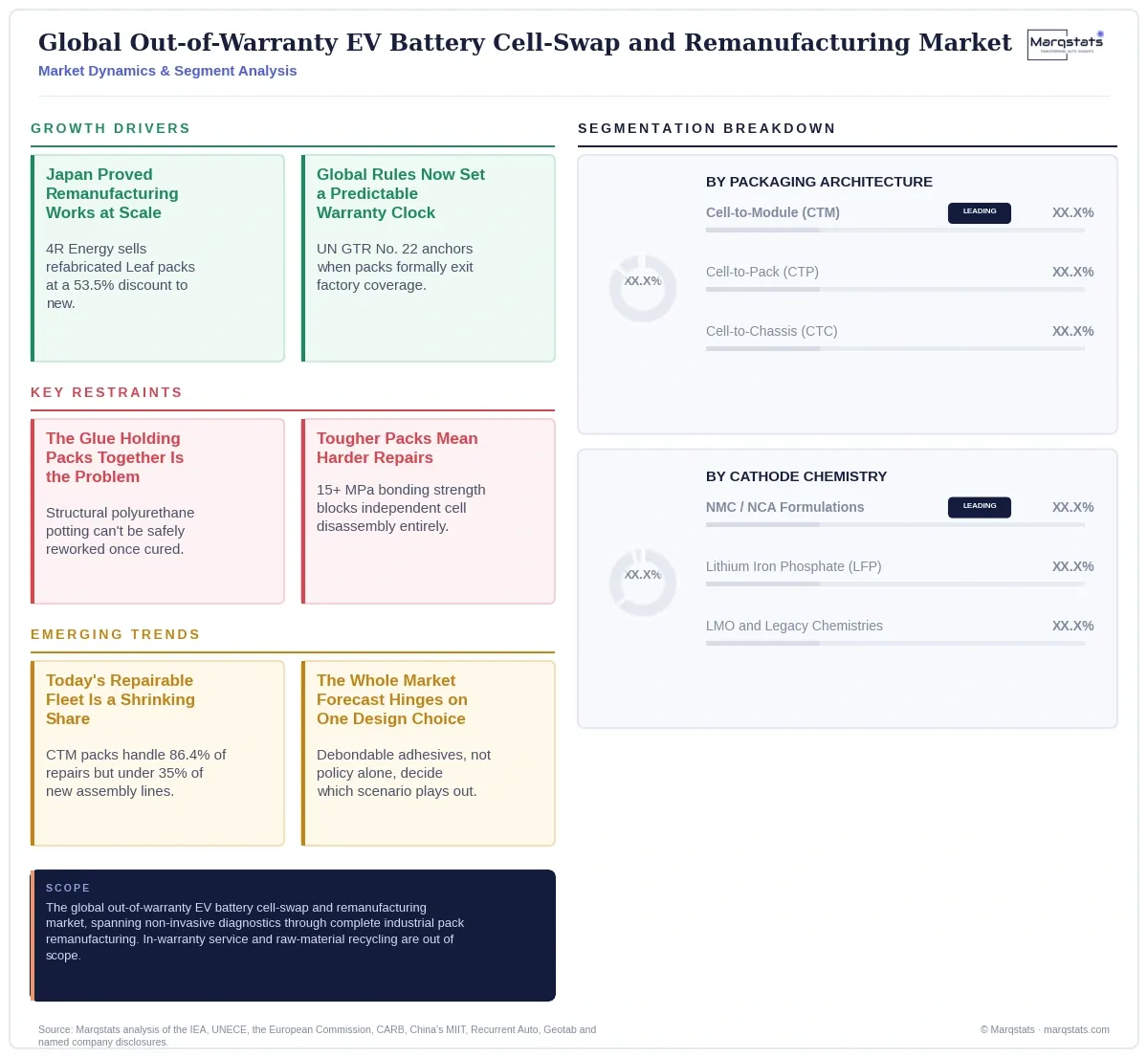
- Factory-certified remanufactured pack exchange delivers 48% to 63% consumer savings against a new OEM pack replacement, following the economic model 4R Energy Corporation pioneered in Japan, where refabricated Nissan Leaf packs sold to out-of-warranty owners at a 53.5% discount to a brand-new equivalent, demonstrating that certified secondary battery remanufacturing preserves used EV residual values at genuine industrial scale.
- The UN GTR No. 22 global technical regulation, incorporated and strengthened under the European Union's Euro 7 regulation and enforced through California's Advanced Clean Cars II framework, establishes statutory durability baselines requiring 80% State of Certified Energy at 5 years and progressively higher thresholds through 2031, creating predictable warranty-exit timing that anchors the addressable out-of-warranty fleet automakers and remanufacturers can plan around.
- European original equipment manufacturers have codified battery remanufacturing into dedicated corporate business units generating genuine industrial-scale volume: Stellantis's SUSTAINera Circular Economy Hub in Turin remanufactured over 1,000 high-voltage traction batteries in its first operational year, while Renault's Flins Re-Factory targets over EUR 1 billion in circular turnover by 2030 through its Expert Battery Repair Centre and THE REMAKERS joint venture.
- The landmark 11 February 2025 federal district court ruling affirming Massachusetts' Right to Repair statute against a preemption challenge from the Alliance for Automotive Innovation, combined with Maine's LD 2211 operationalizing independent data platform access, establishes durable legal precedent that independent aftermarket repairers can build long-term capital investment plans around, rather than facing continuous litigation risk over basic diagnostic access.
- Advanced diagnostic technology, specifically high-frequency Electrochemical Impedance Spectroscopy and rapid pulsed-discharge cycling, has compressed complete module evaluation across a full Nissan Leaf pack from 16 days to 4 hours at 4R Energy's automated grading facility, a throughput improvement that makes industrial-scale remanufacturing genuinely commercially viable rather than a boutique, labor-intensive service.
Key Restraints
- The physical transition from modular Cell-to-Module architectures toward Cell-to-Pack and Cell-to-Chassis designs bonded with non-reworkable 2K polyurethane structural adhesives represents the single most consequential constraint on independent repair capability: these thermoset adhesives cannot be remelted without exceeding cell safety thresholds, and applying mechanical force to pry a bonded cell away from its cooling channel frequently breaches the cell casing and vents flammable electrolyte.
- Structural adhesive layers achieving lap shear strengths exceeding 15 MPa and dielectric isolation exceeding 25 kV per millimeter, while essential for the mechanical and thermal performance automakers require, simultaneously lock independent repairers out of physical pack teardown, confining aftermarket intervention on newer platforms to non-invasive software resets or complete pack recycling rather than genuine module-level repair.
- Hazardous materials transportation rules enforced by the U.S. Department of Transportation add USD 1,200 to USD 2,500 in freight expense per pack movement across state lines for Class 9 Lithium-Ion shipments, structurally favoring regional spoke-and-hub reconditioning networks over single centralized facilities and raising the capital intensity required to operate a geographically distributed independent repair business.
- China's regulatory framework, while providing clear accreditation standards through the Ministry of Industry and Information Technology's White List system, faces persistent competition from informal, unaccredited recycling workshops that outbid officially certified enterprises for spent battery cores, prompting recurring regulatory interventions by provincial environmental protection bureaus and illustrating that accreditation alone does not eliminate informal-market leakage.
Key Trends
- The battery packaging transition toward Cell-to-Pack and Cell-to-Chassis architectures is a genuine structural fork in the road for the entire remanufacturing industry, not an incremental engineering refinement: modular designs currently handling 86.4% of repair volume represent under 35% of new assembly lines, meaning the repair-friendly fleet share will mechanically shrink as older vehicles age out even without any change in consumer behavior or repair economics.
- The market's own two-scenario framework discloses a genuinely unresolved dependency between physical engineering choices and regulatory outcomes: whether automakers adopt standardized debondable structural adhesives, currently under development by Henkel, Sika and 3M, will materially determine whether the Open Aftermarket Ecosystem upside scenario or the OEM-Dominated Closed-Loop base case actually materializes by 2029.
- Massachusetts' successful defense of its Right to Repair statute against federal preemption, and Maine's subsequent operationalization of the same principle through LD 2211, establish a genuine legal template other states and potentially a federal REPAIR Act could follow, making state-level right-to-repair litigation outcomes a directly material variable for the market's five-year trajectory rather than a peripheral policy question.
- China's 156-enterprise White List accreditation system demonstrates that a centrally administered, accredited-operator model can coexist with persistent informal-market competition rather than eliminating it entirely, a pattern with direct relevance for how other jurisdictions might expect their own accreditation frameworks to perform once implemented.
- The consumer savings gradient across service depths, from 48% to 63% for factory-certified remanufactured exchange up to 65% to 75% for independent module replacement, reveals that independent repair, where it remains physically possible, delivers genuinely superior price value to consumers even though it carries meaningfully shorter warranty coverage, a trade-off regulatory right-to-repair advocates and automaker circular-economy programs frame in opposite terms.
Strategic Implications
For an independent aftermarket repairer, capital allocation toward manual single-cell desoldering and cell-level swapping carries growing technical risk as modular pack designs decline; independent workshops should prioritize investment in high-voltage safety equipment, diagnostic scanning tools, and Level 2 electromechanical repair capability covering contactors, pyrotechnic fuses and current sensors, while establishing regional purchasing cooperatives to secure certified BMS diagnostic keys and pre-tested donor modules from licensed dismantling networks.
For an original equipment manufacturer, treating out-of-warranty battery degradation purely through complete pack replacement risks customer attrition from the brand's service network, since high repair estimates frequently cause owners to abandon dealership relationships entirely; automakers should build dedicated circular engineering operations following the Stellantis SUSTAINera and Renault THE REMAKERS models, implement standardized core-exchange credit programs, and rigorously evaluate whether the structural rigidity gains of permanent potting adhesives outweigh the long-term warranty and end-of-life recycling obligations Euro 7 and CARB regulations impose.
For a material supplier or industrial equipment manufacturer, genuine commercial opportunity exists in developing high-strength structural polyurethanes exceeding 15 MPa lap shear strength that can be debonded on demand through targeted chemical solvent, heat or electrical current application, alongside automated robotic dismantling tools using computer vision to safely cut pack enclosures and extract individual cells without triggering thermal runaway, positioning suppliers to serve OEMs balancing structural performance requirements against circularity mandates.
Outlook
Base case (OEM-Dominated Closed-Loop Ecosystem): USD 2.585 billion by 2029 (26.19% five-year value CAGR), on 809,200 serviced pack units. This trajectory assumes strict enforcement of the EU Battery Passport under Article 77 beginning 18 February 2027 and Euro 7 type-approval durability monitoring starting November 2026 and 2027, alongside continued automaker adoption of non-reworkable Cell-to-Pack and Cell-to-Chassis structural potting that concentrates full pack remanufacturing within authorized OEM circular hubs including Stellantis SUSTAINera and Renault THE REMAKERS.
Upside case (Open Aftermarket Ecosystem): USD 3.450 billion by 2029 (33.68% five-year value CAGR), on 1,150,000 serviced pack units. The specific trigger is passage of a United States federal REPAIR Act following the legal precedents established in Massachusetts and Maine, combined with strict European Union enforcement of Article 14's open-telematics mandate guaranteeing unencrypted bidirectional diagnostic access, and automaker adoption of standardized debondable structural adhesives from suppliers including Henkel, Sika and 3M that preserve demountable casing designs while meeting structural performance requirements.
Downside consideration: the market's own testing across policy, corporate filings and technical supply chains explicitly rules out a viable informal grey-market scenario, since high-voltage lithium-ion systems carry inherent fire risks, strict Class 9 transport logistics requirements, and aggressive environmental oversight under frameworks including China's MIIT White List restrictions and European Extended Producer Responsibility directives, preventing unaccredited pack-servicing operations from achieving long-term commercial scale regardless of cost pressure from formal channels.
Market Segmentation
Modular Cell-to-Module architectures, used in the Volkswagen MEB platform, Nissan Leaf and early Tesla Model S, account for 86.4% of current out-of-warranty repair transactions, since discrete internal module enclosures allow technicians to extract, bench-test and replace isolated sub-packs without compromising neighboring cells; CTM platforms represent less than 35% of current OEM global assembly lines, signaling a long-term structural decline in the repair-friendly fleet share.
Cell-to-Pack systems, led by BYD's Blade Battery and CATL's Qilin platform, represent 12.1% of active out-of-warranty servicing volume, dominated by early Chinese imports and second-generation international platforms where servicing requires automated debonding equipment to separate cells bonded directly to liquid-cooling floor decks with structural polyurethane adhesives.
Cell-to-Chassis structural batteries, exemplified by the Tesla Model Y's Austin-built 4680 structural pack and Leapmotor's CTC architecture, currently constitute just 1.5% of out-of-warranty servicing volume, since structural packs integrated directly into the body shell with polyurethane foaming make physical cell replacement virtually impossible, restricting aftermarket intervention to non-invasive software resets or complete pack recycling.
Nickel Manganese Cobalt and Nickel Cobalt Aluminum formulations, sourced predominantly from LG Energy Solution, SK On and Panasonic, account for 63.8% of the aged out-of-warranty fleet; their sloped open-circuit voltage profile allows external diagnostic tools to detect individual cell degradation through static voltage-spread monitoring, though higher thermal reactivity requires strict inert-gas handling during laser re-welding.
LFP chemistry, dominated by CATL, BYD and Gotion High-Tech and concentrated in Chinese domestic vehicles and entry-level global models, represents 31.5% of the aged fleet, offering extended cycle life exceeding 3,000 cycles but featuring an exceptionally flat voltage profile that prevents technicians from identifying weak cells through resting voltage measurements alone, requiring full charge-discharge cycling or multi-frequency impedance spectroscopy.
Legacy Lithium Manganese Oxide and Lithium Cobalt Oxide formulations, anchored by AESC's Generation-1 Nissan Leaf packs, make up the remaining 4.7% of the aged fleet, characterized by high thermal degradation rates that drive persistent, immediate aftermarket replacement demand from the oldest vehicle cohorts still in service.
Combined Level 1 non-invasive software diagnostics and Level 2 electromechanical component restoration account for 50.5% of service transactions, spanning high-voltage balancing rigs that recalibrate BMS capacity calculations without mechanical disassembly through to replacement of pre-charge contactors, pyrotechnic safety fuses and current-sensing shunts sourced from suppliers including TE Connectivity, Eaton and Sensata.
Level 3 sub-pack module extraction and swapping represents the single largest service tier at 38.0% of service events, in which technicians drop the pack, unbolt degraded modules and install voltage-matched donor modules acquired from salvage networks, exemplified by 4R Energy and Autocraft Solutions Group.
Level 4 comprehensive industrial remanufacturing accounts for 11.5% of volume, involving total teardown to bare cells, automated capacity and internal-resistance grading, thermal interface material replacement, automated laser re-welding and digital Battery Passport recertification, a service tier concentrated among OEM circular hubs including Stellantis Mirafiori and Renault THE REMAKERS.
By Geography
China
China accounts for 43.2% of global out-of-warranty battery servicing activity, the largest single national market, operating under the centralized oversight of the Ministry of Industry and Information Technology, which channels spent batteries through 156 accredited White List enterprises under national standard GB/T 34015-2017; a persistent challenge is competition from informal, unaccredited recycling workshops that outbid officially certified operators for spent battery cores.
Europe
Europe represents 28.9% of global out-of-warranty battery servicing, led by mature markets including Norway, Germany, France, the United Kingdom and the Netherlands, anchored by strict circular economy mandates under Euro 7 and Regulation (EU) 2023/1542 that legally compel automakers to establish authorized take-back and remanufacturing networks; the independent sector benefits from formalized certification networks including the United Kingdom's Hybrid and Electric Vehicle Repair Alliance.
North America
North America accounts for 21.8% of global out-of-warranty battery remanufacturing, heavily concentrated in states adhering to zero-emission vehicle mandates, with California representing the largest single state market at 1.77 million cumulative plug-in registrations; the region's active independent repair sector routinely reverse-engineers proprietary BMS protocols, though hazardous materials transportation rules add USD 1,200 to USD 2,500 in freight expense per interstate pack movement.
Rest of World
The remaining 6.1% of global activity spans mature Asia-Pacific markets including Japan, South Korea and Australia alongside emerging hubs in Southeast Asia and Latin America; Japan has built advanced domestic remanufacturing infrastructure through 4R Energy Corporation, while emerging markets including Thailand and Brazil rely on independent reconditioning of secondary imported vehicles given rarely established localized OEM battery replacement channels.
How Competition Is Evolving
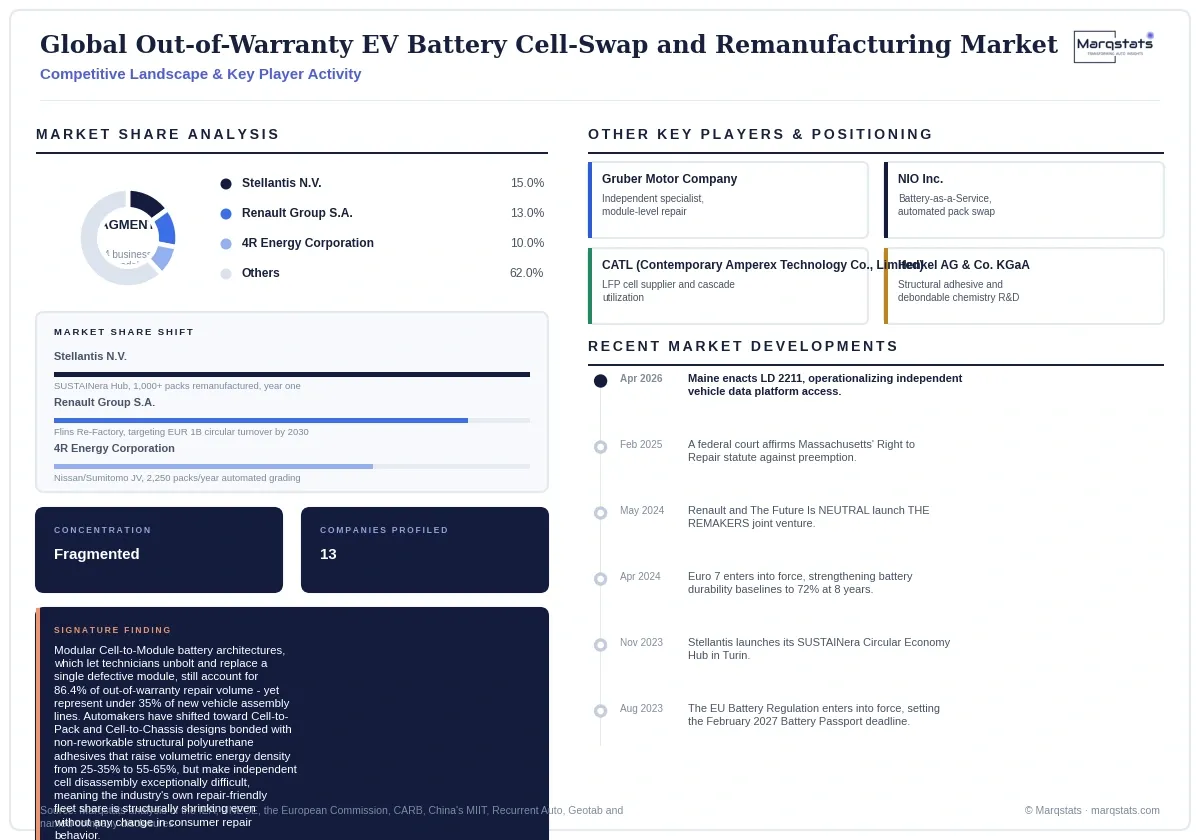
The EV battery remanufacturing market is fragmented across four distinct business models rather than concentrated around a small number of dominant firms: automaker-controlled circular engineering hubs, independent specialized aftermarket repairers, Battery-as-a-Service operators, and second-life repurposing integrators each occupy structurally different competitive positions rather than competing head-to-head for the same customer.
Firms compete differently by segment: automaker circular hubs including Stellantis SUSTAINera and Renault THE REMAKERS compete on closed-loop core-deposit dominance and full industrial pack remanufacturing capability, independent specialists including Gruber Motor Company and the HEVRA network compete on vehicle life extension and reverse-engineered BMS diagnostic access, and Battery-as-a-Service operators including NIO and Aulton compete on retained asset ownership that eliminates point-of-sale friction for degraded pack swaps.
The most significant recent competitive-landscape development is the parallel scaling of European OEM circular hubs: Stellantis's Mirafiori Circular Economy Hub, launched November 2023, remanufactured over 1,000 high-voltage traction batteries in its first operational year and now feeds 30 specialized circular electric repair centres globally, while Renault's Flins Re-Factory, anchored by its May 2024 THE REMAKERS partnership with The Future Is NEUTRAL, targets over EUR 1 billion in circular turnover by 2030.
Companies Covered
The report profiles 13+ companies with full strategy and financials analysis, including:
Recent Market Activity
Table of Contents
Coverage & Segmentation
Coverage spans the global out-of-warranty EV battery cell-swap and remanufacturing market, encompassing the aggregate value of all physical intervention on traction battery packs operating beyond standard factory warranty coverage, from non-invasive software diagnostics through complete industrial pack remanufacturing. The market is sized in USD across a 2020-2024 historical period and a 2025-2029 forecast period, with 2024 as the base year. Three segmentation dimensions are quantified: packaging architecture, cathode chemistry, and intervention depth.
Excluded from scope: in-warranty battery service, which is borne by automaker warranty programs rather than the out-of-warranty aftermarket; complete pack recycling for raw material recovery, covered by a separate Marqstats study addressing global EV salvage and scrap material floor value; and new battery cell manufacturing economics, addressed only insofar as underlying cell costs affect remanufacturing unit economics. A separate Marqstats study addresses the global second-life EV battery storage market on a comparable basis.