Market Snapshot
Middle bar: base-year value × (1 + CAGR), rounded to two decimals. This is a calculated illustration, not a separately researched annual estimate.
The Colombia electric vehicle market is estimated at USD 749.5 million in 2025 and is projected to reach USD 3,894.0 million by 2030, at a CAGR of 39.03%. Battery-electric registrations rise from 19,724 light vehicles in 2025 to 118,000 by 2030, a 43.01% CAGR, lifting battery-electric share of a roughly 330,000-unit national market from under 9% toward a third. SUVs and crossovers carry 62% of 2025 volume.
Market size and forecast figures are generated using Marqstats' proprietary estimation framework, updated as of September 2026.
This report counts new battery-electric light vehicles — passenger cars, SUVs and light commercial vehicles — registered in Colombia. Hybrids and plug-in hybrids are excluded from the market series and reported as context; electric buses are excluded and covered by the Marqstats Latin America Electric Bus report; motorcycles and three-wheelers are excluded as separate vehicle classes.
Colombia has become the third-largest electric vehicle market in Latin America behind Brazil and Mexico, and the fastest-moving. The mechanism is a tariff wedge, not a subsidy: a December 2025 decree raised the import duty on combustion vehicles from 35% to 40% while battery-electric vehicles continue to enter duty-free, and the market's response was immediate — first-quarter 2026 registrations rose 171% year on year, April rose 304%, and by August the Tesla Model Y had become the best-selling vehicle of any kind in the country.
Key Takeaways
Market Overview & Analysis
Report Summary
This report sizes the Colombia electric vehicle market — new battery-electric light vehicles registered in the country, measured at retail value. Colombia's total vehicle market is itself in a boom: 213,377 registrations in the first eight months of 2026, up 42.1%, with the full year projected near 330,000 units, the best since 2014's record of 327,000. Battery-electric vehicles are the fastest-growing technology inside that boom, from 19,724 registrations in 2025 — itself a record, up 115% — to a first-eight-months 2026 total of 33,889.
The policy architecture is unusual in that it taxes the incumbent rather than subsidising the challenger. Battery-electric vehicles have entered Colombia duty-free with a preferential 5% value-added tax and circulation privileges since the 2019 electric mobility law, but the decisive move came on 24 December 2025, when Decreto 1432 raised the import tariff on gasoline and diesel vehicles from 35% to 40% and on gasoline motorcycles from 30% to 35% while leaving electric vehicles untouched. A buyer comparing a duty-free electric SUV against a combustion equivalent carrying 40 points of tariff faces a price gap that no marketing budget needs to explain.
The market's competitive novelty is that it is the one place in Latin America where Tesla and the Chinese manufacturers meet at full strength. Chinese brands led Colombia's electric market for years on price; Tesla's arrival turned the Model Y into the country's best-selling vehicle outright within months — 12,161 units in eight months against 7,628 for the Renault Duster — while BYD, the regional volume leader elsewhere, sold at less than half Tesla's April rate. How that contest resolves will decide the brand-origin mix of the 118,000-unit market this report projects for 2030.
Electricity supply strengthens the case in a way few markets can match. Colombia's grid is roughly two-thirds hydroelectric, so an electric vehicle charged from it carries one of the lowest well-to-wheel carbon footprints in the hemisphere, and residential tariffs keep the per-kilometre energy cost at a fraction of gasoline in every major city. The 2019 electric mobility law adds circulation privileges — exemption from the pico y placa driving restrictions that remove combustion cars from Bogota's roads one or two days a week — which function as a time subsidy no fiscal accounting captures: for a commuter, an electric car is the only way to buy back those lost days.
Market Dynamics
Key Drivers
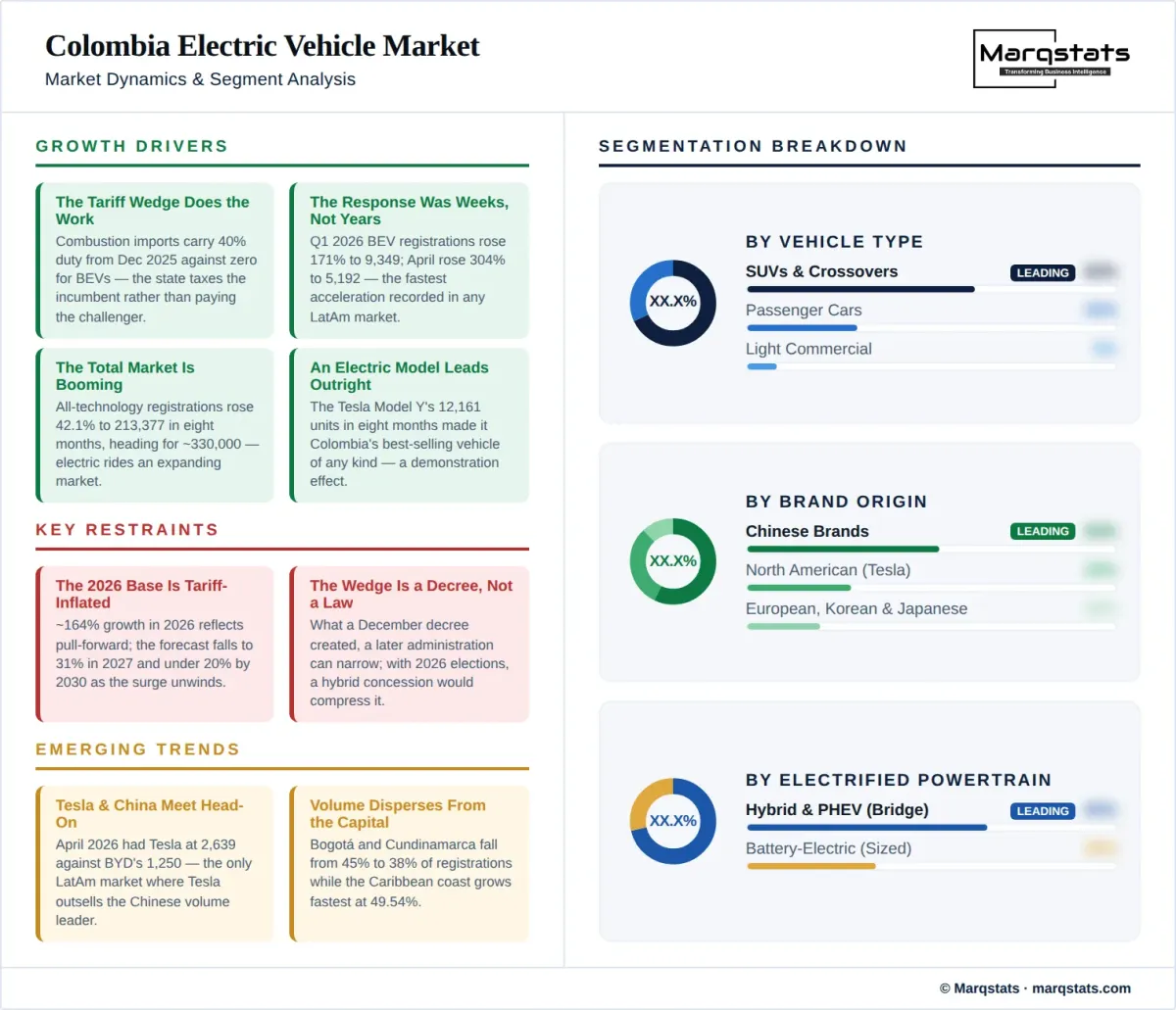
The tariff wedge does the work of a subsidy at negative fiscal cost. Combustion imports carry 40% duty from December 2025 against zero for battery-electric vehicles, and the state collects more from the incumbent rather than spending on the challenger — a structure insulated from the budget cycles that end purchase-subsidy programmes elsewhere.
The response to the wedge was measured in weeks, not years. First-quarter 2026 battery-electric registrations rose 171% year on year to 9,349 units, March alone doubled February at 5,083, and April rose 304% to 5,192 — the fastest acceleration recorded in any Latin American market.
The total market is booming beneath the electric surge. Registrations of all technologies rose 42.1% in January to August 2026 to 213,377 units, heading for roughly 330,000 for the year, so electric growth is riding an expanding market rather than cannibalising a flat one.
An electric model leads the national sales chart outright. The Tesla Model Y's 12,161 units in eight months made it Colombia's best-selling vehicle of any kind — a demonstration effect on mainstream buyers that no fleet trial or pilot programme can match.
Electrified buyers are already the mainstream. Electrified models including hybrids took 34.5% of all 2025 sales, and hybrids' 63,210 units in January to August 2026 represent a pool of buyers already sold on electrification and one price move away from full battery-electric.
Key Restraints
The 2026 base is tariff-inflated and the deceleration is structural. Growth of roughly 164% in 2026 reflects pull-forward ahead of and reaction to the tariff decree; the forecast falls to 31% growth in 2027 and under 20% by 2030, and any reading that extends 2026's rate forward will overstate the market severely.
The tariff wedge is a decree, not a statute. What a December decree created, a later administration can narrow — Colombia faces elections in 2026, and a partial extension of duty relief to hybrids or a cut in the combustion tariff would compress the wedge that currently drives conversion.
Charging infrastructure trails the registration curve. Colombia's public charging network remains concentrated in Bogotá, Medellín and Cali, and a fleet approaching 118,000 annual registrations by 2030 implies home- and workplace-charging dependence well beyond the current grid build-out in secondary cities.
Hybrids offer a cheaper near-substitute at nearly twice the volume. With 63,210 hybrid registrations against 33,889 battery-electric in eight months of 2026, the bridge technology satisfies much of the electrified demand — and any tariff concession to hybrids would divert marginal buyers away from the battery-electric series this report counts.
Key Trends
Tesla and Chinese brands are converging on the same market at full strength. April 2026 had Tesla at 2,639 units against BYD's 1,250 — the only Latin American market where Tesla outsells the Chinese volume leader — while Chinese brands collectively still hold the majority at 52% of 2025 volume.
SUVs and crossovers deepen their dominance, from 62% of battery-electric volume in 2025 to 66% by 2030 at a 44.81% CAGR, mirroring April 2026's pattern in which 4,013 of 5,192 electric registrations were SUV-type vehicles.
Light commercial vehicles are the fastest-growing type at 49.54%, from 8% of volume to 10%, as urban delivery fleets in Bogotá and Medellín convert on duty-free capital cost and low electricity prices.
Volume is dispersing beyond the capital. Bogotá and Cundinamarca fall from 45% of registrations to 38% by 2030 while the Caribbean coast grows fastest at 49.54%, tracking dealer network expansion and charging build-out beyond the three main metros.
Market Segmentation
The dominant class at 62% of 2025 battery-electric registrations, rising to 66% by 2030 at 44.81%. April 2026 illustrates the skew: 4,013 of 5,192 electric registrations were SUV-type vehicles. The Tesla Model Y and BYD's crossover range anchor the class, and duty-free entry narrows the price gap to combustion SUVs carrying 40% tariff more than in any other class.
Hatchbacks and sedans fall from 30% of registrations to 24% by 2030 while still growing at 36.77%. The class is where Chinese entry pricing is sharpest — compact battery-electric models land below most combustion equivalents once the tariff wedge is counted — and where the Kia K3's combustion strength shows what electric compacts must displace.
The fastest-growing class at 49.54%, from 8% of registrations to 10%. Urban delivery fleets in Bogotá and Medellín convert on duty-free capital cost, low electricity prices and circulation-restriction exemptions, and the class benefits from the same tariff wedge as passenger vehicles without the brand-consideration barrier.
The majority at 52% of 2025 registrations rising to 56% by 2030 at 45.15%. BYD leads a field including MG, Great Wall, Chery and Geely that built Colombia's electric market on price before Tesla arrived. Duty-free entry compounds their landed-cost advantage, and the strategic question is whether volume leadership survives Tesla's demonstration effect at the premium end.
At 28% of 2025 registrations easing to 24% by 2030, though growing at 38.67% in absolute terms. Tesla is the segment: the Model Y's rise to best-selling vehicle in the country within months of scale deliveries gives North American brands a stronger position in Colombia than anywhere else in Latin America. General Motors' electric range adds depth beneath the Tesla headline.
Steady at 20% of registrations throughout, growing at 43.01% in line with the market. Kia and Hyundai lead on the strength of Colombia's largest dealer networks — Kia is the country's top brand overall — with Renault leveraging local assembly heritage and Volvo Cars holding the premium European position.
By Geography
Bogotá and Cundinamarca
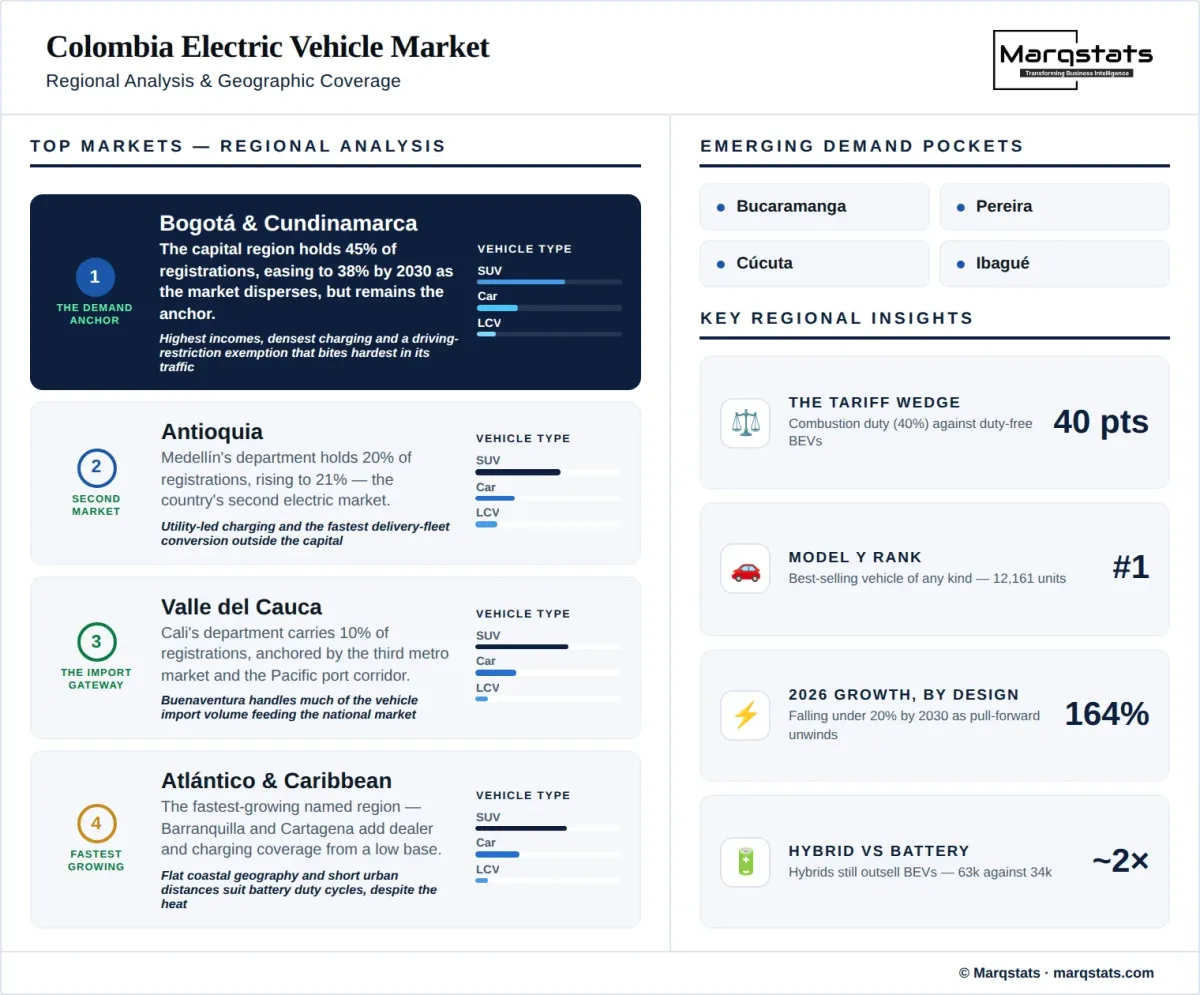
The capital region holds 45% of 2025 battery-electric registrations, easing to 38% by 2030 as the market disperses. Bogotá combines the country's highest incomes, its densest public charging, circulation-restriction exemptions that bind hardest in its traffic, and the first Tesla retail presence. It remains the demand anchor even as its share declines.
Antioquia
Medellín's department holds 20% of registrations rising to 21% by 2030 at 44.42%. The city's utility-led charging build-out and cable-car-linked transit culture make it the country's second electric market, and its delivery-fleet conversion is the fastest outside the capital.
Valle del Cauca
Cali's department carries 10% of registrations rising to 11% at 45.77%, anchored by the country's third metro market and the Pacific port corridor through Buenaventura, which handles much of the vehicle import volume feeding the national market.
Atlántico and Caribbean
The fastest-growing named region at 49.54%, from 8% of registrations to 10%. Barranquilla and Cartagena add dealer and charging coverage from a low base, and flat coastal geography with short urban distances suits battery-electric duty cycles despite the heat's demands on battery management.
Rest of Colombia
The remaining departments grow from 17% of registrations to 20% at 47.74%, the widest-uncertainty segment in the report. Secondary cities follow the metros with a lag tied to dealer network and charging expansion, and the segment's growth assumes both continue on current trajectories.
How Competition Is Evolving
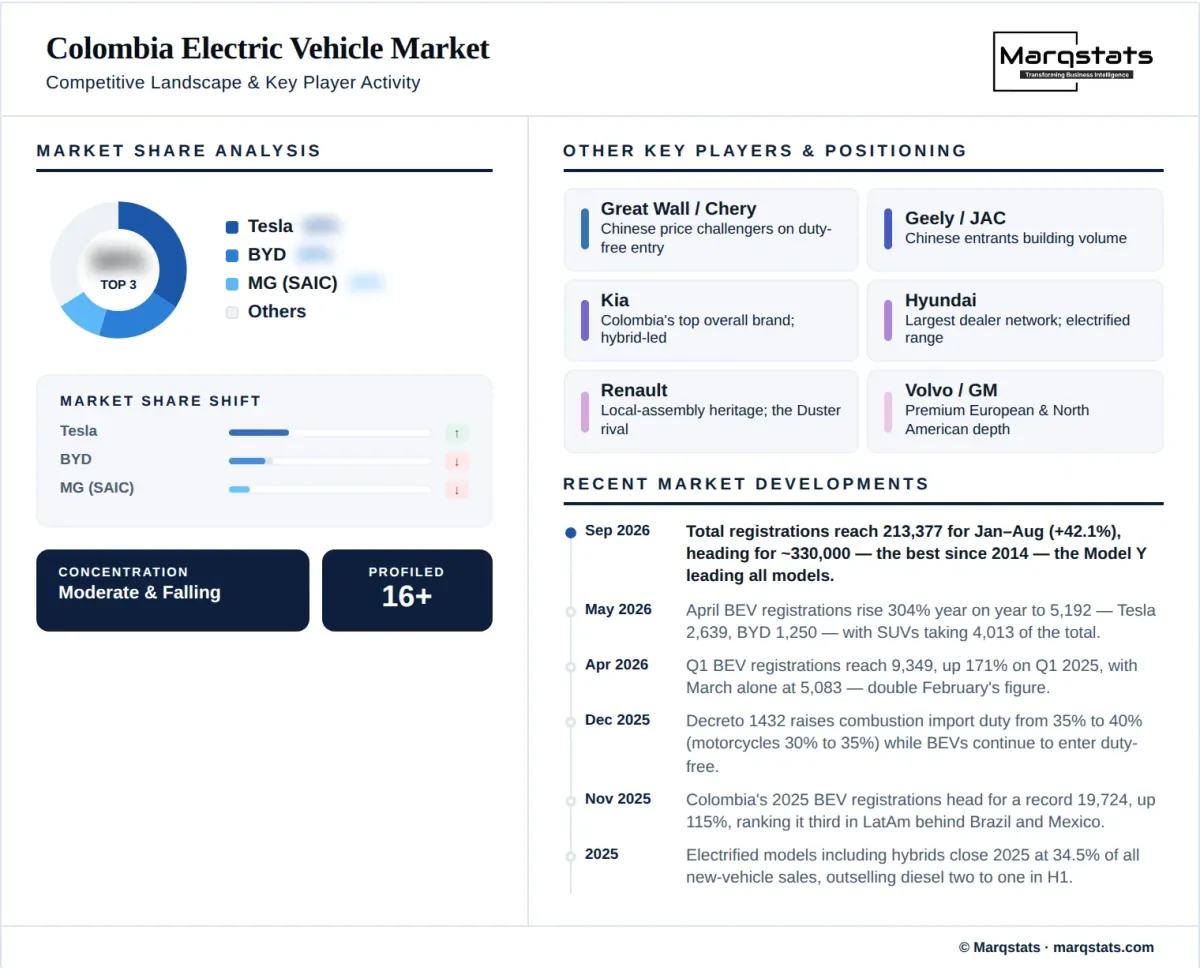
Colombia is the one Latin American market where the global electric vehicle contest is being fought at full strength on neutral ground. Chinese brands collectively hold the majority — 52% of 2025 battery-electric registrations — built on years of price leadership under duty-free entry. Tesla's arrival rewrote the top of the market in months: 12,161 Model Y registrations in January to August 2026 made it the best-selling vehicle of any kind in the country, and April's 2,639 Tesla units against BYD's 1,250 is the only monthly result in the region where Tesla outsells the Chinese volume leader at scale.
The incumbent combustion brands are not bystanders. Kia leads the total market at 28,077 units in eight months of 2026 with Renault, Toyota, Chevrolet and Mazda completing a top five that holds 46.6% of all registrations, and each is routing electrified product through Latin America's strongest dealer networks. Their near-term play is hybrid volume — 63,210 units in eight months, nearly twice the battery-electric total — which keeps their buyers inside the franchise while battery-electric line-ups build.
Concentration is moderate and falling. No single brand holds a third of battery-electric volume, the top of the market changes monthly, and the tariff wedge lowers entry barriers for any manufacturer with battery-electric product — the reverse of markets where subsidy qualification lists entrench incumbents. The competitive risk worth watching is policy, not product: a tariff concession to hybrids would advantage the incumbent franchises' bridge strategy against both Tesla and the Chinese challengers.
Companies Covered
Companies covered in the report include:
Recent Market Activity
Table of Contents
Coverage & Segmentation
This study covers new battery-electric light vehicles — passenger cars, SUVs and crossovers, and light commercial vehicles — registered in Colombia across 2021 to 2030, measured at retail value in US dollars. Segmentation runs across three vehicle types, three brand-origin groups and five regions. Hybrids and plug-in hybrids are excluded from the market series and cited only as context; electric buses are excluded and covered by the Marqstats Latin America Electric Bus report; motorcycles, three-wheelers and heavy commercial vehicles are excluded as separate classes.
The regional registration splits are Marqstats estimates constructed from metro-level dealer, charging and income distributions, as Colombia's published registration data does not break battery-electric volume by department on a consistent monthly basis. The 2024 figure of roughly 9,174 units is derived from the published 2025 total and its stated growth rate rather than reported directly, and is flagged as derived wherever it appears.
Values are stated at retail level in US dollars. The blended price per vehicle falls from roughly USD 38,000 in 2025 to USD 33,000 by 2030 as Chinese compact models deepen the mix against the premium anchor set by the Model Y — so the 39.03% value CAGR sits four points below the 43.01% unit CAGR, and readers comparing the two series should attribute the gap to mix-driven price decline rather than to any weakening of demand. Peso depreciation affects affordability rather than the reported series, since imported vehicles are dollar-priced at landing.