Market Snapshot
Middle bar: base-year value × (1 + CAGR), rounded to two decimals. This is a calculated illustration, not a separately researched annual estimate.
The Europe electric medium and heavy-duty truck market size is estimated at USD 2.43 billion in 2025 and is projected to reach USD 14.13 billion by 2030, at a CAGR of 42.24%. Registrations reached 12,858 units in the European Union in 2025, a 70% increase, for a 4.2% share of a truck market that itself contracted 6.2%. Marqstats calculates battery demand rising from 3.8 GWh to 31.1 GWh. Even so, the 2030 forecast lands roughly 46,000 trucks short of what the bloc's CO2 standards require.
Market size and forecast figures are generated using Marqstats' proprietary estimation framework, updated as of August 2026.
The Europe electric medium and heavy-duty truck market covers zero-emission trucks above 3.5 tonnes gross vehicle weight registered in the European Union — battery-electric and hydrogen fuel-cell, across the N2 medium-duty band from 3.5 to 16 tonnes and the N3 heavy-duty band above 16 tonnes. The market is small, growing fast from a low base, and concentrated in three countries. Germany, the Netherlands and France took 74% of all European Union electric truck registrations in the first half of 2026, and fourteen member states registered fewer than a hundred units each in 2025.
The most important thing to understand about this market is that the published medium-duty numbers are not what they appear. European statistics place zero-emission share in the 3.5 to 16 tonne band at 14.8% in 2025 against just 2.0% above 16 tonnes, which reads as a segment already well into its transition. It is not. Marqstats estimates that roughly three quarters of those registrations are 3.5 to 4.25 tonne van-derived chassis — electric versions of large panel vans that qualify for a weight derogation and therefore register as N2 trucks rather than N1 vans. Strip them out and zero-emission penetration among genuine medium-duty trucks was 3.7% in 2025. Independent analysis reporting medium-duty truck penetration at 3%, measured on a narrower 12-tonne band, lands within 0.7 points of that and corroborates the direction. On a truck-only basis the whole European Union market was 2.26% electric in 2025, not 4.18%.
The second thing to understand is that the vehicles have arrived and the charging has not. Five European manufacturers now sell a 500-kilometre-plus long-haul electric tractor: the eActros 600 at 621 kWh, the MAN eTGX at up to 623 kWh, Volvo's new generation reaching 700 kilometres on the company's own figures, the Iveco S-eWay Artic at 603 kWh, DAF's XF Electric at up to 525 kWh. Against that, Europe had roughly 2,000 charging points genuinely suited to trucks at the end of 2025 against the more than 20,000 the infrastructure regulation implies by 2030, and Germany — the largest market — had exactly seven megawatt-charging points in service in April 2026. The manufacturers' own charging joint venture had 221 points live against an original target of up to 1,700 by 2027.
That gap is now shaping behaviour rather than merely constraining it. In March 2026 the Council granted manufacturers the right to bank compliance credits earned between 2025 and 2029 against the 2030 target, deferring abatement without changing the headline numbers. In June 2026 Scania's chief executive said publicly that the company's 2030 electric share would be closer to 10% than to the 50% it had planned for, citing charging infrastructure running at about a fifth of expected levels. This study forecasts 17.5% zero-emission share of new European Union truck registrations in 2030 against the 31% to 35% that compliance requires — a shortfall of roughly 46,000 to 60,000 vehicles in that year alone.
Key Takeaways
Market Overview & Analysis
Report Summary
Europe's truck fleet numbers roughly 6.2 million medium and heavy commercial vehicles in the European Union, with an average age of 14.0 years — the oldest vehicle segment on the continent. Around 307,460 new trucks were registered in 2025, an annual replacement rate close to 5%, which means the parc and the registration flow decarbonise on completely different timescales. Even total electrification of new sales from 2030 would leave a majority-diesel fleet well into the 2040s. Battery-electric vehicles were 0.3% of the European Union truck parc at the last count.
The registration flow is nonetheless moving quickly. Electrically chargeable trucks went from 0.6% of European Union registrations in 2022 to 1.5% in 2023, 2.3% in 2024 and 4.2% in 2025, when volumes rose 70% to 12,858 units in a total market that fell 6.2%. The first half of 2026 continued the trend: registrations rose 47.7% to a 4.8% share while the overall truck market recovered 9.8%. On the wider European measure including Switzerland, Norway and the United Kingdom the 2025 share was 4.8% rather than 4.2%, because all three outperform the Union average — Switzerland reached 21.3% and Norway 16.9%.
Beneath those headlines the two weight bands are moving in opposite directions, and the reason is definitional rather than industrial. The 3.5 to 16 tonne band reached 14.8% zero-emission share in 2025 on 7,867 units, growing 87%. But that band contains the electric derivatives of large panel vans — battery versions of vehicles sold at 3.5 tonnes as N1 vans and at 4.25 tonnes as N2 trucks under a European weight derogation that preserves the ordinary driving licence. On the narrower 12-tonne band used in independent analysis, those derivatives were more than half zero-emission in 2025 and more than 64% by early 2026, while medium-duty trucks proper were 3% and 7% respectively. Marqstats estimates the van-derived share of electric registrations in the wider 16-tonne registration band at 75% in 2025, falling to 55% by 2030 as genuine medium-duty electric trucks reach the market. On that basis the band contained roughly 1,967 real electric medium-duty trucks in 2025 — 3.7% of the band, a quarter of the published figure.
The heavy-duty band is the opposite: a small number that is about to stop being small. Registrations above 16 tonnes were 4,991 units and 2.0% of the band in 2025, but zero-emission registrations above 12 tonnes nearly doubled year on year in the first half of 2026, on the independent series, as three manufacturers reached series production within twelve months of one another — MAN in June 2025, DAF in September 2025, and Mercedes-Benz having started in November 2024. Marqstats forecasts the heavy band at 15.5% zero-emission share by 2030, 42,620 units, compounding at 53.56% a year and accounting for 85% of market value by the end of the period.
Marqstats sizes the Europe electric medium and heavy-duty truck market at USD 2.43 billion in 2025, rising to USD 14.13 billion in 2030 at a CAGR of 42.24%. Unit volumes grow more slowly than value — 12,858 to 59,847 at 36.01% — because the mix shifts from cheap van derivatives at around EUR 72,000 toward heavy tractors at EUR 237,000 to 280,000, more than offsetting a 3.3% annual decline in heavy-duty prices. In euros the market compounds at 40.67%; the 1.57-point difference is currency translation, the euro having strengthened from an average of 1.1306 dollars in 2025 to 1.1625 through August 2026. A 42% five-year CAGR is a deceleration from the current run rate, not an acceleration: the market grew 70% in 2025 and 47.7% in the first half of 2026.
Market Dynamics
Key Drivers
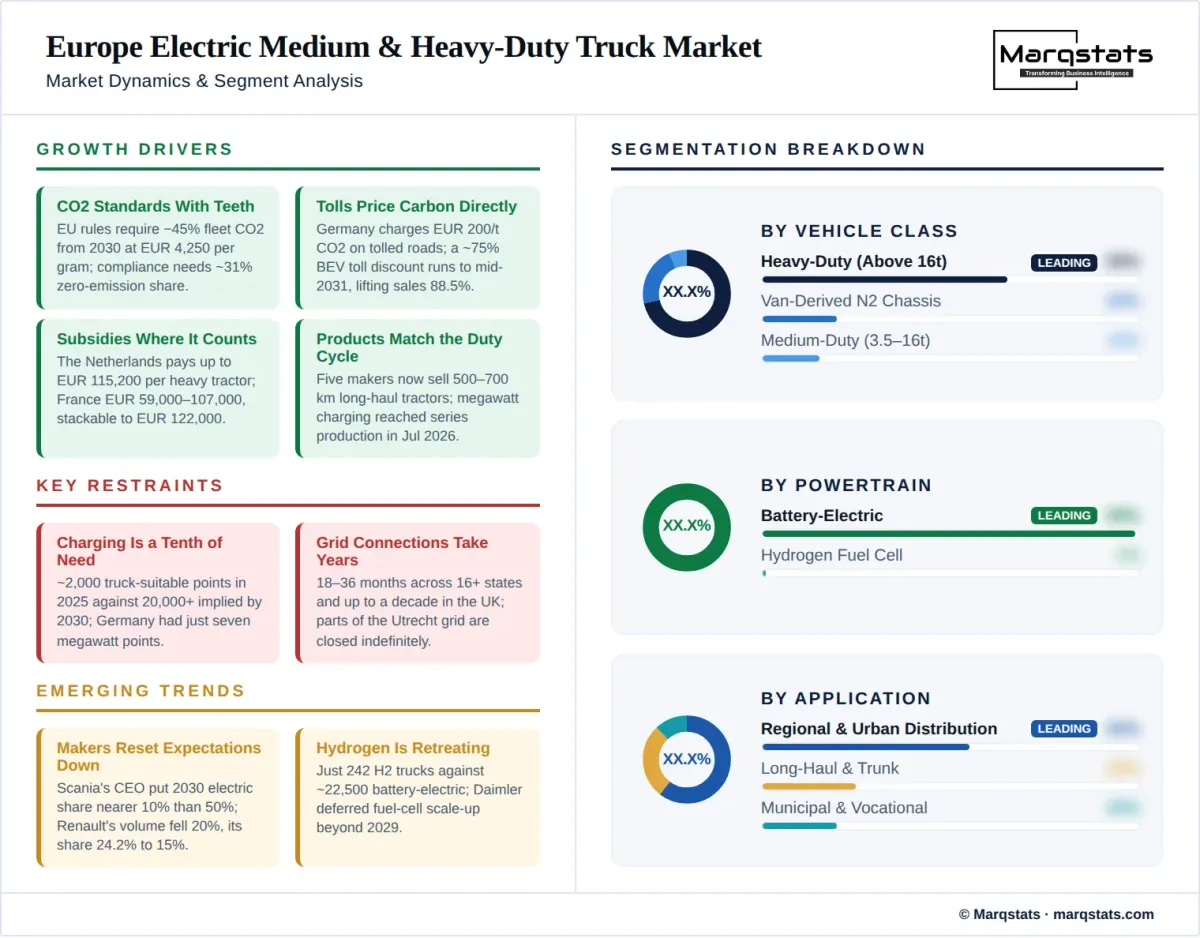
CO2 standards with a penalty attached. Regulation (EU) 2019/1242 as amended requires a 45% reduction in fleet-average CO2 from new heavy-duty vehicle sales from 2030, 65% from 2035 and 90% from 2040, with an interim 15% already applying. Non-compliance costs EUR 4,250 per gram of CO2 per tonne-kilometre per vehicle. Independent modelling puts the zero-emission share needed for 2030 compliance at 31%; the industry's own estimate is 35%.
Road tolls that price carbon directly. Germany has charged EUR 200 per tonne of CO2 on tolled roads since December 2023, extended to vehicles above 3.5 tonnes in July 2024. The full exemption for battery-electric trucks expired on 31 December 2025 and was replaced, by legislation passed in November 2025, with a discount of roughly 75% — a quarter of the infrastructure rate plus air and noise charges — running to mid-2031. Germany's electric truck registrations rose 88.5% in the first half of 2026, the fastest of any major market.
National purchase subsidies at scale in the countries that matter. The Netherlands pays up to EUR 115,200 for a heavy electric tractor under a scheme budgeted at EUR 119.2 million for 2026. France introduced rates of EUR 59,000 to EUR 107,000 by weight class from 1 June 2026, stackable to EUR 122,000. Outside the Union, Norway funds up to 60% of the cost difference against diesel, capped at NOK 5 million per vehicle, and the United Kingdom pays up to GBP 81,000 — though its 2026 scheme caps materially below the GBP 120,000 of the grant it replaced.
Depot charging economics that already work. Industrial and depot electricity tariffs of EUR 0.23 to 0.27 per kWh sit comfortably below the EUR 0.35 threshold at which long-haul electric operation reaches cost parity, and 40% to 50% of trucks in France, Germany and the United Kingdom run under 200 to 300 kilometres a day — within range of overnight depot charging alone.
Products that finally match the duty cycle. Series-production long-haul electric tractors now offer 500 to 700 kilometres of real-world range: the eActros 600 at 621 kWh, the MAN eTGX at up to 623 kWh, the Iveco S-eWay Artic at 603 kWh with a ten-year or 1.2-million-kilometre battery warranty, and Volvo's April 2026 generation reaching 700 kilometres. Megawatt charging reached series production in July 2026.
Key Restraints
A charging network roughly a tenth of the size required. Europe had about 2,000 charging points genuinely suited to trucks at the end of 2025 against more than 20,000 implied along the trans-European network by 2030. Germany had seven megawatt-charging points in service in April 2026 against a projected national need of 1,000 to 2,000 by 2030.
Grid connections measured in years. German analysis puts the full path from planning to an operational truck charging point at two to three years and up to ten in individual cases, with transformer delivery alone taking up to twelve months. The Netherlands received 27,500 applications for higher-capacity connections in the first five months of 2026, half again on the year before, with parts of the Utrecht grid closed to new capacity indefinitely and some regional waits extending beyond 2036.
A purchase price two to three times diesel. European electric trucks sell for roughly EUR 250,000 to EUR 350,000. Only about 30% of European truck sales are estimated to be cost-competitive as zero-emission today, and modelled total cost of ownership ranges from a 20% advantage to a 50% disadvantage depending on duty cycle and electricity price. Public fast charging at an EU average of EUR 0.70 per kWh in early 2025 is roughly double the long-haul parity threshold.
A compliance mechanism that now rewards waiting. The amendment in force from May 2026 lets manufacturers bank credits earned between 2025 and 2029 against the flat 15% interim target rather than an annually tightening trajectory, accumulating far more credits to offset the 2030 obligation. Five of seven European manufacturers already meet the 2025 target through diesel efficiency alone, without selling a single additional electric truck.
No residual value evidence and no second-hand market. The European electric truck fleet averages roughly three years old, too young to have generated a used-price series. No published residual value data exists for European electric medium or heavy trucks, which leaves lessors and fleets pricing an unknown into every acquisition.
Key Trends
Manufacturers are publicly resetting expectations downward. Scania's chief executive said in June 2026 that the company's 2030 electric share would be closer to 10% than to 50%, citing charging infrastructure at roughly a fifth of planned levels. Renault Trucks went backwards outright in 2025, its medium and heavy electric volume falling 20% to 800 units and its share of that segment across Europe, on the company's own measure, falling from 24.2% to 15%.
Megawatt charging has reached vehicles before it has reached roads. The standard IEC TS 63379 was announced as published in February 2026, rated to 3.75 MW; MAN put 750 kW megawatt-charging trucks into series production across nine markets on 31 July 2026. Real-world deployments run at 1.0 to 1.44 MW and public megawatt points remain close to non-existent, so the capability is currently usable only on fixed routes with secured charging.
Hydrogen is retreating rather than advancing. The European Union had 242 hydrogen trucks against roughly 22,500 battery-electric at the end of 2025, a ratio of about one to ninety-three. Germany's public hydrogen refuelling network fell 38% in two years to 50 stations, though the closures are disproportionately small 700-bar car stations and operators are re-specifying toward 350-bar truck-capable sites — the network is shrinking in count while re-orienting toward trucks. Daimler Truck deferred high-volume fuel-cell industrialisation beyond 2029 and rescoped its offering to a 100-unit small series from the end of 2026, supported by EUR 226 million of public funding.
Europe's truck battery supply chain has lost its independent champion. Northvolt entered Swedish bankruptcy in March 2025, having drawn a USD 100 million debtor-in-possession loan from Scania; Scania absorbed the battery systems business and moved on the Vasteras research centre during 2025, and the remaining assets passed to a United States buyer in February 2026. Every major European electric truck now runs on lithium iron phosphate chemistry, and several source cells from Chinese suppliers.
Chinese entrants are credible in intent and negligible in registrations. Six were named for 2026, but the verifiable European delivery record through mid-2026 amounts to two 7.5-tonne BYD units in Spain, an undisclosed handful of SANY tractors in Germany, and an Austrian assembly line whose first vehicle was a diesel. None appears in independent manufacturer breakdowns. Windrose holds European whole-vehicle type approval and quotes EUR 250,000, so the pricing threat is real — but for 2027 onward.
Market Segmentation
Heavy-duty trucks were 4,991 electric registrations in 2025, 2.0% of a 254,488-unit band, but 65% of market value at USD 1.58 billion. This is the segment that carries the forecast: it compounds at 53.56% a year to 42,620 units and 15.5% band penetration by 2030, taking 85% of market value. The inflection is product-driven — Mercedes-Benz began series production of the eActros 600 in November 2024, MAN of the eTGX and eTGS in June 2025, and DAF of the New Generation XD and XF Electric in September 2025, roughly two and a half years later than originally planned. Registrations above 16 tonnes nearly doubled year on year in the first half of 2026.
Genuine medium-duty electric trucks — the DAF XB Electric at 12, 16 and 19 tonnes, the MAN eTGL and eTGM, the eActros 300 and 400, the FUSO eCanter and the Renault E-Tech D — numbered roughly 1,967 units in 2025 on Marqstats' estimate, 3.7% of their band. That figure sits within 0.7 points of the 3% independently reported for medium-duty trucks proper on a narrower 12-tonne band — directional corroboration rather than a reconciliation, since the two band conventions are not reconcilable without the underlying cuts — and it is a quarter of the 14.8% published for the band as a whole. The segment compounds at 31.56% to 7,752 units by 2030, the slower of the two genuine truck segments in this study because urban and regional distribution has no regulatory forcing mechanism equivalent to the heavy-duty CO2 target and no cost driver equivalent to the German carbon toll.
Van-derived chassis are the largest electric segment by units and the smallest by value: Marqstats estimates roughly 5,900 registrations in 2025 at an average of EUR 72,000, or 20% of market value. These are electric versions of large panel vans — the segment is led by products sold interchangeably as N1 vans and N2 trucks, the heavier variant benefiting from a European derogation that lets an ordinary licence holder drive at 4.25 tonnes. On the independent 12-tonne band series they were more than half zero-emission in 2025 and more than 64% by early 2026, which is precisely why the medium-duty band looks transformed. The segment grows at only 9.94% to 2030 because it is already close to saturated, and its share of electric registrations in the band falls from 75% to 55%.
Battery-electric vehicles are effectively the entire market, and the gap is widening. The European Union had roughly 22,500 battery-electric trucks in operation at the end of 2025. Every series-production model discussed in this study is battery-electric, and manufacturers have converged on lithium iron phosphate chemistry for its cost and cycle life — the eActros 600 uses three 207 kWh LFP packs, the Iveco S-eWay Artic a single 603 kWh LFP pack, and DAF's range two to five LFP packs from 210 to 525 kWh. Typical heavy-duty energy consumption is 1.2 to 1.3 kWh per kilometre.
Fuel-cell trucks remain at demonstration scale and are being deliberately slowed by their principal backers. The European Union counted 242 hydrogen trucks at the end of 2025 against roughly 22,500 battery-electric. The largest operating fleet is 165 Hyundai XCIENT units across Switzerland, Germany, France, the Netherlands and Austria, which passed 20 million cumulative kilometres in January 2026. Daimler Truck deferred high-volume industrialisation beyond 2029 and will build 100 NextGenH2 tractors from the end of 2026 with EUR 226 million of federal and state support — a subsidised trial fleet rather than a product ramp. No source publishes a European fuel-cell truck registration count, so this segment is characterised rather than sized separately in this study.
Regional and urban distribution is where the market actually operates today. Between 40% and 50% of trucks in France, Germany and the United Kingdom cover under 200 to 300 kilometres a day, which fits within a single overnight depot charge at EUR 0.23 to 0.27 per kWh — inside the parity threshold and roughly a third of public fast-charging cost. Almost all deployments to date follow this pattern: return-to-base operation, predictable routes, and a charger the operator owns. German projections imply that roughly 70% of that country's truck charge points by 2035 will be private depot infrastructure; no measured European split exists.
Long-haul is the larger prize and the one that has not opened. The vehicles now exist, with 500 to 700 kilometres of range and megawatt charging in series production from July 2026, but the corridor infrastructure does not: about 2,000 truck-suitable public points across Europe, seven megawatt points in Germany, and public fast charging at roughly double the parity threshold. Independent modelling suggests around 1,000 optimally sited megawatt locations would serve some 91% of European long-haul truck traffic by 2030, assuming no depot charging at all — fewer locations than the infrastructure regulation mandates, which points to a specification problem alongside a coverage problem.
Municipal and vocational work — refuse collection, construction, utility and municipal services — benefits from the same return-to-base charging pattern as distribution and from public procurement rules that favour zero-emission vehicles. It is served by dedicated products such as the eEconic and low-entry variants of the Volvo FE and FM ranges. Vocational vehicles were brought within the scope of the CO2 regulation by the 2024 amendment but are exempted from the 45% target applying to other sub-groups from 2030.
By Geography
Germany
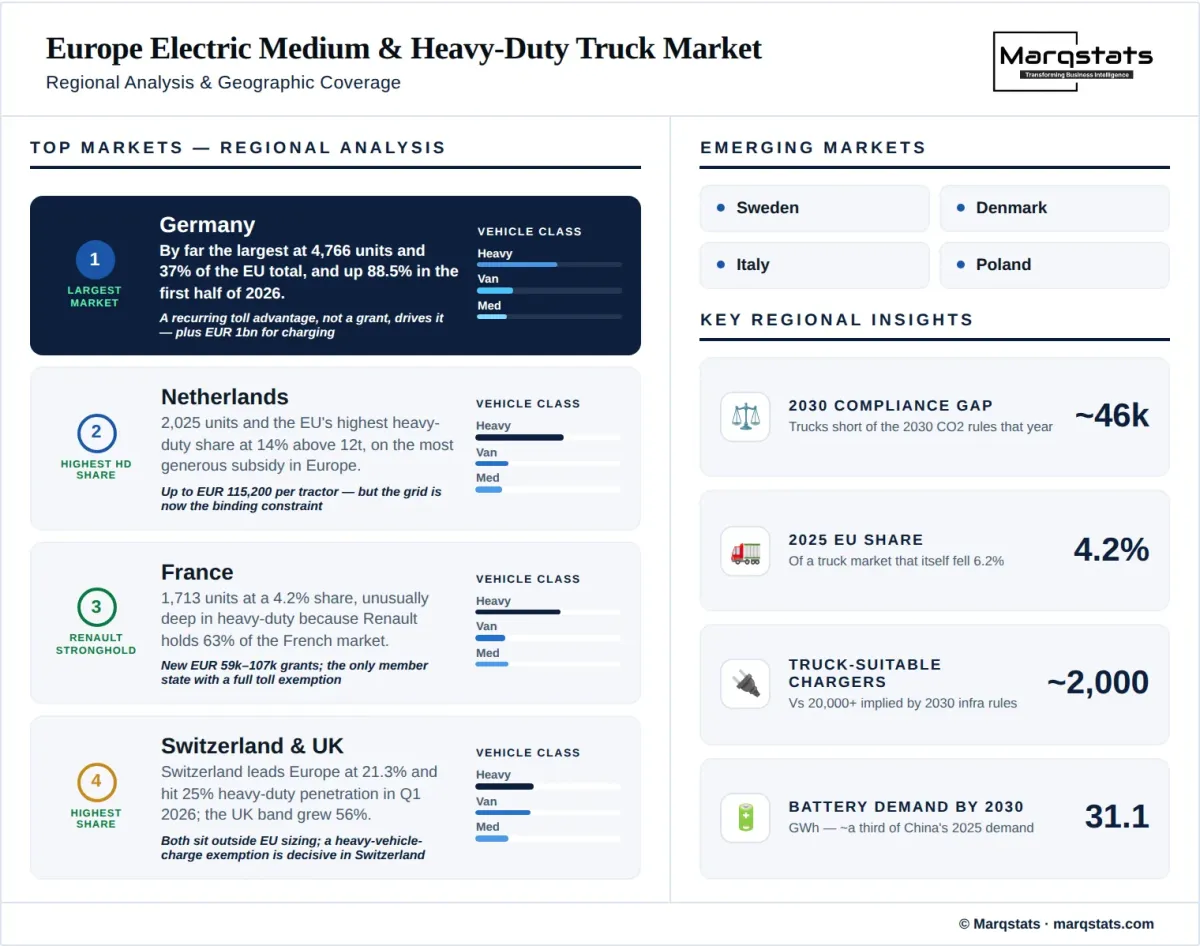
Germany is the largest European market by a wide margin, with 4,766 electric truck registrations in 2025 — 3,368 in the 3.5 to 16 tonne band and 1,398 above 16 tonnes — for 37% of the European Union total and a 6.2% national electric share. It grew 88.5% in the first half of 2026, faster than any other major market, and registered 497 heavy electric trucks in the first quarter alone, 31% of the European Union heavy total. The driver is fiscal rather than grant-based: the national purchase subsidy closed to new applications in early 2024 after a constitutional court ruling on the climate fund, having supported more than 6,000 vehicles, but the CO2-differentiated toll at EUR 200 per tonne and the battery-electric toll discount extended to mid-2031 in November 2025 create a recurring operating advantage that no purchase grant matches. Germany has also committed EUR 1 billion over four years to truck charging infrastructure, including grid connections.
The Netherlands
The Netherlands registered 2,025 electric trucks in 2025, 1,147 in the medium band and 878 above 16 tonnes, and its medium-band volume grew 523%. It leads the European Union on heavy-duty share rather than volume, reaching 14% zero-emission above 12 tonnes in the fourth quarter of 2025. Its purchase scheme is the most generous in Europe at up to EUR 115,200 for a heavy tractor, budgeted at EUR 119.2 million for 2026 with an application window from 29 September to 16 October 2026. The constraint is the grid: 27,500 applications for higher-capacity connections in the first five months of 2026, up 50% year on year, parts of the Utrecht network closed to new capacity indefinitely, and public fast charging at EUR 0.81 per kWh, the highest in Europe. Dutch medium-duty registrations fell 42% year on year in the first quarter of 2026.
France
France registered 1,713 electric trucks in 2025, split almost evenly between 852 in the medium band and 861 above 16 tonnes, for a 4.2% national share, and grew 43.7% in the first half of 2026. France is unusual in the depth of its heavy-duty commitment relative to its size, which reflects Renault Trucks' domestic position — the brand holds 63% of the French electric medium and heavy truck market and 29.8% of the French market above 16 tonnes, against 9.4% across Europe. From 1 June 2026 France introduced energy-certificate payments of EUR 59,000 for 12 to 19 tonne vehicles, EUR 73,000 for 19 to 26 tonnes and EUR 107,000 above 26 tonnes, stackable with other support to between EUR 80,000 and EUR 122,000. France is now the only member state offering a full toll exemption for electric trucks, Germany having replaced its own exemption with a discount from 1 January 2026.
The Nordics
The Nordic markets lead on share and lag on volume. Norway, which sits outside the European Union and therefore outside this study's sizing base, reached a 16.9% electric truck share in 2025 on support that funds up to 60% of the cost difference against diesel, capped at NOK 5 million per vehicle, awarded through monthly competitive bidding. Sweden registered 619 electric trucks in the medium band, growth of 407%, and reached 9.7% zero-emission share above 12 tonnes by the first quarter of 2026; it has 129 heavy-duty charging locations, second only to Germany, but no national heavy-truck purchase premium — its support is infrastructure-side. Denmark registered 470 medium-band units and reached 16% zero-emission share above 12 tonnes in the fourth quarter of 2025 through a fund of DKK 352.5 million, an earlier round of which was fully subscribed in eight minutes.
Switzerland and the United Kingdom
Switzerland has the highest electric truck share in Europe at 21.3% in 2025 on 942 units, and reached 25% heavy-duty penetration in the first quarter of 2026 — a consequence of a distance-and-emissions-based heavy vehicle charge from which electric trucks are exempt, in a small market where that exemption is decisive. The United Kingdom registered 2,562 electric trucks in the 3.5 to 16 tonne band in 2025, growth of 56%, and replaced its purchase grant in 2026 with a scheme paying GBP 15,000 to GBP 81,000 by weight class alongside a GBP 170 million depot charging programme. Both sit outside the European Union figures used for the sizing in this study: including Switzerland, Norway and the United Kingdom raises the 2025 European electric share from 4.2% to 4.8%.
Southern and Central Europe
Southern and Central Europe are barely participating. Italy registered 521 electric trucks in the medium band in 2025 and lost share in the first half of 2026; its EUR 590 million fleet renewal scheme, offering up to EUR 70,000 above 16 tonnes, remained a draft decree as of February 2026 and had not opened. Spain's replacement incentive covers cars and vans only, with no medium or heavy truck provision identified. Poland registered 178 electric trucks in 2025, a 0.6% national share, against a PLN 2 billion programme paying up to PLN 750,000 for an N3 vehicle. Fourteen member states registered fewer than a hundred electric trucks each in 2025, and the concentration is tightening rather than easing: the top three markets rose from roughly two-thirds of European Union electric truck registrations in 2025 to 74% in the first half of 2026.
How Competition Is Evolving
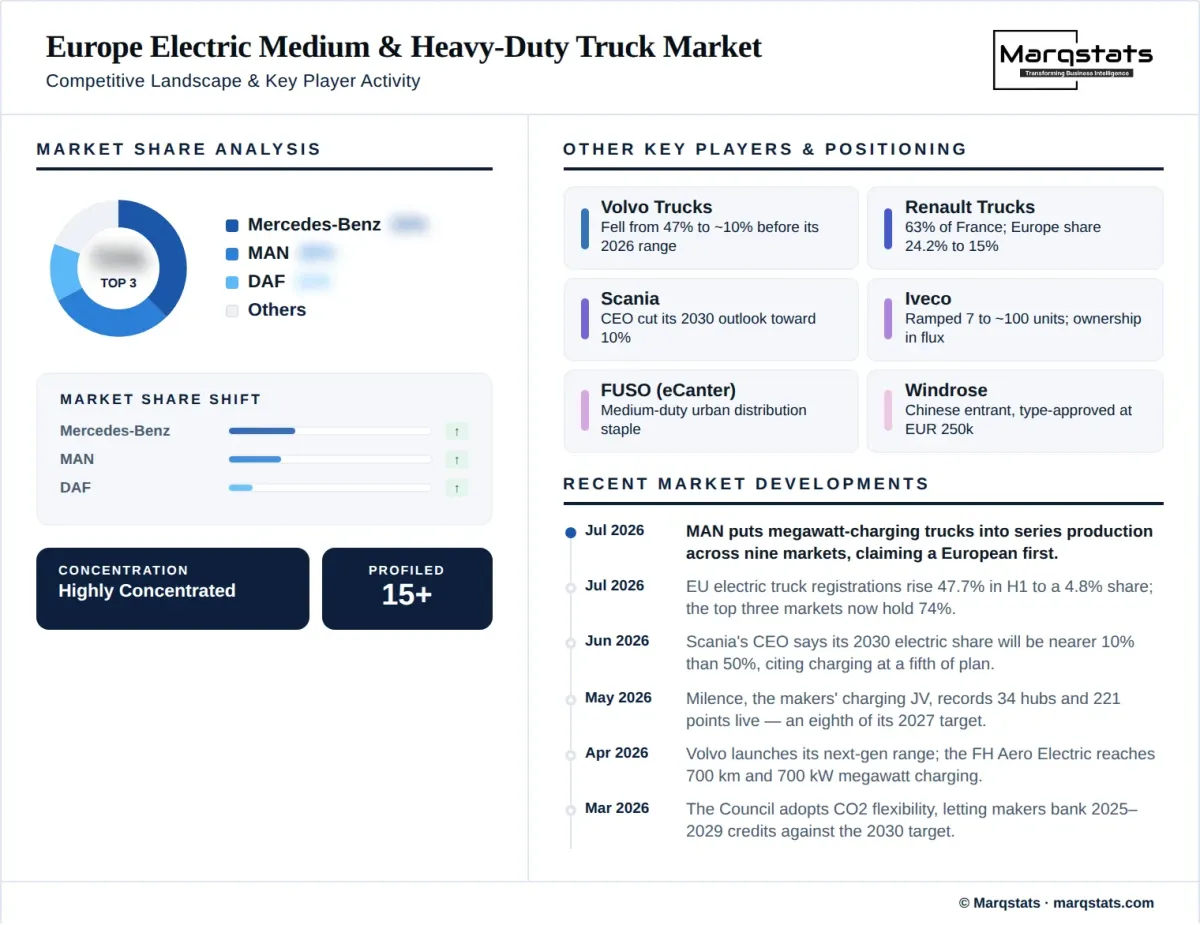
The Europe electric medium and heavy-duty truck market is highly concentrated and its leadership has just changed hands. Volvo Trucks held 47% of European heavy electric trucks in 2024 with 1,970 units, with Renault Trucks a further 24.2% — a group share above 70%. By the first quarter of 2026 Volvo Trucks was at roughly 165 units, about 10% of a 1,600-unit heavy zero-emission market, displaced by Mercedes-Benz at 530 units, MAN at 411 and DAF at approximately 200. The 2024 figures are measured above 16 tonnes and the 2026 figures above 12 tonnes, so the two are directionally rather than precisely comparable, and the 2026 shares are Marqstats calculations from published unit counts. Renault Trucks fell outright, its European electric medium and heavy share dropping from 24.2% to 15% on volume down 20% to 800 units. The mechanism was product timing: Mercedes-Benz, MAN and DAF all reached series production of 500-kilometre-plus long-haul products between November 2024 and September 2025, while Volvo did not launch its 470 to 700 kilometre generation until April 2026, orderable from that summer. Volvo Group has not published its customary annual electric leadership release for 2025.
Strategy now divides on how much of the 2030 target each manufacturer believes will actually be enforced. MAN has committed EUR 1 billion to 2030 to convert its European plants, builds battery packs in-house at Nuremberg, produced roughly 1,300 heavy electric trucks in its first year of series production and, on its own account, became the first European manufacturer in series production with megawatt charging on 31 July 2026 — a primacy claim other manufacturers contest. Its parent raised EUR 850 million of ring-fenced green financing in May 2026. Five weeks later Scania's chief executive said publicly that the company's 2030 electric share would be closer to 10% than to 50%. Scania has not issued a formal revision of the target. Both positions sit inside the same group. Daimler Truck delivered 6,726 battery-electric vehicles globally in 2025, up 67%, though that figure spans North American and Asian products and buses as well as European trucks. Iveco's heavy electric volume moved from 7 units in the first half of 2025 to roughly 100 in the second quarter of 2026 — a real ramp from close to nothing, and its ownership is in transition, with a tender offer for the group expected to complete in late 2026.
Two structural risks sit outside the manufacturers' control. The first is charging: the manufacturers' own joint venture, capitalised at EUR 500 million in 2022 and reinforced with a EUR 111 million grant and a EUR 120 million facility, had 34 hubs and 221 charging points live across eight countries in April 2026 — roughly an eighth of an original target of up to 1,700 points by 2027, a target it has stopped publishing. The second is batteries. Northvolt's Swedish bankruptcy in March 2025 removed Europe's only scaled independent cell champion; its assets passed to a United States buyer in February 2026, and Scania, which had provided a USD 100 million rescue loan, absorbed the battery systems business and the Vasteras research centre. Chinese entrants remain negligible in registrations — two 7.5-tonne units delivered in Spain, an undisclosed handful of tractors in Germany — but the more immediate dependency is upstream, where European trucks now run largely on lithium iron phosphate chemistry with significant Chinese cell content.
Companies Covered
Companies covered in the report include:
Recent Market Activity
Table of Contents
Coverage & Segmentation
This study covers new zero-emission trucks above 3.5 tonnes gross vehicle weight registered in the European Union, across the N2 medium-duty band from 3.5 to 16 tonnes and the N3 heavy-duty band above 16 tonnes, in both battery-electric and hydrogen fuel-cell form. Buses and coaches, light commercial vehicles registered as N1 at or below 3.5 tonnes, trailers, off-highway equipment, and aftermarket parts and service revenue fall outside scope. Market value is measured at manufacturer selling price in euros and converted to United States dollars at annual average exchange rates, with both currency series reported because they diverge by 1.57 percentage points over the forecast period. The base year is 2025, the historical period 2022 to 2025 and the forecast period 2026 to 2030. One caveat applies throughout: the official registration series groups battery-electric with plug-in hybrid vehicles as electrically chargeable, so the 4.2% and 4.8% shares are not pure battery-electric figures, and the comparison against a zero-emission compliance requirement is therefore marginally generous to the market.
Three definitional decisions govern the numbers and should be read before the figures are used. First, the geographic universe is the European Union of 27 member states, the basis on which the registration series and the CO2 regulation both operate; the wider European measure including Switzerland, Norway and the United Kingdom gives a 4.8% electric share for 2025 against the Union's 4.2%, and a total truck market of 371,240 units against 307,460. The two must never appear in one table. Second, the weight bands are the 16-tonne break used in European registration statistics, not the 12-tonne break used in some independent analysis; the two produce different segment totals and are not reconcilable without the underlying cuts. Third, and most consequentially, this study separates van-derived N2 chassis of 3.5 to 4.25 tonnes from genuine medium-duty trucks within the 3.5 to 16 tonne band. Marqstats estimates the van-derived share of electric registrations in that band at 75% in 2025. Reported figures that do not make this separation overstate medium-duty truck electrification by roughly four times.