Market Snapshot
Middle bar: base-year value × (1 + CAGR), rounded to two decimals. This is a calculated illustration, not a separately researched annual estimate.
The global 48V mild hybrid system market size is estimated at USD 10,870.00 million in 2025 and is projected to reach USD 16,200.00 million by 2030, growing at a CAGR of 8.31% over 2026 – 2030. About 10.85 million light vehicles were built with 48V mild hybrid systems in 2025, rising to 14.25 million by 2030, a 5.60% annual rate, while the average value of a system rises from about USD 1,002 to USD 1,137 as carmakers move from belt-driven to transmission-integrated designs.
Marqstats defines the market as the value of 48V mild hybrid systems fitted to new passenger cars and light commercial vehicles, at the price paid by vehicle makers. It covers the 48V motor-generator, the 48V lithium-ion battery, the 48V to 12V DC-DC converter and the inverter and control electronics. Conventional 12V stop-start systems, high-voltage full hybrids, plug-in hybrids and battery electric vehicles are excluded, as is the value of the rest of the vehicle.
SUVs and crossovers account for an estimated 56.00% of 2025 value and belt-driven P0 systems for 52.00%. Europe accounts for 40.49% of 2025 value and Asia-Pacific for 33.00%. The study segments the market by vehicle type, system architecture, component and region.
Key Takeaways
Market Overview & Analysis
Report Summary
Marqstats sizes the 48V mild hybrid system market as the value of the 48V electrification hardware fitted to new light vehicles, at the price paid by vehicle makers. In 2025 about 10.85 million vehicles were built with 48V systems worldwide, and the systems were worth an estimated USD 10,870.00 million, an average of about USD 1,002 per vehicle.
A 48V mild hybrid adds a second electrical network to a combustion vehicle. A 48V lithium-ion battery, typically 0.4 to 1.2 kWh, feeds a motor-generator of 8 to 25 kW that restarts the engine, recovers braking energy, adds torque during acceleration and, in transmission-integrated designs, moves the car at low speed without the engine. A DC-DC converter links the 48V network to the conventional 12V network that powers lights and cabin electronics.
Because 48V stays below the 60V threshold for high-voltage safety rules, the system needs none of the insulated orange cabling, isolation monitoring and crash protection required for full hybrids and electric cars. Carmakers can therefore add it to existing engine and vehicle platforms with limited redesign, at a fraction of the cost of a full hybrid.
Official statistics rarely report 48V mild hybrids separately. ACEA counts mild and full hybrids together as hybrid electric cars, the UK SMMT includes mild hybrids in its petrol and diesel figures, and the International Energy Agency treats mild hybrids as conventional combustion vehicles. Marqstats builds the 48V volume from carmaker disclosures, model-level registration data and supplier production, and estimates that mild hybrids make up about 58% of the hybrid electric cars registered in Europe in 2025.
The market grew quickly from an estimated USD 5,240.00 million in 2021 to USD 6,780.00 million in 2022, USD 8,450.00 million in 2023 and USD 9,820.00 million in 2024, a 20.01% annual rate over 2021 to 2025, as European carmakers fitted belt-driven starter-generators across mid-size and premium models to meet fleet CO2 targets. Growth slows to a steadier 8.31% a year over the forecast as the European market matures and value shifts to more capable systems.
Three groups shape the market. Carmakers such as Stellantis, Mercedes-Benz, Volkswagen Group, Hyundai Motor Group, Suzuki and Ford decide where to fit 48V and which architecture to use. Tier 1 suppliers such as Schaeffler, Valeo, Bosch, BorgWarner, Continental, Forvia and Marelli supply motors, power electronics and complete systems. Battery makers supply the small high-power lithium-ion packs that store recovered energy.
Global 48V Mild Hybrid System Market Size and Forecast
The global 48V mild hybrid system market grows from USD 10,870.00 million in 2025 to USD 16,200.00 million in 2030, a CAGR of 8.31%. Marqstats expects USD 11,770.00 million in 2026, USD 12,750.00 million in 2027, USD 13,810.00 million in 2028 and USD 14,960.00 million in 2029.
Volume growth is moderate. Vehicles fitted with 48V systems rise from about 10.85 million in 2025 to 11.62 million in 2026, 12.38 million in 2027, 13.05 million in 2028, 13.68 million in 2029 and 14.25 million in 2030, a 5.60% annual rate. Growth comes from new fitments on light commercial vehicles, wider use in India and Latin America, and the replacement of plain combustion engines on remaining European models.
Value per vehicle rises. Marqstats estimates the average system value increases from about USD 1,002 in 2025 to USD 1,137 in 2030 as transmission-integrated P2 systems with 18 to 25 kW motors replace 10 to 12 kW belt-driven units, and as higher-power inverters and DC-DC converters are added. Falling lithium-ion cell prices partly offset this, with 48V pack costs moving towards about USD 110 per kWh.
Regulation underpins demand. EU fleet CO2 targets for 2025 to 2029 require a 15% cut from 2021 levels, and manufacturers may average their performance over 2025, 2026 and 2027 after the May 2025 amendment. Euro 7 applies to new car and van types from 29 November 2026 and to all new cars and vans from 29 November 2027. In India, Corporate Average Fuel Economy Phase II rules and price-sensitive buyers favour low-cost mild hybrids, and in the United States, pickups and large SUVs use 48V to improve fuel economy without the cost of high-voltage systems.
Marqstats estimates the share of Europe's hybrid registrations that are mild hybrids is the most important input to the base year. Each percentage point change in that share moves European volume by about 65,000 vehicles and global system value by about USD 65 million, about 0.6% of the 2025 total. Marqstats tracks four indicators to monitor the forecast: European hybrid registrations by type, P2 transmission output at Stellantis and other carmakers, fitment on light commercial vehicles, and 48V battery pack prices.
The mix shifts over the forecast. P2 systems rise from 30.00% to 47.00% of value and P0 systems fall from 52.00% to 30.00%. SUVs and crossovers rise from 56.00% to 58.00% and light commercial vehicles from 10.00% to 12.00%, while cars other than SUVs fall from 34.00% to 30.00%. Europe rises slightly to 41.50% and Asia-Pacific to 34.50%, while North America falls to 17.50% as US rules loosen and pickups keep a large share of plain combustion engines.
Market Dynamics
Key Drivers
Five forces keep carmakers fitting 48V mild hybrid systems to combustion vehicles.
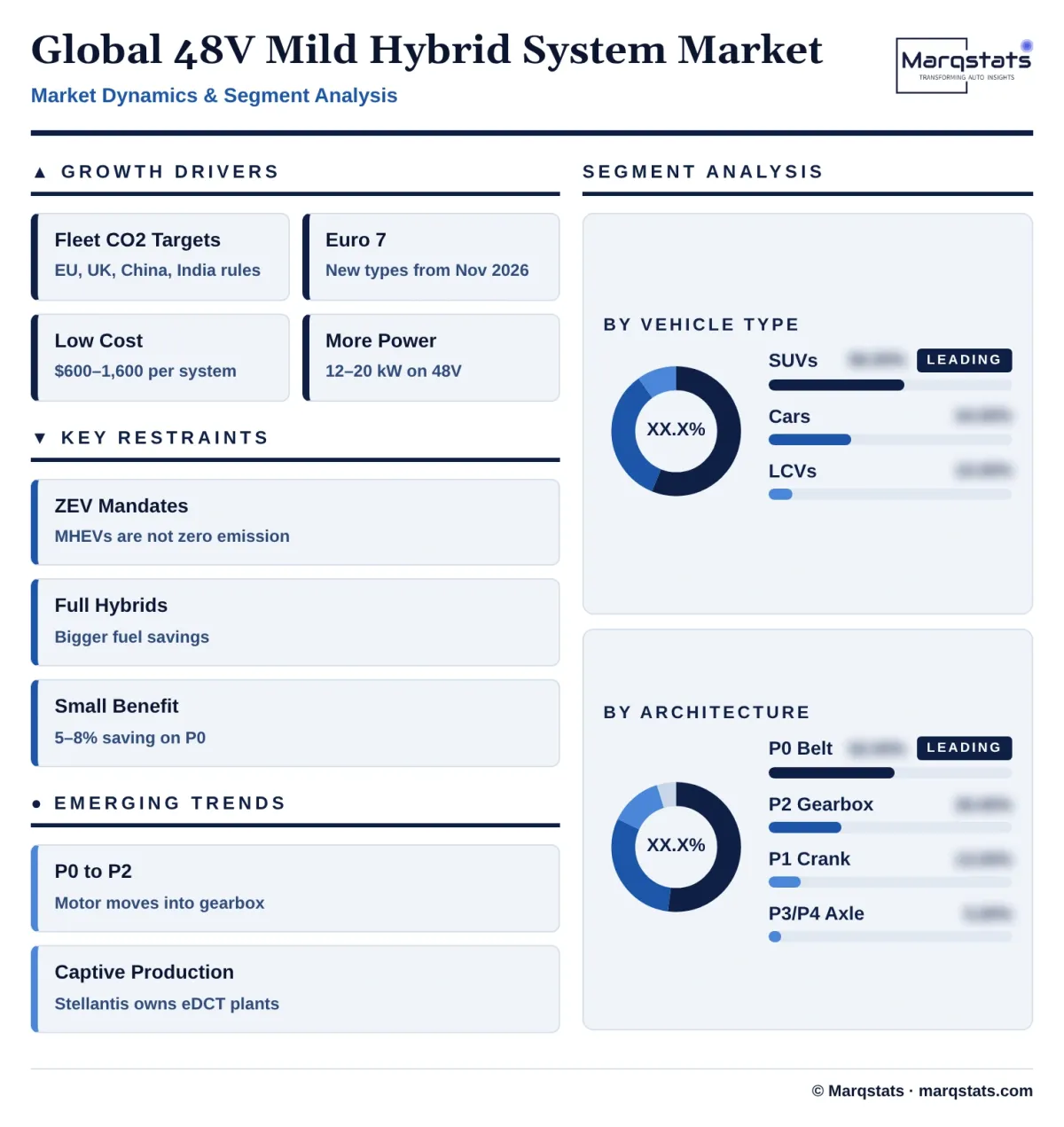
- Fleet CO2 targets. EU targets for 2025 to 2029, the UK zero emission vehicle mandate, China's corporate fuel consumption limits and India's fuel economy rules push carmakers to lower the CO2 of every combustion vehicle they still sell, and 48V is the cheapest way to do it.
- Euro 7. The new European emission standard applies to new types from November 2026 and all new cars and vans from November 2027 and adds tighter limits on real-world driving and cold starts. A 48V network can power an electrically heated catalyst that warms the exhaust system before the engine starts.
- Low cost compared with full hybrids. A belt-driven 48V system costs a carmaker about USD 600 to 900 and a transmission-integrated system about USD 1,200 to 1,600, against about USD 3,200 to 4,500 for a high-voltage full hybrid, keeping prices of small cars and compact SUVs affordable.
- Shared platforms. Carmakers can add 48V to existing engines and vehicle structures without the battery tunnel, high-voltage safety systems and crash protection needed for full hybrids, so one platform can carry combustion, mild hybrid and electric versions.
- More electrical power. A 12V network is limited to about 3 kW, while a 48V network can supply 12 to 20 kW, enough for electric turbochargers, active anti-roll systems, heated catalysts and the computers and sensors used in advanced driver assistance.
Key Restraints
Four constraints limit how far and how fast 48V mild hybrid systems can grow.
- Zero emission mandates. Mild hybrids do not count as zero emission vehicles under the UK mandate, which requires 28% of new cars to be zero emission in 2025 rising to 80% in 2030, or under the EU target of a 100% CO2 cut by 2035, limiting their long-term role.
- Competition from full hybrids. Toyota, Honda, Renault and Chinese brands offer full hybrids that cut fuel use by much more, and plug-in and extended-range hybrids dominate China's electrified market outside joint-venture brands.
- Smaller benefit than buyers expect. Belt-driven systems save only about 5% to 8% of fuel in town, and buyers may see little difference from a conventional car, which reduces the value carmakers can charge for them.
- Statistical invisibility. Mild hybrids are reported together with full hybrids or with petrol and diesel cars, which can lead policymakers and buyers to misjudge their contribution and may expose them to future changes in tax and incentive rules.
Key Trends
Four shifts are changing how 48V mild hybrid systems are designed and used.
- From P0 to P2. Carmakers are moving from belt-driven starter-generators to motors built into the transmission, as in Stellantis's electrified dual-clutch transmission, which disconnects the engine and allows short electric-only driving at low speed.
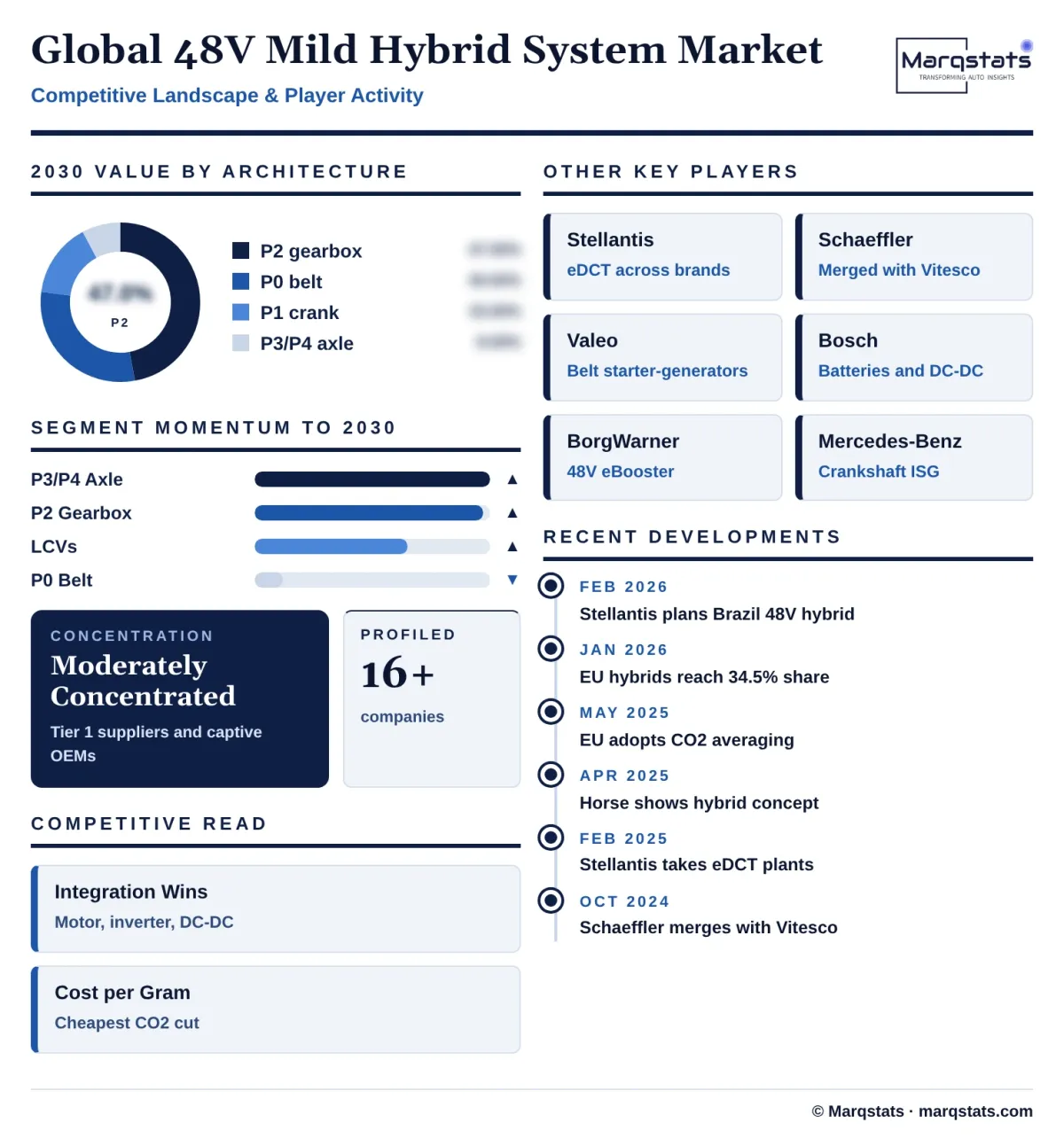
- Captive production. Stellantis bought Punch Powertrain's minority stake in their electrified dual-clutch transmission joint venture in February 2025, taking full control of production at Metz in France and Mirafiori in Italy.
- Supplier consolidation. Schaeffler completed its merger with Vitesco Technologies on 1 October 2024, combining transmissions and electric motors with power electronics and DC-DC converters in one supplier.
- New regions. Stellantis plans a flex-fuel 48V mild hybrid built in Goiana, Brazil, in the first half of 2026 under its Bio-Hybrid programme, and Maruti Suzuki uses mild hybrids on high-volume models in India.
Strategic Implications
- For carmakers, P2 is worth the extra cost on high-volume models. It roughly doubles the urban fuel saving of a belt-driven system and prepares vehicles for Euro 7, while keeping the cost well below a full hybrid.
- For Tier 1 suppliers, integration wins. Suppliers that can deliver the motor, inverter, DC-DC converter and transmission integration together, as Schaeffler can after its merger with Vitesco, capture more value per vehicle than those selling single parts.
- For battery makers, power matters more than capacity. 48V packs need cells that accept high charging and discharging currents over hundreds of thousands of cycles, a different product from electric vehicle cells.
- For investors, the market is a long but finite bridge. 48V demand stays solid through 2030, but zero emission mandates limit its role after the early 2030s, so returns depend on reusing products and plants for electric vehicle components.
- For policymakers, better data would help. Reporting mild hybrids separately from full hybrids and from petrol and diesel cars would give a clearer view of their contribution to CO2 reductions.
Market Segmentation
SUVs and crossovers account for 56.00% of 2025 value, USD 6,087.20 million, rising to USD 9,396.00 million by 2030, a 9.07% CAGR, and 58.00% of the market. Their weight and shape raise CO2 emissions, and 48V adds torque and recovers energy without cutting towing or load capacity, as on the Mercedes-Benz GLC, Volvo XC60, Audi Q5 and Hyundai Tucson.
Hatchbacks, sedans and estate cars account for 34.00% of 2025 value, USD 3,695.80 million, rising to USD 4,860.00 million by 2030, a 5.63% CAGR, while their share falls to 30.00%. The Fiat Grande Panda, Suzuki Swift and Mercedes-Benz C-Class and E-Class are leading examples.
Vans and pickups account for 10.00% of 2025 value, USD 1,087.00 million, and grow fastest, at 12.33% a year, to USD 1,944.00 million and 12.00% of the market by 2030, through models such as the Ford Transit with EcoBlue mild hybrid and the Ram 1500 with eTorque.
Belt-driven starter-generators on the engine's accessory drive account for 52.00% of 2025 value, USD 5,652.40 million, but their value falls by 2.98% a year to USD 4,860.00 million and 30.00% by 2030, because they cannot disconnect the engine and recover only about 10 to 12 kW.
Motors built into the transmission account for 30.00% of 2025 value, USD 3,261.00 million, and grow at 18.48% a year to USD 7,614.00 million and 47.00% of the market by 2030, led by Stellantis's electrified dual-clutch transmission with its 21 kW motor.
Motors mounted directly on the crankshaft account for 13.00% of 2025 value, USD 1,413.10 million, rising to USD 2,430.00 million by 2030, an 11.45% CAGR, mainly on longitudinal premium engines such as Mercedes-Benz's integrated starter-generator.
Motors on the transmission output or rear axle account for 5.00% of 2025 value, USD 543.50 million, and grow at 18.98% a year to USD 1,296.00 million, 8.00% of 2030 value, adding electric all-wheel drive without a propeller shaft.
Motor-generators account for 38.00% of 2025 value, USD 4,130.60 million, rising to USD 5,832.00 million by 2030, a 7.14% CAGR, as air-cooled 10 kW units give way to water-cooled 20 kW machines.
48V lithium-ion packs account for 32.00% of 2025 value, USD 3,478.40 million, rising to USD 5,022.00 million by 2030, a 7.62% CAGR, with falling cell prices offsetting larger usable capacity.
DC-DC converters account for 18.00% of 2025 value, USD 1,956.60 million, rising to USD 3,078.00 million by 2030, a 9.48% CAGR, as converters of 2.5 to 3.5 kW balance power between the 48V and 12V networks.
Inverters and control electronics account for 12.00% of 2025 value, USD 1,304.40 million, and grow fastest, at 11.70% a year, to USD 2,268.00 million and 14.00% of the market by 2030, using 80 to 100V MOSFET and gallium nitride power switches.
By Geography
Europe
Europe is the largest market, with 40.49% of 2025 value, USD 4,401.30 million, rising to USD 6,723.00 million by 2030, an 8.84% CAGR, and 41.50% of the market. EU fleet CO2 targets and Euro 7 drive fitment across Stellantis, Volkswagen Group, Mercedes-Benz, BMW, Hyundai and Kia models. Hybrid electric cars, including mild hybrids, took 34.5% of EU registrations in 2025, and Germany is the largest national market.
Asia-Pacific
Asia-Pacific accounts for 33.00% of 2025 value, USD 3,587.10 million, and grows fastest, at 9.27% a year, to USD 5,589.00 million and 34.50% of the market by 2030. In India, Maruti Suzuki's Smart Hybrid system on the Brezza, Ertiga, Grand Vitara and Fronx and fuel economy rules support mild hybrids. In China, joint-venture brands such as FAW-Volkswagen and Beijing Benz use 48V to lower fleet fuel consumption, while domestic brands favour plug-in and extended-range hybrids. In Japan, full hybrids dominate and 48V is used mainly on imported European cars and some Suzuki and Mazda models.
North America
North America accounts for 20.00% of 2025 value, USD 2,174.00 million, rising to USD 2,835.00 million by 2030, a 5.45% CAGR, while its share falls to 17.50%. Trucks made up 66% of US light vehicle production in model year 2024 under NHTSA definitions, and 48V systems such as Ram's eTorque add launch torque to V6 and V8 pickups. Looser federal fuel economy and emission rules slow growth.
Rest of World
Latin America, the Middle East and Africa account for 6.51% of 2025 value, USD 707.60 million, rising to USD 1,053.00 million by 2030, an 8.27% CAGR, helped by Stellantis's planned flex-fuel 48V mild hybrid in Brazil and tighter emission rules across Latin America.

How Competition Is Evolving
The 48V mild hybrid system market is moderately concentrated. A small number of Tier 1 suppliers, led by Schaeffler, Valeo, Bosch, BorgWarner, Continental, Forvia and Marelli, supply most motor-generators, power electronics and DC-DC converters, while carmakers such as Stellantis increasingly build transmission-integrated systems in their own plants.
Carmakers decide the architecture. Stellantis took full ownership of its electrified dual-clutch transmission production in 2025 and uses the system across Fiat, Peugeot, Citroën, Opel, Jeep and Alfa Romeo models. Mercedes-Benz uses a crankshaft-mounted integrated starter-generator on its premium engines, Volkswagen Group fits 48V to eTSI engines in the Golf, Tiguan and Passat, and Suzuki uses low-cost belt-driven systems on high-volume models.
Suppliers compete on integration and power density. Schaeffler's merger with Vitesco Technologies combined motors, transmissions and power electronics. Valeo pioneered belt-driven 48V starter-generators and electric superchargers, BorgWarner supplies 48V electric boosters and inverters, and Bosch supplies batteries, control units and DC-DC converters.
Competition will be decided by cost per gram of CO2 saved. Suppliers that cut the cost of P2 systems, integrate power electronics and reuse their 48V products in electric and full hybrid vehicles will hold the largest share as the market matures.
New entrants come from the full hybrid side. Horse Powertrain, the Renault and Geely powertrain company, unveiled a compact hybrid powertrain concept at Auto Shanghai in April 2025 that combines engine, motor and transmission in one unit, showing how suppliers are offering drop-in hybrid modules to carmakers that do not want to develop their own.
Companies Covered
Companies covered in the report include:
Recent Market Activity
Table of Contents
Coverage & Segmentation
The study covers the global 48V mild hybrid system market, with 2025 as the base year, 2021 – 2025 as the historical period and 2026 – 2030 as the forecast period. Values are in US dollars at the price paid by vehicle makers, and volumes are new light vehicles fitted with 48V mild hybrid systems. The market is segmented by vehicle type, system architecture, component and region.
Conventional 12V stop-start systems, high-voltage full hybrids, plug-in hybrids, battery electric vehicles, aftermarket parts and the value of the rest of the vehicle are excluded. Segment, architecture and regional splits are Marqstats estimates built on carmaker disclosures, model-level registration data, supplier production and system cost benchmarks.