Statistics & Highlights

Market Snapshot

Market size in USD Billion
$0.14B
2025
Base year
$0.22B
2026
Estimated
  
$1.29B
2030
Forecast
Largest market
Southern California / Inland Empire (EV Realty, Greenlane, WattEV, Forum)
Fastest growing
Interstate Freight Corridor MCS (Tesla/Pilot I-5/I-10, Terawatt I-10)
Dominant segment
Corridor Hub / En-Route MCS (vs depot-adjacent)
Concentration
Moderately Concentrated
CAGR
55.42%
2026 – 2030
GROWTH
+$1.15B
Absolute
STUDY PARAMETERS
Base year2025
Historical period2021 – 2025
Forecast period2026 – 2030
Units consideredValue (USD MN), Stations (Sites), Stalls (Units), Power (MW)
REPORT COVERAGE
Segments covered5 segments
Regions covered5 regions (US state/corridor clusters)
Companies profiled15+
Report pages210+
DeliverablesPDF, Excel, PPT
Executive Summary

Key Takeaways

Market valued at USD 142.35 million in 2025, projected to reach USD 1,287.46 million by 2030 at 55.42% CAGR — driven by SAE J3271 publication (March 2025), Tesla/Pilot 1.2 MW corridor deployment (January 2026), and real-world MCS sessions at EV Realty San Bernardino (March 2026).
SAE J3271 published March 2025: up to 3.75 MW, 1,250 V, 3,000 A DC, ISO 15118-20, V2X — the standard establishes the architecture for MCS as an interoperable, cybersecure, ADA/OSHA-aligned heavy-duty charging system. CharIN’s task force defined the single-plug conductive design with active thermal management.
Tesla + Pilot Travel Centers deploying 1.2 MW Semi Chargers along I-5 and I-10 (summer 2026) — the largest US truck stop operator will host 4–8 V4 cabinet charging stalls per site in California, Georgia, Nevada, New Mexico, and Texas. 500-mile range recovery in 30-minute mandated break.
DOE SuperTruck Charge USD 68 million for MCS-scale demonstrations at ports and corridors — Terawatt Arizona (10 MCS-compatible chargers + 3 MW storage), Greenlane Barstow (10+ MW MCS future-proofed), Utah State (12 MW installed, <4.5 MW grid draw through hybrid architecture).
Power architecture is the real battleground, not just connector availability — WattEV’s solid-state transformer connects to 12–15 kV for 1.2–3.8 MW. ChargePoint/Eaton Express Grid delivers megawatt charging for heavy-duty. Siemens SICHARGE FLEX supports 480 kW–1.68 MW with multi-dispenser dynamic power allocation.
Dual CCS/MCS architecture is the winning near-term strategy — Greenlane’s Colton site operates with 41 CCS chargers today but is future-proofed for MCS. Siemens SICHARGE FLEX supports both CCS and MCS. The truck parc transitions gradually, requiring infrastructure that serves today’s CCS trucks and tomorrow’s MCS trucks simultaneously.
Market Insights

Market Overview & Analysis

Report Summary

The United States megawatt charging system infrastructure market covers all charging infrastructure, power systems, and enabling technology operating at or designed for 1+ MW power delivery to Class 6–8 heavy-duty electric commercial vehicles: MCS-standard hardware (SAE J3271 compliant chargers, connectors, and power cabinets), near-MCS high-power chargers (600 kW–1 MW systems designed for commercial truck applications), behind-the-meter power infrastructure (solid-state transformers, switchgear, battery energy storage, solar/DERs, hybrid AC/DC architectures), corridor hub and truck-stop site development, and the software/controls layer for MCS site energy management, dynamic power allocation, and fleet dispatch optimisation. Lower-power depot charging (sub-500 kW overnight) is excluded as the core scope of the Marqstats US fleet depot charging infrastructure report but referenced for comparison. The market is best understood as the high-power layer that enables en-route and rapid-turn charging for long-haul and high-utilisation commercial fleets.

MCS is becoming necessary because long-haul truck economics require much faster charging than standard depot hardware. Fleets of multiple trucks charging at one location can require several megawatts of total power, and midday or en-route charging can require charger ratings exceeding 1 MW. The infrastructure problem is not just the charger—it is site power, energy management, and grid integration. Utah State’s SuperTruck project demonstrates this: 12 MW installed charging equipment designed to draw less than 4.5 MW from the grid through hybrid architecture, smart controls, and distributed energy resources. That means the most competitive MCS sites will deliver maximum truck throughput per constrained grid connection, using storage, solar, and dynamic power allocation to avoid overbuilding grid capacity.

Market Dynamics

Key Drivers

  • SAE J3271 publication (March 2025) establishing the commercial standard: The Megawatt Charging System standard defines a single conductive plug delivering up to 1,250 V and 3,000 A DC (3.75 MW), with ISO/IEC 15118-20 Ethernet communications, touch safety, ADA/OSHA alignment, cybersecurity requirements, and V2X capability. CharIN’s MCS task force designed the architecture around interoperability and manual usability for Class 6–8 vehicles. Publication transforms MCS from a research concept into an investable commercial standard.
  • Tesla/Pilot partnership creating the first nationwide MCS-class corridor (January 2026): Tesla and Pilot Travel Centers will install Semi Chargers delivering up to 1.2 MW per stall using V4 cabinet technology at select locations along I-5 and I-10, with 4–8 charging stalls per site. First sites expected summer 2026, initially serving Tesla Semi Class 8 trucks with potential future compatibility for other OEMs. Construction will begin in California, Georgia, Nevada, New Mexico, and Texas. Tesla’s 500-mile Semi range recovery in a 30-minute mandated break defines the commercial use case: en-route charging that fits within existing driver-hours regulations.
  • DOE SuperTruck Charge USD 68 million validating MCS at freight nodes: Selected projects demonstrate that MCS infrastructure is being deployed at real freight geography: Terawatt’s Arizona I-10 corridor site with 10 pull-through MCS-compatible chargers, solar canopies, and 3 MW battery storage; Greenlane’s Barstow I-15 project with 10+ MW capacity future-proofed for scalable MCS; and Utah State’s project with 12 MW installed but designed to draw less than 4.5 MW from the grid through hybrid architecture. Federal funding validates MCS as a national freight infrastructure priority.
  • National Zero-Emission Freight Corridor Strategy framing MCS deployment through 2040: The Joint Office’s strategy pursues at least 30% ZE-MHDV sales by 2030 and 100% by 2040, explicitly framing freight electrification around hubs, depots, corridors, utilities, and phased infrastructure rollout. The four-phase approach—from hub-first deployments through corridor connections—creates a policy roadmap that MCS infrastructure developers can plan against. This national planning signal reduces investment uncertainty for corridor developers.
  • OEM readiness improving: Daimler eActros 600, Volvo MCS-adapted long-haul, Tesla Semi: Daimler is field-testing MCS compatibility in the eActros 600 and notes that extreme charging currents place high demands on thermal management. Volvo’s newest long-haul electric truck is being adapted for MCS with expected 20–80% charge in approximately 40 minutes. Tesla’s Semi is already the highest-profile MCS-class vehicle with 500-mile range and 1.2 MW charging. Vehicle readiness is catching up to infrastructure deployment, though the full MCS-capable truck parc will build over several years.

Key Restraints

  • Thermal management and connector engineering at 3,000 A are still technically demanding: NREL tested MCS hardware at 350 A, 1,000 A, and 3,000 A. The 3,000 A configuration requires an actively cooled connector and cooled inlet with strict thermal limits. Liquid-cooled connectors and robotic automated charging are being developed to manage thermal loads safely, but the highest-power configurations remain engineering-intensive. Many EVs on the road today are not capable of charging above 200 kW, even though the standard supports much higher power.
  • Site power and grid interconnection are the main cost and timeline bottlenecks: An MCS site with 10 stalls at 1+ MW each requires 10+ MW of site power—equivalent to a small industrial facility. Grid interconnection timelines of 12–36 months, high-voltage utility service requirements, and behind-the-meter infrastructure costs can exceed the charger hardware investment. WattEV’s solid-state transformer addresses this by connecting directly to 12–15 kV utility lines, but SST technology is still in production ramp-up.
  • Policy instability around federal charger funding and domestic-content requirements: USDOT proposed raising American content requirements for federally funded EV chargers from 55% to as much as 100%. Broader EV charger funding has faced suspension attempts and partial redirection in 2025–2026. MCS is a capital-intensive early market that depends on equipment supply chains and public-private funding alignment. Policy uncertainty can delay investment decisions even where the technology is ready.

Key Trends

  • Dual CCS/MCS architecture as the transitional deployment strategy: Greenlane’s Colton site operates with 41 CCS chargers today but is explicitly future-proofed for MCS. Siemens designed SICHARGE FLEX to support both CCS and MCS (480 kW–1.68 MW). The truck parc will transition gradually from CCS to MCS capability, so infrastructure must serve both standards simultaneously. Dual-standard sites avoid stranded assets during the transition.
  • Freight-node real estate becoming a strategic asset class: EV Realty’s San Bernardino hub is a 76-stall, 9.9 MW, 200+ Class 8 trucks/day site on dedicated high-power truck real estate. The company’s model is private, dedicated facilities for commercial fleets. Terawatt’s I-10 Electric Corridor plans sites approximately 150 miles apart. MCS infrastructure is creating a new real estate asset class at the intersection of freight logistics, utility access, and industrial land.
  • Solid-state transformers and energy storage enabling MCS without overbuilding grid: WattEV’s SST connects directly to 12–15 kV utility lines for 1.2–3.8 MW, replacing transformers, switchgear, and rectifiers with one liquid-cooled cabinet. ChargePoint/Eaton Express Grid delivers megawatt charging with on-site renewables, storage, and V2X. Eaton’s acquisition of Resilient Power (August 2025) commercialises SST technology for EV charging. Utah State’s SuperTruck project demonstrates drawing less than 4.5 MW from grid for 12 MW installed capacity—the template for grid-efficient MCS deployment.
  • Automated and robotic MCS charging being developed for autonomous freight: At 3,000 A with liquid-cooled connectors, manual MCS operation creates ergonomic and safety challenges for drivers. Robotic automated MCS charging eliminates driver interaction, improves safety, and enables autonomous freight operations where no driver is present. This technology is still pre-commercial but is being actively developed alongside MCS hardware for the autonomous truck corridor use case.
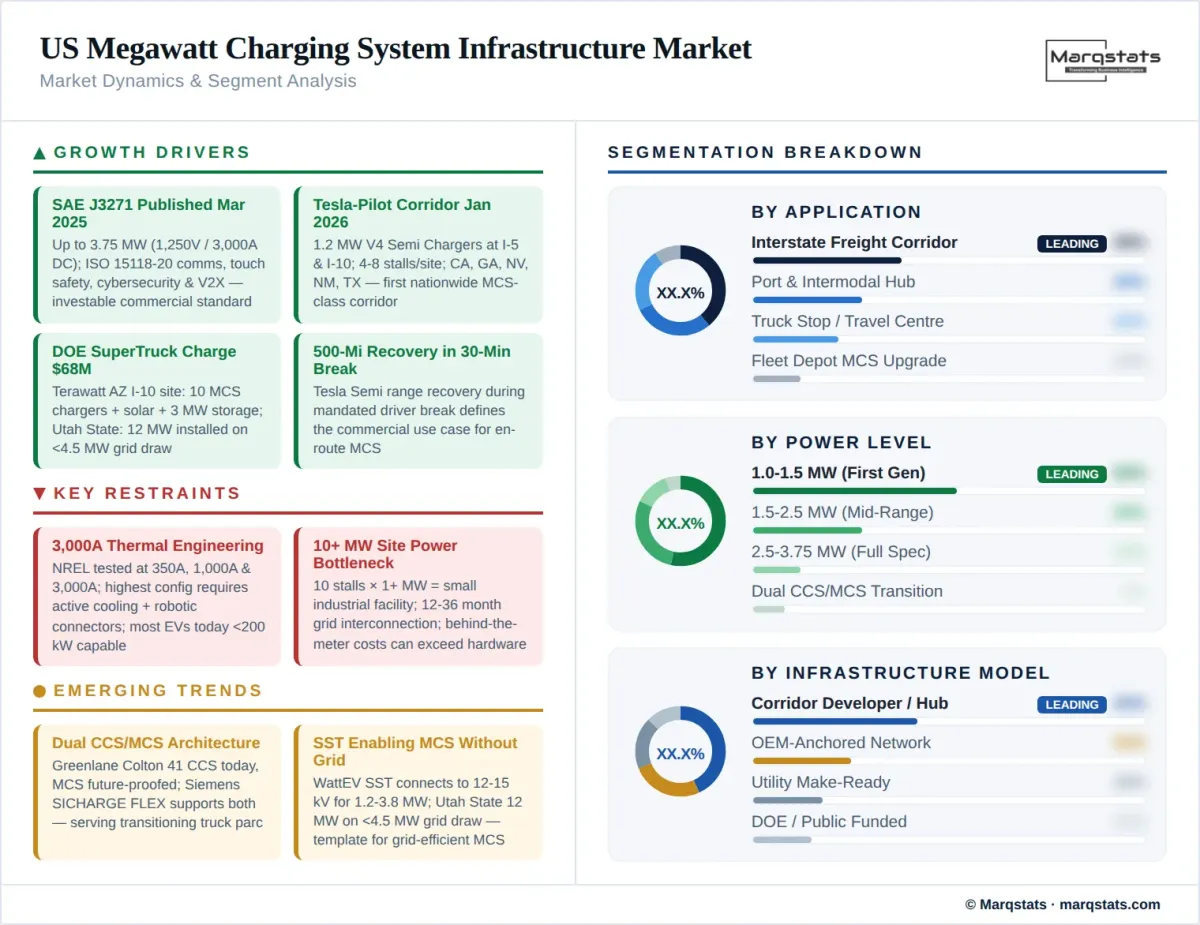
US Megawatt Charging System Infrastructure Market Dynamics Segment Analysis Infographic
Segment Analysis

Market Segmentation

Interstate Freight Corridor Charging (En-Route MCS)
Leading

The highest-profile MCS segment. Tesla/Pilot partnership along I-5 and I-10 (1.2 MW, V4 cabinets, summer 2026). Greenlane’s I-15 corridor from Long Beach to Baker via Colton and Barstow (MCS future-proofed). Terawatt’s I-10 Electric Corridor from LA/Long Beach toward El Paso with sites every ~150 miles. These corridor deployments serve long-haul trucks requiring rapid en-route charging during 30-minute mandated driver breaks. The National Freight Corridor Strategy provides the planning framework for corridor spacing and phasing.

Port and Intermodal Hub Charging

High-power charging at freight concentration nodes. DOE SuperTruck Charge selected projects near ports and distribution hubs. EV Realty San Bernardino (76 stalls, 9.9 MW, 200+ trucks/day) sits at the heart of Inland Empire logistics. Forum Mobility FM Harbor at Port of Long Beach operates at 9 MW today with CCS and is positioned for MCS upgrade. Port-adjacent MCS combines the highest truck throughput with the strongest grid-access economics because port infrastructure already has high-voltage utility service.

Truck Stop / Travel Centre MCS

Tesla/Pilot Travel Centers represents the most commercially significant truck stop deployment. Pilot is the largest US truck stop operator, and the partnership will host 4–8 MCS-class stalls per location across California, Georgia, Nevada, New Mexico, and Texas. Truck stop MCS provides the driver amenities, food, and rest facilities needed during mandated breaks—making MCS charging fit seamlessly into existing trucking operations rather than requiring new infrastructure types.

Depot-Adjacent High-Power Charging

Where fleet depot operations require higher power than standard overnight charging—high-utilisation drayage, multi-shift operations, and mixed depot-corridor sites. Depot-adjacent MCS serves trucks that need rapid top-ups between shifts rather than overnight charging. This segment bridges the depot charging and corridor markets, and is where dual CCS/MCS architecture is most important.

MCS Charger Hardware (SAE J3271 Compliant)
Leading

ABB MCS1200: 1.2 MW, 1,500 A continuous, optional CCS, North American 480 V input. Siemens SICHARGE FLEX: 480 kW–1.68 MW, CCS and MCS support, up to four MCS charge points with dynamic power allocation. Kempower Mega Satellite: 1.2 MW, 1,500 A, used in EV Realty’s March 2026 real-world session. Tesla V4 cabinet: up to 1.2 MW per stall, deployed at Pilot Travel Centers. These represent the first generation of commercially available MCS hardware.

Power Architecture and Grid Integration

WattEV solid-state transformer: connects to 12–15 kV for 1.2–3.8 MW, replacing multiple traditional components. ChargePoint/Eaton Express Grid: up to 600 kW for passenger, megawatt for heavy-duty, with V2X and on-site renewable/storage synchronisation. Eaton/Resilient Power SST technology for DC applications. Battery energy storage, solar canopies, and DERs used at Terawatt (3 MW storage), Utah State (<4.5 MW grid draw for 12 MW installed). Power architecture is where MCS site economics are won or lost.

Liquid-Cooled Connectors and Thermal Management

At 3,000 A, the MCS connector requires active liquid cooling to maintain safe temperatures. NREL’s interoperability testing showed strict thermal limits at maximum current. Connector thermal management is a critical engineering differentiator—it determines how close to the 3.75 MW theoretical maximum a site can actually operate in commercial conditions. Daimler notes that extreme charging currents place high demands on thermal management.

Regional Analysis

By Geography

Southern California / Inland Empire

The epicentre of US MCS deployment. EV Realty San Bernardino: 76 stalls, 9.9 MW, 200+ Class 8 trucks/day, site of March 2026 Kempower real-world MCS session. Greenlane Colton: 41 CCS chargers (first I-15 node, MCS future-proofed). WattEV port operations at Long Beach/LA with SST technology. Forum Mobility FM Harbor at Port of Long Beach (9 MW). CEC USD 30 million depot/hydrogen solicitation. Inland Empire is the largest US freight logistics cluster and the most natural location for MCS scale-up.

I-5 and I-10 Freight Corridors

Tesla/Pilot I-5 and I-10 deployment (1.2 MW, summer 2026, California/Georgia/Nevada/New Mexico/Texas). Terawatt’s I-10 Electric Corridor from LA/Long Beach toward El Paso with sites every ~150 miles. Greenlane’s I-15 corridor from Long Beach through Colton, Barstow, and Baker. These three interstate corridors represent the initial spine of US MCS corridor coverage, chosen because they carry the heaviest freight volumes.

Texas and Southeast

Tesla/Pilot sites planned in Texas and Georgia. Texas’s deregulated electricity market creates different grid-interconnection dynamics. Georgia’s port infrastructure (Savannah) drives heavy-duty freight demand. The Southeast corridor from Atlanta through Texas connects to the I-10 western freight network.

Southwest and Mountain West

DOE SuperTruck Charge selected Terawatt’s Arizona I-10 site (10 MCS-compatible chargers, solar, 3 MW storage) and Utah State’s project (12 MW, <4.5 MW grid draw). Tesla/Pilot sites planned in Nevada and New Mexico. Greenlane’s Barstow and Baker sites on I-15 connect Southern California to Las Vegas and the Mountain West.

Pacific Northwest and Midwest

Portland’s Electric Island (Daimler/PGE) was the first US public site for heavy-duty vehicles and MCS testing venue. The Pacific Northwest I-5 corridor connects California to Oregon and Washington freight markets. Midwest freight hubs (Chicago, Indianapolis, Detroit) represent the next wave of MCS deployment once I-5/I-10/I-15 Western corridors are established.
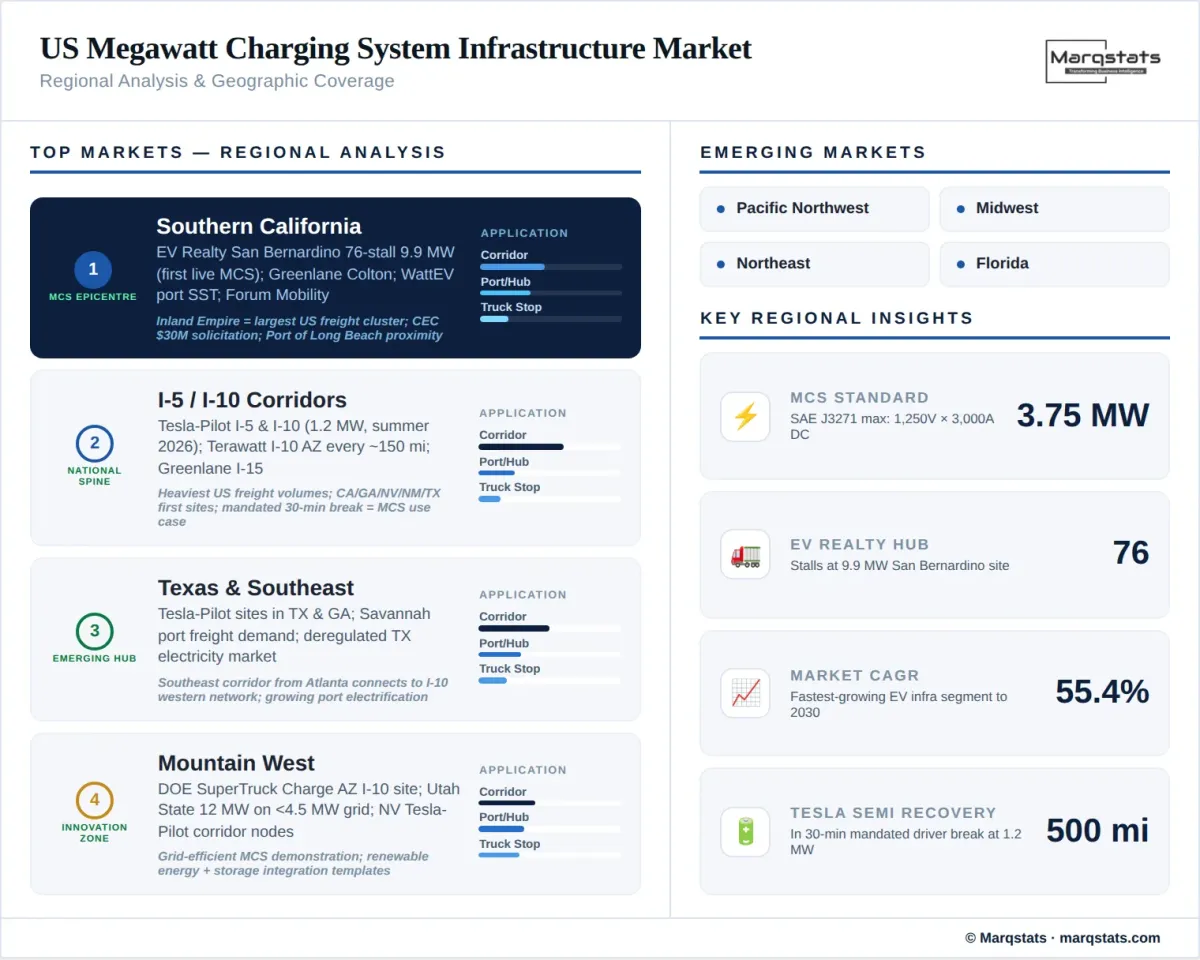
US Megawatt Charging System Infrastructure Market Regional Analysis Infographic
Competitive Landscape

How Competition Is Evolving

The competitive landscape has four layers. Corridor and hub developers are the most visible: Greenlane (backed by Daimler Truck, NextEra Energy, BlackRock—Colton, Barstow, I-15 corridor, 41 CCS chargers MCS future-proofed) leads in public freight corridor development. Terawatt is building the I-10 Electric Corridor from LA/Long Beach toward El Paso with MCS-compatible sites every ~150 miles. EV Realty focuses on dedicated high-power truck real estate: San Bernardino (76 stalls, 9.9 MW, USD 75 million growth funding, site of first real-world MCS session). Tesla/Pilot Travel Centers represents the first major OEM-truck-stop MCS partnership with 1.2 MW V4 cabinets along I-5 and I-10.

Hardware and power-electronics vendors provide the charging technology: ABB (MCS1200: 1.2 MW, 1,500 A continuous, CCS optional, 480 V NA input), Siemens (SICHARGE FLEX: 480 kW–1.68 MW, CCS+MCS, multi-dispenser dynamic allocation), Kempower (Mega Satellite: 1.2 MW, 1,500 A, proven in EV Realty real-world MCS session), Tesla (V4 cabinet: 1.2 MW, Pilot deployment), ChargePoint/Eaton (Express Grid: megawatt HD capability, V2X, SST technology via Resilient Power acquisition), WattEV (SST: 12–15 kV direct connection, 1.2–3.8 MW), and BorgWarner (960 kW liquid-cooled supercharger for Windrose trucks at Goodman properties).

OEMs and vehicle-side enablers determine market timing: Daimler (eActros 600 MCS field testing), Volvo (long-haul MCS adaptation, 20–80% in ~40 minutes), Tesla (Semi: 500-mile range, 1.2 MW native), and Windrose Technology (729 kWh battery, 600 km range, 800V platform). The utility/grid and systems-integration layer is arguably the most strategically important: Portland’s Electric Island (PGE/Daimler learning platform), DOE SuperTruck projects emphasising storage, hybrid AC/DC, and DER integration—the power-system integrator is often as critical as the charger OEM.
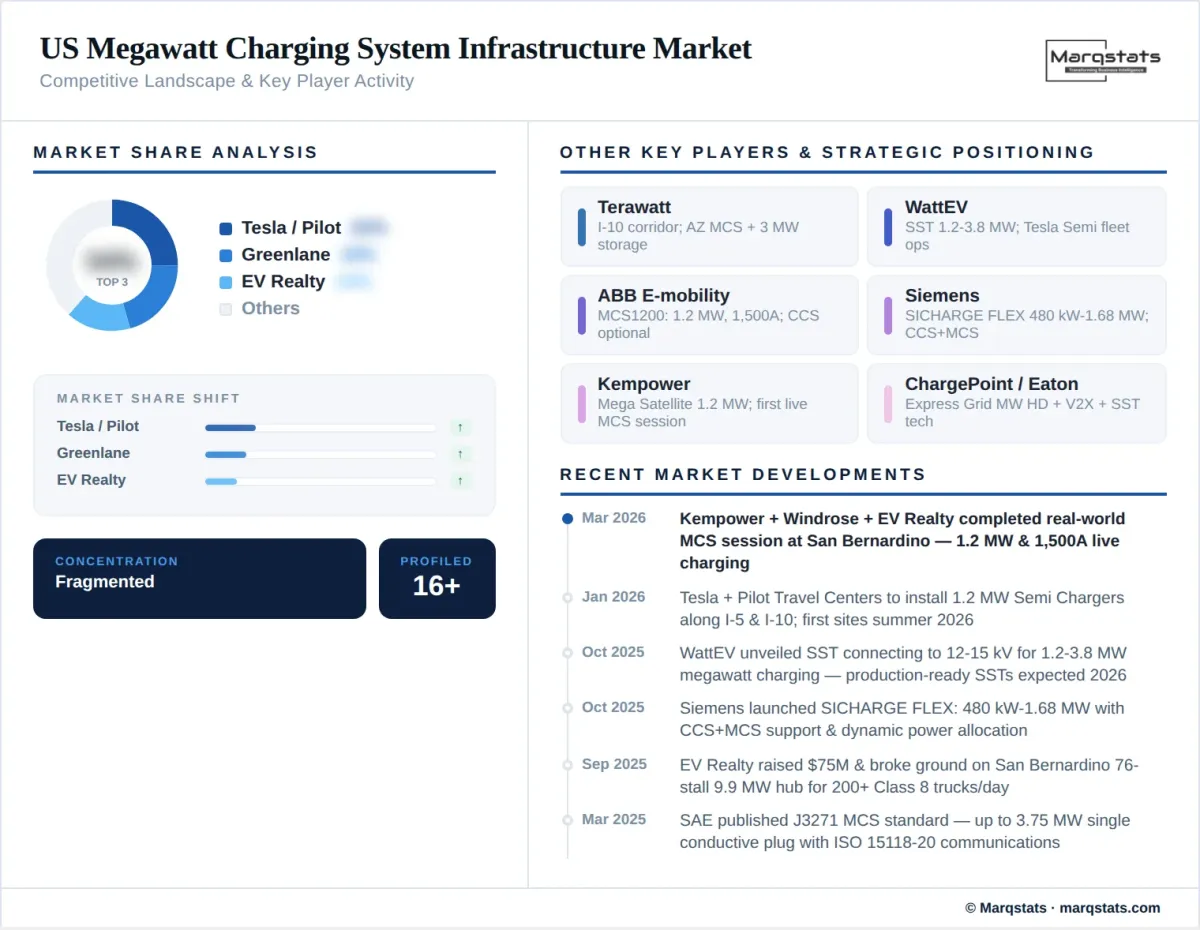
US Megawatt Charging System Infrastructure Market Competitive Landscape Infographic
Major Players

Companies Covered

The report profiles 15+ companies with full strategy and financials analysis, including:

Greenlane (Daimler/NextEra/BlackRock: Colton I-15, Barstow, Baker, MCS future-proofed)
Terawatt Infrastructure (I-10 Electric Corridor, Arizona MCS + 3 MW storage)
EV Realty (San Bernardino: 76 stalls, 9.9 MW, first real-world MCS session Mar 2026)
Tesla / Pilot Travel Centers (I-5/I-10 Semi Chargers, 1.2 MW V4, summer 2026)
WattEV (SST 1.2–3.8 MW, Tesla Semi fleet, 100-station plan by 2035)
ABB E-mobility (MCS1200: 1.2 MW, 1,500 A, CCS optional, 480 V NA)
Siemens (SICHARGE FLEX: 480 kW–1.68 MW, CCS+MCS, dynamic power allocation)
Kempower (Mega Satellite: 1.2 MW, 1,500 A, EV Realty real-world session)
Tesla (V4 cabinet: 1.2 MW per stall, Pilot deployment)
ChargePoint / Eaton (Express Grid: MW HD + V2X, Resilient Power SST)
BorgWarner (960 kW liquid-cooled supercharger for Windrose/Goodman)
Tesla Inc. (Semi: 500-mile range, 1.2 MW native charging)
Daimler Truck North America (eActros 600 MCS field testing)
Volvo Trucks (MCS-adapted long-haul, 20–80% in ~40 minutes)
Windrose Technology (729 kWh, 600 km, 800V platform, 960 kW charging)
SAE International (J3271 MCS standard, published March 2025)
CharIN (MCS task force, connector/communications architecture)
NREL (MCS interoperability testing: 350 A, 1,000 A, 3,000 A)
Portland Electric Island (Daimler/PGE heavy-duty testing venue)
Note: Full company profiles include revenue analysis, product portfolio, SWOT, and recent strategic developments.
Latest Developments

Recent Market Activity

Mar 2026
Kempower, Windrose, and EV Realty completed real-world MCS session at San Bernardino — 1.2 MW and 1,500 A through Kempower Mega Satellite hardware. One of the first live commercial MCS operations in the US.
Jan 2026
Tesla partnered with Pilot Travel Centers to install Semi Chargers at 1.2 MW (V4 cabinets, 4–8 stalls/site) along I-5 and I-10 in California, Georgia, Nevada, New Mexico, and Texas. First sites summer 2026.
Oct 2025
WattEV unveiled solid-state transformer connecting to 12–15 kV utility lines for 1.2–3.8 MW depot/corridor charging — replacing transformers, switchgear, and rectifiers. Production-ready SSTs expected 2026.
Oct 2025
Siemens launched SICHARGE FLEX: 480 kW–1.68 MW, CCS+MCS support, up to 4 MCS charge points with dynamic power allocation. Major industrial supplier entering MCS product market.
Sep 2025
EV Realty announced USD 75 million growth funding and broke ground on San Bernardino 76-stall, 9.9 MW truck charging hub — designed for 200+ Class 8 trucks/day.
Aug 2025
ChargePoint and Eaton launched Express Grid V2X architecture: up to 600 kW passenger, megawatt heavy-duty, with V2X and on-site renewable/storage synchronisation. Deliveries H2 2026.
Apr 2025
Greenlane opened Colton site with 41 OEM-agnostic CCS chargers as first node in I-15 commercial EV corridor — future-proofed for MCS, backed by Daimler Truck/NextEra/BlackRock.
Mar 2025
SAE published J3271 Megawatt Charging System standard — up to 3.75 MW (1,250 V, 3,000 A), ISO 15118-20, cybersecurity, V2X. The foundational commercial standard for MCS.
Jan 2025
DOE announced USD 68 million SuperTruck Charge for large-scale MCS-class demonstrations — Terawatt Arizona (10 MCS chargers + 3 MW storage), Greenlane Barstow (10+ MW), Utah State (12 MW, <4.5 MW grid draw).
Mar 2024
BorgWarner, Windrose, and Goodman announced 960 kW liquid-cooled supercharger collaboration for electric long-haul trucks at Goodman’s properties in China — 400 km range recovery in 36 minutes.
Report Structure

Table of Contents

1. Introduction
1.1 Study Assumptions & Market Definition
1.1.1 MCS = 1+ MW Charging for Class 6–8 Heavy-Duty Commercial Vehicles
1.1.2 SAE J3271 Standard: Up to 3.75 MW (1,250 V, 3,000 A DC)
1.1.3 Depot Charging (<500 kW Overnight) Excluded as Separate Market
1.2 Scope of the Study
1.2.1 By Application
1.2.2 By Infrastructure Layer
1.2.3 By State / Corridor Cluster
1.3 Executive Summary
1.4 Market Snapshot
2. Research Methodology
2.1 Research Framework
2.2 Secondary Research
2.3 Primary Research (40+ Interactions)
2.4 Bottom-Up Site Count, Stall Deployment, and Power Capacity Modelling
3. Standards and Interoperability Framework
3.1 SAE J3271 MCS Standard (Published March 2025)
3.1.1 Single Conductive Plug, 1,250 V, 3,000 A DC, 3.75 MW Maximum
3.1.2 ISO/IEC 15118-20 Ethernet Communications
3.1.3 Touch Safety, ADA/OSHA Alignment
3.1.4 Cybersecurity Requirements
3.1.5 V2X Capability
3.2 CharIN MCS Task Force Architecture
3.3 NREL MCS Interoperability Testing (350 A, 1,000 A, 3,000 A)
3.3.1 Actively Cooled Connector at 3,000 A
3.3.2 Thermal Limits and Cooled Inlet Requirements
3.4 Dual CCS/MCS Transitional Architecture
3.5 Interoperability as a Decisive Commercial Issue
4. Federal Policy and Incentive Framework
4.1 DOE SuperTruck Charge (USD 68M for MCS-Scale Demonstrations)
4.1.1 Terawatt Arizona (10 MCS Chargers + 3 MW Storage)
4.1.2 Greenlane Barstow (10+ MW, MCS Future-Proofed)
4.1.3 Utah State (12 MW Installed, <4.5 MW Grid Draw)
4.2 National Zero-Emission Freight Corridor Strategy (2024–2040)
4.3 Section 30C Tax Credit (6%/30% Up to USD 100,000 Per Item)
4.4 EPA Clean Heavy-Duty Vehicles Programme
4.5 California CEC USD 30M Depot/Hydrogen Solicitation
4.6 Federal Domestic-Content Requirements and Policy Uncertainty
5. Market Dynamics
5.1 Market Drivers
5.1.1 SAE J3271 Publication Transforming MCS Into Investable Standard
5.1.2 Tesla/Pilot Creating First Nationwide MCS-Class Corridor
5.1.3 DOE SuperTruck Charge Validating MCS at Freight Nodes
5.1.4 National Freight Corridor Strategy Framing MCS Through 2040
5.1.5 OEM Readiness: Daimler eActros 600, Volvo MCS, Tesla Semi
5.2 Market Restraints
5.2.1 Thermal Management at 3,000 A Still Technically Demanding
5.2.2 Site Power and Grid Interconnection as Main Bottleneck
5.2.3 Policy Instability Around Federal Charger Funding
5.3 Market Trends
5.3.1 Dual CCS/MCS Architecture as Transitional Strategy
5.3.2 Freight-Node Real Estate as Strategic Asset Class
5.3.3 SSTs and Energy Storage Enabling MCS Without Overbuilding Grid
5.3.4 Automated Robotic MCS for Autonomous Freight
6. Market Size & Growth Forecasts, 2021–2030
6.1 By Application
6.1.1 Interstate Freight Corridor Charging (En-Route MCS)
6.1.1.1 Revenue Analysis (USD, 2021–2030)
6.1.1.2 Tesla/Pilot I-5 and I-10 (1.2 MW, V4 Cabinets, Summer 2026)
6.1.1.3 Greenlane I-15 Corridor (Colton, Barstow, Baker)
6.1.1.4 Terawatt I-10 Electric Corridor (LA/Long Beach–El Paso)
6.1.1.5 500-Mile Range Recovery in 30-Minute Mandated Break
6.1.2 Port and Intermodal Hub Charging
6.1.2.1 Revenue Analysis
6.1.2.2 EV Realty San Bernardino (76 Stalls, 9.9 MW, 200+ Trucks/Day)
6.1.2.3 Kempower Mega Satellite Real-World MCS Session (Mar 2026)
6.1.2.4 Forum Mobility FM Harbor (9 MW, MCS Upgrade Path)
6.1.3 Truck Stop / Travel Centre MCS
6.1.3.1 Revenue Analysis
6.1.3.2 Pilot Travel Centers (Largest US Truck Stop Operator)
6.1.3.3 4–8 V4 Stalls Per Site (CA, GA, NV, NM, TX)
6.1.3.4 Driver Amenities + Mandated Break Integration
6.1.4 Depot-Adjacent High-Power Charging
6.1.4.1 Revenue Analysis
6.1.4.2 High-Utilisation Drayage and Multi-Shift Operations
6.2 By Infrastructure Layer
6.2.1 MCS Charger Hardware (SAE J3271 Compliant)
6.2.1.1 ABB MCS1200 (1.2 MW, 1,500 A, CCS Optional, 480 V NA)
6.2.1.2 Siemens SICHARGE FLEX (480 kW–1.68 MW, CCS+MCS, Dynamic Allocation)
6.2.1.3 Kempower Mega Satellite (1.2 MW, 1,500 A, Real-World Proven)
6.2.1.4 Tesla V4 Cabinet (1.2 MW, Pilot Deployment)
6.2.1.5 ChargePoint/Eaton Express Grid (MW HD + V2X)
6.2.1.6 BorgWarner 960 kW Liquid-Cooled Supercharger
6.2.2 Power Architecture and Grid Integration
6.2.2.1 WattEV Solid-State Transformer (12–15 kV, 1.2–3.8 MW)
6.2.2.2 Eaton/Resilient Power SST Technology
6.2.2.3 Battery Energy Storage (Terawatt 3 MW, Utah State DER)
6.2.2.4 Solar Canopies and On-Site Generation
6.2.2.5 Hybrid AC/DC Architecture for Grid Efficiency
6.2.3 Liquid-Cooled Connectors and Thermal Management
6.2.3.1 NREL 3,000 A Testing: Active Cooling Required
6.2.3.2 Connector Thermal Management as Engineering Differentiator
6.2.4 Robotic and Automated MCS Charging
6.3 By State / Corridor Cluster
6.3.1 Southern California / Inland Empire
6.3.1.1 EV Realty San Bernardino (76 Stalls, 9.9 MW, MCS Session)
6.3.1.2 Greenlane Colton (41 CCS, MCS Future-Proofed)
6.3.1.3 WattEV Port Operations + SST Technology
6.3.2 I-5 Corridor (California–Oregon–Washington)
6.3.2.1 Tesla/Pilot I-5 Deployment
6.3.2.2 Portland Electric Island (Daimler/PGE MCS Testing)
6.3.3 I-10 Corridor (LA/Long Beach–El Paso–Texas)
6.3.3.1 Tesla/Pilot I-10 Deployment
6.3.3.2 Terawatt I-10 Electric Corridor (Arizona, 10 MCS Chargers)
6.3.4 I-15 Corridor (Long Beach–Las Vegas)
6.3.4.1 Greenlane Colton–Barstow–Baker (60–90 Mile Spacing)
6.3.5 Texas
6.3.5.1 Tesla/Pilot Texas Deployment
6.3.5.2 Deregulated Market Grid Dynamics
6.3.6 Georgia
6.3.6.1 Tesla/Pilot Georgia Deployment
6.3.6.2 Savannah Port Freight Connection
6.3.7 Nevada
6.3.7.1 Tesla/Pilot Nevada + Gigafactory Nevada Semi Production
6.3.8 New Mexico
6.3.8.1 Tesla/Pilot New Mexico Deployment
6.3.9 Arizona
6.3.9.1 DOE SuperTruck Terawatt Site (10 MCS + 3 MW Storage)
6.3.10 Utah
6.3.10.1 Utah State SuperTruck (12 MW, <4.5 MW Grid, Hybrid Architecture)
7. Competitive Landscape
7.1 Four Competitive Layers
7.2 Corridor/Hub Developer Profiles
7.2.1 Greenlane (Daimler/NextEra/BlackRock: I-15, Colton, Barstow)
7.2.2 Terawatt Infrastructure (I-10, Arizona MCS + 3 MW Storage)
7.2.3 EV Realty (San Bernardino 76 Stalls, USD 75M, First MCS Session)
7.2.4 Tesla / Pilot Travel Centers (I-5/I-10, 1.2 MW V4, Summer 2026)
7.2.5 WattEV (SST 1.2–3.8 MW, Tesla Semi Fleet)
7.3 MCS Hardware Vendor Profiles
7.3.1 ABB E-Mobility (MCS1200: 1.2 MW, 1,500 A)
7.3.2 Siemens (SICHARGE FLEX: 480 kW–1.68 MW, CCS+MCS)
7.3.3 Kempower (Mega Satellite: 1.2 MW, Real-World Proven)
7.3.4 Tesla (V4 Cabinet: 1.2 MW)
7.3.5 ChargePoint / Eaton (Express Grid: MW HD + SST)
7.3.6 BorgWarner (960 kW Liquid-Cooled for Windrose)
7.4 OEM and Vehicle Profiles
7.4.1 Tesla (Semi: 500 Mi, 1.2 MW Native)
7.4.2 Daimler Truck (eActros 600 MCS Testing)
7.4.3 Volvo Trucks (MCS Long-Haul, 20–80% in ~40 Min)
7.4.4 Windrose Technology (729 kWh, 800V, 960 kW)
7.5 Standards and Research
7.5.1 SAE International (J3271)
7.5.2 CharIN (MCS Task Force)
7.5.3 NREL (Interoperability Testing)
7.5.4 Portland Electric Island (Daimler/PGE)
8. Power Architecture and Site Design Deep Dive
8.1 Throughput Per Constrained Grid Connection as Core Metric
8.2 Solid-State Transformer Architecture
8.3 Battery Storage and DER Integration
8.4 Hybrid AC/DC Site Design
8.5 Dynamic Power Allocation Across Multiple MCS Stalls
8.6 Grid Interconnection Process and Timeline
9. Market Opportunities and Strategic Recommendations
9.1 Dual CCS/MCS as Near-Term Investment Strategy
9.2 Freight-Node Real Estate Development
9.3 SST + Storage for Grid-Efficient MCS Sites
9.4 OEM Interoperability as Competitive Differentiator
9.5 Strategic Recommendations
9.5.1 For Corridor/Hub Developers
9.5.2 For MCS Hardware Vendors
9.5.3 For Truck OEMs
9.5.4 For Utilities
9.5.5 For Investors
10. Appendix
10.1 Research Methodology
10.2 List of Abbreviations
10.3 List of Tables
10.4 List of Figures
10.5 Disclaimer
10.6 About Marqstats Intelligence
Study Scope & Focus

Coverage & Segmentation

This report provides a comprehensive analysis of the United States megawatt charging system infrastructure market covering the historical period (2021–2025) and forecast period (2026–2030), with 2025 as the base year. The study examines market size in USD and deployment metrics across application (interstate corridor, port/intermodal hub, truck stop, depot-adjacent), infrastructure layer (MCS charger hardware, power architecture/grid, thermal management/connectors), and geography covering 10 state/corridor clusters. Company profiling covers 15+ players across corridor developers, charger hardware vendors, OEMs, and standards/research bodies. Standards analysis covers SAE J3271, CharIN MCS architecture, ISO/IEC 15118-20, Section 30C tax credits, DOE SuperTruck Charge, and National Freight Corridor Strategy.

Research methodology combines bottom-up modelling from MCS hardware unit pricing and site deployment counts, corridor hub developer disclosures (EV Realty 76 stalls/9.9 MW, Greenlane 41 stalls, Terawatt 10 MCS chargers), OEM MCS vehicle readiness timelines, DOE programme award data, and utility interconnection cost benchmarks. Primary research encompasses 40+ interactions with MCS corridor developers, charger hardware manufacturers, truck OEM charging programme teams, utility interconnection specialists, and federal programme managers across California, Texas, Arizona, and the broader US freight network.

Frequently Asked Questions

FAQs About the US Megawatt Charging System (MCS) Infrastructure Market

The market is valued at approximately USD 142.35 million in 2025 and projected to reach USD 1,287.46 million by 2030 at 55.42% CAGR. MCS is the high-power infrastructure layer for en-route and rapid-turn heavy-duty truck charging, enabled by SAE J3271 (published March 2025) supporting up to 3.75 MW through a single conductive plug.
Published March 2025, SAE J3271 defines the Megawatt Charging System for Class 6–8 commercial vehicles: single conductive plug, up to 1,250 V and 3,000 A DC (3.75 MW maximum), ISO/IEC 15118-20 Ethernet communications, touch safety, ADA/OSHA alignment, cybersecurity requirements, and V2X capability. CharIN’s MCS task force designed the architecture around interoperability and manual usability.
Corridor developers: Greenlane (I-15 Colton–Barstow, Daimler/NextEra/BlackRock), Terawatt (I-10 LA–El Paso), EV Realty (San Bernardino 76 stalls, first real-world MCS session March 2026), Tesla/Pilot Travel Centers (I-5/I-10, 1.2 MW V4, summer 2026). Hardware: ABB (MCS1200), Siemens (SICHARGE FLEX), Kempower (Mega Satellite), ChargePoint/Eaton (Express Grid), WattEV (SST).
Tesla’s Semi recovers 500 miles of range in a 30-minute session at 1.2 MW, matching the mandated driver break period. Volvo’s MCS-adapted long-haul truck charges from 20–80% in approximately 40 minutes. At the full 3.75 MW standard, charging times could be even shorter, but thermal management at 3,000 A requires actively cooled connectors and inlets.
DOE announced USD 68 million in January 2025 for large-scale MCS-class demonstrations near ports, distribution hubs, and freight corridors. Selected projects: Terawatt Arizona (10 MCS chargers + 3 MW storage), Greenlane Barstow (10+ MW MCS future-proofed), and Utah State (12 MW installed, drawing <4.5 MW from grid through hybrid architecture, controls, and DERs).
Site power and grid interconnection, not charger hardware. A 10-stall MCS site needs 10+ MW—equivalent to a small industrial facility. Grid interconnection takes 12–36 months. WattEV’s solid-state transformer (connecting directly to 12–15 kV for 1.2–3.8 MW) and Utah State’s hybrid architecture (12 MW installed, <4.5 MW grid draw) demonstrate solutions to this bottleneck.
ABB MCS1200: 1.2 MW, 1,500 A continuous, CCS optional. Siemens SICHARGE FLEX: 480 kW–1.68 MW, CCS+MCS, up to 4 MCS charge points with dynamic allocation. Kempower Mega Satellite: 1.2 MW, 1,500 A (used in first real-world US MCS session). Tesla V4 cabinet: 1.2 MW (Pilot deployment). ChargePoint/Eaton Express Grid: MW capability with V2X and SST.
Yes, Marqstats offers customization including corridor-specific MCS site planning, MCS hardware competitive benchmarking, power architecture cost modelling (SST vs traditional), grid interconnection timeline analysis, OEM MCS readiness tracking, and dual CCS/MCS investment strategy assessment. Contact sales@marqstats.com or +91 934-180-0264.
PDF report (210+ pages), Excel data workbook with segment-level forecasts by application, infrastructure layer, and state/corridor (10 clusters), PowerPoint summary deck, and 12 months of analyst email support.