Market Snapshot
Key Takeaways
Market Overview & Analysis
Report Summary
Malaysia's hybrid market in 2025 was a Japanese premium segment of 38,515 units, and by 2030 it is a national-brand mass segment of an estimated 165,000. Almost everything that makes that transition happen was announced or launched between January and September 2026, which is why the 2025 base and the 2030 terminal describe two different markets rather than one market at two sizes.
The measure is the retail value of new hybrid passenger vehicles sold in Malaysia, covering full hybrids, series hybrids and mild hybrids across passenger cars and pickups, together with the local assembly of hybrid vehicles, hybrid batteries and dedicated hybrid powertrains. Plug-in hybrids and battery electric vehicles are excluded and are separate panels in this catalogue. The component value of hybrid powertrains and batteries manufactured in Malaysia belongs to the components market and is never added here.
The analysis is written for manufacturers deciding whether to commit hybrid assembly capacity against a segment whose price point is falling, distributors modelling a volume ramp that outpaces its own revenue, component suppliers whose hybrid content awards run to seven years, and policymakers weighing a powertrain that needs no charging infrastructure against one that does.
Malaysia Hybrid Electric Vehicle Market Size and Forecast
Hybrid retail value is estimated at USD 1,513.09 million in 2025, USD 2,050.00 million in 2026 and USD 5,028.57 million by 2030, an increase of USD 3,515.48 million against 126,485 additional units. Volume moves from 38,515 to 165,000 hybrids, with average transaction value falling from MYR 165,000 to MYR 128,000, or USD 39,286 to USD 30,476 at a constant MYR 4.20 per USD.
Two growth rates apply and the second is the lower one. The five-year value rate connecting 2025 and 2030 is 27.15%; the four-year rate connecting 2026 and 2030 is 25.14%. The 2.01-point gap exists because 2026 carries a step change rather than a trend: the locally assembled Toyota Vios Hybrid arrived in February at MYR 103,900 and the Yaris Cross hybrid in May at MYR 109,900, which lifted both volume and value sharply in a single year before the price mix begins pulling the value rate down.
Value compounds 6.62 points behind volume at 27.15% against 33.77%, and the mechanism is price point rather than discounting. The 2025 mix sat at MYR 130,000 to 200,000 with a premium tail; the 2030 mix sits at MYR 100,000 to 130,000. Both rates are high, and reading either alone misstates the segment: a value-only read understates how many hybrids Malaysia will sell, and a volume-only read overstates what the segment is worth.
The unit base is carried unchanged from the published Malaysian electrified vehicle series at 38,515 hybrids in 2025, which is 4.69% of total industry volume of 820,752. Three powertrain panels in this catalogue draw on one national registration series, and publishing three different readings of it would make them impossible to compare. Battery electric and plug-in hybrid together accounted for a further 30,848 units in the same year.
A sizing range is published rather than a point. The 2030 figure sits within a band of USD 4,120.00 million to USD 6,180.00 million against 138,000 to 198,000 units, corresponding to rates of 22.18% and 32.53%, and the spread turns almost entirely on whether Perodua's Ativa Hybrid reaches volume inside the window.
The Segment Is Getting Cheaper, Which Is Why It Is Getting Bigger
In 2025 Malaysian hybrid buyers were choosing between the Honda HR-V and CR-V e:HEV in the mid range, the Nissan Serena e-POWER at MYR 154,800, the Honda Prelude e:HEV at MYR 278,000, the Toyota Harrier hybrid from MYR 289,000 and the Toyota Vellfire Hybrid from MYR 549,900. The mass-market hybrid did not exist.
It arrived in 2026. The locally assembled Toyota Vios Hybrid launched from MYR 103,900 with a GR Sport variant at MYR 109,900, and the Bukit Raja-built Yaris Cross hybrid followed in May at MYR 109,900, MYR 10,000 above its internal combustion equivalent. A MYR 10,000 hybrid premium on a mass-market model is the number that decides whether this segment reaches 165,000 units or stays below 100,000.
The mass-market band moves from an estimated 6,900 units in 2025, 17.92% of the segment, to an estimated 88,000 units or 53.33% by 2030. Every other band grows in absolute terms and loses share. Premium hybrids move from an estimated 9,650 units to 20,500 and luxury from 2,165 to 4,500, both compounding in the teens against a segment growing at 33.77%.
National Manufacturers Enter a Segment They Were Absent From
Perodua confirmed in May 2026 that it will locally produce and sell the Ativa Hybrid at its Rawang plant, supported by approximately JPY 1.5 billion, or over MYR 37 million, from Japan's Global South Fund for hybrid technology development, with timelines and pricing undecided. A company selling 359,904 vehicles a year entering the hybrid segment changes the segment's arithmetic more than any other single event in the window.
Proton is arriving through its own powertrain. It displayed a hybrid system at GATE 2026 pairing a 1.5-litre dedicated hybrid engine of 82 kW and 136 Nm with a one-speed dedicated hybrid transmission using P1 and P3 motors, expected to debut in the Saga-based AMA02 sport utility vehicle, and began local production of dedicated hybrid transmissions and electric drive units at Tanjung Malim in August 2026, the first manufacturer in Malaysia to build both locally.
The Tanjung Malim hub behind that has taken more than MYR 121 million since 2022, works with 16 suppliers of which eight are Malaysian, employs more than 500 people and runs at a design capacity of up to 240,000 engines a year rising toward 400,000 units by 2028. Proton's stated 2030 roadmap is 330,000 units with 30% exports and 30% electrified, and hybrids rather than battery electric vehicles are the larger part of reaching the electrified share.
National marques move from an estimated 265 hybrid units in 2025 to an estimated 72,000 by 2030, from 0.69% of the segment to 43.64%. Compound rates are not published for that movement because a growth rate calculated off a 265-unit base is arithmetically true and analytically useless; the share shift and the absolute figures are the meaningful statement.
Chinese Brands Are Entering Hybrid Through Contract Assembly
SAIC Motor Malaysia opened bookings for the MG ZS Hybrid+ in June 2026 for local assembly at EP Manufacturing's Pegoh plant, pairing a 1.5-litre engine with a 100 kW motor and a 1.83 kWh battery for a combined 158 kW and 465 Nm and a claimed range of up to 870 km. Great Wall Motor confirmed at GATE 2026 that the Ora 5 hybrid, at 223 PS and 476 Nm on 4.4 litres per 100 km, will also be assembled at Pegoh, with launch expected in the second half of 2026.
Neither brand is building a plant. Both are using the same contract assembler, which is why Chinese hybrid volume can move from an estimated 400 units in 2025 to an estimated 28,500 by 2030 without a single greenfield investment. MG Motor Malaysia sold 807 units in the first quarter of 2026, up 39%, from a base small enough that the hybrid launches rather than the existing range will determine its trajectory.
The route matters because it is the same route the plug-in hybrids are taking. Great Wall Motor's Haval H7 Hi4 plug-in hybrid is scheduled for Pegoh assembly in early 2027, and the WEY G9 plug-in hybrid already runs there at 40.05% localisation against a target of 5,000 domestic and 5,000 export units a year. One contract assembler is becoming the Malaysian manufacturing base for two Chinese powertrain strategies at once.
Hybrids Carry No Charging Dependency, and in Malaysia That Decides Geography
Malaysia had 6,416 public chargers as of 31 May 2026, of which only 2,143 were direct current, and the coverage is concentrated on the Klang Valley corridor. A hybrid requires none of it, which is why the segment's regional spread tracks income and model availability rather than infrastructure.
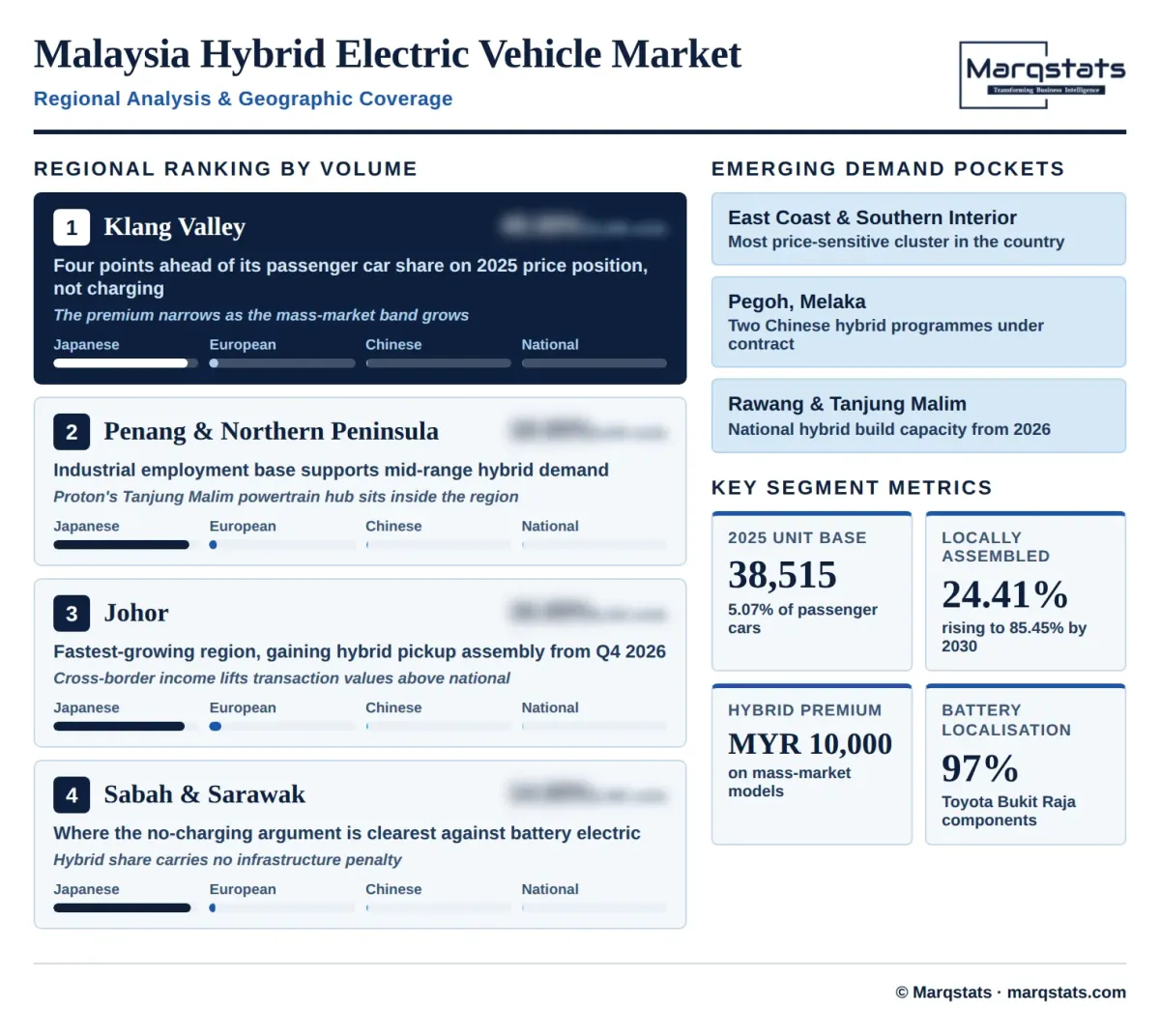
Klang Valley accounts for an estimated 15,406 hybrid units in 2025, 40.00% of the segment, against 36.00% of total passenger car volume, a four-point premium that reflects the segment's 2025 price position rather than any charging advantage. That premium narrows as the mass-market band grows, and Sabah and Sarawak at an estimated 5,392 units or 14.00% is the clearest case: battery electric share there sits well below the national figure while hybrid share does not.
The pickup sub-segment is the newest expression of the same logic. Foton and importer-assembler Handal BCM prepared a May 2026 launch of the Tunland V7 and V9 mild-hybrid turbodiesel pickups with initial fully imported deliveries and completely knocked down assembly in Johor scheduled for the fourth quarter of 2026. Hybrid pickups were zero units in 2025 and reach an estimated 9,500 by 2030.
Market Dynamics
Key Drivers
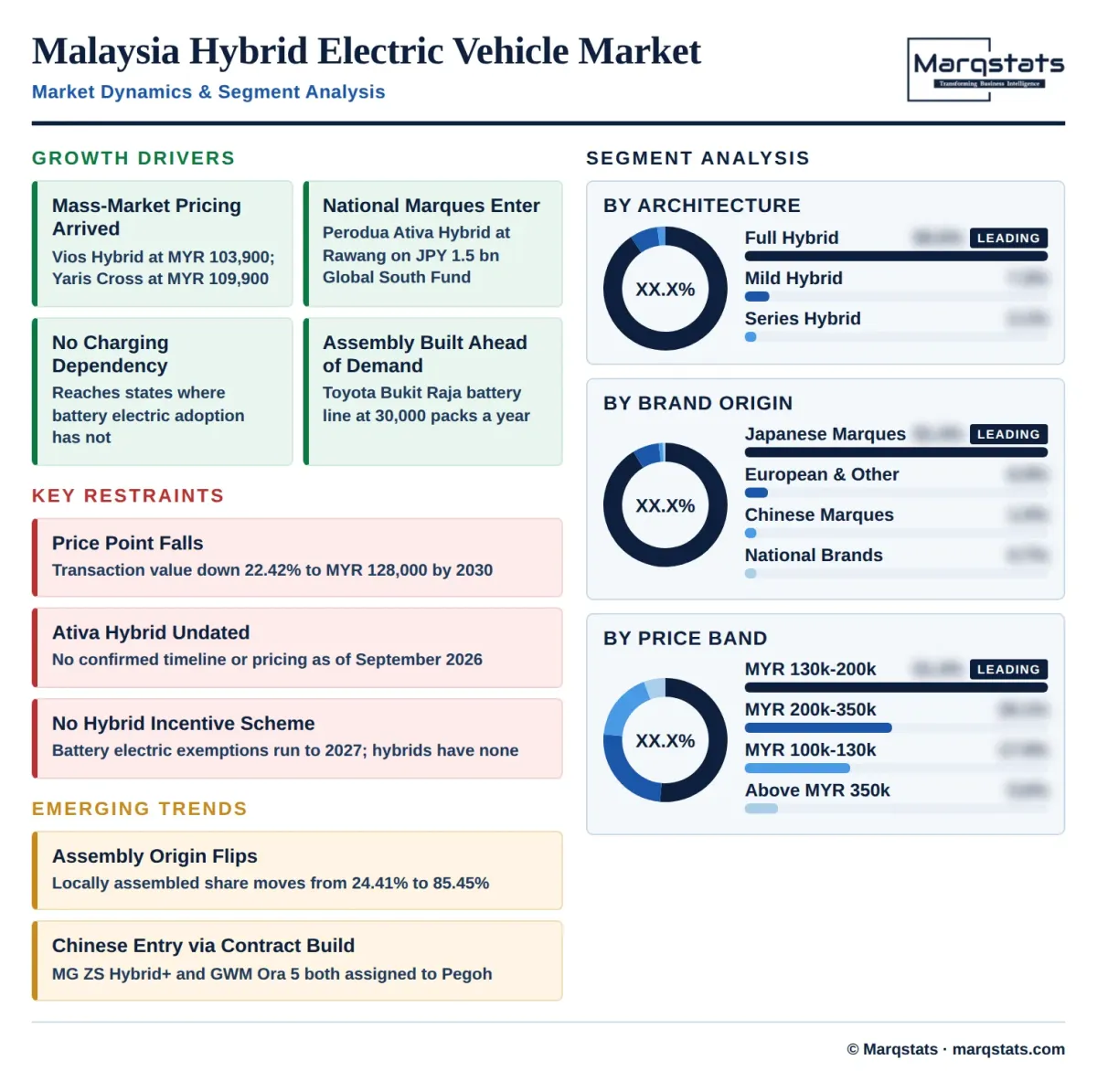
- Mass-market pricing is the primary driver, with the locally assembled Toyota Vios Hybrid at MYR 103,900 and the Yaris Cross hybrid at MYR 109,900, only MYR 10,000 above its internal combustion equivalent.
- National manufacturer entry changes the segment's arithmetic, with Perodua committing the Ativa Hybrid to Rawang on approximately JPY 1.5 billion of Global South Fund support and Proton building hybrid transmissions at Tanjung Malim.
- Local assembly capacity is being committed ahead of demand, with Toyota's Bukit Raja hybrid battery line at up to 30,000 batteries a year on 97% local components and EP Manufacturing's Pegoh plant taking two Chinese hybrid programmes.
- Hybrids require no charging infrastructure in a country with 6,416 public chargers of which only 2,143 are direct current, which extends the segment's reach into states where battery electric adoption has not followed.
- Japanese incumbents are defending share through hybrid rather than price, with Honda at 72,301 units and an 8.8% share in 2025 and the HR-V and CR-V e:HEV each above 30% of its hybrid sales.
Key Restraints
- Average transaction value falls 22.42% from MYR 165,000 to MYR 128,000, so the segment's revenue grows 6.62 points slower than its unit volume throughout the window.
- Perodua's Ativa Hybrid has no confirmed timeline or pricing as of September 2026, and the published sizing band of 138,000 to 198,000 units turns almost entirely on whether it reaches volume inside the window.
- The segment competes directly with battery electric vehicles for the same incentive attention, and locally assembled battery electric tax exemptions run to 31 December 2027 while no equivalent hybrid scheme has been published.
- Distributor financial capacity is uneven, with Tan Chong Motor Holdings reporting a MYR 175.4 million loss before tax on revenue of MYR 2.11 billion for the year ended December 2025.
Key Trends
- Assembly origin flips, with locally assembled hybrids rising from an estimated 24.41% of volume to 85.45% while fully imported supply contracts at 3.79% a year.
- Series hybrid and mild hybrid architectures grow faster than full hybrid from much smaller bases, at 55.88% and 47.43% against 31.65%.
- Chinese brands enter hybrid through contract assembly rather than greenfield investment, with both the MG ZS Hybrid+ and the Great Wall Motor Ora 5 hybrid assigned to EP Manufacturing's Pegoh plant.
- Hybrid powertrain content is localising, with Proton producing dedicated hybrid transmissions and electric drive units at Tanjung Malim from August 2026 and Toyota sourcing 97% of hybrid battery components locally.
Market Segmentation
Full hybrids accounted for an estimated 34,900 units in 2025, 90.61% of the segment, growing to an estimated 138,000 units or 83.64% by 2030 at a 31.65% compound rate. The architecture covers Honda's e:HEV range, Toyota's fourth-generation hybrid system and Proton's dedicated hybrid engine and transmission pairing of 82 kW and 136 Nm.
Mild hybrids accounted for an estimated 2,800 units in 2025, 7.27% of the segment, growing to an estimated 19,500 units or 11.82% by 2030 at a 47.43% compound rate. The Foton Tunland V7 and V9 mild-hybrid turbodiesel pickups and the MG ZS Hybrid+ with its 1.83 kWh battery sit at the two ends of the architecture's price range.
Series hybrids accounted for an estimated 815 units in 2025, 2.12% of the segment and the smallest architecture, growing to an estimated 7,500 units or 4.55% by 2030 at a 55.88% compound rate, the fastest of the three. The Nissan Serena e-POWER at MYR 154,800 for Peninsular Malaysia is the segment's only established nameplate.
Japanese marques accounted for an estimated 35,200 hybrid units in 2025, 91.39% of the segment, and an estimated USD 1,354.22 million or 89.50% of value. Honda sold 72,301 vehicles overall for an 8.8% share with the HR-V and CR-V e:HEV each above 30% of its hybrid sales, and Toyota carried the Harrier, Vellfire and Corolla Cross hybrids alongside the Nissan Serena e-POWER.
The group holds absolute volume and loses share, reaching an estimated 56,000 units or 33.94% by 2030 at a 9.73% compound rate. Its defence is the locally assembled Vios Hybrid and Yaris Cross, which move Japanese supply down into the mass-market band rather than ceding it.
National marques accounted for an estimated 265 hybrid units in 2025, 0.69% of the segment and an estimated USD 6.05 million or 0.40% of value, reaching an estimated 72,000 units or 43.64% by 2030. Perodua's Ativa Hybrid at Rawang and Proton's AMA02, AMA05 and AMA06 hybrid programmes carry the entire movement.
No compound rate is published for this segment because one calculated off a 265-unit base is arithmetically correct and analytically empty. The meaningful statement is the share shift from 0.69% to 43.64% and the absolute move from 265 to an estimated 72,000 units.
Chinese marques accounted for an estimated 400 hybrid units in 2025, 1.04% of the segment, reaching an estimated 28,500 units or 17.27% by 2030. The MG ZS Hybrid+ at a combined 158 kW and 465 Nm and the Great Wall Motor Ora 5 hybrid at 223 PS and 476 Nm are both assigned to contract assembly at EP Manufacturing's Pegoh plant.
European and other marques accounted for an estimated 2,650 hybrid units in 2025, 6.88% of the segment, and an estimated USD 140.72 million or 9.30% of value, the highest value-to-volume ratio in the segment. The group reaches an estimated 8,500 units or 5.15% by 2030 at a 26.25% compound rate, growing in absolute terms while losing share throughout.
The mass-market band accounted for an estimated 6,900 units in 2025, 17.92% of the segment, reaching an estimated 88,000 units or 53.33% by 2030 at a 66.39% compound rate, the fastest band by a wide margin. The locally assembled Toyota Vios Hybrid at MYR 103,900 and the Yaris Cross hybrid at MYR 109,900 established the band in 2026.
The mid-range band accounted for an estimated 19,800 units in 2025, 51.41% of the segment and the largest band, reaching an estimated 52,000 units or 31.52% by 2030 at a 21.30% compound rate. The Honda HR-V and CR-V e:HEV and the Nissan Serena e-POWER at MYR 154,800 anchor it.
The premium band accounted for an estimated 9,650 units in 2025, 25.06% of the segment, reaching an estimated 20,500 units or 12.42% by 2030 at a 16.26% compound rate. The Honda Prelude e:HEV from MYR 278,000 and the Toyota Harrier hybrid from MYR 289,000 define the band.
The luxury band accounted for an estimated 2,165 units in 2025, 5.62% of the segment and the smallest band, reaching an estimated 4,500 units or 2.73% by 2030 at a 15.76% compound rate, the slowest in the segment. The Toyota Vellfire Hybrid from MYR 549,900 is the band's volume nameplate.
Sport utility vehicles and crossovers accounted for an estimated 24,600 units in 2025, 63.87% of the segment, reaching an estimated 96,000 units or 58.18% by 2030 at a 31.30% compound rate. The Honda HR-V and CR-V, Toyota Yaris Cross and Harrier, MG ZS Hybrid+ and Great Wall Motor Ora 5 all sit here, as does Proton's Saga-based AMA02.
Sedans and hatchbacks accounted for an estimated 7,115 units in 2025, 18.47% of the segment, reaching an estimated 32,500 units or 19.70% by 2030 at a 35.50% compound rate, the fastest body type. The locally assembled Toyota Vios Hybrid from MYR 103,900 carries most of the growth.
Multi-purpose vehicles accounted for an estimated 6,800 units in 2025, 17.66% of the segment, reaching an estimated 27,000 units or 16.36% by 2030 at a 31.76% compound rate. The Nissan Serena e-POWER at MYR 154,800 and the Toyota Vellfire Hybrid from MYR 549,900 bracket the body type's price range.
Hybrid pickups accounted for 0 units in 2025 and reach an estimated 9,500 units or 5.76% by 2030. The segment begins with the Foton Tunland V7 and V9 mild-hybrid turbodiesel models, launched as fully imported units in May 2026 with completely knocked down assembly in Johor scheduled for the fourth quarter of 2026.
Locally assembled hybrids accounted for an estimated 9,400 units in 2025, 24.41% of the segment, reaching an estimated 141,000 units or 85.45% by 2030 at a 71.88% compound rate. Toyota's Bukit Raja line, EP Manufacturing's Pegoh plant, Perodua's Rawang plant and Proton's Tanjung Malim complex carry the capacity.
Fully imported hybrids accounted for an estimated 29,115 units in 2025, 75.59% of the segment, contracting to an estimated 24,000 units or 14.55% by 2030 at a negative 3.79% compound rate. The Toyota Vellfire Hybrid from MYR 549,900 and the Honda Prelude e:HEV from MYR 278,000 remain imported throughout.
By Geography
Klang Valley
Selangor and Kuala Lumpur account for an estimated 15,406 hybrid registrations in 2025, 40.00% of the segment, against 36.00% of total passenger car volume. The four-point premium reflects the segment's 2025 premium price position rather than any infrastructure advantage, since hybrids carry no charging dependency, and it narrows as the mass-market band grows.
Penang and the Northern Peninsula
Penang, Kedah, Perlis and Perak account for an estimated 6,933 hybrid registrations, 18.00% of the segment. The region's industrial employment base supports mid-range hybrid demand, and Proton's Tanjung Malim powertrain hub sits inside it at up to 240,000 engines a year.
Johor
Johor accounts for an estimated 6,162 hybrid registrations, 16.00% of the segment, and is the fastest-growing region. Cross-border income supports transaction values above the national average, and the state gains hybrid assembly capacity when Foton's Tunland pickup moves to completely knocked down production in the fourth quarter of 2026.
Sabah and Sarawak
East Malaysia accounts for an estimated 5,392 hybrid registrations, 14.00% of the segment, and is where the charging argument is clearest. Battery electric share in the two states sits well below the national figure because coverage within the country's 6,416 public chargers is thinnest there, while hybrid share does not carry the same penalty.
East Coast and Southern Interior
Pahang, Terengganu, Kelantan, Negeri Sembilan and Melaka account for an estimated 4,622 hybrid registrations, 12.00% of the segment, the lowest of the five clusters in 2025. The region is the most price-sensitive in the country and the clearest test of whether a MYR 10,000 hybrid premium on a mass-market model converts, with EP Manufacturing's Pegoh assembly plant inside it.
How Competition Is Evolving
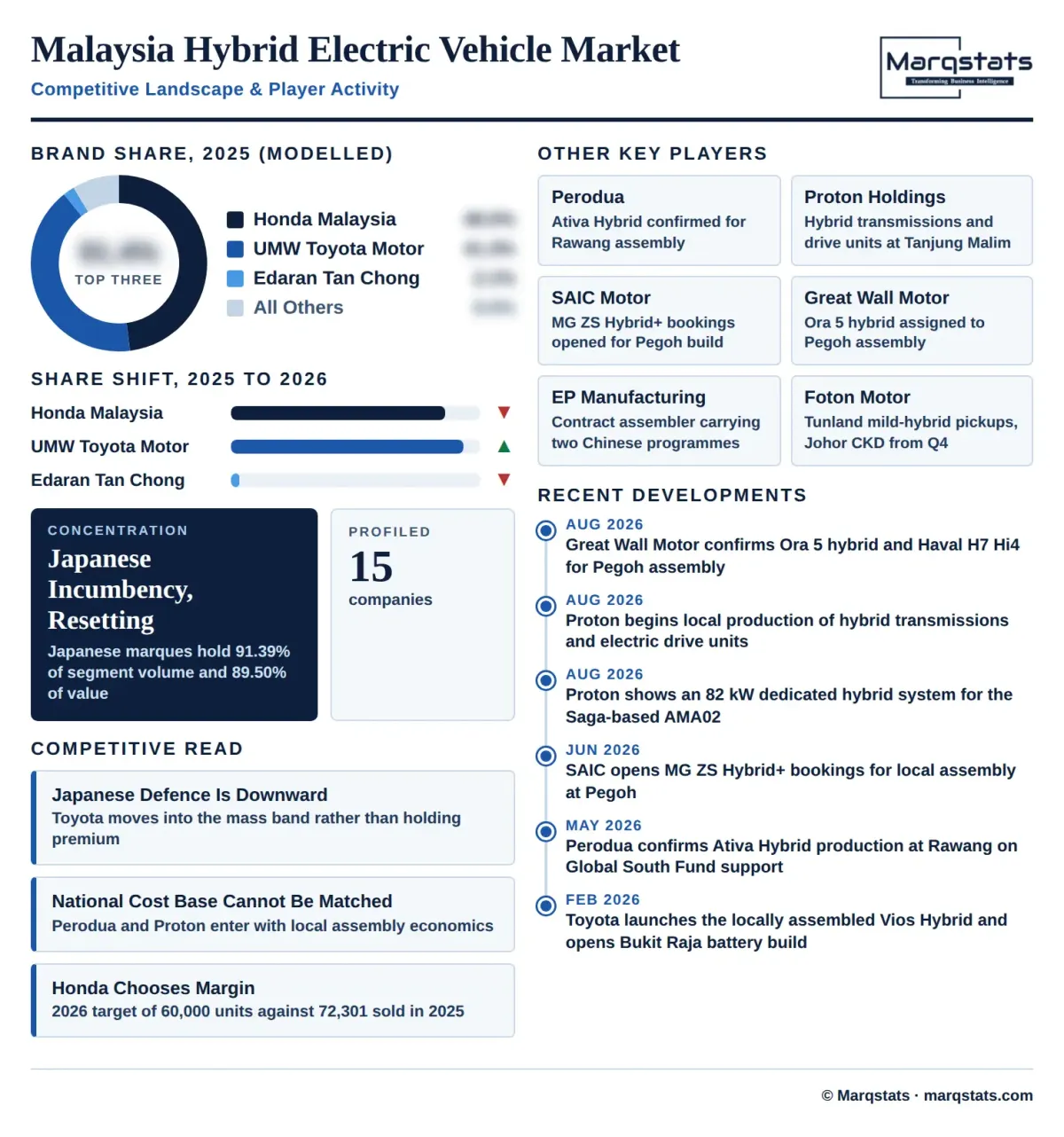
Malaysia's hybrid segment is concentrated today and will not be by 2030. Japanese marques held an estimated 91.39% of 2025 volume and an estimated 89.50% of value, a position built over more than a decade of e:HEV and Toyota hybrid supply, with Honda leading the non-national passenger vehicle segment for a twelfth consecutive year on 72,301 units and an 8.8% share.
The challenge is arriving from two directions at once and neither is price competition in the conventional sense. National manufacturers are entering with cost structures no importer can match, Perodua through the Ativa Hybrid at Rawang on Global South Fund support and Proton through its own dedicated hybrid engine and transmission at Tanjung Malim. Chinese brands are entering through a contract assembler, with both the MG ZS Hybrid+ and the Great Wall Motor Ora 5 hybrid assigned to EP Manufacturing's Pegoh plant rather than to plants of their own.
The Japanese response is to move down rather than to hold position. The locally assembled Vios Hybrid at MYR 103,900 and Yaris Cross hybrid at MYR 109,900 place Toyota directly in the band that Perodua and Proton will occupy, and Toyota's Bukit Raja hybrid battery line at up to 30,000 units a year on 97% local components gives it a cost base to defend there. Honda's 2026 target of 60,000 units against 72,301 sold in 2025 indicates a brand choosing profitability over volume while the segment resets.
Companies Covered
The report profiles 15+ companies with full strategy and financials analysis, including:
Recent Market Activity
Table of Contents
Coverage & Segmentation
The analysis measures the retail value of new hybrid passenger vehicles sold in Malaysia from 2021 to 2030, with 2025 as the base year and 2026 to 2030 as the forecast period, covering full hybrid, series hybrid and mild hybrid architectures across passenger cars and pickups, together with the local assembly of hybrid vehicles, hybrid batteries and dedicated hybrid powertrains. Plug-in hybrids and battery electric vehicles are excluded and are separate panels in this catalogue, accounting for a further 30,848 units in 2025. The component value of hybrid powertrains and batteries manufactured in Malaysia belongs to the components market and is never added here. Values are expressed in USD at a disclosed constant MYR 4.20 per USD.
Coverage spans three hybrid architectures, four brand origin groups, four price bands, four body types and two assembly origins, with five regional clusters analysed on registration volume and price band mix. Hybrid unit volume is carried as the unit series at 38,515 in 2025 and average transaction value as a derived series at MYR 165,000, and both are published alongside the value panel because a segment whose volume is rising while its price point falls cannot be represented by either alone. Fifteen entities are profiled across manufacturers with hybrid supply in market, the contract assembler carrying Chinese hybrid programmes, and the distributor groups that hold the franchises.