Market Snapshot
Key Takeaways
Market Overview & Analysis
Report Summary
This analysis sizes the global automotive Generative Engine Optimization market, encompassing enterprise software-as-a-service subscription revenues and professional agency retainers deployed specifically for generative engine visibility, structured data feeds, Model Context Protocol server deployments, and citation engineering across dealership networks, automotive manufacturers, and digital marketplaces. The market is built from bottom-up calibration of verified corporate financial disclosures, National Automobile Dealers Association promotional expenditure data, and Interactive Advertising Bureau search advertising benchmarks. The market is sized in USD across a 2022-2025 historical period and a 2026-2030 forecast period, with 2025 as the base year.
The global automotive Generative Engine Optimization market grew from USD 4.50 million in 2022 to USD 364.80 million in 2025, a compound annual growth rate exceeding 190% across the historical window, and is projected to reach USD 1,865.40 million by 2030, a 38.59% compound annual growth rate. This growth reflects a category that barely existed three years ago transitioning into standard operational infrastructure, driven by measurable consumer migration toward conversational vehicle research and the documented collapse of traditional organic search click-through rates on complex automotive queries.
The base-case 2030 forecast of USD 1,865.40 million assumes automotive dealerships and manufacturers maintain parallel digital search budgets, systematically reallocating 15% to 25% of existing search engine marketing retainers toward generative structured schema deployment, with specialized automotive GEO software installations reaching approximately 48,500 dealership rooftops globally by 2030. The binding upside condition, reaching USD 2,580.00 million at a 48.33% CAGR, is whether Model Context Protocol servers and agentic transactional APIs achieve formal industry-wide standardization, endorsed by major dealer management system providers and global automotive manufacturers by the third quarter of 2027, transforming generative AI platforms from passive research tools into autonomous transactional agents capable of directly scheduling service appointments and reserving specific vehicles.
Market Dynamics
Key Drivers
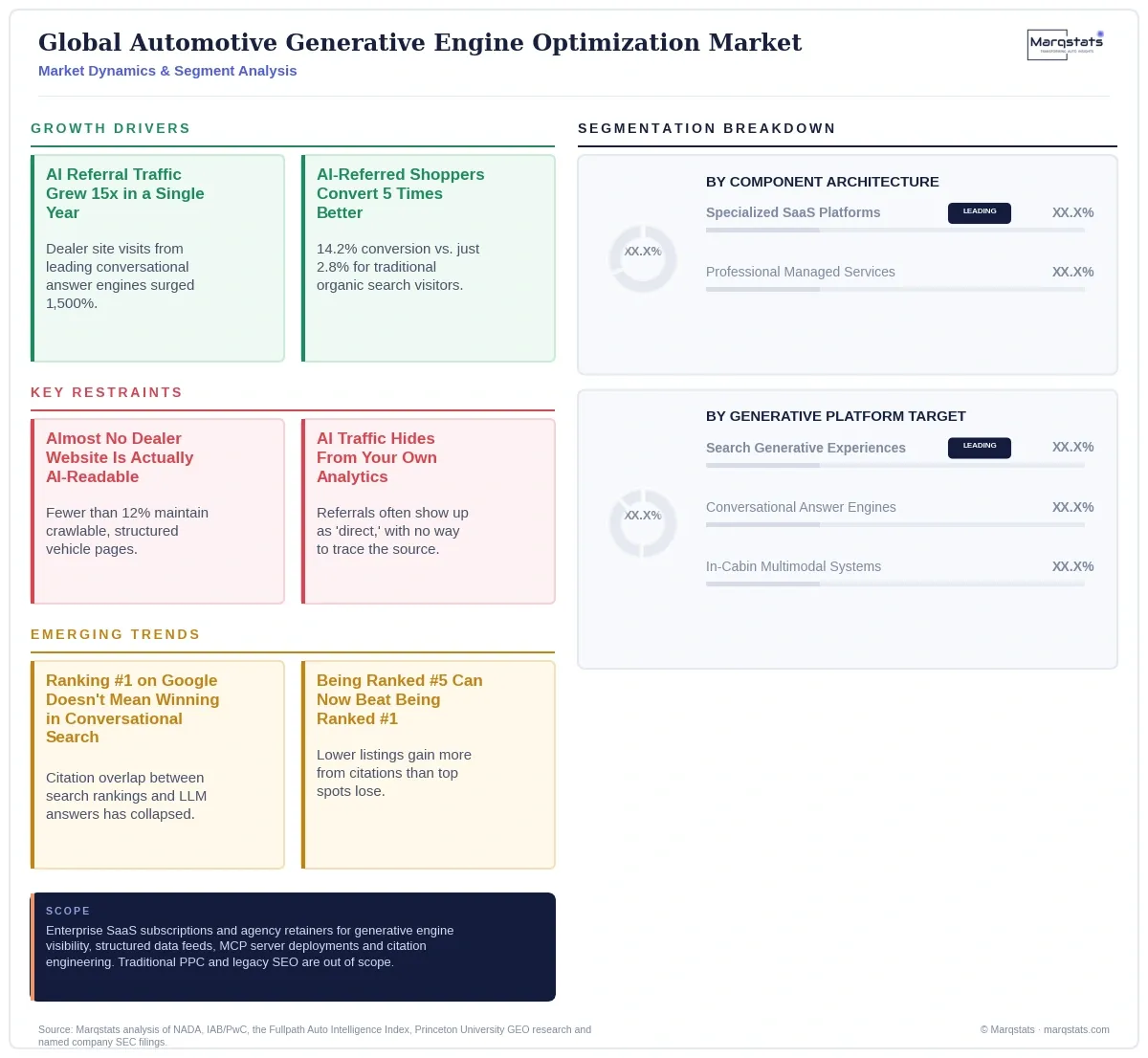
- Consumer behavioral migration toward conversational interfaces has accelerated sharply: dealer website referral traffic originating from generative AI platforms expanded by more than 15.0 times year-over-year between January 2025 and January 2026, while AI-referred commercial shoppers convert at an average rate of 14.2% compared to 2.8% for traditional organic search visitors, a 5.07-fold conversion advantage that directly incentivizes reallocation of marketing budgets toward generative visibility.
- Digital entity consistency across external platforms functions as an algorithmic multiplier for conversational recommendation, since automotive retail domains maintaining verified, synchronized corporate identity, pricing data and customer reviews across four or more independent directory and platform hubs are 2.8 times more likely to be recommended by leading conversational answer engines during conversational vehicle discovery.
- Automated Customer Data Platforms with real-time AI activation generate measurable commercial returns, with dealerships deploying unified CDP infrastructure recording a 37.0% year-over-year surge in digital advertising conversions during early 2026, alongside a 19.0% increase in ad conversions achieved on flat per-store media expenditures.
- Monetization of automotive in-cabin conversational AI is shifting rapidly toward connected software margins, exemplified by Cerence Inc. recognizing USD 248.90 million in revenue across the nine months ended 30 June 2026, a 30.25% expansion over the prior year period, generating gross margins of 76.0% to 80.2% on Connected Services contracts powering generative OEM voice agents.
- Google's expansion of AI Overviews globally across more than 100 countries and territories, combined with the March 2025 public testing of Google AI Mode, which increased the search zero-click rate to 93% for interacting users, has structurally normalized zero-click, citation-based vehicle discovery as the default consumer research pathway rather than a transitional phenomenon.
Key Restraints
- Fewer than 12% of franchised dealer websites maintain crawlable, structured Vehicle Detail Pages accessible to generative retrieval agents, exposing a 73 percentage-point implementation deficit against the 85% of car shoppers who conduct online research and express willingness to use conversational AI during vehicle acquisition.
- Attribution opacity within privacy-preserving conversational AI sessions represents a genuine unresolved measurement challenge, since leading generative engines increasingly execute user retrieval sessions without passing standardized HTTP referrer tags or UTM tracking parameters, causing dealership web analytics platforms to frequently misclassify high-converting AI-referred visitors as direct or unassigned organic traffic.
- Search engines currently classify AI Overviews as organic search enhancements rather than sponsored advertising, exempting platforms from Federal Trade Commission commercial endorsement disclosure requirements while stripping automotive retail domains of 34% to 65% of organic click-through volume without any compensatory publisher remuneration mechanism.
- More than 88% of the 2,149,759 average consumer data points each franchised dealership manages remains isolated within legacy dealer management system environments utilizing batch-file exports that cannot execute the sub-second application programming interface data transfers required by real-time conversational shopping agents.
Key Trends
- The structural decoupling between traditional search authority and conversational answer engine citation authority represents a genuine architectural shift in how consumers discover vehicles, not a temporary algorithmic anomaly, since the underlying cause, conversational engines synthesizing answers from multiple sources rather than surfacing ranked links, is a permanent design feature of generative retrieval rather than a reversible ranking adjustment.
- Generative Engine Optimization functions as a genuine equalizer for lower-ranked automotive web properties rather than simply reinforcing existing search dominance, since fifth-ranked search listings achieve a 115.1% visibility lift when enriched with authoritative citations, while top-ranked results experience a 30.3% visibility reduction in synthetic summaries, indicating smaller dealerships and independent retailers can meaningfully compete for generative visibility independent of legacy domain authority.
- The 5.07-fold conversion advantage AI-referred buyers demonstrate over traditional organic search visitors indicates that generative discovery channels are not simply displacing existing search volume but are surfacing genuinely higher-intent, better-qualified consumers, making generative visibility a commercially consequential priority independent of pure traffic volume metrics alone.
- The extreme platform concentration within conversational referral traffic, with the leading conversational answer engine commanding an 89.0% share as of January 2026, demonstrates that automotive GEO strategy currently requires disproportionate optimization investment toward a single dominant platform, a concentration risk that could shift rapidly given a rival platform's documented 50% monthly referral surge during the same period.
- The industry's largest connected retail platform operator's acquisition of a specialized Customer Data Platform provider, announced 23 April 2026 and completed 1 June 2026, integrating Customer Data Platform and Model Context Protocol infrastructure across more than 40,000 dealership relationships, demonstrates that automotive GEO capability is consolidating rapidly within established retail technology incumbents rather than remaining fragmented among independent point-solution vendors.
Strategic Implications
For a software entrant or technology startup, competing successfully in generative discovery requires building automated Model Context Protocol server connectors and real-time inventory syndication application programming interfaces that integrate directly into dealer management systems, enabling conversational answer engine agents to verify vehicle availability and pricing dynamically; software roadmaps must replace traditional keyword optimization dashboards with citation share analytics and multi-engine mention scoring across leading conversational platforms, since traditional keyword-dense content creation measurably degrades generative visibility by 8.81%.
For an automotive dealership principal or multi-rooftop franchise group, defensive commercial action is urgently required to mitigate the collapse of traditional search engine referral pipelines; dealership technical teams must audit Vehicle Detail Pages to eliminate client-rendered JavaScript and paywalled inventory scripts that prevent AI web crawlers from indexing local stock, while establishing cross-platform entity consistency across Google Business Profiles, OEM directories and third-party review platforms to secure the 2.8-fold recommendation multiplier required to capture pre-qualified, high-converting conversational car shoppers.
For an automotive original equipment manufacturer or institutional investor, generative engine dynamics require centralizing vehicle data architecture and consolidating fragmented retail software providers; manufacturers must build machine-readable knowledge graphs covering technical specifications, charging network compatibility and regional lease incentives to ensure central product data feeds conversational search engines accurately, while institutional capital should target unified Customer Data Platforms and inventory feed middleware bridging legacy dealer management systems with emerging conversational shopping interfaces, following the consolidation model demonstrated by the industry's largest connected retail platform operator acquiring a specialized Customer Data Platform provider.
Outlook
Base scenario (Standard Search Stack Migration): USD 1,865.40 million by 2030 (38.59% five-year value CAGR). This trajectory assumes dealerships and manufacturers maintain parallel digital search budgets, systematically reallocating 15% to 25% of existing search engine marketing retainers toward generative structured schema deployment, citation monitoring and entity verification, with specialized automotive GEO software installations reaching approximately 48,500 dealership rooftops globally by 2030 across North America, Western Europe and developed Asia-Pacific markets.
Upside scenario (Agentic Transaction Orchestration and MCP Standard): USD 2,580.00 million by 2030 (48.33% five-year value CAGR). The specific trigger is formal industry-wide standardization of Model Context Protocol servers and agentic transactional APIs, endorsed by major dealer management system providers including CDK Global and Reynolds and Reynolds alongside global automotive manufacturers by the third quarter of 2027, under which generative AI platforms transition from passive informational research tools into autonomous transactional agents capable of directly scheduling service appointments, valuing trade-in vehicles and reserving specific vehicle identification numbers, with active enterprise software installations reaching 62,000 rooftops globally.
A market-contraction downside scenario was formally evaluated and explicitly rejected, since it lacks an empirical trigger condition: search engine operators have permanently integrated generative summaries into core search layouts, and consumer search behavior has fundamentally and measurably transitioned toward conversational discovery, meaning no plausible reversion pathway to legacy blue-link search result pages currently exists within the forecast window.
Market Segmentation
Specialized SaaS platforms represent the dominant and fastest-growing component, expanding from USD 248.06 million in 2025 to USD 1,361.74 million by 2030, a 40.59% compound annual growth rate, encompassing automated structured schema generators, real-time inventory feed connectors, Model Context Protocol server gateways and vector citation tracking software that eliminate manual agency intervention.
Professional managed services expand from USD 116.74 million in 2025 to USD 503.66 million by 2030, a 33.99% compound annual growth rate, encompassing entity reconciliation consulting, technical website remediation, knowledge graph development and authoritative digital public relations copywriting sustained by complex multi-rooftop dealership entity audits and custom requirements.
Dealership networks generated USD 218.88 million (60.0% share) in 2025, driven by the immediate requirement to defend local showroom foot traffic and test-drive inquiries from zero-click search displacement, projected to reach USD 1,063.28 million by 2030 though contracting slightly to 57.0% share as manufacturer and marketplace investment scales faster.
Automotive original equipment manufacturers accounted for USD 94.85 million (26.0% share) in 2025, projected to expand to USD 540.97 million by 2030 (29.0% share) as manufacturers allocate Tier-1 digital advertising co-op funds to guarantee that new electric vehicle nameplates appear within conversational comparison shortlists.
Automotive marketplaces and digital retailing portals represented USD 51.07 million (14.0% share) in 2025, deploying specialized generative engine optimization infrastructure to maintain their position as cited reference domains within conversational answer engine retrieval graphs, reaching USD 261.15 million by 2030 while holding a steady 14.0% share.
Search Generative Experiences represent the largest target platform, generating USD 186.05 million (51.0% share) in 2025, driven by defensive spending to maintain visibility within Google AI Overviews and Google AI Mode, focused on in-SERP schema injection and passage-level answer capsules, reaching USD 876.74 million by 2030.
Conversational Answer Engines captured USD 134.98 million (37.0% share) in 2025, addressing unbranded comparative vehicle research inside standalone chat platforms through off-site entity corroboration and unstructured comparison guides, projected to reach USD 727.51 million by 2030.
In-Cabin Multimodal Systems accounted for USD 43.77 million (12.0% share) in 2025, representing the fastest-growing frontier where drivers query in-vehicle voice assistants for local maintenance, charging stations and dealer facilities via vehicle telematics APIs and connected local service directory feeds, reaching USD 261.15 million by 2030.
By Geography
North America
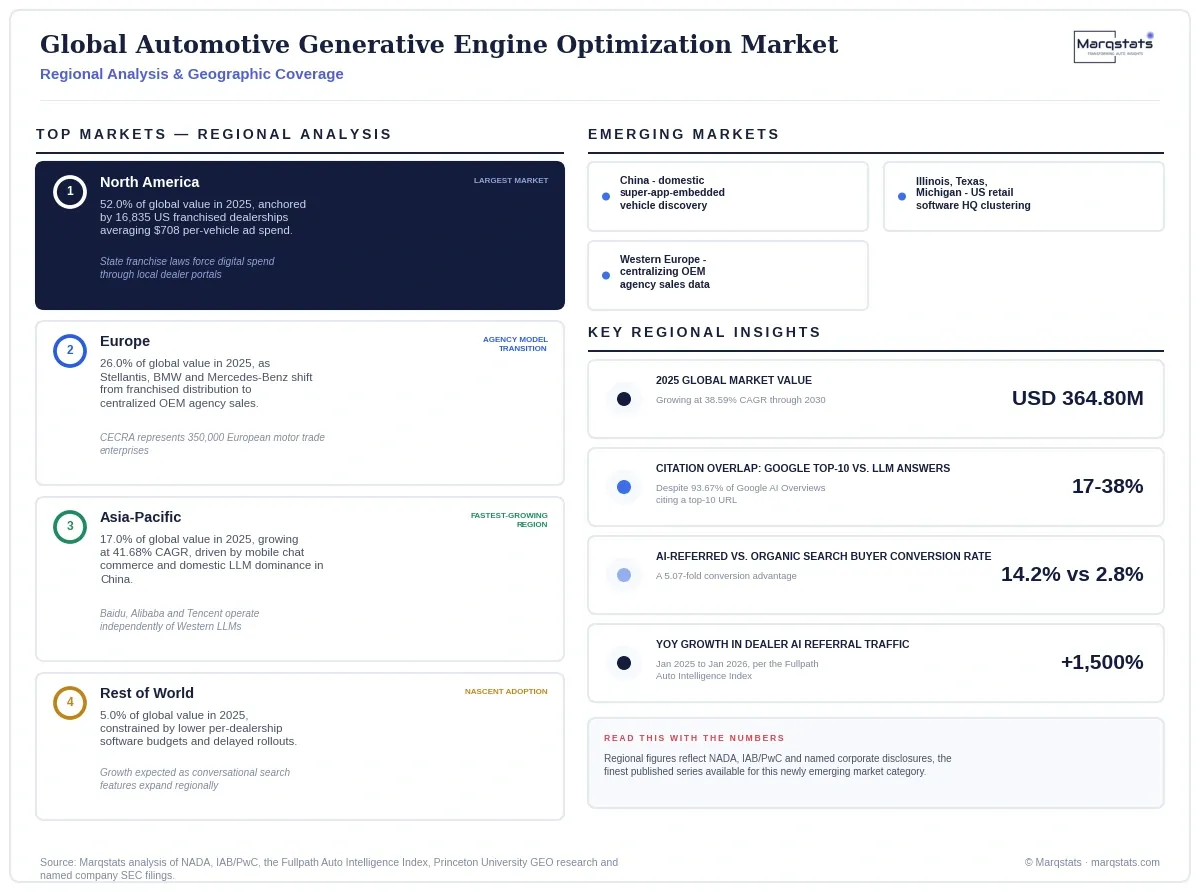
North America is the largest geographic market, capturing USD 189.70 million (52.0% share) in 2025 and expanding to USD 932.70 million by 2030 at a 37.51% compound annual growth rate. Demand is centered in the United States, where 16,835 franchised dealerships maintain an average advertising outlay of USD 708 per new vehicle sold, and state dealer franchise laws restrict direct manufacturer vehicle retailing, forcing digital promotional capital through local franchised dealership portals.
Europe
Europe represents the second-largest market, accounting for USD 94.85 million (26.0% share) in 2025 and projecting to USD 485.00 million by 2030 at a 38.60% compound annual growth rate. The European market operates under structural reorganization governed by CECRA, representing 350,000 motor trade enterprises, as major manufacturers including Stellantis, BMW and Mercedes-Benz shift commercial agreements from traditional franchised distribution toward the agency sales model, centralizing generative optimization expenditures from individual local dealerships to central manufacturer budgets.
Asia-Pacific
Asia-Pacific generated USD 62.02 million (17.0% share) in 2025 and is projected to expand at a 41.68% compound annual growth rate, the fastest-growing region, driven by high mobile chat commerce adoption and domestic conversational platform dominance in China, where automotive generative search operates independently of Western conversational answer engines, relying on domestic platforms embedded within super-app ecosystems.
Rest of World
The Rest of World segment accounted for USD 18.23 million (5.0% share) in 2025, constrained by lower per-dealership software budgets and delayed regional rollouts of conversational search features, projected to reach USD 93.27 million by 2030 while maintaining a steady 5.0% share.
How Competition Is Evolving
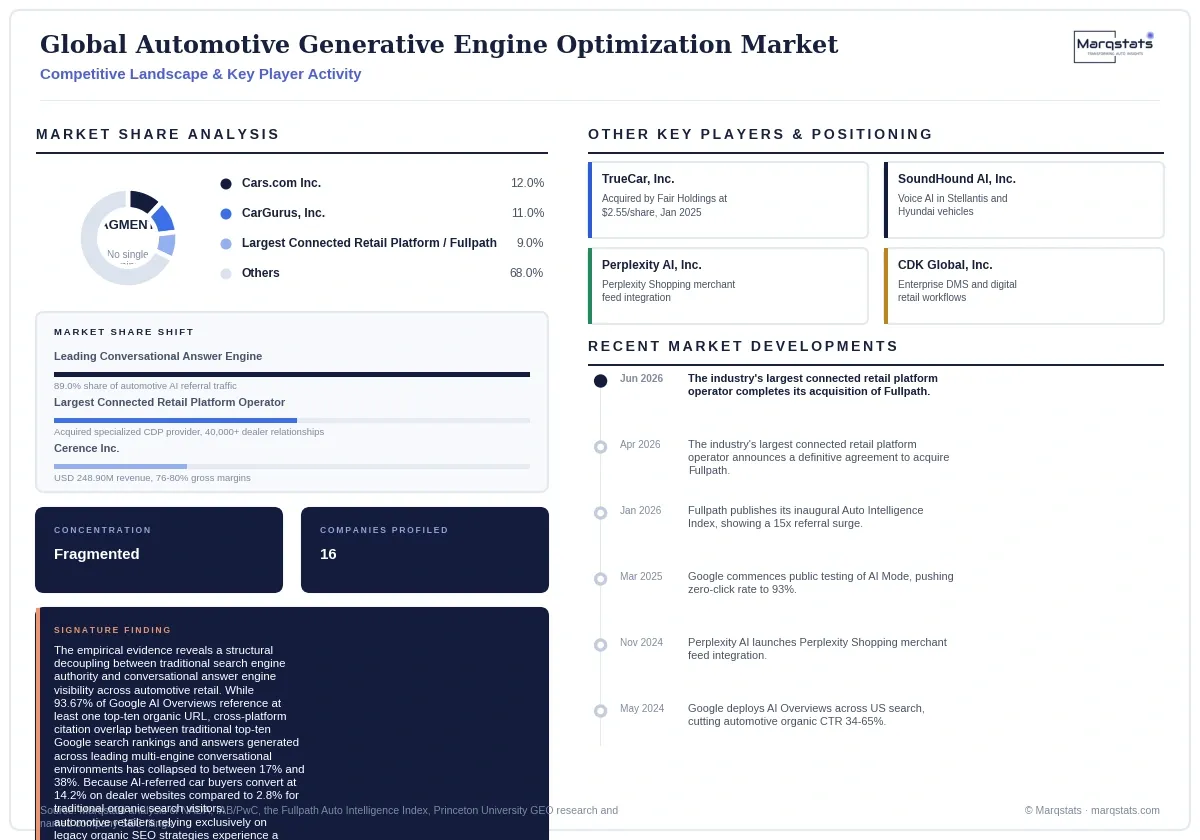
The global automotive Generative Engine Optimization market is fragmented across conversational platform providers, automotive retail software vendors, and specialized marketing agencies, with no single vendor commanding dominant share: leading conversational answer engine and search platform operators anchor the underlying infrastructure that automotive retailers must optimize toward, while established automotive retail software providers compete directly for dealership software subscription revenue.
Firms compete differently by tier: conversational platform providers compete on referral share, with the leading conversational answer engine commanding an 89.0% share of automotive referral traffic as of January 2026, automotive retail SaaS vendors compete on structured inventory syndication and Model Context Protocol gateway capability, and specialized marketing agencies compete on entity reconciliation and citation audit depth for multi-rooftop dealership groups.
The most significant recent competitive-landscape development is the industry's largest connected retail platform operator acquiring a specialized Customer Data Platform provider, announced 23 April 2026 and completed 1 June 2026, integrating Customer Data Platform and agentic Model Context Protocol infrastructure with existing first-party consumer data across more than 40,000 dealership relationships, establishing the most connected generative-AI-native retail data ecosystem in the industry.
Companies Covered
The report profiles 16+ companies with full strategy and financials analysis, including:
Recent Market Activity
Table of Contents
Coverage & Segmentation
Coverage spans the global automotive Generative Engine Optimization market, encompassing enterprise software-as-a-service subscription revenues and professional agency retainers deployed specifically for generative engine visibility, structured data feeds, Model Context Protocol server deployments and citation engineering across dealership networks, automotive manufacturers and digital marketplaces. The market is sized in USD across a 2022-2025 historical period and a 2026-2030 forecast period, with 2025 as the base year. Three segmentation dimensions are quantified: component architecture, end-user vertical, and generative platform target.
Excluded from scope: conventional pay-per-click search engine marketing budgets, traditional legacy search engine optimization focused exclusively on ten-blue-link organic rankings, offline showroom merchandising, and disconnected dealership management system database licenses lacking generative API connectors. A separate Marqstats study addresses the global automotive data management market on a comparable basis.