Market Snapshot
Key Takeaways
Market Overview & Analysis
Report Summary
This analysis sizes the Asia Pacific automotive Generative Engine Optimization market, encompassing enterprise software platforms, specialized digital advisory services, structured catalog optimization and application programming interface data infrastructure deployed by automotive manufacturers, franchised dealership networks and multi-brand automotive retail portals to ensure vehicle nameplates, dealer inventories, technical specifications and retail incentives are accurately retrieved and cited within generative discovery interfaces. The market is built from calibrated enterprise software allocations, dealer digital marketing budgets and hyperscaler retrieval-augmented generation infrastructure billing across mainland China, Japan, South Korea, India, Australia and Southeast Asia. The market is sized in USD across a 2021-2025 historical period and a 2026-2030 forecast period, with 2025 as the base year.
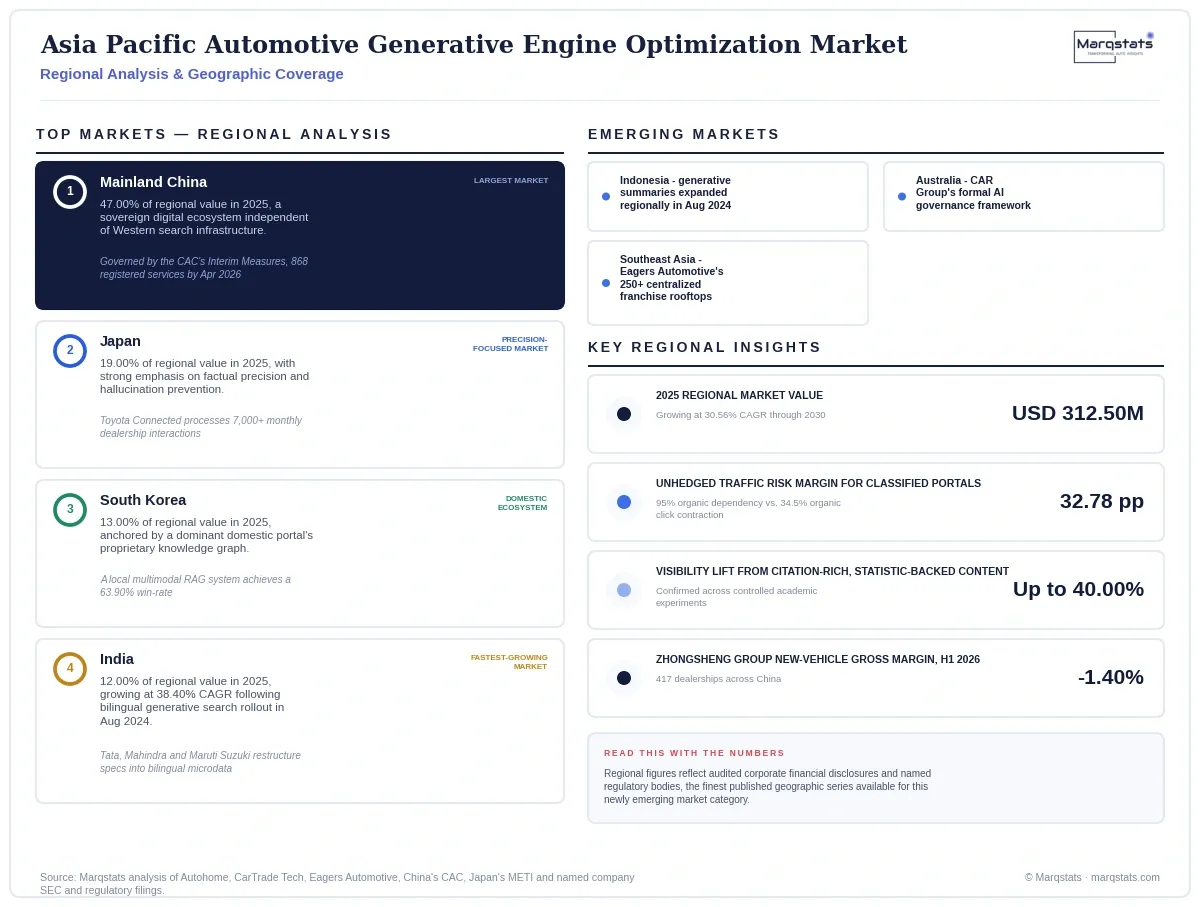
The Asia Pacific automotive Generative Engine Optimization market grew from USD 14.20 million in 2021 to USD 312.50 million in 2025, a compound annual growth rate exceeding 115% across the historical window, and is projected to reach USD 1,185.60 million by 2030, a 30.56% compound annual growth rate. This growth reflects a category that transitioned from early algorithmic search prototyping into commercial enterprise infrastructure as generative discovery interfaces displaced traditional ranked hyperlink search across the region's major markets.
The base-case 2030 forecast of USD 1,185.60 million assumes organic search click losses stabilize between 30.00% and 40.00% across major regional search platforms, with search operators maintaining hybrid interfaces combining generative summaries with external source links, as automotive manufacturers and dealer groups steadily increase investment in structured schema and retrieval-augmented generation pipelines. The binding upside condition, reaching USD 1,495.00 million at a 36.78% CAGR, is whether autonomous AI agents transition from information retrieval to direct transactional execution by late 2026 and connected vehicles universally embed conversational retrieval-augmented generation platforms across new electric vehicle models by 2028; the binding downside condition, reaching only USD 765.00 million at a 19.61% CAGR, is whether search platform operators monetize generative summaries by restricting unpaid citations and requiring paid placements within generative answers by mid-2026, while regulatory authorities enforce restrictive cross-border data barriers.
Market Dynamics
Key Drivers
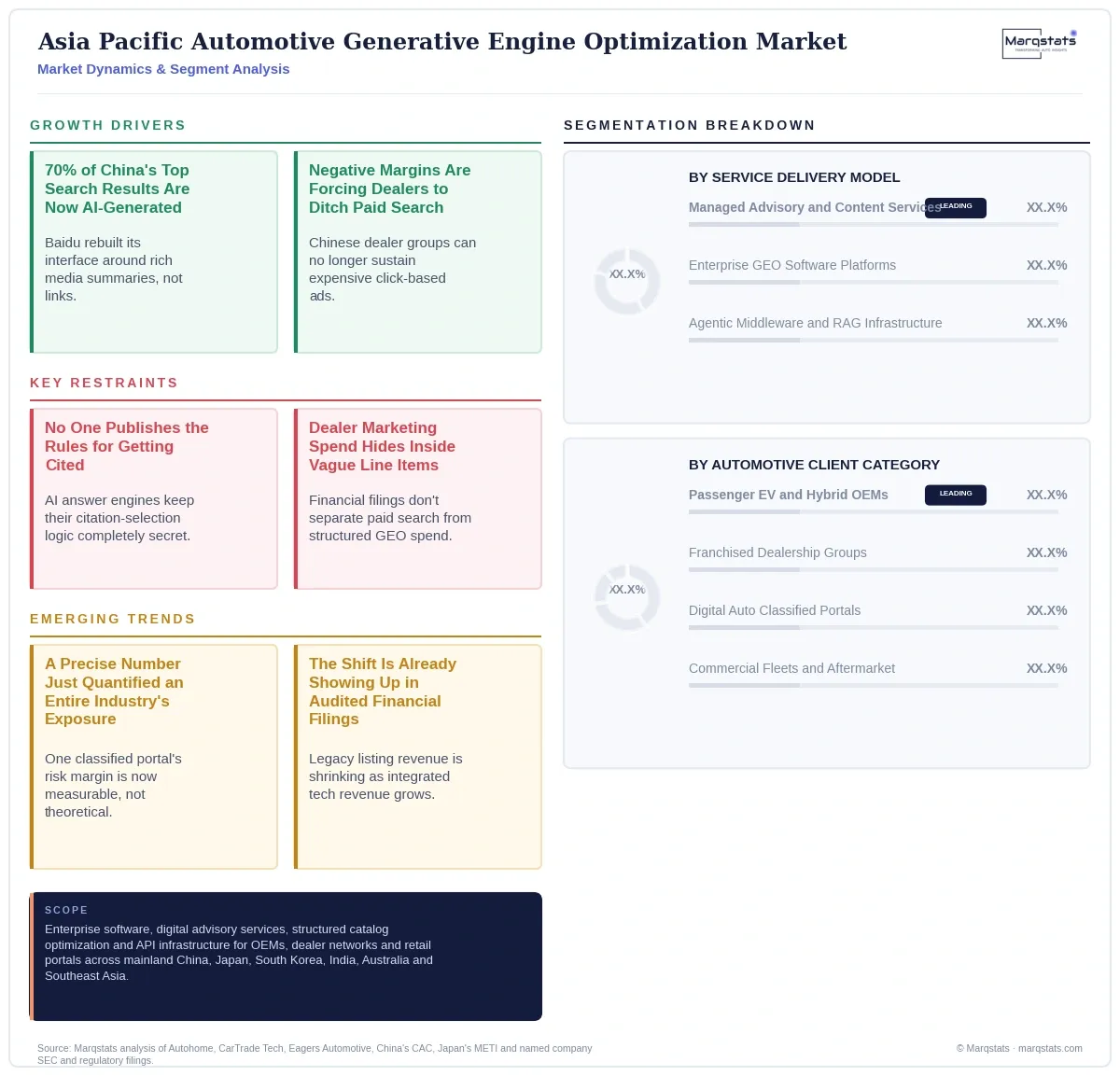
- A leading Chinese search platform restructured its interface so that approximately 70.00% of top search results are delivered via generative rich media and interactive conversational summaries rather than traditional hyperlinks, compelling automotive manufacturers marketing in China to syndicate vehicle models and local inventory directly into enterprise-grade retrieval platforms to remain discoverable.
- Severe automotive retail margin compression across the region is accelerating the shift to organic optimization, exemplified by Zhongsheng Group Holdings Limited's negative 1.40% gross margin on new vehicle sales during the first half of 2026, forcing dealer groups toward low-cost structured data frameworks rather than sustaining high cost-per-click customer acquisition budgets.
- A domestic South Korean multimodal retrieval-augmented generation architecture achieves a 63.90% win-rate on multi-source queries spanning web, shopping and maps data, integrating mobility platforms directly into its foundation model, requiring automotive brands to calibrate technical schemas specifically for this proprietary ecosystem rather than relying on standard global crawlers.
- A major Japanese automotive manufacturer's dealership sales platform, built on enterprise cloud infrastructure, processes over 7,000 monthly customer interactions with citation-backed legal disclaimers, serving as a foundation for transition toward an agentic inventory discovery network across its dealership network.
- Geopolitical constraints and data compliance mandates have spurred strategic alliances between foreign automakers and domestic Chinese technology firms, since Western generative search infrastructure cannot legally operate within China's regulatory borders, exemplified by a major Japanese automaker's April 2024 partnership with a Chinese technology conglomerate to deploy AI cloud services in Chinese-market vehicles.
Key Restraints
- No generative engine provider publishes the precise algorithmic weighting matrices that govern source citation selection within automotive summaries, meaning agency claims regarding guaranteed inclusion or deterministic ranking in generative search results remain unverified marketing rhetoric that market participants cannot independently audit.
- Major dealership conglomerates aggregate digital customer acquisition expenses within general administrative overhead in their audited financial statements, without segmenting spending between legacy paid search, third-party classified fees and structured generative optimization infrastructure, obscuring the precise scale of this specific spending category.
- Cloud hyperscalers do not disclose vertical-specific token consumption or application programming interface revenues for automotive retrieval-augmented generation workloads, requiring analyst modeling to calibrate software infrastructure spend rather than relying on direct vendor disclosure.
- While automakers actively promote smart-cockpit technology partnerships, the precise conversion rate of in-cockpit voice recommendations into dealership showroom foot traffic remains strictly proprietary enterprise data, leaving a genuine measurement gap between documented technology deployment and verified commercial outcomes.
Key Trends
- The 32.78 percentage point unhedged traffic risk margin facing digital classified portals represents a genuine, quantified structural exposure rather than a speculative concern, since it combines a verified organic-traffic-dependency figure with an empirically measured click contraction rate, meaning platforms failing to restructure for generative citation face a concrete, documented revenue threat rather than an abstract industry trend.
- Footnote-level analysis of internal revenue reallocation at major automotive classified platforms, showing legacy directory listing revenue contracting while integrated technology and data product revenue expands, demonstrates that the shift toward generative optimization is already visible in audited financial disclosures, not merely a forward-looking strategic prediction.
- The gap between regulatory registration figures and actual dealership compliance, with fewer than 12.00% of Tier-1 Chinese dealership networks having completed required algorithm filings despite hundreds of registered generative AI services, indicates that regulatory risk exposure across the region's largest single market remains substantially underappreciated by market participants.
- The stark divergence between severe dealership margin compression, exemplified by negative gross margins on new vehicle sales at a major Chinese dealership group, and continued growth in generative optimization software spending demonstrates that this category is increasingly viewed as a necessary cost-reduction mechanism rather than a discretionary marketing enhancement.
- The fact that a specific academic finding regarding a 40.00% generative visibility lift from citation-rich content has become a widely repeated industry benchmark, cited across multiple regional markets and company strategies, indicates that market participants are converging on a shared, evidence-based playbook for generative optimization rather than pursuing fragmented, untested tactics independently.
Strategic Implications
For a software entrant or technology provider, commercial success requires moving beyond legacy search engine optimization auditing software to develop multi-agent knowledge connectors; the immediate market opportunity lies in building middleware that transforms dealer management system inventory into vector-indexed, citable endpoints consumable by major generative search application programming interfaces, while offering citation-tracking analytics that report brand mention rates and competitive positioning within generative summaries.
For an incumbent automotive manufacturer or franchised dealer network, immediate action is required to eliminate technical crawlability barriers and client-side script rendering issues that prevent automated retrieval systems from indexing vehicle detail pages; given severe retail margin compression across the region, dealership leadership must reallocate capital from expensive paid keyword bidding toward structured schema deployment and third-party corroboration building, while centralizing digital asset governance to ensure vehicle specifications and retail pricing are uniformly represented across all digital channels.
For a digital classified portal operator or automotive investor, organizations dependent on organic search must prepare for top-of-funnel traffic erosion as generative engines absorb vehicle research queries; classified platforms must accelerate their transformation into transactional execution engines handling financing, insurance and online reservation, where users cannot be intercepted by search summaries, while monetizing their verified inventory databases by licensing direct data feeds to enterprise generative infrastructure providers.
Outlook
Base scenario (Structural Search Realignment): USD 1,185.60 million by 2030 (30.56% five-year value CAGR). This trajectory assumes organic search click losses stabilize between 30.00% and 40.00% across major regional search platforms, with search operators maintaining hybrid interfaces combining generative summaries with external source links, as automotive manufacturers and dealer groups steadily increase investment in structured schema and retrieval-augmented generation pipelines, allocating 10% to 15% of digital marketing budgets to structured generative optimization.
Upside scenario (Accelerated Agentic Commerce): USD 1,495.00 million by 2030 (36.78% five-year value CAGR). The specific trigger is autonomous AI agents transitioning from information retrieval to direct transactional execution by late 2026, combined with connected vehicles universally embedding conversational retrieval-augmented generation platforms across new electric vehicle models by 2028, under which automotive discovery shifts entirely to conversational agents and dealerships invest heavily in real-time agentic middleware and dynamic data syndication.
Downside scenario (Walled-Garden Monopolization): USD 765.00 million by 2030 (19.61% five-year value CAGR). The specific trigger is search platform operators monetizing generative summaries by restricting unpaid citations and requiring paid placements within generative answers by mid-2026, combined with regulatory authorities enforcing restrictive cross-border data barriers, under which generative optimization spending contracts as marketing capital reverts to paid advertising placements within generative summaries themselves and high-organic-traffic platforms experience sustained traffic declines without offsetting software gains.
Market Segmentation
Managed advisory and content services represent USD 131.25 million (42.00% share) in 2025, expanding to USD 462.38 million by 2030 at a 28.64% compound annual growth rate, encompassing vehicle detail page schema deployment, citation building and content restructuring as automotive brands overhaul their websites to meet retrieval extraction standards.
Enterprise software and visibility monitoring platforms account for USD 118.75 million (38.00% share) in 2025, growing to USD 468.31 million by 2030 at a 31.58% compound annual growth rate, representing the largest recurring subscription category as dealer groups license multi-location monitoring tools to track brand mentions across generative search surfaces.
Agentic middleware and hyperscaler retrieval-augmented generation infrastructure captures USD 62.50 million (20.00% share) in 2025, the fastest-growing service delivery segment, compounding at 32.46% annually to reach USD 254.91 million by 2030 as automotive platforms link live inventory databases with conversational search engines via vector indexing and server middleware protocols.
Hybrid search overview architectures account for USD 181.25 million (58.00% share) in 2025, growing to USD 604.66 million by 2030, driven by high consumer query volume on traditional search platforms that now embed dynamic generative summaries grounded in web crawl indices directly atop conventional results pages.
Standalone conversational engines capture USD 84.38 million (27.00% share) in 2025, expanding to USD 343.82 million by 2030, spanning platforms offering deep conversational reasoning and direct application programming interface retrieval-augmented generation without traditional web links back to source pages.
Original equipment manufacturer in-cockpit dialogue agents represent USD 46.87 million (15.00% share) in 2025, the fastest-growing architectural segment, expanding to 20.00% share (USD 237.12 million) by 2030 as connected vehicles increasingly utilize natural-language systems embedding vehicle telemetry and local routing for real-time maintenance and service booking.
Passenger electric vehicle and hybrid manufacturers account for USD 128.13 million (41.00% share) of 2025 spending, the largest client category, as consumers conduct complex, multi-factor research regarding battery lifespan, charging speeds and government subsidies, queries that frequently trigger generative summaries requiring detailed technical schema investment.
Franchised dealership groups represent USD 96.88 million (31.00% share) of 2025 spending, focusing resources on local entity clarity and vehicle detail page crawlability to prevent competitors from dominating local generative recommendations and to capture nearby customer walk-ins and service appointments.
Digital automotive classified portals account for USD 53.13 million (17.00% share) of 2025 spending, deploying proprietary technology labs and direct data feeds to hyperscaler infrastructure to defend organic lead generation against zero-click generative displacement of their traditional listing model.
Commercial fleets and aftermarket parts providers represent USD 34.36 million (11.00% share) of 2025 spending, structuring compatibility cross-referencing and stock-keeping-unit catalog schemas to win business-to-business maintenance and parts replacement searches across the region's growing vehicle parc.
By Geography
Mainland China
Mainland China commands 47.00% of the regional market (USD 146.88 million) in 2025, projected to reach USD 528.00 million by 2030 at a 29.15% compound annual growth rate, characterized by a sovereign digital ecosystem independent of Western search infrastructure and governed by the Cyberspace Administration of China's Interim Measures for the Management of Generative Artificial Intelligence Services, which had registered 868 generative AI services by April 2026.
Japan
Japan accounts for 19.00% of regional spend (USD 59.38 million) in 2025, projected to reach USD 203.24 million by 2030 at a 27.90% compound annual growth rate, regulated under the Ministry of Economy, Trade and Industry's Digital Platform Transparency Act, with Japanese automotive enterprises placing strong emphasis on factual precision and hallucination prevention across dealership retrieval platforms.
South Korea
South Korea represents 13.00% of regional market spend (USD 40.62 million) in 2025, projected to reach USD 143.76 million by 2030 at a 28.80% compound annual growth rate, governed by the Personal Information Protection Commission's data boundary regulations, with the market uniquely anchored by a dominant domestic search portal's proprietary knowledge graph ecosystem.
India
India commands 12.00% of regional spend (USD 37.50 million) in 2025 and represents the fastest-growing regional market, expanding at a 38.40% compound annual growth rate through 2030, following the August 2024 launch of bilingual English and Hindi generative search voice and text functionality, with major domestic manufacturers restructuring vehicle specifications into bilingual microdata for conversational buyer comparisons.
Australia and Southeast Asia
Australia and Southeast Asia together represent the remaining 9.00% of regional spend (USD 28.12 million) in 2025, projected to reach USD 119.53 million by 2030 at a 26.50% compound annual growth rate, governed by Australian Competition and Consumer Commission frameworks, with Australia's largest automotive retail group deploying centralized digital inventory infrastructure to bypass third-party aggregator lead costs.
How Competition Is Evolving
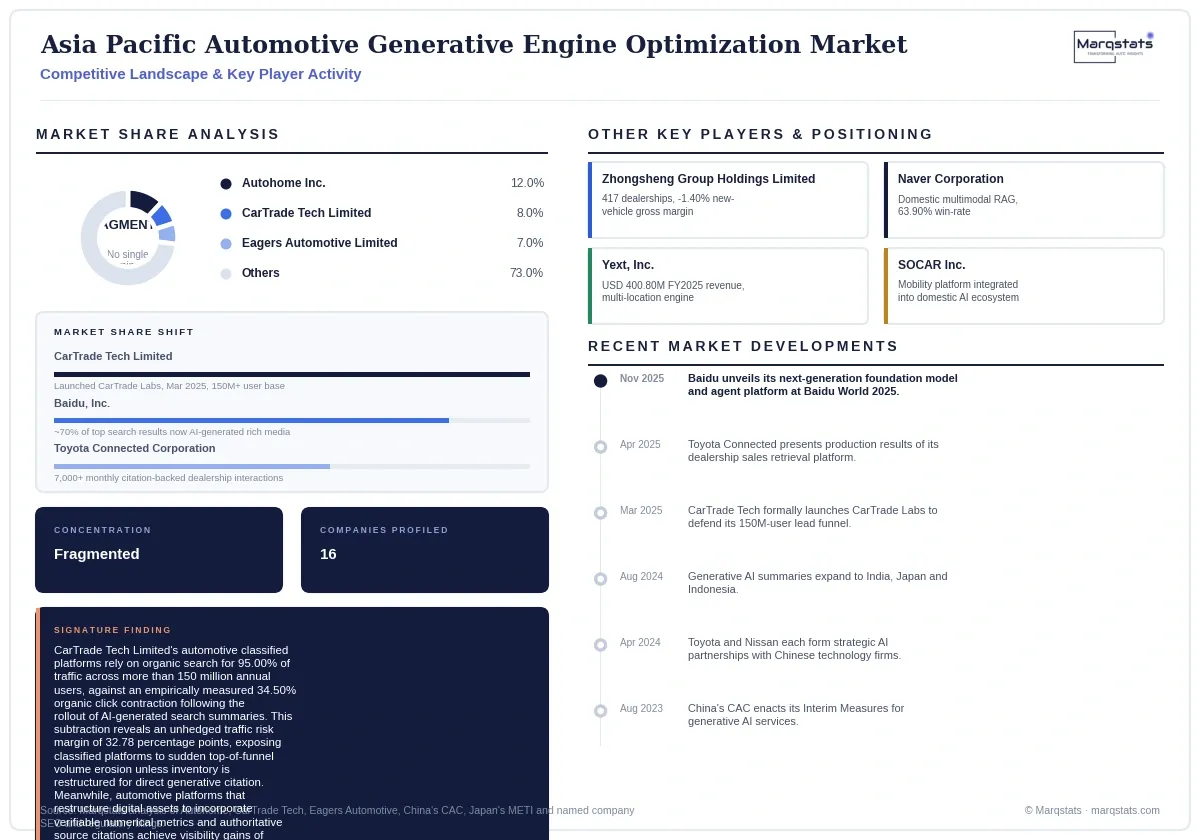
The Asia Pacific automotive Generative Engine Optimization market is fragmented across enterprise software vendors, automotive classified operators, dealership conglomerates and hyperscaler infrastructure providers, with no single vendor commanding dominant share of the fully addressable market; Yext, Inc., a primary global enterprise knowledge engine powering multi-location discovery across Japan and other regional markets, reported annual consolidated revenue of USD 400.80 million for fiscal year 2025, illustrating the scale of enterprise software competing alongside classified operators including Autohome and CarTrade for lead-generation defense spending across their respective home markets.
Firms compete differently by tier: enterprise software platforms compete on multi-location monitoring and brand mention tracking capability, automotive classified portals compete on defending organic lead-generation volume through proprietary technology labs and direct data feeds, and dealership conglomerates compete on centralizing digital asset governance to bypass third-party aggregator costs entirely.
The most significant recent competitive-landscape development is CarTrade Tech Limited's March 2025 formal launch of CarTrade Labs, an enterprise innovation hub allocating capital to restructure its 150-million-user automotive classified assets for generative discovery resilience, illustrating how high-organic-traffic platforms across the region are proactively building internal capability rather than relying solely on external vendors.
Companies Covered
The report profiles 16+ companies with full strategy and financials analysis, including:
Recent Market Activity
Table of Contents
Coverage & Segmentation
Coverage spans the Asia Pacific automotive Generative Engine Optimization market, encompassing enterprise software platforms, specialized digital advisory services, structured catalog optimization and application programming interface data infrastructure deployed by automotive manufacturers, franchised dealership networks and multi-brand automotive retail portals across mainland China, Japan, South Korea, India, Australia and Southeast Asia. The market is sized in USD across a 2021-2025 historical period and a 2026-2030 forecast period, with 2025 as the base year. Three segmentation dimensions are quantified: service delivery model, generative engine architecture, and automotive client category.
Excluded from scope: foundational compute hardware procurement, general corporate internal productivity assistants unrelated to customer-facing discovery, telematics subscription fees, and legacy paid search advertising media budgets. A separate Marqstats study addresses the global automotive Generative Engine Optimization market on a comparable basis.