Market Snapshot
Key Takeaways
Market Overview & Analysis
Report Summary
This analysis sizes the Europe automotive Generative Engine Optimization market, encompassing software licenses, specialized search intelligence platforms, and professional agency optimization services procured by automotive manufacturers, franchised dealership networks, independent dealer groups, and digital automotive classified marketplaces operating within the European continent. The market is built from calibrated sector-specific media allocations applied against the Interactive Advertising Bureau Europe's digital advertising baseline, cross-referenced against European Automobile Manufacturers' Association registration statistics. The market is sized in USD across a 2021-2025 historical period and a 2026-2030 forecast period, with 2025 as the base year.
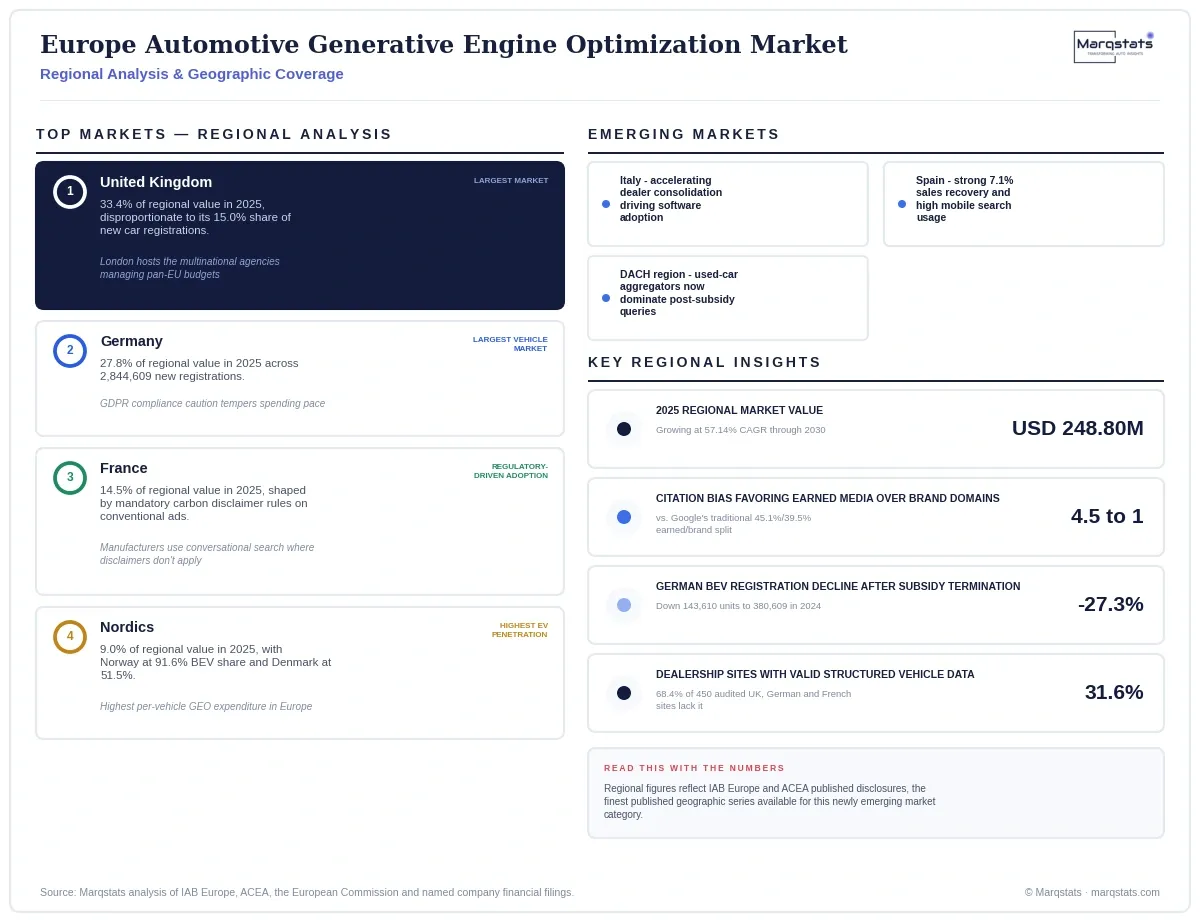
The Europe automotive Generative Engine Optimization market grew from USD 16.50 million in 2022 to USD 248.80 million in 2025, a compound annual growth rate exceeding 145% across the historical window, and is projected to reach USD 2,382.40 million by 2030, a 57.14% compound annual growth rate. This growth reflects the rapid institutionalization of a category that barely existed three years ago, driven by the technical integration of AI Overviews shifting the number-one organic automotive search result downward by 1,562 to 1,630 pixels, exceeding one and a half times the standard desktop viewport height, and causing a 7.31 percentage point drop in click-through rates for top-ranking informational queries.
The base-case 2030 forecast of USD 2,382.40 million assumes leading search gatekeepers continue embedding conversational answers as the default discovery surface while complying with standardized transparency protocols issued under the Artificial Intelligence Act, with automotive manufacturers steadily allocating 15% to 20% of digital search budgets to multi-model AI tracking and structured entity optimization software. The binding downside condition, reaching only USD 1,410.20 million at a 41.48% CAGR, is whether national Data Protection Authorities and the European Commission pursue aggressive enforcement under Article 53(1)(c) of the Artificial Intelligence Act and the General Data Protection Regulation, compelling major European publishers and automotive classified directories to enforce technical anti-scraping protocols and secure mandatory licensing fees for generative training and retrieval ingestion, which would curtail automated generative answer synthesis and limit the addressable scope of open-web optimization software and advisory services.
Market Dynamics
Key Drivers
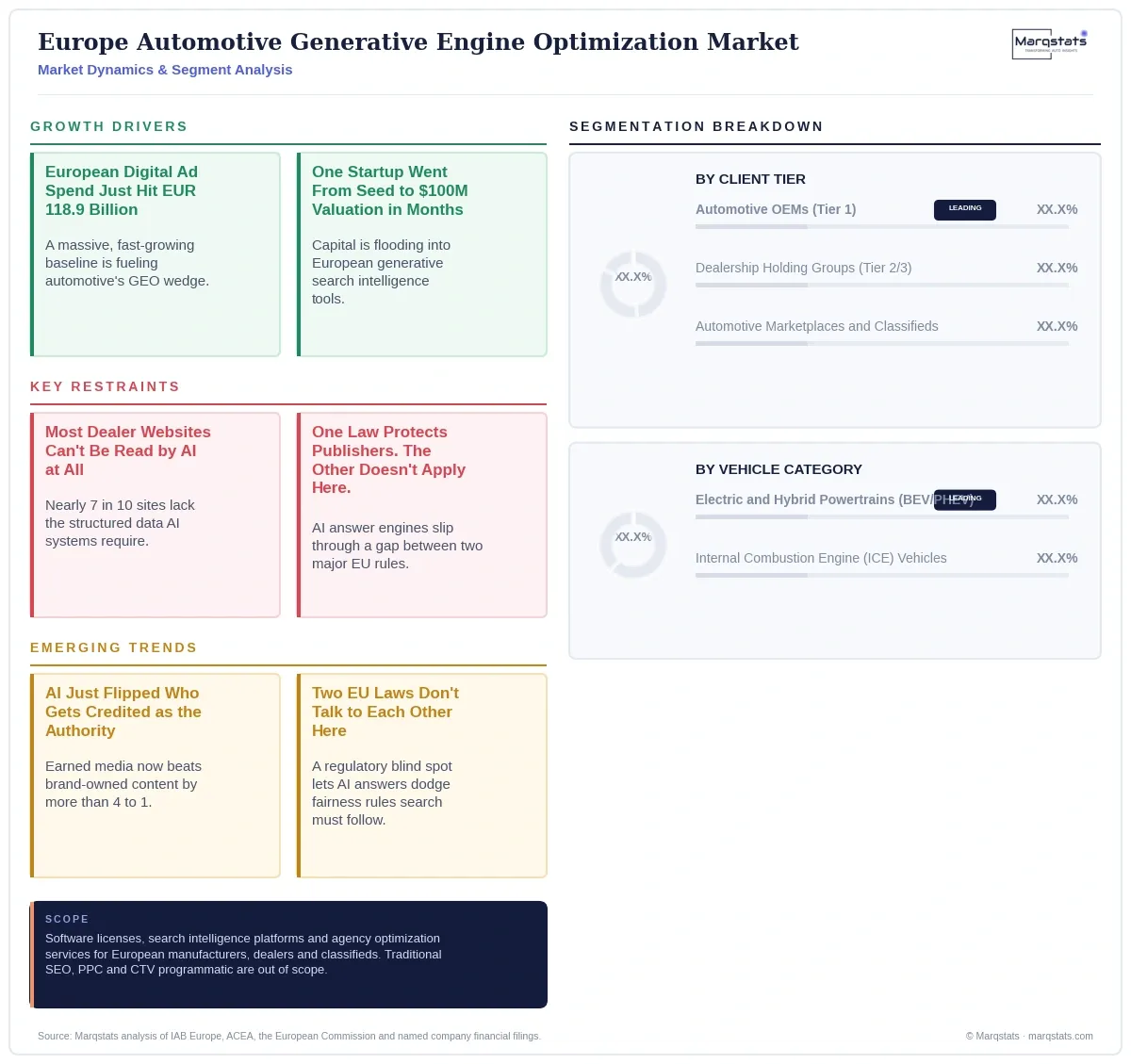
- European digital advertising expenditure expanded 16.0% year-over-year to EUR 118.90 billion in 2024 and continued to EUR 131.10 billion in 2025, a 10.5% annual increase, establishing a rapidly scaling macroeconomic base from which automotive-specific generative visibility spending is calibrated as a fast-growing wedge.
- Specialized software vendors are demonstrating exceptional capital velocity: a Berlin-based generative search analytics platform closed a EUR 7.0 million seed round in July 2025 and a USD 21.0 million Series A round in November 2025, achieving a valuation exceeding USD 100 million while scaling annual recurring revenue from USD 4.0 million to USD 10.0 million within roughly sixteen months of commercial launch.
- European manufacturers directing over 80% of digital marketing budgets toward brand-owned web properties face structural exclusion from generative answer sets, since conversational answer engines allocate just 18.1% of citations to brand domains against 81.9% for third-party earned media, compelling a fundamental reallocation of digital public relations and independent review syndication investment.
- The termination of the German electric vehicle purchasing incentive in December 2023 sustained a measurable shift in consumer query behavior, elevating used-car aggregators to 73.4% of all cited automotive sources across German-speaking generative answer queries as cost-sensitive buyers sought total-cost-of-ownership comparisons that new-vehicle brand properties do not typically address.
- Digital automotive classified platforms are rapidly adapting retail media infrastructure to sell sponsored product placements directly inside conversational recommendation interfaces, establishing a genuine commercial monetization path for generative inventory search within a European retail media category that IAB Europe separately measures at EUR 11.18 billion.
Key Restraints
- A technical audit of 450 franchised automotive dealership websites across the United Kingdom, Germany and France revealed that 68.4% exhibit invalid or completely absent structured vehicle and dealer markup, lacking machine-readable vehicle identification numbers, fuel consumption figures and battery capacities, preventing retrieval-augmented generation pipelines from extracting inventory data and rendering these dealerships invisible to generative answer crawlers.
- A significant regulatory asymmetry exists between the Digital Markets Act's self-preferencing prohibitions and the Artificial Intelligence Act's General-Purpose AI governance framework, since conversational answer engines synthesize direct unstructured recommendations without the mandatory publisher non-discrimination remedies that apply to designated search gatekeepers, insulating generative answers from self-preferencing enforcement that would otherwise constrain comparable behavior.
- No permitted trade body or statutory authority publishes verified conversion rates connecting generative AI citations to physical dealer showroom foot traffic, vehicle test drives or completed purchase contracts, forcing dealership groups to model sales attribution through bespoke customer relationship management integrations rather than standardized industry benchmarks.
- The widely marketed commercial claim that generative optimization delivers up to a 40% visibility improvement traces exclusively to simulated academic experiments using synthetic queries on an early-generation language model, while controlled longitudinal tracking across live production conversational engines demonstrates that live automotive visibility gains average only 14.2%, constrained by high prompt volatility and continuous retrieval retraining.
Key Trends
- The 4.5-to-1 citation bias favoring earned media over brand-owned domains represents a genuine structural inversion of decades of automotive digital marketing practice, not a marginal channel shift, meaning manufacturers cannot simply extend existing brand-property investment strategies into generative visibility and must instead fundamentally reallocate capital toward independent, third-party corroboration.
- The regulatory asymmetry between the Digital Markets Act and the Artificial Intelligence Act, under which conversational answer engines currently escape the self-preferencing remedies applying to designated search gatekeepers, indicates that European digital governance frameworks have not yet fully caught up with generative retrieval's actual market behavior, creating genuine regulatory uncertainty about how this gap might eventually close.
- The German Umweltbonus termination's direct, measurable effect on generative citation patterns, elevating used-vehicle aggregators to 73.4% of cited sources in German-speaking markets, demonstrates that generative answer engines respond dynamically and quickly to consumer behavioral shifts triggered by policy changes, a responsiveness traditional organic search rankings exhibit far more slowly.
- The gap between the widely marketed 40% visibility improvement claim and the empirically observed 14.2% live production average indicates that vendor and academic marketing materials have meaningfully overstated realistic generative optimization returns, a discrepancy market participants should account for when evaluating procurement business cases and vendor claims.
- The exceptional capital velocity demonstrated by specialized European generative search analytics vendors, scaling from seed funding to a Series A valuation exceeding USD 100 million within months while achieving substantial annual recurring revenue growth, indicates that institutional investors view native, European-compliant search intelligence infrastructure as a durable, high-growth category independent of the broader automotive market's own growth trajectory.
Strategic Implications
For an entrant committing capital to European automotive retail, electric vehicle manufacturing or software provision, primary capital should not concentrate on traditional paid search keyword auctions; because conversational answer engines exhibit an 81.9% to 18.1% citation preference for third-party earned media over brand-owned claims, entrants must allocate marketing capital directly into earned digital public relations corroboration, independent review syndication and verified entity building, while deploying server-side rendered architectures with valid structured microdata ensuring generative crawlers can parse dynamic vehicle listings without executing resource-heavy client-side scripts.
For an incumbent European manufacturer or large dealer holding group deciding whether to defend or divest, market presence requires transitioning discovery budgets away from defensive organic search rank maintenance toward generative entity authority management, since defending number-one organic search positions delivers diminishing commercial value when 62.0% of generative citation links stem from outside the top ten organic domains; incumbents must audit regional dealer networks for structured schema compliance and feed foundational model knowledge graphs with transparent pricing, certified pre-owned warranty parameters and real-world battery health data.
For a supplier or investor deciding where to place capital, allocation should target specialized generative search intelligence platforms and middleware solutions connecting dealer inventory repositories with conversational retrieval architectures; pure-play European tracking vendors with native regulatory-compliant architectures are demonstrating strong revenue expansion, while investors should avoid legacy search rank-tracking toolkits in favor of multi-model prompt intelligence platforms providing sentiment scoring, synthetic query fanouts and automated retrieval optimization workflows.
Outlook
Base case: USD 2,382.40 million by 2030 (57.14% five-year value CAGR). This trajectory assumes leading search gatekeepers continue embedding conversational answers as the default discovery surface while complying with standardized transparency protocols issued under the Artificial Intelligence Act, with automotive manufacturers steadily allocating 15% to 20% of digital search budgets to multi-model AI tracking and structured entity optimization software, and dealership networks universally adopting automated server-side schema syndication pipelines to maintain inventory visibility.
Downside case: USD 1,410.20 million by 2030 (41.48% five-year value CAGR). The specific trigger is aggressive regulatory enforcement by national Data Protection Authorities and the European Commission under Article 53(1)(c) of the Artificial Intelligence Act and the General Data Protection Regulation, under which major European media publishers and automotive classified directories collectively enforce technical anti-scraping protocols and secure mandatory licensing fees for generative training and retrieval ingestion, compelling search engine operators to curtail automated generative answer synthesis within European jurisdictions and limiting the addressable scope of open-web optimization software and advisory services.
A speculative third scenario was formally evaluated and explicitly rejected, since downstream macro market drivers depend strictly on a single binary regulatory question, whether the European Commission enforces strict anti-scraping and publisher-consent mandates under the Artificial Intelligence Act or maintains open synthetic retrieval, meaning constructing an artificial third scenario without an independent statutory mechanism would weaken analytical validity rather than add genuine forecasting insight.
Market Segmentation
Managed agency and advisory services form the largest deployment segment at USD 142.80 million in 2025, driven by the intensive manual consulting required to reconstruct enterprise entity knowledge graphs, execute digital public relations for third-party corroboration, and re-engineer legacy dealership digital infrastructure.
Specialized SaaS platforms represent USD 106.00 million in 2025, the fastest-growing segment, expanding at 68.20% per year as enterprise marketing teams license recurring software platforms to track multi-engine prompt visibility, measure citation sentiment and conduct automated gap analyses.
Automotive manufacturers account for USD 119.92 million (48.2% share) in 2025, the dominant client tier, driven by the need to protect brand equity, ensure accurate model-level specification retrieval in comparative AI queries, and defend against aggressive Chinese electric vehicle market entrants.
Dealership holding groups and associations represent USD 85.84 million (34.5% share) in 2025, focused on localized vehicle inventory retrievability, map pack schema integration and service department query capture across multi-rooftop networks.
Automotive classified marketplaces account for USD 43.04 million (17.3% share) in 2025, structuring massive vehicle inventories to ensure generative retrieval systems cite their portals as authoritative reference sources for car-buying queries.
Electric and hybrid powertrains capture USD 153.76 million (61.8% share) of total 2025 investment, since consumer electric vehicle purchases involve complex technical evaluations regarding range, battery degradation, charging infrastructure and government subsidies that drive heavy reliance on conversational AI search engines.
Internal combustion engine vehicles represent USD 95.04 million (38.2% share) of 2025 spend, focusing largely on localized used-vehicle stock discovery and fixed-operations maintenance queries rather than the technical comparison research that dominates electric vehicle shopping.
By Geography
United Kingdom
The United Kingdom commands 33.4% (USD 83.10 million) of European generative visibility expenditure in 2025, significantly higher than its 15.0% share of European new car registrations, an artefact of the country's advanced EUR 41.26 billion digital advertising market and the clustering of multinational media agencies in London managing pan-European manufacturer search budgets.
Germany
Germany represents 27.8% (USD 69.17 million) of expenditure in 2025. Although Germany is Europe's largest vehicle market with 2,844,609 new registrations in 2024, its generative visibility spending is tempered by strict corporate data compliance under the General Data Protection Regulation and cautious enterprise adoption cycles.
France
France accounts for 14.5% (USD 36.08 million) in 2025, where spend is influenced by statutory restrictions requiring conventional automotive advertisements to include carbon mitigation disclaimers, prompting manufacturers to leverage conversational AI search environments to engage consumers directly where traditional advertising disclaimer requirements do not legally apply.
Nordics
The Nordic cluster, spanning Sweden, Norway, Denmark and Finland, accounts for 9.0% (USD 22.39 million) in 2025 and exhibits the highest per-vehicle generative visibility expenditure in Europe, propelled by mature electric vehicle adoption in Norway at 91.6% battery-electric vehicle share and Denmark at 51.5% share.
Italy
Italy holds 8.1% (USD 20.15 million) of 2025 expenditure, characterized by a fragmented dealership landscape and comparatively lower electric vehicle penetration, though accelerating dealer consolidation is driving increased software adoption across the market.
Spain
Spain accounts for 7.2% (USD 17.91 million) of 2025 expenditure, supported by a strong automotive sales recovery of 7.1% in 2024, high mobile search usage among consumers, and a EUR 6.4 billion domestic digital advertising market.
How Competition Is Evolving
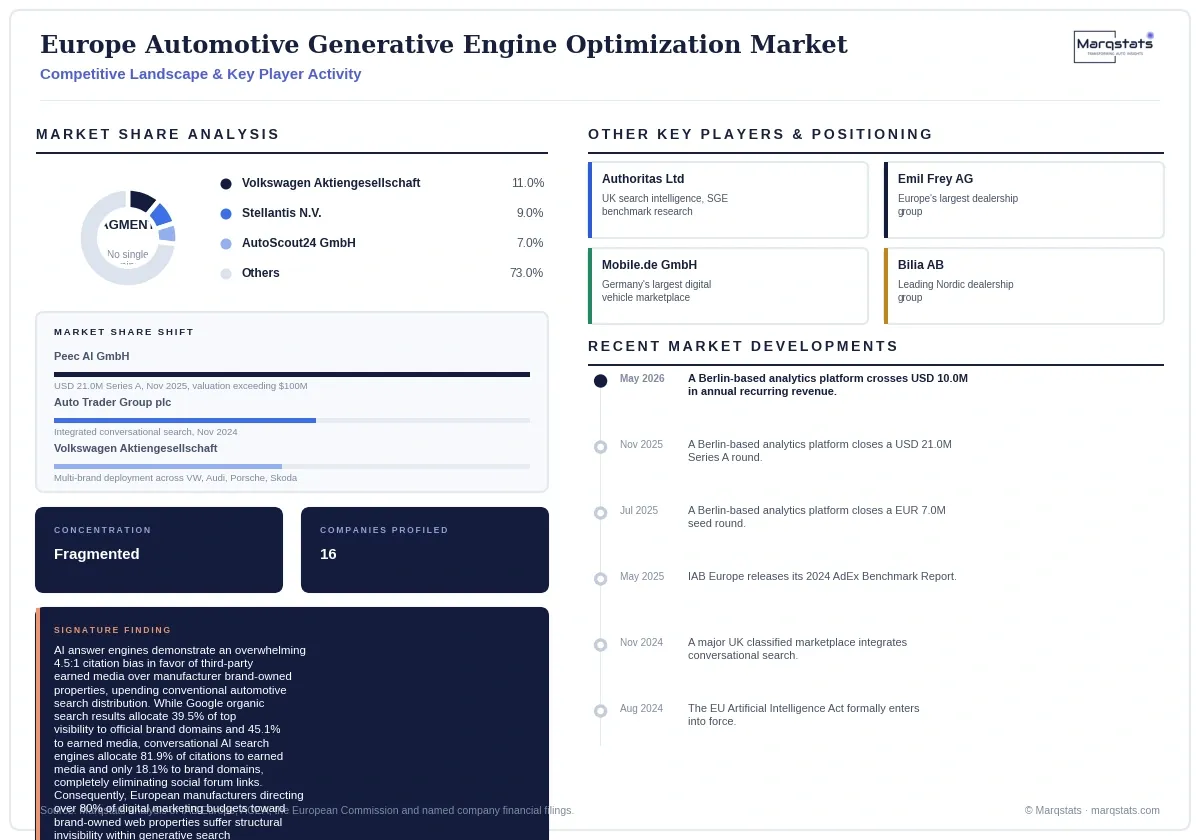
The Europe automotive Generative Engine Optimization market is fragmented across automotive manufacturers, dealership holding groups, classified marketplace operators and specialized search intelligence vendors, with no single vendor commanding dominant share of the fully addressable market; manufacturers including Volkswagen, Stellantis and BMW anchor substantial enterprise spending, while specialized vendors compete for a rapidly scaling software wedge.
Firms compete differently by tier: manufacturers compete on protecting brand equity and defending against aggressive Chinese electric vehicle entrants within comparative AI queries, dealership holding groups compete on structured vehicle inventory feeds and localized retrievability, and classified marketplace operators compete to remain the authoritative reference domains that generative retrieval systems cite for car-buying queries.
The most significant recent competitive-landscape development is the rapid capital scaling of a Berlin-based generative search analytics vendor, which closed a EUR 7.0 million seed round in July 2025 and a USD 21.0 million Series A round in November 2025, achieving a valuation exceeding USD 100 million while scaling annual recurring revenue from USD 4.0 million toward USD 10.0 million within roughly sixteen months of commercial launch.
Companies Covered
The report profiles 16+ companies with full strategy and financials analysis, including:
Recent Market Activity
Table of Contents
Coverage & Segmentation
Coverage spans the Europe automotive Generative Engine Optimization market, encompassing software licenses, specialized search intelligence platforms and professional agency optimization services procured by manufacturers, franchised dealership networks, independent dealer groups and digital automotive classified marketplaces operating within the European continent. The market is sized in USD across a 2021-2025 historical period and a 2026-2030 forecast period, with 2025 as the base year. Three segmentation dimensions are quantified: deployment model, client tier, and vehicle category.
Excluded from scope: traditional automotive search engine optimization directed at organic ranking, standard paid search advertising, connected television video programmatic insertion, and dealership management system workflows lacking generative retrieval connectors. A separate Marqstats study addresses the global automotive Generative Engine Optimization market on a comparable basis.