
Why France's 2G Shutdown Is Happening in 2026, Not 2025
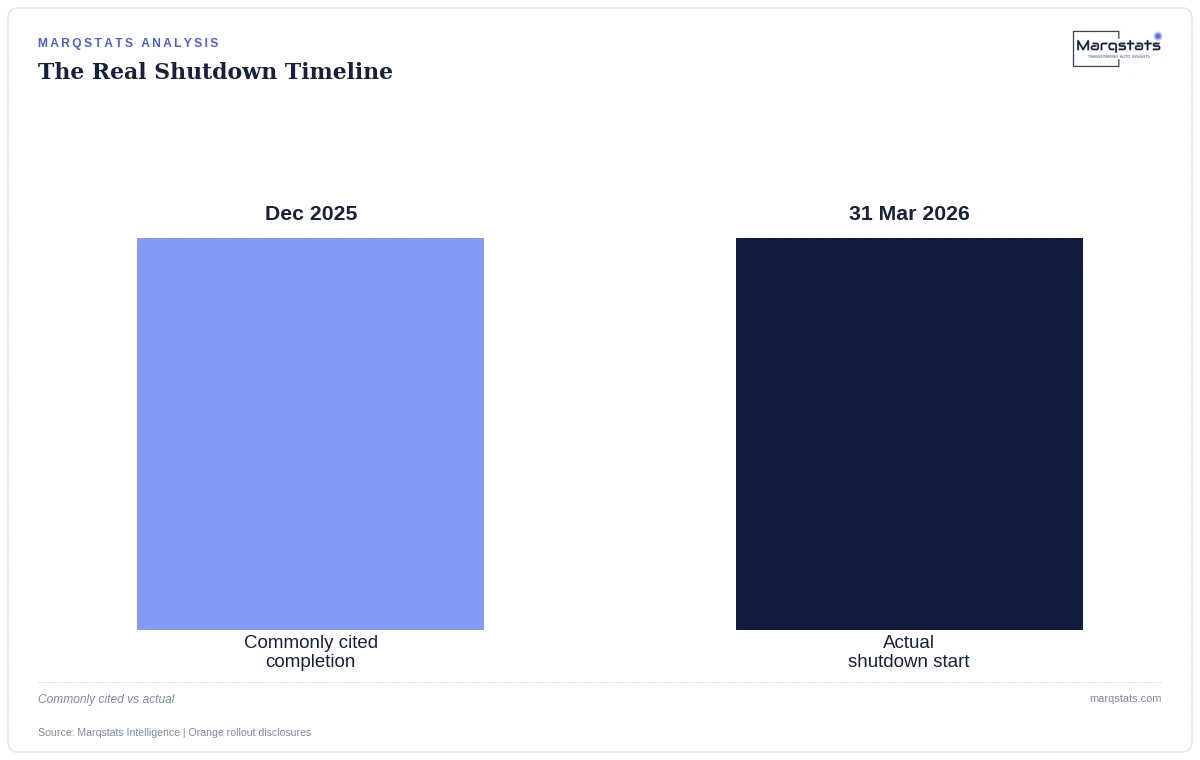
Because Orange's own rollout schedule says so, and that schedule is worth reading carefully. Much of the commentary on France's cellular 2G sunset cites a December 2025 completion date, treating the shutdown as a finished event. It is not. Orange began decommissioning its national 2G network in phases on 31 March 2026 — three months after the date most sources say it was supposed to be finished — and the rollout is still working its way department by department across France as this piece is being written.
What the Actual Timeline Looks Like
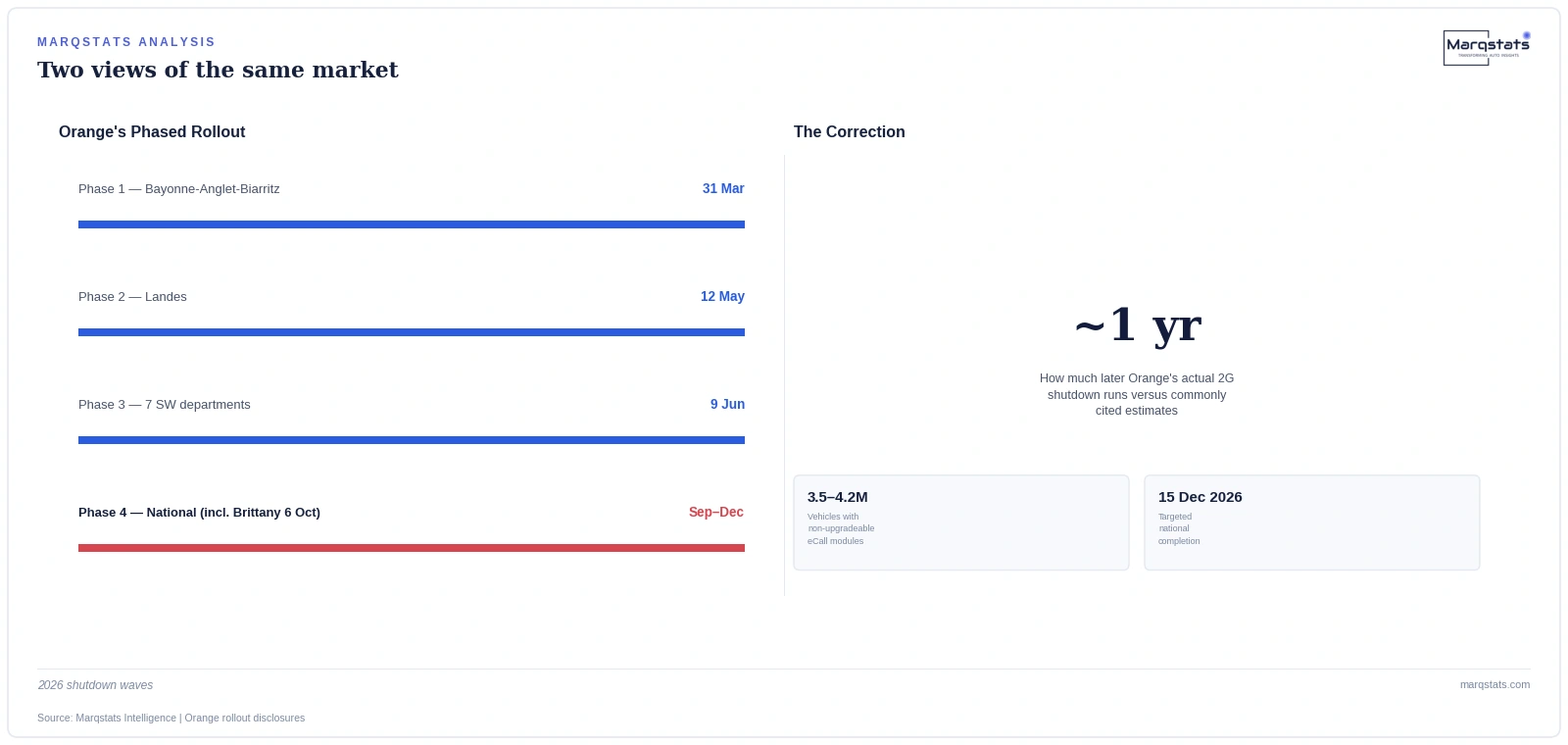
Orange's phased shutdown started with a pilot zone: the Bayonne-Anglet-Biarritz urban area and the surrounding Pyrénées-Atlantiques department, switched off entirely on 31 March 2026. The rollout then extended to the Landes on 12 May, and to seven further south-western departments including Haute-Garonne and Lot on 9 June. A national generalization phase runs from September through 15 December 2026, with specific regional dates confirmed as they are announced — Brittany's four departments (Côtes-d'Armor, Finistère, Ille-et-Vilaine, Morbihan) are scheduled for 6 October 2026.
Where the December 2025 Date Came From
Orange's original 2022 public announcement did target a 2025 window for the French 2G shutdown, framed at the time as part of a broader European rollout running from 2025 to 2030 across the countries where Orange operates. That announcement appears to have hardened into a specific "December 2025" completion date in secondary reporting and research summaries over the following years — even though Orange's own subsequent technical disclosures describe a phased, multi-department rollout that did not actually begin switching off live service until the following spring.
This is a familiar pattern in infrastructure reporting generally: an early strategic announcement gets cited as a firm operational date long after the operator's own execution plan has evolved into something more gradual and specific. The gap between a company's first public target and its actual phased execution schedule is often where secondary sources drift furthest from what is actually happening on the ground, and France's 2G transition is a clean illustration of that gap.
Why the Year Matters for Planning, Not Just Accuracy
A market analysis, an insurer's risk model, or a fleet operator's retrofit budget built around a completed December 2025 shutdown will misjudge exactly how much exposure remains and exactly when it materializes. If the shutdown were genuinely finished, every affected 2G-dependent eCall module in France would already be silent, and the only remaining work would be counting the damage. Since the shutdown is instead unfolding through the second half of 2026, the actual planning question is different: how many vehicles in each specific department can still be retrofitted before that department's shutdown date arrives.
That is a fundamentally different operational question than a post-mortem, and it should change how urgently a fleet operator or automaker allocates retrofit capacity right now, this quarter, rather than treating the 2G risk as a historical event to simply report on.
The Counter-Case: Does the Exact Date Actually Change Much?
A reasonable objection is that the underlying risk — 3.5 to 4.2 million vehicles with non-upgradeable 2G-dependent eCall modules — is the same regardless of whether the shutdown finished in December 2025 or is still running through December 2026. That is true for the total exposed population. It is not true for urgency and sequencing: a department-by-department rollout means the at-risk population shrinks gradually as retrofit programmes catch up in each region, rather than all 3.5 to 4.2 million vehicles losing service simultaneously on a single date. The corrected timeline changes how fast the exposure is actually realized, even if the ceiling stays the same.
A Named Comparison: Germany's Equivalent Transition
Germany offers a useful point of comparison for how these national cellular transitions actually unfold in practice. German carriers Deutsche Telekom and Vodafone both completed their own 2G shutdowns earlier and on a tighter public timeline than Orange's French rollout, giving German automotive telematics providers a genuine head start on retrofit planning relative to their French counterparts. That precedent is itself informative: it confirms that a full national 2G decommissioning, even when announced years in advance, tends to run later and more gradually in practice than the original headline date suggests — exactly the pattern this piece has traced for France specifically.
What SFR and Bouygues Are Doing Differently
Orange is not the only carrier managing this transition, and the other two major operators are running noticeably different timelines that a France-wide risk model needs to track separately, department by department where the data allows it. SFR (Altice France) has targeted the end of 2026 for its own 2G shutdown, while Bouygues Telecom has set the same end-2026 date for 2G but is retaining its 3G network specifically until December 2029 to accommodate enterprise machine-to-machine transitions that need more runway. Free Mobile, which never built its own 2G radio access network, depends entirely on Orange's wholesale roaming agreement — meaning Free subscribers' vehicles are exposed on Orange's actual schedule, not a separately announced Free Mobile date.
That divergence matters because a vehicle's actual carrier, not just its manufacturer or model year, determines which shutdown calendar applies to it. A fleet operator managing vehicles across multiple carrier SIM profiles needs three separate shutdown calendars, not one national date, to plan retrofit priority correctly.
What This Means for Insurers and Roadside Assistance Providers
Insurers and roadside assistance operators have a specific, near-term stake in getting this timeline right that goes beyond general market sizing, and it is worth spelling out concretely. A policy or service contract that assumes eCall functionality is universally available across a French vehicle fleet, because the shutdown was supposedly completed in 2025, will overstate its own automated-response coverage for exactly the vehicles this piece has been describing — the 3.5 to 4.2 million still running 2G-dependent modules as their specific department's shutdown date approaches through the rest of 2026. That overstatement is not a rounding error; it is the exact population a roadside-assistance or emergency-response product exists to serve.
What This Means for a Sizing or Sourcing Model
Anyone building a France connected-car risk model should anchor the 2G exposure timeline to Orange's actual phased 2026 schedule, department by department, rather than a single historical cutover date. The full regional breakdown this piece draws on is set out in the Marqstats analysis linked below.
Related reportFrance Connected Car Market Size, Share & Forecast 2026 – 2030