Company Car or Personal Car: Which One Gets the Connected Features First in France?
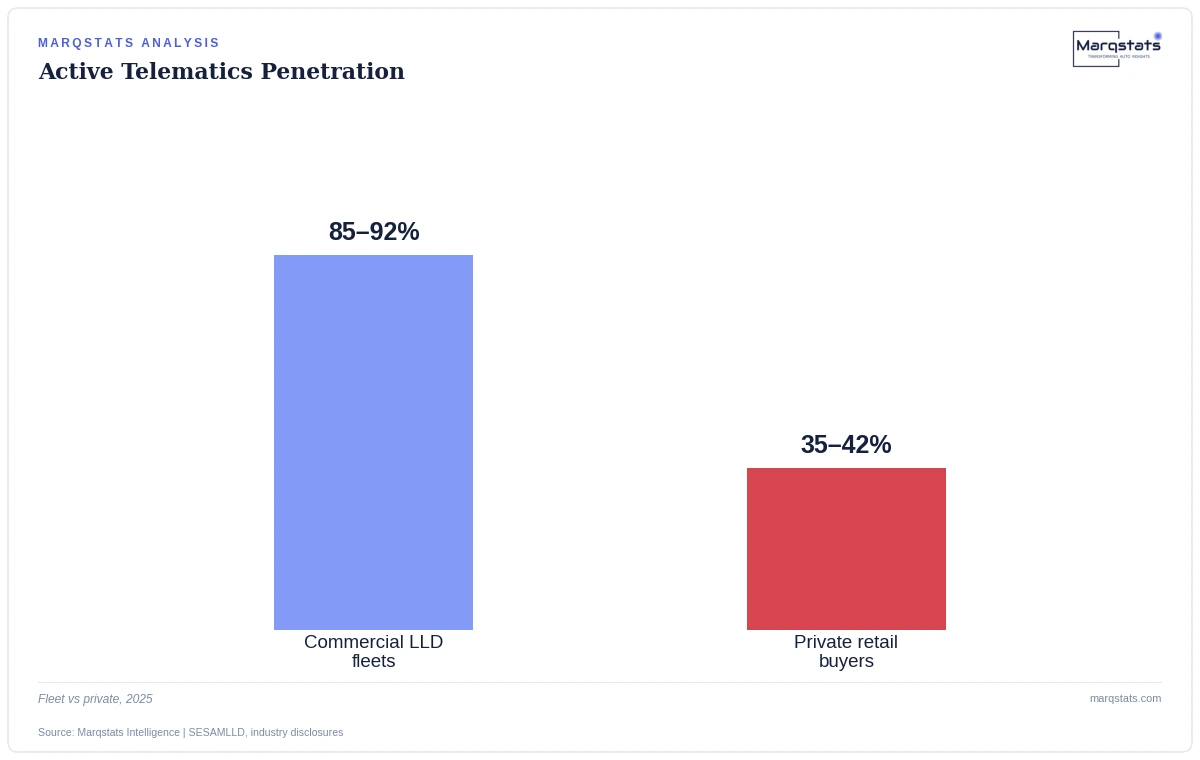
The company car, by a wide margin. French commercial fleets, dominated by long-term operational leasing (LLD), run active telematics penetration of 85% to 92%. Private retail buyers, driving the exact same vehicle models in many cases, run active paid penetration of just 35% to 42%. The gap isn't about technology availability — it's about who is actually paying for the connection, and why.
Why Fleets Pay Without Hesitating
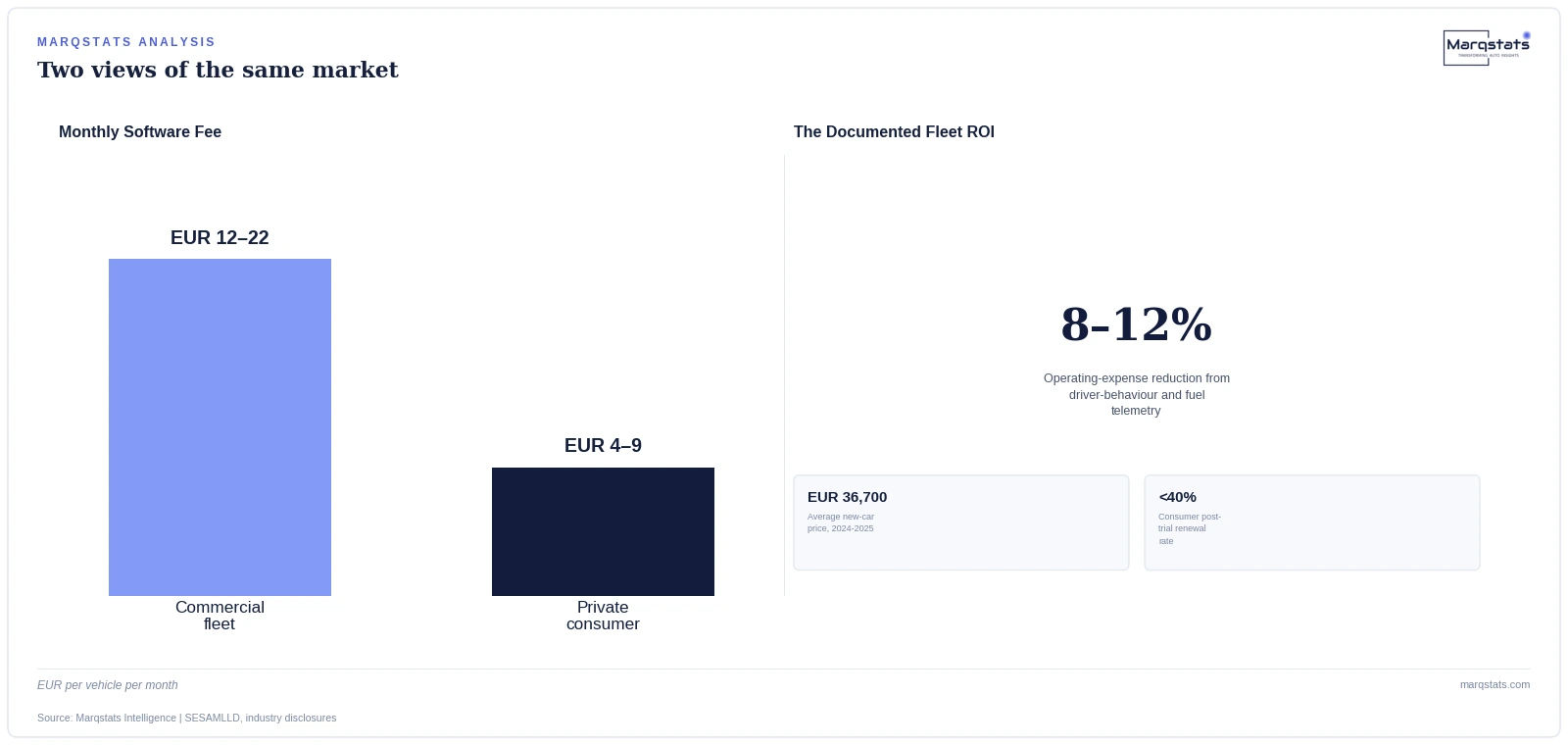
A fleet manager overseeing hundreds of leased vehicles can measure the return on telematics directly: driver-behaviour scoring and fuel-consumption optimization documented at 8% to 12% operating-expense reduction, automated maintenance alerts that cut unscheduled downtime, and statutory greening-quota reporting required under the Loi d'Orientation des Mobilités. At EUR 12.00 to EUR 22.00 per vehicle per month on a 36-to-48-month leasing contract, the monthly fee is a rounding error against the documented savings.
Why Private Buyers Say No
A private buyer facing a EUR 36,700 average new-car price — up 70% over twelve years, outpacing wage growth — has already stretched the household budget on the vehicle itself. Free2move, Apple CarPlay and Android Auto deliver navigation, music and hands-free calling at no additional cost, covering most of what a private driver actually wants day to day. Paying an extra EUR 4.00 to EUR 9.00 a month for a bundle that mostly duplicates a free smartphone feature is, for most buyers, an easy expense to decline once the promotional trial period ends.
What Actually Changes the Calculation
Two things narrow this gap, and neither is a lower price. Regional Low-Emission Zone (ZFE-m) access requirements are starting to make certain connected compliance features relevant to private buyers in restricted zones, not just fleets. And the European Data Act's FRAND access rules, in full application since September 2025, are letting independent providers build cheaper, more targeted consumer offers on top of standardized vehicle data — potentially undercutting the OEM-bundled pricing that has kept private consumer adoption low.
What Happens When a Fleet Vehicle Becomes a Personal Car
This split also has a practical afterlife worth knowing about: a large share of France's private used-car market is supplied by former leasing fleet vehicles reaching the end of their 36-to-48-month LLD contracts. A buyer purchasing a used vehicle that was previously part of a corporate fleet may inherit hardware that was fully telematics-equipped from new, even though the private buyer has no intention of paying for the ongoing service. In that scenario, the connectivity hardware already exists in the vehicle — the only decision left is whether the new private owner activates and pays for the subscription, which is exactly where this piece's earlier point about free smartphone alternatives comes back into play.
Why This Matters for Insurers Specifically
Usage-based insurance providers sit in an unusual position relative to this fleet-versus-retail split. A UBI provider building risk models on vehicle telemetry gets richer, more consistent data from the commercial fleet segment, where the connectivity is already active and paid for by someone else, than from the private retail segment, where the same underlying hardware often sits unused. That asymmetry is part of why usage-based insurance in France has scaled faster in corporate and rental contexts than in the mainstream private consumer market, independent of whatever regulatory tailwind the European Data Act eventually provides.
The Simplest Way to Check Which Category You're In
If your vehicle is leased through your employer or a corporate fleet programme, telematics is almost certainly already active and paid for as part of the lease agreement — check with your fleet manager rather than assuming you need to opt in separately. If you own your car personally, the honest question to ask before paying for a renewal is simply whether you have used any feature in the past year that CarPlay or Android Auto could not have provided for free. For most private drivers, the answer settles the decision on its own.