
Does Your French Connected Car Count Include a Dormant eCall Module?
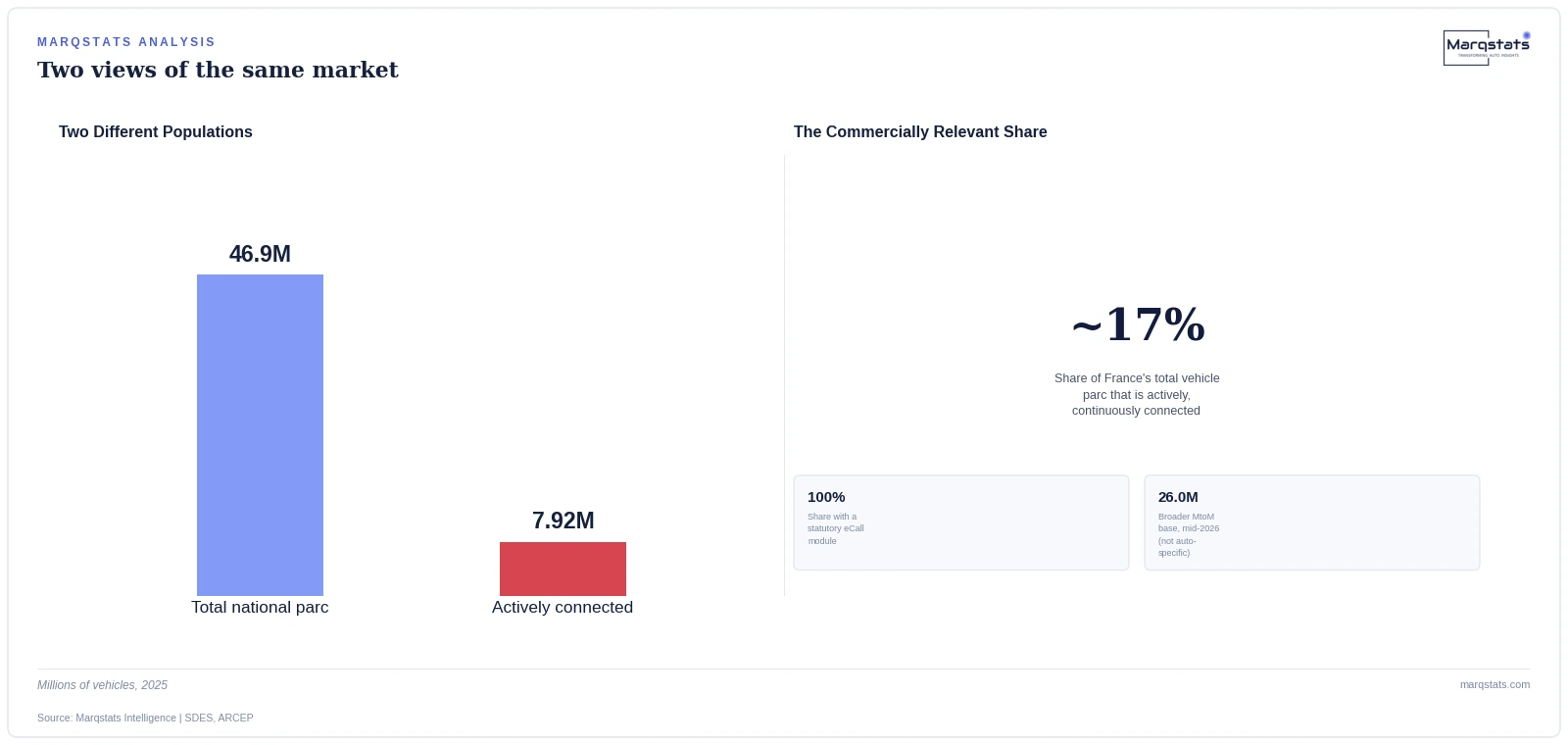
In brief: almost every new car sold in France since March 2018 carries an embedded cellular eCall module, but that module is dormant by design — it establishes no ongoing data connection and transmits only when a crash sensor triggers or a driver presses the SOS button. The commercially meaningful connected-vehicle count is a much smaller, specifically defined population: vehicles running an active machine-to-machine SIM that transmits continuous telemetry, estimated at 7.92 million in 2025 against a 46.9 million-vehicle total national parc.
What a Dormant eCall Module Actually Does
Regulation (EU) 2015/758 requires every new M1 and N1 type-approved vehicle to carry an embedded 112-based eCall system from March 2018 onward, a mandate that now covers the overwhelming majority of France's operating fleet by vehicle count if not by age. The system's job is narrow and specific: detect a severe collision through onboard sensors, or respond to a manually pressed SOS button, and then place an automated emergency call carrying a Minimum Set of Data to the nearest Public Safety Answering Point. Outside that trigger event, the module does nothing — no background data session, no continuous location reporting, no telemetry a fleet manager or insurer could use.
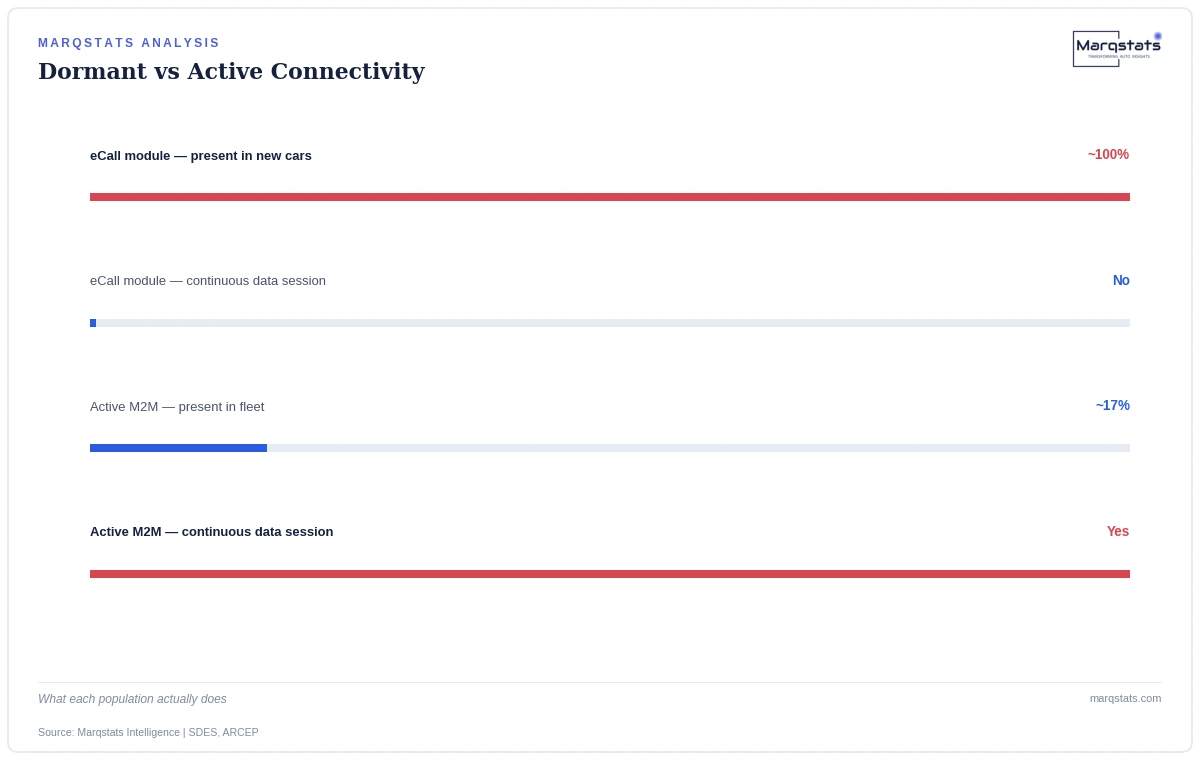
The technical reason for this design is deliberate, not a limitation. Building a permanently active data connection into every statutory eCall module would have meant a far more expensive mandate across the entire EU new-vehicle fleet, with ongoing carrier costs that manufacturers would have had to absorb or pass to buyers regardless of whether the owner wanted continuous connectivity at all. The dormant-by-design approach kept the safety mandate affordable and universal while leaving commercial connectivity as a genuinely separate, opt-in product decision for automakers to build on top of it, once the safety mandate itself was satisfied.
What Actually Counts as 'Connected' Commercially
The market this analysis measures is built around vehicles doing something categorically different: maintaining a persistent, continuous machine-to-machine connection that supports fleet management software, over-the-air firmware updates, remote diagnostics or paid consumer digital services. That population reached 7.20 million vehicles in 2024, estimated at 7.92 million in 2025 — roughly one in six vehicles on French roads, not the near-universal population a statutory-eCall-based count would imply.
Nearly every new French car has an eCall module. Only about one in six vehicles on French roads is actually, continuously connected.
— Marqstats Analyst Team
The gap between these two numbers is not static, and it is worth tracking rather than treating as a fixed ratio. As Next-Generation eCall becomes standard on new type approvals from January 2026 and the broader vehicle fleet gradually turns over, the technical hardware underpinning both populations will increasingly converge on the same 4G/5G packet-switched foundation — even though the commercial and regulatory distinction between a dormant safety module and an active paid connection will remain, since that distinction is a business-model choice, not a hardware limitation.
Why the Distinction Gets Blurred So Often
The conflation is an easy mistake to make, because both figures are technically true statements about "connected vehicles" — they just answer different questions. A regulator counting eCall compliance for road-safety purposes correctly cites the near-100% figure. A telecommunications carrier counting revenue-generating M2M connections correctly cites the much smaller active figure. The error only occurs when a reader takes one figure and applies it to a question the other figure was actually built to answer — sizing a commercial software or data-services market using a statutory compliance count, for instance.
What This Looks Like in the Broader MtoM Numbers
ARCEP's own quarterly telemetry monitoring adds a further layer worth separating out. Total active machine-to-machine cellular SIM subscriptions across France reached 25.7 million by late 2025 and 26.0 million by mid-2026 — but that broader MtoM base includes industrial smart meters, security systems and retail point-of-sale terminals alongside automotive connections. The commercially defined connected car population, 7.92 million vehicles, is a specific subset of that larger telecommunications category, not a proxy for it.
A Named Comparison: How This Plays Out Elsewhere in Europe
France is not unusual in carrying this definitional gap — every EU market subject to Regulation (EU) 2015/758 has near-universal eCall hardware penetration on new vehicles alongside a much smaller actively communicating commercial fleet, since the underlying regulation and its dormant-by-design architecture apply identically across the bloc. What varies by country is how clearly national statistical agencies and telecom regulators separate the two populations in their own published reporting. SDES and ARCEP's practice of publishing the actively-communicating automotive SIM count as a distinct series, rather than folding it into a single "connected vehicle" headline, is part of what makes the French market unusually possible to size correctly — markets with less granular official reporting are more exposed to exactly the conflation this piece describes, particularly as the connected-vehicle market itself continues to attract more commercial and analytical attention from parties unfamiliar with the underlying regulatory distinction between a dormant safety mandate and continuous commercial telemetry.
Germany and Italy both publish new-vehicle eCall compliance statistics through their own national type-approval bodies, but neither country's telecommunications regulator publishes an equivalent dedicated automotive M2M series with the same granularity ARCEP provides for France. That difference means a market-sizing exercise for Germany or Italy has to work harder, and with more assumptions, to separate statutory compliance from commercial connectivity than the same exercise does for France — a methodological advantage worth crediting to French regulatory transparency specifically, independent of the underlying market's own size or growth rate.
A researcher building a comparable multi-country connected-vehicle dataset across the EU should expect France to be the easiest single market to size accurately for exactly this reason, and should treat any equivalent figure for a market with less transparent reporting as carrying materially wider error bars by comparison.
Why This Distinction Matters for Insurers and Advertisers Specifically
An insurer marketing a usage-based product on the promise of "connected vehicle" eligibility needs to know which population it is actually addressing. Marketing that implies near-universal eligibility, drawing on the near-100% eCall statistic, will generate far more inbound interest than the product can actually serve, since only the roughly 7.92 million actively connected vehicles can support the continuous telemetry a usage-based policy requires. The same caution applies to any advertiser or software vendor pitching a connected-car audience size based on the wrong population, since the gap between the two figures is large enough to materially change a campaign's actual reach estimate, and by extension its projected return on advertising spend.
What This Means for Regulators Publishing Connectivity Statistics
SDES and ARCEP's own practice of separating statutory eCall penetration from active commercial M2M counts in their published reporting is itself a form of public infrastructure worth preserving as France's connected-vehicle market continues to evolve and mature over the coming forecast period. A regulator that collapsed the two figures into a single "connected vehicle" headline — as some national statistical agencies elsewhere in Europe are more prone to do — would make it structurally harder for any market participant, from an insurer to an independent telematics vendor, to size the addressable market correctly. That granularity is a genuine competitive advantage for anyone building a business on top of official French data, relative to markets where the equivalent official statistics blur the two populations together.
The Government Buyer Behind the Distinction
It is worth remembering that this entire distinction traces back to a single regulatory choice: the European Commission designed statutory eCall as a public-safety floor, not a commercial product, and left commercial monetization entirely to automakers and carriers building on top of it. That choice is why France's connected car market can be measured at all as a distinct commercial category, separate from a pure compliance mandate.
Outlook: One Trigger, Not Three
This market does not support a three-scenario outlook on the definitional question specifically. The single evidenced trigger is the Next-Generation eCall mandate itself: once packet-switched NG-eCall becomes standard on all new type approvals from January 2026, and eventually across the full new-registration base from 2027, the technical distinction between a dormant safety module and an active data connection may narrow, since NG-eCall's underlying 4G/5G hardware is closer in capability to always-on connectivity than the legacy 2G/3G circuit-switched systems it replaces.