Market Snapshot
Middle bar: base-year value × (1 + CAGR), rounded to two decimals. This is a calculated illustration, not a separately researched annual estimate.
The Europe small electric car market size is estimated at USD 16,893.50 million in 2025 and is projected to reach USD 54,663.75 million by 2030, growing at a CAGR of 26.47% over 2026 – 2030. Registrations of A- and B-segment battery electric cars rise from 575,000 to 2,250,000, with B-segment superminis and small SUVs leading at 77.57% of 2025 volume.
Small electric cars are the fastest-growing part of the European battery electric market. Across the European Union, the United Kingdom and the EFTA countries, about 2.59 million battery electric passenger cars were registered in 2025, and Marqstats estimates 575,000 of them were A-segment city cars or B-segment superminis and small SUVs, about 22% of the total. In the EU alone, battery electric cars reached 1,880,370 registrations and a 17.4% market share in 2025, according to the European Automobile Manufacturers' Association (ACEA).
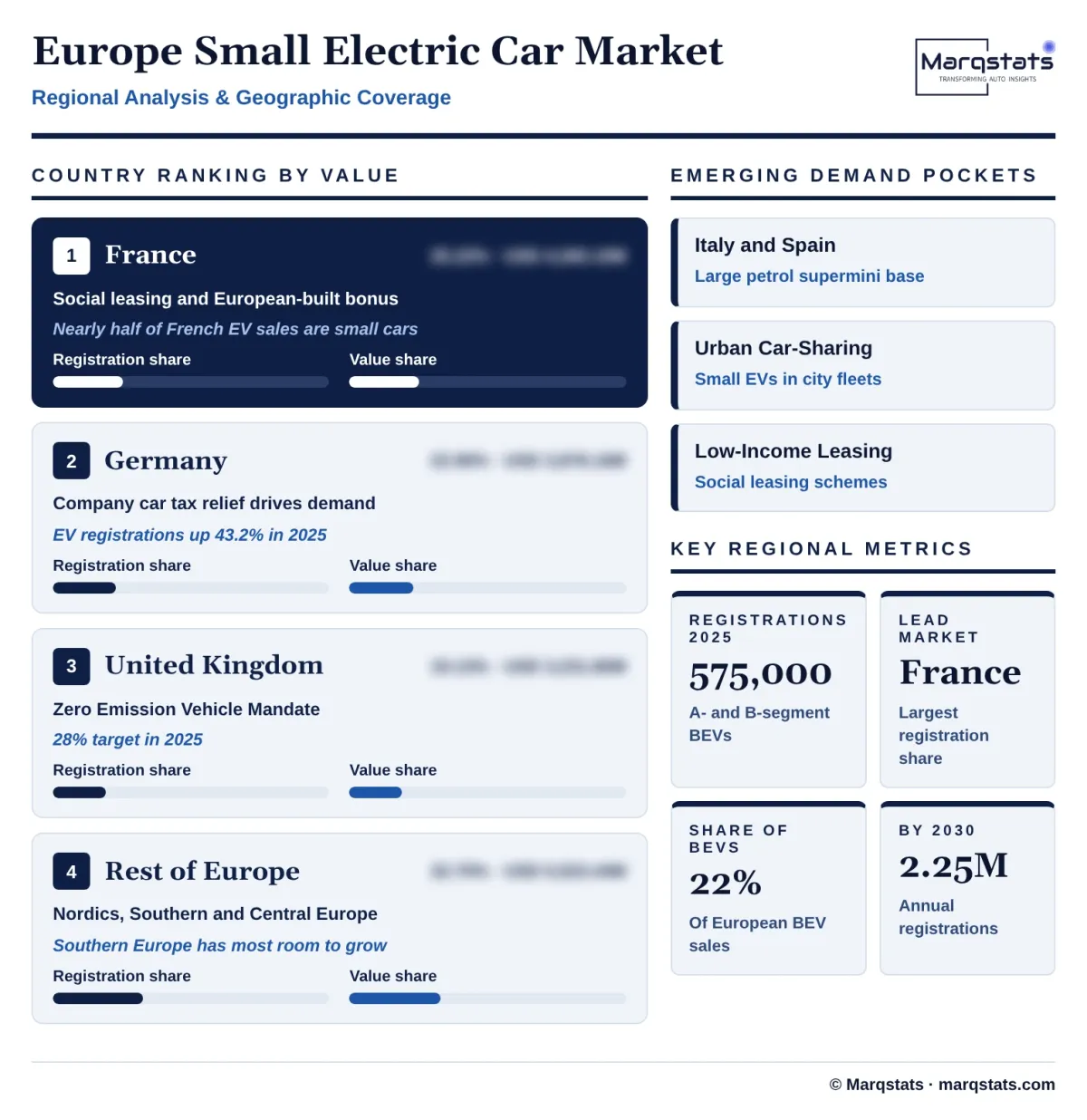
Demand is concentrated in the three largest markets. France accounts for an estimated 25.22% of 2025 small electric car registrations, Germany for 22.96% and the United Kingdom for 19.13%. The study segments the market by car segment (A-segment and B-segment), price band and battery chemistry (lithium iron phosphate and nickel manganese cobalt), and values the market at net transaction prices excluding VAT, converted at the 2025 European Central Bank average of USD 1.13 per euro.
Key Takeaways
Market Overview & Analysis
Report Summary
Marqstats sizes the Europe small electric car market as the value of new battery electric passenger cars (category M1) in the A-segment, typically under 3.7 metres long, and the B-segment, typically 3.7 to 4.2 metres, registered across the 27 EU member states, the United Kingdom, Norway, Switzerland and Iceland. Plug-in hybrids, range extenders, hybrids, fuel cell cars and L-category quadricycles are excluded. Registrations are valued at an average net transaction price, excluding VAT and registration taxes, of EUR 26,000 in 2025, which reflects city cars such as the Dacia Spring and Hyundai Inster at about EUR 17,000 to 21,000 and superminis such as the Renault 5, Citroën ë-C3, Peugeot e-208 and Mini Cooper E at about EUR 23,000 to 34,000.
The market grew from an estimated 185,200 registrations in 2021 to 575,000 in 2025. Growth slowed in 2024 as Germany ended its purchase grant and few affordable models were on sale, then jumped about 47% in 2025 as a wave of sub-EUR 25,000 models arrived just as tighter EU CO2 targets took effect. Marqstats estimates registrations of about 840,000 in 2026 as the Renault 4, Fiat Grande Panda, Hyundai Inster and new Kia, BYD and Volkswagen Group models build volume.
Small electric cars sit at the centre of European climate policy. The EU's CO2 regulation requires fleet emissions to fall 15% from 2021 levels in 2025 and 55% by 2030, and the 2025 amendment lets manufacturers average compliance over 2025 to 2027. Small electric cars are the cheapest way for mass-market brands to cut their fleet averages, because they displace petrol superminis that make up a large share of their sales. Brands such as Peugeot, Renault, Citroën, Fiat, Opel and Hyundai sell large volumes of small petrol cars, so electrifying their small car ranges has the biggest effect on their CO2 performance.
Pricing differs sharply by model and chemistry. Entry versions with LFP batteries of about 30 to 44 kWh, such as the Citroën ë-C3 You and Fiat Grande Panda, start at about EUR 20,000 to 22,000 before incentives, while longer-range versions with NMC batteries of about 50 kWh, such as the Renault 5 Iconic and Mini Cooper E, sell for EUR 30,000 or more. Net transaction prices are lower than list prices because of dealer discounts, fleet rebates and manufacturer-funded leasing offers, which have grown as manufacturers push volume to meet CO2 targets.
The forecast rests on three conditions. EU CO2 targets for 2030 remain broadly in place after the 2026 review, battery costs keep falling as European LFP cell production grows, and national incentives such as France's social leasing continue to support low-income buyers. Under these conditions registrations reach 2,250,000 in 2030, about one in seven new cars sold in Europe, and market value reaches USD 54,663.75 million.
Europe Small Electric Car Market Size and Forecast
The Europe small electric car market grows from USD 16,893.50 million in 2025 to USD 54,663.75 million in 2030, a CAGR of 26.47%. In euro terms the market grows from EUR 14,950.00 million to EUR 48,375.00 million at the same rate, because values are converted at a constant USD 1.13 per euro. Registrations grow from 575,000 to 2,250,000, a 31.37% annual rate, passing 1 million in 2027.
Value grows more slowly than volume because prices fall. The average net transaction price drops from EUR 26,000 in 2025 to about EUR 21,500 by 2030 as LFP batteries take over entry trims, Smart Car, AmpR Small and MEB Entry platforms reach full scale, and more models are launched below EUR 20,000. The sub-EUR 20,000 band rises from 11.30% of registrations to 20.89%, while premium small cars above EUR 27,000 fall from 39.13% to 25.11%.
Growth is fastest in the first half of the forecast. Registrations rise about 46% in 2026 and 40% in 2027 as manufacturers meet the 2025 to 2027 averaging period, then slow to about 20% to 30% a year as the market matures and the 2030 target approaches. A-segment city cars grow slightly faster than B-segment cars, rising from 22.43% of registrations to 24.89%.
Market Dynamics
Key Drivers
Five forces are pulling small electric cars into the European mass market.
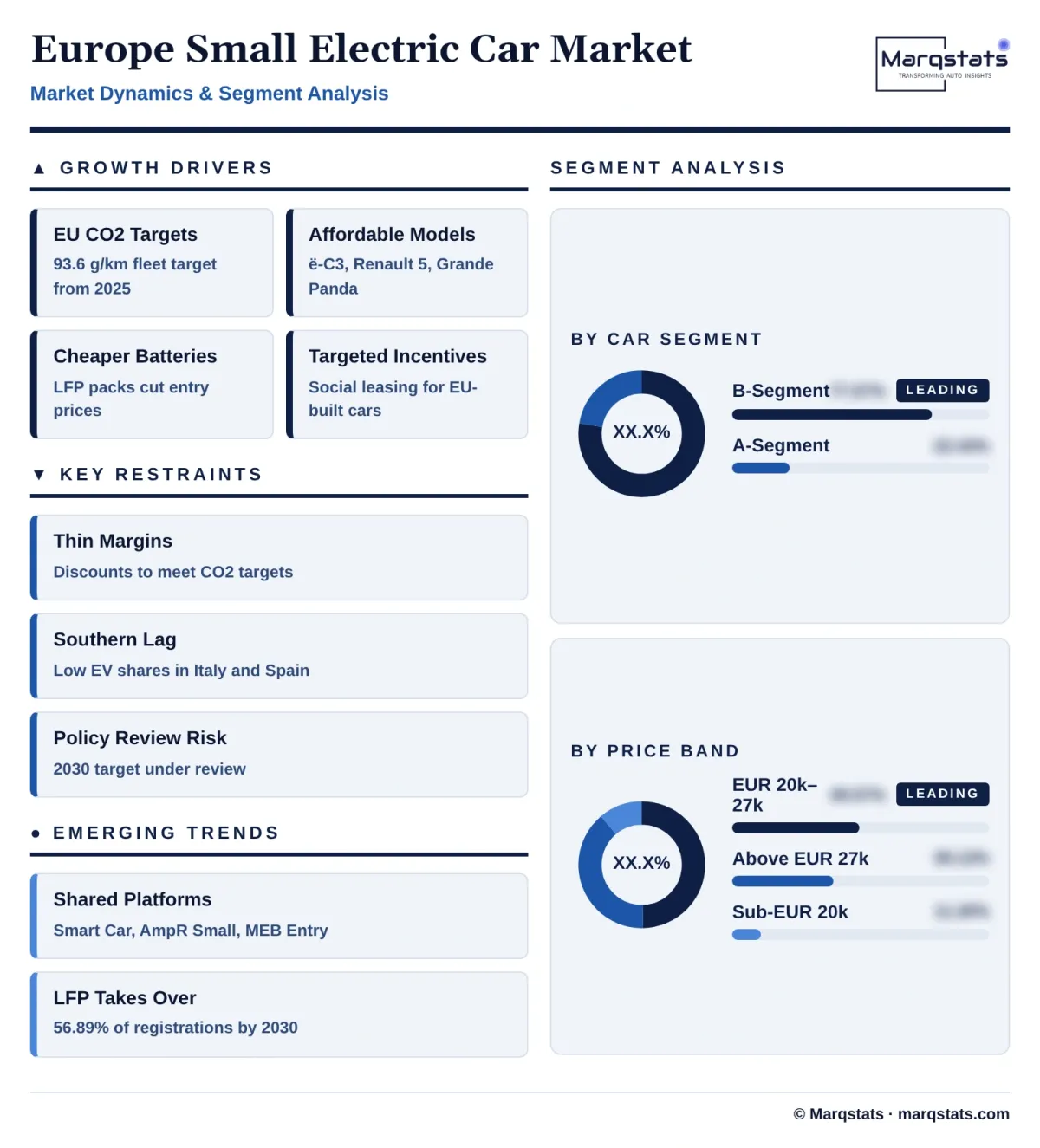
- EU CO2 targets force manufacturers to sell more small electric cars. The 2025 fleet target of 93.6 g CO2/km and the 2030 cut of 55% from 2021 levels make small electric cars the cheapest compliance route for volume brands. ACEA data showed fleet emissions still above target in 2026, which keeps pressure on manufacturers to push small electric models with discounts and leasing offers.
- Affordable models are arriving in numbers. The Citroën ë-C3 from EUR 19,990, Renault 5, Renault 4, Fiat Grande Panda, Hyundai Inster, Kia EV2, BYD Dolphin Surf and the Volkswagen ID. Polo and Cupra Raval give buyers a wide choice of small electric cars near price parity with petrol equivalents for the first time.
- Battery costs are falling. LFP cells, used in the Citroën ë-C3, Fiat Grande Panda and Dacia Spring, cost significantly less than NMC cells, and pack prices continue to fall. Marqstats estimates LFP pack costs in small cars falling from about EUR 92 per kWh in 2025 to about EUR 54 per kWh by 2030, allowing entry models below EUR 20,000.
- National incentives target small, European-built cars. France's social leasing scheme offers subsidised leases from under EUR 100 a month to lower-income households, and its environmental score limits incentives to cars built in Europe. Germany's company car tax relief and other national schemes support demand among business and private buyers.
- Small electric cars suit European cities. Narrow streets, limited parking, low-emission zones and short daily trips make small electric cars practical for urban households, and the growth of on-street and lamppost charging in cities such as Paris, London and Amsterdam reduces the need for home chargers.
Key Restraints
Four constraints slow adoption and squeeze manufacturer margins.
- Margins on small electric cars are thin. Battery costs make up a larger share of the price of a small car than of a large one, and manufacturers discount heavily to meet CO2 targets. Many small electric models earn little or no operating profit on their own, which limits how fast manufacturers can expand production without regulatory pressure.
- Southern and Eastern Europe lag behind. Battery electric shares in Italy and Spain remain far below the European average because of fewer fast chargers, lower incomes and smaller company car incentives. These markets have large petrol supermini sales that small electric cars have yet to replace. As charging networks expand and cheaper models arrive, Italy and Spain offer the largest untapped volume for small electric cars in Europe.
- Policy could be relaxed. The European Commission's 2026 review of CO2 targets could weaken the 2030 target or allow credits for synthetic fuels, which would reduce the pressure on manufacturers to sell small electric cars.
- Trade rules limit low-cost imports. EU countervailing duties and European-content requirements in national incentives raise the cost of Chinese-built small electric cars. Stellantis stopped assembling the Leapmotor T03 in Tychy, Poland, in 2025, showing how hard it is to bring the cheapest Chinese models to Europe.
Key Trends
Four shifts are reshaping how small electric cars are built, priced and sold.
- Small electric cars are moving from niche to mainstream. Shared platforms such as Stellantis Smart Car, Renault AmpR Small and Volkswagen MEB Entry let manufacturers spread development costs across several brands, bringing prices of the most popular models close to petrol equivalents.
- LFP is becoming the standard battery for entry models. Entry trims of the Citroën ë-C3 and Fiat Grande Panda use LFP batteries of about 30 to 44 kWh, while higher trims of the Renault 5 and Mini Cooper E use NMC batteries of about 50 kWh, creating a price gap of about EUR 4,500 between entry and range-focused versions.
- Chinese brands are localising production. BYD is building a car plant in Szeged, Hungary, and Leapmotor sells through Stellantis' European network. Local production lets Chinese brands avoid EU duties and qualify for national incentives.
- Social leasing is spreading. France's scheme has shown that subsidised leases can bring small electric cars to lower-income households. Other governments are studying similar schemes, which could be co-funded from the EU Social Climate Fund from 2026.
Strategic Implications
- For European manufacturers, volume matters more than unit margin. Every small electric car sold reduces CO2 penalty exposure across the whole fleet, so Stellantis, Renault Group and Volkswagen Group should prioritise output of small electric models and maximise platform sharing to protect profitability.
- For Chinese and Korean manufacturers, local production is the entry ticket. Duties and European-content rules make imported small electric cars uncompetitive in key markets. BYD's Hungarian plant and Hyundai's and Kia's European production plans show the route.
- For battery and component suppliers, LFP and electric drive units are the growth areas. Suppliers of fuel injection, exhausts and manual gearboxes for petrol superminis face falling volumes, while demand rises for LFP cells, e-axles, power electronics and battery enclosures.
- For charging operators, cities are the priority. Small electric cars with 30 to 50 kWh batteries are mainly charged at home or on the street, so investment should go to 11 to 22 kW street chargers and 50 to 100 kW urban hubs rather than only to motorway sites. Many small electric car buyers live in apartments without private parking, so reliable public charging near home is often the deciding factor in the purchase.
- The main uncertainty is the 2026 policy review. The base case assumes the 2030 target stays broadly intact. A weaker target, for example allowing credits for synthetic fuels, would reduce 2030 registrations and slow the arrival of sub-EUR 20,000 models. Stronger support through social leasing co-funded by the EU Social Climate Fund would raise registrations, particularly in Southern and Eastern Europe.
Market Segmentation
B-segment superminis and small SUVs account for 446,000 registrations in 2025, 77.57% of volume and USD 13,978.10 million, at an average of about EUR 27,700. They remain the largest segment, rising to 1,690,000 registrations and USD 43,589.75 million by 2030, a 25.54% value CAGR. The Renault 5, Citroën ë-C3, Peugeot e-208, Mini Cooper E, Fiat Grande Panda and the coming Volkswagen ID. Polo and Cupra Raval lead the segment.
A-segment city cars account for 129,000 registrations in 2025, 22.43% of volume and USD 2,915.40 million, at an average of about EUR 20,000. They grow faster than B-segment cars, rising to 560,000 registrations and USD 11,074.00 million by 2030, a 30.59% value CAGR, as the Hyundai Inster, Renault Twingo, Dacia Spring, Fiat 500e, Kia EV2 and BYD Dolphin Surf bring prices below EUR 20,000.
Small electric cars priced below EUR 20,000 account for 65,000 registrations in 2025, 11.30% of volume and USD 1,275.53 million. They are the fastest-growing price band, rising to 470,000 registrations and USD 8,677.94 million by 2030, a 46.74% value CAGR, as LFP batteries and low-cost platforms bring more models into this band.
Small electric cars priced between EUR 20,000 and EUR 27,000 account for 285,000 registrations in 2025, 49.57% of volume and USD 7,566.58 million. This mainstream band rises to 1,215,000 registrations and USD 29,231.40 million by 2030, a 31.04% value CAGR, led by the Citroën ë-C3, Renault 5, Hyundai Inster and Fiat Grande Panda.
Premium small electric cars priced above EUR 27,000 account for 225,000 registrations in 2025, 39.13% of volume and USD 8,051.39 million, the largest share of value. Their share of registrations falls to 25.11% by 2030, with value growing at 15.78% a year to USD 16,754.41 million. The Mini Cooper E, Alpine A290, Peugeot e-208 GT and Volvo EX30 lead.
NMC-powered small electric cars account for 395,000 registrations in 2025, 68.70% of volume and USD 12,520.40 million. Their share falls to 43.11% of registrations by 2030, with value growing at 16.14% a year to USD 26,458.95 million, as NMC is concentrated in longer-range and premium versions such as the Renault 5 with 52 kWh, Peugeot e-208 and Mini Cooper E.
LFP-powered small electric cars account for 180,000 registrations in 2025, 31.30% of volume and USD 4,373.10 million. LFP becomes the majority chemistry by 2030, rising to 1,280,000 registrations, 56.89% of volume and USD 28,204.80 million, a 45.18% value CAGR, led by the Citroën ë-C3, Fiat Grande Panda and Dacia Spring.
By Geography
France
France is the largest market, with an estimated 145,000 small electric car registrations in 2025, 25.22% of the European total and USD 4,260.10 million. Small cars make up nearly half of French battery electric sales. The environmental score limits the bonus and social leasing to cars built in Europe, favouring the Renault 5, Citroën ë-C3 and Peugeot e-208, all built in Europe, and French battery electric shares reached record levels in 2026 as social leasing deliveries arrived.
Germany
Germany accounts for an estimated 132,000 small electric car registrations in 2025, 22.96% of the total and USD 3,878.16 million. German battery electric registrations rose 43.2% in 2025 to about 545,000, driven by company car tax relief and faster depreciation for business buyers. Small cars make up about a quarter of German battery electric sales, a lower share than in France because company fleets favour larger models.
United Kingdom
The United Kingdom accounts for an estimated 110,000 small electric car registrations in 2025, 19.13% of the total and USD 3,231.80 million. The Zero Emission Vehicle Mandate required 28% of 2025 car sales to be zero-emission, and manufacturers discounted heavily to approach the target. The Mini Cooper E, Renault 5, Peugeot e-208 and Vauxhall Corsa Electric are the leading small electric models, and fleet and business buyers account for most battery electric registrations.
Nordics and EFTA
Norway, Sweden, Denmark, Finland, Switzerland and Iceland account for an estimated 68,000 small electric car registrations in 2025, 11.83% of the total and USD 1,997.84 million. Battery electric shares are the highest in Europe, at about 96% in Norway and 68% in Denmark, but buyers favour larger crossovers, so small cars make up only about 16% of battery electric sales. Growth in small electric cars here comes mainly from second cars for urban households and from car-sharing fleets in Oslo, Copenhagen and Stockholm.
Southern Europe
Italy, Spain, Portugal and Greece account for an estimated 62,000 small electric car registrations in 2025, 10.78% of the total and USD 1,821.56 million. Battery electric shares in Italy and Spain remain low because of fewer fast chargers and lower incomes, but these countries have Europe's largest markets for petrol superminis, so small electric cars have significant room to grow.
Rest of Europe
Benelux, Austria, Ireland and Central and Eastern Europe account for an estimated 58,000 small electric car registrations in 2025, 10.09% of the total and USD 1,704.04 million. Company car fleets in Belgium and the Netherlands favour larger electric cars, while private electric car buying in Central and Eastern Europe is at an early stage. Country shares are a Marqstats allocation based on national registration data.
How Competition Is Evolving
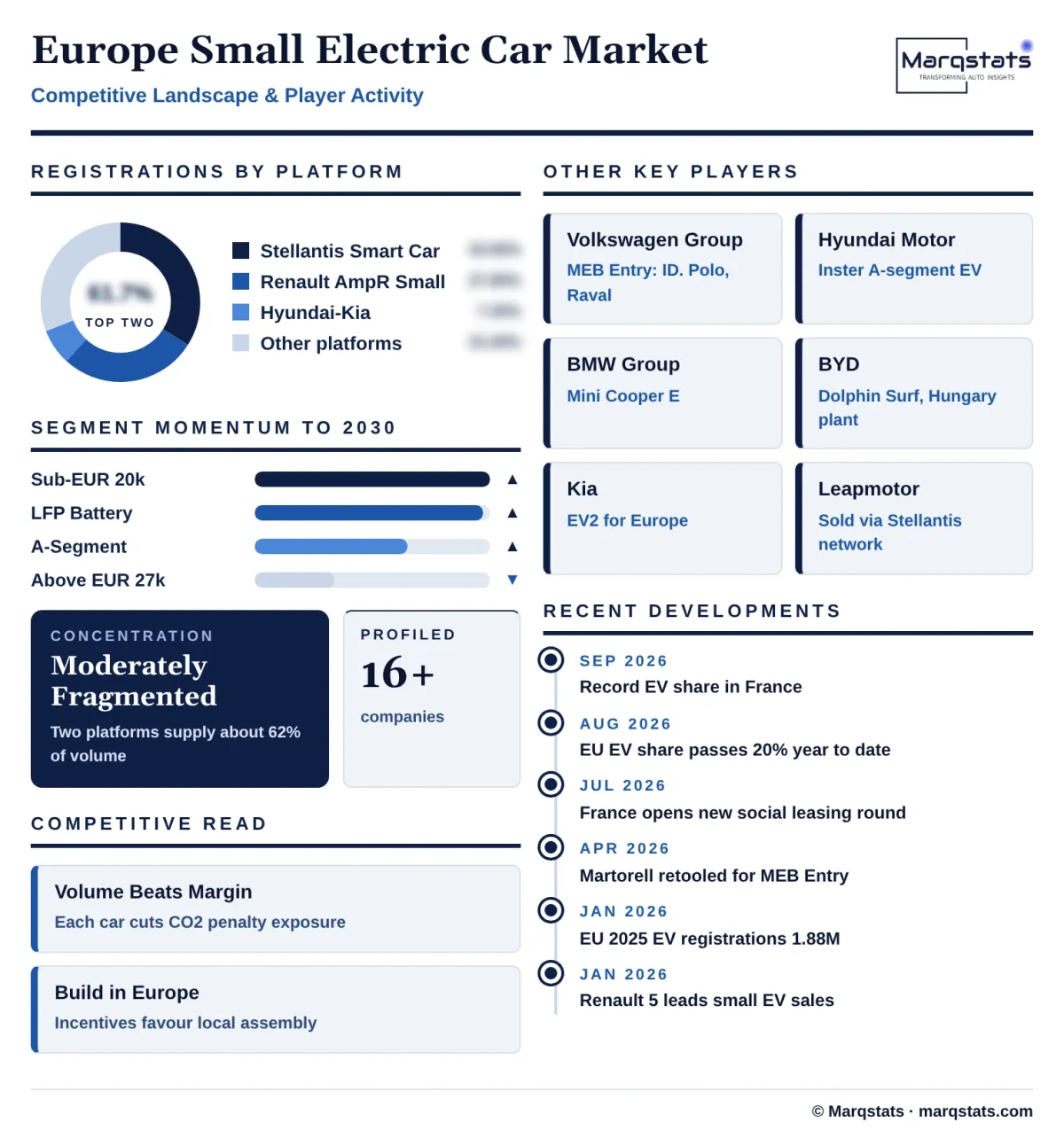
The Europe small electric car market is moderately fragmented. Stellantis and Renault Group lead through their shared Smart Car and AmpR Small platforms, which together accounted for about 62% of 2025 registrations, followed by Hyundai Motor Company, BMW Group with the Mini Cooper E, Volkswagen Group, SAIC Motor with MG, BYD, Geely Holding with the Volvo EX30 and smart, and Dacia, part of Renault Group, with the Spring.
Stellantis offers the widest range. Its Smart Car platform underpins the Citroën ë-C3 built in Trnava, Slovakia, the Fiat Grande Panda built in Kragujevac, Serbia, and the Opel Frontera, while the Peugeot e-208, Opel Corsa Electric and Fiat 500e use other platforms. Through its 51% share of Leapmotor International, Stellantis also sells Chinese-developed small electric cars in Europe.
Renault Group leads the B-segment. The Renault 5, built at the Douai ElectriCity plant in France, was Europe's best-selling small electric car in 2025, and the Renault 4, Alpine A290 and Nissan Micra share the AmpR Small platform. The Renault Twingo electric, due in 2026, targets a price below EUR 20,000, while the Dacia Spring remains Europe's cheapest small electric car.
Volkswagen Group and Korean and Chinese brands are the main challengers. Volkswagen Group is preparing the ID. Polo, ID. Cross, Cupra Raval and Škoda Epiq on its MEB Entry platform at Martorell and Pamplona in Spain. Hyundai's Inster, built in Gwangju, South Korea, sold about 34,000 units in Europe in 2025, Kia is launching the EV2, and BYD is entering the segment with the Dolphin Surf and building a European plant in Hungary.
Pricing strategy is changing. Manufacturers are using leasing offers, trade-in bonuses and national incentives rather than headline list price cuts to move small electric cars, which protects residual values. Social leasing in France and company car tax relief in Germany have become key channels for small electric car volume, and manufacturers with European-built models are best placed to use them.
Competition is shifting to cost and localisation. With EU CO2 targets pushing volume and incentives rewarding European production, the winners will be manufacturers that combine low-cost platforms, LFP batteries and European assembly. Price competition will intensify as more models launch below EUR 20,000 from 2026.
Companies Covered
Companies covered in the report include:
Recent Market Activity
Table of Contents
Coverage & Segmentation
The study covers the Europe small electric car market across the 27 EU member states, the United Kingdom, Norway, Switzerland and Iceland, with 2025 as the base year, 2021 – 2025 as the historical period and 2026 – 2030 as the forecast period. Values are in US dollars, converted from euros at the 2025 European Central Bank average of USD 1.13 per euro. The market is defined as the value of new A-segment and B-segment battery electric passenger cars (category M1) at net transaction prices excluding VAT. It is segmented by car segment, price band and battery chemistry.
Plug-in hybrids, range-extended electric vehicles, full and mild hybrids, fuel cell cars, C-segment and larger electric cars, light commercial vans and L-category quadricycles are excluded, as are used cars, charging and aftersales revenue. The small electric car share of battery electric registrations, the average transaction prices and the segment, price band, chemistry and country splits are Marqstats estimates built on ACEA, KBA, SMMT and national registration data and manufacturer disclosures.