Market Snapshot
Middle bar: base-year value × (1 + CAGR), rounded to two decimals. This is a calculated illustration, not a separately researched annual estimate.
The India used electric car market size is estimated at USD 383.48 million in 2025 and is projected to reach USD 2,027.59 million by 2030, growing at a CAGR of 39.52% over 2026 – 2030. Resale transactions grow from about 42,500 cars to 245,000, a 41.96% annual rate, as the large 2024 and 2025 cohorts of new electric cars reach their first change of ownership.
Marqstats defines the market as the gross transaction value of pre-owned battery electric passenger cars that change ownership in India, through organised online platforms, carmaker certified pre-owned programmes, independent dealers and direct sales between individuals. In rupee terms, the market grows from INR 3,336.25 crore in 2025 to INR 17,640.00 crore in 2030. Values are converted at INR 87.00 per US dollar. Used electric two-wheelers and three-wheelers, hybrids, petrol, diesel and CNG cars, and new car sales are excluded.
Cars that cost INR 8 lakh to 15 lakh when new, such as the Tata Nexon EV, Punch EV and Mahindra XUV400, account for an estimated 45.25% of 2025 value. South India accounts for 42.00% of 2025 value and West India for 31.00%. The study segments the market by original price class, sales channel, body type and region.
Key Takeaways
Market Overview & Analysis
Report Summary
Marqstats sizes the India used electric car market as the gross value of pre-owned battery electric passenger cars that change ownership in a year, at the price paid by the buyer. In 2025 about 42,500 used electric cars changed hands at an average price of about INR 7.85 lakh, worth an estimated INR 3,336.25 crore or USD 383.48 million. Used electric cars were still a small part of India's used car market of nearly 6 million cars a year, but they are the fastest-growing part of it.
Supply comes from new car sales. India's retail sales of new electric passenger cars rose 77.04% from 99,875 in 2024 to 176,817 in 2025, according to dealer association data, and monthly sales exceeded 36,000 in September 2026. Tata Motors, JSW MG Motor India and Mahindra together sold close to 88% of new electric cars in 2025. These cars form the supply of used electric cars over 2026 to 2030, as owners trade up after three to four years and fleet operators replace cars after two and a half to three years.
The first used electric cars in India were Mahindra eVerito sedans and early Tata Nexon EVs sold by companies and fleet operators. Volumes grew from about 4,800 in 2021 to 9,500 in 2022, 18,200 in 2023 and 27,600 in 2024, as online platforms such as Spinny, Cars24 and CarDekho began listing electric cars and carmakers launched certified pre-owned programmes.
Valuation is different from a petrol car. The battery accounts for 35% to 50% of a used electric car's replacement value, so the battery's state of health, measured as usable capacity compared with the original, matters more than engine condition or odometer reading. Buyers need diagnostic reports that read the battery management system, cell voltage balance and charging history, which most independent dealers cannot produce.
Policy shapes the market. The Ministry of Road Transport and Highways requires used car dealers to obtain authorisation certificates and treats authorised dealers as deemed owners of cars in their stock. Its January 2026 draft guidelines for a Battery Pack Aadhaar Number would give every electric vehicle battery a unique 21-character identity recording its life from manufacture to recycling. The Battery Waste Management Rules, 2022 make carmakers responsible for collecting and recycling end-of-life batteries.
Marqstats expects about 78,000 used electric car transactions worth INR 5,943.60 crore, or USD 683.17 million, in 2026, rising to 245,000 transactions worth INR 17,640.00 crore, or USD 2,027.59 million, in 2030.
Two groups of used electric cars now trade at very different prices. Single-owner electric SUVs and crossovers, often charged mainly at home and fitted with LFP batteries, hold their value well and sell quickly through certified channels. High-mileage former fleet sedans, many with batteries below 80% state of health after years of daily fast charging, sell at deep discounts to taxi drivers, small operators and buyers looking for the cheapest possible electric car.
India Used Electric Car Market Size and Forecast
The India used electric car market grows from USD 383.48 million in 2025 to USD 2,027.59 million in 2030, a CAGR of 39.52%. In rupees, the market grows from INR 3,336.25 crore to INR 17,640.00 crore at the same rate. Transactions grow faster, at 41.96% a year, from about 42,500 to 245,000.
Growth is fastest in the near term. Marqstats estimates transactions of about 78,000 in 2026, 115,000 in 2027, 154,000 in 2028 and 196,000 in 2029, worth USD 683.17 million, USD 984.77 million, USD 1,301.03 million and USD 1,640.09 million respectively. Annual growth slows from about 84% in 2026 to about 25% in 2030 as the market grows larger.
Average prices fall slowly. The average resale price falls from about INR 8.80 lakh in 2021 to INR 7.85 lakh in 2025 and INR 7.20 lakh in 2030, because the mix shifts towards affordable hatchbacks such as the Tata Tiago EV and MG Comet EV, and towards high-mileage former fleet sedans. Single-owner electric SUVs with healthy LFP batteries keep strong prices.
Depreciation is steeper than for petrol cars but is improving. A mainstream electric car loses about 22% to 26% of its value in the first year, against 15% to 20% for a petrol car. After three years, a well-maintained personal electric SUV with an LFP battery keeps about 58% to 64% of its original price, an early NMC electric SUV 50% to 55%, and a former fleet sedan only 25% to 30%. Price cuts on new electric cars and new models with larger batteries pull down used prices.
The used electric car market also grows as a share of India's used car market. Marqstats expects used electric cars to rise from less than 1% of used car transactions in 2025 to about 2.6% by 2030, as India's used car market grows towards about 9.5 million cars a year.
Marqstats tracks four indicators to monitor the forecast: new electric car registrations two to four years earlier, the share of used electric cars sold with a certified battery health report, average resale value after three years, and the share of used electric car purchases financed by banks and non-bank lenders.
Financing is a lever for growth. Lenders have typically charged 150 to 300 basis points more on used electric car loans than on comparable petrol car loans and limited loan-to-value ratios to about 70% to 75% because of uncertainty over battery condition. Finance penetration is about 45% to 52% on cars sold through organised platforms and carmaker programmes, against about 18% at independent dealers and 12% in private sales. As certified battery reports become standard, Marqstats expects lenders to narrow this premium and lend on more cars, supporting faster growth in the certified channels.
Market Dynamics
Key Drivers
Five forces are expanding resale of electric cars in India.
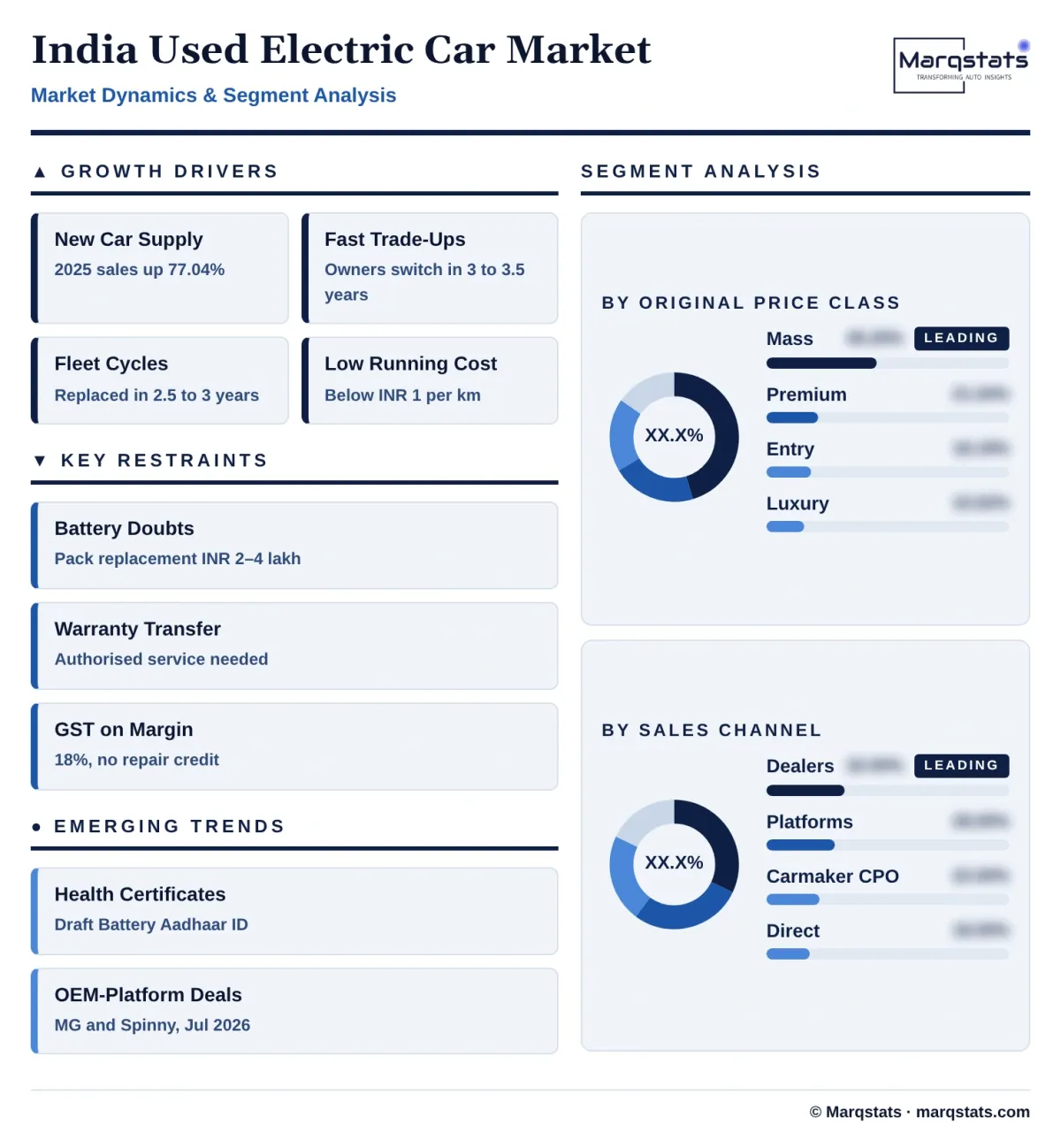
- New car sales create supply. New electric passenger car sales rose 77.04% in 2025 to 176,817, and these cars begin to reach the used market from 2027 onwards, adding to the cars sold in 2021 to 2024.
- Owners trade up quickly. Private electric car owners replace their cars after three to three and a half years to get larger batteries, longer range, faster charging and driver assistance features, faster than the four years typical for petrol cars.
- Fleet operators replace cars on schedule. Ride-hailing and corporate fleets replace electric cars after two and a half to three years because of high mileage, creating regular waves of supply.
- Running costs attract buyers. Used electric cars offer running costs below INR 1 per km on home charging, attractive to commuters and small businesses facing high fuel prices.
- Carmakers support resale value. JSW MG Motor India offers an assured buyback on the Windsor EV, Tata Motors runs Tata Motors Assured, and carmakers are building certified pre-owned programmes to protect residual values and new car sales.
Key Restraints
Four constraints hold back prices and trust in used electric cars.
- Battery uncertainty. Buyers worry about battery wear and replacement costs of INR 2 lakh to 4 lakh, and many sellers cannot provide a reliable battery health report.
- Warranty transfer conditions. Battery warranties of eight years or 160,000 km usually pass to the next owner only if the car has been serviced at authorised workshops and the transfer is registered with the carmaker, and some new offers such as lifetime battery warranties apply only to first owners.
- Tax on dealer margins. Registered dealers pay 18% GST on their margin without input tax credit for reconditioning, discouraging investment in battery refurbishment.
- Charging access. Used car buyers are more likely to live in apartments without a private charging point, so used electric cars sell more slowly in cities with few public fast chargers, where cars can take more than 60 days to sell.
Key Trends
Four shifts are changing how used electric cars are checked, priced and sold.
- Battery health certificates. Platforms and carmakers issue state of health certificates based on battery management system data, and the draft Battery Pack Aadhaar Number would create a national record for each battery.
- Carmaker and platform partnerships. Carmakers are working with online platforms to sell certified used electric cars with warranty continuity, as JSW MG Motor India and Spinny did in July 2026.
- Battery-as-a-service models. Tata Motors and JSW MG Motor India offer new electric cars with the battery rented per kilometre, which may separate battery and vehicle values in future resale transactions.
- Data-led pricing. Online platforms use pricing models that take account of battery chemistry, charging history, climate and local demand to value used electric cars more accurately.
Strategic Implications
- For online platforms, battery diagnostics are the main competitive edge. Platforms that read battery data, issue trusted certificates and offer warranties will sell cars faster and at higher margins than dealers that rely on cosmetic reconditioning.
- For carmakers, used car values support new car sales. Assured buyback programmes, easy warranty transfer and certified pre-owned sales protect residual values, lower lease costs and help carmakers recover old batteries for recycling.
- For lenders, battery health should replace age as the main credit input. Lenders that use measured state of health to set loan-to-value ratios and interest rates can lend more safely and win share from cautious competitors.
- For independent dealers, partnerships are the way to stay relevant. Dealers that partner with diagnostic providers and certified programmes can keep selling electric cars; those that do not will lose share to organised channels.
- For policymakers, two changes would make the market more transparent: finalising the Battery Pack Aadhaar Number, and allowing dealers to account for battery refurbishment costs under the GST margin scheme.
- For insurers and warranty providers, used electric cars create demand for new products. Extended battery warranties, battery health-based pricing and cover for high-voltage repairs can help buyers accept used electric cars and give insurers a growing line of business.
Market Segmentation
Entry cars, including the Tata Tiago EV, MG Comet EV, older Tata Tigor EVs and former fleet sedans, account for 34.00% of 2025 transactions and 18.19% of value, USD 69.76 million, rising to USD 302.17 million by 2030, a 34.07% CAGR. Their share of value falls to 14.90% as average prices for former fleet sedans stay low.
Mass-market cars, led by the Tata Nexon EV, Punch EV and Mahindra XUV400, account for 48.00% of transactions and 45.25% of 2025 value, USD 173.52 million, rising to USD 865.10 million by 2030, a 37.89% CAGR. These cars offer 200 to 280 km of real-world range and suit single-car households.
Premium cars, including the MG ZS EV, Tata Curvv EV and BYD Atto 3, account for 14.00% of transactions and 21.04% of 2025 value, USD 80.70 million, and grow fastest, at 44.49% a year, to USD 508.31 million and 25.07% of value by 2030.
Luxury cars, including the BMW iX, Mercedes-Benz EQ models and BYD Seal, account for 4.00% of transactions and 15.52% of 2025 value, USD 59.50 million, rising to USD 352.01 million by 2030, a 42.69% CAGR, as steep early depreciation attracts buyers.
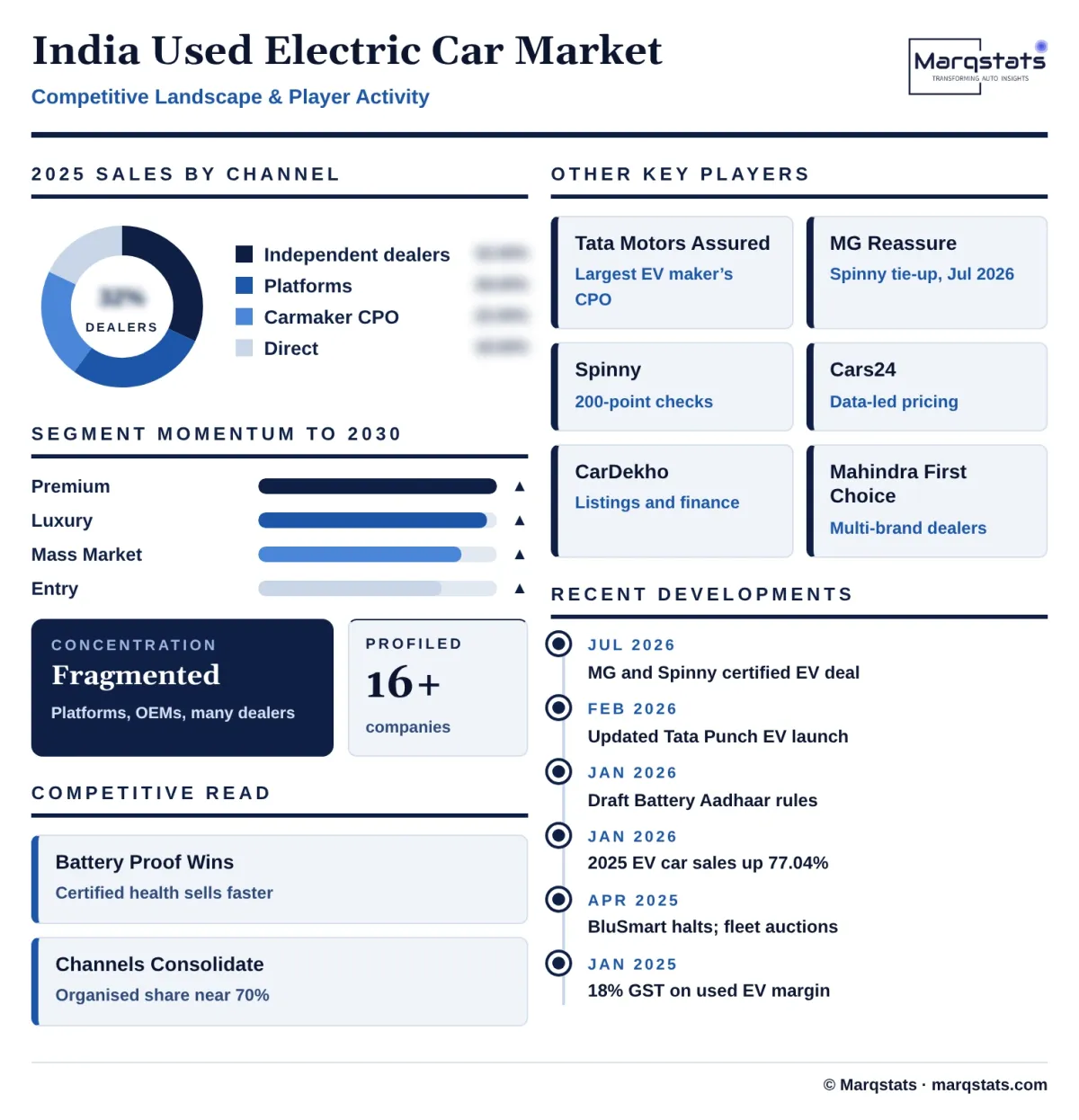
Spinny, Cars24, CarDekho and other platforms that buy, recondition and sell cars handle about 28% of 2025 transactions, rising to about 36% by 2030. They offer 200-point inspections, short warranties and five-day money-back guarantees.
Tata Motors Assured, MG Reassure and other carmaker programmes handle about 22% of 2025 transactions, rising to about 34% by 2030, because authorised workshops can read battery data directly and offer warranty continuity.
Independent dealers handle about 32% of 2025 transactions but fall to about 18% by 2030, as most lack high-voltage diagnostic equipment and hold electric cars for 42 to 55 days, against about 28 days for petrol hatchbacks.
Direct sales through classified sites and owner forums account for about 18% of 2025 transactions, falling to about 12% by 2030, because buyers bear the risk of unchecked battery health and outstanding loan records.
Electric SUVs and crossovers account for about 62% of 2025 transactions, rising to about 68% by 2030. Ground clearance of 190 mm to 205 mm protects underfloor batteries, and three-year value retention is 68% to 74% for well-kept cars.
Electric hatchbacks account for about 26% of transactions, falling to about 22%, with lower three-year value retention of 58% to 63% because of smaller batteries and shorter range.
Electric sedans account for about 12% of transactions, falling to about 10%, with the steepest depreciation because of large volumes of former fleet cars.
By Geography
South India
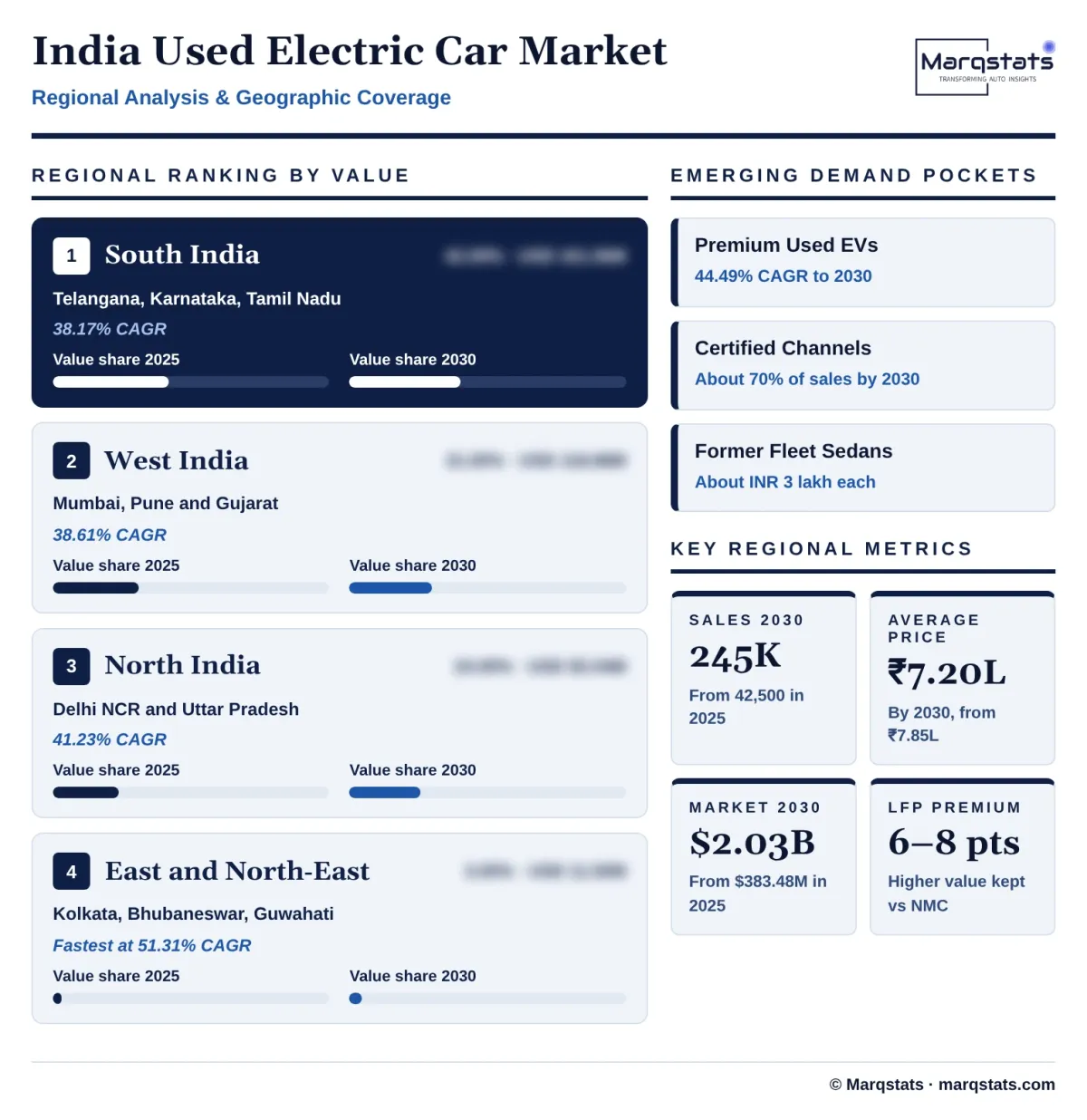
South India is the largest market, with an estimated 42.00% of 2025 value, USD 161.06 million and about 17,850 transactions, rising to USD 811.03 million by 2030, a 38.17% CAGR. Telangana, Karnataka, Tamil Nadu and Kerala are important markets. Telangana's road tax and registration fee exemptions for electric vehicles support resale, Bengaluru accounts for more than half of Karnataka's electric vehicle registrations, and Kerala's changes to electric vehicle taxes have slowed sales.
West India
West India accounts for an estimated 31.00% of 2025 value, USD 118.88 million and about 13,175 transactions, rising to USD 608.28 million by 2030, a 38.61% CAGR. Maharashtra is the largest single state for used electric car sales, led by the Mumbai, Pune and Thane area, where early adoption and home charging support resale. Gujarat cut road tax on electric vehicles from 6% to 1% from April 2025 to March 2026, boosting new sales that will feed future resale.
North India
North India accounts for an estimated 24.00% of 2025 value, USD 92.04 million and about 10,200 transactions, and grows at 41.23% a year to USD 517.04 million by 2030. Delhi NCR leads, supported by road tax waivers, dense public charging and age limits on diesel and petrol cars, followed by Uttar Pradesh.
East and North-East India
East and North-East India accounts for an estimated 3.00% of 2025 value, USD 11.50 million, and grows fastest, at 51.31% a year, to USD 91.24 million by 2030, from a small base as Kolkata, Bhubaneswar and Guwahati add public charging and new electric car sales.
How Competition Is Evolving
The India used electric car market is fragmented. Organised online platforms and carmaker certified pre-owned programmes handle about half of transactions, while thousands of independent dealers and private sellers handle the rest.
Online platforms such as Spinny, Cars24 and CarDekho compete on inspection, warranties, financing and delivery. Cars24 and Spinny use data-driven pricing models and have added electric vehicle diagnostic tools to their reconditioning centres.
Carmakers are building their own channels. Tata Motors Assured, MG Reassure and Mahindra First Choice Wheels sell certified used cars through dealers, and JSW MG Motor India partnered with Spinny in July 2026 to sell certified used MG electric cars with battery health certification and warranty continuity.
Diagnostic and service providers, lenders and insurers form the supporting ecosystem. Battery testing firms, banks and non-bank lenders such as Tata Capital, and insurers that cover used electric cars all influence how quickly cars sell and at what price.
Competition will be decided by trust in battery health. Sellers that can prove battery condition, transfer warranties and arrange finance will win the largest share of growth.
Companies Covered
Companies covered in the report include:
Recent Market Activity
Table of Contents
Coverage & Segmentation
The study covers the India used electric car market, with 2025 as the base year, 2021 – 2025 as the historical period and 2026 – 2030 as the forecast period. Values are in US dollars converted from Indian rupees at INR 87.00 per US dollar, and volumes are annual changes of ownership of battery electric passenger cars. The market is segmented by original price class, sales channel, body type and region.
Used electric two-wheelers and three-wheelers, hybrids and plug-in hybrids, petrol, diesel and CNG cars, commercial goods vehicles and new car sales are excluded. Segment and regional splits are Marqstats estimates built on registration data, platform and carmaker disclosures, resale price benchmarks and dealer interviews.