Market Snapshot
Key Takeaways
Market Overview & Analysis
Report Summary
The Europe used EV market comprises second-hand passenger cars powered by battery-electric or plug-in hybrid drivetrains and resold through fleet and lease remarketing channels, original-equipment certified pre-owned programs, franchised dealers, independent dealers, and online retail platforms. Sized on the basis of the five largest national markets—Germany, the United Kingdom, France, Italy, and Spain—which together account for the large majority of European used-EV activity, the market was worth an estimated USD 35.57 billion in gross transaction value in 2025 on roughly 1.3 million units. The share of used-car transactions that are electric quadrupled from about 1% in 2021 to roughly 4% in 2025.
Europe’s used-EV market is unusually professionalized because its supply profile is set by the fleet channel. With only around 40% of new-car registrations coming from private buyers, the second-hand pipeline is largely pre-determined by leasing, salary-sacrifice, and company-car decisions taken three to four years earlier. That structure gives remarketing platforms, captive lessors, and OEM certified pre-owned programs an outsized role relative to pure consumer-to-consumer trade. The best-performing age band is three-to-six-year-old ex-fleet and ex-lease vehicles—old enough to be affordable yet young enough to retain most of their battery warranty—where consumer enquiries rose about 50% year over year and cars sold in an average of 25 days.
Pricing has moved from correction to normalization. Battery-electric residual values across the five markets fell from about 50% retention in 2022 to roughly 35% in 2025 as a post-supply-squeeze reset and new-vehicle price competition compressed used values, and residual providers expected a further modest decline through 2025 before stabilizing. By mid-2026, however, UK used-EV prices had returned to year-over-year growth for the first time since 2022, and elevated petrol prices through the first half of 2026 lifted used-EV demand—UK buyers alone were estimated to have spent £1.3 billion more on EVs in the 100 days after fuel prices spiked. Europe therefore appears to be moving from a residual-value correction phase into a normalization phase.
The plug-in mix is shifting steadily toward battery-electric. In Europe’s new-EV market, BEVs rose from 55% of electric-car sales in 2020 to nearly 70% in 2025, and UK used-car data already show battery-electric volumes far ahead of plug-in hybrids in second-hand plug-in sales. Plug-in hybrids remain commercially useful in corporate fleets and in markets with weaker charging access, but the European used-EV market is becoming progressively more BEV-led as those newer cohorts mature into the second-hand channel.
Trust infrastructure is the market’s emerging differentiator, and Europe is regulating it faster than any other region. Rather than a purchase subsidy, the decisive policy lever is traceability: the EU’s battery framework introduced a digital battery registry from 20 July 2026, with the battery passport mandatory for relevant categories from 18 February 2027, while tightening recycling rules target 90% recovery of cobalt, copper, lead, and nickel and 50% of lithium by 2027. Alongside independent state-of-health certification and battery-warranty transfer, these measures convert battery condition from a hidden risk into a priced, portable attribute. Insurance and repairability remain frictions—EV repair costs have run about 25% higher and repair times about 14% longer than for comparable combustion cars—so operators increasingly bias inventory toward models with stronger parts and repair ecosystems and toward channels that can certify battery health credibly.
Market Dynamics
Key Drivers
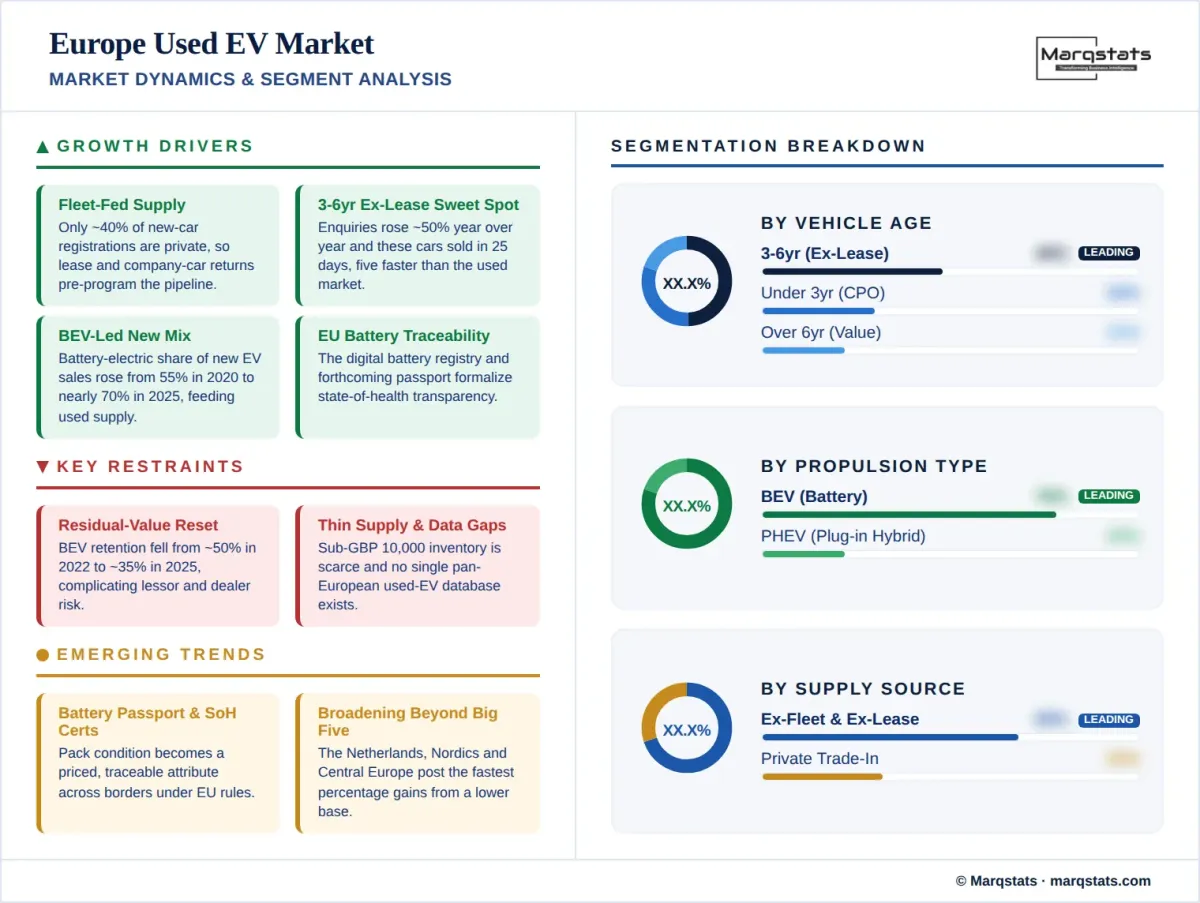
Fleet-fed supply: with only ~40% of new-car registrations private, lease maturities, salary-sacrifice returns, and company-car renewals pre-programme a durable and rising used-EV inventory.
The three-to-six-year ex-lease sweet spot: enquiries up ~50% year over year and 25-day average selling times make affordable, warranty-intact ex-fleet BEVs the mass-market entry point.
BEV-led new-market mix: battery-electric share of European new EV sales rose from 55% in 2020 to nearly 70% in 2025, feeding a progressively BEV-heavy second-hand supply base.
Fuel-cost sensitivity: elevated petrol prices through the first half of 2026 pushed buyers toward pre-owned electric cars, with UK buyers estimated to have spent £1.3 billion more on EVs in 100 days.
Battery transparency and EU regulation: the EU digital battery registry and forthcoming battery passport are formalizing state-of-health traceability, raising buyer confidence in used-EV condition.
Key Restraints
Sharp residual-value reset: battery-electric retention across the five markets fell from about 50% in 2022 to roughly 35% in 2025, complicating lessor and dealer risk management.
Thin low-price supply: sub-£10,000 used-EV inventory remains scarce, leaving the lower-income household segment only partly electrified.
Fragmented pan-European data: no single official European used-EV transaction database exists, and national reporting standards differ, complicating cross-border pricing and sourcing.
Higher insurance and repair friction: EV repair costs have run about 25% higher and repair times about 14% longer than for comparable combustion cars, raising write-off risk on damaged units.
Key Trends
Battery state-of-health certification and the EU battery passport are becoming standard, turning pack condition into a priced, traceable attribute across borders.
Digital used-EV retail is scaling, with dedicated online resale platforms and OEM-backed marketplaces expanding sourcing, inspection, and financing across markets.
Fleet and lease remarketing is professionalizing, as captive lessors and OEM certified pre-owned programs standardize inspection, warranty transfer, and multi-channel disposal.
Growth is broadening beyond the big five: smaller markets such as the Netherlands, the Nordics, and Central Europe are posting the fastest percentage gains from a lower base.
Market Segmentation
Battery-electric vehicles are the volume core of the European used-EV market and are gaining share as new-market BEV penetration—up from 55% in 2020 to nearly 70% in 2025—feeds the second-hand channel. UK used-car data already show battery-electric volumes well ahead of plug-in hybrids. BEV values are more exposed to new-vehicle price competition and battery-health scrutiny, making state-of-health certification and warranty transfer the decisive trust variables.
Plug-in hybrids form a meaningful but shrinking share of used plug-in supply. They retain appeal in corporate fleets and in markets with weaker charging access, and their residual values tend to be steadier than BEVs because they are less exposed to fast-charging and range-degradation concerns. Over the forecast period, however, the used mix tilts further toward battery-electric.
Sub-three-year vehicles are largely ex-demonstration, ex-lease, and manufacturer certified pre-owned stock. They carry the strongest battery-warranty coverage and command the highest ticket prices, and they underpin OEM CPO programs that behave commercially more like the nearly-new market than the used market.
The three-to-six-year band is Europe’s demand and value sweet spot. These ex-fleet and ex-lease battery-electric cars are affordable yet still hold most of their original battery warranty; consumer enquiries rose about 50% year over year and the cars sold in an average of 25 days—about five days faster than the broader used market.
Vehicles older than six years anchor the affordability tier but depend heavily on independent battery certification to convert value-focused buyers. Supply below £10,000 remains scarce, which keeps the lower-income household segment only partly electrified across the region.
Ex-fleet and ex-lease vehicles are the dominant and most predictable supply source, reflecting that the majority of European new-car registrations are non-private. Standardized condition, mileage, and service history make this channel the backbone of professional remarketing and OEM certified pre-owned inventory.
Private trade-ins and consumer-to-consumer sales are a smaller, less standardized source. They matter more in markets with higher private new-car ownership, but battery and warranty complexity continues to favor professional, inspection-backed sellers over pure peer-to-peer transactions.
Fleet and lease remarketing—often paired with OEM certified pre-owned programs—commands the trust-sensitive, higher-value end of the market. Captive lessors and manufacturers bundle inspection, transferable battery warranty, and financing, and their residual-value decisions directly shape future used-EV flow.
Franchised dealers move certified and near-new used EVs with manufacturer backing, competing on trust, service capability, and warranty. They are central to converting ex-lease inventory into retail transactions across the major markets.
Independent dealers and online-first platforms compete on price, inventory breadth, and convenience, pooling demand across borders. Digital resale platforms are scaling rapidly, though battery and warranty complexity still favors inspection-backed professional sellers.
By Geography
Germany
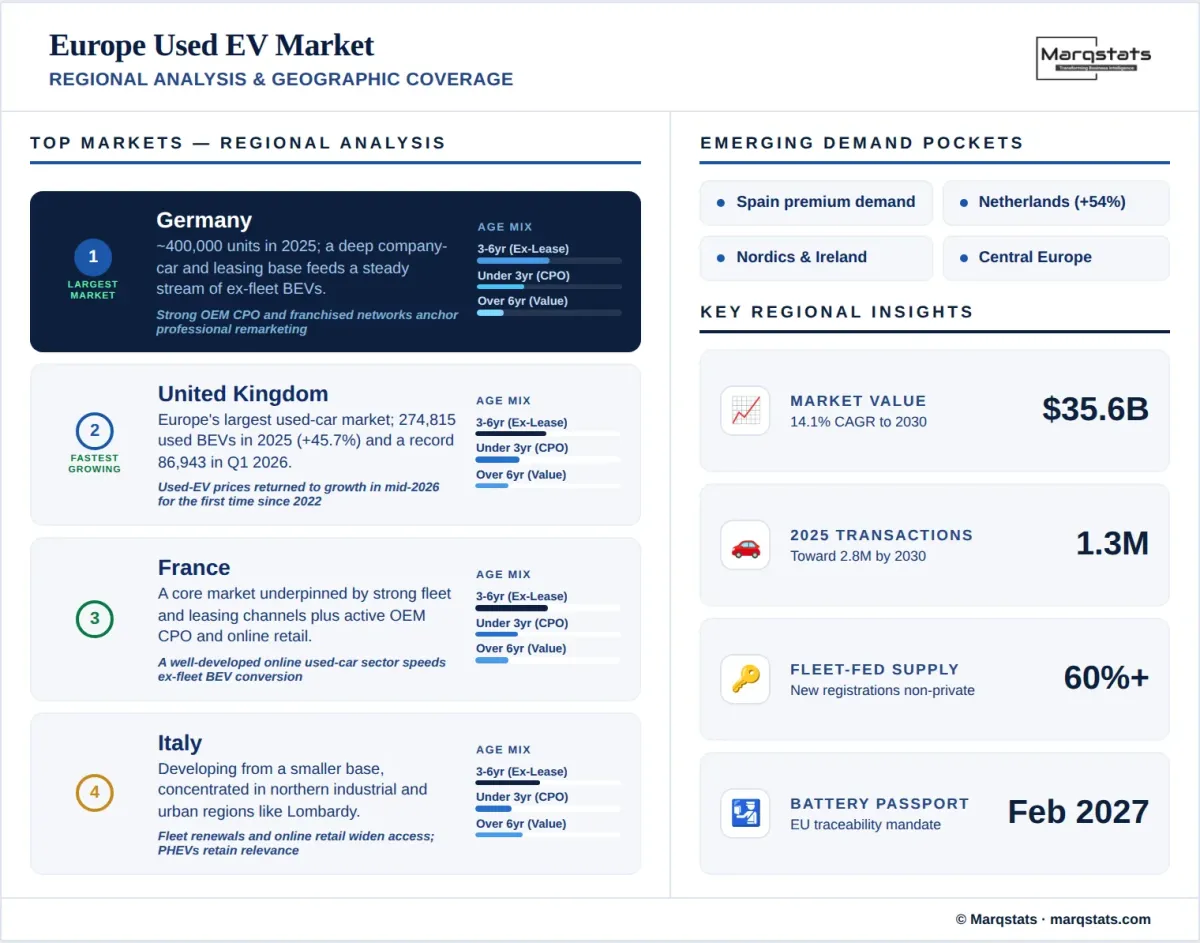
Germany is the largest European used-electric market by volume, at around 400,000 units in 2025, supported by a deep company-car and leasing base that feeds a steady stream of ex-fleet BEVs into the second-hand channel. Strong OEM certified pre-owned participation and a large franchised-dealer network make Germany the anchor of the region’s professionalized remarketing model.
United Kingdom
The United Kingdom is Europe’s largest overall used-car market, with nearly 8 million used cars sold in 2025, and a fast-growing used-EV segment: 274,815 used battery-electric transactions in 2025, up 45.7%, followed by a record 86,943 in the first quarter of 2026, up 32%, alongside 20,021 used plug-in hybrids. UK used-EV prices returned to year-over-year growth in mid-2026 for the first time since 2022, signaling residual-value stabilization.
France
France is a core used-EV market underpinned by strong fleet and leasing channels and active OEM certified pre-owned and online-retail participation. Ex-lease battery-electric supply and affordability-led demand position France among the region’s largest contributors to used-EV volume over the forecast period. A well-developed domestic online used-car sector and captive-finance remarketing accelerate the conversion of ex-fleet BEVs into retail transactions, and buyer interest has broadened as three-to-six-year-old electric cars reach affordable price points.
Italy
Italy’s used-EV market is developing from a smaller base, with demand concentrated in northern industrial and urban regions such as Lombardy and the metropolitan corridors. Fleet renewals and expanding online retail are widening access, while plug-in hybrids retain relevance in areas with less mature charging infrastructure. As affordable ex-lease battery-electric inventory grows, Italy is expected to narrow the adoption gap with the northern European markets over the forecast period.
Spain
Spain is an emerging used-EV market where rising new-EV adoption and fleet turnover are beginning to feed second-hand supply. Demand for used premium electric cars has strengthened—regional marketplace data pointed to a roughly 37% year-over-year increase in interest in used premium electric cars in mid-2026, with supply up about 22%—and affordable ex-lease inventory is broadening the buyer base across Madrid, Barcelona, and other major metropolitan areas.
Rest of Europe
Beyond the five largest markets, smaller European markets are posting the fastest percentage growth. The Netherlands’ used-EV sales rose more than 54% to 70,547 cars in the first half of 2026, the Czech Republic’s nearly doubled to 11,998 units (+98%), and Nordic markets and Ireland—where used EVs became cheaper than comparable diesels—are electrifying quickly from a lower base. Collectively, the Rest of Europe is the fastest-growing regional grouping.
How Competition Is Evolving
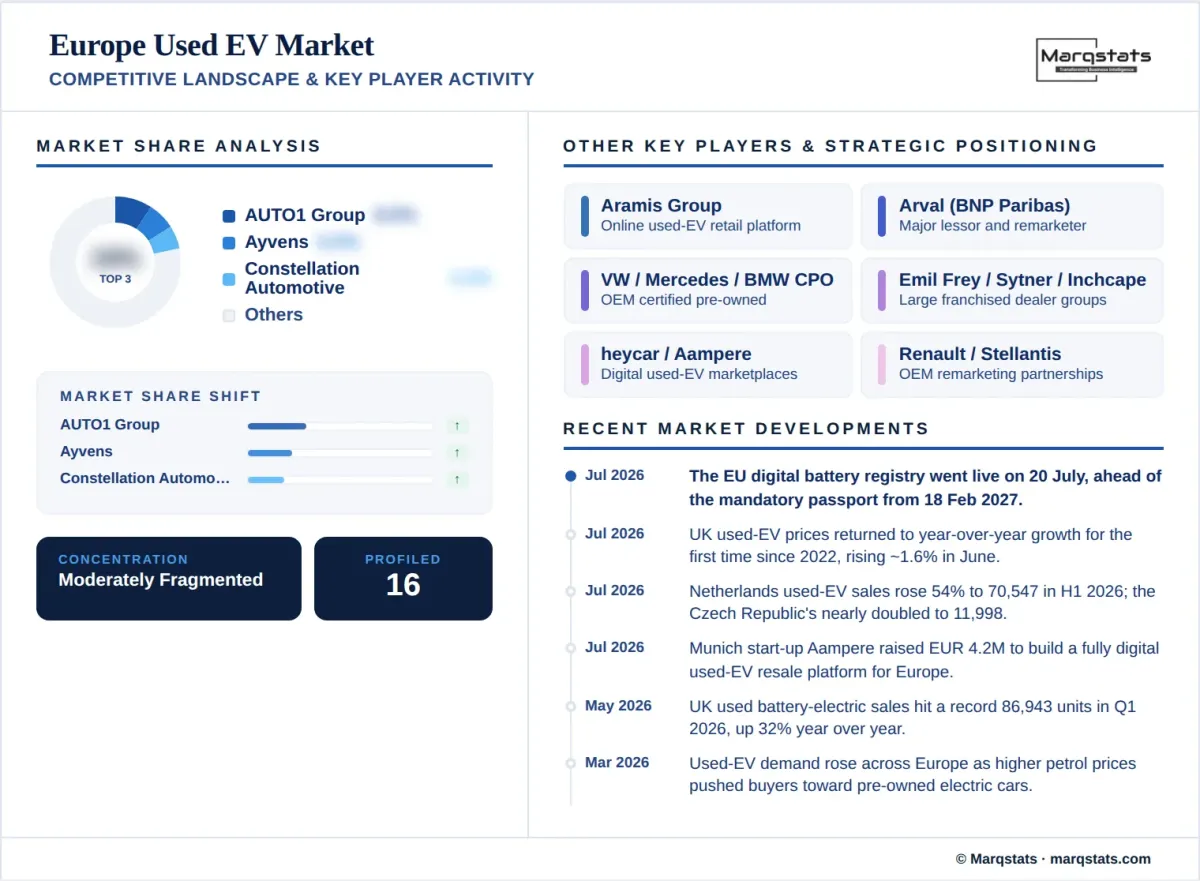
The Europe used EV market is moderately fragmented and unusually professionalized, spanning pan-European wholesale marketplaces, fleet lessors and remarketers, OEM certified pre-owned programs, large franchised-dealer groups, and online-first retailers. Competitive advantage is shifting toward operators that can combine fleet-fed sourcing, battery diagnostics, reconditioning, financing, and multi-channel disposal, because scale without battery transparency is becoming less defensible as state-of-health certification and the EU battery passport turn pack condition into a priced, traceable attribute.
Independent digital platforms are among the most influential players: the largest pan-European used-car marketplace sold more than 840,000 vehicles in 2025 and held around 3.1% of the continent’s used-car market, expanding data-led pricing and financing. Fleet lessors are equally pivotal on the supply side—one major lessor sold roughly 304,000 used units in the first half of 2025—and their residual-value decisions determine future used-EV flow; several have flagged that rising used-EV volumes could exceed market appetite and pressure prices.
Original-equipment manufacturers are deepening certified pre-owned and remarketing partnerships to capture more resale margin and defend residuals, while online retailers and newly funded digital resale start-ups expand inspection, battery-scoring, and cross-border logistics. The durable winners are increasingly hybrid operators: digital demand generation on the front end, inspection, reconditioning, and finance in the middle, and multi-channel remarketing on the back end. Because manufacturer- and channel-specific used-EV shares are rarely disclosed, competitive position is best read through vehicle throughput, used-car market share, and electrified mix rather than published EV-only rankings—and leadership will be won on reliable ex-lease sourcing, credible battery certification, and disciplined residual-value management rather than raw inventory scale.
Companies Covered
The report profiles 16++ companies with full strategy and financials analysis, including:
Recent Market Activity
Table of Contents
Coverage & Segmentation
This report provides a comprehensive analysis of the Europe used EV market for the historical period 2021–2025, with 2025 as the base year and a 2026–2030 forecast period. A used EV is defined as a second-hand passenger car powered by a battery-electric or plug-in hybrid drivetrain, and the market is quantified in gross transaction value (USD billion, converted from euro at prevailing mid-2026 rates) with unit volume as a validation metric. The market is sized on the basis of the five largest national markets—Germany, the United Kingdom, France, Italy, and Spain—which account for the large majority of European used-EV transactions, with additional qualitative coverage of the Netherlands, the Nordics, and Central Europe.
The study examines market sizing and forecasts, segmentation by propulsion type, vehicle age, supply source, and sales channel, regional demand across the major markets and the Rest of Europe, competitive structure, and the fleet, battery-health, financing, insurance, and regulatory factors shaping residual values. It integrates fleet-fed supply dynamics with affordability- and fuel-cost-driven demand, and it provides an operating framework for sourcing, pricing, certification, channel strategy, and residual-risk management.