Market Snapshot
Middle bar: base-year value × (1 + CAGR), rounded to two decimals. This is a calculated illustration, not a separately researched annual estimate.
The global electric luxury car market size is estimated at USD 225.30 billion in 2025 and is projected to reach USD 385.58 billion by 2030, growing at a CAGR of 11.34% over 2026 – 2030. Deliveries rise from about 2.54 million cars to 4.85 million, a 13.81% annual rate, while the average transaction price falls from about USD 88,700 to USD 79,500.
Marqstats defines the market as the wholesale and transaction value of new luxury and executive passenger cars with battery-electric, plug-in hybrid or extended-range electric powertrains, sold by luxury brands or premium model lines at average transaction prices above about USD 50,000. Mass-market electric cars, light commercial vehicles, mild hybrids, conventional hybrids, used cars and conversion kits are excluded.
Battery-electric cars account for an estimated 70.48% of 2025 value and SUVs and crossovers for 63.00%. China accounts for 42.00% of 2025 value and Europe for 30.00%. The study segments the market by powertrain, price tier, body type and region.
Key Takeaways
Market Overview & Analysis
Report Summary
Marqstats sizes the electric luxury car market as the wholesale and realised transaction value of new luxury and executive passenger cars with battery-electric, plug-in hybrid or extended-range electric powertrains. In 2025 about 2.54 million such cars were delivered worldwide, worth an estimated USD 225.30 billion at an average transaction price of about USD 88,700. This is about half of the roughly 5.1 million luxury cars sold worldwide across all powertrains.
The market includes three price tiers. Entry luxury cars priced about USD 50,000 to 80,000, such as the BMW i4 and iX3, Audi Q4 and Q6 e-tron, Mercedes-Benz CLA and Volvo EX40 and EX60, account for 55% of deliveries. Core executive cars priced USD 80,000 to 150,000, such as the BMW iX, Mercedes-Benz EQE and EQS, Porsche Macan Electric and NIO ET7, account for 38%. Top-end cars above USD 150,000, such as the Rolls-Royce Spectre, Porsche Taycan Turbo GT, Mercedes-AMG electric models and Lucid Air Sapphire, account for 7% of deliveries but 16.59% of value.
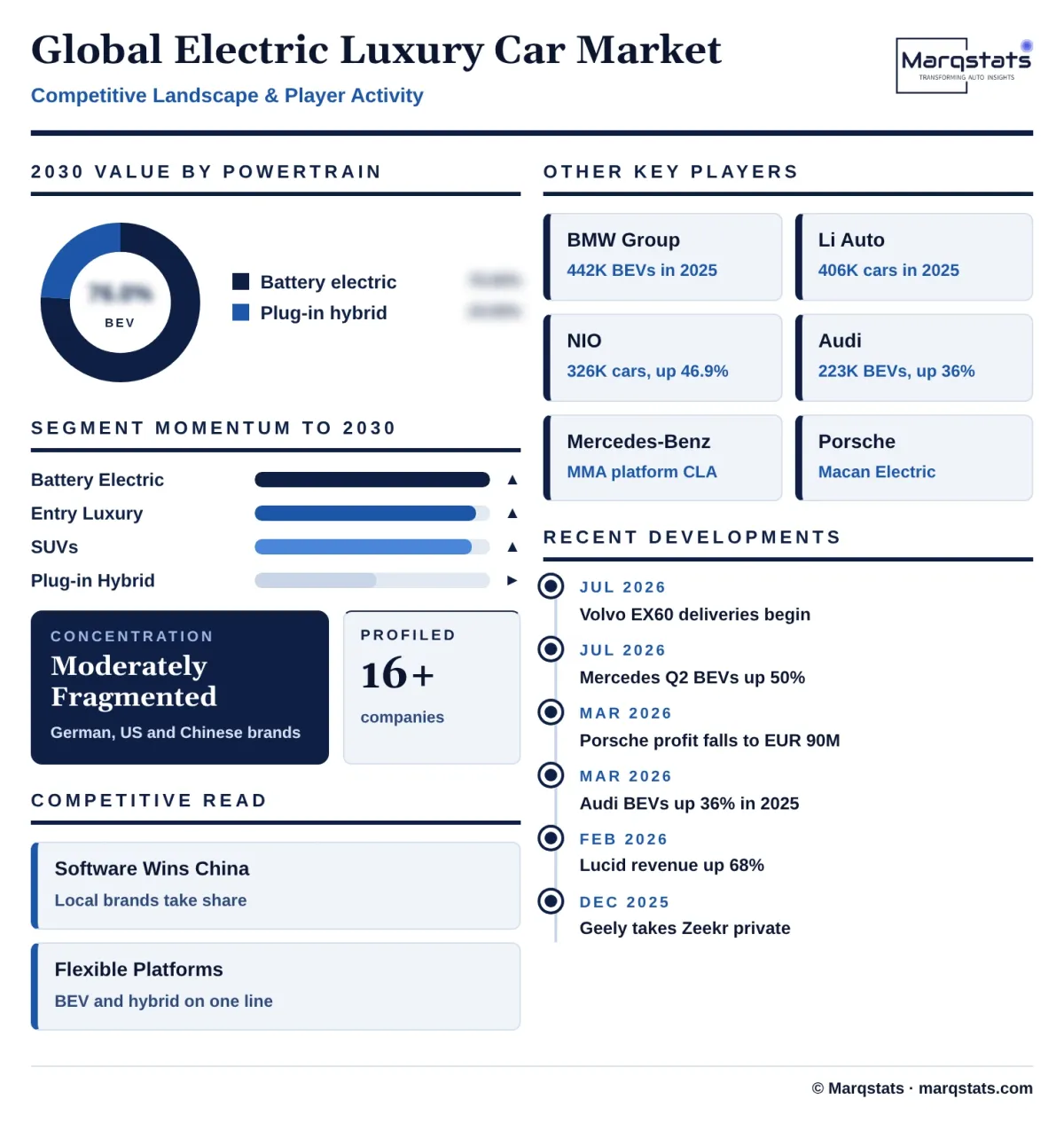
Two groups of manufacturers compete. Established luxury brands from Germany, Sweden, the United Kingdom and the United States are adding electric models to ranges that are still mostly petrol and diesel. BMW Group delivered 642,087 electrified cars in 2025, including 442,072 battery-electric cars, and Audi delivered 223,032 battery-electric cars, up 36%. Chinese premium brands sell only electrified cars and compete on software, driver assistance and price. NIO delivered 326,028 cars, up 46.9%, Li Auto delivered 406,343 extended-range and electric cars, and Zeekr was taken private by Geely in December 2025.
The market grew from USD 82.80 billion in 2021 to USD 127.10 billion in 2022, USD 172.90 billion in 2023 and USD 201.10 billion in 2024, as deliveries rose from 820,000 to 2.21 million. Growth slowed from about 60% in 2022 to about 15% in 2025 as the European and Chinese markets matured, price competition intensified in China and incentives were withdrawn in Germany and the United States. Marqstats expects about 2.87 million deliveries worth USD 250.26 billion in 2026.
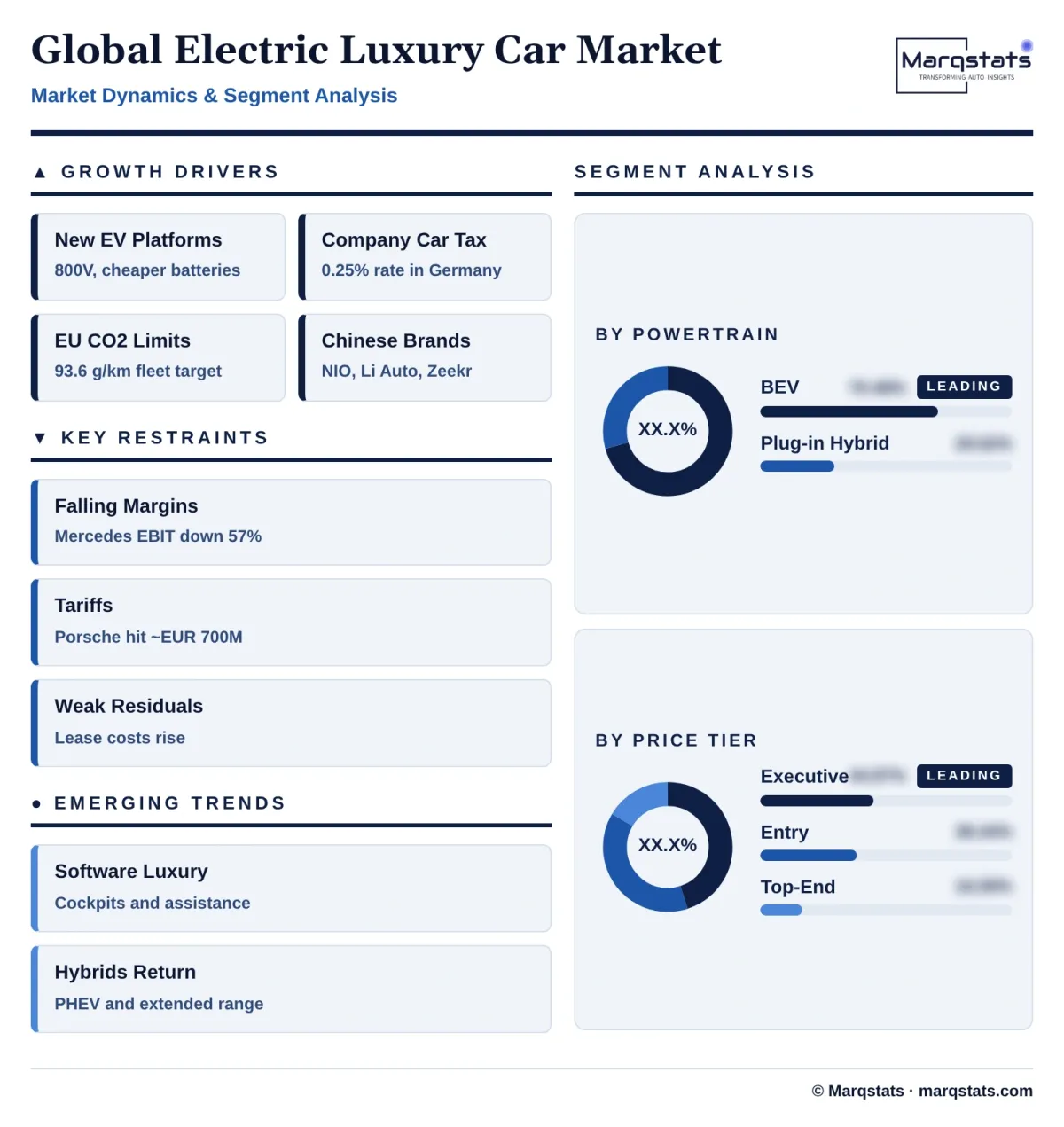
Regulation and tax keep electrification moving. The EU fleet limit of 93.6 g CO2 per km applies from 2025, with averaging over 2025 to 2027 allowed under Regulation (EU) 2025/1214. China taxes cars priced above RMB 900,000 at an extra 10% at retail, now including battery-electric cars. Company car tax rules in Germany, the United Kingdom and other European countries strongly favour electric cars for executives, who make up a large share of luxury buyers.
Profitability has become the central issue for the market. Electric luxury deliveries kept growing in 2025, but established brands earned far less from them. Mercedes-Benz car sales fell 9.2% to about 1.80 million and its operating profit fell 57%, Porsche deliveries fell 10% to 279,449 with Taycan deliveries down 22%, and Porsche took about EUR 3.9 billion of special charges, including about EUR 700 million for US tariffs. Lucid grew deliveries 55% to 15,841 but reported a net loss of about USD 2.70 billion. In contrast, Li Auto kept a vehicle margin of 17.9% on its extended-range models, showing that cost-efficient platforms and hybrid powertrains can earn returns in the segment.
Global Electric Luxury Car Market Size and Forecast
The global electric luxury car market grows from USD 225.30 billion in 2025 to USD 385.58 billion in 2030, a CAGR of 11.34%. Marqstats expects deliveries of about 3.29 million worth USD 279.65 billion in 2027, 3.75 million worth USD 311.25 billion in 2028 and 4.27 million worth USD 345.87 billion in 2029, before reaching 4.85 million cars in 2030.
Prices fall as volume grows. The average transaction price falls from about USD 100,975 in 2021 to USD 88,700 in 2025 and USD 79,500 in 2030, as battery costs fall, entry luxury models take a larger share and Chinese competition limits pricing. Deliveries therefore grow at 13.81% a year while value grows at 11.34%.
The forecast is sensitive to pricing. Marqstats estimates that each USD 1,000 change in the average transaction price changes 2025 market value by about USD 2.54 billion. A 5% fall in the average price, about USD 4,435 per car, would cut 2025 value by about USD 11.26 billion to USD 214.04 billion with no change in deliveries.
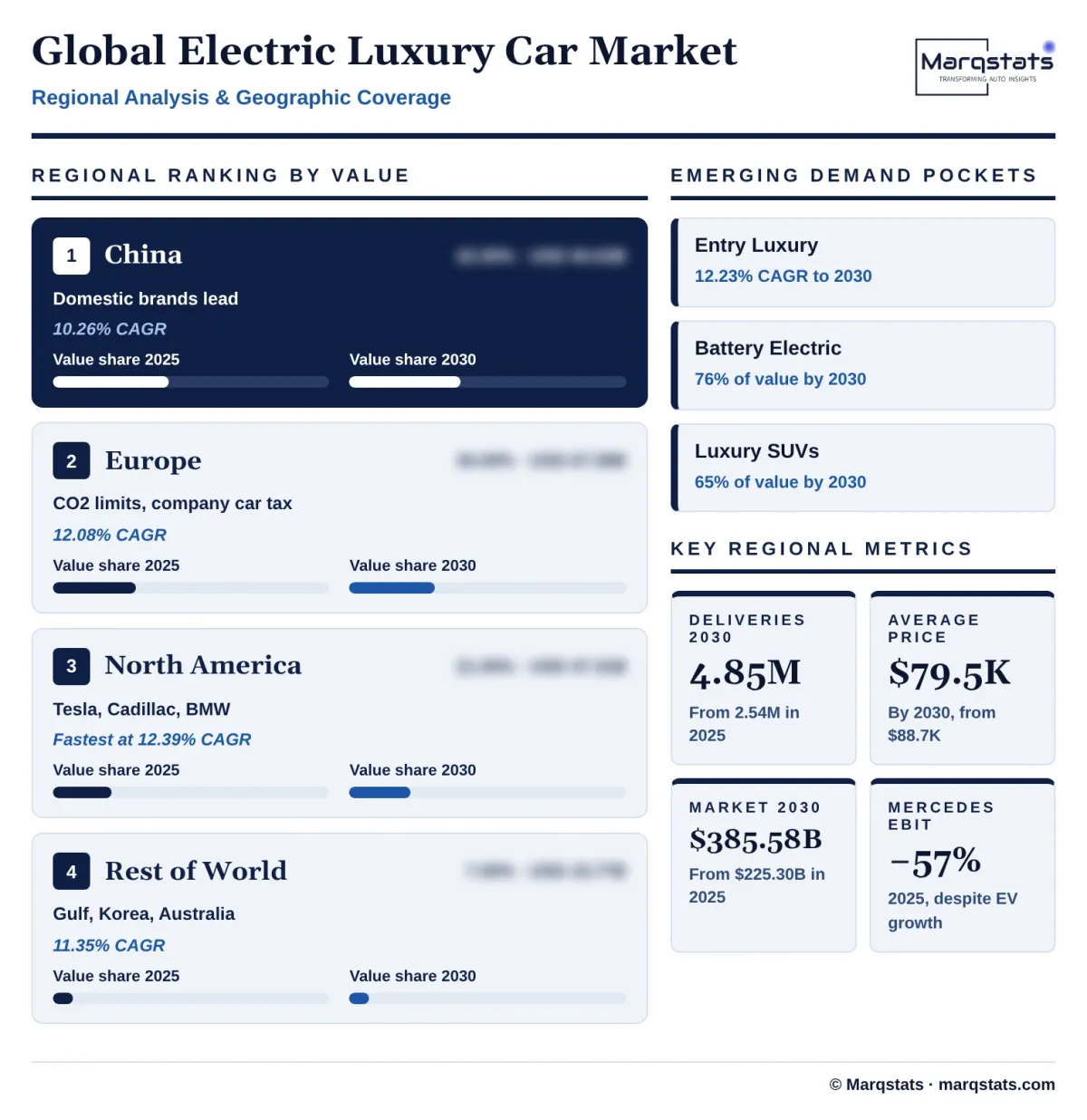
Growth shifts between regions. China grows at 10.26% a year as its share falls from 42.00% to 40.00%, Europe at 12.08% to 31.00%, North America at 12.39% to 22.00%, and the rest of the world, led by the Gulf states, Japan, Korea, Australia and India, at 11.35% to 7.00%.
Marqstats tracks four indicators to monitor the forecast: monthly electrified deliveries by luxury brand, average transaction prices and discounts in China, Europe and the United States, the share of new model launches built on dedicated 800-volt electric platforms, and changes to EU fleet emissions rules and national company car taxes.
The mix of powertrains matters for value. Battery-electric cars carry higher prices than plug-in hybrids in most model lines, so their rise from 70.48% to 76.00% of value supports average prices even as competition pushes list prices down. Extended-range hybrids remain important in China, where Li Auto and other brands sell large SUVs that run on electricity for daily trips and use a petrol generator on long journeys.
Segment mix shifts gradually. Entry luxury cars rise from 38.44% to 40.00% of value as new compact and mid-size models such as the BMW iX3, Mercedes-Benz CLA and Volvo EX60 reach volume, while core executive cars slip from 44.97% to 44.00% and top-end cars from 16.59% to 16.00%. SUVs and crossovers rise from 63.00% to 65.00% of value, while sedans fall from 31.00% to 29.00%.
Market Dynamics
Key Drivers
Five forces are expanding sales of electric luxury cars.
- New dedicated electric platforms. BMW Neue Klasse, Mercedes-Benz MMA, Audi and Porsche PPE, Volvo SPA3 and Geely SEA platforms use 800-volt electrical systems, faster charging and lower-cost batteries, improving range and cost compared with first-generation electric luxury cars.
- Company car taxes favour electric cars. Germany taxes the private use of electric company cars at 0.25% of the list price per month for cars up to EUR 100,000, against 1% for petrol and diesel cars, and the United Kingdom and other European countries offer similar benefits. Marqstats estimates an executive choosing an EUR 85,000 electric car over a petrol car of the same price saves about EUR 3,200 a year in income tax.
- Fleet emissions rules. The EU limit of 93.6 g CO2 per km for 2025 to 2029 requires luxury brands with heavy, powerful cars to sell a large share of electrified cars to avoid penalties of EUR 95 per gram per car.
- Chinese premium brands. NIO, Li Auto, Zeekr, AITO, Xiaomi and BYD premium brands compete on software, driver assistance and price, expanding the luxury electric segment in China and increasingly in export markets.
- Wealthy buyers in new markets. Demand from the Gulf states, Korea, Australia and India adds volume as luxury brands launch electric models and charging networks expand.
Key Restraints
Four constraints are squeezing returns on electric luxury cars.
- Falling margins. Price competition, high development costs and slower demand cut profits at established luxury brands in 2025, leading Porsche to scale back its all-electric plans and extend combustion and plug-in hybrid models.
- Tariffs and trade barriers. US tariffs on imported cars cost Porsche about EUR 700 million in 2025, and EU and US tariffs on Chinese-built electric cars limit exports of Chinese premium brands.
- Withdrawal of incentives. Germany ended its electric car purchase grant at the end of 2023, and the US federal clean vehicle and commercial vehicle credits ended on 30 September 2025, removing support for leasing in particular.
- Residual values. Used electric luxury cars have lost value faster than petrol and diesel models, raising lease costs and forcing finance companies owned by carmakers to set aside provisions.
Key Trends
Four shifts are changing how electric luxury cars are built, priced and sold.
- Software defines luxury. In China, buyers judge luxury cars on digital cockpits, voice assistants and urban driver assistance as much as on brand heritage, pushing established brands to work with Chinese software partners.
- Extended-range and plug-in hybrids return. Established brands are keeping plug-in hybrids and developing extended-range models to cover buyers who are not ready for battery-electric cars.
- 800-volt charging spreads to cheaper cars. Fast charging, first offered on the Porsche Taycan and Audi e-tron GT, is now standard on Chinese executive cars priced below USD 60,000, so luxury brands compete on comfort, materials and digital services instead.
- Groups consolidate electric brands. Geely took Zeekr private in December 2025 to share platforms and purchasing across Zeekr, Volvo, Polestar and Lynk and Co, reversing the trend of separately listed electric brands.
Strategic Implications
- For established luxury carmakers, flexible platforms protect returns. Platforms that can build battery-electric, plug-in hybrid and extended-range versions on the same line let carmakers follow demand without stranding investment.
- For Chinese premium brands, exports are the next step. Brands that localise production or assembly in Europe, the Gulf and Southeast Asia can avoid tariffs and use their software and cost advantages abroad.
- For suppliers, 800-volt and software content grows. Suppliers of silicon carbide inverters, high-voltage batteries, zonal electronics and driver assistance software gain content per car as dedicated electric platforms scale.
- For dealers and finance companies, residual values need managing. Certified used programmes, battery health checks and longer battery warranties can support residual values and lease pricing.
- For start-ups, scale and capital decide survival. Lucid lost about USD 2.70 billion in 2025 on 15,841 deliveries, showing that new luxury electric brands need large investors and higher volumes to become profitable.
- For investors, platform timing matters. Brands whose new dedicated electric platforms reach volume between 2026 and 2028, such as BMW Neue Klasse, Mercedes-Benz MMA and Volvo SPA3, are best placed to recover margins as battery costs fall, while those still selling first-generation electric models face continued price pressure.
Market Segmentation
Battery-electric luxury cars account for 70.48% of 2025 value, USD 158.80 billion and about 1.745 million cars, and grow at 13.04% a year to USD 293.04 billion and 76.00% of the market by 2030. BMW, Audi, Mercedes-Benz, NIO, Zeekr, Tesla and Lucid lead this segment.
Plug-in hybrid and extended-range electric luxury cars account for 29.52% of 2025 value, USD 66.50 billion and about 795,000 cars, and grow at 6.83% a year to USD 92.54 billion and 24.00% of the market by 2030. Li Auto leads extended-range sales in China, while BMW, Mercedes-Benz, Porsche and Volvo sell plug-in hybrids in Europe and North America.
Entry luxury cars priced about USD 50,000 to 80,000 account for 38.44% of 2025 value, USD 86.61 billion, and grow fastest, at 12.23% a year, to USD 154.23 billion and 40.00% of the market by 2030 as new compact and mid-size electric models launch.
Core executive cars priced about USD 80,000 to 150,000 are the largest value segment, with 44.97% of 2025 value, USD 101.31 billion, rising to USD 169.66 billion by 2030, a 10.86% CAGR, and 44.00% of the market.
Top-end cars priced above USD 150,000 account for 16.59% of 2025 value, USD 37.38 billion, and grow at 10.54% a year to USD 61.69 billion and 16.00% of the market by 2030, led by Rolls-Royce, Porsche, Mercedes-AMG, Lucid and Chinese flagships.
Luxury electric SUVs and crossovers account for 63.00% of 2025 value, USD 141.94 billion, and grow at 12.04% a year to USD 250.63 billion and 65.00% of the market by 2030.
Executive sedans and gran turismos account for 31.00% of 2025 value, USD 69.84 billion, and grow at 9.87% a year to USD 111.82 billion, 29.00% of 2030 value.
Sports coupes and convertibles account for 6.00% of 2025 value, USD 13.52 billion, rising to USD 23.13 billion by 2030, an 11.34% CAGR.
By Geography
China
China is the largest market, with an estimated 42.00% of 2025 value, USD 94.63 billion and about 1.19 million cars, rising to USD 154.23 billion by 2030, a 10.26% CAGR, while its share falls to 40.00%. Electrified cars account for more than half of new car sales, and domestic brands such as NIO, Li Auto, Zeekr, AITO and BYD premium brands lead. Mercedes-Benz sales in China fell 19% in 2025 and Porsche deliveries fell 26% to 41,938. From July 2025 China applies its extra 10% super-luxury consumption tax to battery-electric cars and to all cars priced above RMB 900,000 excluding VAT, down from RMB 1.3 million.
Europe
Europe accounts for an estimated 30.00% of 2025 value, USD 67.59 billion, and grows at 12.08% a year to USD 119.53 billion and 31.00% of the market by 2030. The EU fleet limit of 93.6 g CO2 per km, company car tax rules and high electric shares in Norway, Denmark and the Netherlands drive demand. Mercedes-Benz battery-electric deliveries in Europe rose 87% in the second quarter of 2026 and BMW battery-electric deliveries in Europe rose 38%. Under Regulation (EU) 2025/1214, carmakers can average their emissions over 2025 to 2027 instead of meeting the limit each year, giving luxury brands more time to launch new electric models before penalties apply.
North America
North America accounts for an estimated 21.00% of 2025 value, USD 47.31 billion, and grows fastest, at 12.39% a year, to USD 84.83 billion and 22.00% of the market by 2030. Tesla, Cadillac, BMW, Mercedes-Benz, Lucid and Rivian lead. The end of federal clean vehicle and lease credits in September 2025 and tariffs on imported cars weigh on demand, while local production in Spartanburg, Spring Hill and Casa Grande reduces tariff exposure.
Rest of World
The rest of the world, led by the Gulf states, Japan, Korea, Australia and India, accounts for an estimated 7.00% of 2025 value, USD 15.77 billion, rising to USD 26.99 billion by 2030, an 11.35% CAGR. Lucid builds cars in Saudi Arabia, and luxury brands are launching electric models in India despite high import duties.
How Competition Is Evolving
The global electric luxury car market is moderately fragmented. BMW Group, Geely Holding brands including Zeekr, Volvo, Polestar and Lotus, and Li Auto deliver the largest volumes, followed by Mercedes-Benz, Audi, NIO, Porsche, Tesla, Cadillac and Lucid. Chinese brands lead in China, while established European and American brands lead in Europe and North America.
Established brands are defending share by launching new dedicated electric platforms. BMW is launching the Neue Klasse iX3 and i3, Mercedes-Benz the MMA-based CLA and GLC, Audi the PPE-based Q6 and A6 e-tron, and Volvo the EX60. At the same time Porsche is extending combustion and plug-in hybrid models after cutting its electric plans.
Chinese brands compete on technology and cost. NIO offers battery swapping and its own driver assistance chip, Li Auto leads extended-range SUVs, and Zeekr uses Geely's SEA platform and fast charging. Their lower costs and faster model cycles put pressure on established brands' pricing in China and, increasingly, in export markets.
Competition will be decided by software, cost and flexibility. Brands that offer competitive digital features, cut battery and platform costs, and can switch production between battery-electric and hybrid models as demand changes will hold margins best.
Ownership structures are also changing. Geely took Zeekr private in December 2025 to combine platforms and purchasing with Volvo, Polestar and Lynk and Co, while Lucid depends on investment from the Public Investment Fund of Saudi Arabia and builds cars in both Arizona and Saudi Arabia. Established German brands are cutting costs and using plants in the United States, China and Hungary to reduce exposure to tariffs.
Companies Covered
Companies covered in the report include:
Recent Market Activity
Table of Contents
Coverage & Segmentation
The study covers the global electric luxury car market, with 2025 as the base year, 2021 – 2025 as the historical period and 2026 – 2030 as the forecast period. Values are in US dollars at constant 2025 exchange rates, and volumes are new car deliveries. The market is segmented by powertrain, price tier, body type and region.
Mass-market electric cars below about USD 50,000, light commercial vehicles, mild hybrids, conventional hybrids, used cars and conversion kits are excluded. Segment and regional splits are Marqstats estimates built on carmaker delivery and financial disclosures, registration data, and transaction price benchmarks.