Market Snapshot
Key Takeaways
Market Overview & Analysis
Report Summary
The Egypt Chinese automotive brands market covers new passenger cars sold in Egypt under Chinese-origin brands. The measure uses Automotive Information Council country-of-origin passenger car sales as its core denominator, which places Chinese-brand volume at 50,699 units in 2025. A separate model-level dataset records 58,572 Chinese-brand units across all vehicle classes including commercial vehicles, and that broader figure serves as a cross-check rather than as the same metric. Conflating the two would overstate the passenger car market by roughly 16%.
The scale of the shift over two years is the market's defining feature. Chinese-origin passenger car sales rose from 30,441 units in 2024 to 50,699 in 2025, an increase of about 67% in a single year, taking the Chinese share of Egyptian passenger cars from roughly 22.7% to 37.8%. That is a faster share transfer than most emerging markets have recorded, and it happened while the overall market was itself expanding sharply, so Chinese brands captured growth rather than only displacing incumbents.
What the share figure conceals is how concentrated the position remains. Chery at approximately 18,500 units and MG at approximately 16,500 hold 13.9% and 12.4% of the total passenger car market respectively, and between them account for around 69% of all Chinese-brand volume. The remaining Chinese brands divide roughly 15,700 units. An entrant reading the 37.8% headline as evidence of a broad and established Chinese presence would be misreading a market in which two brands carry the position and the rest are still building it.
Chinese-Origin Passenger Car Sales in Egypt
Annual Chinese-origin passenger car sales rise from 50,699 units in 2025 to 117,500 in 2030, an 18.31% compound annual growth rate and an absolute increase of 66,801 units. The indicative 2031 endpoint is approximately 135,000 vehicles. The 2026 estimate of roughly 68,000 units is anchored on observed data rather than projected, since Egyptian passenger car sales reached about 74,300 units in the first half of 2026 and four Chinese brands were already ranked inside the top ten by volume.
Retail value grows from USD 1,216.78 million to USD 3,172.50 million, a 21.13% compound annual growth rate. Average transaction value rises from approximately USD 24,000 to USD 27,000, an increase of about 2.38% each year, driven by mix rather than by price inflation as electrified and larger models enter the Chinese portfolio. The value series compounds faster than the unit series because both quantity and average price increase, which distinguishes this market from the value-led entry phase Chinese brands used in 2023 and 2024.
The forecast implies Chinese brands reaching roughly 60 to 66% of Egyptian passenger car sales by 2030, depending on how fast the total market grows, and that figure deserves stating plainly rather than leaving implicit. It is a high number. It is also consistent with the observed trajectory from 22.7% to 37.8% in a single year, with four Chinese brands already inside the top ten by the first half of 2026, and with comparable share positions Chinese brands have reached in other markets where price, product cadence and local assembly aligned. The forecast assumes the pace of share transfer decelerates materially from the 2024 to 2026 surge.
Market Dynamics
Key Drivers
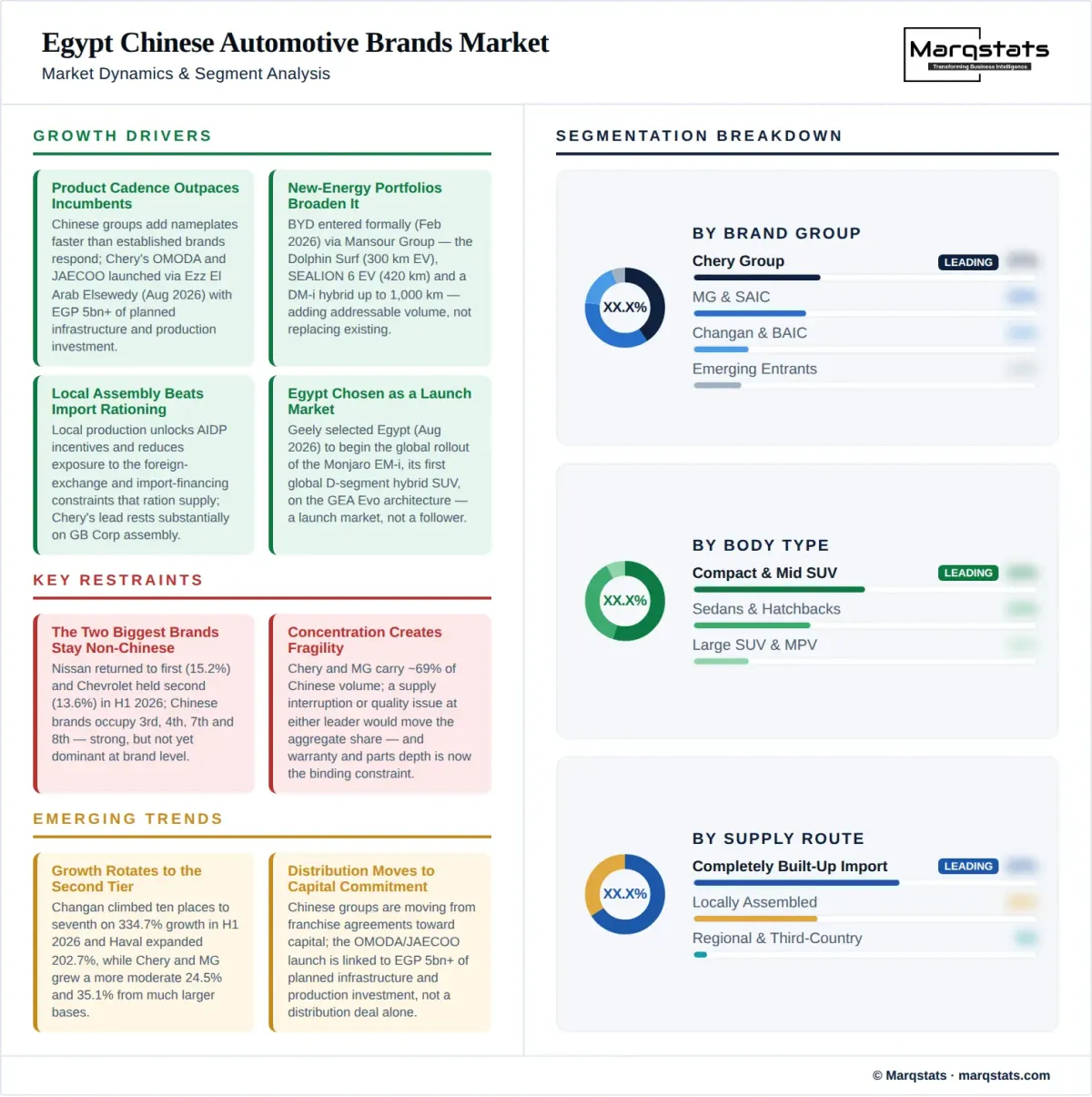
- Product cadence is the primary driver, with Chinese groups adding nameplates faster than established brands can respond. Chery's OMODA and JAECOO brands launched through Ezz El Arab Elsewedy in August 2026 with the JAECOO J5 and J7 as the opening models and more than EGP 5 billion of planned infrastructure and production investment attached.
- New-energy portfolios are broadening the addressable segment rather than replacing existing volume, with BYD entering formally in February 2026 through Mansour Group and ManDream, launching the Dolphin Surf city electric vehicle at 300 kilometres WLTP range, the SEALION 6 electric sport utility vehicle at 420 kilometres and a DM-i hybrid offering up to 1,000 kilometres of total range.
- Local assembly reduces exposure to import constraints and unlocks Automotive Industry Development Programme incentives, which matters disproportionately in a market where foreign exchange availability has rationed vehicle supply. Chery's position as the largest Chinese passenger car brand rests substantially on local assembly through GB Corp.
- Established distribution networks are being opened to Chinese product, with Nissan Egypt and Dongfeng introducing the Venucia brand in February 2026 through Nissan's existing Egyptian sales and after-sales infrastructure, described as the first overseas Venucia collaboration of its kind outside China.
- Egypt is being selected as a launch market rather than a follower, with Geely choosing the country in August 2026 to begin the global rollout of the Monjaro EM-i, its first global D-segment hybrid sport utility vehicle, built on the GEA Evo architecture with a 1.5TD hybrid system and an all-wheel-drive version reaching 100 kilometres per hour in 5.83 seconds.
Key Restraints
- The two largest individual brands in Egypt remain non-Chinese, with Nissan returning to first place at 15.2% share and Chevrolet holding second at 13.6% during the first half of 2026. Chinese brands occupy third, fourth, seventh and eighth, so the position is strong but not yet dominant at brand level.
- Warranty execution, parts availability and service network depth are becoming the constraint rather than product or price, and consumer protection enforcement is tightening. A brand that sells 5,000 units without the parts pipeline to support them creates a reputational liability that price positioning cannot offset.
- Concentration creates fragility, since Chery and MG carry roughly 69% of Chinese-brand volume and the remaining entrants divide approximately 15,700 units between them. A supply interruption or quality issue at either of the two leaders would move the aggregate Chinese share materially.
- Foreign exchange availability and import financing continue to ration completely built-up supply, and brands without local assembly carry that exposure on their entire volume rather than on the imported component share alone.
Key Trends
- Growth is rotating toward the second tier, with Changan climbing ten places to seventh on 334.7% growth in the first half of 2026 and Haval expanding 202.7%, while Chery and MG grew a more moderate 24.5% and 35.1% respectively from much larger bases.
- Electrified nameplates are entering across price points rather than at the premium end only, spanning the Dolphin Surf city electric vehicle through to the Monjaro EM-i D-segment hybrid, which broadens the technology's addressable buyer base considerably.
- Chinese groups are moving from distribution agreements toward capital commitment, with the OMODA and JAECOO launch linked to more than EGP 5 billion of planned infrastructure and production investment rather than to a franchise arrangement alone.
- The 37.8% passenger car share creates a large and growing Chinese-brand aftermarket and service opportunity, since vehicles sold across 2024 to 2026 enter their main service and parts replacement cycle from 2027 onward.
Market Segmentation
Chery is the largest Chinese passenger car brand in Egypt at approximately 18,500 units in 2025 and a 13.9% share of the total market, supported by local assembly through GB Corp. Its model line carries the segment's deepest volume, with the Tiggo 7 at 5,710 units, Tiggo 4 at 4,921, Arrizo 5 at 4,361 and Tiggo 8 at 3,184. The August 2026 addition of OMODA and JAECOO extends the group upward into a distinct brand tier rather than adding another Chery nameplate.
MG holds the second Chinese position at approximately 16,500 units and 12.4% of the total market, built on value-oriented sedans and compact sport utility vehicles. The MG ZS at 5,649 units was the highest-selling single Chinese model in 2025 and ranked fourth among all models sold in Egypt during the first half of 2026, with the MG5 at 4,193 units and MG ONE at 2,471 completing the core range.
Changan and BAIC form the fast-growing second tier, with Changan climbing ten places to seventh in the first-half 2026 brand ranking on 334.7% growth and BAIC eighth on 59.5%. The Changan CS55 Plus rose 21 places to seventh among individual models on 312.8% growth, and the BAIC U5 Plus recorded 3,019 units in 2025. Both brands are converting from opportunistic import volume toward structured distribution.
The emerging tier covers brands establishing position from a small or zero base, including BYD following its February 2026 entry, Geely, Venucia, Jetour, Haval and IM Motors. Haval grew 202.7% in the first half of 2026 and the BYD F3 recorded 1,744 units in 2025 ahead of the formal brand launch. This tier carries the segment's highest growth rates and its least established service infrastructure.
Compact and mid sport utility vehicles are the volume core of the Chinese proposition in Egypt, covering the Chery Tiggo 4 and Tiggo 7 at 4,921 and 5,710 units, the MG ZS at 5,649 and the Changan CS55 Plus at 3,360. The segment matches Egyptian buyer preference for elevated ride height on variable road surfaces, and it is where Chinese specification advantage over similarly priced established models is most visible.
Sedans and hatchbacks remain substantial in Egypt where the segment retains mainstream status, represented by the Chery Arrizo 5 at 4,361 units, the MG5 at 4,193 and the BYD F3 at 1,744. The segment competes directly against the market's highest-volume model, the Nissan Sunny at 11.3% share, and it is where Chinese brands face the most entrenched incumbent position.
Larger bodies are the newest Chinese entry point in Egypt and the least contested, opened by products such as the Chery Tiggo 8 at 3,184 units and extended by the Geely Monjaro EM-i, a 4.8-metre D-segment hybrid whose global rollout began in Egypt in August 2026. The segment carries the highest transaction values in the Chinese portfolio and correspondingly lifts the blended average.
Internal combustion accounts for the overwhelming majority of the 50,699 Chinese passenger cars sold in Egypt in 2025 and for nearly all of the established volume in the Chery and MG ranges. The segment grows in absolute terms across the forecast while declining as a share, and it remains the entry point through which most Chinese brands establish distribution before introducing electrified product.
Hybrid and plug-in hybrid volume is small in 2025 and expands rapidly from 2026 as BYD's SEALION 6 DM-i, offering up to 1,000 kilometres of total range, and Geely's Monjaro EM-i reach the market. Only 1,332 units across the whole Egyptian market carried explicit powertrain coding in available model-level data, so electrified volumes are measured as a lower bound rather than a complete count.
Battery electric volume is the smallest and newest part of the Chinese portfolio in Egypt, opened at scale by BYD's February 2026 launch of the Dolphin Surf at 300 kilometres WLTP range and the SEALION 6 electric sport utility vehicle at 420 kilometres. Adoption is constrained by charging availability rather than by product, which is why hybrid and range-extended architectures are expanding faster in the same portfolios.
Locally assembled Chinese vehicles carry a structural advantage in Egypt that goes beyond cost, because local production reduces exposure to the foreign exchange and import financing constraints that have rationed supply. Chery's leading position at approximately 18,500 units rests substantially on assembly through GB Corp, and Automotive Industry Development Programme incentives attach only to locally produced volume meeting content thresholds.
Completely built-up imports account for the majority of Chinese-brand volume outside the Chery assembly programme and carried 74,165 units across all origins in the Egyptian market during 2025. The route allows rapid model introduction without capital commitment, which is how most new Chinese entrants establish presence, at the cost of full duty exposure and vulnerability to currency availability.
A smaller share of Chinese-brand supply, estimated below 5% of the 50,699 units recorded in 2025, reaches Egypt through regional distribution hubs rather than direct shipment from China, using Gulf redistribution channels and free-zone stock. The route offers flexibility on specification and timing but adds a margin layer of roughly 3 to 6 percentage points on landed cost, and its share is expected to fall toward 2% by 2030 as direct volumes justify dedicated shipment and as local assembly expands.
By Geography
Greater Cairo
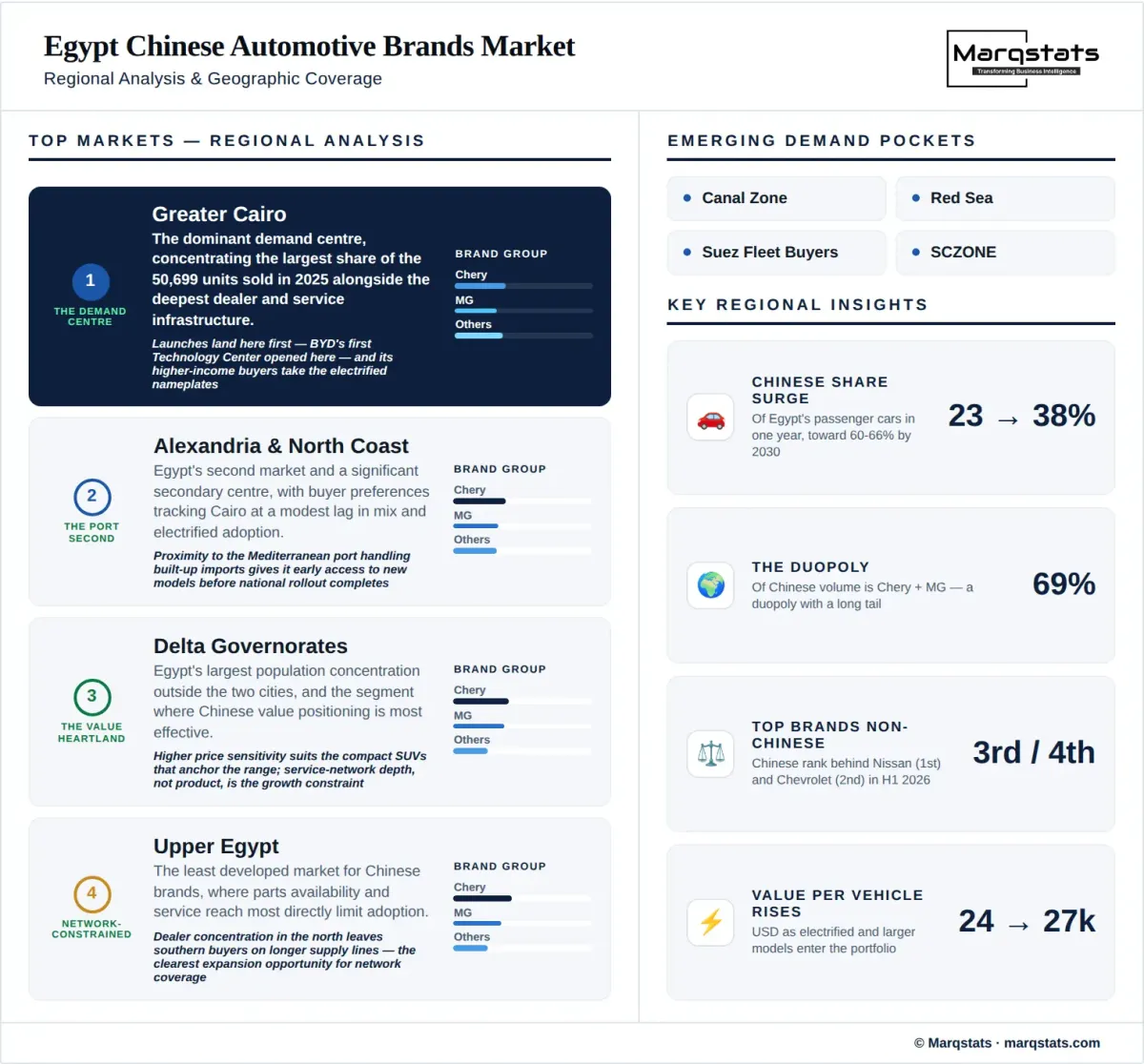
Greater Cairo is the dominant demand centre for Chinese brands in Egypt, concentrating the largest share of the 50,699 units sold in 2025 alongside the deepest dealer and service infrastructure. New brand launches enter here first, with BYD establishing Egypt's first BYD Technology Center in the capital region in February 2026, and the metropolitan concentration of higher-income buyers supports the electrified nameplates that carry the highest transaction values.
Alexandria and the North Coast
Alexandria is Egypt's second market and a significant secondary centre for Chinese-brand distribution, with buyer preferences tracking Cairo at a modest lag in both model mix and electrified adoption. The corridor's proximity to the Mediterranean port infrastructure that handles completely built-up imports gives it early access to newly introduced models before national rollout completes.
Delta Governorates
The Delta governorates represent Egypt's largest population concentration outside the two principal cities and the segment where Chinese value positioning is most effective, since price sensitivity is higher and the compact sport utility vehicles that anchor the Chinese range at 4,921 to 5,710 units per model suit the usage pattern. Service network depth rather than product availability is the constraint on growth here.
Upper Egypt
Upper Egypt is the least developed market for Chinese brands and the one where parts availability and service reach most directly limit adoption, since the concentration of dealer infrastructure in the north leaves southern buyers dependent on longer supply lines. The region represents the clearest expansion opportunity for brands willing to invest in network coverage ahead of demonstrated volume.
Canal Zone and Red Sea
The Canal Zone and Red Sea governorates combine industrial employment with tourism-linked commercial demand, producing a mix skewed toward utility and fleet purchases rather than private retail. Proximity to Suez Canal Economic Zone industrial development and to port infrastructure gives the corridor a supply advantage, and fleet buyers here weigh total cost of ownership more heavily than the retail buyers who dominate elsewhere.
How Competition Is Evolving
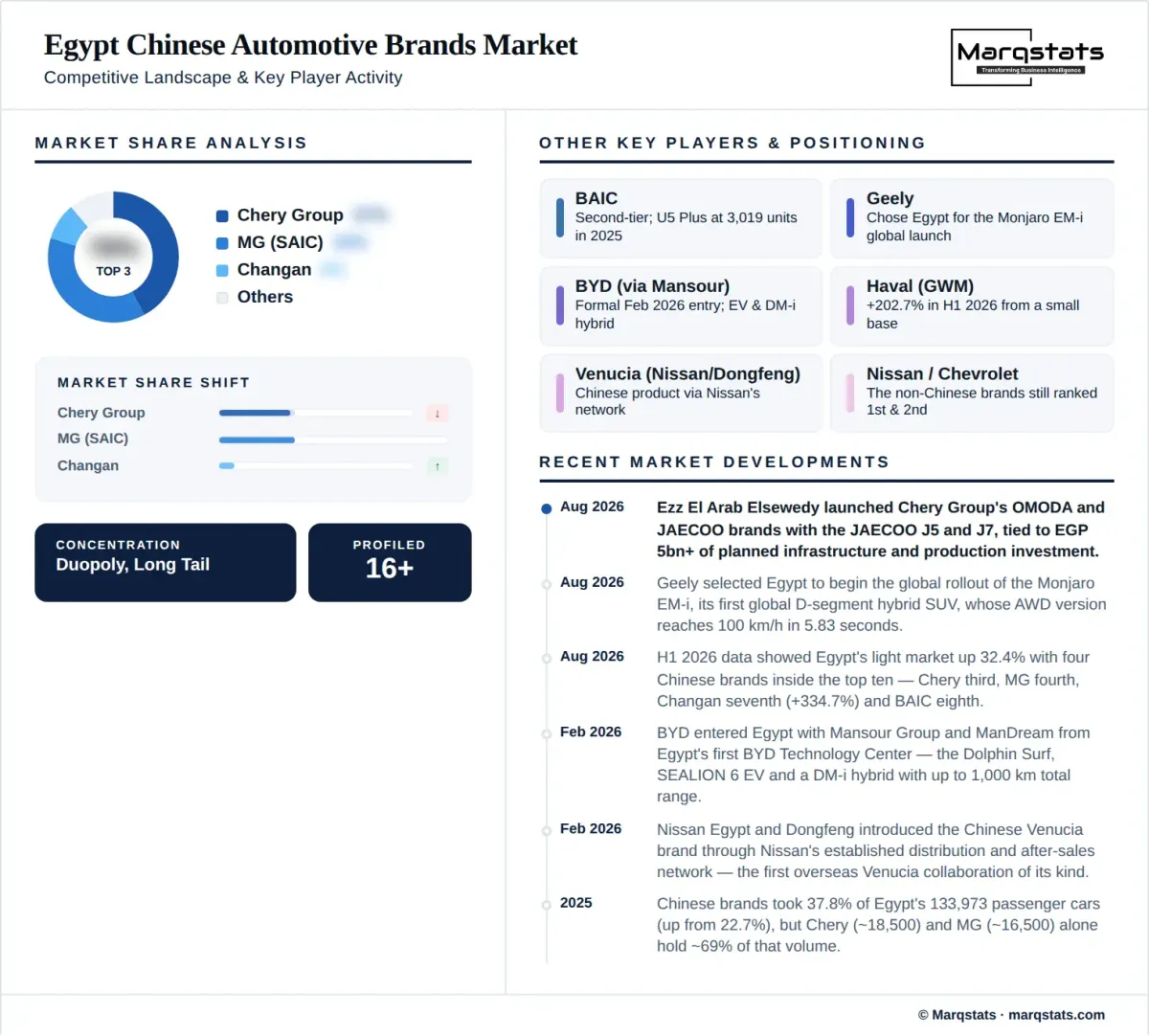
The Chinese-brand position in Egypt is concentrated at the top and fragmenting rapidly below it. Chery leads at approximately 18,500 passenger cars and 13.9% of the total market, MG follows at approximately 16,500 and 12.4%, and between them the two brands carry roughly 69% of all Chinese volume. Below that, Changan, BAIC, BYD, Geely, Venucia, Haval, Jetour and IM Motors divide approximately 15,700 units while adding nameplates faster than the leaders. The first-half 2026 ranking placed Chery third, MG fourth, Changan seventh and BAIC eighth.
The competitive basis has shifted materially in eighteen months and price is no longer the differentiator it was. Chinese brands entered Egypt on specification-per-pound and have moved to competing on local assembly, warranty execution, parts availability, financing and electrified technology. Chery's assembly position through GB Corp, BYD's establishment of a dedicated Technology Center at launch, and Nissan's decision to carry Venucia through its existing after-sales network all address the same underlying weakness: buyers who accepted an unfamiliar brand on price now expect the service infrastructure that established marques provide.
The structural question for the next three years is whether the second tier converts growth rates into durable position. Changan's 334.7% expansion and Haval's 202.7% in the first half of 2026 are impressive from small bases and say little about whether either brand can build the dealer coverage, parts depth and residual value support that turn a launch surge into a franchise. The pattern in comparable markets is that most entrants at this stage do not, and that the field consolidates toward three or four Chinese brands with genuine infrastructure rather than the dozen currently competing.
Companies Covered
The report profiles 16+ companies with full strategy and financials analysis, including:
Recent Market Activity
Table of Contents
Coverage & Segmentation
The study covers Egypt with demand-cluster detail for Greater Cairo, Alexandria and the North Coast, the Delta governorates, Upper Egypt, and the Canal Zone and Red Sea governorates. It measures annual Chinese-origin passenger car sales and registrations as the primary unit and annual retail value in United States dollars as the secondary measure. The base year is 2025, the historical period covers 2021 to 2025, and the forecast period runs from 2026 to 2030 with an indicative 2031 endpoint. Segmentation covers brand group, body type, powertrain and supply route.
Three boundaries define the market. Passenger cars only are counted, which is why the Automotive Information Council country-of-origin figure of 50,699 units is used rather than the 58,572 Chinese-brand units recorded across all vehicle classes in model-level data. Brand origin rather than manufacturing location determines inclusion, so a Chinese-brand vehicle assembled in Egypt counts here while a non-Chinese brand assembled in China does not. Commercial vehicles, buses and trucks fall outside scope entirely.
Two adjacent measures overlap this market and neither is additive to it. Egypt's vehicle manufacturing and localization market counts locally assembled units of all brand origins at 99,600 in 2025, of which the Chinese-brand portion sits inside both measures. Egypt's hybrid and range-extended vehicle market counts electrified units of all brand origins, and Chinese-brand electrified volume forms a component of it. Both intersections are partial, so the three measures overlap without summing.