Market Snapshot
Key Takeaways
Market Overview & Analysis
Report Summary
The global automotive air filter market comprises engine intake air filters and cabin HVAC air filters, sold as original equipment and through aftermarket replacement channels across passenger cars and commercial vehicles. This study segments the market by filter type, vehicle type, and sales channel, with a 2025 base year, historical coverage from 2021 to 2025, and forecasts to 2030. Market size is stated as filter sales revenue in United States dollars, covering both factory-installed and replacement filter sales. Two-wheelers and other powered vehicle categories outside the passenger car and commercial vehicle scope defined here are excluded, since their filtration requirements and replacement economics differ meaningfully from the four-wheel vehicle categories this report focuses on.
Replacement interval economics distinguish this market from many other automotive component categories: engine air filters typically require replacement every 15,000 kilometres or annually, while cabin filters follow a broadly similar service-driven cycle, meaning both categories generate recurring revenue tied to distance driven and time elapsed rather than a one-time original equipment sale. This recurring-revenue structure gives the market a demand base more closely correlated with total vehicle parc and average distance driven than with new-vehicle production volume alone, a distinction that becomes increasingly important as vehicle production growth moderates in several mature markets. Service-channel behaviour further shapes this demand base, since vehicles serviced through authorised dealer networks typically follow manufacturer-recommended replacement intervals more closely than vehicles serviced through independent garages, where replacement timing more often reflects driver-reported symptoms or technician recommendation at the point of an unrelated service visit.
Electric vehicles are reshaping filter demand composition without eliminating it entirely: battery-electric vehicles have no engine and therefore no engine air filter requirement, yet they retain, and in some cases specify at a higher level, cabin air filtration given the quieter cabin environment that makes air quality and filtration noise more noticeable to occupants. This shift is gradually rebalancing the market's product mix toward cabin filters even as the transition to electric vehicles remains a multi-decade process across most major markets. Battery thermal management systems in electric vehicles have also introduced a secondary filtration consideration distinct from cabin air quality, since battery pack cooling circuits in some architectures require their own particulate protection, a specialised, smaller-volume filtration need adjacent to, yet distinct from, the cabin and engine categories this report sizes.
Market Dynamics
Key Drivers
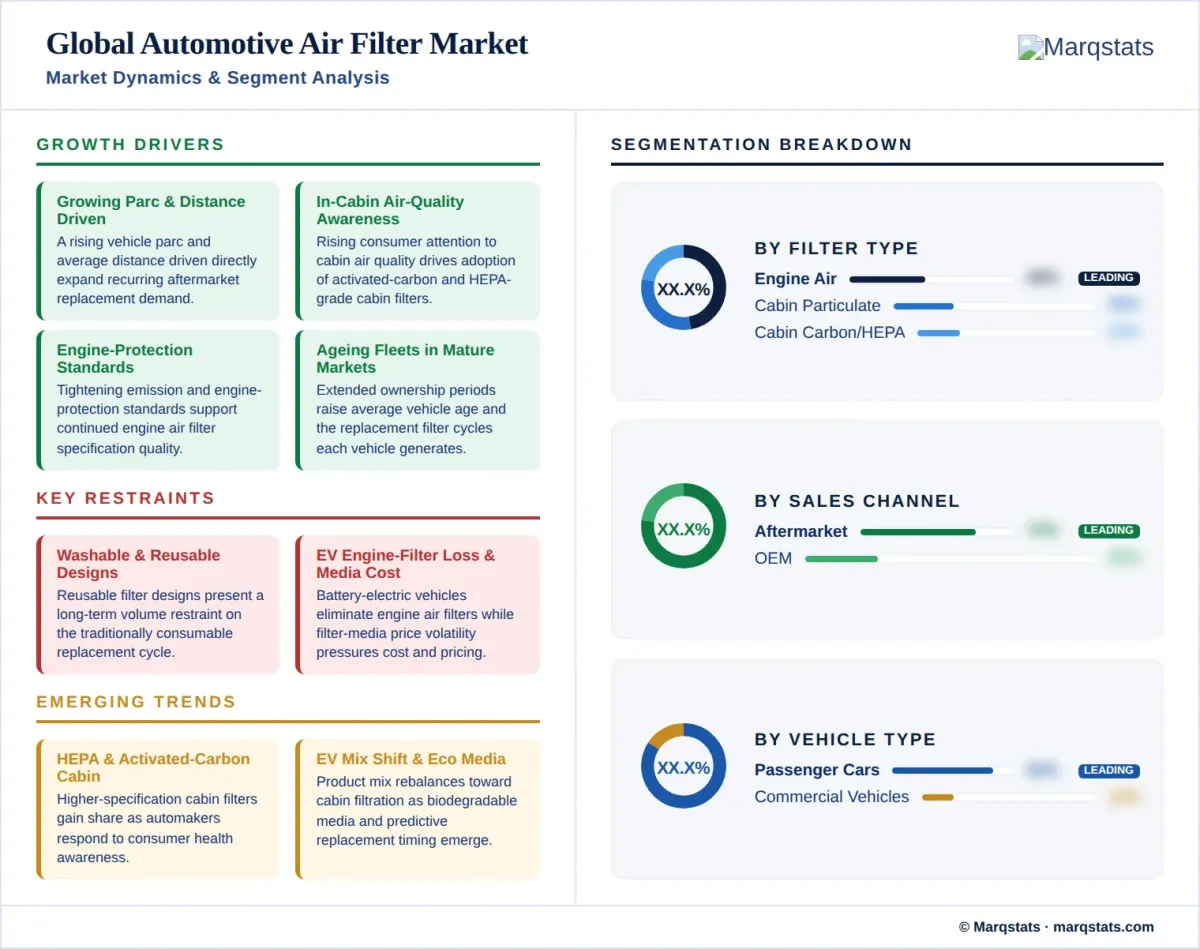
- Rising global vehicle parc and average distance driven directly expand recurring aftermarket replacement filter demand.
- Growing consumer awareness of in-cabin air quality is driving adoption of higher-specification activated-carbon and HEPA-grade cabin filters.
- Tightening emission and engine-protection standards are supporting continued engine air filter specification quality improvements.
- Expanding vehicle production in Asia-Pacific, particularly China and India, is growing the region's addressable filter base.
- Extended vehicle ownership periods in mature markets are increasing average vehicle age and associated replacement filter demand.
Key Restraints
- Washable and reusable filter designs present a long-term volume restraint on the traditionally consumable filter replacement cycle.
- Electric vehicle adoption is gradually eliminating engine air filter demand within the vehicle categories that convert to battery power.
- Raw material and filter media price volatility affects manufacturer cost and aftermarket pricing.
Key Trends
- HEPA-grade and activated-carbon cabin filters are gaining specification share as automakers respond to consumer health awareness.
- Electric vehicle platforms are shifting product mix toward cabin filtration as engine air filter demand naturally declines within that vehicle category.
- Eco-friendly filter media, including biodegradable fibre alternatives, are emerging in response to sustainability-focused procurement.
- Predictive maintenance data is enabling aftermarket distributors to time replacement filter offers more precisely to actual vehicle need.
Market Segmentation
Engine air filters protect the combustion system's intake from dust, debris, and airborne particles, supporting engine efficiency and longevity. This category remains the larger of the two filter types by long-term installed base, though its growth is structurally capped by the industry's gradual shift toward electric propulsion, which requires no engine intake filtration at all. Replacement intervals for engine air filters, typically every 15,000 kilometres or annually, are influenced by local driving conditions, with dustier operating environments requiring more frequent replacement than the standard interval assumes. Panel and cylindrical filter designs both remain in wide commercial use, with the choice between them driven primarily by engine bay packaging constraints specific to a given vehicle platform rather than any consistent performance difference between the two form factors.
Cabin air filters condition air entering the vehicle interior through the heating, ventilation, and air conditioning system, ranging from basic particulate filtration to advanced activated-carbon and HEPA-grade configurations that address odour, allergens, and fine particulate matter. This category is the faster-growing of the two filter types, benefiting from both rising consumer health awareness and its continued relevance in electric vehicles that have eliminated engine air filter requirements entirely. Activated-carbon variants, which add odour and volatile organic compound absorption beyond basic particulate filtration, command a meaningful price premium and are increasingly specified as standard rather than optional equipment across mid-market and premium vehicle trims alike. Multi-stage cabin filter designs, combining particulate and activated-carbon layers within a single element, represent the fastest-growing sub-category within cabin filtration specifically, as automakers seek to offer comprehensive air-quality protection through a single, straightforward replacement part rather than separate components.
Passenger cars represent the largest vehicle-type segment by revenue, reflecting both the scale of the global passenger vehicle parc and rising consumer willingness to specify premium cabin filtration options at the point of both original purchase and aftermarket replacement. Sport-utility vehicles and crossovers, which have grown to dominate passenger-vehicle production in many markets, typically require larger filter media surface area than smaller sedans, providing a modest structural tailwind to passenger-car filter revenue independent of unit production growth.
Commercial vehicles represent a smaller, growing segment, with fleet operators increasingly formalising filter replacement schedules as part of broader preventive maintenance programmes aimed at minimising unplanned downtime and protecting engine longevity across vehicles in continuous service. Heavy-duty commercial vehicles typically specify larger, higher-capacity filter elements than passenger cars, reflecting both larger engine displacement and the more demanding operating conditions, including unpaved routes and extended duty cycles, these vehicles commonly encounter.
Original equipment fitment represents a meaningful, minority share of market revenue, reflecting the one-time nature of factory-installed filters relative to the recurring aftermarket replacement demand that dominates this market's overall revenue structure. Original equipment specification decisions nonetheless carry influence beyond their direct revenue share, since the filter grade and technology an automaker specifies at factory installation often sets consumer expectations and purchasing preferences for subsequent aftermarket replacement choices.
Aftermarket replacement accounts for the substantial majority of market revenue, roughly three-quarters, directly reflecting the routine service-driven replacement cycle both engine and cabin filters require over a vehicle's operating life. This channel's scale gives independent service providers and parts retailers a structurally larger role in this market than in automotive component categories dominated by one-time original equipment sales. Brand loyalty in this channel is shaped substantially by original equipment brand recognition, meaning suppliers with strong original equipment relationships often carry a meaningful aftermarket advantage even in a channel where any qualified replacement part can technically be substituted.
By Geography
Asia-Pacific
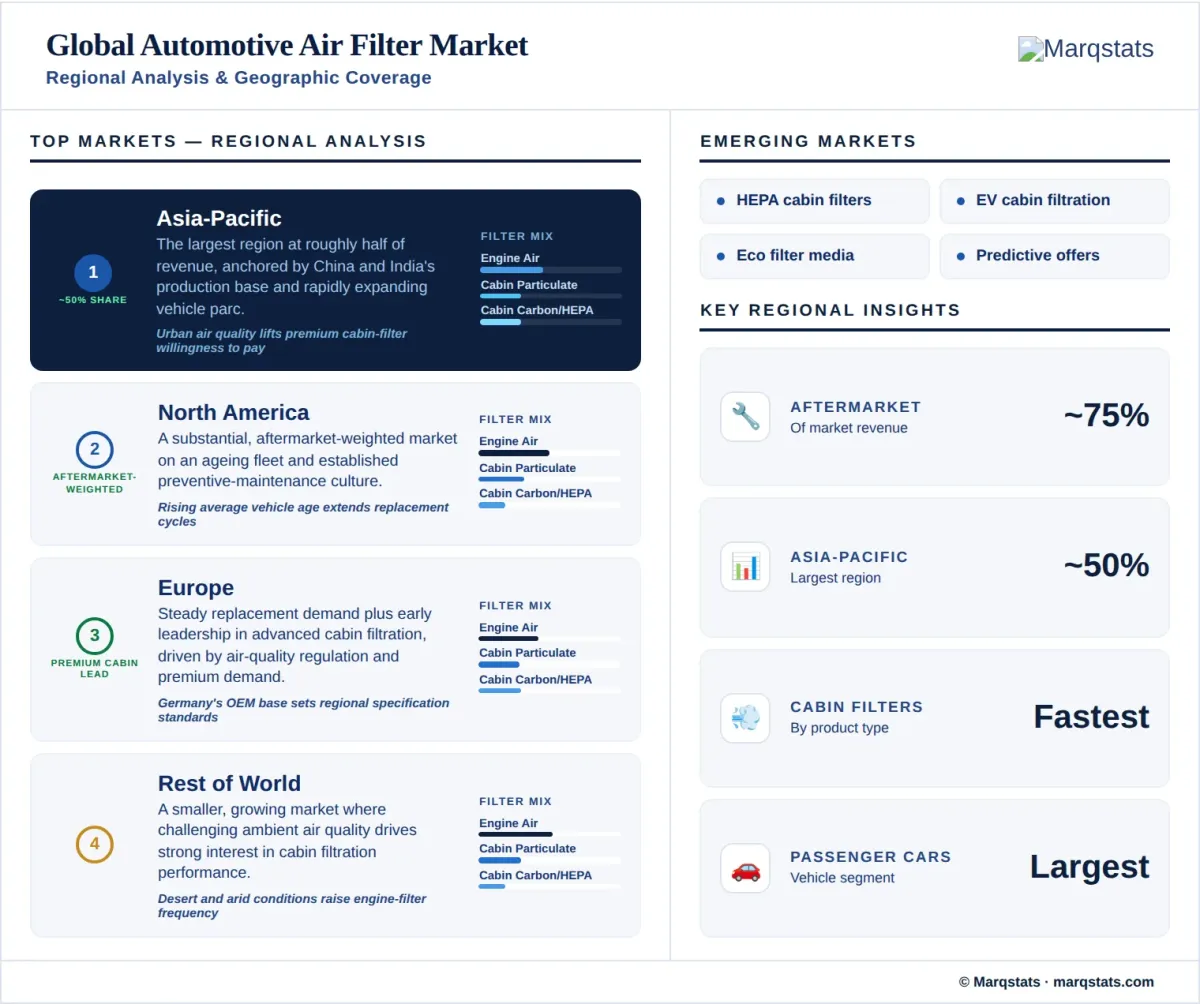
Asia-Pacific holds roughly half of global revenue, the largest of any region, anchored by China and India's vehicle production base and rapidly expanding vehicle parc. Rising vehicle ownership across the region is compounding two demand drivers simultaneously: growing new-vehicle original equipment fitment and an expanding installed base generating recurring aftermarket replacement demand. Air quality conditions in several of the region's largest cities add a further, distinctly regional demand driver, with consumers in markets facing elevated ambient particulate levels showing heightened willingness to pay for premium cabin filtration specifically. China's domestic filter manufacturing base has also scaled substantially alongside the country's vehicle production growth, supplying both domestic original equipment programmes and a growing share of regional aftermarket demand.
North America
North America represents a substantial, aftermarket-weighted market, supported by a comparatively aged average vehicle fleet and well-established preventive maintenance culture that sustains consistent replacement filter demand even where new-vehicle production growth has moderated. Average vehicle age in the region has continued rising in recent years, directly extending the number of filter replacement cycles a typical vehicle generates over its ownership life relative to a market with a younger average fleet.
Europe
Europe combines steady replacement demand with early leadership in advanced cabin filtration specification, driven by both regulatory attention to vehicle occupant air quality and strong consumer demand for premium filtration options across the region's substantial premium vehicle segment. The region's concentration of premium and luxury automakers has historically made it an early proving ground for advanced cabin filter technology that subsequently cascades into mass-market vehicle specifications globally over following product cycles. Germany's large domestic automotive manufacturing base gives the country an outsized role in setting regional filter specification standards relative to its share of overall European vehicle parc.
Rest of World
Latin America, the Middle East, and Africa represent a smaller, growing market, with demand shaped by rising vehicle ownership and, in markets with challenging ambient air quality conditions, particularly strong consumer interest in cabin filtration performance specifically. Desert and arid operating environments common across parts of the Middle East and Africa place additional demands on engine air filter durability and replacement frequency relative to more temperate markets, a factor that shapes both product specification and replacement-interval economics in these markets.
How Competition Is Evolving
The market is moderately fragmented, with a group of large, globally distributed filter manufacturers competing across both original equipment and aftermarket channels, alongside a broader population of regional and specialist aftermarket-focused filter producers. Original equipment relationships typically require multi-year platform qualification, while the aftermarket channel supports a more fragmented competitive set given lower barriers to entry for a replacement part not requiring the same original equipment validation process. This structural difference between the two channels means a manufacturer's competitive position can differ substantially between its original equipment and aftermarket business lines, even for the same underlying filter product technology. Private-label and store-brand filters, sold through major retail and auto-parts chains, represent a further competitive layer within the aftermarket specifically, often manufactured by the same established suppliers under a retailer's own brand alongside their branded product lines.
Competitive strategy centers on filter media innovation, particularly for cabin filters where activated-carbon and HEPA-grade specifications command meaningful price premiums over standard particulate filtration, alongside distribution network depth in the aftermarket channel where brand recognition and retail availability significantly influence purchasing decisions. Manufacturers increasingly compete on sustainability credentials as well, introducing biodegradable filter media alternatives in response to procurement teams and consumers seeking lower-environmental-impact replacement parts. Scale in filter media manufacturing, spanning paper, foam, and synthetic substrate production, remains a meaningful cost advantage for the largest suppliers, since media production represents a capital-intensive upstream stage that smaller regional filter assemblers typically do not integrate themselves. Vertically integrated suppliers who control both media production and finished-filter assembly are generally better positioned to absorb raw material cost volatility than assemblers reliant on third-party media supply.
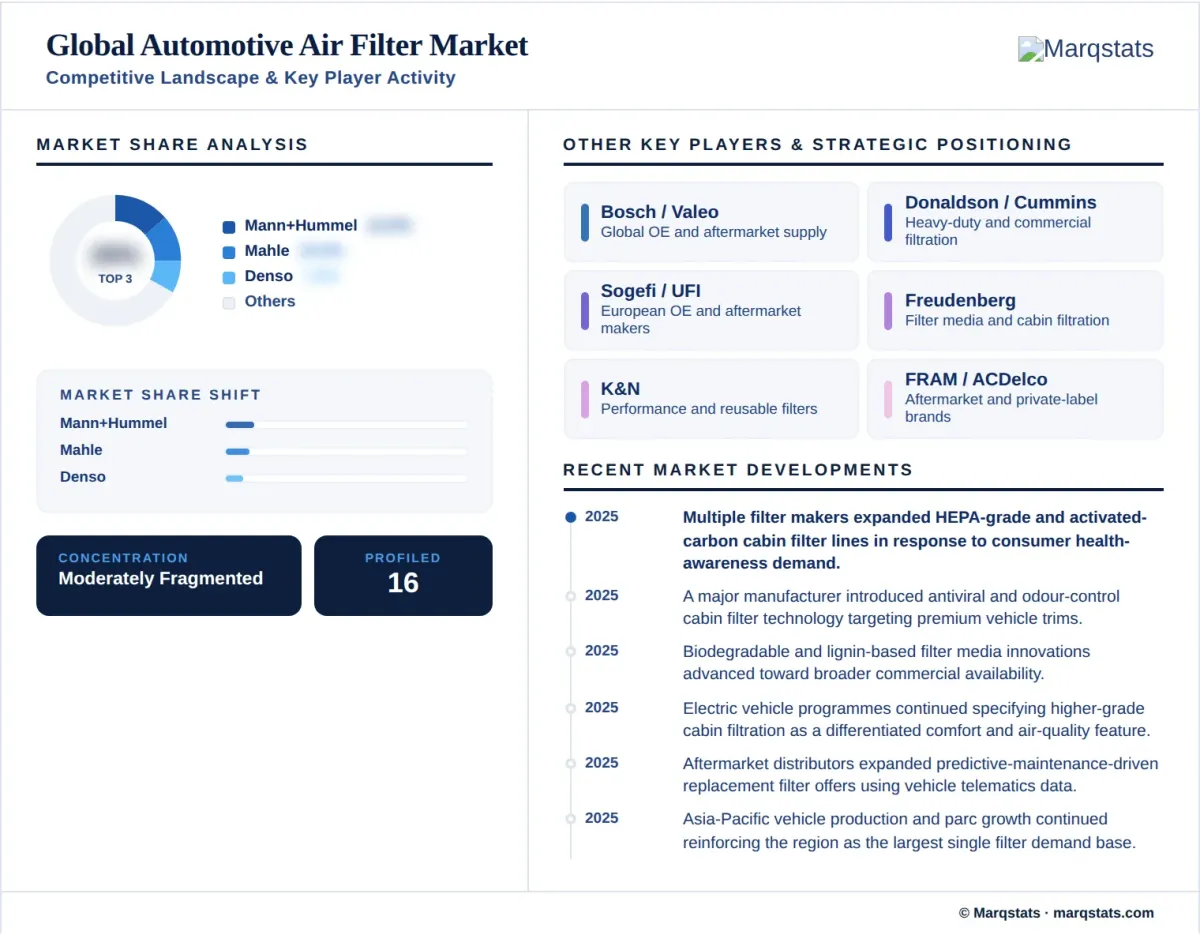
Companies Covered
The report profiles 16+ companies with full strategy and financials analysis, including:
Recent Market Activity
Table of Contents
Coverage & Segmentation
This report provides a comprehensive assessment of the global automotive air filter market across a 2025 base year, historical data from 2021 to 2025, and forecasts spanning 2026 to 2030. Market size is stated as filter sales revenue in United States dollars. Segmentation covers three dimensions: filter type, vehicle type, and sales channel, alongside regional analysis spanning Asia-Pacific, North America, Europe, and the rest of world.
The scope covers engine intake air filters and cabin HVAC air filters, including standard particulate, activated-carbon, and HEPA-grade cabin variants, sold as original equipment and through aftermarket replacement channels for passenger cars and commercial vehicles. The study excludes oil, fuel, and transmission filters, and diesel and gasoline particulate exhaust filters, each of which follows distinct replacement economics and regulatory drivers that Marqstats covers in separate automotive filtration reports. This scope choice keeps the reported figure focused specifically on the air-handling filtration category, distinct from fluid-system and emissions-system filtration, which serve different maintenance schedules and, in the case of exhaust filtration, different regulatory drivers entirely. Two-wheeler and other powered vehicle filtration is similarly excluded, since replacement economics and typical filter specification differ meaningfully from the four-wheel vehicle categories this report covers. Country-level detail beyond the four-region split covered here is available under customization, alongside deeper cuts by filter type, vehicle type, or sales channel.