Market Snapshot
Key Takeaways
Market Overview & Analysis
Report Summary
The global automotive digital key market comprises cryptographic vehicle access and operation credentials stored on smartphones, smartwatches, and cards, spanning near-field communication, Bluetooth Low Energy, and ultra-wideband technologies, sold as original equipment and through aftermarket services. This study segments the market by technology, use case, and sales channel, with a 2025 base year, historical coverage from 2021 to 2025, and forecasts to 2030. Market size is stated as digital key hardware, software, and service revenue in United States dollars, covering the vehicle-side hardware and software content specifically rather than smartphone or wearable device revenue, which Marqstats treats as a separate consumer-electronics category outside this report's automotive-focused scope.
Adoption follows a clear diffusion pattern from premium and electric vehicle segments toward the broader mass market, mirroring the adoption curve many other connected-vehicle technologies have followed. Premium automakers and electric vehicle manufacturers have led specification of digital key technology, reflecting both their generally more advanced connected-vehicle architecture and their customer base's greater willingness to pay for the convenience digital key access provides, while mass-market adoption is following as component costs decline and cross-platform standardisation reduces the engineering burden of adding the feature. This diffusion pattern gives the market a reasonably predictable adoption path to forecast against, since the technology and cost curve driving mass-market adoption today largely mirrors the path premium-segment adoption already took several years earlier.
Cybersecurity is a defining concern shaping both technology choice and consumer trust in this market: early keyless entry systems proved susceptible to relay attacks capable of unlocking and starting a vehicle without the legitimate key nearby, and digital key implementations have had to demonstrate materially stronger security to earn both regulatory and consumer confidence. Adoption of FIDO Alliance passkey authentication standards and the Car Connectivity Consortium's security-focused Digital Key specification are the industry's primary responses to this concern, and security credibility has become a genuine competitive differentiator among suppliers rather than a mere compliance checkbox. Ultra-wideband's precise distance-ranging capability directly addresses relay-attack vulnerability in a way Bluetooth-only implementations cannot easily replicate, since it can distinguish between a key physically near the vehicle and a signal relayed from a distance, a technical distinction increasingly central to how suppliers position their security credentials.
Market Dynamics
Key Drivers
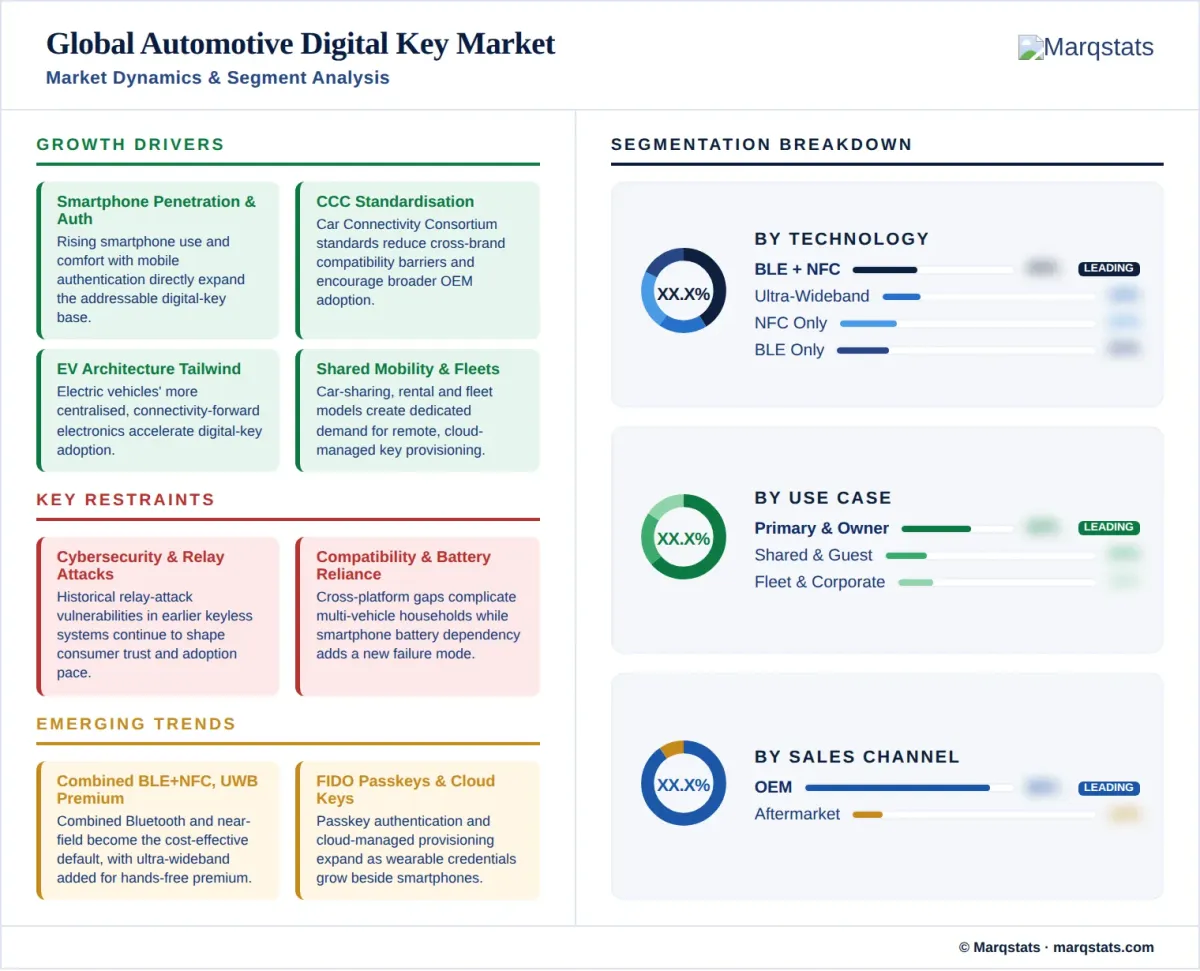
- Rising smartphone penetration and consumer comfort with mobile-based authentication are directly expanding the addressable digital key user base.
- Car Connectivity Consortium standardisation is reducing cross-brand compatibility barriers and encouraging broader OEM adoption.
- Electric vehicle production growth is accelerating digital key adoption given EVs' typically more centralised, connectivity-forward electronic architecture.
- Growing shared mobility, corporate fleet, and vehicle subscription business models are creating dedicated demand for remote key provisioning capability.
- Declining ultra-wideband and secure-element component costs are extending premium digital key features into mass-market vehicle segments.
Key Restraints
- Cybersecurity concerns, including historical relay-attack vulnerabilities in earlier keyless systems, continue to shape consumer trust and adoption pace.
- Cross-brand and cross-platform compatibility gaps persist despite standardisation progress, complicating the user experience for multi-vehicle households.
- Reliance on smartphone battery life and device availability creates a dependency absent from traditional physical key ownership.
Key Trends
- Combined BLE and NFC configurations are becoming the dominant cost-effective specification, with ultra-wideband added for premium hands-free applications.
- FIDO Alliance passkey authentication is gaining adoption as the industry's primary response to digital key cybersecurity concerns.
- Cloud-managed digital keys for shared mobility, rental, and corporate fleet applications are enabling remote, time-limited key provisioning.
- Smartwatch and wearable-based secondary key credentials are expanding alongside primary smartphone-based digital key adoption.
Market Segmentation
Near-field communication enables tap-to-unlock functionality by bringing a smartphone or card into close proximity with the vehicle, offering a reliable, low-power solution that remains the most widely deployed individual technology, though its share is gradually declining as combined and ultra-wideband configurations gain ground. Near-field communication's low power draw makes it particularly valuable as a fallback access method when a smartphone's battery is depleted, a practical consideration that has kept the technology relevant even as more advanced configurations gain overall specification share.
Bluetooth Low Energy enables app-based proximity detection and remote functions over a longer range than near-field communication, making it the foundation for most smartphone digital key applications, and increasingly paired with near-field communication in combined configurations that balance cost against convenience. Combined BLE and NFC solutions are increasingly positioned as the default mainstream specification, offering meaningfully improved functionality over a Bluetooth-only or NFC-only system at a cost premium substantially lower than adding full ultra-wideband capability.
Ultra-wideband is the fastest-growing individual technology, enabling precise, hands-free entry and start functionality through accurate distance and location detection that also materially improves resistance to relay-style security attacks relative to Bluetooth-only implementations. Adoption remains concentrated in premium and electric vehicle segments given the additional hardware cost ultra-wideband capability requires. Major smartphone manufacturers' decisions to include dedicated ultra-wideband chipsets in flagship devices has been a significant enabling factor, since automotive ultra-wideband adoption depends on a sufficient installed base of compatible consumer devices to make the feature broadly useful rather than limited to a small subset of premium smartphone owners. Multiple vehicle-mounted ultra-wideband anchor points, rather than a single receiver, are typically required to achieve the precise spatial positioning premium implementations offer, adding to both the hardware cost and the engineering integration effort relative to single-point Bluetooth or near-field communication systems.
Primary owner key applications represent the largest use case by volume, covering the core function of an individual vehicle owner's smartphone or wearable serving as their everyday vehicle access credential. This use case anchors the market's core revenue base and is where original equipment specification decisions carry the most weight, since it represents the default configuration nearly every digital key-equipped vehicle ships with. A physical backup credential, typically a key card or fob, remains standard alongside the digital key in nearly all current implementations, reflecting continued caution around scenarios where a smartphone is unavailable, discharged, or lost.
Shared and guest access applications, enabling an owner to grant temporary or limited digital key access to family members or other authorised users, represent a growing use case that has no straightforward equivalent in traditional physical key ownership, since digital credentials can be provisioned and revoked remotely without physical key exchange. Configurable access permissions, including time-limited validity and feature restrictions such as speed or geographic boundaries for a shared credential, are increasingly common, extending this use case beyond simple lock and unlock sharing toward more granular access management. Parents sharing a vehicle with a teenage driver under restricted terms represent a commonly cited consumer application of this granular permission capability, illustrating how the use case extends beyond its origins in commercial and fleet contexts.
Fleet and corporate use cases, including car-sharing, rental, and corporate vehicle pool applications, represent the fastest-growing use case category, driven by the operational efficiency cloud-managed digital key provisioning offers relative to physical key logistics across a distributed vehicle fleet. Rental and car-sharing operators in particular have been early and enthusiastic adopters, since remote key provisioning eliminates the need for staffed handover locations and enables fully contactless vehicle pickup and return processes.
Original equipment integration accounts for the large majority of market revenue, reflecting automaker preference for digital key systems engineered and validated as part of the vehicle's broader connected-vehicle architecture rather than added as a separate aftermarket component. Deep integration with a vehicle's body control module and immobiliser system is generally required for full digital key functionality, a level of access an aftermarket solution cannot typically achieve without automaker cooperation. This deep integration requirement is also why digital key qualification for a new vehicle platform typically proceeds alongside the broader connected-vehicle software development programme rather than as an isolated, later-stage addition.
Aftermarket digital key solutions, including universal dongles and standalone mobile application services, represent a smaller channel serving vehicles not originally equipped with factory digital key capability, though this channel remains inherently more limited than OEM integration given the deeper vehicle electronic architecture access digital key functionality typically requires. Most aftermarket solutions function as a supplementary remote-start or telematics-linked convenience feature rather than a full replacement for a vehicle's primary key system, reflecting the practical limits of retrofitting deep vehicle-access functionality onto an already-manufactured vehicle. This channel is expected to remain structurally smaller than its counterpart in categories such as audio or infotainment retrofitting, where aftermarket solutions can more readily achieve feature parity with factory-installed systems.
By Geography
Asia-Pacific
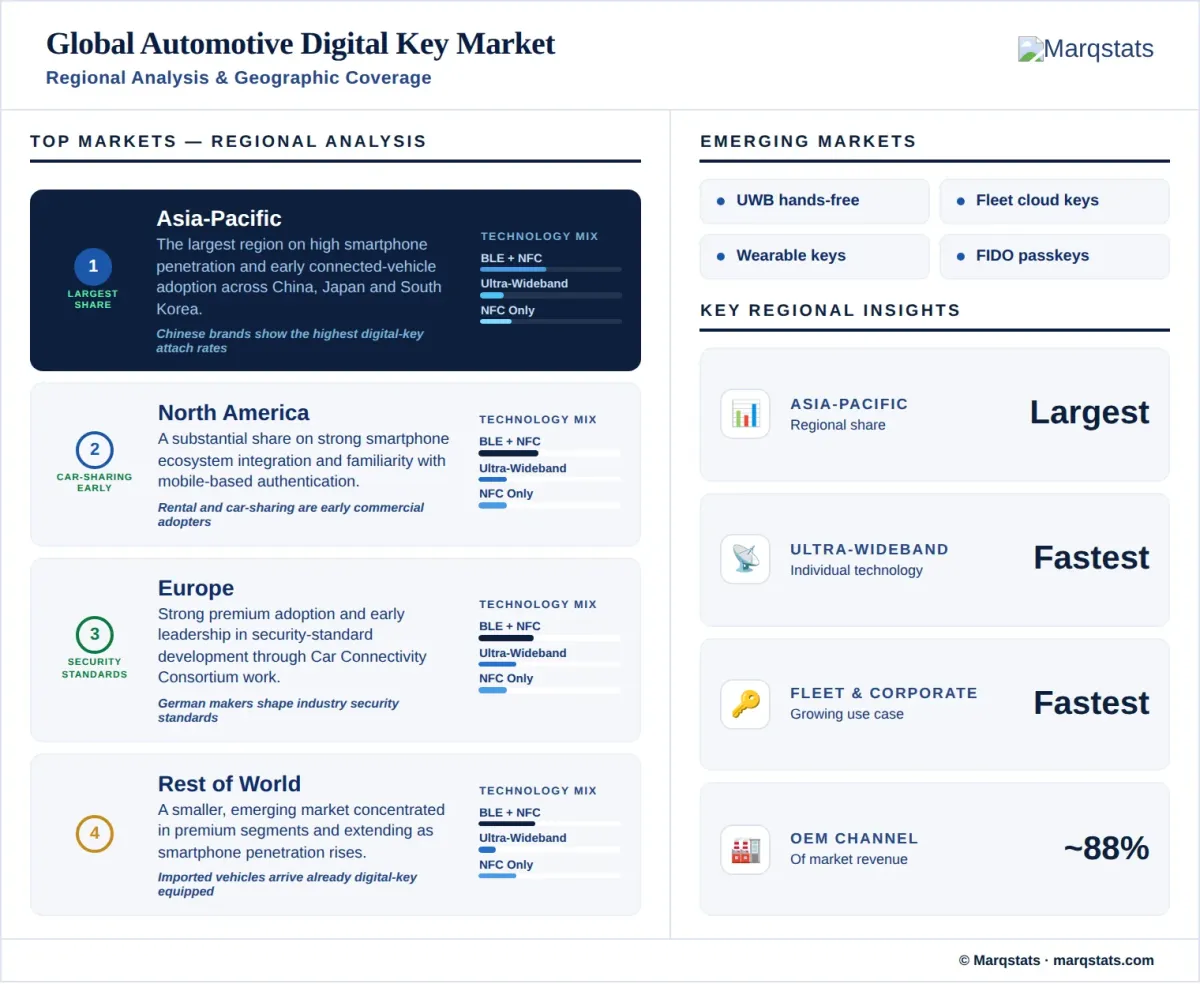
Asia-Pacific holds the largest regional share, led by China, Japan, and South Korea's high smartphone penetration and early connected-vehicle adoption. Chinese automakers in particular have moved aggressively on digital key specification as a competitive differentiator, with installation rates on new domestic passenger vehicles rising rapidly in recent years. Emerging domestic Chinese brands have shown particularly high digital key attach rates, often exceeding those of established international automakers operating in the same market, reflecting these brands' broader strategy of competing on connected-vehicle feature breadth.
North America
North America represents a substantial share of global demand, supported by strong smartphone ecosystem integration through both Apple and Android platforms and growing consumer familiarity with mobile-based authentication across other aspects of daily life. The region's well-established car-sharing and rental industry has also provided an early, receptive commercial application for cloud-managed digital key provisioning beyond individual vehicle ownership. Premium and electric vehicle segments in the region have shown particularly strong digital key attach rates, consistent with the broader adoption pattern observed globally across these two vehicle categories.
Europe
Europe combines strong premium automaker digital key adoption with early leadership in security standard development, reflecting the region's concentration of luxury brands that have historically led connected-vehicle feature introduction ahead of mass-market specification. German automakers specifically have played an outsized role in shaping industry security standards through their participation in the Car Connectivity Consortium, reflecting the premium segment's particular sensitivity to both convenience and security credibility.
Rest of World
Latin America, the Middle East, and Africa represent a smaller, emerging market, with adoption concentrated in premium vehicle segments and gradually extending as smartphone penetration rises and international automakers introduce digital key capability across a broader range of models sold in these markets. Vehicle import composition plays a meaningful role in these markets, since a share of the digital key-equipped passenger vehicle parc arrives already featuring the capability from origin markets with more advanced connected-vehicle specifications.
How Competition Is Evolving
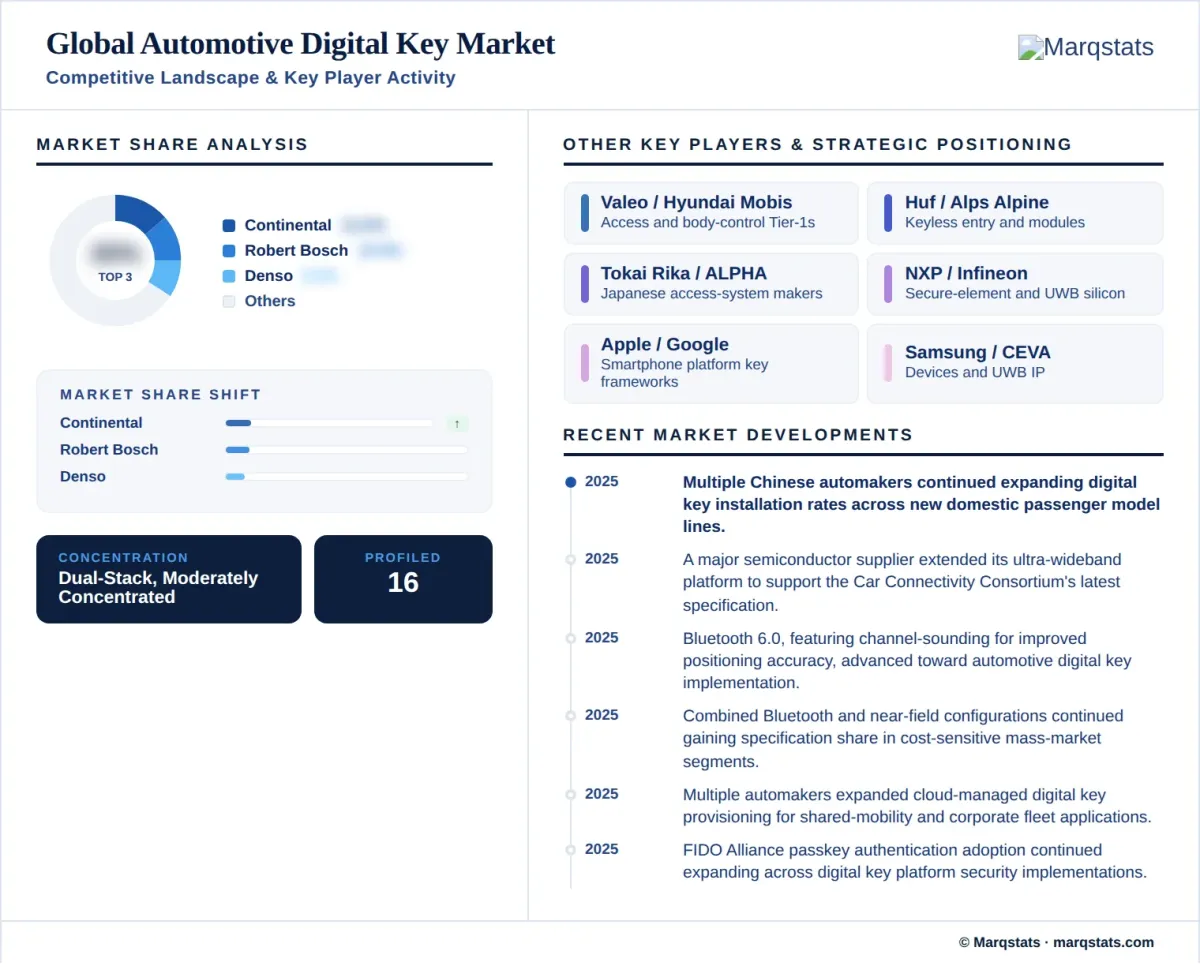
The market is moderately concentrated among established automotive Tier-1 suppliers and semiconductor companies who provide the underlying hardware and secure-element technology, operating alongside a distinct layer of smartphone platform providers, Apple and Google chief among them, whose operating system-level digital key frameworks automakers must integrate against. This dual structure means competitive success in this market depends on both automotive supplier relationships and smartphone platform compatibility simultaneously. Automakers must effectively satisfy two distinct sets of technical and certification requirements, automotive-grade safety and reliability standards on one side and smartphone platform integration requirements on the other, a dual-compliance burden that differentiates this market from more purely automotive-supplier-driven component categories.
Competitive strategy centers on Car Connectivity Consortium standard compliance, ultra-wideband and secure-element technology capability, and the ability to deliver a validated, automotive-grade solution that integrates cleanly with both vehicle electronic architecture and consumer smartphone ecosystems. Suppliers with strong existing keyless entry and access-control relationships hold a meaningful advantage, since digital key implementation often builds directly on existing vehicle access hardware and software architecture rather than requiring an entirely new system. Partnerships between automotive Tier-1 suppliers and semiconductor or smartphone ecosystem companies have become increasingly common, reflecting the reality that no single supplier typically controls the full technology stack a complete digital key solution requires.
Companies Covered
The report profiles 16+ companies with full strategy and financials analysis, including:
Recent Market Activity
Table of Contents
Coverage & Segmentation
This report provides a comprehensive assessment of the global automotive digital key market across a 2025 base year, historical data from 2021 to 2025, and forecasts spanning 2026 to 2030. Market size is stated as digital key hardware, software, and service revenue in United States dollars. Segmentation covers three dimensions: technology, use case, and sales channel, alongside regional analysis spanning Asia-Pacific, North America, Europe, and the rest of world.
The scope covers near-field communication, Bluetooth Low Energy, and ultra-wideband digital key technologies, including combined multi-technology configurations, sold as original equipment and through aftermarket services for passenger and commercial vehicles. The study excludes conventional radio-frequency key fobs without smartphone or cloud integration, which remain a distinct, non-connected keyless entry category that Marqstats covers separately. This distinction matters commercially as much as technically, since conventional keyless entry and digital key solutions typically involve different supplier relationships and, for automakers, different engineering and certification processes despite superficial functional similarity. Country-level detail beyond the four-region split covered here is available under customization, alongside deeper cuts by technology, use case, or mobile platform.