Market Snapshot
Key Takeaways
Market Overview & Analysis
Report Summary
The global automotive aluminum gravity die casting market comprises aluminum-silicon alloy components cast into permanent steel molds under gravity, supplied to vehicle manufacturers and Tier-1 assemblers for engine, transmission, chassis, and structural applications. This study segments the market by part type, vehicle type, and sales channel, with a 2025 base year, historical coverage from 2021 to 2025, and forecasts to 2030. Market size is stated as cast-component sales revenue in United States dollars, covering both original equipment production and the smaller aftermarket and remanufacturing channel. Casting weight and complexity vary considerably across part types, meaning revenue share and unit-volume share for a given part-type category do not always move in the same direction, a distinction this report tracks explicitly rather than presenting a single blended volume metric.
Gravity die casting occupies a specific position within the broader aluminum casting process family, distinct from both high-pressure die casting and sand casting: it produces parts with fewer internal porosity defects and generally higher mechanical strength than high-pressure die casting, making it the preferred process for structural and safety-critical components even though it typically runs at lower production rates and higher per-part cost. This trade-off explains why gravity die casting has retained a durable position in engine and transmission applications even as high-pressure die casting has captured a growing share of thinner-walled body and structural castings elsewhere in the vehicle. Low-pressure die casting, a related process that applies modest pressure during mold filling rather than relying on gravity alone, is frequently grouped alongside gravity die casting in industry reporting given the two processes' similar quality characteristics and overlapping application set; this report treats the two as a single combined category consistent with common industry practice.
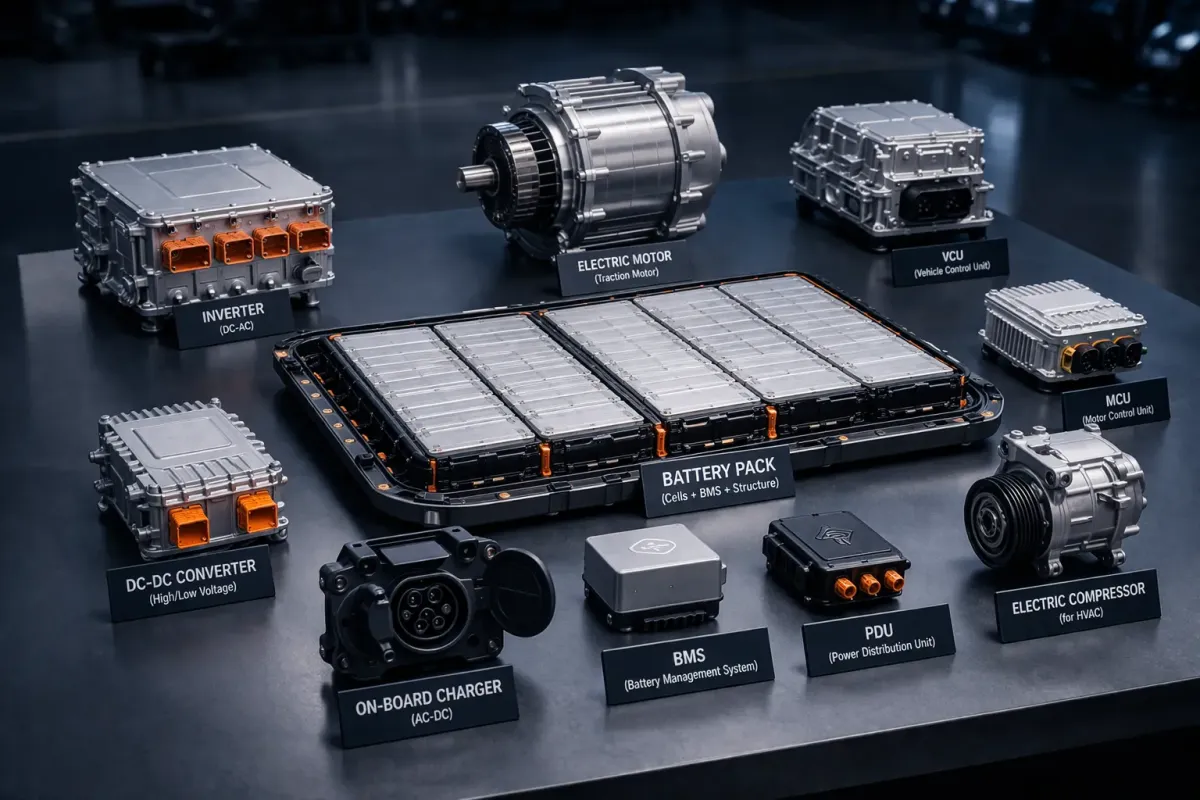
Electric vehicle production is reshaping part-type demand within this market without straightforwardly expanding or contracting overall gravity die casting volume: EV powertrains eliminate traditional engine block and cylinder head castings entirely, a meaningful loss of historical gravity die casting demand, yet introduce new motor housing, gearbox, and select structural casting requirements that in several cases favour gravity die casting's strength and dimensional accuracy advantages over high-pressure alternatives. The net effect on any given foundry's order book depends heavily on its existing part-type specialisation and its success in qualifying for new EV-specific casting programmes. Foundries historically specialised in engine block and cylinder head production face the most direct transition pressure, while those with existing structural and chassis casting capability are generally better positioned to absorb the propulsion shift with less disruption to their core business.
Market Dynamics
Key Drivers
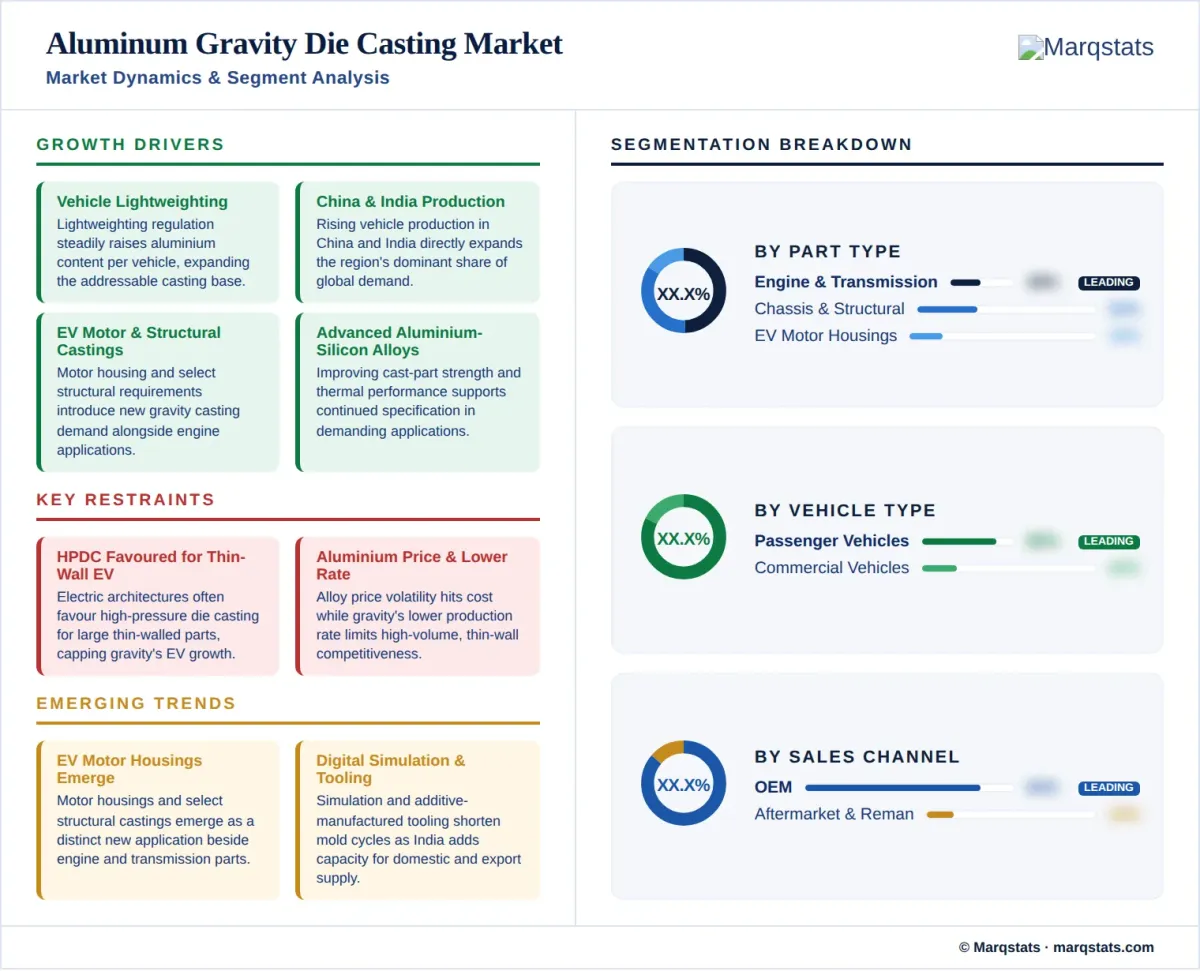
- Vehicle lightweighting regulation is steadily increasing the aluminum content of a typical vehicle, expanding the addressable casting base.
- Rising vehicle production in China and India directly expands the region's dominant share of global gravity die casting demand.
- Electric vehicle motor housing and select structural casting requirements are introducing new gravity die casting demand alongside traditional engine applications.
- Advanced aluminum-silicon alloy development is improving cast-part strength and thermal performance, supporting continued specification in demanding applications.
- Digital simulation and mold design tools are reducing trial iterations and improving casting yield, supporting foundry cost competitiveness.
Key Restraints
- Electric vehicle architectures often favour high-pressure die casting for large, thin-walled structural components, capping gravity die casting's EV-specific growth.
- Aluminum and alloy price volatility directly affects foundry material cost and casting selling price.
- Gravity die casting's lower production rate relative to high-pressure alternatives limits its competitiveness for very high-volume, thin-walled part programmes.
Key Trends
- Electric vehicle motor housings and select structural castings are emerging as a distinct new gravity die casting application alongside traditional engine and transmission parts.
- Advanced aluminum-silicon alloys are improving strength and thermal performance for demanding structural and powertrain applications.
- Digital simulation and additive-manufactured tooling are shortening mold development cycles and improving first-pass casting yield.
- India's foundry industry continues adding gravity die casting capacity under domestic manufacturing and export-oriented investment initiatives.
Market Segmentation
Engine and transmission components, including cylinder heads, engine blocks, crankcases, and transmission housings, remain the largest part-type category, reflecting gravity die casting's long-established suitability for these dimensionally demanding, mechanically stressed applications. Continued internal-combustion and hybrid vehicle production sustains this category even as the industry's longer-term propulsion transition gradually shifts demand toward other part types. Cylinder heads specifically demand the internal porosity control and mechanical strength gravity die casting provides, since this component must withstand sustained thermal cycling and combustion pressure that a less structurally sound casting process would struggle to support reliably over a vehicle's service life.
Chassis and structural components, including suspension subframes and steering knuckles, represent a significant secondary category, valued for gravity die casting's mechanical strength and dimensional accuracy in safety-critical structural applications where casting defects carry particularly serious consequences. Demand in this category tracks vehicle production volume closely across both internal-combustion and electric vehicles, since structural chassis and suspension casting needs persist regardless of a vehicle's propulsion architecture, giving this part-type category a more stable demand profile than engine components specifically. Steering knuckles in particular illustrate gravity die casting's continued relevance for safety-critical parts, since this component directly transmits steering and braking forces and cannot tolerate the internal porosity that a less rigorous casting process would risk introducing.
Electric vehicle motor housings and select battery-adjacent structural components represent the fastest-growing part-type category, a genuinely new demand source introduced by the industry's propulsion transition rather than a substitute for existing engine casting demand, though its ultimate scale depends on the ongoing competitive balance between gravity and high-pressure die casting processes for this specific application. Foundries that have successfully qualified for early-generation EV motor housing programmes are generally well positioned to retain that business into subsequent vehicle platform generations, given the multi-year qualification and validation process automakers typically require before switching a structural casting supplier.
Passenger vehicles account for the large majority of demand, reflecting both the scale of global passenger vehicle production and the concentration of engine, transmission, and chassis casting applications within this vehicle category. Sport-utility vehicles and crossovers, which typically require larger and heavier chassis and structural castings than smaller sedans, contribute a disproportionate share of passenger-vehicle casting revenue relative to their unit production share.
Commercial vehicles, including light and heavy trucks and buses, represent a smaller, steadier secondary segment, with casting specifications typically emphasising durability and load-bearing capacity for components subject to more demanding duty cycles than passenger-vehicle equivalents. Heavier-gauge castings and more conservative safety margins are common in this vehicle category, reflecting both the higher payload and towing requirements these vehicles are designed to meet.
Original equipment production accounts for the substantial majority of market revenue, reflecting gravity die casting's role in structural and powertrain components integrated during vehicle assembly rather than commonly replaced during a vehicle's service life. Supplier qualification for a new vehicle platform typically spans years of joint development between foundry and automaker, covering material specification, tooling design, and validation testing well before production volumes begin. Once qualified on a given vehicle platform, a foundry typically retains that business for the platform's full production run, giving original equipment relationships in this market a multi-year revenue visibility uncommon in less qualification-intensive component categories.
Aftermarket and remanufacturing represent a smaller channel, concentrated in replacement engine and transmission components for older vehicles and in remanufactured casting programmes that recondition and resell components removed during vehicle overhaul or repair. Remanufacturing in particular offers a lower-cost alternative to new-casting replacement for older vehicles, extending component service life through machining and reconditioning rather than full replacement. Markets with an older average vehicle fleet age tend to show proportionally higher remanufacturing activity relative to new-casting aftermarket sales, since remanufacturing economics improve as the pool of vehicles old enough to need engine or transmission overhaul work expands.
By Geography
Asia-Pacific
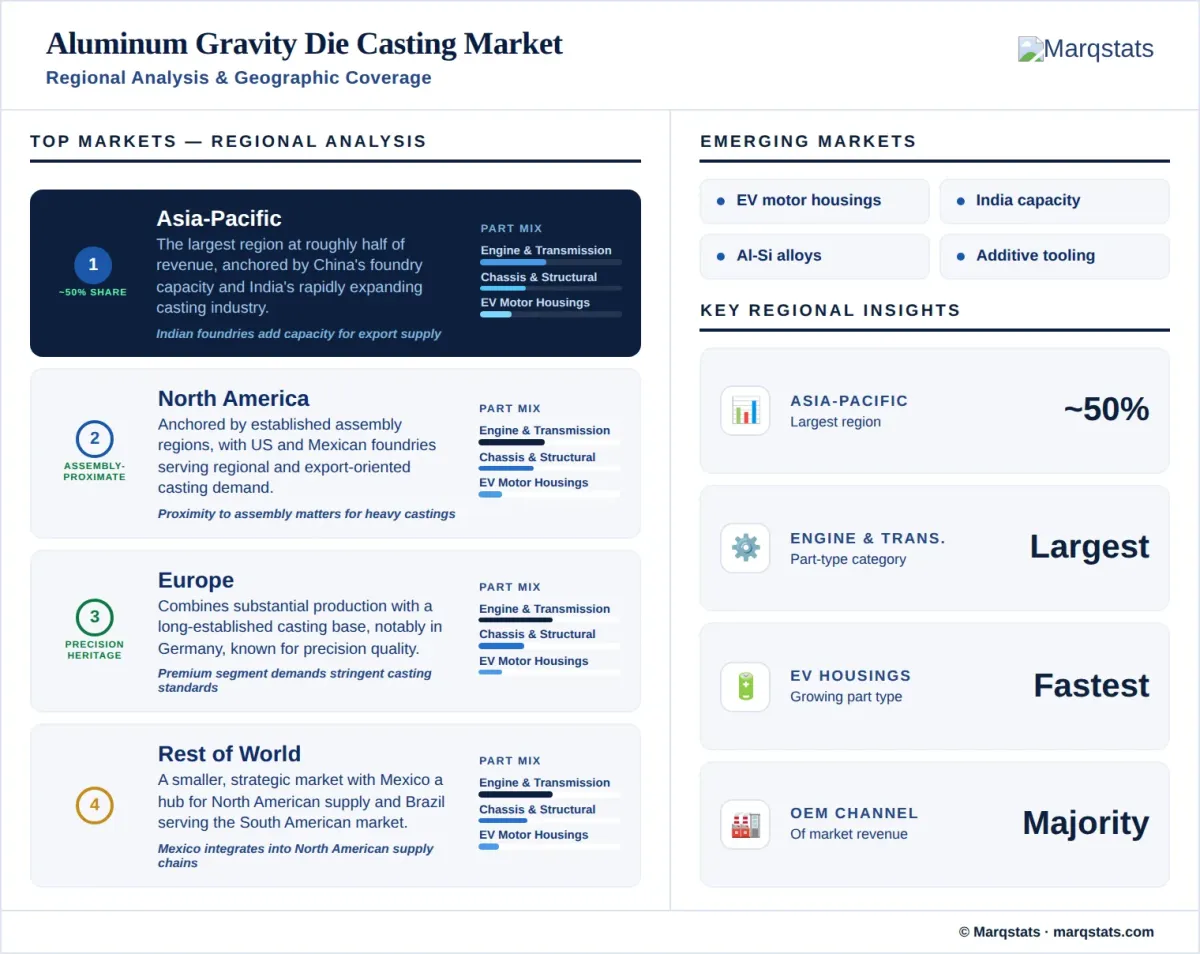
Asia-Pacific holds roughly half of global revenue, the largest of any region, anchored by China's extensive foundry capacity and India's rapidly expanding casting industry, among the largest globally by volume. Indian foundries in particular have added significant gravity die casting capacity in recent years, supported by domestic manufacturing initiatives and growing export-oriented production serving international automakers. China's domestic foundry base has also expanded export activity substantially in recent years, increasingly supplying international automotive supply chains beyond its historically dominant domestic vehicle production base.
North America
North America represents a substantial market anchored by established automotive assembly regions, with domestic and Mexican foundries serving both regional original equipment demand and, increasingly, export-oriented supply into North American vehicle assembly plants. Proximity to final vehicle assembly remains a meaningful competitive consideration in this region specifically, given the cost and logistics disadvantage of shipping heavy cast components over long distances relative to sourcing from a nearby foundry.
Europe
Europe combines substantial automotive production with a long-established casting supplier base, particularly in Germany, reflecting the region's historical strength in engine and precision component manufacturing for both domestic and export-oriented vehicle production. The region's premium automotive segment has historically demanded particularly stringent casting quality standards, giving European foundries a reputation for precision that has supported export competitiveness even against lower-cost regional alternatives.
Rest of World
Latin America, the Middle East, and Africa represent a smaller, strategically important market, with Mexico serving as a significant casting production hub integrated into North American automotive supply chains alongside domestic vehicle assembly. Brazil represents the region's other significant casting production base, serving primarily the domestic South American vehicle market rather than the export-oriented role Mexico plays within North American supply chains. The Middle East and Africa remain the smallest of the four regions covered in this study, with limited domestic vehicle assembly outside South Africa constraining local casting demand relative to the region's population and vehicle parc.
How Competition Is Evolving
The market is fragmented, with a group of established global casting suppliers competing alongside numerous regional and specialist foundries serving local vehicle assembly plants. Long-term supply agreements tied to specific vehicle platforms are standard practice, meaning competitive contests are typically decided at the platform-award stage years before production begins rather than through ongoing price competition on already-awarded programmes. This fragmentation is more pronounced than in some other automotive casting categories, reflecting both the proximity-to-assembly-plant economics that favour regional foundries and the relatively lower capital-investment barrier gravity die casting presents relative to high-pressure die casting or investment casting processes.
Competitive strategy centers on process capability breadth, since suppliers offering both gravity and high-pressure die casting can serve a broader range of a customer's part-type needs than a single-process specialist, alongside proximity to vehicle assembly plants given the cost and logistics disadvantage of shipping heavy cast components long distances. Indian foundries have expanded competitive reach beyond their traditional domestic market in recent years, increasingly competing for export-oriented supply programmes on the strength of cost-competitive, high-volume casting capacity. Vertical integration into alloy melting and tooling design remains a further differentiator among the largest suppliers, since in-house capability across the casting value chain shortens development lead times and gives suppliers greater control over total programme cost relative to foundries reliant on third-party tooling and alloy supply.
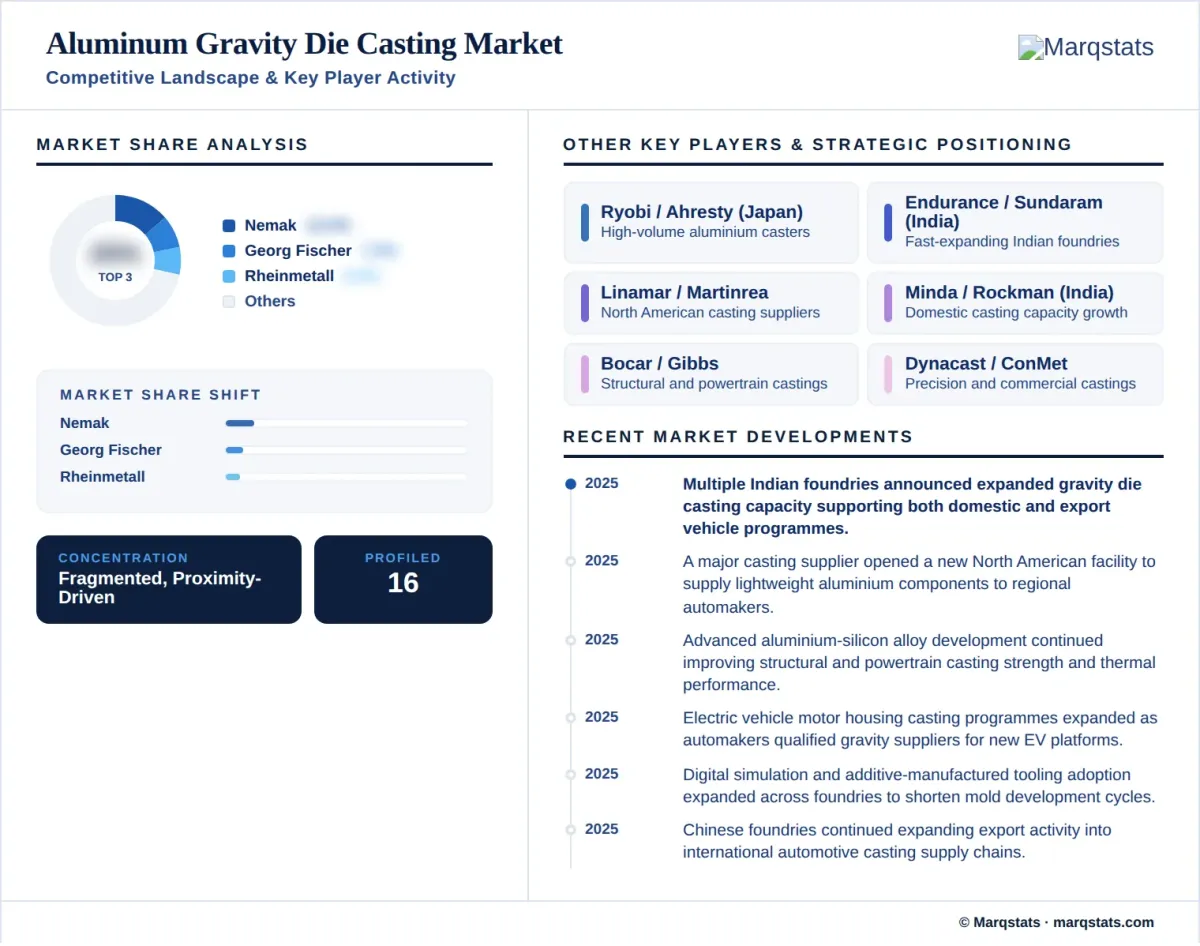
Companies Covered
The report profiles 16+ companies with full strategy and financials analysis, including:
Recent Market Activity
Table of Contents
Coverage & Segmentation
This report provides a comprehensive assessment of the global automotive aluminum gravity die casting market across a 2025 base year, historical data from 2021 to 2025, and forecasts spanning 2026 to 2030. Market size is stated as cast-component sales revenue in United States dollars. Segmentation covers three dimensions: part type, vehicle type, and sales channel, alongside regional analysis spanning Asia-Pacific, North America, Europe, and the rest of world.
The scope covers aluminum-silicon alloy automotive components produced via gravity die casting, including engine, transmission, chassis, and electric vehicle motor and structural housing applications, sold to original equipment manufacturers and through aftermarket and remanufacturing channels. The study excludes non-automotive gravity die casting applications, including electrical, industrial, and general engineering castings, as well as high-pressure die casting and sand casting, which serve different part populations using distinct processes and equipment. This scope choice keeps the reported figure focused on the automotive-specific gravity die casting relationship, distinct from the broader multi-application gravity die casting category and from the separate, larger high-pressure die casting process that dominates automotive aluminum casting more broadly. High-pressure die casting is covered separately by Marqstats, since it serves a materially larger, thinner-walled part population using distinct equipment and a different competitive supplier base than gravity die casting. Country-level detail beyond the four-region split covered here is available under customization, alongside deeper cuts by part type, vehicle type, or alloy grade.