Market Snapshot
Key Takeaways
Market Overview & Analysis
Report Summary
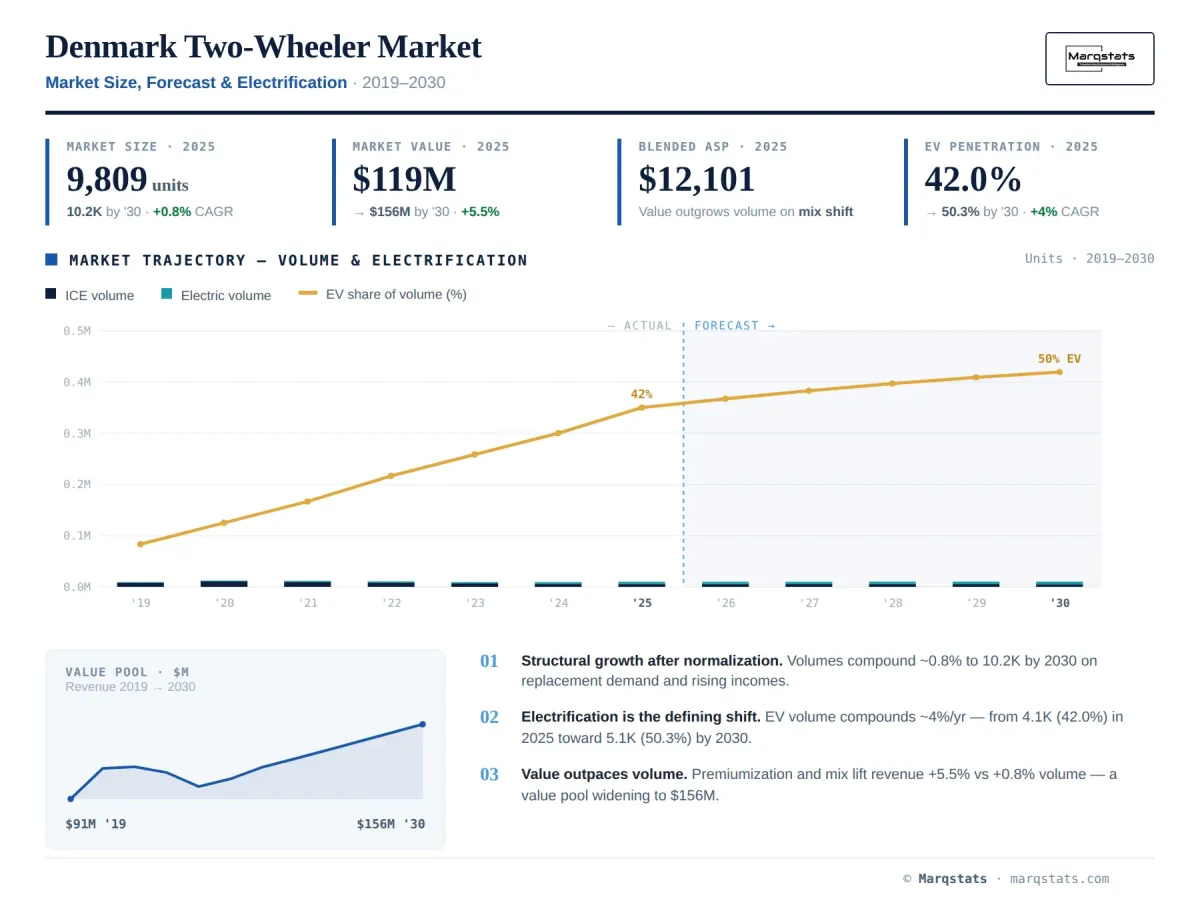
The Denmark two-wheeler market is a small, high-value European market defined by premium pricing and rapid electrification rather than volume expansion. Two-wheelers in Denmark serve leisure riding, urban commuting, and last-mile delivery, and the country distinctive road culture places electric mopeds and speed pedelecs at the centre of everyday micromobility. The market generated USD 118.7 million in revenue in 2025 on roughly 9,800 units, an average value density far above emerging two-wheeler markets and consistent with high disposable incomes and elevated vehicle taxation.
Denmark market structure differs sharply from volume-driven two-wheeler economies. Unit demand has been broadly stable since 2021, moving within a narrow band, whereas revenue has climbed steadily owing to premiumisation and the migration toward electric powertrains that carry higher price points. The country cycling infrastructure, among the densest in Europe, supports a large base of scooters, mopeds, and electric light vehicles used for short urban trips, while a smaller cohort of higher-displacement motorcycles serves recreational and touring demand.
Regulation shapes demand more than in most markets. The full introduction of the Euro 5+ emissions standard on 1 January 2025 pulled a portion of combustion demand forward into 2024 and produced a market adjustment through the first half of 2025, a pattern visible across European registration data compiled by the European motorcycle industry association. At the same time, Denmark permits speed pedelecs on many cycle paths, a policy that has directly encouraged electric two-wheeler uptake and reinforced the market shift toward battery propulsion.
Taxation is a decisive force in the Danish market. Denmark applies one of the highest vehicle registration-tax regimes in Europe, which raises the delivered price of higher-displacement combustion motorcycles and reinforces the premium, value-led character of the market. Electric vehicles benefit from a materially lighter fiscal burden, and the reduced registration-tax rate for zero-emission vehicles was maintained under the 2026 Finance Act, sustaining the incentive that pushes buyers toward electrified two-wheelers. This fiscal structure, combined with high incomes, explains why the market grows in value while remaining flat in units.
Premiumisation is the second structural theme. Average selling prices rise across the forecast period as buyers migrate toward higher-specification electric models, larger-displacement motorcycles, and premium European marques. The premium and high-performance price bands expand faster than entry tiers, and brand competition centres on average selling price rather than unit share. The combined effect of electrification and premiumisation is a market whose revenue compounds at 5.47% even as annual registrations hold near 9,800 units, a defining characteristic that separates Denmark from volume-driven two-wheeler markets elsewhere.
Market Dynamics
Key Drivers
- Electrification momentum drives value growth, with electric two-wheeler revenue expanding at a 9.06% CAGR and crossing 50% of market value by 2030 as riders migrate from combustion mopeds to electric equivalents.
- Favourable treatment of electric light vehicles, including permission for 45 km/h speed pedelecs on many cycle paths, widens the addressable base for electric two-wheelers and accelerates category substitution.
- High disposable incomes and premiumisation lift average selling prices, so revenue grows even where unit demand is flat; the premium and high-performance price bands expand faster than entry tiers.
- Dense protected cycle infrastructure and short urban trip chains position scooters, mopeds, and electric two-wheelers as practical substitutes for car trips in Copenhagen and other cities.
- Growth in urban delivery raises fleet demand, and the delivery and logistics end-user segment expands at an 8.00% CAGR as courier and food-delivery operators adopt electric two-wheelers.
- Maintained fiscal incentives for zero-emission vehicles under the 2026 Finance Act preserve the price advantage of electric two-wheelers and support continued substitution away from combustion mopeds.
Key Restraints
- Structurally low unit volumes, near 9,800 per year, cap absolute market size and limit economies of scale for importers and dealers relative to larger European markets.
- One of Europe highest vehicle registration-tax regimes raises the delivered cost of higher-displacement combustion motorcycles and restrains volume growth in the premium combustion category.
- A short riding season and cold-weather climate constrain year-round two-wheeler usage, keeping demand concentrated in leisure and warmer-month commuting for combustion models.
- Competition from a mature bicycle and pedal-assist e-bike culture diverts a share of short-trip mobility away from registered mopeds and scooters.
Key Trends
- Electric revenue overtakes combustion revenue by 2030, the central structural shift reshaping vehicle mix and dealer inventory in the Danish market.
- Online retail expands fastest at a 12.33% CAGR as direct-to-consumer models and digital configurators gain share, though offline dealers still handle the large majority of value.
- Premiumisation continues as the high-premium and performance band grows at a 6.82% CAGR, faster than entry and mid segments, lifting the market average price.
- Chinese challenger brands, spearheaded by Voge, gain share at an 8.15% revenue CAGR by pairing competitive pricing with expanding electric and mid-capacity ranges.
- Fleet electrification accelerates as delivery and B2B operators replace combustion mopeds with electric equivalents, aligning commercial buyers with the national push toward zero-emission road transport.
Market Segmentation
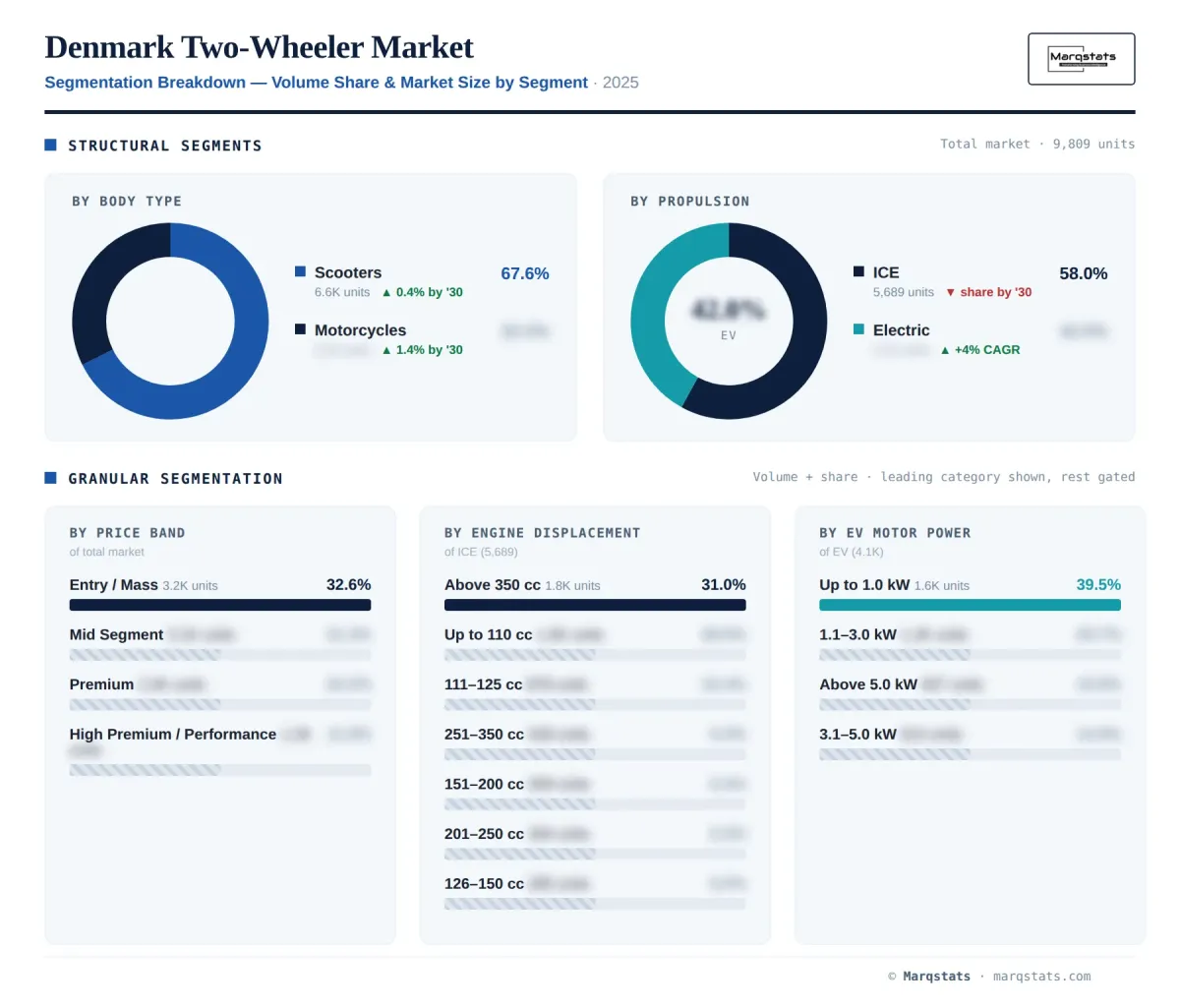
Scooters and mopeds form the largest vehicle-type segment by revenue, generating USD 80.3 million in 2025 and rising to USD 103.6 million by 2030 at a 5.12% CAGR. The segment reflects Denmark urban-mobility orientation, where light two-wheelers handle short commuting and errand trips. Electric mopeds and speed pedelecs are the primary growth engine within this segment, progressively displacing combustion mopeds as buyers respond to favourable rules for electrified light vehicles.
Motorcycles generated USD 38.4 million in 2025 and expand to USD 52.2 million by 2030 at a 6.18% CAGR, the faster-growing vehicle type by value. The segment carries a higher average selling price than scooters and mopeds and is anchored in leisure, touring, and higher-displacement riding. Premium European and Japanese motorcycles dominate this segment, and its above-market value growth is attributed to premiumisation and steady demand for larger-capacity machines.
Electric is the fastest-growing propulsion category, expanding from USD 49.9 million in 2025 to USD 78.6 million by 2030 at a 9.06% CAGR. Electric revenue reaches 50.4% of the market by 2030, overtaking combustion models within the forecast period and mirroring electric two-wheeler momentum visible in other electric two-wheeler markets tracked by Marqstats. Growth is concentrated in electric mopeds, speed pedelecs, and higher-power electric motorcycles, with the above-5.0 kW power band expanding fastest at 11.05%.
Internal combustion engine models generated USD 68.8 million in 2025 and grow slowly to USD 77.4 million by 2030 at a 2.39% CAGR. Combustion revenue holds up in the higher-displacement leisure and touring bands even as electric propulsion captures the light-vehicle and commuting segments. Combustion unit volumes decline over the forecast period, however, so the segment value growth is carried by average-price gains rather than rising sales.
Within combustion models, the up-to-110 cc band and the above-350 cc band anchor the segment by revenue, contributing USD 19.6 million and USD 21.3 million respectively in 2025. The above-350 cc band reflects leisure and touring demand for larger motorcycles and carries the highest average price of any combustion tier, whereas the up-to-110 cc band captures entry mopeds used for short urban trips. The mid-capacity 111 to 125 cc band adds a further USD 10.6 million, serving licence-tier commuters, while the 126 to 350 cc bands together represent a smaller enthusiast cohort. Combustion displacement bands broadly hold their revenue as premium pricing offsets slowly declining unit volumes.
Within electric models, the up-to-1.0 kW band forms the largest tier at USD 19.7 million in 2025, consistent with the dominance of electric mopeds and speed pedelecs in Danish urban mobility. The 1.1 to 3.0 kW band follows at USD 14.8 million and captures higher-performance electric mopeds and light motorcycles. The above-5.0 kW band, though smaller at USD 7.9 million in 2025, expands fastest at an 11.05% CAGR as full electric motorcycles gain acceptance among riders trading up from combustion machines. The electric motor-power mix therefore shifts gradually toward higher-power bands over the forecast period.
The entry and mid price bands together account for the majority of revenue, at USD 38.7 million and USD 37.2 million in 2025, serving mainstream commuting demand. The premium and high-premium bands, however, grow faster, at 5.89% and 6.82% CAGR respectively, reflecting the premiumisation that carries Denmark revenue-led market. The high-premium and performance band, at USD 14.1 million in 2025, is the fastest-expanding price tier and lifts the market average selling price over the forecast period.
The B2C segment dominates the Denmark two-wheeler market, generating USD 112.7 million in 2025, roughly 95% of revenue, and growing at a 5.34% CAGR. Private ownership reflects the country high incomes and the use of two-wheelers for leisure riding and personal urban mobility rather than shared fleets. Fleet and commercial demand is smaller yet faster-growing: the delivery and logistics segment expands at an 8.00% CAGR to serve urban courier and food-delivery operators, while the B2B and fleet segment grows at 7.82% as businesses electrify light-vehicle fleets. Government and institutional demand adds a further USD 1.5 million in 2025, growing at 7.41%. Ride-hail and rental demand is negligible in Denmark, consistent with a market oriented toward private ownership rather than shared two-wheeler services, and this absence distinguishes Denmark from emerging two-wheeler markets where rental and ride-hail fleets form a meaningful share of demand.
Offline dealers remain the dominant channel, handling USD 105.2 million of revenue in 2025 and growing at a 4.38% CAGR, owing to the service, financing, and registration support that two-wheeler purchases require. Online sales, however, expand fastest at a 12.33% CAGR, rising from a small base as direct-to-consumer brands, digital configurators, and online-first electric two-wheeler players gain share. The channel shift is gradual, and physical dealers retain the large majority of value through the forecast period.
By Geography
Capital Region and Copenhagen
The Capital Region, centred on Copenhagen, is the largest demand centre for two-wheelers in Denmark. Dense population, protected cycle superhighways, and short urban trip chains make electric mopeds and speed pedelecs practical car substitutes, and the city concentrates the country electric two-wheeler and delivery-fleet demand. Copenhagen speed-pedelec trials also guide national policy on where higher-speed electric light vehicles operate, reinforcing the region role as the electrification frontier of the Danish market.
Central Denmark and Jutland
Central Denmark, anchored by Aarhus, and the wider Jutland peninsula form the second demand cluster. Demand here mixes urban commuting in Aarhus with leisure and touring motorcycle use across more open road networks, supporting a higher share of higher-displacement combustion motorcycles than in the capital. Regional dealers serve both electric commuting demand in cities and recreational riders in surrounding areas.
Southern Denmark and Zealand Periphery
Southern Denmark, including Odense and the Funen area, together with the Zealand periphery around the capital, rounds out national demand. These areas combine commuter mopeds with recreational motorcycling, and adoption of electric two-wheelers tracks the national shift as charging access and product availability expand beyond the capital. Odense mature cycling infrastructure supports a strong base of light electric two-wheelers.
Across all regions, new registrations remain concentrated and stable in volume, a pattern confirmed by national vehicle registration data published by Statistics Denmark, and value growth is carried by premiumisation and electrification rather than by geographic expansion of the fleet.
How Competition Is Evolving
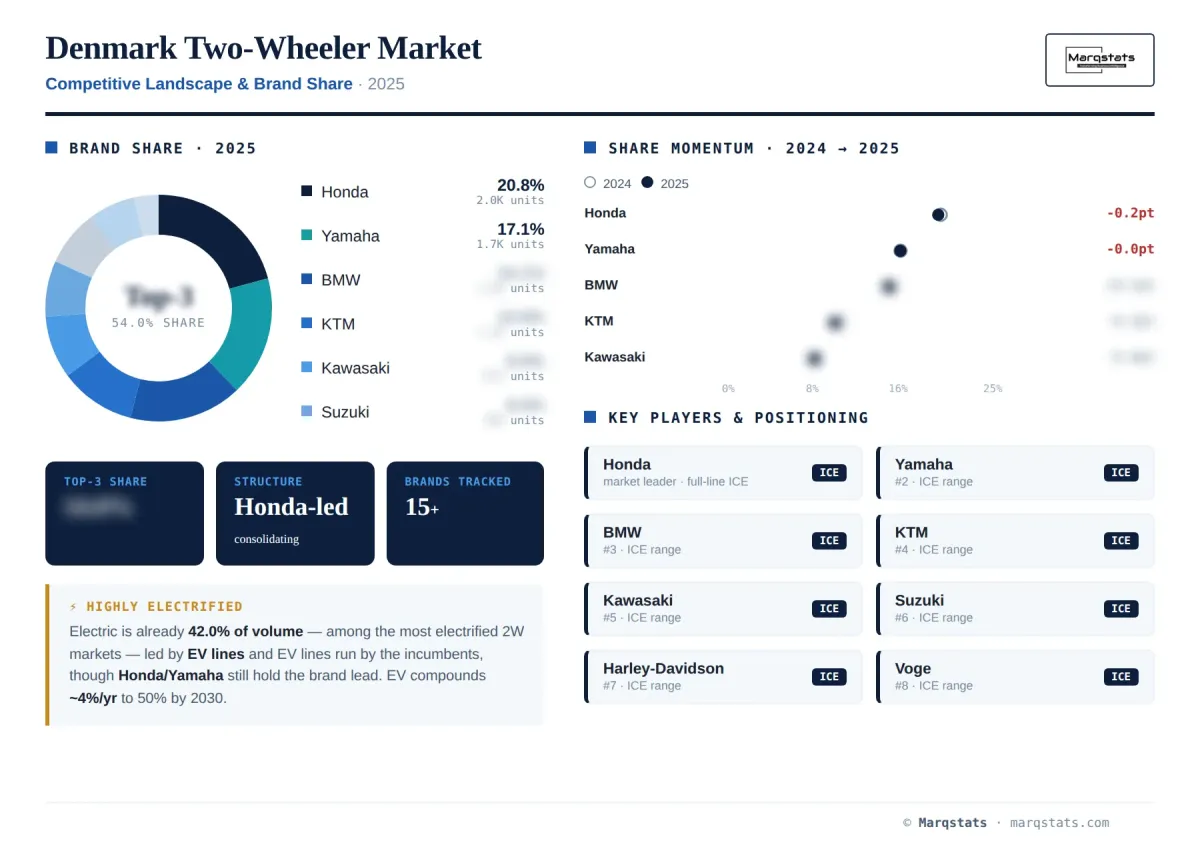
The Denmark two-wheeler market is moderately concentrated. The three largest brands by revenue, Honda, Yamaha, and BMW, together account for roughly 54% of market value in 2025, and the eight largest brands account for around 92%. Honda holds the foremost position at about 20.7% revenue share, followed by Yamaha at 17.1% and BMW at 16.1%, the latter reflecting the strength of premium motorcycles in a high-income market. Japanese and European manufacturers dominate, and their competition centres on premium positioning, dealer service depth, and electric range expansion.
Competition is intensifying at two ends of the market. At the premium end, BMW and KTM compete on higher-displacement and performance models where average prices are highest, whereas at the value and electric end, Chinese challenger brands led by Voge gain share rapidly, expanding revenue at an 8.15% CAGR by pairing competitive pricing with growing electric and mid-capacity ranges. Established brands are responding by broadening electric two-wheeler portfolios and strengthening online sales channels, the fastest-growing route to market.
Because the market is revenue-led, brand strategy in Denmark prioritises average selling price and electrification over unit share. Manufacturers that align with the country favourable rules for electric light vehicles, and that expand speed-pedelec and electric-moped ranges, are positioned to capture the value migration toward battery propulsion. Dealer networks, financing, and after-sales service remain decisive competitive levers given the registration and servicing requirements attached to two-wheeler ownership.
Specialist electric brands add a further competitive dimension. Zero Motorcycles and Niu Technologies extend the electric motorcycle and electric moped segments respectively, while Segway-Ninebot targets the light electric two-wheeler tier that overlaps with the speed-pedelec category. European scooter and moped houses including Piaggio, Peugeot Motocycles, and KYMCO compete in the urban commuting segment where scooters and mopeds hold the largest revenue share. The combined presence of premium motorcycle marques, mainstream Japanese brands, Chinese challengers, and electric specialists gives Denmark a diverse supplier base for a market of its size, and the pace of each participant electric roadmap is emerging as the primary determinant of future share.
Companies Covered
The report profiles 16+ companies with full strategy and financials analysis, including:
Recent Market Activity
Table of Contents
Coverage & Segmentation
This report provides a comprehensive analysis of the Denmark two-wheeler market for the 2021 to 2025 historical period and the 2026 to 2030 forecast period, with 2025 as the base year. The study quantifies market size in revenue terms, in USD, and in unit volume, and segments the market by vehicle type, propulsion type, engine displacement and motor power, price band, end user, sales channel, and brand. It examines the drivers, restraints, and trends shaping demand, and profiles the competitive structure of the market.
The study focuses on registered two-wheelers, spanning motorcycles, scooters, mopeds, and electric light vehicles including speed pedelecs classified as mopeds. Coverage addresses the revenue-led character of the Danish market, the electrification shift that reshapes vehicle mix through 2030, and the regional distribution of demand across the Capital Region, Central Denmark and Jutland, and Southern Denmark. Values are reported in USD MN throughout, consistent with a market below USD 1 billion in size.