Market Snapshot
Middle bar: base-year value × (1 + CAGR), rounded to two decimals. This is a calculated illustration, not a separately researched annual estimate.
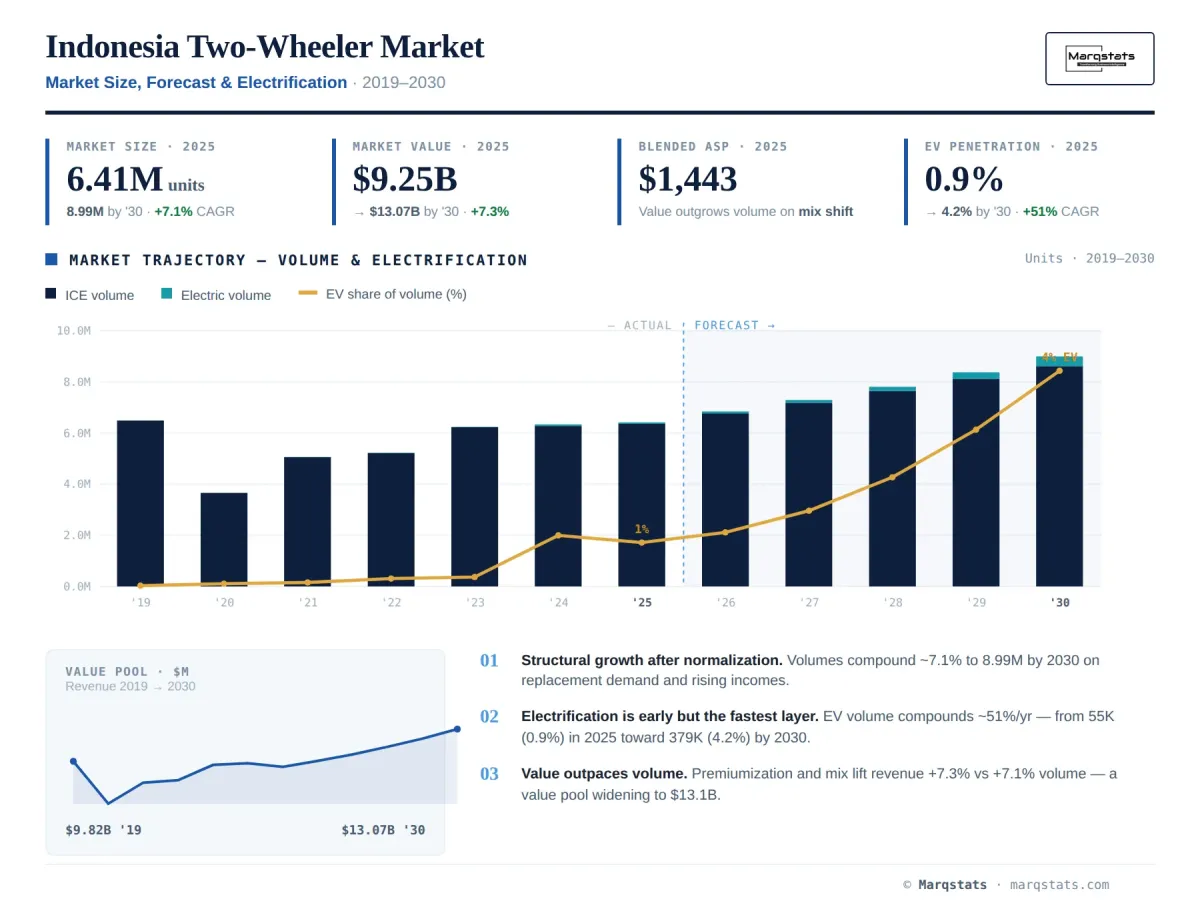
The Indonesia two-wheeler market reached 6.41 million units in 2025 and is projected to reach 8.99 million units by 2030, expanding at a 7.07% CAGR across the 2026–2030 forecast period; in value terms the market rises from USD 9.25 billion to USD 13.07 billion. Indonesia is the world's third-largest two-wheeler market, trailing only India and China, and the most scooter-oriented in Southeast Asia, with scooters representing 86.3% of 2025 volume. Against an installed base exceeding 120 million motorcycles, the two-wheeler is the default mode of mobility for a population of about 280 million, serving commuting, family transport, trade, and a vast ride-hail and delivery economy.
Demand is anchored by affordability and dominated by two brands: Honda and Yamaha together command roughly 96% of unit sales, making Indonesia the most concentrated major two-wheeler market in the region. Electrification remains early, with electric models under 1% of 2025 volume; adoption dipped as government subsidies lapsed, even as the national target of 13 million electric motorcycles by 2030 frames substantial latent upside. Battery swapping, backed by the Gojek-linked Electrum ecosystem, is emerging as the pragmatic path to scale.
Growth is driven by rising incomes, urbanisation, and a resilient gig economy, tempered by weak purchasing power and policy uncertainty around electric incentives. The Indonesia two-wheeler market therefore presents a paradox: enormous, stable combustion demand at the base, and the largest untapped electrification opportunity in ASEAN at the margin, contingent on durable policy and battery-cost reduction rather than short-lived subsidies.
Key Takeaways
Market Overview & Analysis
Report Summary
The Indonesia two-wheeler market comprises motorcycles, scooters, and mopeds sold for personal and commercial use across internal combustion and electric propulsion. This study segments demand by vehicle type, propulsion type, engine displacement and motor power, price band, end user, sales channel, and brand, with a 2025 base year, historical coverage from 2021 to 2025, and forecasts to 2030. Two-wheelers are the backbone of Indonesian mobility across a sprawling archipelago, valued for affordability, fuel economy near 40 kilometres per litre, and manoeuvrability in dense, congested cities.
Domestic demand is large and cyclical. The Association of Indonesian Motorcycle Industry recorded about 6.4 million units sold in 2025, up 1.3% on 2024, supported by central-bank interest-rate cuts and regional vehicle-tax relief, though volumes remain below the roughly 8 million-unit peak of the previous decade. Scooters, especially automatic commuter models, account for the overwhelming majority of sales, while conventional motorcycles hold a modest and shrinking share.
Supply is concentrated and heavily localised, with around 90% of motorcycles produced domestically. Honda, through PT Astra Honda Motor, leads by a wide margin, followed by Yamaha, with Kawasaki, Suzuki, TVS, and Piaggio occupying niche positions. A cohort of domestic and Chinese electric brands, including Gesits, Alva, Volta, Polytron, and the Gojek-linked Electrum venture, is building the electric segment around battery swapping and fleet adoption, though scale remains modest against the combustion base.
The scale of dependence on two-wheelers is difficult to overstate. More than 120 million motorcycles operate across the archipelago, and the vehicle underpins livelihoods for millions of ride-hail and delivery riders serving platforms such as Gojek, Grab, and ShopeeFood. Tightening emission rules, including the phase-in of Euro 4 standards for motorcycles, are lifting average specification and cost, while manufacturers reinforce Indonesia's role as a production hub for domestic demand and regional export. This combination of vast scale, near-total localisation, and an early-stage electric transition defines the strategic character of the Indonesia two-wheeler market.
Market Dynamics
Key Drivers
- Growth is driven by the gig and delivery economy, where ride-hail and food-delivery platforms such as Gojek, Grab, and ShopeeFood sustain demand for automatic scooters used for daily income generation.
- Rising incomes and a middle class approaching 140 million expand access to financed two-wheeler ownership, lifting both entry and premium demand across urban and rural markets.
- Supportive monetary and local-tax conditions aided 2025 demand, as central-bank rate cuts and regional relief on vehicle registration and transfer fees improved affordability and financing access.
- Urbanisation, congestion, and an archipelagic geography sustain continuous replacement demand, with two-wheelers remaining the most practical transport across islands, narrow streets, and areas underserved by public transit.
- A large food-delivery and e-commerce economy, among the biggest in Southeast Asia, sustains high-utilisation commercial demand and shortens replacement cycles for delivery and ride-hail riders.
Key Restraints
- Weak purchasing power constrains volume, as demand remains sensitive to interest rates, down-payment rules, and household budgets, holding the market below its prior-decade peak.
- Electric-vehicle policy is unstable, as the IDR 7 million per-unit subsidy lapsed at the end of 2024 and was not renewed through 2025, and a proposed new incentive for 100,000 electric motorcycles remained under coordination, leaving investment planning uncertain.
- Charging and battery-swap infrastructure lags ambition, with a few thousand swap points against a national plan for tens of thousands, and low household grid capacity, often around one kilowatt, limiting practical home charging for delivery riders.
Key Trends
- Battery swapping is emerging as the scaling model, led by the Gojek-linked Electrum venture and dedicated operators; the broader Indonesia electric-vehicle ecosystem is analysed in the companion study.
- Scooterization is near-total, as automatic matic models dominate new sales and define the product mix around commuting, storage, and delivery use cases.
- Fleet electrification leads consumer adoption, with ride-hail and delivery operators converting to electric two-wheelers for lower running costs, seeding demand ahead of private buyers.
- Digital retail expands rapidly, with the online channel growing at an 18.51% CAGR as marketplaces and manufacturer platforms complement dense dealer networks.
Market Segmentation
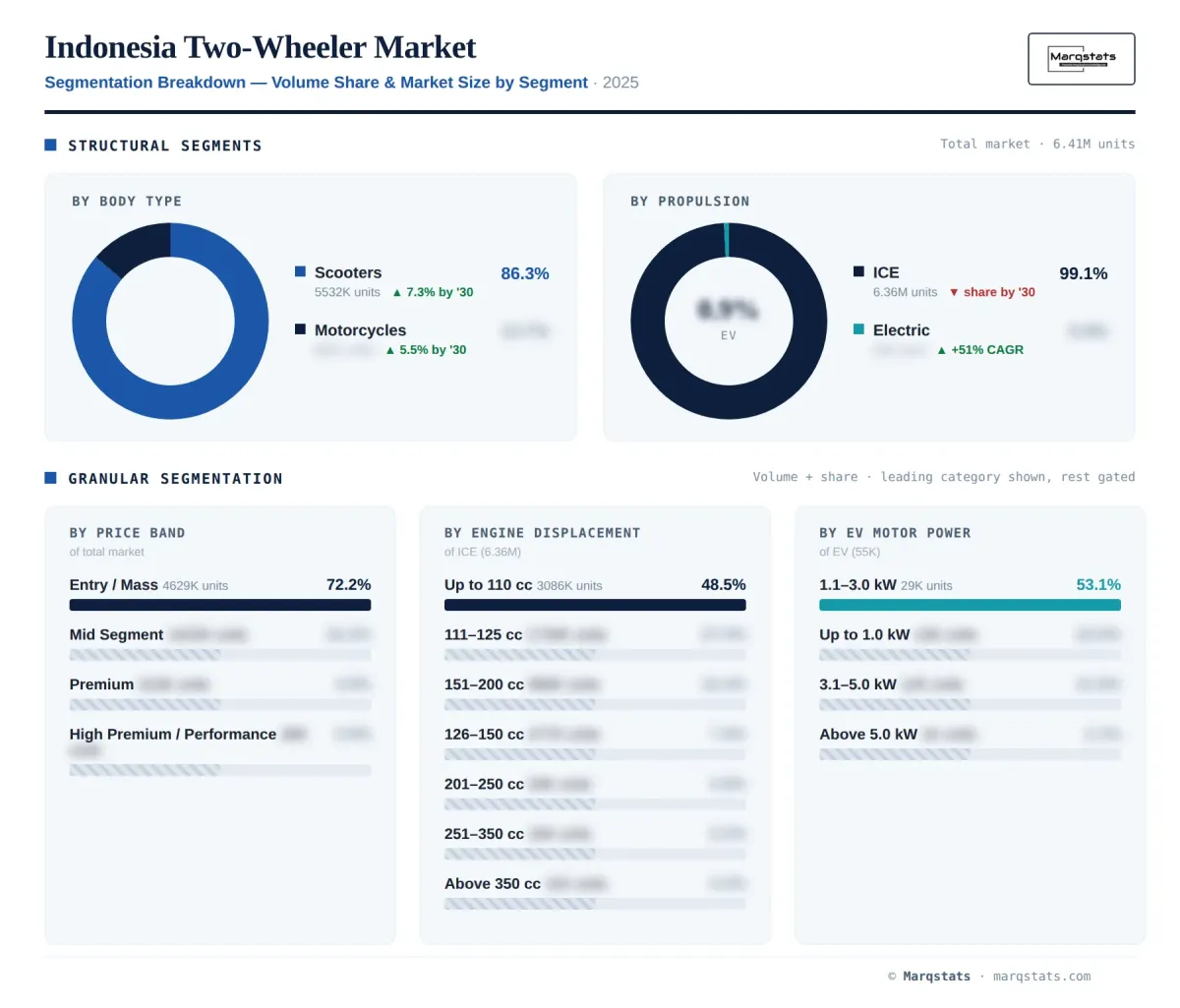
Scooters overwhelmingly dominate the market, contributing 86.3% of 2025 volume at 5.53 million units and expanding at a 7.31% CAGR through 2030. Automatic transmission, storage practicality, and low running cost make scooters the default choice for commuting and delivery, and nearly all electric two-wheelers also adopt this format. This concentration makes Indonesia the most scooter-oriented major market in the region. The matic category has steadily displaced traditional underbone motorcycles over the past decade, driven by convenience, styling, and the needs of a young, urban, gig-employed rider base, and it now sets the design and pricing agenda for the entire market.
Conventional motorcycles, chiefly underbone and sport models, account for 881,000 units in 2025 and grow more slowly at a 5.52% CAGR. Demand persists in rural and provincial markets and among enthusiasts, though the centre of gravity has shifted decisively toward automatic scooters. Sport and naked models retain a loyal following among younger male riders, and the category benefits from Yamaha's positioning, yet it no longer sets the pace of overall market growth.
Mopeds register negligible sales across the study period and do not form a material commercial segment in Indonesia.
Combustion models hold 99.1% of 2025 volume at 6.36 million units, spanning the full displacement range. Growth is steady at roughly a 6% CAGR, sustained by affordability, dense service and dealer networks, and the near-complete localisation of production. Combustion remains firmly entrenched given the early stage of electrification and the lapse of purchase incentives. Fuel economy near 40 kilometres per litre, low maintenance, and strong resale value reinforce combustion ownership, particularly among rural and lower-income buyers for whom total cost of ownership outweighs the appeal of newer technology.
Electric two-wheelers hold under 1% of 2025 volume at 55,000 units, having dipped from 2024 as subsidies expired, yet grow at a 51.34% volume CAGR from a small base to reach 379,000 units by 2030. Adoption is led by fleet operators and domestic brands, underpinned by battery swapping, and remains contingent on durable policy support and falling battery costs rather than short-lived cash incentives. The government targets 13 million electric motorcycles on the road by 2030 and a domestic manufacturing capacity near 2.45 million units, against tens of thousands of planned battery-swap stations versus only a few thousand today. The Electrum venture, which links Gojek's rider network with battery-swap infrastructure, illustrates how captive commercial fleets can seed adoption ahead of private demand.
The up-to-110cc band is the single largest displacement class at 3.09 million units in 2025, about 48% of the market and growing at a 7.68% CAGR, with the 111–125cc band adding 1.73 million units. These commuter classes define mainstream mobility and anchor the entry price tier. Their continued growth, even as electrification advances elsewhere in the region, reflects the affordability imperative that governs the bulk of Indonesian demand and the limited price parity that electric models have so far achieved without subsidy.
Mid and large displacement classes are smaller, with a notable 151–200cc sport and premium-scooter segment near 980,000 units. Displacement classes above 200cc grow at low-double-digit rates from a limited base, while within electric, higher-power classes above 5 kW record the fastest growth as performance expectations rise.
The entry and mass band is the volume core at 4.63 million units in 2025, about 72% of the market, growing at a 6.6% CAGR, while the mid segment adds 1.42 million units. Together these bands frame an affordability-led market that Honda and Yamaha overwhelmingly serve. Price sensitivity is acute: modest changes in interest rates, down-payment requirements, or fuel and living costs move volumes materially, which is why financing availability and instalment terms are decisive competitive levers at these tiers.
Premium and high-premium performance bands are small yet the fastest-growing by value, with the high-premium band expanding at about a 22% volume CAGR. Rising discretionary income, premium scooters, and imported performance and adventure models drive this upmarket shift among affluent urban buyers. Although these bands remain a small share of total volume, they contribute disproportionately to revenue and margin, and they represent the clearest avenue for value growth in a market where entry-tier prices are structurally constrained.
Private consumers account for about 87% of 2025 volume, sustaining the mainstream commuter and scooter segments in step with incomes and financing access across the archipelago.
Commercial demand grows faster than private use. Delivery and logistics expands at a 12.09% volume CAGR as e-commerce scales, while ride-hail and rental fleets lead electric adoption, turning commercial riders into the earliest electric two-wheeler users. For these high-mileage riders, battery swapping and lower running costs translate into meaningful monthly savings, making commercial fleets the most economically rational entry point for electrification and a priority target for swap-network operators.
Physical dealerships remain dominant, handling the majority of sales and providing financing, registration, and after-sales service. Dense dealer and service coverage is central to Honda's and Yamaha's durable advantage across urban and remote island markets.
The online channel is the fastest-growing route to market at an 18.51% volume CAGR, reflecting Indonesia's advanced e-commerce culture and high marketplace penetration. Manufacturers and dealers increasingly use online platforms for discovery, booking, and financing, complementing rather than replacing the dense physical network, and digital lead generation is becoming central to how younger urban buyers research and purchase their first two-wheeler.
By Geography
Java and Greater Jakarta
Java concentrates the majority of demand and nearly all electric-two-wheeler activity, anchored by Greater Jakarta. Dense congestion, a large gig-delivery workforce, and battery-swap networks operated by Electrum and dedicated players make the capital region the primary testbed for electrification and premium models. Electrum alone runs several hundred swap stations serving thousands of active electric motorcycles across the Jabodetabek metropolitan area, while operators anchored at convenience-store and fuel-station sites extend coverage along high-traffic delivery corridors.
Sumatra
Sumatra is the second-largest regional market, combining urban centres with extensive rural and plantation economies. Demand skews toward affordable commuter scooters and motorcycles used for trade, agriculture, and household transport, closely tied to commodity incomes from palm oil, rubber, and coffee. Purchasing power in these areas rises and falls with crop prices, making the entry tier sensitive to commodity cycles and credit conditions, while electrification remains minimal outside the largest cities.
Eastern Indonesia and Outer Islands
Sulawesi, Kalimantan, and the eastern islands rely heavily on two-wheelers where road and public-transport networks are limited. Entry-tier combustion models dominate, and electrification lags owing to sparse charging and swap infrastructure. These markets are the most exposed to logistics and distribution costs, which raise effective vehicle prices, and they are likely to be the last to electrify, remaining a combustion stronghold well beyond the forecast period absent targeted infrastructure investment.
Indonesia within ASEAN
Indonesia is the largest two-wheeler market in ASEAN and the world's third-largest overall, yet trails Vietnam and Thailand in electric penetration. Its scale, localisation, and 13-million-unit electric target make it the region's largest latent electrification opportunity, dependent on policy consistency.
How Competition Is Evolving
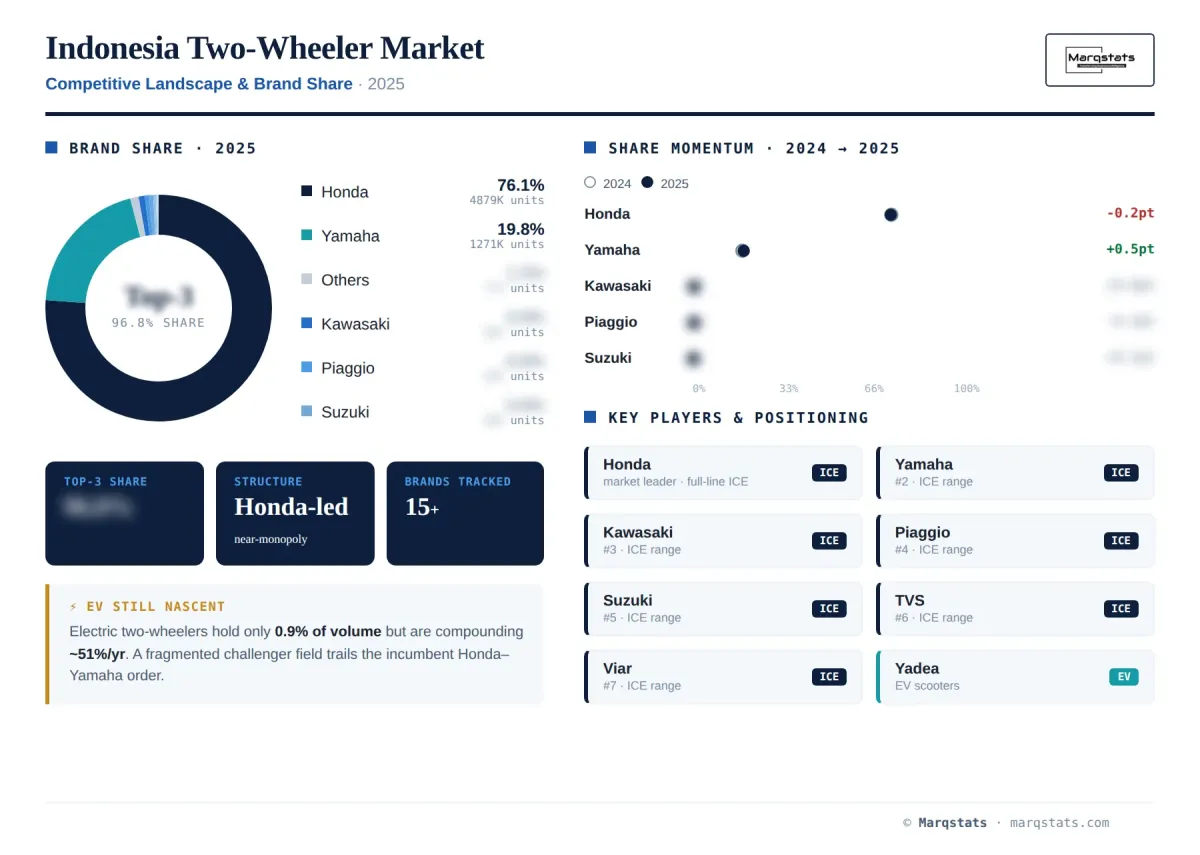
The Indonesia two-wheeler market is the most concentrated in the region, structured as a near-duopoly. Honda, through PT Astra Honda Motor, holds about 76% of 2025 unit sales and roughly 73% of revenue, sustained by unmatched dealer density, product breadth, financing, and resale value. Yamaha follows with close to 20% of volume, appealing to younger and sportier buyers, giving the two brands a combined share near 96%.
Beyond the leaders, Kawasaki and Suzuki hold performance and commuter niches, Piaggio serves the premium scooter segment, and India's TVS grows from a small base at a double-digit rate. The electric segment is contested by domestic and Chinese brands, including Gesits, Alva, Volta, Polytron, United E-Motor, and Viar, alongside the Gojek-linked Electrum venture, which pairs manufacturing with battery-swap infrastructure and a captive fleet anchor of hundreds of thousands of ride-hail drivers. Honda and Yamaha are piloting electric models, including Honda's battery-sharing service, to defend their base as the transition unfolds.
Competition centres on dealer reach, financing, and product cadence in combustion, and on battery-swap coverage and fleet partnerships in electric. Strategic activity includes Astra Honda's battery-sharing launch, Electrum's swap-network expansion, and joint ventures linking energy firms, battery producers, and ride-hail platforms. Growth is attributed to incumbents that defend scale while building credible electric roadmaps, moreover rewarding operators able to anchor swap networks with commercial fleets.
Companies Covered
Companies covered in the report include:
Recent Market Activity
Table of Contents
Coverage & Segmentation
This report provides a comprehensive assessment of the Indonesia two-wheeler market across a 2025 base year, historical data from 2021 to 2025, and forecasts spanning 2026 to 2030. Market sizing is presented in unit-volume terms and complemented by value analysis in United States dollars, with segmentation by vehicle type, propulsion type, engine displacement and motor power, price band, end user, sales channel, and brand. Brand-level shares, segment growth rates, and competitive positioning are quantified to support commercial and investment decisions.
The scope covers demand drivers, restraints, and structural trends, with particular focus on the near-duopoly competitive structure, the electrification transition and its policy dependencies, and the battery-swap ecosystem. Competitive analysis quantifies brand shares and profiles combustion and electric producers, while segment forecasts identify where volume and value growth concentrate through 2030. Particular attention is given to the sensitivity of electric adoption to incentive design, since the 2025 subsidy lapse demonstrated how quickly demand can retreat when support is withdrawn. An extended forecast to 2035 is available under customization for subscribers requiring a longer planning horizon, alongside deeper cuts by island region, brand, or channel on request.