Market Snapshot
Middle bar: base-year value × (1 + CAGR), rounded to two decimals. This is a calculated illustration, not a separately researched annual estimate.
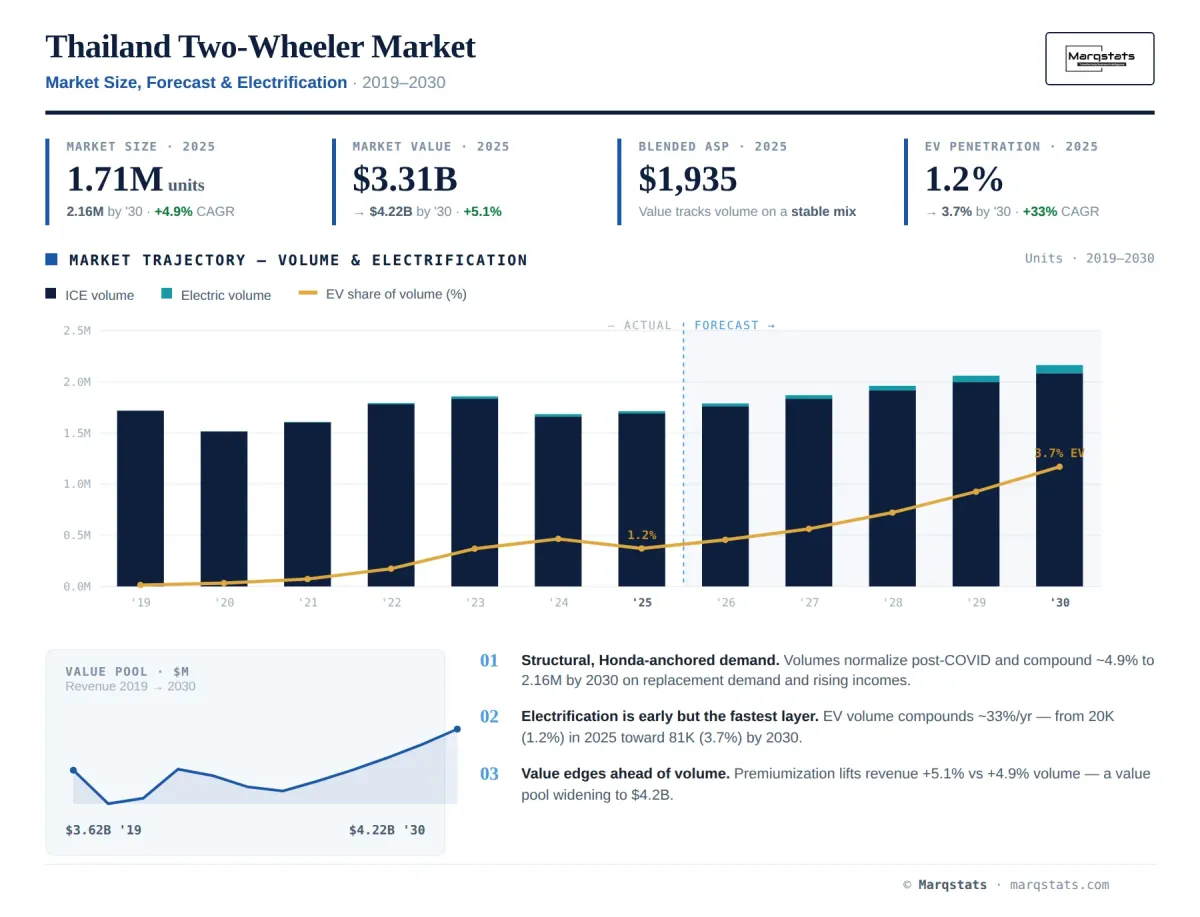
The Thailand two-wheeler market was valued at USD 3.31 billion in 2025 and is projected to reach USD 4.22 billion by 2030, expanding at a 5.09% CAGR across the 2026–2030 forecast period. Annual sales totalled 1.71 million units in 2025 and are projected to reach 2.16 million units by 2030, a 4.87% volume CAGR. Thailand ranks among the ten largest two-wheeler markets worldwide and functions as Southeast Asia's premier motorcycle production and export base, giving the market a dual character: a value story anchored in premium and big-bike manufacturing, set against a domestic retail base constrained by elevated household debt and tightened vehicle financing.
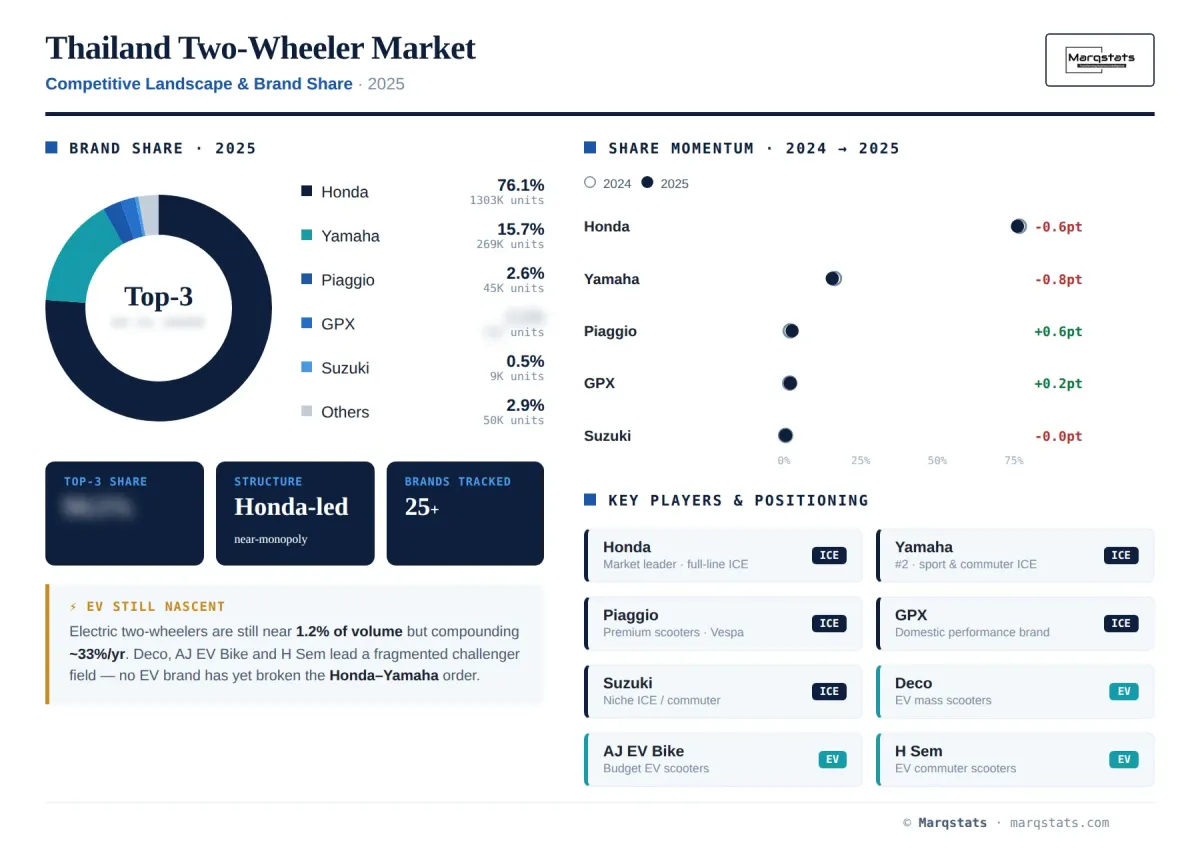
Scooters now generate the majority of market value, accounting for 55.6% of 2025 revenue and expanding at a 7.68% CAGR as urban commuting and gig-economy delivery reshape demand. Honda commands roughly 76% of unit sales, and the two foremost brands together hold about 92%, defining a highly concentrated competitive structure. Electric propulsion, though only 1.2% of 2025 revenue, records the fastest growth at a 36.87% revenue CAGR, supported by the government's EV 3.5 incentive runway and a national target of 675,000 electric motorcycles produced annually by 2030 under the 30/30 policy.
Revenue eased marginally in 2025 even as volume edged higher, reflecting a mix shift toward economical models and cautious spending under stricter hire-purchase rules. Over the forecast window, growth is attributed to premiumization at the upper end, scooterization at the volume core, and an electrification transition that gathers pace from a small base, positioning Thailand as both a production powerhouse and an evolving consumer market.
Key Takeaways
Market Overview & Analysis
Report Summary
The Thailand two-wheeler market comprises motorcycles, scooters, and mopeds sold for personal and commercial use, spanning internal combustion engine and electric propulsion. This study segments demand by vehicle type, propulsion type, engine displacement and motor power, price band, end user, sales channel, and brand, with a base year of 2025, historical coverage from 2021 to 2025, and forecasts to 2030. Two-wheelers remain the backbone of everyday mobility in Thailand, where an installed base of roughly 22.9 million registered motorcycles reflects decades of dependence on affordable personal transport, dense motorcycle-taxi networks, and rising last-mile delivery activity.
Domestic retail demand has moved through a soft patch. Annual sales eased in 2024 amid weak consumption and stricter lending, then stabilised in 2025 as volume edged up 1.7% to 1.71 million units while revenue eased slightly to USD 3.31 billion, a divergence that reflects a shift toward lower-priced models under cautious credit conditions. Household debt near 90% of GDP, together with hire-purchase supervision introduced by financial regulators, has curbed access to financing for entry-level buyers, concentrating growth in scooters, premium models, and commercial use cases where income generation offsets purchase cost.
On the supply side, Thailand operates as the manufacturing anchor of the regional industry. Around 25 companies assemble two-wheelers domestically, and the country serves as the global or Asia-Pacific production hub for premium marques including Triumph, Ducati, Harley-Davidson, BMW Motorrad, and Kawasaki, alongside domestic and Japanese volume producers. Concentrated in the Eastern Economic Corridor around Chonburi and Rayong, this supplier ecosystem underpins export competitiveness and channels investment into electric-motorcycle and battery capacity, reinforcing the Thailand two-wheeler market's structural depth even when domestic sales soften.
The scale of everyday reliance on two-wheelers is substantial. Roughly 22.9 million motorcycles were registered nationally as of end-2024, equivalent to about one motorcycle for every three residents, and sub-125cc commuter models represent close to 75% of annual domestic registrations. The 2024 downturn was pronounced, with industry bodies reporting a high-single-digit to mid-teens decline in domestic sales, before the market steadied in 2025. This resilience at the volume core, combined with premiumization and electrification at the margins, frames a market that grows steadily in value even as unit demand matures.
Market Dynamics
Key Drivers
- Growth is driven by the gig and delivery economy, where food-delivery riders, motorcycle-taxi operators, and new graduates seeking income adopt automatic scooters; automatic models captured about 58% of sales in 2024.
- Thailand's manufacturing scale and export orientation sustain the market, with around 25 domestic assemblers and premium marques using the country as an ASEAN production base that benefits from free-trade access and deep component sourcing.
- Electrification incentives support demand, as the EV 3.5 scheme trims electric-motorcycle prices by up to THB 10,000 and cuts excise from 8% to 2%, while the government's EV 3.0 and EV 3.5 policy framework anchors OEM planning through 2027 and funds 555 motorcycle battery-swap stations.
- Premiumization lifts value, as mid- and upper-income buyers migrate toward higher-specification scooters and big bikes, expanding revenue faster than unit volume across the premium and performance bands.
- Urbanisation and replacement demand persist, owing to congestion in major cities, the ubiquity of motorcycle-taxi services, and a large registered parc that continually renews at the entry and mid tiers.
- Recovering inbound tourism supports rental, ride-hail, and tourism-oriented two-wheeler demand, reinforcing scooter fleets in resort provinces and major urban destinations.
Key Restraints
- Elevated household debt near 90% of GDP, alongside auto-loan delinquencies and hire-purchase supervision, has tightened bank lending and suppressed first-time and entry-level purchases.
- Export demand faces pressure as neighbouring countries expand their own assembly and as tariff exposure weighs on shipments, with Thailand accounting for about 16.4% of regional motorcycle export value.
- Electric adoption is constrained by a residual price and range gap, a step-down in EV 3.5 subsidies relative to EV 3.0, and competitive pressure from low-cost imported models.
Key Trends
- Scooterization accelerates, evidenced by surging demand for automatic models such as the Honda Giorno+, which rose more than fourfold to about 137,690 units in 2024, and the Yamaha Grand Filano, up 26.7% to 106,335 units, shifting the volume core away from traditional underbone motorcycles.
- Electrification advances from a low base through domestic producers including Deco Green Energy, Etran, H Sem Motor, and Strom, with battery swapping emerging as a practical model for delivery fleets; the electric two-wheeler segment is analysed in greater depth in the companion study.
- Premium and big-bike expansion continues, reinforced by Royal Enfield's local assembly and by export-led model launches from European and American marques manufactured in Thailand.
- Digital retail grows quickly, with the online channel expanding at a 15.47% CAGR as dealers adopt online lead generation, and with subscription and battery-swap leasing pilots targeting younger urban riders.
Market Segmentation
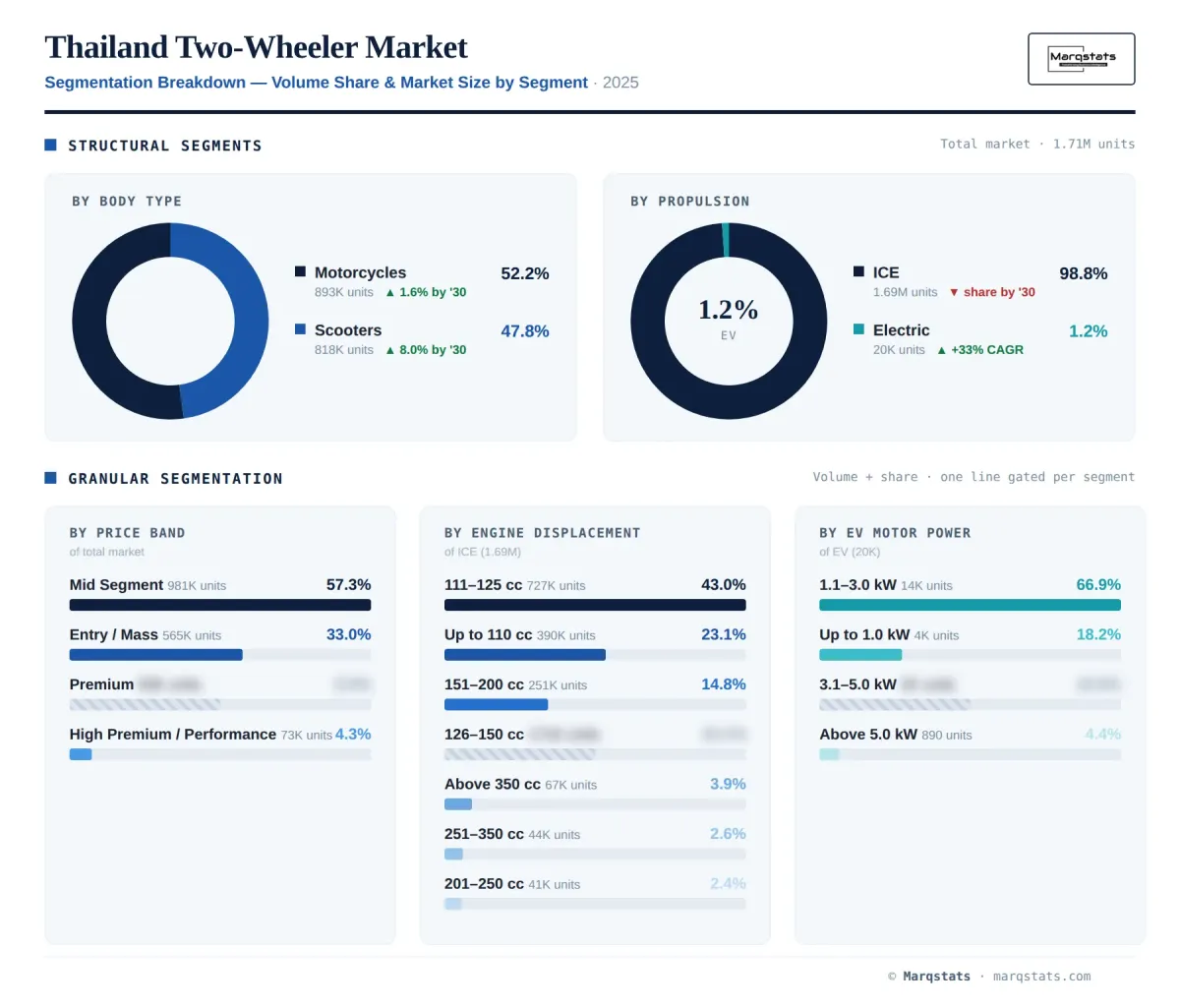
Scooters lead the market by value, contributing 55.6% of 2025 revenue at USD 1.84 billion and expanding at a 7.68% CAGR through 2030. Automatic transmission, storage practicality, and suitability for delivery work drive adoption, and models spanning commuter to premium tiers position scooters as the principal growth engine of the Thailand two-wheeler market.
Conventional motorcycles, chiefly underbone and sport models, account for the larger share of unit volume at 893,000 units in 2025 yet trail scooters in revenue at USD 1.47 billion. Growth is modest at a 1.31% revenue CAGR, as sub-125cc commuter demand matures and buyers migrate toward automatic and premium formats. The category retains structural relevance in provincial and agricultural use, where durability, fuel economy, and low maintenance sustain replacement demand, even as the centre of gravity in urban markets shifts decisively toward scooters.
Mopeds register negligible sales across the study period and do not form a material commercial segment in Thailand.
Internal combustion models dominate with 98.8% of 2025 revenue at USD 3.27 billion, spanning the full displacement range from sub-110cc commuters to performance machines above 350cc. Growth is steady at roughly a 4% CAGR, sustained by affordability, established financing, and dense service networks. Tightening emissions requirements and the gradual introduction of anti-lock braking on higher-capacity models are lifting average specification and price, supporting value growth even as combustion unit volumes plateau. The maturity of the combustion ecosystem, from spare-parts availability to resale liquidity, remains a powerful anchor for buyers who prioritise total cost of ownership over novelty.
Electric two-wheelers hold 1.2% of 2025 revenue at USD 41 million yet grow fastest at a 36.87% revenue CAGR, reaching USD 191 million by 2030. Fifteen domestic electric-motorcycle producers, including Deco Green Energy, Etran, H Sem Motor, and Strom, compete alongside imported models, and cumulative subsidies had supported more than 34,000 electric motorcycles by mid-2025. Government purchase support, an approved network of 555 battery-swap stations, and falling battery costs underpin the transition, though adoption remains early relative to the 30/30 ambition of 675,000 electric motorcycles produced annually by 2030. Higher-power classes above 3 kW grow fastest within the electric mix as performance and range expectations rise.
The 111–125cc band is the single largest displacement class, generating USD 1.05 billion in 2025, with the up-to-110cc band adding a further USD 432 million. These commuter classes anchor everyday mobility, though tight lending has softened first-time purchases at the entry tier.
Mid-displacement classes from 126cc to 250cc grow at high-single-digit to low-double-digit rates, while models above 350cc contribute USD 507 million in 2025. The 201–250cc band expands fastest among combustion classes at about a 10% volume CAGR, reflecting rising aspiration and the availability of locally assembled premium machines.
The entry and mass band contracts at a 4.36% revenue CAGR as constrained credit suppresses first-time demand, whereas the mid segment remains the volume core at USD 1.59 billion in 2025. Together these bands frame the mainstream commuter market that Honda and Yamaha overwhelmingly serve.
Premium and high-premium performance bands are the value accelerators, growing at 10% and 12.68% revenue CAGRs respectively. The high-premium band alone contributes USD 820 million in 2025, a scale attributable to Thailand's domestic assembly of European and American big bikes and rising discretionary income among upper-tier buyers. Locally built Triumph, Ducati, Harley-Davidson, and BMW Motorrad models make performance ownership accessible at lower prices than imports would allow, while Royal Enfield's mid-capacity classics broaden the aspirational entry point into the premium tier.
Private consumers account for about 85% of 2025 revenue, sustaining the mainstream commuter and premium-scooter segments. Growth is steady rather than rapid, moving in step with employment, income, and access to hire-purchase credit across urban and provincial households.
Commercial use cases grow faster than private demand. Delivery and logistics expands at a 9.34% revenue CAGR as food-delivery and parcel platforms scale, while B2B and fleet purchases add durable volume. Ride-hail, rental, and tourism demand recovers alongside inbound travel, concentrating in Bangkok and resort provinces.
Physical dealerships remain dominant, handling the large majority of sales and providing the financing, registration, and after-sales service that commuter buyers depend on. Dealer credit relationships are decisive at the entry and mid tiers, where approval conditions directly shape conversion.
The online channel is the fastest-growing route to market, expanding at a 15.47% revenue CAGR as manufacturers and dealers adopt digital lead generation, virtual showrooms, and online booking. Digital adoption is strongest among younger urban buyers and complements, rather than replaces, the dealer service network.
By Geography
Bangkok Metropolitan Region
Greater Bangkok concentrates the highest density of two-wheeler use, where congestion, motorcycle-taxi networks, and food-delivery platforms sustain year-round scooter demand. The metropolitan area also leads premium and electric adoption, supported by charging access, battery-swap pilots, and higher discretionary income.
Eastern Economic Corridor Manufacturing Belt
The Eastern Economic Corridor provinces of Chonburi and Rayong form the production heart of the market, hosting assembly plants for Triumph, Ducati, and Japanese OEMs alongside a dense component-supplier base. The scale of export orientation is pronounced: Thailand supplies the majority of Triumph's global output and serves as Ducati's Asia-Pacific export base, so the region's output far exceeds domestic absorption. This cluster orients the belt toward premium and export volume rather than domestic retail alone, reinforcing Thailand's role as the region's foremost two-wheeler production hub.
Upcountry and Provincial Markets
Provincial and rural demand skews toward affordable commuter motorcycles used for agriculture, small trade, and household transport. Purchasing power in these areas is closely tied to farm incomes and credit availability, making the entry and mid tiers sensitive to lending conditions and crop cycles.
Thailand within ASEAN
Within Southeast Asia, Thailand trails Indonesia and Vietnam in annual unit volume yet outperforms on value density and manufacturing sophistication. Its free-trade access, supplier depth, and premium-brand assembly give it disproportionate influence over regional supply, positioning it as an export anchor for neighbouring markets.
How Competition Is Evolving
The Thailand two-wheeler market is highly concentrated. Honda holds roughly 76% of unit sales and about 74% of revenue in 2025, with Yamaha second at around 16% of volume, giving the top two brands a combined share near 92%. This durable duopoly rests on unmatched dealer and service coverage, financing partnerships, and a rapid cadence of new-model launches across commuter and scooter lines. Honda's single top-selling model, the Wave 110i, alone approached 434,000 units in 2024, illustrating the depth of its commuter franchise, while its scooter refreshes have captured much of the shift toward automatic formats.
Beyond the leaders, the market divides into specialised tiers. Piaggio competes in premium scooters through the Vespa brand, GPX represents domestic design and value positioning, and Suzuki has refocused on affordable commuter models. The premium and big-bike tier is served by European and American marques manufactured locally, including Triumph, Ducati, Harley-Davidson, BMW Motorrad, and Kawasaki, whose Thai plants supply both domestic buyers and export markets. A cohort of fifteen domestic electric-motorcycle producers competes for the emerging electrified segment.
A distinct contest is forming in the electrified tier. Domestic start-ups compete on battery swapping and fleet partnerships, targeting delivery riders for whom running-cost savings outweigh the higher purchase price, while imported low-cost electric models pressure margins. Incumbent leaders are responding with hybrid-ready engine lines and selective electric launches rather than wholesale conversion, a measured stance that reflects the still-small share of electric demand and the four-year runway that policy provides.
Competition centres on model freshness, financing accessibility, and electrification readiness rather than price alone. Strategic activity is visible in Royal Enfield's completely-knocked-down assembly investment, in cumulative EV supply-chain commitments exceeding THB 137 billion, and in capacity consolidation by incumbents seeking efficiency. Growth is attributed to firms that pair scooter refreshes with credible electric and premium roadmaps, moreover rewarding those with export reach that offsets domestic demand cycles.
Companies Covered
Companies covered in the report include:
Recent Market Activity
Table of Contents
Coverage & Segmentation
This report provides a comprehensive assessment of the Thailand two-wheeler market across a 2025 base year, historical data from 2021 to 2025, and forecasts spanning 2026 to 2030. Market sizing is presented in value terms in United States dollars and complemented by unit-volume analysis, with segmentation by vehicle type, propulsion type, engine displacement and motor power, price band, end user, sales channel, and brand. Brand-level shares, segment growth rates, and competitive positioning are quantified to support commercial and investment decisions.
The scope covers demand drivers, restraints, and structural trends, including the electrification transition, the manufacturing and export base, and the effect of household debt and financing conditions on retail demand. Competitive analysis quantifies brand shares and profiles the strategies of volume, premium, and electric producers, while segment forecasts identify where value and volume growth concentrate through 2030. An extended forecast to 2035 is available under customization for subscribers requiring a longer planning horizon, alongside deeper cuts by province, channel, or brand on request.