Market Snapshot
Key Takeaways
Market Overview & Analysis
Report Summary
The Turkey two-wheeler market covers motorcycles, scooters, and mopeds sold for private, commercial, and institutional use. The study measures demand in unit volumes and revenue across 2021 to 2025 historical years and 2026 to 2030 forecast years, with 2025 as the base year. Coverage spans propulsion type, engine displacement and motor power, price band, end user, sales channel, and brand.
Turkey stands apart from most European two-wheeler markets. Motorcycles serve daily commuting and last-mile delivery rather than recreation alone, and small-displacement commuter models dominate volume. The country also carries a high electric share for the region, supported by favorable licensing and tax treatment for qualifying electric models. Domestic manufacturers hold the top positions, an uncommon feature in a market of this size.
Import exposure shapes pricing across the market. Domestic assembly covers part of supply, however many models and key components are imported, so landed cost tracks the lira exchange rate and freight conditions. Retail prices therefore move with currency cycles and tax changes, and demand shifts with credit availability. This exposure was visible in the 2025 correction and in the softer start to 2026.
Growth is attributed to urban commuting demand, the expansion of food and parcel delivery, rising car ownership costs, and electrification. A 2024 licensing change allowed holders of a standard car licence to ride motorcycles up to 125 cc, which widened the addressable market. According to the motorcycle industry association (moted.org.tr), close to one in two motorcycles sold in Europe is now sold in Turkey. Revenue grows faster than units as buyers move toward higher-priced motorcycles and electric models command higher average selling prices.
Market Dynamics
Key Drivers
- Urban commuting demand supports steady motorcycle sales, owing to congestion, parking costs, and rising fuel prices in major cities.
- A large courier and delivery economy raises demand for durable commuter motorcycles and electric two-wheelers used by riders.
- The 2024 licence change, allowing car-licence holders to ride motorcycles up to 125 cc, widened the buyer base and lifted 2024 sales above one million units.
- Rising car purchase and running costs push consumers toward two-wheelers, owing to lower prices and lower operating costs.
- Favorable treatment of qualifying electric models, including licence eligibility and tax exemptions, accelerates electric adoption.
Key Restraints
- High financing costs and elevated interest rates constrain purchases, which weighed on demand in early 2026.
- New vehicle taxes introduced in early 2025 raised prices and contributed to the market correction from the 2024 peak.
- Currency depreciation raises the cost of imported models and components, which pressures affordability.
- Seasonal demand concentrates sales in warmer months, which caps year-round volumes in interior regions.
Key Trends
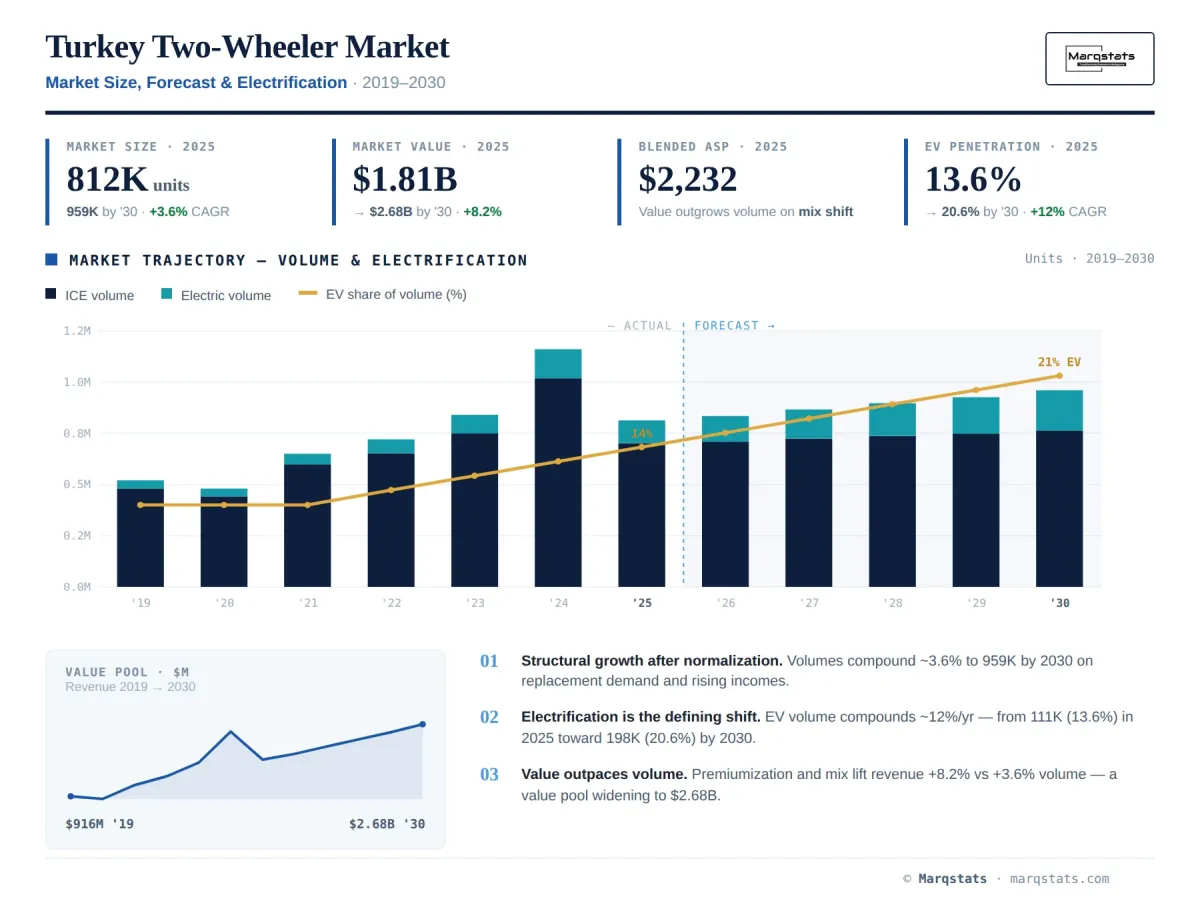
Electric two-wheelers gain share, rising from about 14% of units in 2025 toward 21% by 2030, resembling the faster electric transitions tracked in markets such as Thailand’s electric two-wheeler market.
- Online sales channels scale rapidly and are projected to surpass dealership volumes before 2030.
- Domestic brands consolidate the entry and mass tiers, while international marques hold premium and performance positions.
- Scooters gain share within the vehicle mix as urban delivery and short-trip commuting expand.
Market Segmentation
Motorcycles are the dominant category, at close to 80% of unit sales in 2025. Volumes reach 648 thousand units in 2025 and are projected to reach 753.63 thousand units by 2030, a 3.36% CAGR. Small commuter and underbone models drive volume, while premium and touring motorcycles lift average revenue per unit. Demand spans commuting, delivery, and recreation.
Within motorcycles, sub-125 cc commuter and underbone models carry the largest volumes, supported by the 2024 licence change. Larger displacement classes serve touring and recreational buyers and lift average revenue. Delivery riders form a substantial and stable share of motorcycle demand across major cities.
Scooters form the second category, at about 19% of units in 2025. Volumes rise from 152.04 thousand units in 2025 to 203.4 thousand units by 2030, a 5.61% CAGR. Urban buyers favor scooters for short trips and delivery, and electric scooters add incremental demand within this category.
Scooter demand benefits from the courier economy and from riders seeking simple, low-cost urban transport. Electric scooters are a growing part of this category, owing to low running costs and licence advantages for qualifying models.
Mopeds are a small and declining category. Volumes fall from 12.2 thousand units in 2025 to 2.4 thousand units by 2030, a negative 30.66% CAGR. Buyers migrate toward higher-capacity motorcycles and electric models, which erodes moped demand. Regulatory shifts and consumer preference for more capable machines accelerate the decline through the forecast period. Regulatory and consumer preference for more capable machines accelerates the category’s decline through the forecast period.
Combustion models held about 86% of units in 2025. Volumes move from 701.45 thousand units in 2025 to 761.73 thousand units by 2030, a 1.82% CAGR. Combustion remains the base of the market through the forecast period, however its share declines as electric models advance. Small-displacement commuter models sustain most combustion volume.
Electric two-wheelers are the fastest-growing propulsion type and hold a high share for the region. Volumes rise from 110.79 thousand units in 2025 to 197.71 thousand units by 2030, a 12.06% CAGR, and revenue expands at a 15.65% CAGR. Growth is driven by licence eligibility for qualifying models, tax and insurance advantages, courier fleets, and urban commuters. Electric share of units is projected to reach about 21% by 2030.
Courier operators are among the most active adopters, owing to high daily mileage that rewards lower energy costs. Domestic electric supply, led by a Turkish specialist brand, keeps entry prices competitive. Licence eligibility for qualifying models and exemptions from certain taxes and insurance requirements further support adoption, which places Turkey ahead of most European peers on electric two-wheeler share.
Small-displacement models anchor the market. Combined volumes for engines up to 125 cc account for about 75% of combustion units, with the up-to-110 cc band the single largest at 281.87 thousand units in 2025. The 2024 licence change concentrated demand in this range, owing to car-licence eligibility.
Mid-capacity motorcycles serve commuting and touring buyers seeking more power. This band grows steadily, owing to rising incomes and recreational demand. Average selling prices exceed the entry tier, which supports revenue growth.
High-capacity motorcycles form a smaller unit share, at 22.39 thousand units in 2025, yet they carry the highest prices. Demand concentrates among higher-income riders in coastal and metropolitan areas, owing to touring and recreational use.
Large-displacement demand is steady rather than fast-growing, and it concentrates in warmer coastal regions where year-round riding is feasible. These models anchor the premium revenue pool despite modest unit counts.
Within electric two-wheelers, the 1.1 to 3.0 kW band is the largest in 2025 at 61.47 thousand units, while the above 5.0 kW band grows fastest at a 21.39% volume CAGR. Higher-power electric models gain share as performance and range improve.
The entry tier is the largest price band, at close to 69% of units in 2025 with 557.4 thousand units. Volumes grow at a 2.29% CAGR. Commuters and first-time buyers sustain this tier, and domestic brands hold strong positions here.
The entry tier benefits most from the 2024 licence change, which brought new car-licence holders into the market. Affordability and low running costs keep this tier the volume core of the market through the forecast period.
The mid segment held about 23% of units in 2025 with 186.47 thousand units, growing at a 5.63% CAGR. Buyers trade up from entry models for better performance and features.
Premium models reached 51.78 thousand units in 2025 at an 8.67% CAGR, the fastest-growing price band, while high-premium and performance models add 16.58 thousand units. These bands lift average revenue and reflect recreational and touring demand.
Private consumers are the dominant end user, at roughly 73% of demand with 593.95 thousand units in 2025. Purchases serve commuting, personal mobility, and recreation. This base grows at a 2.47% CAGR through the forecast period.
Commercial and fleet demand accounts for about 27% of units and grows faster than private demand. Delivery and logistics is the largest commercial use at 120.53 thousand units, followed by ride-hail, rental, and tourism at 74.71 thousand units, which grows at an 8.85% CAGR. Courier operators drive much of this growth, and many adopt electric models to lower running costs.
Dealerships and physical retailers held about 75% of units in 2025 with 609.75 thousand units. However, offline volumes decline at a negative 6.82% CAGR as buyers shift online. Physical channels retain value for premium sales, service, and financing.
Online retail is the fastest-growing channel. Volumes rise from 202.48 thousand units in 2025 to 526.53 thousand units by 2030, a 19.29% CAGR, and revenue grows at a 25.00% CAGR. Online sales are projected to overtake offline volumes before 2030, owing to e-commerce platforms, courier-oriented offers, and wider model access.
Online growth reflects both consumer buying habits and courier-oriented sales models. Platforms bundle financing, insurance, and delivery, which lowers friction for first-time buyers. Physical dealers retain a role in premium sales and after-sales service, however their share of unit volume declines steadily through the forecast period.
By Geography
Istanbul and Marmara
Istanbul and the Marmara region form the largest demand center, owing to concentration of population, employment, and courier activity. Registration data from the national statistics institute (tuik.gov.tr) records the country’s largest motorcycle base here, near 940 thousand motorcycles. Delivery fleets, commuting, and premium demand all concentrate in the metropolitan area, which makes it the reference market for new-model launches and electric two-wheelers.
Mediterranean and Antalya
The Mediterranean region, led by Antalya, carries the second-largest motorcycle base. A warm climate supports year-round riding, and tourism raises rental and recreational demand. The region supports entry-level commuting alongside mid-capacity and premium models.
Seasonal tourism raises rental and recreational demand along the Mediterranean coast, which lifts scooter and mid-capacity motorcycle sales during summer months. The warm climate also supports a longer riding season than interior regions.
Aegean and Izmir
The Aegean region, led by Izmir, is the third-largest market. Demand spans urban commuting, delivery, and coastal recreation. Both domestic entry models and international mid-capacity motorcycles sell here.
Izmir and surrounding cities combine dense urban commuting with coastal recreation. Delivery activity in the metropolitan area supports commercial demand, while higher-income riders add premium volume.
Central and Eastern Anatolia
Central and Eastern Anatolia, including Ankara and interior provinces, add demand around secondary cities and rural districts. Colder winters limit year-round riding, which caps volumes relative to coastal regions. Small-displacement and utility-oriented models are most common here.
Ankara anchors demand in the interior, where commuting and institutional use support steady volumes. Rural districts favor durable, low-cost machines, and replacement demand grows as the installed base ages.
How Competition Is Evolving
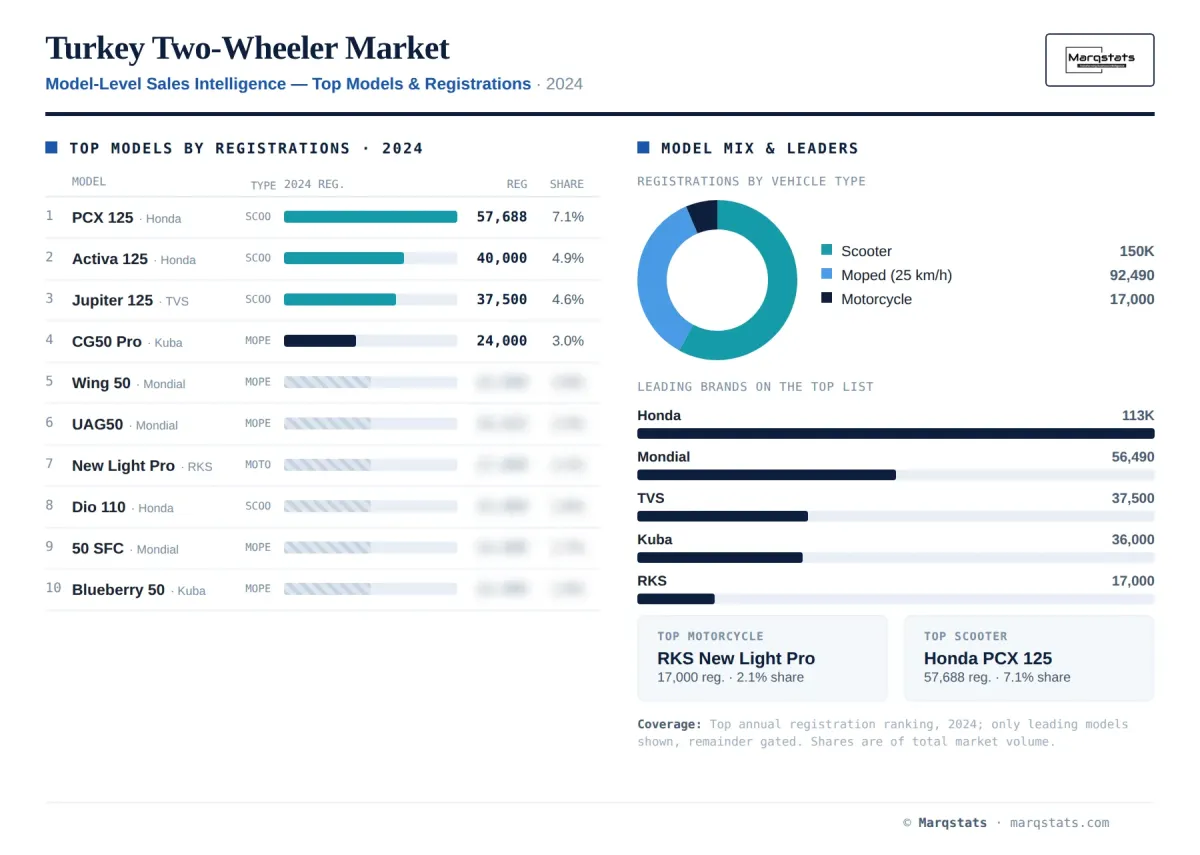
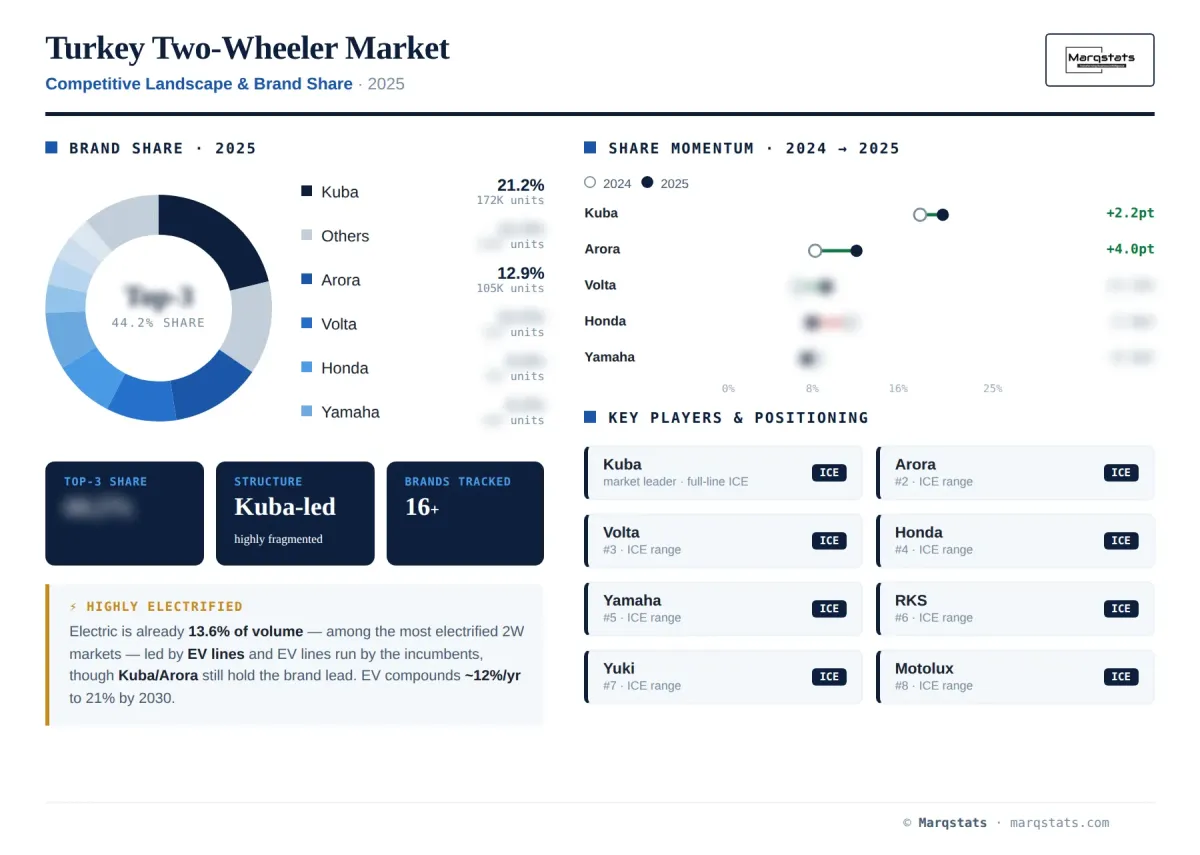
The Turkey two-wheeler market is moderately concentrated, and it is unusual for a market of this size in that domestic manufacturers hold the top positions. Turkish brand Kuba led with about 21% of unit volume in 2025, ahead of domestic brand Arora at about 13%, which moved ahead of international marques during the year. Domestic electric specialist Volta held close to 10% of volume, while Honda and Yamaha anchored the international field.
Competition centers on price, dealer and service coverage, financing access, and model breadth. Domestic brands compete on landed cost, local assembly, and entry-tier value. International marques compete on brand strength, performance, and premium positioning. Electric entrants compete on running cost, licence and tax advantages, and courier-focused fleet programs.
The 2025 correction reshaped brand positions. Several brands recorded sharp volume declines from the 2024 peak, while domestic electric supply and select value brands held share more effectively. Distribution strategy is a growing point of difference, and brands that build online sales and courier partnerships gain share as e-commerce scales. Service network depth remains decisive for premium and high-capacity sales.
Brand strategy also reflects propulsion shifts. Domestic manufacturers extend ranges into electric commuter models to hold entry-tier share, while international marques defend premium positions. Aftermarket parts availability and service coverage influence buyer confidence across a large installed base, and brands that pair competitive pricing with reliable parts supply hold share most effectively during periods of lira depreciation.
Companies Covered
The report profiles 16+ companies with full strategy and financials analysis, including:
Recent Market Activity
Table of Contents
Coverage & Segmentation
This report provides a comprehensive analysis of the Turkey two-wheeler market across 2021 to 2030, with 2025 as the base year and 2026 to 2030 as the forecast period. The study measures market size in unit volumes and revenue, and it segments demand by vehicle type, propulsion type, engine displacement and motor power, price band, end user, sales channel, and brand.
The report examines demand drivers, restraints, and trends, along with competitive structure and brand positioning. Regional coverage spans Istanbul and Marmara, the Mediterranean, the Aegean, and Central and Eastern Anatolia. The analysis integrates registration data, industry association figures, import records, and primary interviews to reconcile brand-level and category-level estimates into a single market view. The 2024 sales peak is treated as an exceptional year rather than a trend indicator.
The study also assesses distribution shifts, electrification, and the balance between private and commercial demand. Forecasts are built at the segment level and reconciled to the total market, so that vehicle type, propulsion, displacement, price band, end user, and channel views remain internally consistent across the historical and forecast periods.