Market Snapshot
Key Takeaways
Market Overview & Analysis
Report Summary
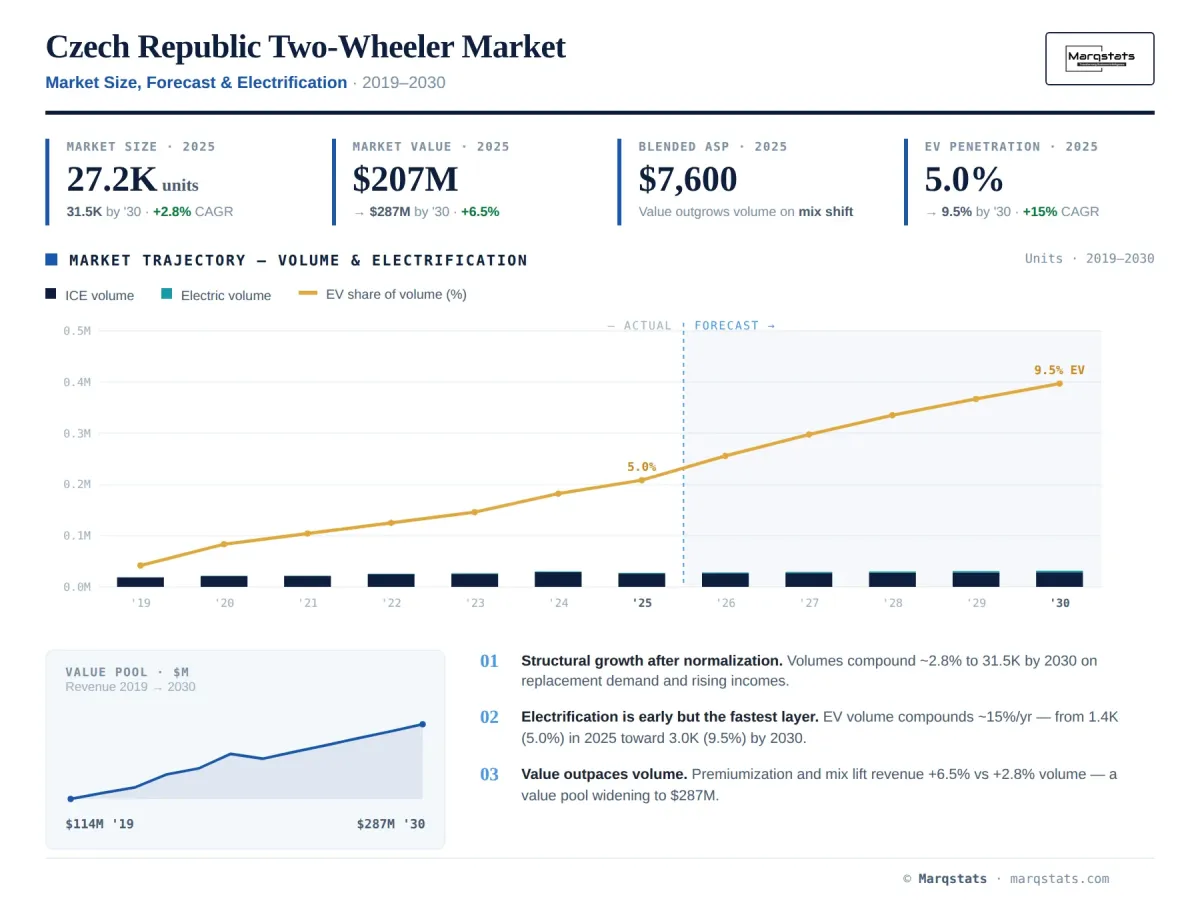
The Czech Republic two-wheeler market is a motorcycle-led Central European market with a deep manufacturing heritage and a fast-changing brand structure. Two-wheelers in the Czech Republic serve leisure and touring riding, urban commuting in Prague and other cities, and a growing base of larger-displacement machines. The market generated USD 207.1 million in revenue in 2025 on roughly 27,250 units, a value density consistent with a product mix weighted toward motorcycles rather than entry mopeds, and with rising average selling prices across the forecast period.
Market demand is distinctly polarised. Entry machines up to 125 cc and larger motorcycles above 350 cc together account for the bulk of registrations, while the middle displacement bands are comparatively thin. This barbell structure explains the strategy of the market leaders: Honda holds the foremost position, at about 21.9% of revenue, by spanning both poles, from popular sub-125 cc scooters to large touring machines. The polarisation also creates space for value-oriented challengers to contest the mid-capacity segment, where Chinese brands have grown fastest.
Regulation framed the recent path. The full introduction of the Euro 5+ emissions standard on 1 January 2025 pulled combustion demand into 2024, lifting registrations before a correction through 2025 recorded in national vehicle statistics from the Czech Statistical Office. The same pattern appears across European registration data, and it distorts near-term growth comparisons even as the underlying market continues to expand in value.
The rise of Chinese brands is the structural story of the market. CFMoto, which built its capability partly through a long-standing partnership with KTM, has advanced to third place by revenue on the strength of competitively priced mid-capacity motorcycles, while Voge and QJ Motor expand at double-digit rates from smaller bases. Together these brands approach the revenue share of market leader Honda, and they have reshaped buyer expectations in the middle of the range, where specification and value increasingly outweigh brand heritage.
Domestic heritage remains a distinctive feature. The Czech Republic has a long motorcycle-manufacturing history, and the Jawa brand, once a global name, has sustained a revival over the past decade, rebuilding annual registrations from a low base and concentrating its sales in the up-to-350 cc class that defined its historic models. This combination of a rising Chinese challenger cohort, established Japanese and European brands, and a reviving domestic marque gives the Czech market a competitive character that is unusually diverse for its size.
Market Dynamics
Key Drivers
- Premiumisation lifts average selling prices, so revenue grows more than twice as fast as units; the premium and high-performance bands expand fastest among all price tiers.
- Rising Chinese brands widen model choice and value at the mid-capacity end, with CFMoto, Voge, and QJ Motor together expanding faster than the market and lifting overall demand.
- Leisure and touring culture supports the large above-350 cc segment, the single largest displacement band, which anchors the high value density of the market.
- Electrification accelerates from a small base, with electric two-wheeler revenue expanding at an 18.84% CAGR as electric mopeds and light electric motorcycles enter the range.
- Growth in urban delivery raises fleet demand, and the delivery and logistics end-user segment expands at an 8.23% CAGR to serve courier and food-delivery operators.
Key Restraints
- A short riding season and cold Central European winters concentrate demand in warmer months, constraining year-round two-wheeler usage and volume growth.
- Pull-forward of combustion demand ahead of the Euro 5+ standard inflated 2024 registrations and produced a market correction in 2025, distorting near-term comparisons.
- The thin middle of the displacement range limits mainstream mid-capacity volume, concentrating demand at the entry and large-motorcycle poles.
- Elevated purchase prices and vehicle taxation moderate entry-level volume growth and skew demand toward committed riders and higher-value machines.
Key Trends
- Chinese brands gain share fastest, with CFMoto now third by revenue and Voge and QJ Motor expanding at double-digit CAGRs in the mid-capacity segment.
- The domestic Jawa brand sustains a revival centred on its historic up-to-350 cc class, reinforcing the market Czech manufacturing heritage.
- Electric two-wheeler revenue grows fastest at 18.84% CAGR, rising from about 5% of the market in 2025 toward 10% by 2030 as electric ranges broaden.
- Online retail expands fastest among channels at a 13.49% CAGR, though physical dealers still handle the large majority of value.
Market Segmentation
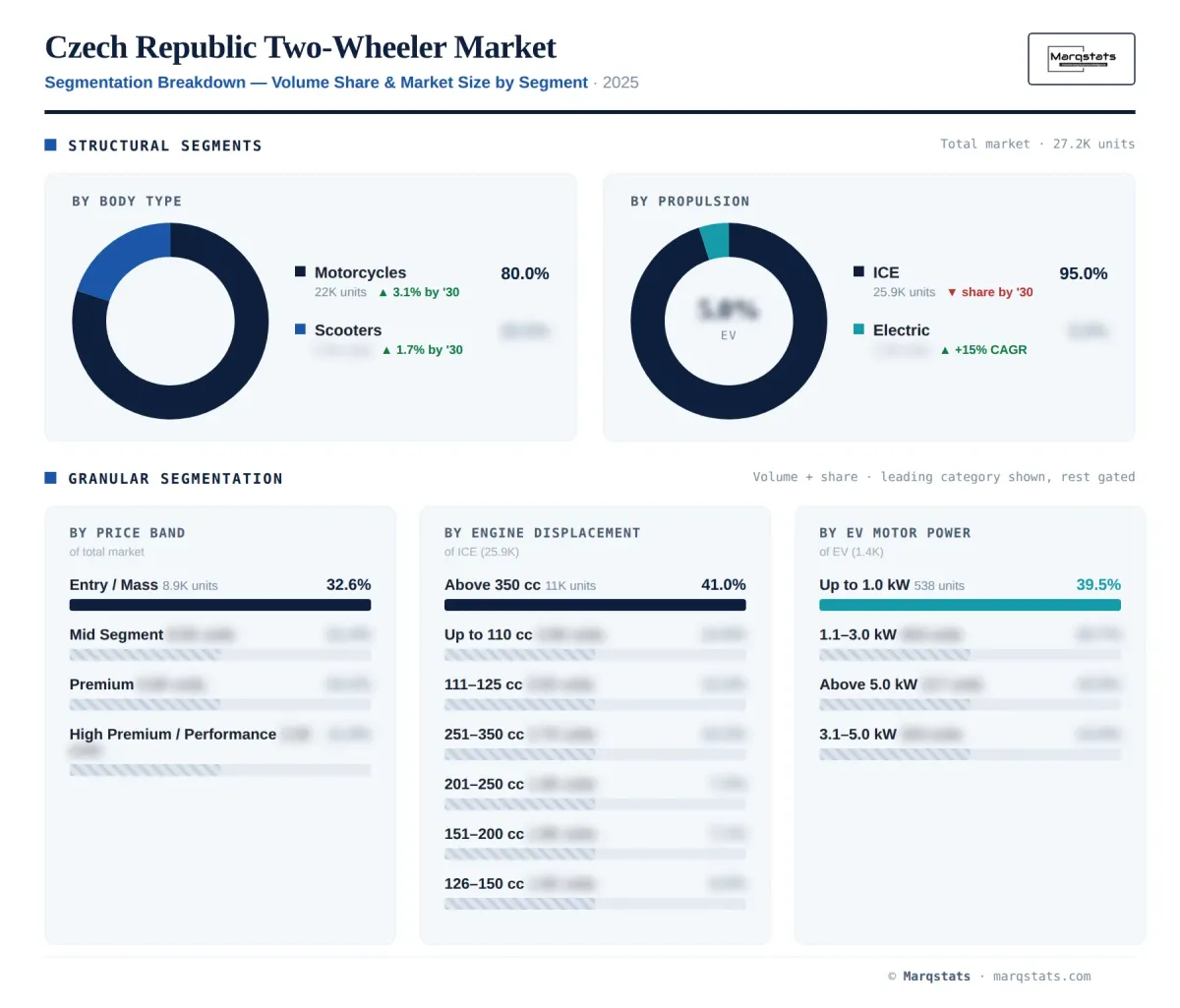
Motorcycles form the dominant vehicle-type segment, generating USD 165.7 million in 2025, roughly four-fifths of market revenue, and rising to USD 232.4 million by 2030 at a 6.73% CAGR. The segment reflects the country orientation toward leisure and touring riding, and it carries the higher average price that lifts the market value density. Honda, Yamaha, CFMoto, KTM, and BMW anchor the motorcycle segment, spanning entry commuters through large touring machines.
Scooters and mopeds generated USD 41.4 million in 2025 and grow to USD 54.2 million by 2030 at a 5.31% CAGR. The segment serves urban commuting in Prague and other cities, where light two-wheelers handle short trips. Electric mopeds are the primary growth engine within this segment as buyers respond to expanding electric ranges, though the segment remains far smaller than motorcycles by both value and volume, consistent with the market motorcycle-led character.
The dominance of motorcycles over scooters and mopeds distinguishes the Czech market from urban-mobility markets where light two-wheelers carry most demand. Czech buyers lean toward touring, sport, and enduro machines, a preference rooted in the country riding culture and reinforced by the strong above-350 cc segment. This orientation shapes the market response to both premiumisation and the rise of Chinese brands, which have entered most effectively through mid-capacity and larger motorcycles rather than through the scooter and moped tier.
Internal combustion engine models dominate the Czech Republic two-wheeler market, generating USD 196.7 million in 2025, about 95% of revenue, and growing to USD 259.3 million by 2030 at a 5.48% CAGR. Combustion demand is anchored in the larger-displacement touring and sport segments and in the entry sub-125 cc band, the two poles of the barbell. The combustion share declines gradually over the forecast period as electric models capture the commuting and light-vehicle tiers.
Electric is the fastest-growing propulsion category, expanding from USD 10.4 million in 2025 to USD 27.3 million by 2030 at an 18.84% CAGR. Electric revenue rises from roughly 5% of the market toward 10% by 2030, mirroring electric two-wheeler momentum visible in other electric two-wheeler markets tracked by Marqstats. Growth concentrates in electric mopeds and light electric motorcycles, with the above-5.0 kW power band expanding fastest at 21.93% as higher-performance electric machines enter the range.
Within combustion models, the above-350 cc band is the single largest tier by revenue at USD 80.7 million in 2025, reflecting demand for touring and sport motorcycles. The entry bands follow, with the up-to-110 cc band at USD 29.3 million and the 111 to 125 cc band at USD 26.5 million, together forming the other pole of the barbell. The 251 to 350 cc band adds USD 20.2 million from mid-capacity machines, while the 126 to 250 cc bands are comparatively thin, consistent with the polarised demand structure that defines the Czech market.
Within electric models, the up-to-1.0 kW band leads at USD 4.1 million in 2025, consistent with electric mopeds, followed by the 1.1 to 3.0 kW band at USD 3.1 million. The higher-power bands are smaller yet expand fastest: the above-5.0 kW band grows at a 21.93% CAGR as full electric motorcycles gain acceptance. The electric motor-power mix therefore shifts gradually toward higher-power tiers over the forecast period as the range of electric machines widens.
The entry and mid price bands together account for the largest share of revenue, at USD 67.5 million and USD 64.9 million in 2025, serving mainstream commuting and mid-capacity demand. The premium and high-premium bands, however, grow faster, at 6.96% and 7.94% CAGR respectively, reflecting the premiumisation that carries the Czech market. The high-premium and performance band, at USD 24.6 million in 2025, is the fastest-expanding price tier and lifts the market average selling price over the forecast period. The premium band, at USD 50.1 million in 2025, adds further weight to the upper half of the market as buyers trade up toward touring and higher-specification machines.
The B2C segment dominates the Czech Republic two-wheeler market, generating USD 193.5 million in 2025, roughly 93% of revenue, and growing at a 6.33% CAGR. Private ownership reflects the country strong leisure and enthusiast base. Fleet and commercial demand is smaller yet faster-growing: the delivery and logistics segment expands at an 8.23% CAGR to serve urban courier and food-delivery operators, while the B2B and fleet segment grows at 8.12%. Government and institutional demand adds a further USD 3.3 million in 2025, and ride-hail and rental demand is negligible, consistent with a market oriented toward private ownership.
Offline dealers remain the dominant channel, handling USD 184.2 million of revenue in 2025 and growing at a 5.35% CAGR, owing to the service, financing, and registration support that motorcycle purchases require. Online sales, however, expand fastest at a 13.49% CAGR, rising from USD 22.9 million as direct-to-consumer models and digital configurators gain share. The channel shift is gradual, and physical dealers retain the large majority of value through the forecast period, supported by dealer networks that increasingly pair in-store sales with digital configuration and reservation tools.
By Geography
Prague and Central Bohemia
Prague, together with Central Bohemia, forms the largest demand centre for two-wheelers in the Czech Republic. The capital concentrates urban commuting demand, where scooters, mopeds, and electric two-wheelers handle short trips, alongside a base of premium motorcycle owners. The region hosts the densest dealer and service presence and leads adoption of electric mopeds within the national market.
South Moravia and Brno
South Moravia, anchored by Brno, forms the second demand cluster. Demand here mixes urban commuting in Brno with leisure and touring motorcycle use across the surrounding region, supporting a strong base of larger-displacement machines. Regional dealers serve both electric commuting demand in the city and recreational riders across Moravia.
Broader Bohemia and Moravia
The broader Bohemian and Moravian regions, including Ostrava and rural districts, round out national demand. These areas concentrate touring, sport, and enduro riding, supporting the above-350 cc band that anchors the national displacement mix. The domestic Jawa brand retains a loyal following across these regions, reinforcing the market Czech manufacturing heritage.
Across all regions, national registrations followed the European pattern of a 2024 pull-forward and a 2025 correction under the Euro 5+ transition, a trend documented in registration releases from the European motorcycle industry association, while value growth is carried by premiumisation and the rising share of Chinese brands in the mid-capacity segment.
How Competition Is Evolving
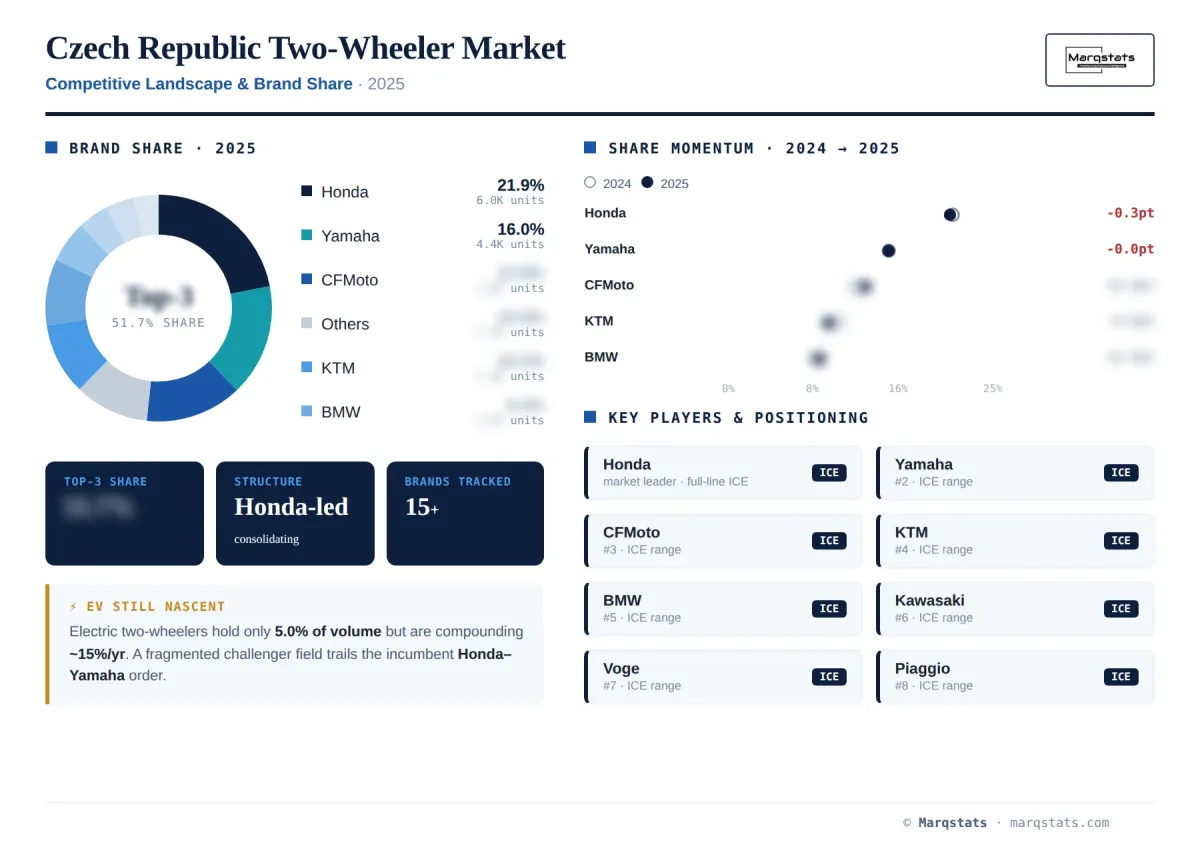
The Czech Republic two-wheeler market is moderately concentrated, yet its structure is shifting as Chinese brands gain share. Honda holds the foremost position at about 21.9% of revenue in 2025, followed by Yamaha at 16.0% and CFMoto at 13.8%. CFMoto rise to third place reflects a strong position in the mid-capacity segment, and Chinese brands together, including Voge and QJ Motor, approach the share of the market leader. KTM, BMW, Kawasaki, and Piaggio complete the field, with the domestic Jawa brand holding a distinctive heritage position.
Competition centres on the two poles of demand and on the contested middle. Honda dominance rests on its ability to serve both the entry sub-125 cc scooter segment and the large touring segment, whereas CFMoto and other Chinese brands compete most effectively in the mid-capacity classes where value and specification matter most. Voge and QJ Motor expand at double-digit revenue CAGRs, the fastest cohort in the market, while premium European marques such as BMW, KTM, and Ducati contest the higher-displacement and performance tiers.
Because the market is motorcycle-led and premium-leaning, brand strategy in the Czech Republic prioritises model breadth, dealer relationships, and value positioning across the barbell. Chinese brands leverage competitive pricing and expanding ranges to contest the mid-capacity segment, established Japanese and European brands defend the entry and premium poles, and the domestic Jawa brand sustains a heritage niche. The pace of each participant electric roadmap is emerging as a growing determinant of future share as electrification accelerates from its small base.
The competitive structure is therefore in transition. As Chinese brands consolidate their mid-capacity gains and broaden into larger and electric machines, the established leaders are defending share through model refreshes, financing, and dealer-network strength, while premium marques emphasise touring and performance heritage. Electric specialists such as Zero Motorcycles and Niu Technologies address the emerging electric tiers, and scooter houses including Piaggio contest the urban commuting segment. The balance of the market through 2030 will depend on how quickly Chinese brands move up the displacement range and how effectively incumbents electrify, making the Czech Republic a closely contested Central European market despite its modest size.
Companies Covered
The report profiles 16+ companies with full strategy and financials analysis, including:
Recent Market Activity
Table of Contents
Coverage & Segmentation
This report provides a comprehensive analysis of the Czech Republic two-wheeler market for the 2021 to 2025 historical period and the 2026 to 2030 forecast period, with 2025 as the base year. The study quantifies market size in revenue terms, in USD, and in unit volume, and segments the market by vehicle type, propulsion type, engine displacement and motor power, price band, end user, sales channel, and brand. It examines the drivers, restraints, and trends shaping demand, and profiles the competitive structure of the market.
The study focuses on registered two-wheelers, spanning motorcycles, scooters, mopeds, and electric light vehicles. Coverage addresses the motorcycle-led and barbell-shaped character of the Czech market, the rising share of Chinese brands led by CFMoto, the revival of the domestic Jawa brand, and the early electrification of the light-vehicle segment. Values are reported in USD MN throughout, consistent with a market below USD 1 billion in size, and regional demand is examined across Prague and Central Bohemia, South Moravia, and the broader Bohemian and Moravian regions.