Market Snapshot
Key Takeaways
Market Overview & Analysis
Report Summary
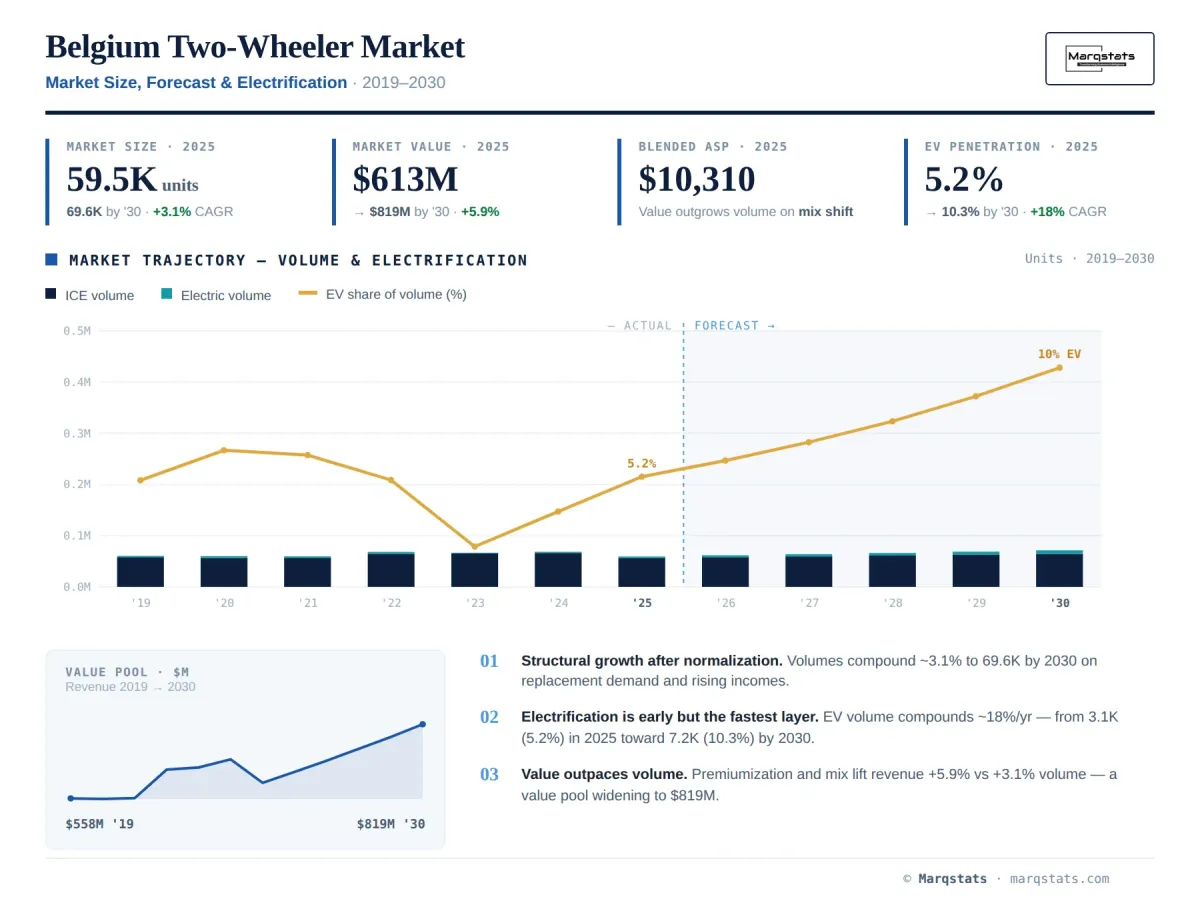
The Belgium two-wheeler market comprises motorcycles, scooters, and mopeds sold for personal and commercial use across internal combustion and electric propulsion. This study segments demand by vehicle type, propulsion type, engine displacement and motor power, price band, end user, sales channel, and brand, with a 2025 base year, historical coverage from 2021 to 2025, and forecasts to 2030. Belgium is a compact, affluent, densely urbanised market in which commuting and premium leisure demand coexist in near-equal measure.
The 2025 result must be read against an exceptional 2024. The Euro 5+ emissions standard, effective 1 January 2025, accelerated purchases considerably in November and December 2024, and the market was penalised accordingly through the following year. Belgium's 2024 was the strongest in fifteen years, and new motorcycle registrations then fell about 7% across the first half of 2025 even as second-hand registrations rose more than 14%. The same pull-forward pattern was recorded across major European markets by the European Association of Motorcycle Manufacturers, and the forecast rebuilds from this distorted base.
Supply is unusually premium-weighted. BMW leads by volume as well as value, its adventure and touring range anchoring demand, followed by Yamaha and Honda, whose ranges span 125cc scooters to large machines. The Piaggio Group, through Piaggio, Vespa, and Aprilia, holds a strong position in the scooter segment alongside Kymco and Peugeot Scooters. Kawasaki, Triumph, Ducati, and Suzuki compete across premium categories, while KTM and Husqvarna, both part of Pierer Mobility, saw registrations halve during financial restructuring. Electric adoption is concentrated in higher-power urban machines.
Belgium's structure is distinctive within Western Europe. In most markets of comparable size, a Japanese volume brand leads on the strength of scooter and commuter sales; in Belgium a premium German marque holds first place while scooters and mopeds still account for nearly half of all units. The market therefore sustains two parallel demand pools of similar scale: affluent riders buying large touring and adventure machines for leisure, and urban commuters buying scooters and 125cc machines for daily mobility across a densely populated and heavily congested country.
Market Dynamics
Key Drivers
- Recovery from the emissions-led correction drives growth, with first-half 2026 registrations reaching their highest level since 2011.
- Urban commuting demand supports volume, as scooters and 125cc machines ease congestion and parking pressure in Brussels, Antwerp, and Ghent.
- Premiumisation lifts value, as large touring and adventure machines from BMW and European marques command high prices.
- Affluence and dense population sustain both premium leisure riding and everyday commuting across a compact and heavily congested geography.
Key Restraints
- Imported and second-hand machines compete with new sales, with used registrations rising more than 14% through the first half of 2025.
- Regional tax differences complicate the market, as Flanders applies environmental criteria while Wallonia and Brussels tax by engine power.
- The mid price band declines through the forecast as buyers move toward entry and premium tiers.
Key Trends
- Electrification advances from a small base, concentrated in higher-power urban machines; the global electric ATV and UTV market reflects the wider electrification of powered vehicles.
- Online retail expands rapidly at an 18% CAGR, reaching about 27% of sales as offline dealership volumes decline.
- The market polarises by price, as entry and high-premium bands grow at double-digit rates while the mid segment contracts.
- The competitive field is reshaping, as KTM and Husqvarna restructure and premium marques gain share.
Market Segmentation
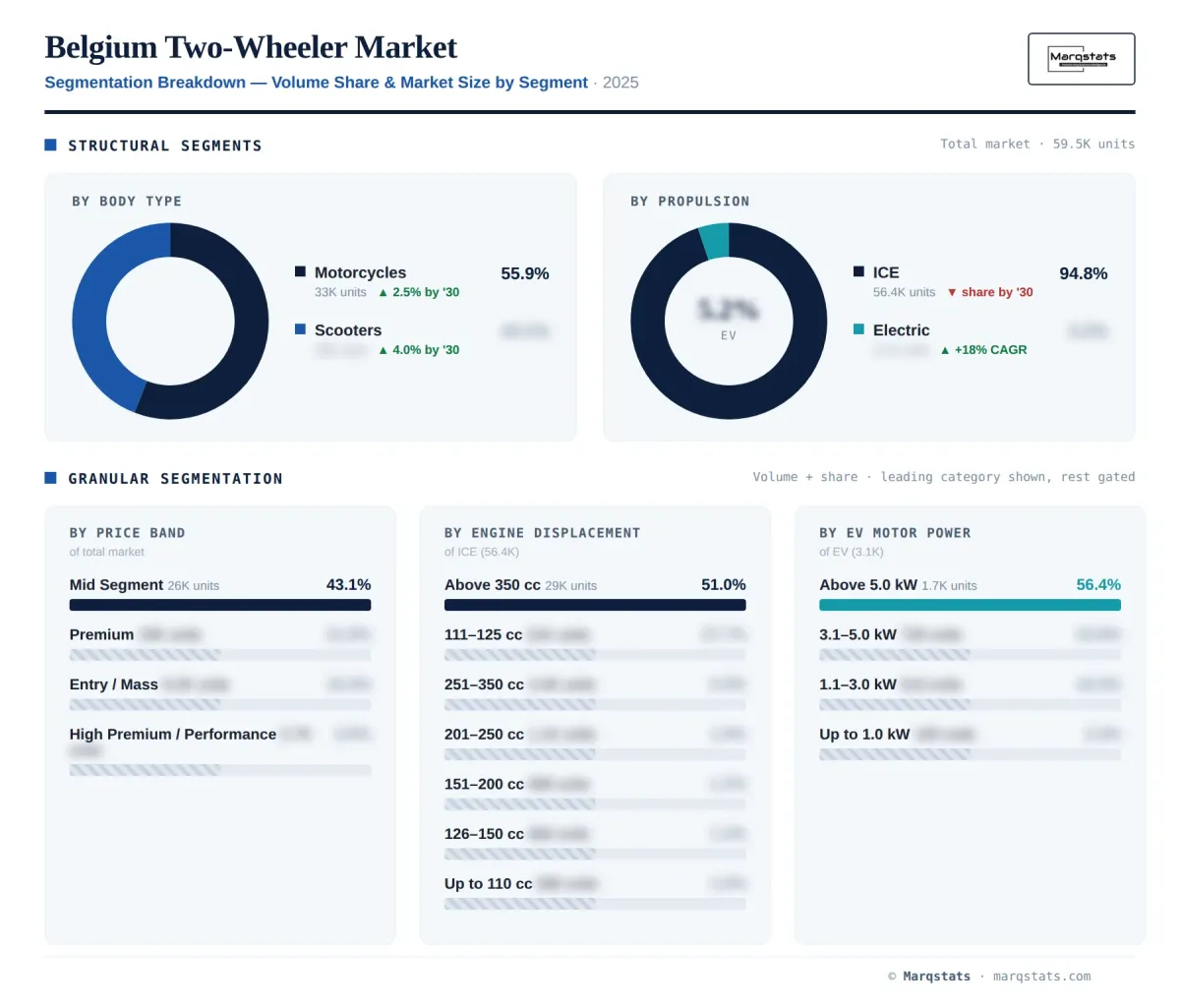
Motorcycles account for about 56% of 2025 volume, roughly 33,300 units, growing at a 2.46% CAGR. The category spans large touring and adventure machines, roadsters, and 125cc motorcycles, and it concentrates in the premium displacements. Adventure and touring models, led by BMW's range, define the segment and generate the majority of market value. Belgium's compact geography places riders within easy reach of the Ardennes, the German Eifel, and the Dutch and French borders, sustaining a touring culture that supports demand for capable long-distance machines.
Scooters and mopeds account for about 26,200 units in 2025, roughly 44% of volume, growing faster at a 3.99% CAGR. The share is among the highest in Western Europe, reflecting dense urban commuting and a long-established moped culture. Piaggio, Vespa, Kymco, and Peugeot Scooters lead this category, and it hosts much of the electric two-wheeler market. Mopeds remain accessible from the age of sixteen, drawing young riders into the market early, and the category serves as an entry point that feeds later demand for 125cc machines and larger motorcycles.
Combustion models hold about 95% of 2025 volume, roughly 56,400 units, growing at a 3% CAGR from the 2025 low. Combustion remains dominant across touring, adventure, scooter, and commuter classes, now built to the Euro 5+ standard, and it continues to define the premium large-displacement machines at the heart of the market. The Euro 5+ transition raised compliance costs and removed older models from sale, yet combustion machines retain decisive advantages in range and refuelling for the touring segments that generate most of the market's value.
Electric two-wheelers hold about 5% of 2025 volume, roughly 3,100 units, growing fastest at an 18.39% CAGR to reach about 7,200 units by 2030. Adoption is concentrated in higher-power machines above 5.0 kW, which grow at about 24% and account for most electric volume, rather than in the lightest categories. Urban commuting and delivery use anchor demand, and low-emission requirements in Brussels support gradual uptake. The concentration of electric demand at the higher-power end distinguishes Belgium from markets where light electric mopeds lead adoption, and it reflects buyers seeking machines capable of matching combustion scooters on speed and range.
Large-displacement machines above 350cc are the largest segment at about 48% of 2025 volume, roughly 28,800 units. Touring, adventure, and premium roadsters fall here, generating the large majority of market value. The strength of this band alongside a substantial 125cc class gives Belgium its bimodal character, with thin demand across the middle displacements. The band's high share, combined with BMW's leadership, explains why market value grows nearly twice as fast as unit volume through the forecast period.
The 111–125cc class is the second-largest at about 36% of volume, central to urban commuting and accessible to a broad base of riders. The class is broadly flat through the forecast period, reflecting saturation, while the smaller mid displacements between 126cc and 350cc grow at double-digit rates from low bases as riders step up. Growth therefore comes from riders trading up rather than from expansion of the commuter base itself, a pattern that lifts market value even as the dominant commuter class holds steady.
The mid segment is the largest price band by volume at about 43%, though it contracts at about 3% annually as buyers move toward the extremes. The entry and mass band holds about 15% and grows fastest in unit terms at about 12%, supported by scooters, mopeds, and value-priced commuter machines. Together these bands anchor the market's unit volumes, and the entry tier is where value-focused and imported brands compete most aggressively on price and equipment.
Premium accounts for about 32% of volume and the high-premium performance band a further 10%, together contributing the clear majority of value. The high-premium band grows at about 13%, the fastest of the premium tiers, driven by large adventure and touring machines. This polarisation, with both ends of the price spectrum outgrowing the middle, is a defining feature of the Belgian market. Buyers are increasingly choosing either an affordable commuter machine or a flagship touring model, and the mid segment that once absorbed both groups is steadily losing share through the forecast period.
Private consumers account for about 87% of 2025 volume, the core of a market weighted toward personal mobility and leisure. Ownership spans urban commuters on scooters and 125cc machines, touring and adventure enthusiasts, and returning riders drawn by premium models. The near-equal split between commuting and leisure use within this private base distinguishes Belgium from markets driven predominantly by one or the other.
Commercial demand is meaningful and led by delivery. Delivery and logistics accounts for about 9% of volume, supported by urban food-delivery platforms in Brussels and the larger Flemish cities, while rental and tourism grows fastest among commercial users at about 8%. This delivery base is an early adopter of electric scooters. Clean-air requirements in the major cities increasingly steer fleet demand toward electric machines, making delivery the principal commercial channel for electrification through the forecast period.
The online channel reaches about 27% of 2025 sales and grows fastest at an 18% CAGR. Buyers research, configure, finance, and increasingly transact online, and the channel is central to how value-focused buyers compare models and locate second-hand and nearly-new machines. Its growth accelerated through the 2025 correction, when discounted pre-registered stock circulated widely and buyers searched across platforms for the keenest terms.
Franchised dealerships remain central to premium sales and after-sales service, though offline volumes decline at about 7% annually as digital retail expands. Dealers retain their role in test rides, servicing, and financing for the large-displacement machines that generate most of the market's value. The channel is evolving toward a hybrid model in which buyers research online before completing high-value purchases in person, and dealers that combined both approaches weathered the 2025 correction most successfully.
By Geography
Flanders
Flanders is the largest regional market, encompassing Antwerp, Ghent, and Bruges, and it combines dense urban commuting with strong leisure riding. The region applies vehicle taxation weighted toward environmental criteria, which shapes demand toward cleaner and smaller machines, and its cities sustain substantial scooter and 125cc volumes. Antwerp's low-emission zone and the region's flat terrain and cycling culture make powered two-wheelers a natural extension of everyday mobility, and Flanders accounts for the largest share of both new and second-hand registrations.
Brussels-Capital Region
The Brussels-Capital Region concentrates commuting, delivery, and early electric demand. Congestion, limited parking, and low-emission requirements make scooters and 125cc machines a practical mobility choice, and the region taxes vehicles by engine power rather than emissions, unlike Flanders. As the seat of European institutions and a dense employment hub, Brussels draws heavy inbound commuting, and powered two-wheelers offer a reliable alternative to congested road and rail corridors.
Wallonia
Wallonia, including Liège, Charleroi, and Namur, sustains steady demand across urban and rural areas. The region taxes by engine power and applies a supplementary charge linked to carbon emissions, and its open roads support touring and adventure riding alongside commuter demand in the larger cities. Lower population density than Flanders shifts the mix toward larger machines and leisure use, and the region's proximity to the Ardennes reinforces its touring character.
The Ardennes & Coastal Belgium
The Ardennes in the southeast and the North Sea coast anchor seasonal leisure and touring demand. The Ardennes' forested routes draw adventure and touring riders through the warmer months, while the coastal strip supports rental and recreational use across the summer season. Seasonality is pronounced across both areas, concentrating sales into spring and summer and shaping dealer inventory and promotional cycles accordingly.
How Competition Is Evolving
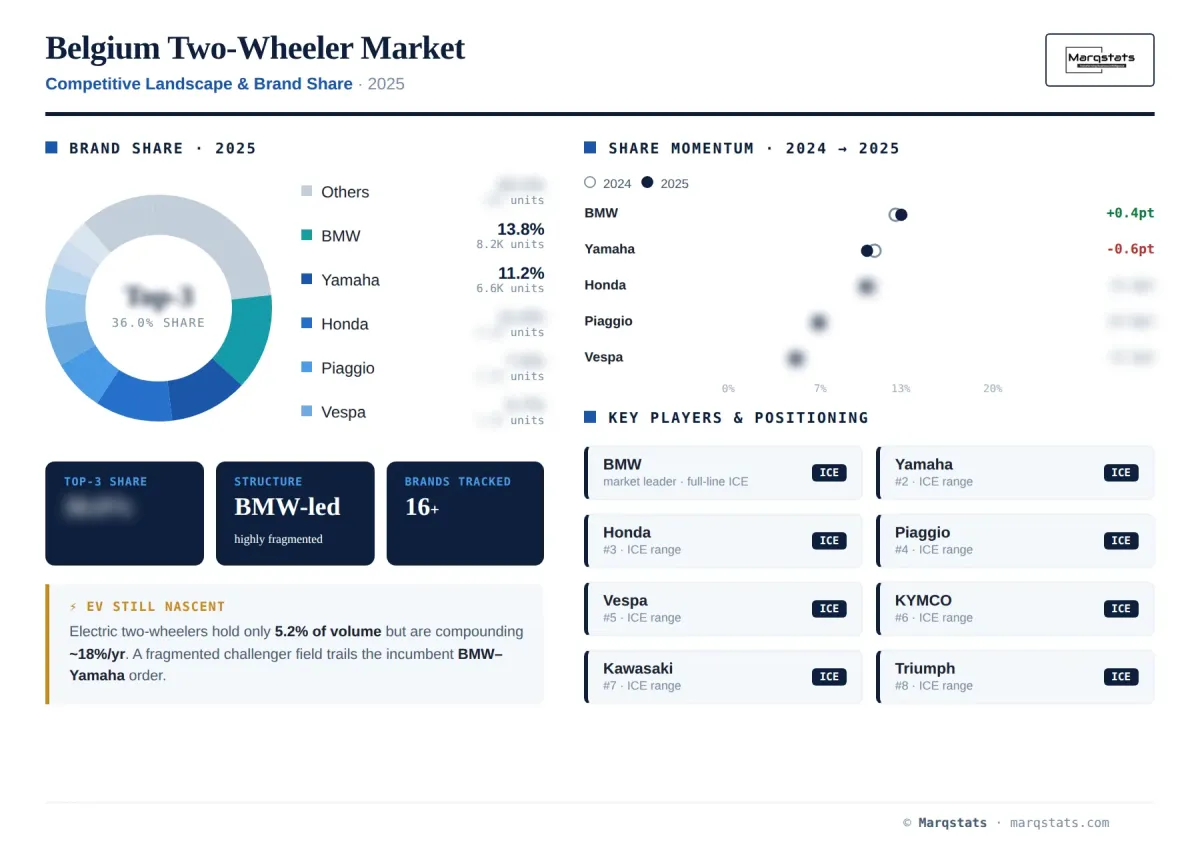
The Belgium two-wheeler market is moderately fragmented, and unusually for Western Europe, a premium marque leads it. BMW holds about 14% of volume on the strength of its adventure and touring range, ahead of Yamaha at about 11% and Honda at a similar share. The Piaggio Group, counting Piaggio, Vespa, and Aprilia, holds a strong combined position in scooters. The top four brands account for about 43% of volume, leaving a substantial tail of specialist, scooter, and imported marques.
The competitive field has shifted through the 2025 disruption. KTM and Husqvarna, both part of Pierer Mobility, saw registrations halve during a financial restructuring driven by heavy debt, ceding share across sport and off-road segments. Kawasaki, Triumph, Ducati, and Suzuki compete across premium categories, Royal Enfield has gained on the modern-classic trend, and Kymco and Peugeot Scooters anchor value in the urban segment. Electric competition is small and concentrated in higher-power urban machines.
The surge in second-hand supply has reshaped competition alongside the brand shifts. Machines registered during the late-2024 pre-buy moved quickly into the used market, and second-hand registrations rose more than 14% through the first half of 2025 while new sales fell. Buyers gained access to nearly-new stock at a discount, compressing dealer margins and favouring brands with fresh model ranges over those reliant on ageing portfolios. The overhang cleared through 2026, and first-half registrations that year reached their highest level since 2011, confirming that the underlying demand had not weakened.
Competition centres on brand and capability at the premium end, and on value and product breadth in the scooter and commuter tiers. Growth is attributed to brands that combine strong adventure and touring portfolios with disciplined pricing, moreover rewarding those that navigate the emissions transition and the surge in second-hand supply. BMW's premium leadership, the Japanese marques' breadth, Piaggio's scooter strength, and the retreat of the Pierer brands together define a market in which brand and positioning increasingly determine competitive position.
Companies Covered
The report profiles 16+ companies with full strategy and financials analysis, including:
Recent Market Activity
Table of Contents
Coverage & Segmentation
This report provides a comprehensive assessment of the Belgium two-wheeler market across a 2025 base year, historical data from 2021 to 2025, and forecasts spanning 2026 to 2030. Market sizing is presented in unit-volume terms and complemented by value analysis in United States dollars, with segmentation by vehicle type, propulsion type, engine displacement and motor power, price band, end user, sales channel, and brand. Brand-level shares, segment growth rates, and competitive positioning are quantified to support commercial and investment decisions.
The scope covers demand drivers, restraints, and structural trends, with particular focus on the 2025 emissions-led correction and the strong 2026 recovery, the substantial scooter and moped segment, premium leadership by BMW, regional taxation differences across Flanders, Wallonia, and Brussels, price polarisation, and the electric transition. An extended forecast to 2035 is available under customization for subscribers requiring a longer planning horizon, alongside deeper cuts by region, brand, or channel on request.