Market Snapshot
Key Takeaways
Market Overview & Analysis
Report Summary
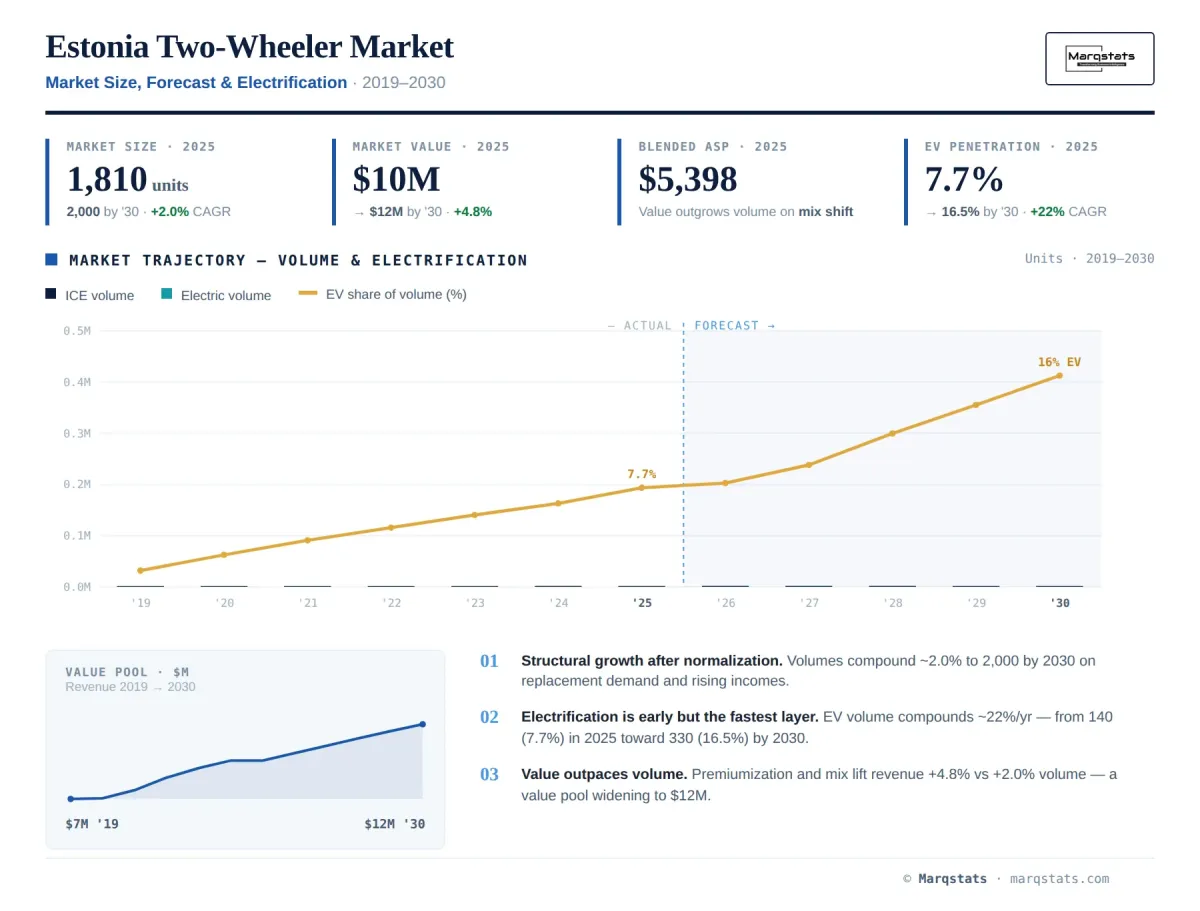
The Estonia two-wheeler market comprises motorcycles, scooters and mopeds registered for personal and commercial use across internal combustion and electric propulsion, measured on a new-registration basis. Estonia is a small Baltic market of about 1.4 million people, and its two-wheeler demand is concentrated in Tallinn and Tartu, where motorcycles serve commuting, touring and leisure riding. The market is mature and steady: unit volume rose modestly from about 1.58 thousand units in 2019 to about 1.81 thousand units in 2025, and the structural story is premiumisation, electrification, and a shift toward digital retail rather than rapid unit expansion.
Between 2021 and 2025 the market moved within a narrow band, easing slightly in 2025 amid a new motor-vehicle tax, high inflation and softer new-vehicle demand. Growth over the forecast period is modest and value-led: the volume base grows gently while the value pool expands faster, owing to premiumisation and the higher unit prices of electric models. Estonia's direction is set less by demographics than by regulation, urban policy and the country's distinctive digital economy.
Estonia's demand is anchored by premium European and Japanese OEMs — Honda, Yamaha, BMW Motorrad, KTM and Piaggio — the same brands central to the intelligent connected two-wheeler market, where European Union safety rules increasingly mandate rider-assistance and connectivity features. As one of the world's most digitally advanced societies, Estonia is especially receptive to online purchasing and connected-vehicle features, which supports the fastest-growing sales channel in the market. Electrification is advancing from a small base, moderated by the higher upfront cost of electric two-wheelers, the end of direct purchase subsidies, and cold-climate range considerations.
Two features set Estonia apart within the Baltics. First, its vehicle mix is unusually motorcycle-heavy: at about 73% of volume, motorcycles outweigh scooters and mopeds more decisively than in neighbouring markets, reflecting a rider base oriented toward commuting, touring and leisure rather than pure urban step-through mobility. Second, its digital maturity shapes how two-wheelers are researched, bought and serviced, accelerating the shift toward online retail and receptiveness to connected features. Together these give Estonia a premium, motorcycle-led and digitally forward character even as its absolute volume remains small.
Market Dynamics
Key Drivers
- Market is driven by steady urban mobility and leisure demand around Tallinn and Tartu, where motorcycles serve commuting, touring and recreational riding.
- Demand is increasing owing to premiumisation, as riders trade up to premium and larger-displacement machines that lift average prices and value faster than volume.
- Growth is attributed to electrification, with electric two-wheelers expanding at a 21.79% CAGR as a new motor-vehicle tax favours zero-emission machines.
- Online retail, growing at a 21.93% CAGR, is accelerated by Estonia's advanced digital economy and high receptiveness to e-commerce and connected features.
- Commercial demand is expanding, with B2B, fleet, delivery and rental use growing faster than personal ownership as urban services scale in Tallinn.
Key Restraints
- Total volume is constrained by a small population base of about 1.4 million, limiting absolute market size despite steady growth.
- High inflation and softer new-vehicle demand in 2025 weighed on discretionary purchases, moderating two-wheeler volume.
- The end of direct electric-vehicle purchase subsidies leaves electrification reliant on tax exemptions rather than upfront grants.
- Cold-climate seasonality and uneven rural charging access concentrate riding and electric adoption into warmer months and urban centres.
Key Trends
- Electric adoption is rising owing to a new motor-vehicle tax that lowers registration and ownership costs for zero-emission two-wheelers.
- Digital retail is expanding fastest, as Estonia's e-commerce maturity moves research, purchase and after-sales interactions online.
- Premiumisation is deepening, as premium and high-premium classes grow at 1.82% and 4.97% CAGRs and larger-displacement machines gain share.
- Scooters are outgrowing motorcycles at a 3.64% CAGR for urban commuting, moreover mopeds continue a structural decline.
Market Segmentation
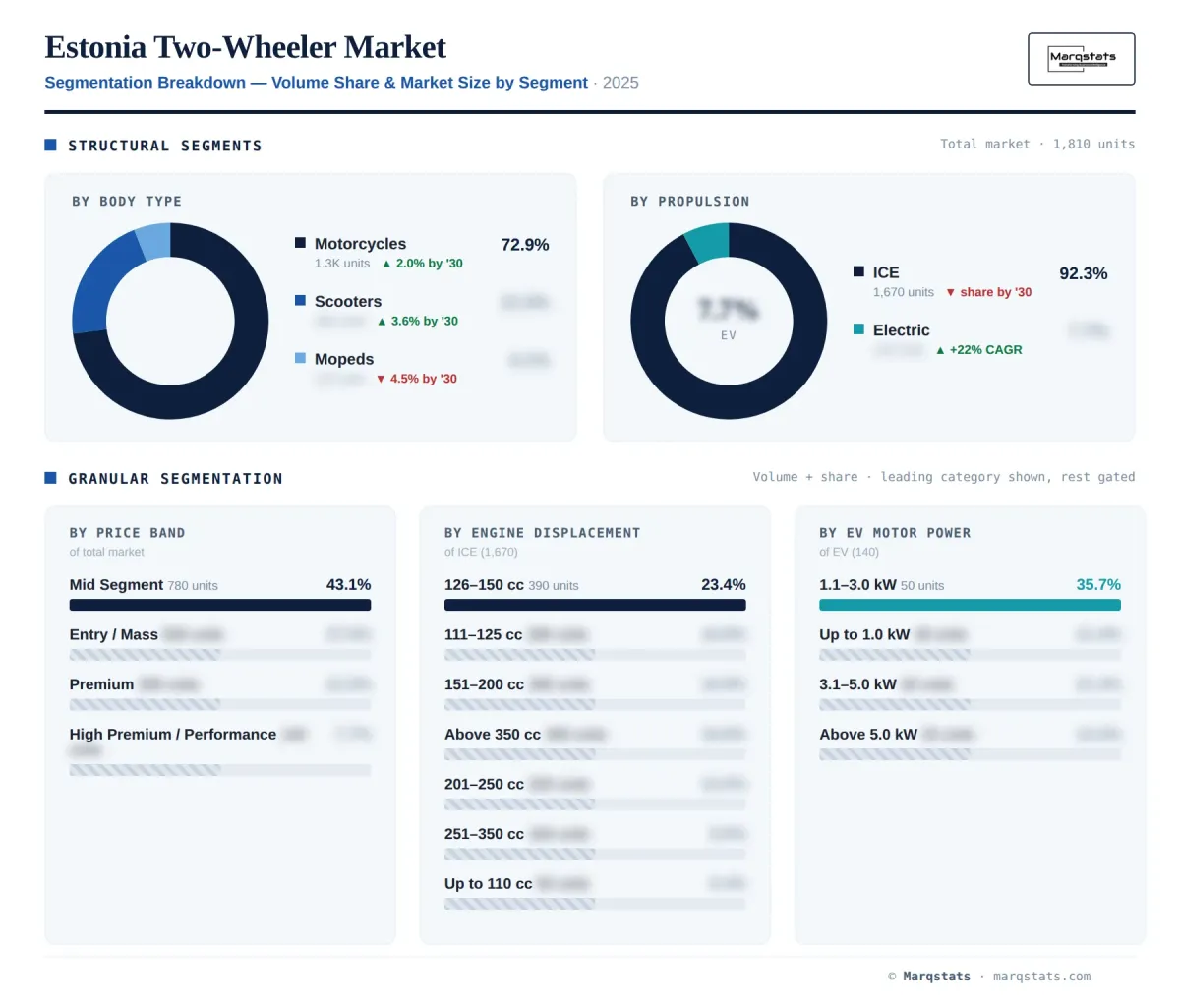
Motorcycles accounted for about 73% of 2025 volume, at roughly 1.32 thousand units, and are forecast to reach about 1.45 thousand units by 2030 at a 1.99% CAGR. This is the highest motorcycle share among the Baltic states, reflecting a rider base oriented toward commuting, touring and leisure riding rather than pure urban step-through use. Demand skews toward mid and larger-displacement machines and toward the premium European and Japanese brands that define the market.
Scooters accounted for about 21% of 2025 volume, at roughly 0.38 thousand units, growing to about 0.45 thousand units by 2030 at a 3.64% CAGR — the fastest-growing vehicle type. Uptake is increasing owing to urban commuting in Tallinn and Tartu and the appeal of automatic, easy-to-park machines, however scooters remain a smaller share than in neighbouring markets.
Mopeds accounted for about 6% of 2025 volume, at roughly 0.11 thousand units, and are the only vehicle type in decline, contracting at a 4.46% negative CAGR to about 0.1 thousand units by 2030. The segment is eroding as riders shift toward more capable scooters and motorcycles and as tighter emissions rules reduce the appeal of small low-power machines.
ICE two-wheelers supplied about 92% of 2025 volume, at roughly 1.67 thousand units, and are broadly flat through 2030 at a 0.44% negative CAGR. Petrol motorcycles and scooters remain the default owing to established refuelling infrastructure and rider familiarity, however their share erodes gradually as electric substitution advances and as the new motor-vehicle tax tilts costs toward zero-emission machines.
Electric two-wheelers accounted for about 8% of 2025 volume, at roughly 0.14 thousand units, expanding to about 0.33 thousand units by 2030 at a 21.79% CAGR — the fastest-growing propulsion class. Adoption is increasing owing to motor-vehicle tax advantages for zero-emission machines, expanding charging access around Tallinn and Tartu, and European Union climate policy, and is moderated by higher upfront prices, the end of direct subsidies, and cold-climate range considerations.
Within ICE machines, the 126–150cc class was the largest displacement band in 2025 at about 0.39 thousand units — the commuter and maxi-scooter core — followed by the 111–125cc class, the 151–200cc class and the above-350cc touring and adventure category. The 251–350cc band grows fastest at a 7.03% CAGR as riders trade up, while smaller sub-125cc classes grow slowly. Across electric motor-power bands, the 1.1–3.0 kW class leads volume and the above-5.0 kW category grows fastest at a 31.61% CAGR, reflecting demand for more capable electric machines.
The displacement mix reinforces the market's value story. Because premium and larger machines carry higher prices, the blended average selling price rises even as unit volume grows only modestly, which is why revenue grows at a 4.78% CAGR against a 1.97% volume CAGR. Larger and premium machines also generate higher parts and service revenue over their lifecycle, deepening the value available to dealers and after-sales networks. On the electric side, motor-power upgrades track both commuter and light-commercial demand, with higher-kilowatt models seeding adoption beyond entry-level e-scooters.
The mid segment dominated 2025 volume at about 0.78 thousand units, or roughly 43% of the market, and grows slowly at a 0.94% CAGR. The entry and mass band followed at about 0.5 thousand units and grows at 2.77%, while the premium and high-premium/performance bands, at about 0.39 thousand and 0.14 thousand units, grow faster at 1.82% and 4.97% CAGRs. This upward price migration, concentrated in premium scooters and larger motorcycles, is the primary reason value expands faster than volume across the forecast period.
The price-band pattern reflects a market broadening at both ends. At the entry and mass end, value-oriented machines from CFMoto and classic mid-priced models from Royal Enfield are widening access and supporting first-time and returning riders. At the premium and high-premium end, established European and Japanese marques capture riders trading up to touring, adventure and performance machines, generating a disproportionate share of value. Because the high-premium band grows fastest while the mid segment holds the largest share, the blended average price rises steadily, reinforcing the gap between the 4.78% value CAGR and the 1.97% volume CAGR through the forecast period.
The B2C segment accounted for about 75% of 2025 volume, at roughly 1.36 thousand units, and is broadly flat at a 0.18% negative CAGR as personal ownership matures. Commercial demand is the growth engine: B2B and fleet use expands fastest at an 11.37% CAGR, delivery and logistics use, at about 0.17 thousand units, grows at 5.14%, and ride-hail, rental and tourism use grows at 5.33% owing to Tallinn's urban services and seasonal visitor activity. Government and institutional use, though small, expands quickly from a low base.
This end-user pattern captures the market's underlying shift. Personal ownership remains the backbone of demand yet is broadly flat because the addressable population is small and replacement cycles are long in a cold-climate market. The momentum instead sits with commercial buyers — delivery operators, corporate fleets and rental services concentrated in Tallinn — whose utilisation rates and cost sensitivity make scooters and, increasingly, electric machines attractive working assets. As urban delivery and shared-mobility services scale, commercial channels are expected to account for a rising share of both volume and electric adoption.
Offline dealerships retained about 90% of 2025 volume, at roughly 1.63 thousand units, and ease at a 1.08% negative CAGR, reflecting the continued importance of test rides, trade-ins and servicing in a premium-skewed market. Online channels, though only about 10% of volume at roughly 0.18 thousand units, grow fastest at a 21.93% CAGR — accelerated by Estonia's advanced digital economy, high e-commerce penetration and consumer comfort with online research, purchase and after-sales interactions.
By Geography
Two-wheeler demand in Estonia concentrates in the largest urban economies — Tallinn and Tartu — which contain the bulk of population, commercial activity, dealer coverage and charging access. Regional differences are shaped by urban density, income and infrastructure, and these factors determine where scooters, electric models and commercial fleets are most prevalent.
Tallinn & Harju County
Tallinn and surrounding Harju County form the dominant demand centre, concentrating urban commuting, delivery activity and the densest dealer and charging networks. The capital region anchors both motorcycle and scooter demand and the earliest electric two-wheeler adoption, and it is the focal point for commercial and rental use and for the fast-growing online retail channel. More than half of the country's charging points are located here, reinforcing its lead in electrification.
Tartu & Southern Estonia
Tartu, the country's second city and a university and technology hub, adds a strong secondary base of commuter, leisure and fleet demand. Its student and professional population supports both personal ownership and early electric adoption, and improving charging access underpins gradual electrification beyond the capital.
Pärnu & Other Regions
Pärnu, the principal coastal resort, and other regional centres contribute seasonal and commuter demand, with summer tourism lifting rental and short-trip scooter use. Demand across smaller towns and rural areas is thinner and almost entirely ICE-based owing to sparser charging access, and growth is attributed to gradual road and infrastructure improvement.
How Competition Is Evolving
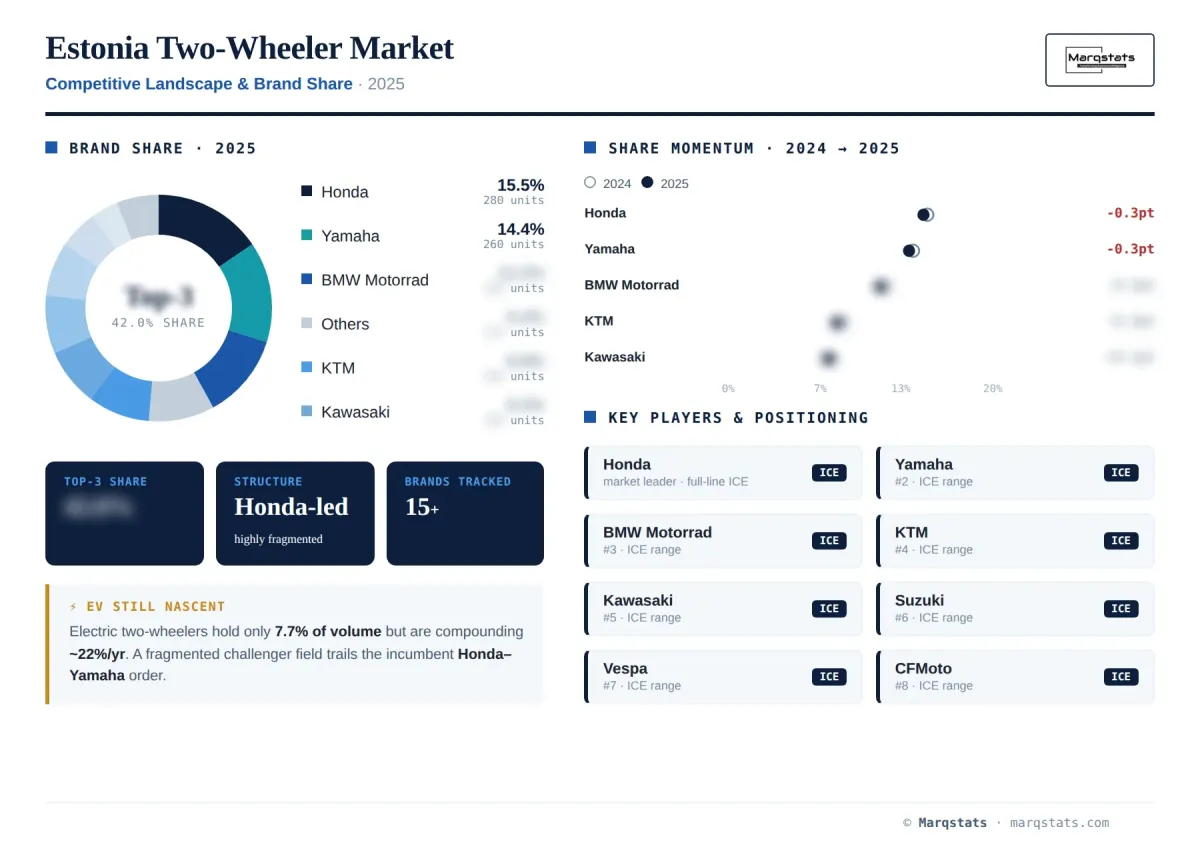
The Estonia two-wheeler market is moderately fragmented and premium-skewed, shaped by European and Japanese OEMs alongside emerging Chinese and Indian entrants. Honda held the largest single-brand volume in 2025 at about 15%, followed by Yamaha, BMW Motorrad and KTM, with a long tail of premium and niche marques. Competition centres on brand trust, dealer and service coverage, model breadth and resale value, increasingly complemented by electric ranges, connected features and digital retail.
Japanese brands such as Honda and Yamaha anchor the mid and commuter tiers with broad motorcycle and scooter ranges, while European premium marques including BMW Motorrad, KTM, Piaggio and Ducati compete in touring, adventure and lifestyle segments where heritage and technology support higher prices. Chinese challenger CFMoto is expanding on competitive pricing, and Royal Enfield adds a mid-premium classic option that suits Estonia's leisure-oriented rider base. Electric-focused brands including NIU, Zero and Yadea contest the fast-growing yet still small electric niche, with growth tied to tax advantages and charging access.
At the brand level, Honda's lead rests on its motorcycle and scooter breadth, while Yamaha holds a close second on a comparable portfolio. BMW Motorrad and KTM anchor the premium and adventure tiers, supported by strong resale value and heritage that sustain higher price points. Kawasaki, Suzuki and Piaggio occupy focused sport, commuter and scooter niches, while CFMoto and Royal Enfield gain ground on value and classic positioning respectively. Over the forecast period the balance is expected to tilt toward brands that pair reliable service networks with credible electric, connected and digital-retail offerings as the mix continues to premiumise and electrify.
Companies Covered
The report profiles 16+ companies with full strategy and financials analysis, including:
Recent Market Activity
Table of Contents
Coverage & Segmentation
This report provides a comprehensive analysis of the Estonia two-wheeler market across a 2025 base year, historical data from 2021 to 2025, and forecasts spanning 2026 to 2030. The study sizes the market in both volume (thousand units, on a new-registration basis) and value (USD million), and segments it by vehicle type (motorcycles, scooters and mopeds), propulsion type (internal combustion engine, electric), engine displacement and motor power, price band, end user, and sales channel. Brand-level analysis covers the premium European and Japanese manufacturers that shape Estonian supply, alongside emerging Chinese and Indian entrants.
The study examines market drivers, restraints and trends, segment-level growth, regional demand across Tallinn, Tartu and the wider country, competitive structure, and forward catalysts including the new motor-vehicle tax, electrification, digital retail and charging-infrastructure expansion. All market estimates represent Marqstats-reconciled figures derived from a bottom-up methodology validated against top-down benchmarks, using national registration indicators and European Union statistics rather than any single external source.
The report is designed for two-wheeler manufacturers, importers and distributors, fleet and delivery operators, component and battery suppliers, and policymakers assessing Estonia's urban-mobility and electrification path. It supports market sizing, brand and channel benchmarking, and scenario planning around taxation, electrification and seasonal demand. Volume and value forecasts are provided at segment level for the 2026–2030 window, with 2021–2025 historical context, enabling comparison against neighbouring Baltic and European markets.