Market Snapshot
Key Takeaways
Market Overview & Analysis
Report Summary
The EV aftersales market is undergoing the most significant structural transformation in the automotive service industry since the introduction of electronic engine management. The study period is 2021–2030 with 2025 as base year. The market's trajectory is not one of simple growth or decline but of compositional transformation: the revenue pool generated by a single vehicle in service shifts from high-frequency, low-skill consumable maintenance toward lower-frequency but higher-value, higher-skill interventions — battery diagnostics, power electronics repair, software service, high-voltage safety inspection, thermal system management, and ADAS recalibration. This transformation creates simultaneous winners (OEMs with connected-vehicle software capability, specialised EV diagnostic tool providers, trained technician networks, battery health service providers) and structural pressures (general repair workshops with ICE-only skills, OEM dealers without digital service capability, parts distributors dependent on engine oil and filter volumes).
The addressable base is now substantial and growing rapidly. The global electric car fleet reached approximately 57.5 million at end-2024, with annual additions exceeding 17.2 million in 2024 and projected to exceed 20 million in 2025. European EV market share in new cars is expected to reach approximately 24.5% in 2025. Each vehicle in the global EV fleet is both a current service opportunity — for tyre rotation, alignment, brake work, software updates, warranty inspection, and crash repair — and a growing opportunity as it ages — for battery state-of-health testing, power electronics diagnosis, cooling system maintenance, and eventually battery module or pack service. The composition of the service opportunity changes as the vehicle ages: early in vehicle life, OEM warranty coverage dominates; in years three to eight, warranty management, software service, and diagnostics become important; in years eight-plus, the independent repair market gains competitiveness as warranty expires and cost-of-ownership pressure increases.
The regulatory environment is actively reshaping the competitive dynamics of EV aftersales in ways that will determine the long-term split between OEM-captive and independent service revenue. The EU RMI framework's requirement for easy, restriction-free, and standardised access to repair and maintenance information — with no discrimination versus authorised dealers — is the foundational principle for independent EV workshop competitiveness. The EU Data Act's vehicle-specific guidance (published September 2025) and the Commission's 2025 Automotive Action Plan signal that connected-vehicle data access is moving from principle to implementation. California's Advanced Clean Cars II regulation establishes battery durability standards that force OEMs to publish service information and support more standardised battery diagnostics. The Massachusetts and Maine right-to-repair mandates establish open data platform requirements for vehicle access. Together, these represent the most active regulatory period in automotive aftersales competition in a generation — and the outcome will determine whether the EV era concentrates service revenue within OEM networks or sustains a competitive independent workshop ecosystem.
Market Dynamics
Key Drivers
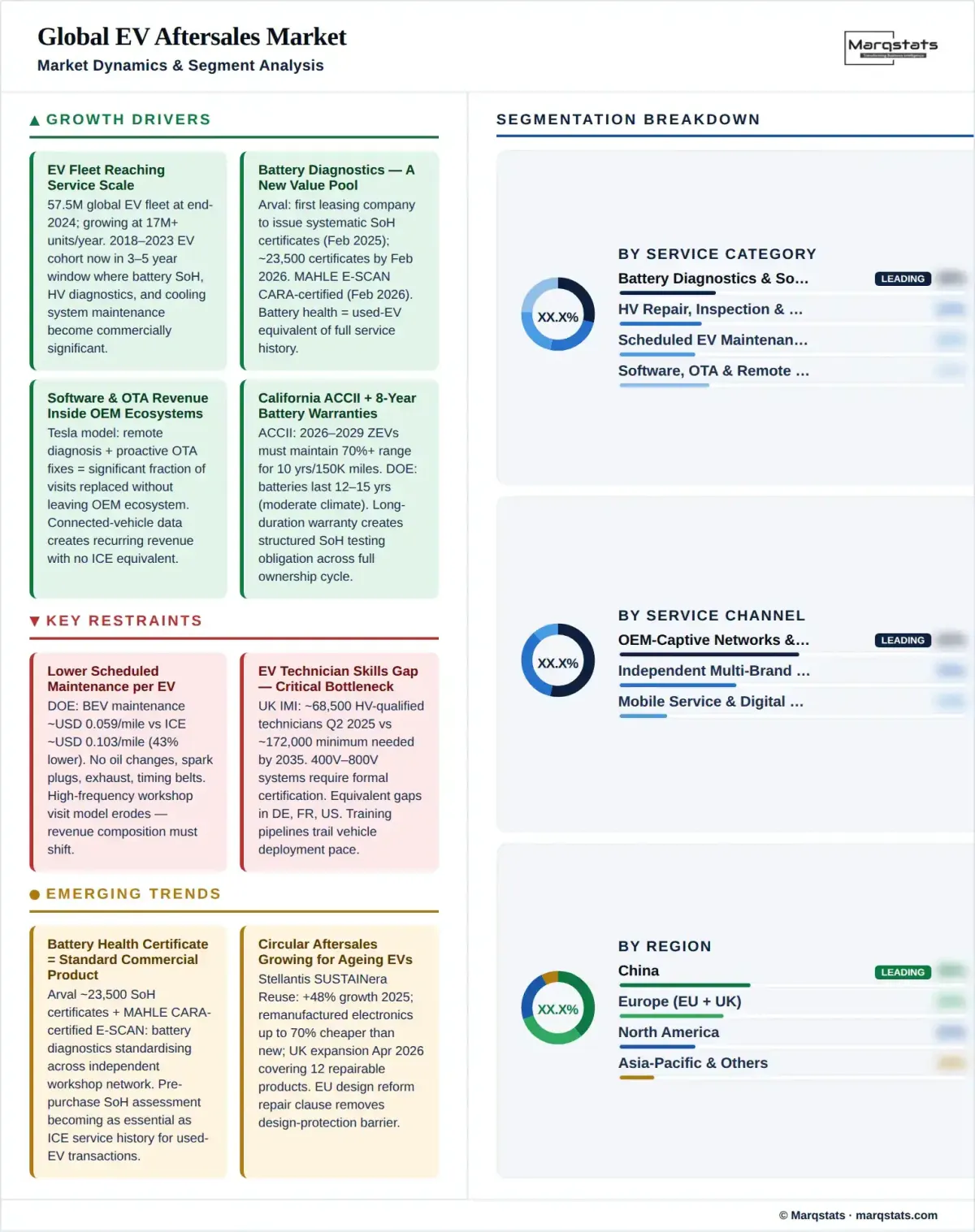
- EV parc scale reaching the threshold where aftersales is structurally significant: The EV aftersales market's most fundamental driver is the sheer scale of the EV fleet now in operation. Approximately 57.5 million electric cars globally at end-2024, growing at 17+ million per year, creates an installed base that generates service revenue on tyre replacement, alignment, brake maintenance, collision repair, software support, warranty work, and battery diagnostics — even at a lower per-vehicle service intensity than ICE equivalents. The progression matters as much as the current scale: as the 2018–2023 EV cohort moves beyond three to five years old, the range of service needs expands from warranty-covered items toward scheduled inspections, battery state-of-health assessments, cooling system checks, and power electronics diagnostics. The IEA's projection of EV sales exceeding 20 million in 2025 means the aftersales addressable base is expanding at approximately 20 million vehicles per year — adding service revenue potential that compounds through vehicle lifetime.
- Battery diagnostics and state-of-health transparency becoming a commercial service category: The importance of battery diagnostics in EV aftersales is growing rapidly as the commercial ecosystem around used EVs, leasing company asset management, fleet uptime services, and insurance underwriting all demand credible, standardised battery state-of-health data. Arval's systematic issuance of battery health certificates when reselling used EVs (from February 2025) and its publication of analysis based on approximately 23,500 state-of-health certificates (February 2026) represents the transition of battery diagnostics from a workshop tool to a structured commercial service product. MAHLE's E-SCAN battery diagnostics function achieving CARA-approved certification (February 2026) — confirming compliance with European quality standards for battery condition assessment — signals that battery diagnostics is standardising and becoming deployable across the broader independent workshop network rather than only within OEM dealer systems.
- Software and over-the-air services creating recurring aftersales revenue inside OEM ecosystems: EV manufacturers' ability to deliver software updates, remote diagnostics, feature activations, and predictive service notifications over-the-air creates a recurring aftersales revenue stream that has no direct equivalent in the ICE aftermarket. Tesla's model — servicing through company-owned locations and Tesla Mobile Service technicians, with remote diagnosis and proactive remedies through vehicle connectivity — has demonstrated that a significant fraction of traditional workshop visits can be replaced or pre-empted by OTA interventions, keeping service value inside the OEM ecosystem. For other OEMs implementing connected-vehicle service platforms, the OTA update capability creates both a customer experience advantage (fewer workshop visits, faster fixes) and a revenue capture mechanism (subscription features, remote diagnostics fees, software-enabled service workflows).
- EV battery warranty and durability driving warranty management as a structured service activity: OEM battery warranties — typically eight years or 100,000 miles across most major brands — create a structured, long-duration warranty management obligation that affects both OEM dealer networks (processing warranty claims, conducting warranty inspections) and independent operators (who need access to diagnostic data to conduct compliant warranty assessments and provide credible battery health documentation). California's Advanced Clean Cars II regulation hardening battery durability standards — 2026–2029 ZEVs maintaining 70%+ of certification range for 10 years/150,000 miles — directly expands the warranty obligation period and the commercial importance of accurate battery state-of-health testing at every warranty interaction. DOE modeling suggesting batteries may last 12–15 years in moderate climates creates a long-duration warranty and post-warranty service window that sustains battery diagnostics revenue far beyond initial ownership cycles.
- Circular aftersales and remanufactured electronics creating cost-effective repair pathways for ageing EVs: As EVs age and move beyond warranty coverage, the cost of repair becomes a more significant ownership factor — and the availability of remanufactured, repaired, and reused electronic components, power electronics, battery modules, and 'must-match' visible parts becomes a key enabler of cost-effective repair. Stellantis SUSTAINera's expanded electronic repaired parts offer in the UK — covering repairable products at up to 70% lower cost than new with full traceability — and its approximately 48% growth in 2025 are early-scale examples of the circular aftersales trend. The EU design reform's permanent repair clause removes EU design protection for component parts used solely to restore original appearance, directly supporting competitive availability of EV visible-repair parts. This circular economy dimension is growing in commercial importance as the average age of the EV parc increases.
Key Restraints
- Lower scheduled maintenance intensity per vehicle reducing traditional workshop revenue from the EV service pool: The most structurally significant restraint in the EV aftersales market is that BEVs require materially less scheduled maintenance than equivalent ICE vehicles. DOE data indicate an estimated scheduled maintenance cost of approximately USD 0.059 per mile for a BEV versus USD 0.103 per mile for a conventional vehicle — a difference of approximately 43%. The elimination of engine oil changes, spark plug replacements, exhaust system maintenance, timing belt or chain service, and transmission fluid changes removes regular-interval workshop revenue that has been a cornerstone of ICE aftersales economics. For dealer networks and independent workshops that have built their business model around high-frequency, consumer-defined maintenance intervals, this revenue erosion creates a structural challenge that cannot be fully offset by growth in new EV service categories in the near term.
- EV technician skills gap constraining service capacity ahead of fleet growth: The gap between the number of EV-qualified technicians currently available and the number required to service the projected EV parc is a material constraint on the EV aftersales market's ability to convert vehicle demand into service throughput. The UK's IMI forecast projects approximately 68,500 EV-qualified technicians by Q2 2025 against a minimum of approximately 172,000 required by 2035 — a gap of over 100,000 trained technicians in one national market alone. Equivalent gaps exist across Germany, France, the US, and other major markets. The EV servicing skill requirement is genuinely different from ICE: working on high-voltage systems (typically 400V–800V) requires formal certification, specialised PPE, and different workshop safety procedures. Training pipelines, accreditation bodies, and equipment investment all take time — constraining the pace at which the independent workshop sector can capture EV aftersales share regardless of vehicle demand growth.
- Data access barriers and OEM control of diagnostic ecosystems limiting independent workshop competitiveness: The central competitive tension in EV aftersales is between OEM-controlled diagnostic and software ecosystems and the independent repair sector's need for equivalent data access. EVs are increasingly software-defined vehicles — fault codes, battery management data, ADAS calibration parameters, charging system diagnostics, and OTA update authorisation are all mediated by OEM-proprietary software platforms. Without open access to these data streams, independent workshops cannot diagnose, repair, or certify EV performance to the same standard as OEM-authorised networks. The EU RMI framework mandates access, and the Commission's 2025 vehicle-data guidance addresses connected-vehicle data access — but implementation is contested and enforcement varies by OEM and market. FIGIEFA and independent operator associations have raised concerns that cybersecurity requirements under UNECE Regulation 155 could be used to restrict legitimate aftermarket diagnostic access.
- Capital investment requirements creating barriers for independent workshops transitioning to EV service: Workshop readiness for EV servicing requires significant upfront capital investment: high-voltage safety equipment (insulated tools, PPE, battery handling equipment, fire suppression systems), EV-specific diagnostic software and scan tool subscriptions, technician training and HV certification, and in many cases physical workshop modifications to handle high-voltage vehicle systems safely. For multi-brand independent workshops that service a mixed ICE/EV vehicle parc and have uncertainty about the pace of EV parc growth in their customer base, committing to this investment ahead of sufficient EV service volume is a commercial risk. This creates a transitional period in which workshop readiness lags vehicle deployment — resulting in either OEM-network concentration of EV service or underservice of EV owners who lack nearby qualified independent workshop options.
Key Trends
- Battery health certification becoming a standard commercial product at the used-EV and fleet remarketing interface: Battery health certification — formally documented state-of-health assessment providing a credible, standardised measure of remaining battery capacity and health — is transitioning from a technical capability to a structured commercial product. Arval's systematic battery health certificate programme (from February 2025) and MAHLE's CARA-certified E-SCAN battery diagnostics (February 2026) represent the leading edge of this standardisation. As the used EV market expands — with growing volumes of off-lease, high-mileage, and first-ownership EVs entering the secondary market — battery health certification is becoming as important to used-EV transactions as a full service history is to used-ICE transactions. The commercial opportunity is significant: standardised battery health certificates reduce information asymmetry in used-EV sales, support insurance underwriting, enable fleet residual-value management, and provide the data foundation for battery warranty assessment and warranty claims.
- Remote diagnostics and predictive maintenance replacing reactive repair for connected EVs: The shift from reactive fault-response to remote diagnostic and predictive maintenance is one of the most commercially significant trends in EV aftersales. Connected EVs constantly generate telematics, battery management, powertrain, ADAS, and charging system data — data that, when properly analysed, can predict component failures, identify battery degradation trends, schedule preventive interventions before breakdowns occur, and dramatically reduce roadside assistance events. Tesla's model of proactive remote remedies through vehicle connectivity is the most visible example of this trend, but OEM connected-service platforms from BMW, Volkswagen, Mercedes-Benz, and others are building equivalent predictive service capabilities. The commercial boundary between this OEM-operated remote diagnostic capability and independent workshop access is precisely the terrain that the EU RMI framework and vehicle-data guidance are seeking to level — the outcome will determine whether predictive maintenance revenue stays inside OEM networks or flows to independent service providers.
- High-voltage repair certification and independent EV workshop development accelerating as technician pipeline matures: The technician skills gap is beginning to be addressed by a maturing training and certification ecosystem, though at a pace that still trails vehicle deployment. LKQ's explicit positioning of workshops to become independent EV and hybrid repair centres — with training, certification, and technical support — is one indicator of the ecosystem building required to address the gap. ZF Aftermarket's ZF [pro]Service concept, oriented around training, OE-based technical support, and diagnostic tools for truck, trailer, and bus fleets, is a commercial-vehicle equivalent. Bosch Car Service's position as the world's largest brand-independent repair network — with approximately 14,800 repair shops in approximately 148 countries — includes active EV workshop readiness programmes that are expanding the qualified independent EV service footprint. The pace of technician pipeline development will be the primary constraint on the independent EV repair market's growth for at least the next five years.
- Circular and remanufactured EV parts growing as ageing vehicles create repair economics requiring cost-competitive alternatives to new OEM parts: As EVs age and the cost of repair becomes more relevant to ownership economics, the availability of remanufactured power electronics, repaired battery modules, and circular 'must-match' visible parts becomes a structural requirement for a competitive EV repair ecosystem. Stellantis SUSTAINera's growth (approximately 48% in 2025) and its electronic repaired parts offer — covering 12 popular repairable products at up to 70% lower cost than new — signals the direction. The EU design reform's permanent repair clause removes design protection for component parts used solely to restore original appearance, reducing one legal barrier to competitive repair-parts availability. For the EV ecosystem specifically, remanufactured power electronics (inverters, on-board chargers, DC-DC converters), battery module refurbishment, and repaired ADAS sensor assemblies represent the highest-value circular parts categories.
Market Segmentation
Battery electric vehicles eliminate several of the highest-frequency, highest-revenue scheduled maintenance categories that have sustained the automotive aftermarket for a century. Engine oil and filter changes — performed every 5,000–10,000 miles in ICE vehicles, generating regular workshop visits and consumable parts revenue — do not apply to BEVs. Spark plugs, air filters, timing belts, exhaust systems, and conventional transmission service are similarly eliminated. DOE data indicate estimated scheduled maintenance cost of approximately USD 0.059 per mile for BEVs versus USD 0.103 per mile for conventional vehicles — confirming the structural shift in per-vehicle service economics. AAA's 2025 ownership-cost analysis similarly identifies EVs as the least expensive vehicle type for maintenance, repair, and tyre costs combined.
This does not mean EV maintenance disappears — it means the composition changes. EVs still require tyre replacement, alignment, wheel balancing, brake inspection (though regenerative braking extends pad life), cabin air filter replacement, washer fluid, wiper blades, and 12-volt battery maintenance. They additionally require software update management, high-voltage system safety inspections, thermal and cooling system maintenance (battery thermal management systems are more complex than ICE cooling), ADAS system calibration and recalibration after collisions, and battery state-of-health monitoring. What changes is that the routine-interval, consumable-replacement model that drove workshop visit frequency weakens, and the diagnostic, software, and specialist repair model that generates less frequent but higher-value interactions grows. Workshops that adapt to this composition shift retain revenue; workshops that depend predominantly on oil change and filter replacement frequency face structural revenue erosion as their ICE customer base transitions to EVs.
The competitive split between OEM-authorised dealer networks and independent multi-brand workshops is more contested in EV aftersales than it was in the ICE aftermarket, because the technical barriers and data access requirements have increased relative to traditional mechanical repair. OEM dealer networks benefit from direct access to vehicle diagnostic software, OTA update authorisation, proprietary fault code libraries, battery warranty administration systems, and manufacturer training programmes — advantages that are structurally harder for independent workshops to replicate without regulatory mandates requiring open access. Tesla's service model — using company-owned service centres and mobile service technicians with remote diagnostic capability — is the most vertically integrated version of this OEM-captive approach, and its ability to perform remote diagnostics and proactive remedies through vehicle connectivity sets the standard that dealer and independent networks are competing against.
Independent multi-brand workshops remain essential to the EV service ecosystem for reasons of geographic coverage, competitive pricing pressure, and post-warranty service economics. Bosch Car Service's approximately 14,800 repair shops in approximately 148 countries represent the independent sector's scale advantage — no OEM can match that coverage. LKQ's investment in positioning workshops as independent EV and hybrid repair centres — providing training, certification, and technical support — reflects the independent sector's strategy to close the capability gap through ecosystem building rather than waiting for regulatory access mandates to fully equalise the diagnostic data playing field. The EU RMI framework's requirement for equal and unrestricted access to repair information and diagnostic tools, with no discrimination versus authorised dealers, provides the legal foundation — but practical implementation remains contested.
Battery diagnostics is the most strategically important new service category created by the EV era in automotive aftersales. It encompasses state-of-health testing (measuring remaining capacity and degradation relative to original specification), fault code diagnostics for battery management system alerts, thermal behaviour assessment, cell balancing checks, and charging system integrity verification. The commercial applications of battery diagnostics span the full vehicle lifecycle: warranty inspections during the OEM warranty period, pre-purchase assessments for used-EV buyers, systematic fleet SoH monitoring for leasing companies and fleet operators, insurance underwriting data provision, and residual-value certification for remarketing. None of these applications existed at commercial scale in the ICE aftermarket — battery diagnostics is a genuinely new service category that creates revenue for the workshops, equipment suppliers, and data service companies that invest in the capability.
Arval's systematic battery health certificate programme — making Arval the first leasing company to issue SoH certificates when reselling used EVs from February 2025, with approximately 23,500 certificates issued by February 2026 — is the clearest early commercial-scale example of battery diagnostics as a structured product rather than an ad hoc workshop service. MAHLE's E-SCAN battery diagnostics receiving CARA-approved certification in February 2026 — confirming compliance with European quality standards — demonstrates that the equipment and methodology for battery health assessment is being standardised and certified in ways that make it deployable across the broader workshop network. As used EV volumes grow and as battery warranty periods become commercially significant for second-owner buyers, battery diagnostics will progressively become a prerequisite for used-EV transactions equivalent to the pre-purchase inspection in ICE vehicle sales.
High-voltage repair represents the most significant safety and skills departure from ICE vehicle servicing. EV high-voltage systems typically operate at 400V–800V (compared to the 12V systems in ICE vehicles), with high-voltage cables, battery modules, inverters, electric motors, on-board chargers, and DC-DC converters all operating at levels that require formal technician certification, specialised safety equipment, and specific workshop safety procedures — including vehicle de-energisation protocols, insulated tool requirements, and hazardous-material handling procedures for damaged or thermally compromised battery packs. Working on high-voltage systems without formal certification is illegal in most jurisdictions and carries real safety risk — creating a genuine qualification barrier that limits which workshops can serve the EV market.
The technician skills gap quantified by the UK's IMI — approximately 68,500 EV-qualified technicians projected by Q2 2025 against approximately 172,000 minimum required by 2035 — is one of the clearest expressions of the supply-side bottleneck in EV aftersales. The gap represents not a shortage of willingness to train but a structural lag between vehicle deployment pace and the training pipeline's ability to certify technicians at equivalent speed. Training providers — IMI, BOSCH, ZF Aftermarket, LKQ's workshop certification programmes, and OEM-sponsored training academies — are all expanding capacity, but the 2025–2030 period will continue to be characterised by a structural undersupply of HV-certified technicians relative to the EV service demand. Workshops with HV-certified technicians and appropriate safety equipment command a structural advantage in the EV service market during this transition period, and investment in technician training is both a regulatory obligation and a competitive differentiation strategy.
ZF Aftermarket's ZF [pro]Service concept — oriented around training, OE-based technical support, diagnostic tools, and uptime-oriented maintenance for commercial vehicle fleets — illustrates how the independent parts and service ecosystem is building the training and tooling infrastructure needed to serve EV workshops. LKQ's explicit EV and hybrid workshop readiness investment demonstrates the same strategic direction in the passenger vehicle segment. The commercial market for HV training, certification programmes, diagnostic tool subscriptions, and EV-specific workshop safety equipment is a directly growing sub-segment of the EV aftersales market that serves the broader service ecosystem's readiness needs.
Software updates and remote diagnostics represent the most novel commercial dimension of EV aftersales — and the dimension where OEM competitive advantage is most pronounced relative to the independent sector. EVs are software-defined vehicles: battery management, powertrain control, ADAS systems, thermal management, charging management, and infotainment all run on software that can be updated remotely, extended with new features, and diagnosed without a physical workshop visit. Tesla's capability to perform remote diagnosis and proactive remedies through vehicle connectivity — pushing over-the-air fixes that avoid workshop visits while keeping the service interaction inside the Tesla ecosystem — is the leading example of how software-enabled aftersales changes the competitive dynamics fundamentally.
The EU Data Act's vehicle-specific guidance published September 2025 and the Commission's 2025 Automotive Action Plan commitment to measures ensuring the full automotive ecosystem benefits from connected-vehicle data are directly relevant to this segment. The Commission's statement that it would initially work through the Data Act and then potentially through further in-vehicle data access legislation confirms that connected-vehicle data access is an active policy priority — one that will determine whether independent workshops can access the diagnostic data streams needed to perform software diagnosis and warranty assessment, or whether those capabilities remain exclusively in OEM hands. For the independent workshop sector, the commercial value of each OTA update and remote diagnostic intervention that stays within an OEM ecosystem represents lost service revenue — making the data access question a fundamental competitive and policy issue.
Predictive service — using telematics and battery management data to schedule maintenance interventions before failures occur — is growing as a commercial proposition for fleet operators, where vehicle uptime is a direct financial variable. ZF Aftermarket's uptime-oriented maintenance positioning for commercial fleets and Tesla's proactive service reminders for consumer EVs are both manifestations of the same predictive service model. As connected-vehicle data access improves for independent operators, predictive service based on third-party telematics interpretation is becoming a commercial layer that independent service providers can access — but it requires both data access and analytical capability that most independent workshops do not yet have in-house.
Charging equipment maintenance and service support is an adjacent but growing segment of the EV aftersales ecosystem, encompassing the maintenance, inspection, repair, and software management of home charging units (AC wallboxes), public AC and DC charging infrastructure, and fleet depot charging systems. Europe's public charging stock grew more than 35% in 2024 to approximately 1.05 million charging points — with the Netherlands at approximately 178,000, Germany at approximately 158,000, and France at approximately 152,000. This charging infrastructure base requires ongoing maintenance: cable integrity checks, connector replacement, software updates, billing system maintenance, grid connection compliance testing, and fault diagnosis when units go offline. While charging equipment maintenance is structurally separate from vehicle aftersales, the two categories are converging commercially — EV dealerships and independent workshops are increasingly offering charging installation, commissioning, and maintenance as part of an integrated EV ownership support package.
Fleet depot charging maintenance is the highest-value sub-segment of charging equipment service, because fleet operators depend on charging availability for vehicle utilisation and any charging downtime directly affects operational efficiency. Fleet service contracts combining vehicle maintenance, battery health monitoring, charging system uptime, and remote fleet management are an emerging commercial model that blends traditional aftersales with charging infrastructure service — creating a higher-value, longer-duration service relationship than traditional transactional vehicle repair.
By Geography
Europe — Most Advanced Regulatory Framework, Largest Fleet per Capita
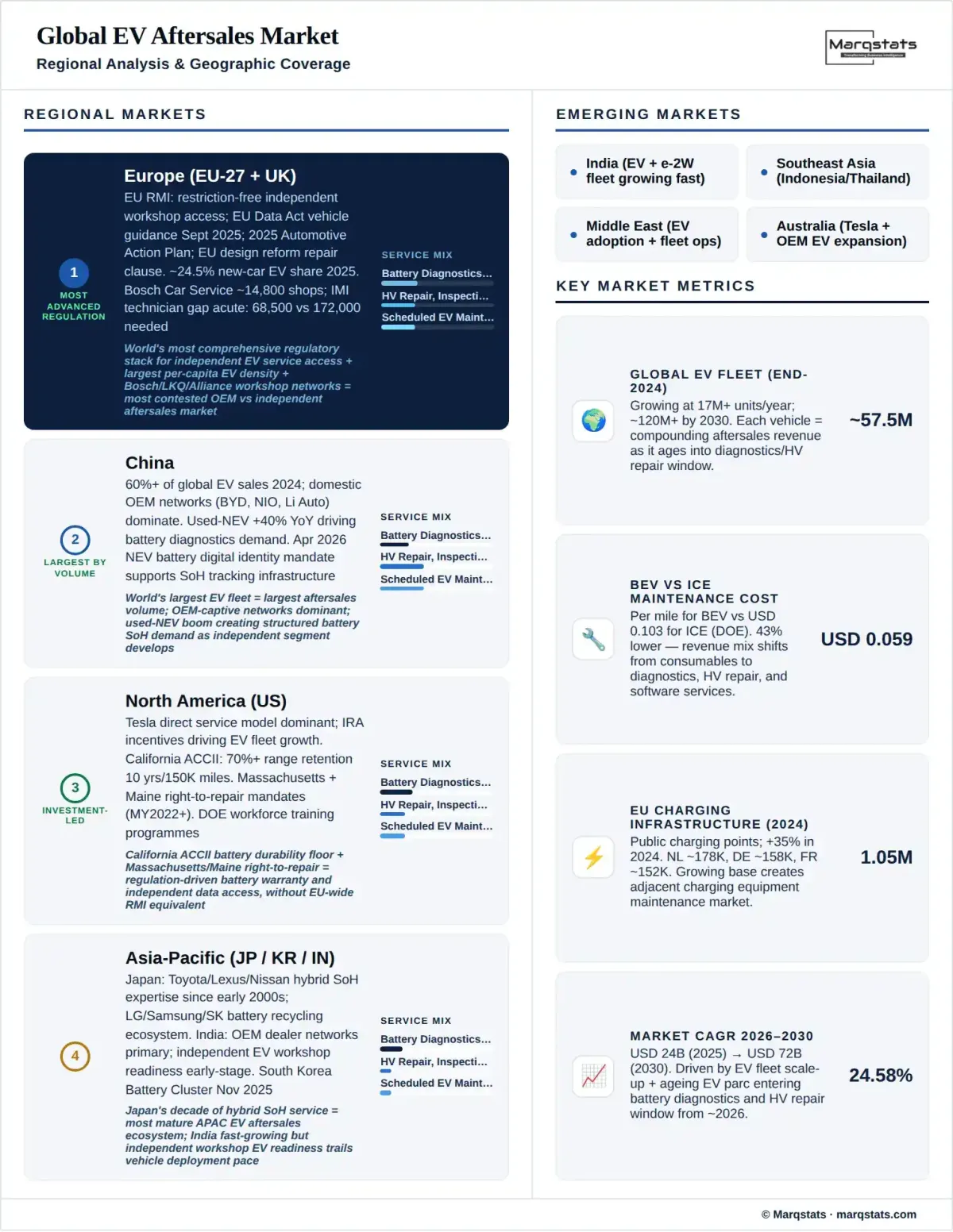
Europe is the world's most advanced EV aftersales market from a regulatory and competitive-framework standpoint, combining the EU RMI mandate (restriction-free independent access to repair information), the EU Data Act vehicle guidance (September 2025), the EU design reform repair clause, and the EU's 2025 Automotive Action Plan into the most comprehensive policy stack addressing independent EV service competitiveness globally. European EV market share in new cars is expected to reach approximately 24.5% in 2025, with the cumulative European EV fleet already representing tens of millions of vehicles. Europe's charging infrastructure — approximately 1.05 million public charging points by end-2024, growing at 35%+ per year — creates the service ecosystem context for EV ownership. The skills gap challenge is acute in Europe: the UK's IMI technician data is the most transparent published estimate, but equivalent gaps exist in Germany, France, Italy, Spain, and other major European markets. European workshop networks — Bosch Car Service (~14,800 shops, ~148 countries), LKQ Europe, Alliance Automotive Group, and Autodis — are all actively building EV workshop readiness programmes to address the technician and tooling gap.
North America — Investment-Led, Data Access Rights in Development
North America is the second-largest EV aftersales market by vehicle base, with the US EV fleet growing rapidly as IRA incentives accelerate EV adoption and as OEM model proliferation expands beyond early-adopter Tesla dominance. The US policy framework for EV aftersales is characterised by state-level right-to-repair mandates (Massachusetts for MY 2022+ vehicles, Maine for vehicles sold from January 2025), federal investment in workforce training through DOE programmes, and California's Advanced Clean Cars II regulation establishing battery durability standards that directly shape warranty and diagnostic service requirements. The US lacks the EU's cross-national RMI framework equivalent, creating state-by-state variation in independent repair data access rights and leaving the federal competitive landscape more tilted toward OEM captive service than the European equivalent. Tesla's service model — company-owned service centres plus mobile service technicians — is the dominant operational reference in the US market, but franchise dealer networks (OEM-authorised) and independent chains (such as LKQ-supported independent shops) are building EV service capacity.
China — Largest EV Market, Domestic Service Ecosystem Building
China is the world's largest EV market by annual sales and fleet size — accounting for approximately 60%+ of global EV sales in 2024 — and its EV aftersales market is the largest by vehicle volume. China's domestic EV manufacturers (BYD, NIO, Li Auto, Xpeng, and others) operate primarily through OEM-affiliated service networks, with independent multi-brand workshops developing EV capability at a pace that trails the vehicle deployment rate. Battery diagnostics is emerging as a commercial service in China as the used-NEV market grows — CADA data show used NEV transactions growing approximately 40% year on year. China's national NEV battery digital identity mandate (effective April 2026) creates the traceability infrastructure that supports battery health tracking and eventually battery diagnostics as a structured service product. The skills gap in China is proportionally as significant as in Europe and North America, reflecting the pace of EV parc expansion relative to technician training pipeline capacity.
Asia-Pacific Excluding China — Growing Fast, Infrastructure Building
Japan, South Korea, India, and other Asia-Pacific markets collectively represent a growing EV aftersales market at varied stages of development. Japan has an established hybrid and EV aftersales ecosystem through Toyota (Lexus hybrid), Nissan, and Honda, with battery diagnostics and HV service capability embedded in OEM dealer networks for over a decade. South Korea's three major battery manufacturers (LG Energy Solution, Samsung SDI, SK On) create a domestic supply context for battery service capability. India's rapidly growing EV and electric two-wheeler market is building the aftersales infrastructure from a lower base — OEM dealer networks are the primary service channel, with independent workshop readiness for EV service at early stage. Australia's EV market is growing rapidly, with Tesla's direct service model and expanding OEM dealer EV programmes creating the initial service ecosystem.
How Competition Is Evolving
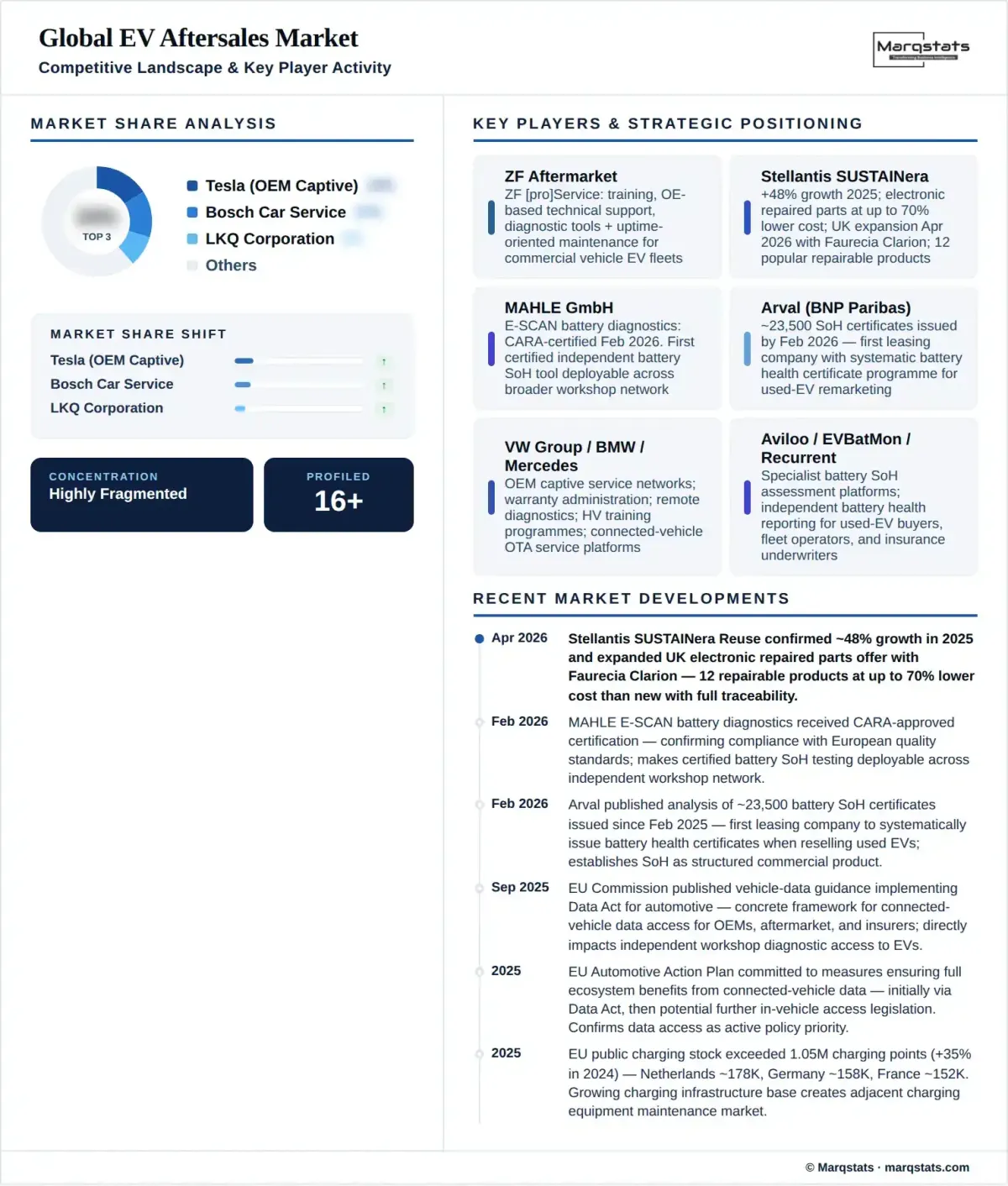
The EV aftersales competitive landscape is structured across five layers: OEM-captive service networks; large multi-brand workshop chains; parts and service ecosystems (distributors, tool suppliers, parts remanufacturers); specialist EV diagnostic and battery service providers; and software and connected-vehicle service platforms. There is no single market-share leader that spans all five layers globally — the market is inherently fragmented by geography, vehicle brand, and service category.
OEM-captive networks hold the strongest structural position in the current period because they control diagnostic software access, warranty administration, OTA update authorisation, and manufacturer training. Tesla's integrated model — remote diagnostics, proactive software fixes, company-owned service centres, and mobile service technicians — is the most visible and vertically integrated example. Volkswagen Group, Mercedes-Benz, BMW, Stellantis, and other OEMs with large European dealer networks have equivalent (if less digitally integrated) captive service ecosystems that capture warranty revenue and manufacturer-authorised service work.
In the independent sector, Bosch Car Service (~14,800 shops, ~148 countries) represents the largest brand-independent repair network by disclosed outlet count, and its active EV workshop readiness programme gives it the most extensive geographical platform for independent EV service deployment. LKQ's workshop positioning strategy — providing EV and hybrid certification, training, and diagnostic tool access to independent workshops — is building the independent sector's capability from the parts distributor side. ZF Aftermarket's ZF [pro]Service concept addresses the commercial vehicle segment. In battery diagnostics specifically, MAHLE (E-SCAN, CARA-certified), Arval (systematic SoH certificates), and specialist battery health platform providers are building the commercial infrastructure for battery diagnostics as a standardised service product.
Companies Covered
The report profiles 16++ companies with full strategy and financials analysis, including:
Recent Market Activity
Table of Contents
Coverage & Segmentation
This report provides a comprehensive analysis of the global EV aftersales market covering post-sale services, maintenance, repair, diagnostics, software support, parts supply, and warranty management for battery electric vehicles (BEVs), plug-in hybrid electric vehicles (PHEVs), and hybrid electric vehicles (HEVs) — across OEM-captive service networks, franchise dealer workshops, independent multi-brand repair centres, mobile service technicians, fleet uptime operators, and digital service platforms — spanning the 2021–2030 study period with 2025 as base year. Service category coverage includes: scheduled EV maintenance (tyre, brake, cooling, cabin filter, 12V battery); battery diagnostics, state-of-health testing, and battery health certification; high-voltage system repair, inspection, and safety certification; software updates, OTA service, and remote diagnostics; ADAS recalibration and sensor service; collision repair for EVs; warranty administration and battery warranty management; fleet uptime and telematics-integrated predictive service; circular and remanufactured EV electronic parts; and charging equipment maintenance and service support. Market scope excludes vehicle manufacturing, new-vehicle sales, and EV battery recycling (covered separately). Geographic coverage spans North America, Europe (EU-27 plus UK), China, Asia-Pacific (Japan, South Korea, India, Australia), and other key markets. Regulatory analysis covers EU RMI framework, EU Data Act vehicle guidance (September 2025), EU 2025 Automotive Action Plan, EU design reform repair clause, California Advanced Clean Cars II, Massachusetts and Maine right-to-repair mandates. Primary research includes 40+ interviews with OEM aftersales executives, independent workshop operators, fleet service managers, battery diagnostics platform providers, technician training organisations, and EV aftersales parts distributors across Europe, North America, and Asia-Pacific.