Statistics & Highlights

Market Snapshot

Market size in USD Billion
$2.10B
2025
Base year
$2.76B
2026
Estimated
  
$8.20B
2030
Forecast
Largest market
Java (Greater Jakarta Corridor)
Fastest growing
Java — West Java (BYD Subang Plant Hub)
Dominant segment
Battery Electric Vehicle (BEV)
Concentration
Moderately Fragmented
CAGR
31.29%
2026 – 2030
GROWTH
+$6.10B
Absolute
STUDY PARAMETERS
Base year2025
Historical period2021 – 2025
Forecast period2026 – 2030
Units consideredValue (USD BN), Volume (Units)
REPORT COVERAGE
Segments covered4 segment dimensions (Propulsion, Vehicle Type, End User, Charging Infrastructure)
Regions covered7 regions
Companies profiled17+
Report pages260+
DeliverablesPDF, Excel, PPT
Executive Summary

Key Takeaways

Market valued at USD 2.10 billion in 2025, projected to reach USD 8.20 billion by 2030 at 31.29% CAGR — fuelled by TKDN-linked incentives, major battery manufacturing investments, and 103,931 EV units sold in 2025.
BYD leads Indonesia's BEV segment with ~39% share — selling 16,427 units in Jan–Jul 2025; Denza, Wuling, Chery, and GAC AION complete the Chinese OEM top five that collectively account for over 90% of BEV sales.
Indonesia holds the world's largest nickel reserves (~22% of global supply) — anchoring a government strategy to become the world's third-largest EV battery producer by 2027 through integrated upstream-to-cell investment chains.
EV penetration jumped from 10.1% to 15.2% of passenger car sales in a single quarter (Q1–Q2 2025) — confirming policy-sensitive but accelerating structural demand beyond mere subsidy pull.
Battery manufacturing pipeline is the most advanced in ASEAN — Hyundai-LGES 10 GWh cell plant operational, CATIB 6.9 GWh plant targeting Q3 2026, and Huayou-EVE Energy upstream chain targeting 1H 2026 groundbreaking.
Policy discontinuity is the key downside risk — incentive frameworks for 2026 and beyond remained under negotiation as of April 2026, and electric motorcycle sales fell sharply after the 2023–2024 subsidy period ended, underscoring market sensitivity to incentive continuity.
Market Insights

Market Overview & Analysis

Report Summary

The Indonesia electric vehicle market encompasses battery electric vehicles (BEVs), plug-in hybrid electric vehicles (PHEVs), and hybrid electric vehicles (HEVs) across passenger cars, commercial vehicles, electric motorcycles, and three-wheelers. The study covers the full Indonesian automotive ecosystem with particular depth on the BEV segment where the majority of policy support, manufacturing investment, and competitive activity is concentrated. Indonesia is simultaneously the ASEAN region's most complex EV demand market and its most strategically significant manufacturing base — a combination that creates analytical depth requiring separate treatment from the broader ASEAN-level report.

Indonesia's EV journey is uniquely shaped by three structural realities. First, the country is the world's largest nickel producer, and government industrial policy frames the EV supply chain — from ore extraction through cathode materials, cell production, pack assembly, and vehicle manufacturing — as an integrated national economic priority, not just an automotive policy choice. Second, the overall automotive market is under cyclical pressure: GAIKINDO revised its 2024 target downward to 850,000 units as the market contracted 13.9% YoY, with household debt levels, tighter auto lending, and a weakening rupiah compressing consumer purchasing power. EV growth is accelerating against this backdrop precisely because policy incentives have made BEVs price-competitive with equivalent ICE models. Third, Japanese OEMs — which command approximately 70% of Indonesia's total automotive market — have been structurally slow to commit BEV models, creating an opening that Chinese brands have exploited with speed and scale.

The market's 2026–2030 trajectory will be determined primarily by three variables: the shape of the post-2025 incentive framework (under active government discussion as of April 2026), the pace of TKDN ramp-up compliance among major OEMs, and the operational timeline of battery manufacturing facilities that will progressively reduce per-unit costs and deepen the domestic content stack. Independent assessments from institutions including ICCT, IISD, and PwC Indonesia consistently highlight that Indonesia's EV growth is real and structural, but that the market remains policy-sensitive at the margin — meaning that incentive discontinuity could create near-term demand softness even as the long-term trajectory points strongly upward.

Market Dynamics

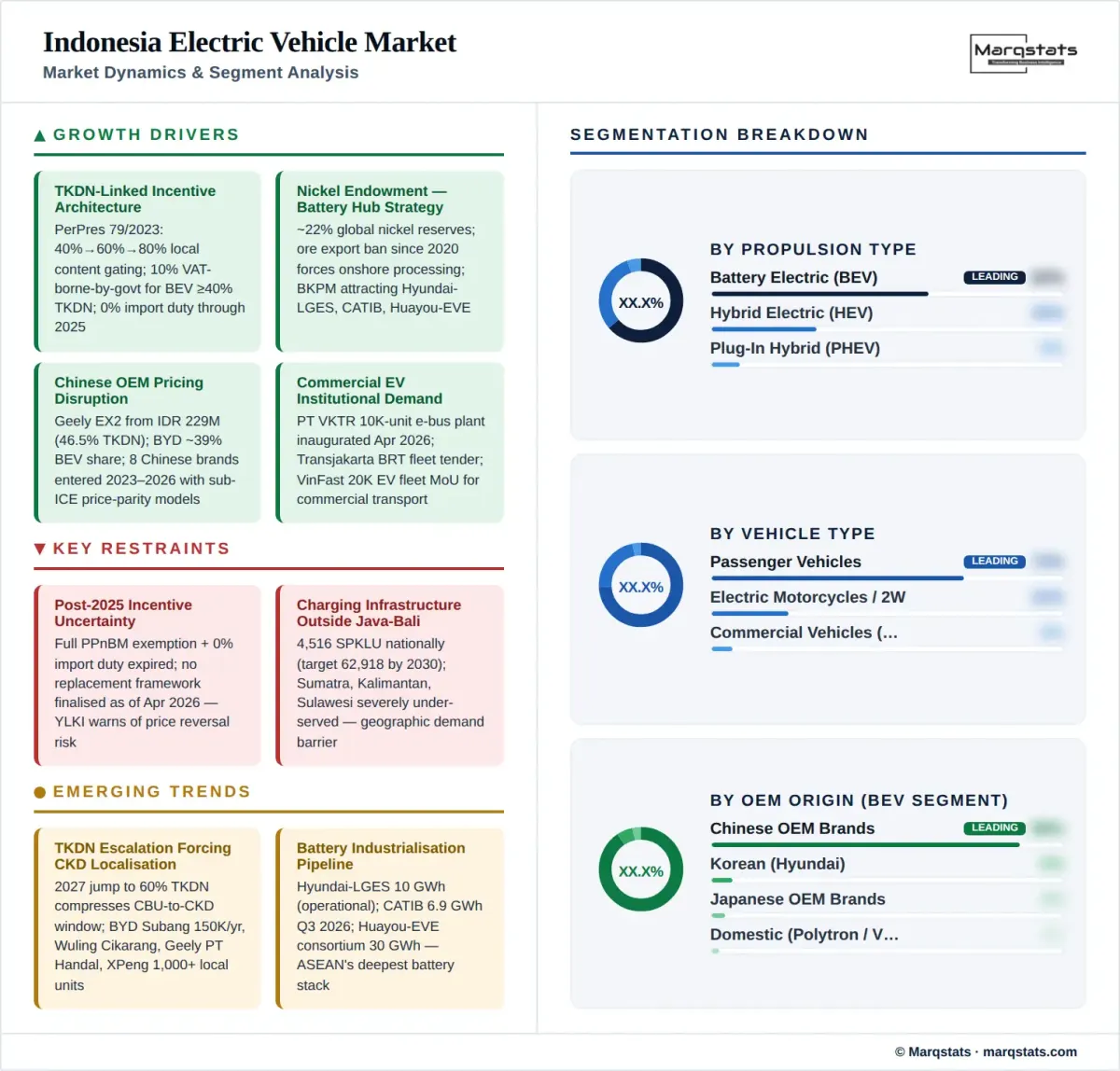
Key Drivers

  • Presidential Regulation 79/2023 and TKDN-linked incentive architecture: Indonesia's phased local-content framework makes BEV market access contingent on manufacturing commitment, creating a self-reinforcing investment cycle. The 10% VAT-borne-by-government scheme for BEVs with TKDN ≥40% (reducing effective VAT from 12% to 2%) and the full luxury-sales-tax exemption through 2025 have been the primary consumer-side demand triggers, complemented by 0% import duty for qualifying EV imports through end-2025.
  • World-class nickel endowment underpinning battery cost advantages: Indonesia holds approximately 22% of global nickel reserves, the dominant input for nickel-rich NMC and NCA battery chemistries. Government industrial policy has explicitly prohibited exports of unprocessed nickel ore since 2020, forcing downstream processing and cell manufacturing investments onshore. This commodity advantage, combined with preferential investment terms from Indonesia's Investment Coordinating Board (BKPM), has anchored multi-billion dollar battery chain commitments from Hyundai-LGES, BYD, CATIB, Huayou-EVE, and Wuling.
  • Aggressive Chinese OEM market entry and competitive pricing: BYD, Wuling, Chery, Denza, GAC AION, Geely, XPeng, and Leapmotor entered or expanded in Indonesia between 2023 and 2026, introducing BEV models priced between IDR 229 million (Geely EX2) and IDR 755 million (Suzuki e VITARA), covering a wider consumer addressable market than any Japanese OEM BEV offering. BYD's Subang manufacturing plant — when fully operational — is designed to produce 150,000 units per year, fundamentally altering the landed-cost equation.
  • Electric motorcycle and two-wheeler market scale: With 115 million two-wheelers on Indonesian roads — the world's second-largest fleet — the government has targeted annual conversion of 6 million petrol motorcycles to electric. The 2023–2024 electric motorcycle subsidy programme (IDR 7 million per unit for qualifying models) demonstrated both the scale of latent demand and the policy sensitivity of the segment: sales peaked during the subsidy window and declined sharply afterward, but the addressable base remains enormous.
  • Public transport electrification and commercial EV institutional demand: The April 2026 inauguration of PT VKTR Sakti Industries' electric bus and truck assembly plant — Indonesia's first, with 10,000-unit annual capacity — and the Transjakarta bus fleet electrification programme create recurring institutional procurement demand that is structurally less price-sensitive than consumer sales. Ashok Leyland's February 2026 MoU with PT Pindad for joint electric bus development signals that international commercial EV players see Indonesia's public procurement pipeline as bankable.

Key Restraints

  • Post-2025 incentive uncertainty: As of April 2026, Indonesia's government had not finalised a new EV incentive package following the sunset of the full luxury-sales-tax exemption and the 0% import duty scheme. Indonesia's Consumer Foundation (YLKI) warned that removing incentives without replacement would drive up BEV prices and risk pushing consumers back to ICE vehicles. The policy gap creates near-term demand uncertainty that OEM planning cycles — typically 12–24 months — cannot easily absorb.
  • LCV and HDV segment lag: ICCT's December 2025 Indonesia market review explicitly noted that BEV uptake has been concentrated in the passenger car segment, with light commercial vehicles and heavy-duty vehicles showing minimal electric-model penetration. Commercial EV economics (payload penalty, route constraints, depot charging costs) in Indonesia's logistics network have not yet reached parity, limiting the market to institutional and pilot deployments.
  • Charging infrastructure density gaps outside Java-Bali: PLN's 4,516 SPKLU units nationally are heavily concentrated on the Java-Madura-Bali corridor — the 1,515 units deployed for the 2025–2026 year-end holiday period were all on this route. Sumatra, Kalimantan, Sulawesi, and eastern Indonesia remain severely under-served, creating a practical geographic barrier to BEV adoption beyond the main island.
  • Household debt and auto-credit tightness: Indonesia's broader automotive market contracted 13.9% in 2024 and faced continued headwinds in 2025 from high household debt levels, cautious bank lending, and a weak rupiah raising import-linked vehicle costs. While EV incentives have offset some of this, first-time buyers who represent a large share of Indonesia's new-car market are disproportionately affected by credit availability constraints.

Key Trends

  • Localisation imperative shaping OEM strategy: Every significant EV brand operating in Indonesia is pursuing or has announced a local manufacturing footprint. Wuling was among the earliest with its Cikarang plant; BYD's Subang plant targets full operation by end-2025; Leapmotor-Indomobil announced local assembly plans; Geely EX2 launched at IDR 229 million with 46.5% TKDN from PT Handal Indonesia Motor; and XPeng has locally produced and delivered over 1,000 vehicles with the G6 Pro joining the X9 in local production. TKDN escalation from 40% to 60% by 2027 is compressing the timeframe for CKD-to-local manufacturing transitions.
  • Battery industrialisation as national strategic priority: Indonesia's battery investment pipeline is the most advanced in ASEAN by scale. The Hyundai-LGES 10 GWh cell plant in Karawang (already operational, 2024), CATIB's 6.9 GWh Karawang facility (Q3 2026), and the Huayou-EVE Energy consortium's two-site upstream-to-cathode chain (targeting 1H 2026 groundbreaking and discussed 30 GWh total capacity) collectively signal a timeline to domestic cell cost reduction that should progressively close the ICE-EV price gap even without subsidies.
  • Total-cost-of-ownership analysis driving commercial EV decisions: ICCT, LPEM UI, and VKTR launched collaborative TCO research for electric trucks and buses in Indonesia in December 2025 — signalling that the market is moving from 'is this possible?' to 'under what conditions does this make economic sense?'. This analytical infrastructure shift typically precedes commercial fleet operators' procurement decisions by 12–18 months.
  • Domestic EV brand emergence: Polytron delivered 455 wholesale units in 2025 — the first year for the electronics brand in the automotive sector — and entered 2026 with a functioning dealer network. This early signal that domestically branded EVs can find a buyer base alongside Chinese challengers is strategically significant for Indonesia's long-term industrial ambition to develop home-grown EV champions.
Indonesia Electric Vehicle Market Dynamics Segment Analysis Infographic
Segment Analysis

Market Segmentation

Battery Electric Vehicle (BEV)
Leading

BEVs dominate Indonesia's electrification story, accounting for the vast majority of EV registrations and the entirety of government incentive architecture designed to drive EV uptake. GAIKINDO data shows BEV four-wheeler sales of 103,931 units in 2025, with EV penetration reaching 15.2% of passenger car sales by Q2 2025. Chinese OEMs lead: BYD held approximately 39% of BEV market share in January–May 2025, with Wuling (15.6%), Chery (13.5%), Denza (13.1%), GAC AION (6.1%), and Geely (3.4%) completing the top six. All of these brands are either locally assembling (Wuling, Geely) or actively pursuing CKD operations to satisfy TKDN requirements. The BEV segment will remain the primary growth driver through 2030, supported by the TKDN escalation schedule that makes BEV localisation commercially inevitable for brands seeking incentive eligibility.

Plug-In Hybrid Electric Vehicle (PHEV)

PHEVs are a growing but secondary segment in Indonesia, appealing to consumers who want electrification without full range-anxiety exposure. Wuling introduced the Eksion as Indonesia's first family SUV available in both BEV and PHEV variants at IIMS 2026, directly targeting the consumer segment that values optionality. The PHEV market is expected to grow as Chinese OEMs import their extensive PHEV portfolios and as TKDN requirements push manufacturers to add more electrified options. Under Indonesia's excise and tax framework, PHEVs receive partial incentive benefits versus BEVs, maintaining a pricing gap that limits PHEV volumes relative to full BEVs.

Hybrid Electric Vehicle (HEV)

HEVs receive only a 3% tax incentive under Indonesia's framework — significantly less than BEVs — yet they have consistently outsold BEVs in total volume because Japanese OEMs have deep HEV portfolios (Toyota Kijang Innova Zenix HEV, Yaris Cross HEV, Honda HR-V RS e:HEV, Mitsubishi Outlander PHEV) that tap into existing Japanese brand loyalty. Industry association data confirms that hybrid vehicles have shown stronger sales performance than fully electric vehicles despite smaller incentive support, reflecting the market's structural preference for familiar brands and lower charging-infrastructure dependency. HEV volumes are expected to moderate through 2030 as BEV model breadth and charging infrastructure close the convenience gap.

Passenger Vehicles
Leading

Passenger vehicles account for approximately 97% of Indonesia's BEV registrations. The dominant segment is the compact SUV and city car category, where Chinese OEMs have concentrated their launches: BYD Atto 3 and Seal, Wuling Air EV and Binguo, Chery Omoda E5, GAC AION Y and UT, MG ZS EV and S5 EV, Geely EX2, XPeng G6, and Suzuki e VITARA. At IIMS 2026, MG Motor recorded 708 SPK orders with the MG S5 EV accounting for 579 units — demonstrating the depth of consumer demand for mid-price electric SUVs. The sub-IDR 300 million price tier opened by the Geely EX2 (from IDR 229 million) is critical to expanding Indonesia's EV buyer base beyond the upper-middle-income segment that has dominated early adoption.

Commercial Vehicles

Commercial EVs are at an early-commercial stage in Indonesia, with adoption concentrated in public buses and pilot freight programmes. The April 2026 inauguration of PT VKTR Sakti Industries' 10,000-unit-capacity electric bus and truck assembly plant in Purwakarta is the market's most significant commercial EV manufacturing milestone. VKTR is the primary supplier to Transjakarta — Jakarta's BRT system — and its TKDN ecosystem strengthening positions it as the dominant domestic player in public fleet electrification. Mitsubishi Fuso (KTB) confirmed its Krama Yudha Ratu Motor plant can adapt to EV production if demand materialises, while Ashok Leyland's MoU with PT Pindad signals an India-Indonesia co-development pathway for electric buses aligned with Indonesia's defence and industrial procurement priorities. Light commercial EVs and vans remain at the pilot stage, with VinFast's 20,000-unit supply agreements with Indonesian transport operators (PT Satu Kosong Tujuh and PT Sembilan Benua Abadi by 2028) the most concrete near-term commercial EV pipeline.

Electric Motorcycles and Three-Wheelers

Electric motorcycles represent the largest potential volume opportunity in Indonesia, with 115 million petrol motorcycles as the addressable conversion base. The government-sponsored subsidy of IDR 7 million per unit (2023–2024) drove a surge-and-correction cycle, demonstrating extreme price sensitivity. Indonesia's stated target of converting 6 million motorcycles annually to electric by 2030 would require a structural pricing shift that is unlikely without resumed subsidy support or a significant domestic manufacturing cost reduction from local battery production. Domestic brands including GESITS and Electrum compete with Chinese entrants including Yadea and Viar in this segment. Three-wheelers remain an emergent category with limited policy support to date.

Regional Analysis

By Geography

Java and Greater Jakarta

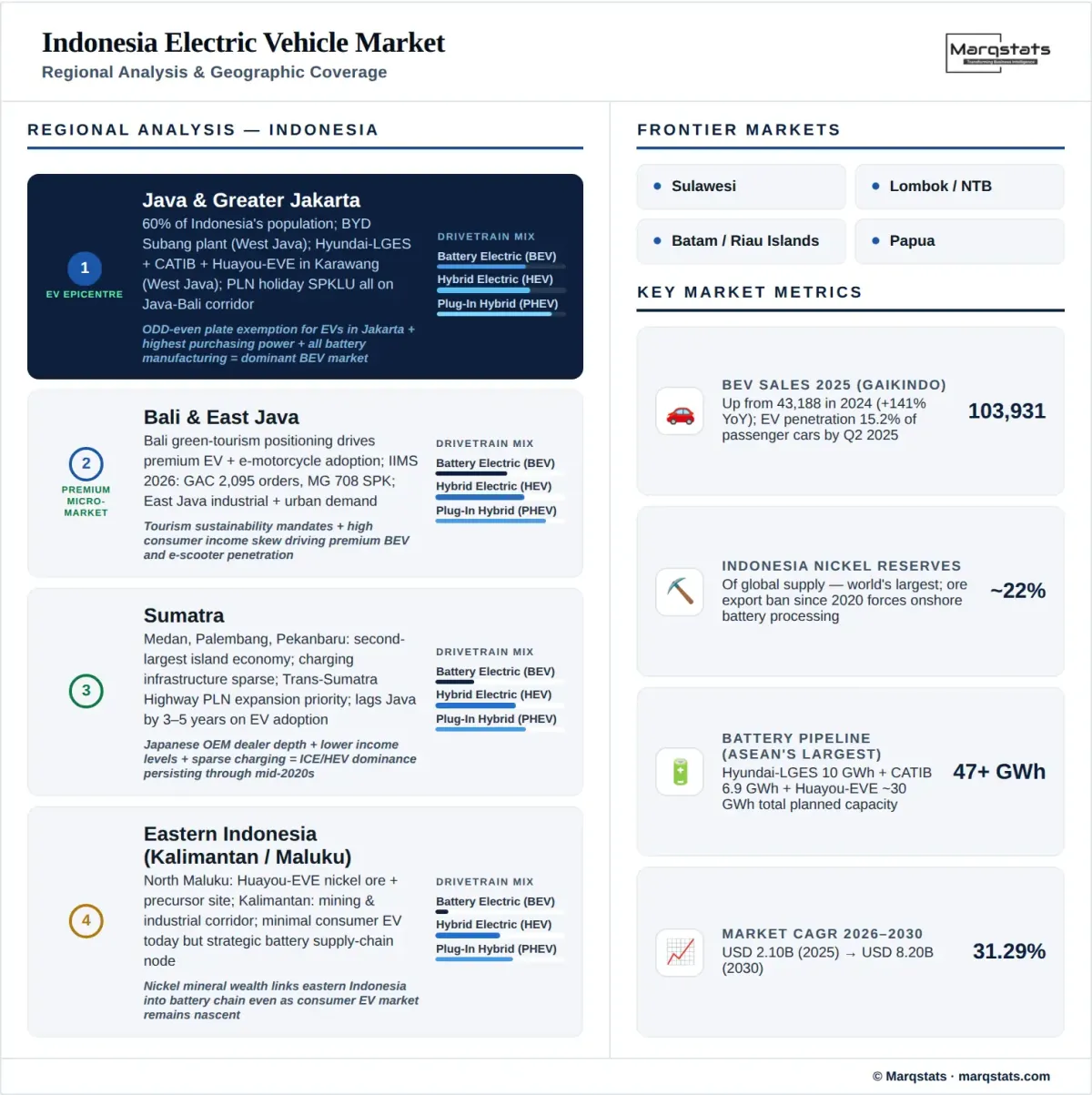
Java — home to approximately 60% of Indonesia's population and the majority of its urban middle class — is the epicentre of Indonesia's EV market. Greater Jakarta (Jabodetabek) accounts for the majority of passenger BEV registrations, driven by the ODD-even license plate exemption for EVs in Jakarta, the concentration of charging infrastructure, and the highest consumer purchasing power in the country. BYD's Subang plant in West Java serves this demand base directly. The Java corridor hosts all of Indonesia's major battery manufacturing investments: Hyundai-LGES in Karawang (West Java), CATIB's planned Karawang facility, and the Huayou-EVE Energy consortium's West Java plant site. GAIKINDO reports, PLN deployment data, and BKPM investment disclosures all confirm that Java-centric infrastructure will remain the primary demand and supply node through 2030.

Sumatra

Sumatra is Indonesia's second-largest island economy, with key automotive markets in Medan (North Sumatra), Palembang (South Sumatra), and Pekanbaru (Riau). EV penetration in Sumatra lags Java significantly due to lower income levels, sparser charging infrastructure, and market dependence on Japanese OEM dealer networks that have been slower to launch BEV models. The Trans-Sumatra Highway corridor is a priority for PLN's charging infrastructure expansion, but deployment as of late 2025 remained limited to select cities. Sumatra's contribution to Indonesia's EV market is expected to grow progressively post-2027 as charging infrastructure expands and CKD-produced models bring prices into range for Sumatra's consumer base.

Kalimantan and Eastern Indonesia

Kalimantan (Borneo), Sulawesi, Maluku, and Papua currently contribute marginally to Indonesia's EV sales but are strategically significant for the battery supply chain. North Maluku is the designated site for the upstream component of the Huayou-EVE Energy battery chain (nickel ore and precursor processing), linking the mineral endowment of eastern Indonesia directly to the battery cell plants in West Java. EV market development in these regions will remain infrastructure-constrained through 2030, but government green-energy corridor initiatives and the planned integration of battery manufacturing with local power generation may create early EV adoption catalysts in industrial zones and mining operations.

Bali and Eastern Java

Bali has emerged as a micro-market for premium EVs and electric motorcycles, driven by strong tourism-sector sustainability commitments and a consumer profile skewed toward higher incomes and environmental awareness. The Bali provincial government has actively promoted EV adoption as part of its green-tourism positioning. IIMS 2026 electric vehicle launches by GAC Indonesia (2,095 orders, led by Aion UT at 997 units) and MG Indonesia reflect the broadening geographic demand base, though Java-Bali remains overwhelmingly the dominant combined EV region.
Indonesia Electric Vehicle Market Regional Analysis Infographic
Competitive Landscape

How Competition Is Evolving

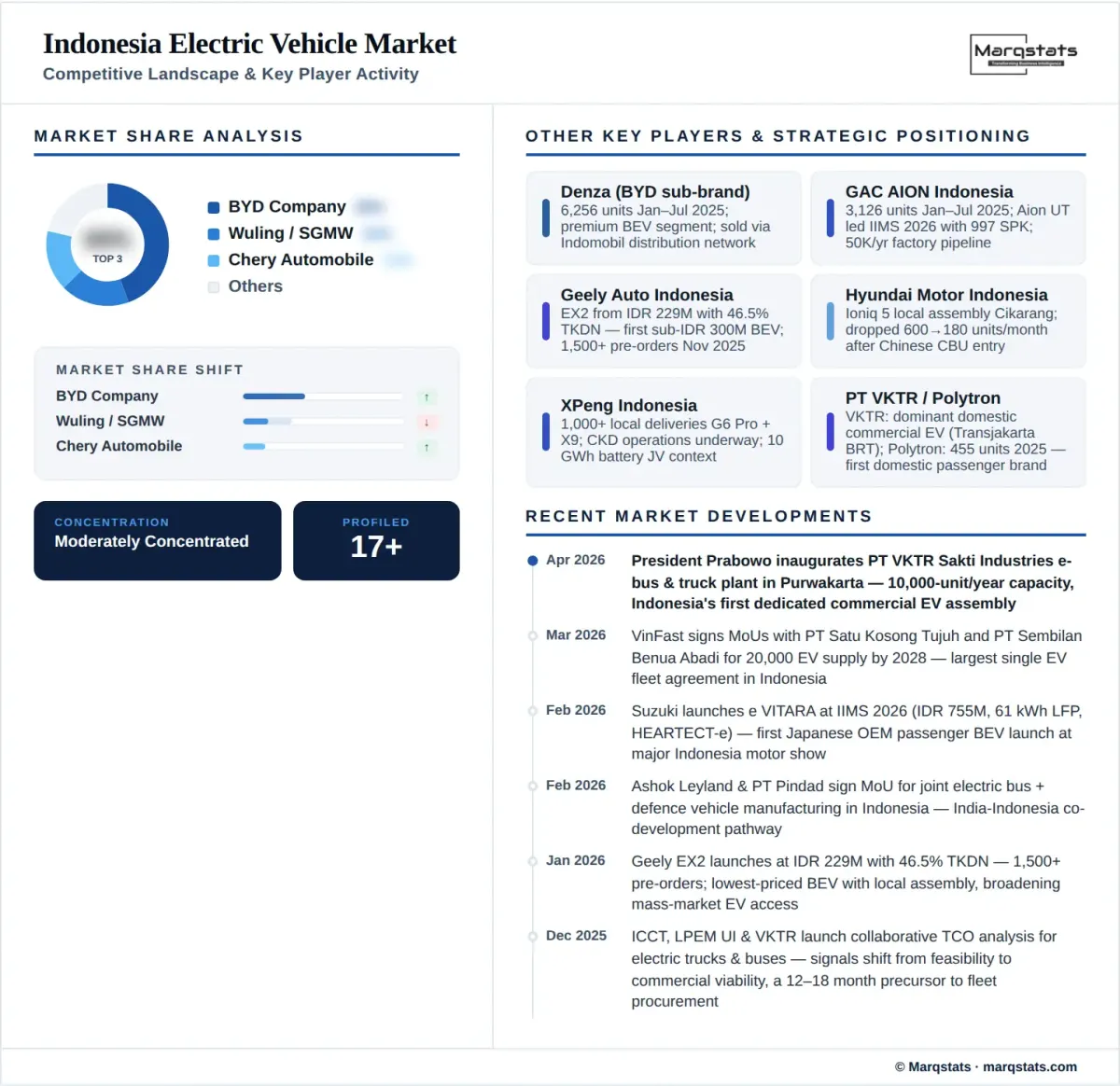
Indonesia's BEV competitive landscape has experienced one of the most rapid structural shifts in any automotive market globally. In 2022–2023, Hyundai Motor and Wuling Motors together accounted for approximately 80% of EV sales. By the first half of 2025, BYD, Denza, Wuling, Chery, and GAC AION collectively dominated, with BYD alone holding close to 40% share. This disruption unfolded in under 24 months, driven by the 0% import duty framework (which enabled CBU imports), aggressive Chinese OEM pricing, and portfolio breadth across price segments that no single incumbent could match.

The competitive dynamics split clearly across two groups. Chinese OEM challengers — BYD, Wuling, Chery, GAC AION, Denza, Geely, XPeng, and Leapmotor — are competing on price, feature richness, and speed of localisation, with TKDN compliance as the primary medium-term differentiator. BYD's Subang plant (when fully operational) and Wuling's established Cikarang production base give them structural cost advantages over pure CBU importers. Japanese and Korean incumbents — Toyota, Honda, Daihatsu, Isuzu, Mitsubishi, and Hyundai — retain dominance in the overall vehicle market through HEV offerings and brand loyalty, but their BEV portfolios remain thin. Hyundai's experience is instructive: its locally produced Ioniq 5 averaged 600 monthly units in H2 2023 but fell to 180 units per month after Chinese CBU imports entered the market, demonstrating the vulnerability of early-mover advantage when product-price positioning is not sufficiently competitive.

The domestic entrant space is nascent but strategically meaningful. Polytron — primarily an electronics brand — delivered 455 wholesale EV units in 2025, ranking ahead of several established automotive brands. PT VKTR Teknologi Mobilitas is the dominant domestic commercial EV player, anchored to the Transjakarta public bus tender pipeline. Industry analyses indicate that the 2027–2028 TKDN escalation will reshape the competitive field by forcing CBU-dependent players to either commit to CKD assembly or exit the incentive-eligible market, effectively rewarding those who have invested in localisation earliest.
Indonesia Electric Vehicle Market Competitive Landscape Infographic
Major Players

Companies Covered

The report profiles 17+ companies with full strategy and financials analysis, including:

BYD Company Limited
PT SGMW Motor Indonesia (Wuling Motors)
Hyundai Motor Company
Chery Automobile Co., Ltd.
GAC AION New Energy Automobile Co., Ltd.
PT Indomobil Sukses Internasional (Denza distribution partner)
Geely Auto Indonesia
XPeng Inc.
MG Motor Indonesia (SAIC Motor)
PT VinFast Auto Indonesia
Leapmotor International (Stellantis-Leapmotor JV, via Indomobil)
Suzuki Indomobil Sales (Suzuki e VITARA)
PT Krama Yudha Tiga Berlian Motors (Mitsubishi Fuso)
PT VKTR Teknologi Mobilitas
PT Hyundai Motors Indonesia
Polytron (PT Hartono Istana Teknologi)
PT Toyota Astra Motor (Hybrid EV)
Note: Full company profiles include revenue analysis, product portfolio, SWOT, and recent strategic developments.
Latest Developments

Recent Market Activity

Apr 2026
President Prabowo Subianto inaugurated Indonesia's first electric bus and truck assembly plant, operated by PT VKTR Sakti Industries in Purwakarta, West Java, with annual capacity for up to 10,000 electric buses — the country's most significant commercial EV manufacturing milestone.
Mar 2026
VinFast signed MoUs with PT Satu Kosong Tujuh and PT Sembilan Benua Abadi for the supply of 20,000 EVs by 2028 — the Nerio Green and Limo Green models — for deployment in commercial transportation services, representing the largest single EV fleet agreement in Indonesia to date.
Feb 2026
Ashok Leyland (India) and PT Pindad signed an MoU for joint development and manufacturing of electric buses and defence vehicles in Indonesia, aligning with Indonesia's dual objectives of EV fleet electrification and domestically produced defence mobility platforms.
Feb 2026
Suzuki Indomobil Sales launched the e VITARA — Suzuki's first BEV in Indonesia — at IIMS 2026, priced from IDR 755 million with a 61 kWh LFP battery (128 kW, 193 Nm, HEARTECT-e platform), marking the first Japanese OEM passenger BEV launch at a major Indonesian motor show.
Jan 2026
Geely Auto Indonesia launched the EX2 at introductory prices from IDR 229 million with 46.5% TKDN, recording over 1,500 SPK reservations since November 2025 — the lowest entry-level BEV price point from a brand with existing Indonesian assembly, broadening the accessible EV consumer base.
Dec 2025
ICCT, LPEM UI (University of Indonesia), and VKTR launched collaborative TCO analysis specifically focused on electric trucks and buses in Indonesia, signalling the market's transition from EV feasibility assessment to commercial viability modelling — typically a 12–18 month precursor to fleet procurement decisions.
Report Structure

Table of Contents

1. Introduction
1.1 Study Assumptions & Market Definition
1.2 Scope of the Study — Coverage and Exclusions
1.3 Executive Summary
1.4 Currency, Units, and Exchange Rate Assumptions
1.4.1 Currency Convention — USD and IDR
1.4.2 Units and Conversion Factors
2. Research Methodology
2.1 Analysis Framework
2.2 Primary Research — Interviews and Field Studies
2.3 Secondary Research — Data Sources
2.4 Market Estimation Approach
2.4.1 Bottom-Up Model — GAIKINDO Registration Data
2.4.2 Top-Down Validation — ASP Benchmarks
2.4.3 Cross-Validation Against PLN and ESDM Planning Data
2.5 Assumptions and Limitations
3. Indonesia Automotive Industry Overview
3.1 Automotive Market Size and Structure (2021–2025)
3.1.1 Total Industry Volume — GAIKINDO Annual Data
3.1.2 Japanese OEM Dominance and Market Share
3.1.3 Chinese OEM Market Entry and Impact
3.2 Indonesia EV Sales Historical Trajectory
3.2.1 EV Sales 2020–2025 — GAIKINDO Data
3.2.2 Quarterly EV Penetration Rate — Q1 2024 to Q2 2025
3.2.3 BEV vs PHEV vs HEV Sales Split
3.3 Indonesia's EV Ambition — National Targets and Industrial Vision
3.3.1 2030 National EV Targets — 2M Cars, 13M Motorcycles
3.3.2 Third-Largest EV Battery Producer Target by 2027
3.3.3 30% of New Vehicle Sales to be EV by 2035
3.4 Market Size and Forecast 2021–2030
4. Policy and Regulatory Landscape
4.1 Presidential Regulation 79/2023 — EV Acceleration Framework
4.1.1 Overview of the Regulation and Key Provisions
4.1.2 TKDN Phased Schedule — 40% (2026), 60% (2027–2029), 80% (2030)
4.1.3 Import Facilitation Linked to Manufacturing Commitment
4.1.4 SPKLU and SPBKLU Infrastructure as Policy Pillar
4.2 Fiscal Incentive Architecture
4.2.1 VAT 'Borne by Government' — 10% for TKDN ≥40% BEVs
4.2.2 Luxury Sales Tax (PPnBM) Exemption — 100% for Qualifying BEVs/CBU (2024)
4.2.3 0% Import Duty for Eligible EV Imports Through End-2025
4.2.4 Electric Motorcycle Purchase Subsidy (2023–2024) — IDR 7M per Unit
4.3 Post-2025 Incentive Uncertainty — Policy Transition Risk
4.3.1 Status of 2026 Incentive Framework Discussions (as of April 2026)
4.3.2 YLKI Warning on Subsidy Removal and Consumer Impact
4.3.3 Implications for OEM Planning and Demand Forecasting
4.4 Charging Infrastructure Governance
4.4.1 Permen ESDM 1/2023 — Charging Connection and Fee Rules
4.4.2 PLN Corporate Charging Expansion Programme
4.4.3 SPKLU Deployment Target — 62,918 Units by 2030 (ESDM Plan)
4.5 Environmental and Emissions Policy
4.5.1 Indonesia's 29% Emissions Reduction Target by 2030
4.5.2 Nickel Export Ban and Its Role in Downstream EV Strategy
5. Market Dynamics
5.1 Key Market Drivers
5.1.1 Presidential Regulation 79/2023 and TKDN-Linked Incentive Architecture
5.1.2 World-Class Nickel Endowment Underpinning Battery Cost Advantages
5.1.3 Aggressive Chinese OEM Market Entry and Competitive Pricing
5.1.4 Electric Motorcycle Market Scale — 115M Two-Wheeler Base
5.1.5 Public Transport Electrification — Transjakarta, VKTR, and Bus Procurement
5.2 Key Market Restraints
5.2.1 Post-2025 Incentive Uncertainty and Demand Sensitivity
5.2.2 LCV and HDV Segment Lag — Minimal Commercial EV Penetration
5.2.3 Charging Infrastructure Gaps Outside Java-Bali Corridor
5.2.4 Household Debt and Auto-Credit Tightness
5.3 Key Market Trends
5.3.1 Localisation Imperative — CKD Assembly Becoming Non-Negotiable
5.3.2 Battery Industrialisation as National Strategic Priority
5.3.3 TCO Analysis Infrastructure — From Feasibility to Commercial Viability
5.3.4 Domestic EV Brand Emergence — Polytron and VKTR
5.4 Industry Value Chain Analysis
5.4.1 Upstream — Nickel, Cobalt, Lithium Sourcing and Processing
5.4.2 Midstream — Battery Cell and Pack Manufacturing
5.4.3 Midstream — CKD Assembly and OEM Operations
5.4.4 Downstream — EV Retail, After-Sales, Charging Services
6. Market Segmentation — By Propulsion Type
6.1 Overview and Market Share by Propulsion (2025 vs. 2030)
6.2 Battery Electric Vehicle (BEV)
6.2.1 BEV Market Size and Revenue Share
6.2.2 BEV Sales Growth — 10,327 Units (2022) to 103,931 Units (2025)
6.2.3 BEV Penetration by Price Segment
6.2.4 Chinese OEM BEV Dominance — BYD 39%, Wuling 15.6%, Chery 13.5%
6.2.5 BEV Forecast 2026–2030
6.3 Plug-In Hybrid Electric Vehicle (PHEV)
6.3.1 PHEV Market Size and Revenue Share
6.3.2 PHEV Product Landscape — Wuling Eksion, Denza D9
6.3.3 PHEV Forecast 2026–2030
6.4 Hybrid Electric Vehicle (HEV)
6.4.1 HEV Market Size and Revenue Share
6.4.2 HEV Product Landscape — Toyota, Honda, Mitsubishi Offerings
6.4.3 HEV Forecast 2026–2030
6.5 Fuel Cell Electric Vehicle (FCEV) — Outlook
7. Market Segmentation — By Vehicle Type
7.1 Overview and Market Share by Vehicle Type (2025 vs. 2030)
7.2 Passenger Vehicles
7.2.1 Segment Overview — 97% of BEV Registrations
7.2.2 A-Segment and B-Segment EVs — Geely EX2, Wuling Air EV
7.2.3 C-Segment and D-Segment EVs — BYD Atto 3, Seal, Chery Omoda E5
7.2.4 SUVs and Crossovers — BYD Sealion 7, MG S5 EV, GAC AION
7.2.5 MPVs and Luxury Segment — Denza D9, XPeng X9
7.3 Commercial Vehicles
7.3.1 Electric Buses — Transjakarta Programme and VKTR Supply
7.3.2 Electric Trucks — TCO Modelling and Pilot Deployments
7.3.3 Electric Vans — VinFast Nerio Green and Limo Green Fleet Contracts
7.4 Electric Motorcycles and Three-Wheelers
7.4.1 Electric Motorcycles — 115M Base, Subsidy Sensitivity
7.4.2 Government 6M Annual Conversion Target
7.4.3 Key Players — GESITS, Electrum, Yadea, Viar
7.4.4 Electric Three-Wheelers — Nascent Segment Overview
8. Market Segmentation — By End User
8.1 Overview and Market Share by End User (2025 vs. 2030)
8.2 Personal and Household
8.2.1 Retail EV Buyer Profile — Income Level and Geographic Distribution
8.2.2 ODD-Even Exemption in Jakarta as Demand Driver
8.3 Commercial Fleets and Mobility Services
8.3.1 Ride-Hailing and Taxi Fleets — VinFast Green SM Indonesia
8.3.2 Logistics and Last-Mile Delivery Fleet Electrification
8.3.3 Corporate and Enterprise Fleet Procurement
8.4 Public Transport and Government
8.4.1 Transjakarta BRT Electric Bus Programme
8.4.2 Government Fleet Electrification Mandates
8.4.3 PT Pindad and Ashok Leyland MoU for Electric Buses
9. Market Segmentation — By Charging Infrastructure
9.1 Overview — SPKLU Network Status and 2030 Targets
9.1.1 PLN SPKLU Deployment — 4,516 Units Across 2,935 Points (Late 2025)
9.1.2 ESDM 2030 Target — 62,918 SPKLU Units
9.1.3 SPBKLU (Battery Swap) — 1,902 Units at End-2024
9.2 AC Slow / Level 2 Charging
9.2.1 Installed Base and Market Size
9.2.2 Residential vs. Public AC Charging
9.3 DC Fast Charging
9.3.1 Market Size and Growth
9.3.2 Java-Madura-Bali Corridor Deployment
9.4 Battery Swapping Networks
9.4.1 Electric Motorcycle Swap — Gogoro-like Models and Domestic Players
9.4.2 Commercial Vehicle Swap — Pilot Programmes
10. Regional Analysis
10.1 Java
10.1.1 Greater Jakarta (Jabodetabek) — Primary BEV Demand Hub
10.1.2 West Java — BYD Subang Plant, Hyundai-LGES Karawang, CATIB Karawang
10.1.3 East Java (Surabaya) — Second-Tier Urban EV Adoption
10.1.4 Central Java — Manufacturing Ecosystem and Emerging Consumer Market
10.2 Sumatra
10.2.1 North Sumatra (Medan) — EV Market Overview
10.2.2 South Sumatra (Palembang) and Riau — Energy Corridor Significance
10.2.3 Trans-Sumatra Highway — PLN Charging Rollout Plan
10.3 Kalimantan (Borneo)
10.3.1 EV Market Overview — Limited Current Penetration
10.3.2 Nickel and Mineral Significance for Battery Supply Chain
10.4 Sulawesi
10.4.1 EV Market Overview
10.4.2 Industrial Zone EV Potential
10.5 Bali
10.5.1 Bali as Premium EV and Electric Motorcycle Micro-Market
10.5.2 Tourism-Driven Sustainability Demand
10.6 Maluku and North Maluku
10.6.1 Huayou-EVE Energy Upstream Battery Chain Site
10.6.2 Nickel Processing and Battery Precursor Strategy
10.7 Papua and Eastern Indonesia
10.7.1 EV Market Overview — Early Stage
10.7.2 Infrastructure Development Timeline
11. Battery Manufacturing and EV Supply Chain
11.1 Indonesia's Position in the Global EV Battery Value Chain
11.2 Active Battery Manufacturing Investments
11.2.1 PT HLI Green Power — Hyundai-LGES 10 GWh Cell Plant, Karawang
11.2.2 CATIB — 6.9 GWh Battery Plant, Karawang (Target Q3 2026)
11.2.3 Huayou-EVE Energy Consortium — 1H 2026 Groundbreaking, West Java
11.2.4 Wuling MAGIC Battery Production Line — Cikarang Plant
11.2.5 Kim Long Motor-BYD Battery JV — USD 130M Vietnam (Context)
11.3 CKD Assembly Operations
11.3.1 PT Hyundai Motors Indonesia — Cikarang Assembly Plant
11.3.2 PT SGMW Motor Indonesia (Wuling) — Cikarang
11.3.3 PT Handal Indonesia Motor — Geely EX2 CKD (46.5% TKDN)
11.3.4 BYD Subang Assembly Plant — 150,000 Units/Year Target
11.3.5 VinFast West Java Plant — Subang Operations
11.3.6 XPeng Indonesia Local Production — G6 Pro and X9
11.4 Nickel and Upstream Resource Governance
11.4.1 Indonesia Nickel Reserves — ~22% of Global Supply
11.4.2 Nickel Export Ban and Mandatory Downstream Processing
11.4.3 North Maluku Upstream Site for Huayou-EVE Energy Chain
12. Competitive Landscape
12.1 Market Concentration Analysis
12.1.1 BEV Market Share by Brand — Jan–May 2025 (GAIKINDO)
12.1.2 Chinese OEM vs. Japanese/Korean OEM Share Dynamics
12.1.3 Competitive Disruption — Hyundai's Market Share Erosion
12.2 Company Profiles
12.2.1 BYD Company Limited
12.2.1.1 Company Overview
12.2.1.2 Indonesia Market Position — ~39% BEV Share, Jan–May 2025
12.2.1.3 Subang Manufacturing Plant — USD 1B, 150,000 Units/Year
12.2.1.4 Key Models — M6, Sealion 7, Atto 3, Seal, Dolphin, Atto 1
12.2.1.5 Recent Strategic Developments
12.2.2 PT SGMW Motor Indonesia (Wuling Motors)
12.2.2.1 Company Overview
12.2.2.2 Indonesia Market Position — 15.6% BEV Share
12.2.2.3 Cikarang Assembly Plant and MAGIC Battery Production Line
12.2.2.4 Key Models — Air EV, Binguo, Almaz, Eksion (BEV/PHEV)
12.2.2.5 Recent Strategic Developments
12.2.3 Chery Automobile Co., Ltd.
12.2.3.1 Company Overview
12.2.3.2 Indonesia Market Position — 13.5% BEV Share
12.2.3.3 Product Portfolio — Omoda E5 and Other EV Models
12.2.3.4 Recent Strategic Developments
12.2.4 GAC AION New Energy Automobile Co., Ltd.
12.2.4.1 Company Overview
12.2.4.2 Indonesia Market Entry via Indomobil Partnership
12.2.4.3 Key Models — Aion Y, Aion UT, Aion V
12.2.4.4 Recent Strategic Developments — IIMS 2026: 2,095 Orders
12.2.5 Hyundai Motor Company / PT Hyundai Motors Indonesia
12.2.5.1 Company Overview
12.2.5.2 Indonesia Manufacturing — Cikarang Plant
12.2.5.3 Market Share Decline — 600 Monthly Units (H2 2023) to 180 (2024)
12.2.5.4 Hyundai-LG Energy Solution Battery JV (10 GWh)
12.2.5.5 Recent Strategic Developments
12.2.6 PT VinFast Auto Indonesia
12.2.6.1 Company Overview
12.2.6.2 Subang Manufacturing Plant and Indonesia Market Entry
12.2.6.3 Fleet Supply MoUs — 20,000 EVs by 2028
12.2.6.4 Key Models — Nerio Green, Limo Green
12.2.6.5 Recent Strategic Developments
12.2.7 Leapmotor International (Stellantis-Leapmotor JV)
12.2.7.1 Company Overview
12.2.7.2 Indonesia Distribution — PT Indomobil National Distributor
12.2.7.3 Local Assembly Plans and TKDN Strategy
12.2.7.4 Recent Strategic Developments
12.2.8 Geely Auto Indonesia
12.2.8.1 Company Overview
12.2.8.2 EX2 Launch — IDR 229M Entry Price, 46.5% TKDN
12.2.8.3 PT Handal Indonesia Motor Assembly Partnership
12.2.8.4 Recent Strategic Developments — 1,500+ SPK Pre-Reservations
12.2.9 XPeng Inc.
12.2.9.1 Company Overview
12.2.9.2 Indonesia Debut — Next P7 Showcase at IIMS 2026
12.2.9.3 Local Production — G6 Pro and X9 MPV
12.2.9.4 AI Mobility Strategy in Indonesia
12.2.9.5 Recent Strategic Developments
12.2.10 MG Motor Indonesia (SAIC Motor Corporation)
12.2.10.1 Company Overview
12.2.10.2 IIMS 2026 — 708 Orders, MG S5 EV Leads (579 Units)
12.2.10.3 Product Portfolio — ZS EV, MG4 EV, MG Cyberster, S5 EV
12.2.10.4 Recent Strategic Developments
12.2.11 Suzuki Indomobil Sales
12.2.11.1 Company Overview
12.2.11.2 e VITARA — Indonesia's First Suzuki BEV (IIMS 2026, IDR 755M)
12.2.11.3 HEARTECT-e Platform Specifications
12.2.11.4 Recent Strategic Developments
12.2.12 PT VKTR Teknologi Mobilitas
12.2.12.1 Company Overview
12.2.12.2 Indonesia's First Electric Bus & Truck Assembly Plant (April 2026)
12.2.12.3 Transjakarta Supply Relationship and TKDN Ecosystem
12.2.12.4 TCO Research with ICCT and LPEM UI
12.2.12.5 Recent Strategic Developments
12.2.13 PT Toyota Astra Motor
12.2.13.1 Company Overview — 54.2% Overall Market Share (2020–H1 2025)
12.2.13.2 Hybrid Strategy — Kijang Innova Zenix HEV, Yaris Cross HEV
12.2.13.3 BEV Transition Plans — USD 1.8B Indonesia Investment
12.2.13.4 Recent Strategic Developments
12.2.14 PT Krama Yudha Tiga Berlian Motors (Mitsubishi Fuso)
12.2.14.1 Company Overview — ~40% Indonesia Commercial Vehicle Share
12.2.14.2 EV Production Readiness at KRM Plant
12.2.14.3 Ashok Leyland MoU for Electric Bus Co-Development
12.2.14.4 Recent Strategic Developments
12.2.15 Polytron (PT Hartono Istana Teknologi)
12.2.15.1 Company Overview — Electronics Brand Entering Automotive
12.2.15.2 EV Sales 2025 — 455 Wholesale Units, G3 and G3+ Models
12.2.15.3 Assembly at PT Handal Indonesia Motor, Purwakarta
12.2.15.4 Recent Strategic Developments
12.2.16 Stellantis / Indomobil (Leapmotor Distribution)
12.2.16.1 Company Overview
12.2.16.2 Leapmotor-Indomobil Distribution Agreement
12.2.16.3 Local Assembly Plan and TKDN Pathway
12.2.16.4 Recent Strategic Developments
12.2.17 Denza (BYD Premium Sub-Brand)
12.2.17.1 Brand Overview — BYD's Luxury EV Sub-Brand
12.2.17.2 Indonesia Sales — 6,256 Units in Jan–Jul 2025 (2nd Largest EV Brand)
12.2.17.3 Key Model — Denza D9 PHEV Luxury MPV
12.2.17.4 Recent Strategic Developments
12.3 Strategic Developments, Partnerships, and M&A Activity
13. Appendix
13.1 Research Methodology
13.2 Glossary of Key Terms
13.3 List of Tables
13.4 List of Figures
13.5 Disclaimer and Legal Notice
Study Scope & Focus

Coverage & Segmentation

This report provides a comprehensive analysis of the Indonesia electric vehicle market covering the 2021–2030 study period, with 2025 as the base year, historical data from 2021 to 2025, and a forward-looking forecast from 2026 to 2030. The study encompasses all major EV powertrain categories — battery electric vehicles (BEVs), plug-in hybrid electric vehicles (PHEVs), and hybrid electric vehicles (HEVs) — across passenger vehicles, commercial vehicles, and electric two- and three-wheelers. Geographic analysis covers Indonesia's major automotive markets by region including Java (Greater Jakarta, West Java, East Java, Central Java), Sumatra, Kalimantan, Sulawesi, Bali, and eastern Indonesia, with particular depth on the Java-Bali corridor that accounts for the majority of EV registrations.

The report's competitive intelligence covers 17+ OEMs and covers the full battery and charging supply chain. Policy analysis is centred on Presidential Regulation 79/2023, the TKDN phased schedule through 2030, the evolution of VAT and luxury-tax incentive frameworks, and PLN's SPKLU/SPBKLU deployment roadmap. Manufacturing and investment mapping covers battery cell production, CKD assembly operations, and charging infrastructure deployment from 2024 through projected 2030 milestones. Primary research for this report includes 40+ interviews with automotive industry executives, fleet operators, government officials at the Ministry of Industry, Ministry of Energy and Mineral Resources (ESDM), BKPM, and PLN, and charging infrastructure operators across Indonesia.
Frequently Asked Questions

FAQs About the Indonesia Electric Vehicle Market

The Indonesia electric vehicle market was valued at approximately USD 2.10 billion in 2025 and is projected to reach USD 8.20 billion by 2030, growing at a CAGR of 31.29% during the 2026–2030 forecast period. GAIKINDO-reported EV sales reached 103,931 units in 2025, up from 43,188 units in 2024.
BYD Company Limited leads Indonesia's BEV segment with approximately 39% market share in January–May 2025 (GAIKINDO data), selling 12,000 units in that period. Wuling Motors (15.6%), Chery (13.5%), and Denza (13.1%) complete the top four. Together, the top 10 brands hold 98.6% of BEV wholesale volume.
Indonesia's Presidential Regulation 79/2023 requires a minimum 40% domestic content (TKDN) through 2026 for BEVs to qualify for a 10% VAT-borne-by-government incentive. The requirement escalates to 60% for 2027–2029 and 80% from 2030, making local manufacturing commitment a prerequisite for ongoing incentive eligibility.
Indonesia has the region's most advanced EV battery manufacturing pipeline: the Hyundai-LG Energy Solution 10 GWh cell plant in Karawang (operational since 2024), CATIB's 6.9 GWh Karawang facility (targeting Q3 2026), and the Huayou-EVE Energy consortium's upstream-to-cathode chain in West Java and North Maluku (targeting 1H 2026 groundbreaking).
Key players include BYD Company Limited, PT SGMW Motor Indonesia (Wuling), Chery Automobile, GAC AION, Hyundai Motor Company, PT VinFast Auto Indonesia, Leapmotor International, Geely Auto Indonesia, XPeng Inc., MG Motor Indonesia, Suzuki Indomobil Sales, PT VKTR Teknologi Mobilitas, PT Toyota Astra Motor, PT Krama Yudha Tiga Berlian Motors (Mitsubishi Fuso), Polytron, and Denza (BYD premium sub-brand).
Yes. Marqstats offers customization including additional regional breakdowns, TKDN compliance tracking, battery supply chain deep-dives, and competitor benchmarking. Contact sales@marqstats.com for customization options at Single User, Team, and Enterprise tiers.
The report is delivered as a PDF (260+ pages) with full analysis, Excel data tables with GAIKINDO-based historical figures and 2026–2030 forecasts, and a PowerPoint executive summary deck. All formats are included in every licence tier.