Market Snapshot
Key Takeaways
Market Overview & Analysis
Report Summary
The Singapore electric vehicle market comprises all cleaner-energy vehicle categories across passenger, commercial, and public transport applications. The market is segmented by propulsion type, vehicle category, brand origin, price band, and end-use. Singapore’s EV adoption is structurally policy-led, reflecting the country’s compact geography, high vehicle ownership costs under the Certificate of Entitlement (COE) system, and dense urban charging network. Market formation is further shaped by the cleaner-energy vehicle mandate, the Vehicular Emissions Scheme, and the 2040 full cleaner-energy vehicle target.
BEVs account for approximately 62% of Singapore’s electrified new car registrations in 2025, with HEVs at 31% and PHEVs at 7%. The 2025 Singapore Motorshow featured a record 70%+ electric and hybrid vehicle share of displayed models, up from approximately 40% in 2023. The January 2026 Singapore Motorshow at Suntec hosted 36 participating brands across Audi, Avatr, BMW, BYD, Deepal, Denza, Dongfeng, GAC, Honda, Hongqi, Hyundai, ICAUR, IM Motors, Jaecoo, Kia, Leapmotor, Lexus, Maxus, Mazda, Mercedes-Benz, MG, MINI, NIO, Nissan, Omoda, Ora, Proton e.MAS, smart, Subaru, Suzuki, Toyota, Volvo, XPeng, Yangwang, and Zeekr.
The Certificate of Entitlement (COE) framework is the dominant cost factor for vehicle ownership. EVs above 110 kW fall under Category B, while smaller EVs occupy Category A. Electric vehicles receive rebates under the Vehicular Emissions Scheme (VES) and the Electric Vehicle Early Adoption Incentive (EEAI), which reduces effective purchase costs by up to SGD 45,000 for qualifying models. For deeper regional context, the ASEAN Electric Vehicle Market report on Marqstats provides comparative country-level EV forecasts and policy benchmarks.
Local assembly emerged in 2025 as a structural anchor. Kia launched the EV5 in May 2025, the first vehicle assembled locally at the Hyundai Motor Group Innovation Center Singapore (HMGICS), powered by AI, robotics, digital twins, and cell-based manufacturing. The launch marks Singapore’s return to automotive manufacturing after decades of absence. Commercial vehicle electrification accelerated with the January 2025 opening of the BYD Commercial Mobility Hub and the launch of the BYD T9R e-commercial truck featuring a 302 kWh Blade Battery and 320 km city driving range.
Market Dynamics
Key Drivers
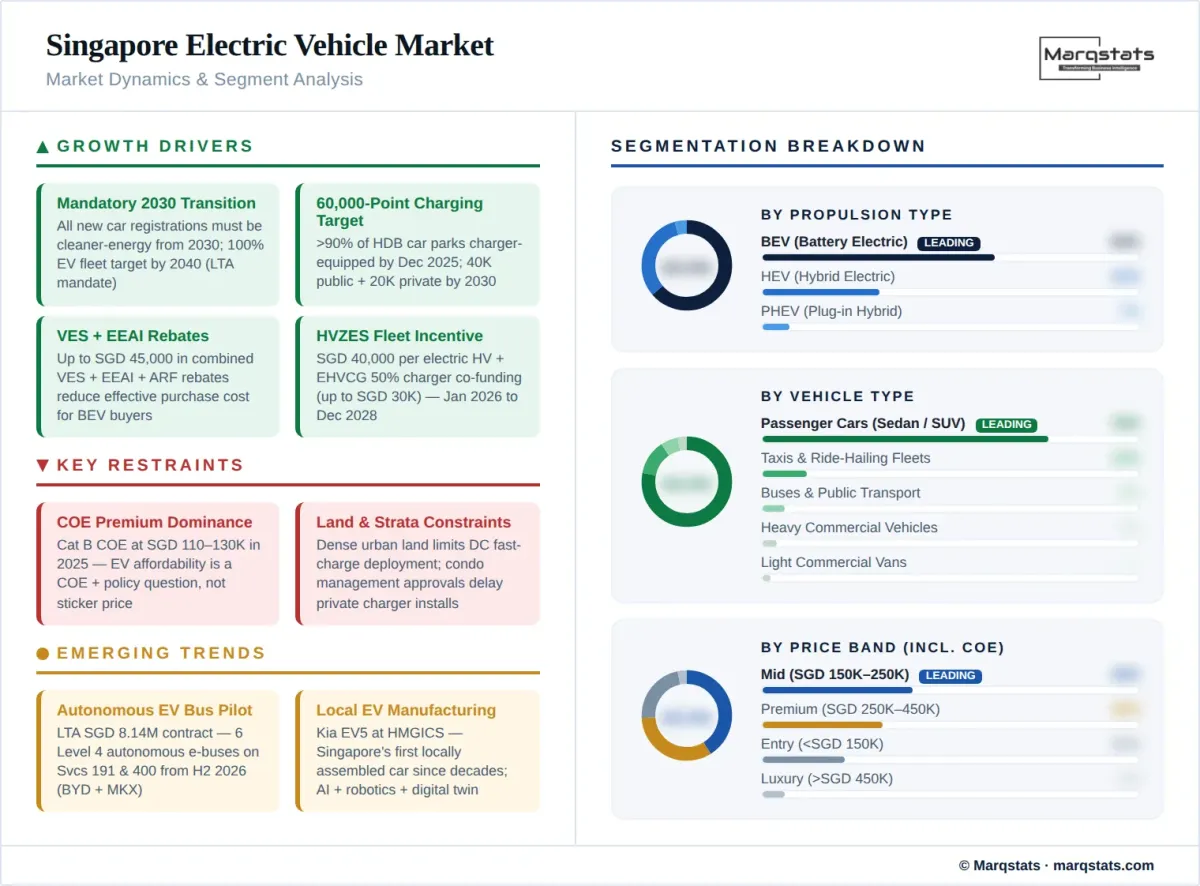
- The Singapore Green Plan 2030 and the 2040 full cleaner-energy vehicle target create a mandatory transition pathway. All new car registrations from 2030 must be cleaner-energy models, including BEV, HEV, and hydrogen fuel-cell variants.
- The 60,000-point national charging target by 2030 anchors infrastructure investment. HDB car park coverage exceeded 90% by December 2025, removing the primary residential charging barrier for urban buyers.
- Vehicular Emissions Scheme (VES) rebates and the EV Early Adoption Incentive (EEAI) reduce effective purchase costs. Combined rebates and Additional Registration Fee (ARF) offsets can save qualifying EV buyers up to SGD 45,000.
- Fleet electrification incentives under HVZES (SGD 40,000 per electric heavy vehicle) and EHVCG (50% charger co-funding up to SGD 30,000) accelerate commercial vehicle transition from January 2026 to December 2028.
- Chinese brand entry is reshaping pricing dynamics. BYD achieved 20.7% market share in April 2025, while NIO, XPeng, Zeekr, Leapmotor, Deepal, ICAUR, Avatr, Yangwang, and Hongqi expanded portfolios through 2025 and into 2026.
Key Restraints
- COE premiums continue to dominate total cost of ownership. Category B COE prices reached SGD 110,000 to SGD 130,000 in 2025, materially exceeding vehicle sticker prices for mid-market EVs.
- Limited land availability constrains charging-station deployment, particularly for high-power DC fast charging. Dense urban environments favour slow AC charging at residential and workplace locations.
- Apartment strata constraints require management committee approvals for private charger installation in non-HDB condominiums, introducing administrative delays for some buyers.
- Battery disposal and second-life infrastructure remains under development. Scaled battery-recycling capacity locally will not be operational before the late 2020s, creating an environmental flow-through consideration as the fleet ages.
Key Trends
- Autonomous electric mobility pilots are accelerating. The LTA awarded an SGD 8.14 million contract in October 2025 to MKX Technologies, MOGOX, and BYD Singapore for six Level 4 autonomous electric buses on Services 191 and 400 starting in the second half of 2026.
- Battery swapping for heavy commercial vehicles has entered commercial operation. EcoSwift launched Singapore’s first public charging and battery-swap station for electric heavy commercial vehicles in Tuas in August 2025.
- Local manufacturing returned to Singapore. The Kia EV5 launched in May 2025 became the first vehicle assembled at HMGICS (Hyundai Motor Group Innovation Center Singapore) using AI-powered cell-based manufacturing, robotics, and digital twins.
- EV-capable aftermarket infrastructure is scaling. ComfortDelGro Engineering opened a 27,400 sqm integrated automotive engineering centre at Ubi Road 3 in March 2026, featuring 260+ vehicle bays and 58 EV charging points for maintenance and high-voltage battery diagnostics.
Market Segmentation
BEVs dominate electrified new car registrations in Singapore, accounting for approximately 62% of the electrified mix in 2025. BYD leads the segment through the Atto 3, Seal, Dolphin, Sealion 7, and M6 portfolio. Tesla Model Y and Model 3 anchor the premium BEV band. Kia EV5 (locally assembled), Hyundai Ioniq 5 and Ioniq 6, BMW i4 and iX, Mercedes-EQ, Polestar 2 and 4, Volvo EX30 and EX90, and XPeng G6 and G9 compete across mid-market and premium segments.
HEVs hold approximately 31% share of Singapore’s electrified mix in 2025. Toyota dominates the segment through the Corolla Cross, RAV4, Camry, Alphard, and Vellfire hybrid variants. Honda CR-V, HR-V, and Accord e:HEV serve the mid-market. Lexus hybrids anchor the premium hybrid segment. HEVs remain attractive to buyers who seek lower running costs without full dependence on charging infrastructure.
PHEVs hold approximately 7% share of Singapore’s electrified mix in 2025. BYD Sealion 6 DM-i, Mercedes GLC 300e, BMW 530e, Volvo XC60 and XC90 Recharge, and Audi Q5 PHEV compete in this segment. PHEV adoption is concentrated in the premium band, where buyers value the combination of electric range for daily commutes with petrol flexibility for longer trips.
FCEV deployment remains at pilot scale. Hyundai Nexo and Toyota Mirai represent the primary passenger FCEV options. The Singapore Green Plan 2030 explicitly includes hydrogen fuel-cell vehicles under the cleaner-energy vehicle framework. Commercial applications in heavy-duty trucking and long-haul logistics are under evaluation. FCEV share is forecast to remain below 2% of new registrations through 2030.
Passenger cars account for approximately 76% of Singapore’s electrified vehicle volume in 2025. Sedans, SUVs, and crossovers dominate the category. BYD Atto 3, Tesla Model Y, Hyundai Ioniq 5, Kia EV5, Mercedes EQE, BMW i4, and Polestar 2 represent high-volume models. Proton e.MAS 7, launched in September 2025 at SGD 175,988 (Prime) and SGD 179,888 (Premium), marked Proton’s return to the Singapore market after more than a decade.
Taxis and ride-hailing fleets represent approximately 12% of Singapore’s electrified vehicle volume in 2025. ComfortDelGro is progressively electrifying its taxi fleet and operates maintenance infrastructure for the broader EV ecosystem. Grab’s partnership with Autonomous A2Z (July 2025) introduced autonomous electric shuttle bus pilots on a 3.9 km route between one-north and the nearby MRT station, supporting future job transitions for private-hire and taxi drivers.
Buses and public transport comprise approximately 6% of Singapore’s electrified vehicle volume in 2025. LTA’s Level 4 autonomous electric bus pilot, awarded in October 2025 to MKX Technologies, MOGOX, and BYD Singapore, will deploy six 16-seat autonomous buses on Services 191 and 400 from the second half of 2026 for a three-year pilot. SBS Transit and SMRT are electrifying conventional bus services in parallel.
Heavy commercial vehicles and trucks account for approximately 4% of Singapore’s electrified vehicle volume in 2025, however the segment is the fastest-growing vehicle category. BYD Trucks Singapore by Inchcape+ opened the BYD Commercial Mobility Hub in January 2025, introducing the T9R electric truck with a 302 kWh Blade Battery, 320 km city range, and 184 kW DC charging (20–80% in approximately 60 minutes). EcoSwift’s Tuas Battery Charge and Swap Station opened in August 2025.
Light commercial vehicles and vans account for approximately 2% of Singapore’s electrified vehicle volume in 2025. Maxus and BYD lead the electric van segment. Last-mile logistics operators and government agencies are progressively converting fleets to electric vans, supported by the LTA’s heavy vehicle grant extensions to qualifying commercial platforms.
Chinese-origin brands collectively secured approximately 58% of Singapore’s electrified vehicle sales in 2025. BYD led the cohort with 3,002 registrations between January and April 2025, reaching 20.7% market share in April. Other Chinese entrants include Deepal, Denza, Dongfeng, GAC, ICAUR, IM Motors, Jaecoo, Leapmotor, Maxus, MG, NIO (entering in 2026 via Wearnes Automotive), Omoda, Ora, XPeng, Yangwang, Zeekr, and Avatr.
Japanese brands hold approximately 22% share of Singapore’s electrified vehicle sales in 2025, concentrated in HEV. Toyota remains dominant through eight electrified models including Corolla Cross, RAV4, Camry, Alphard, and Vellfire hybrids. Honda, Lexus, Nissan, Mazda, Subaru, and Suzuki maintain portfolios across the premium hybrid and mild-hybrid segments.
European brands hold approximately 12% share of Singapore’s electrified vehicle sales in 2025. BMW, Mercedes-Benz, Audi, Volvo, Polestar, Porsche, and MINI compete in the premium BEV and PHEV segments. Mercedes-EQ and BMW i-series models anchor the luxury electric sedan and SUV band. Volvo and Polestar compete in the mid-premium electric SUV tier.
Korean brands hold approximately 6% share of Singapore’s electrified vehicle sales in 2025. Hyundai and Kia anchor the segment. The Hyundai Motor Group Innovation Center Singapore (HMGICS) launched the Kia EV5 in May 2025 as the first locally assembled vehicle, with claimed 540 km range. Hyundai Ioniq 5, Ioniq 6, and Kona Electric support the mid-market BEV segment.
American brands, led by Tesla, hold approximately 2% share of electrified vehicle sales in 2025. Tesla Model Y and Model 3 anchor the premium American BEV segment. Malaysian brand Proton re-entered the Singapore market in September 2025 through Vincar Group distribution, launching the e.MAS 7 with plans to expand the cleaner-energy vehicle portfolio.
The entry-level band is compressed in Singapore owing to COE premiums. Models competitively positioned in this band include the BYD Atto 3, BYD Dolphin, MG4, GAC Aion Y Plus, and smaller Chinese BEVs. The band captured approximately 22% of electrified vehicle volume in 2025. COE fluctuations materially shift the band boundaries across quarterly bidding rounds.
The mid-market band captures mainstream Singaporean buyer volumes. Proton e.MAS 7 at SGD 175,988–179,888, BYD Seal and Sealion 7, Kia EV5, Hyundai Ioniq 5, Volvo EX30, MG ZS EV, Tesla Model 3, and XPeng G6 compete in this segment. The band captured the largest revenue share of 2025 electrified sales.
The premium band includes high-specification BEVs and PHEVs. Tesla Model Y Long Range and Performance, BMW i4 and iX1, Mercedes EQE, Audi Q6 e-tron, Polestar 4, Volvo EX90, XPeng G9, and Zeekr 001 and 007 compete in this segment. Corporate and executive fleet acquisitions anchor segment volumes.
The luxury band serves high-net-worth buyers. Mercedes EQS, BMW i7, Porsche Taycan, Audi e-tron GT, Lucid Air, and the Yangwang U8 and U9 ultra-luxury electric models compete in this tier. Volume is limited to 800–1,200 units annually, however the band anchors brand positioning and after-sales ecosystem investment.
By Geography
Central Region
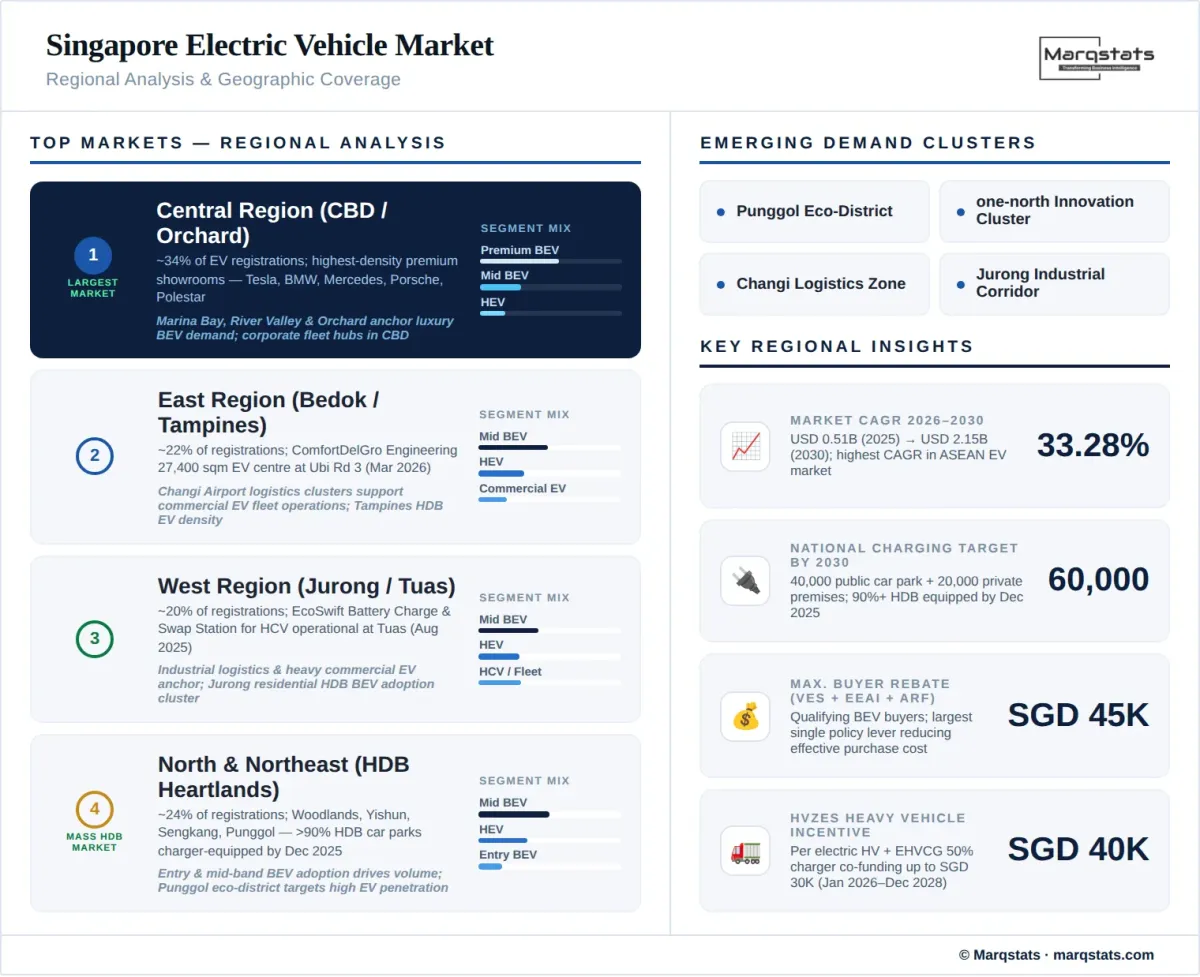
The Central Region, including the Central Business District, Orchard Road, Marina Bay, and River Valley, accounts for approximately 34% of Singapore’s electrified vehicle registrations in 2025. The region hosts the highest density of premium brand showrooms, including Tesla, BMW, Mercedes-Benz, Porsche, and Polestar. Luxury EV sales concentrate in this region, supported by high-income residential zones.
East Region
The East Region, including Bedok, Tampines, Pasir Ris, and Changi, accounts for approximately 22% of registrations in 2025. ComfortDelGro Engineering’s 27,400 sqm integrated automotive centre opened at Ubi Road 3 in March 2026. The region serves as a commercial vehicle maintenance and operations anchor, supported by proximity to Changi Airport logistics clusters.
West Region
The West Region, including Jurong, Clementi, Tuas, and Boon Lay, holds approximately 20% of registrations in 2025. Tuas hosts EcoSwift’s Battery Charge and Swap Station for electric heavy commercial vehicles, operational since August 2025. The region anchors industrial logistics and heavy commercial vehicle operations.
North and Northeast Regions
The North Region (Woodlands, Yishun, Sembawang) and Northeast Region (Hougang, Sengkang, Punggol, Ang Mo Kio) collectively hold approximately 24% of registrations in 2025. High-density HDB housing drives residential BEV adoption in these regions. HDB car park charger deployment exceeded 90% by December 2025, supporting sustained mass-market EV uptake.
How Competition Is Evolving
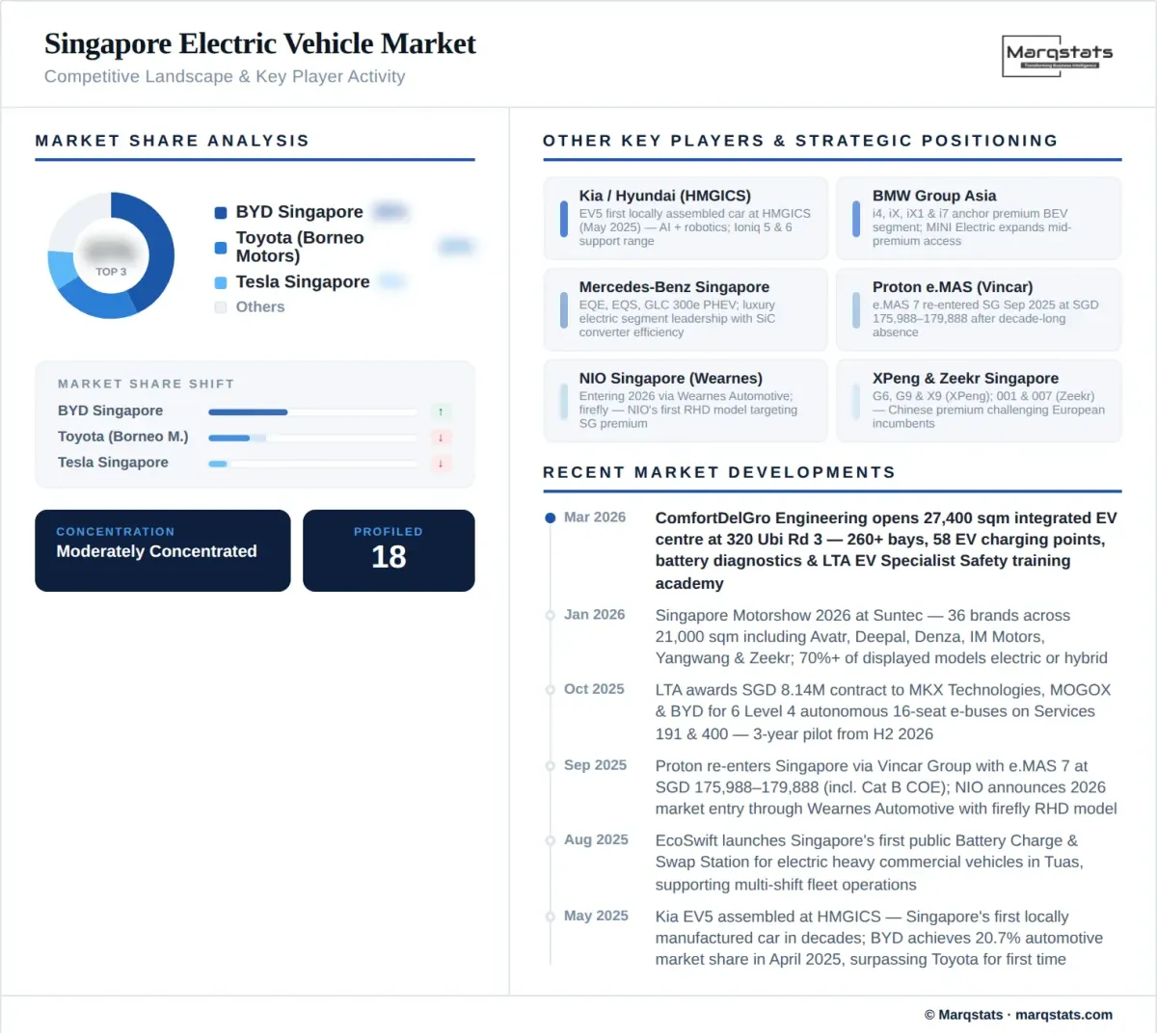
The competitive environment in the Singapore electric vehicle market is moderately concentrated with rapid structural rebalancing. The top five OEM groups accounted for approximately 67% of electrified vehicle sales in 2025. Market structure has shifted from Japanese hybrid dominance toward Chinese BEV leadership within 18 months, driven by price-competitive Chinese models, premium Tesla and German OEM entries, and emerging Korean local-assembly capability.
BYD Singapore, distributed by Inchcape’s subsidiary Vantage Automotive, secured market leadership with 3,002 registrations between January and April 2025 at 20.7% market share in April. BYD operates both passenger and commercial mobility hubs, with the T9R e-commercial truck launched in January 2025 extending the portfolio into heavy-duty logistics. Toyota remains the second-largest electrified vehicle brand through HEV leadership across eight models.
Korean OEMs scaled significantly in 2025. Kia launched the EV5 in May 2025 as the first vehicle assembled at the Hyundai Motor Group Innovation Center Singapore (HMGICS), powered by AI-driven cell-based manufacturing. Proton re-entered Singapore in September 2025 after more than a decade. NIO announced Singapore market entry in 2026 through Wearnes Automotive partnership for the firefly small smart high-end EV. Strategic partnerships, premium-brand aftermarket investment, commercial fleet electrification, and autonomous electric mobility pilots are the primary competitive differentiators for the 2026–2030 period.
Companies Covered
The report profiles 18 company profiles+ companies with full strategy and financials analysis, including:
Recent Market Activity
Table of Contents
Coverage & Segmentation
The Singapore Electric Vehicle Market report analyzes the market across propulsion type, vehicle category, brand origin, price band, end-use, and regional geography for the period 2021 to 2030. The report covers historical data for 2021-2025, with 2025 as the base year, and forecasts spanning 2026-2030. Market sizing is conducted in USD billions and unit volumes. The study examines the full electrified vehicle value chain, including OEM imports, local assembly at HMGICS, battery supply, charging infrastructure deployment, fleet electrification, autonomous mobility pilots, and aftermarket service.
The scope encompasses all cleaner-energy vehicle categories including battery-electric (BEV), plug-in hybrid (PHEV), hybrid electric (HEV), and hydrogen fuel-cell (FCEV) vehicles. Vehicle categories covered include passenger cars, taxis and ride-hailing fleets, buses and public transport, heavy commercial vehicles, and light commercial vehicles. The study evaluates policy impact from the Singapore Green Plan 2030, the cleaner-energy vehicle mandate, the Vehicular Emissions Scheme (VES), the EV Early Adoption Incentive (EEAI), the Heavy Vehicle Zero Emissions Scheme (HVZES), and the Electric Heavy Vehicle Charger Grant (EHVCG). Competitive profiling covers 18 OEM groups operating in Singapore.