Market Snapshot
Key Takeaways
Market Overview & Analysis
Report Summary
Spain's EV maintenance market is measured across commercial workshop billings for scheduled servicing, wear-and-tear component replacement, high-voltage diagnostics and mechanical repair on registered BEVs and PHEVs, valued at €295.18 million (USD 319.38 million) in 2025. This figure is taken directly from the underlying research's own sourced sizing chain, reconciled from ANFAC and IDEAUTO parc data against GANVAM and GiPA aftermarket repair spend surveys.
Structurally, this is a market defined by two simultaneous transitions: a propulsion-architecture shift from PHEV to BEV dominance, and a channel shift from franchised OEM dealerships toward independent and fast-fit workshops as the electrified parc ages past its warranty window. Both transitions are driven less by consumer choice than by structural forces — subsidy design in the first case, warranty expiration and SERMI accreditation access in the second.
The analysis is built for four reader types making different decisions: an independent workshop operator weighing SERMI accreditation investment against the pace of post-warranty fleet decentralization, a component distributor balancing inventory between Spain's aging 14.6-year average internal combustion fleet and its rapidly expanding electrified parc, a fast-fit chain operator assessing tire and brake service capacity against accelerated EV-driven wear rates, and an investor tracking how Plan Auto+'s funding durability and SERMI accreditation pace together shape this market's Baseline-versus-Accelerated scenario range.
Madrid's 44.8% Registration Share Is a Statistical Artefact, Not a Market Reality
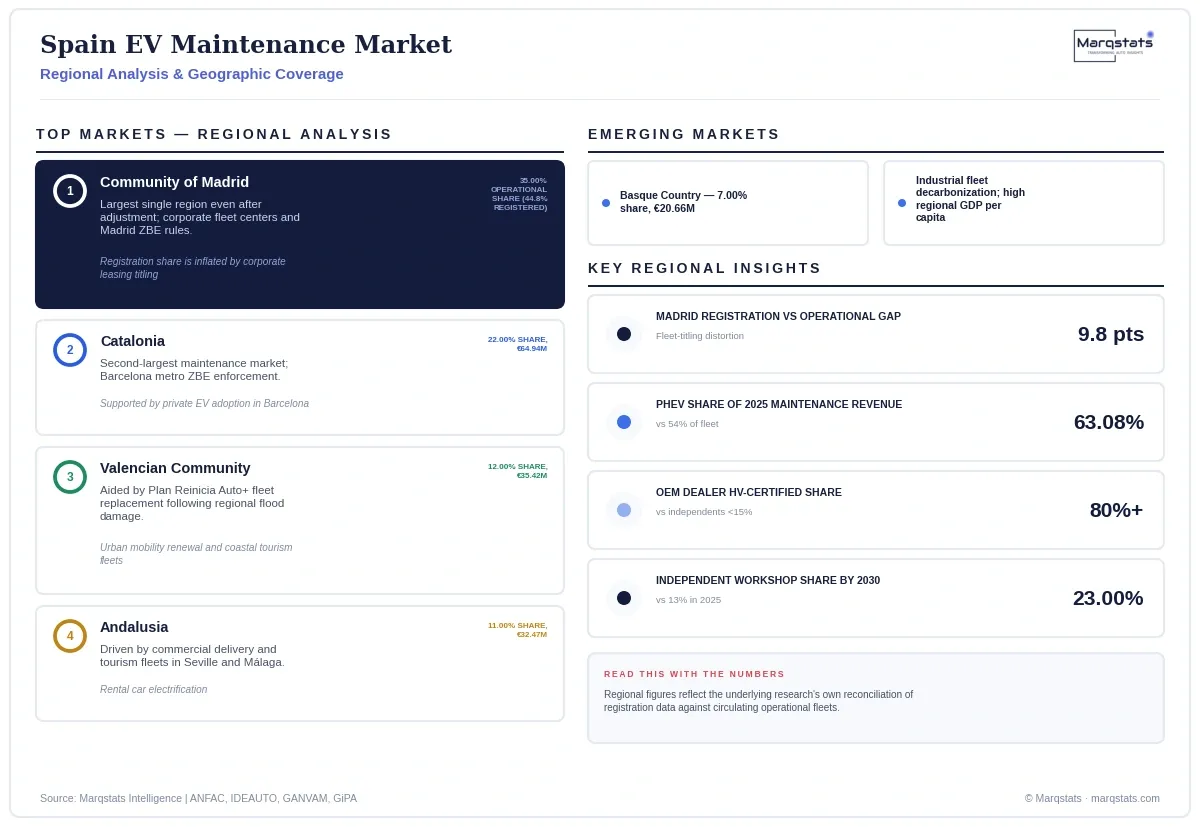
Anyone reading Spain's official DGT and ANFAC registration statistics would conclude the Community of Madrid dominates the country's electrified vehicle maintenance opportunity by a wide margin — 44.8% of national registrations is a genuinely commanding share. That figure describes where vehicles are titled, not where they operate. Spain's major automotive leasing, long-term corporate rental (renting), and short-term car rental companies are headquartered in Madrid specifically because of favorable regional tax policies and municipal vehicle tax (IVTM) rates, and they register their fleets centrally there before distributing vehicles across commercial branches, logistics corridors and regional delivery hubs nationwide.
Reconciling registration data against actual circulating operational fleets brings Madrid's genuine maintenance-expenditure share down to 35.00% — still the largest single region, but a materially smaller lead than the headline registration figure implies. The practical consequence: a workshop chain, parts distributor or diagnostic equipment supplier using raw DGT registration data to plan regional capacity would systematically over-invest in Madrid itself and under-invest in the corridors and cities where leased and rental vehicles actually generate service demand day to day.
Why PHEVs, Not BEVs, Currently Carry Spain's EV Maintenance Market
It would be reasonable to assume battery electric vehicles, as the more complex high-voltage platform, generate the larger maintenance opportunity. In Spain's current market, the opposite is true. PHEVs, representing 54.0% of the 2025 electrified parc, generated 63.08% of total maintenance expenditure — €473 in average annual spend per vehicle against just €325 for BEVs. The explanation is structural: PHEV platforms combine a downsized internal combustion engine, with its own lubrication, cooling and exhaust systems, alongside the electric motor, inverter, onboard charger and traction battery a BEV also carries — PHEV owners pay for both maintenance profiles simultaneously.
This dynamic is set to invert by 2030 as Spain's own subsidy architecture actively favors BEV adoption: Plan Auto+'s EEE framework provides 50% base aid to BEVs against just 25% for PHEVs. Under the Baseline Scenario, BEV circulating units reach 1,750,000 by 2030, generating €682.50 million in maintenance expenditure and a 51.50% market share, while PHEV expenditure grows in absolute terms to €642.75 million but declines to 48.50% share. For workshop operators today, PHEVs remain the more valuable customer on a per-vehicle basis — a transitional reality current capacity planning should reflect, even as the long-term trajectory points toward BEV dominance.
Market Dynamics
Key Drivers
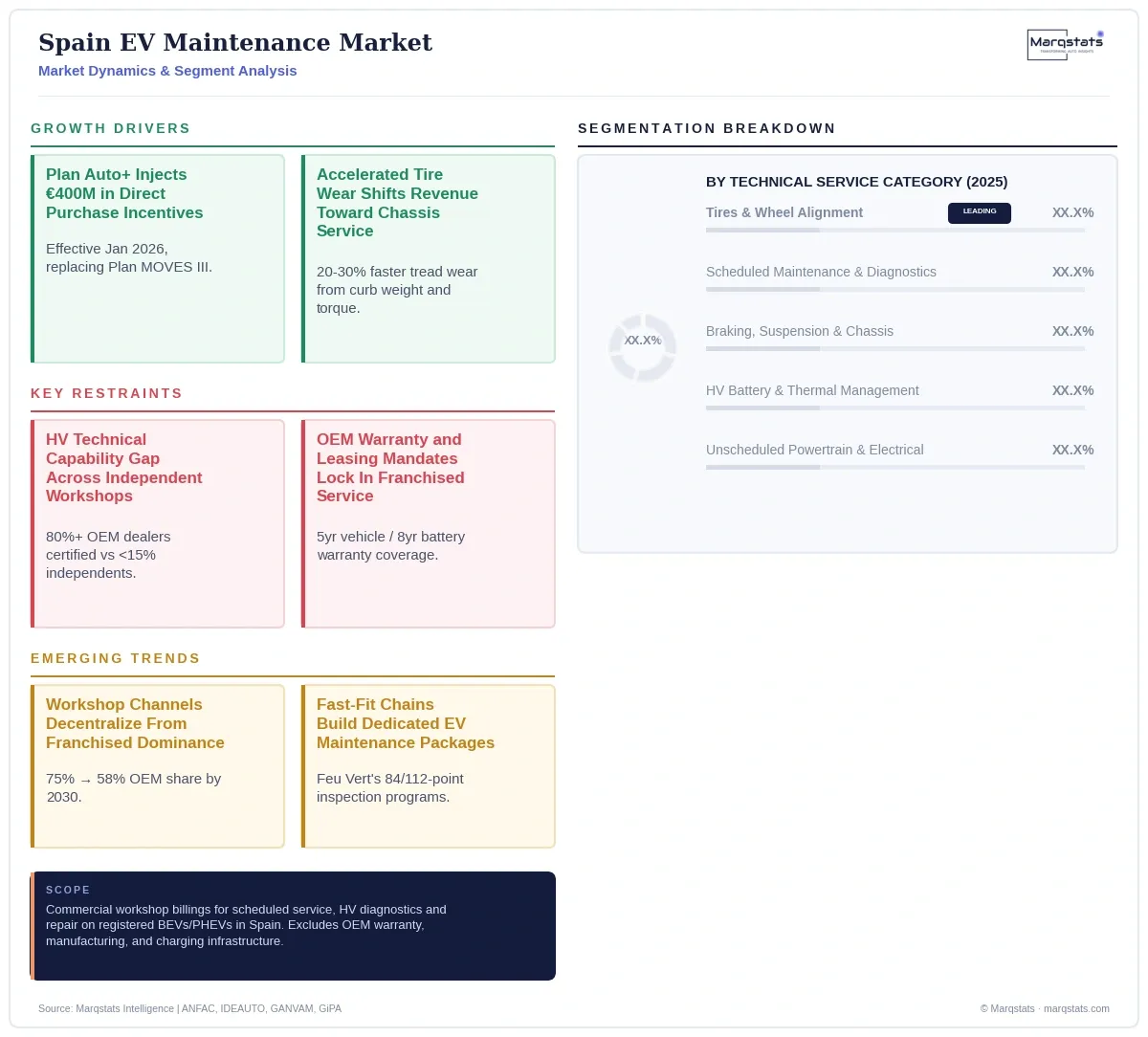
- Spain's own subsidy architecture actively discriminates in favor of pure electric adoption over plug-in hybrids, with Plan Auto+'s EEE formula providing 50% base aid to BEVs against just 25% for PHEVs, a policy design that will accelerate the propulsion-mix shift this analysis's own segment analysis already documents underway.
- Spain's Plan Auto+ program, effective 1 January 2026 under the broader Plan España Auto 2030 framework, injects €400 million in centrally administered direct purchase incentives applied at point of sale, directly expanding the base of vehicles that will require aftermarket maintenance over the coming five years.
- Accelerated tire wear from heavier electrified curb weights and instant electric torque delivery is structurally shifting workshop revenue toward Spain's largest maintenance category: tires and wheel alignment reached €85.60 million in 2025 and is projected to grow to €410.83 million by 2030 as replacement intervals compress to every 25,000 to 35,000 km.
- The phased implementation of Euro 7 standards under Regulation (EU) 2024/1257, with initial application from late November 2026, mandates standardized onboard battery State of Health monitoring during periodic technical inspections, converting battery diagnostics into a routine, recurring aftermarket service line rather than an occasional specialty repair.
- Municipal Low Emission Zone enforcement under Spain's Climate Change Law (Law 7/2021), mandatory across 151 Spanish cities with populations exceeding 50,000, restricts polluting vehicle access and is accelerating urban fleet electrification independent of national purchase-incentive policy.
- The maturing SERMI (Security-related Repair and Maintenance Information) accreditation scheme, supported in Spain by workshop confederations CETRAA and CONEPA, is progressively opening independent workshop access to the security gateway modules that lock electronic control units on modern electrified platforms, expanding the addressable service base beyond franchised OEM networks.
Key Restraints
- Independent workshops face a genuine chicken-and-egg problem in the near term: SERMI accreditation requires capital outlay that is hardest to justify before post-warranty EV volume materializes, yet that same volume cannot shift toward independent channels until accreditation is already in place, a sequencing challenge the pack's own scenario analysis treats as a genuine constraint on how quickly the 2030 channel-mix projections can be realized.
- Fewer than 15% of Spain's independent multibrand workshops currently possess certified high-voltage technicians, dedicated insulated work bays and OEM diagnostic interfaces, against over 80% of authorized franchised dealerships, per data compiled by GANVAM, CETRAA and GiPA, constraining how quickly maintenance volume can genuinely decentralize away from OEM networks.
- Manufacturer warranty coverage of up to 5 years on vehicles and 8 years or 160,000 km on traction batteries, combined with corporate leasing contracts (renting) representing over 40% of fleet registrations that contractually require authorized-network servicing, locks a substantial share of Spain's electrified parc into franchised dealership maintenance regardless of independent workshop pricing or accessibility.
- SERMI accreditation carries genuine capital and administrative costs that create a structural barrier for smaller independent facilities, per CETRAA's own technical guidance, potentially concentrating post-warranty maintenance capture among larger independent chains rather than distributing it evenly across Spain's roughly 40,000 registered commercial workshops.
- Component distributors and parts wholesalers face a genuine dual-inventory burden: Spain's average passenger car age of 14.6 years, per ANFAC's own published fleet data, means continued demand for internal combustion components alongside rapidly expanding requirements for EV-specific parts including high-voltage air conditioning compressors and low-wear braking systems.
Key Trends
- Insurance underwriters and fleet-leasing companies are increasingly specifying particular diagnostic and repair standards as a condition of coverage or lease-return acceptance, pushing workshop certification toward standardized, insurer-recognized credentials rather than informal competency claims alone.
- Workshop delivery channels are decentralizing from franchised OEM dominance toward independent and fast-fit operators as Spain's electrified parc crosses the four-year warranty threshold, with franchised dealership share projected to fall from 75.00% in 2025 to 58.00% by 2030 under the Baseline Scenario.
- Fast-fit and tire specialist chains including Norauto (Mobivia Group), Feu Vert, Midas, Euromaster and First Stop are building dedicated electrified maintenance packages — Feu Vert's structured 84-point and 112-point inspection programs now include high-voltage diagnostics, cabin filtration checks and dielectric fluid inspections alongside traditional tire and brake service.
- Established dealership consortia including QUADIS, Salvador Caetano Auto and Movento are expanding multi-brand EV maintenance hubs to service new market entrants, exemplified by Salvador Caetano's distribution and aftermarket service alliance with Chinese manufacturers Zeekr and XPeng across hubs in Madrid and Barcelona.
- Component suppliers Bosch España, Valeo, Schaeffler and Continental are expanding dedicated EV product lines including electric axle lubricants and copper-free brake pads formulated for regenerative braking systems, while Michelin and Continental supply low-rolling-resistance tires engineered for electrified platforms' higher torque and curb weight.
Strategic Implications
- Franchised dealership consortia should treat the coming channel decentralization as a planning certainty rather than a risk to resist, since the underlying driver — vehicles aging past warranty coverage — is a demographic process no commercial strategy can reverse, and should instead focus competitive energy on retaining high-margin specialized repairs (battery pack resealing, module cell balancing) where OEM diagnostic access remains a genuine structural advantage.
- New market entrants, including independent EV repair franchises, diagnostic technology providers and battery remanufacturing specialists, should prioritize capital investment in multi-brand diagnostic tools compatible with SERMI security protocols and mobile tire maintenance units targeting commercial and logistics fleets, securing recurring revenue through service agreements with carsharing operators, municipal fleets and corporate leasing providers seeking lower-cost alternatives to franchised dealership networks.
- Established independent workshops should treat certified high-voltage safety training, insulated tools, dielectric fluid evacuation stations and SERMI digital accreditation as near-term operational necessities rather than optional upgrades, given that diesel passenger car sales fell to just 2.7% of Spain's monthly market in August 2026, per ANFAC's own registration data, signaling how quickly traditional mechanical repair volumes are contracting.
- Component manufacturers and wholesale parts distributors should adjust catalog strategy to serve two simultaneously aging and expanding fleets: Spain's internal combustion parc, averaging 14.6 years, alongside its rapidly growing electrified parc, expanding inventories of specialized suspension arms, high-voltage air conditioning compressors and low-wear braking systems without abandoning legacy component supply.
- Regional workshop chains and parts distributors should weight actual metropolitan population and freight-corridor density more heavily than raw DGT registration counts when allocating capital toward Spanish regional capacity, given the documented gap between Madrid's 44.8% registration share and its 35.00% genuine operational maintenance-expenditure share.
Outlook
Two genuinely distinct, evidenced trajectories emerge from named trigger conditions rather than differing growth-rate assumptions applied to the same story. Under the Baseline Electrification Scenario, Plan Auto+ maintains its €400 million annual funding allocation through 2026 and 2027 before tapering as European-built compact BEVs achieve retail price parity below €25,000, and Spain's circulating electrified parc reaches 2,850,000 units by 2030, generating €1,325.25 million (USD 1,433.92 million) in annual maintenance expenditure.
Under the Accelerated Decarbonization and Regulatory Convergence Scenario, the 15% personal income tax (IRPF) deduction extends beyond its scheduled 31 December 2026 expiration, municipal Low Emission Zone enforcement tightens under Spain's Climate Change Law (Law 7/2021), and Euro 7 standards under Regulation (EU) 2024/1257 make battery State of Health verification mandatory during periodic ITV inspections from late November 2026. Under this trigger set, the circulating fleet expands to 3,400,000 units by 2030, lifting annual maintenance expenditure to €1,632.00 million (USD 1,765.82 million) at a 40.75% CAGR. A third, severe-contraction scenario was evaluated and rejected: EU CO2 fleet targets and municipal access regulations legally preclude an abandonment of vehicle electrification in Spain, per ANFAC's own published industry assessment.
Market Segmentation
€186.20 million (63.08% share) in 2025, from 393,633 vehicles at a €473 average annual spend, driven by dual internal-combustion-plus-electric maintenance requirements; projected to reach €642.75 million (48.50% share) by 2030 as absolute PHEV maintenance value continues rising even as its overall share declines.
€108.98 million (36.92% share) in 2025, from 335,317 vehicles at a €325 average annual spend; projected to reach €{f2(P['bev_value30'])} million (51.50% share) by 2030, a 44.33% CAGR, overtaking PHEV as Spain's largest propulsion segment by value as Plan Auto+'s 50% BEV subsidy rate accelerates adoption.
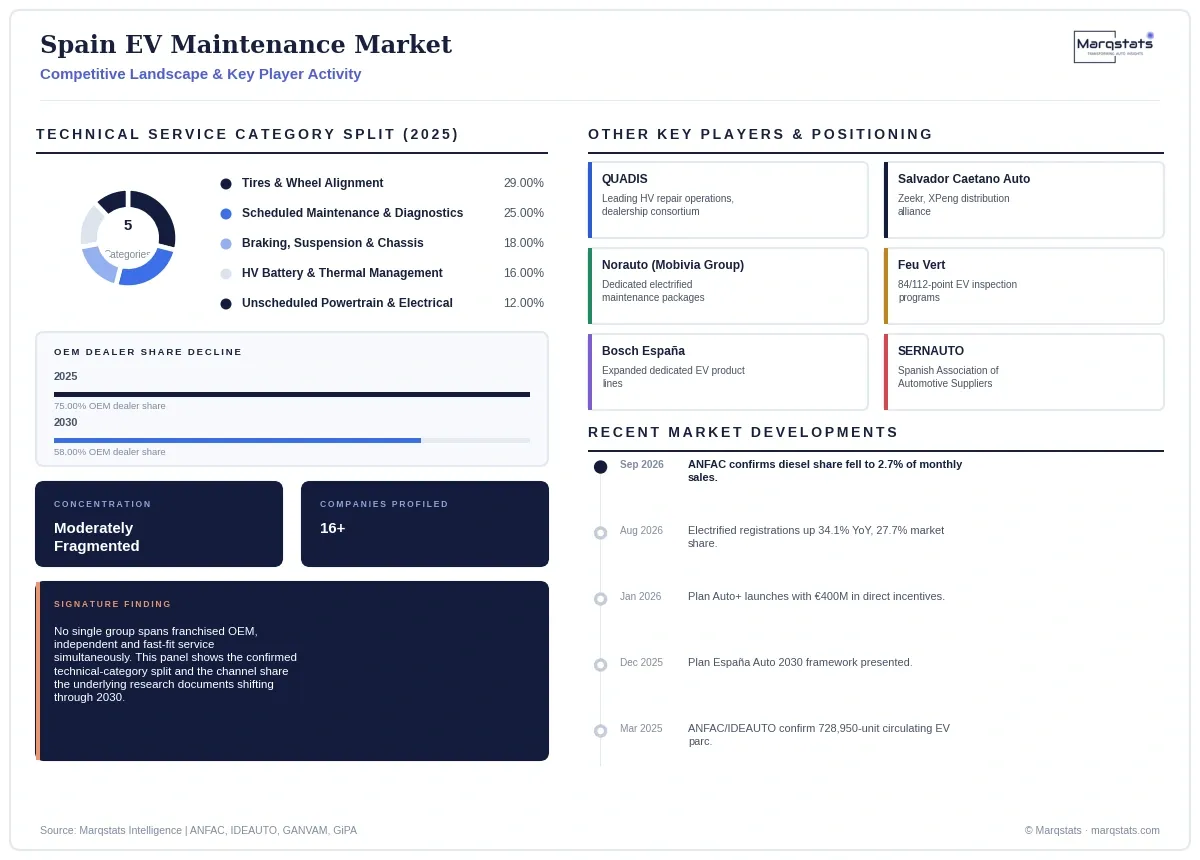
€85.60 million (29.00% share) in 2025, the largest technical category, driven by curb weight and instant torque accelerating tread wear by 20-30%; projected to reach €410.83 million (31.00% share) by 2030.
€73.80 million (25.00% share) in 2025, covering high-voltage safety scans, insulation resistance checks and battery State of Health evaluations; projected at €298.18 million (22.50% share) by 2030.
€53.13 million (18.00% share) in 2025, driven by vehicle weight straining control arm bushings, ball joints and shock absorbers; projected at €251.80 million (19.00% share) by 2030.
€47.23 million (16.00% share) in 2025, covering dielectric coolant replacement and pyrofuse/contactor servicing; projected at €225.29 million (17.00% share) by 2030.
€35.42 million (12.00% share) in 2025, covering inverter gate driver repair and onboard charger remediation; projected at €139.15 million (10.50% share) by 2030.
€221.39 million (75.00% share) in 2025, driven by manufacturer warranty coverage and corporate leasing mandates; projected to decentralize to €768.65 million (58.00% share) by 2030 as the parc ages past warranty windows.
€38.37 million (13.00% share) in 2025; projected to nearly double to €304.81 million (23.00% share) by 2030 as SERMI accreditation expands independent access to electronic control gateways.
€35.42 million (12.00% share) in 2025; projected at €251.80 million (19.00% share) by 2030, capturing standardized tire, brake and chassis servicing volumes.
By Geography
A note on regional registration distortion
Official DGT and ANFAC registration statistics attribute 44.8% of Spain's electrified vehicle registrations to the Community of Madrid. This figure is inflated by corporate fleet registration practices; the shares below reflect the underlying research's own reconciliation against actual circulating operational fleets.
Community of Madrid
€103.31 million (35.00% operational share) in 2025 from an estimated 255,133 active units, still the largest single region even after adjustment, anchored by corporate fleet centers and Madrid's own Low Emission Zone rules.
Catalonia
€64.94 million (22.00% share) in 2025 from an estimated 160,369 units, Spain's second-largest maintenance market, supported by private EV adoption in the Barcelona metropolitan area and municipal Low Emission Zone (ZBE) enforcement.
Valencian Community
€35.42 million (12.00% share) in 2025 from an estimated 87,474 units, aided in late 2024 and 2025 by fleet replacement initiatives under the Plan Reinicia Auto+ program following regional flood damage.
Andalusia
€32.47 million (11.00% share) in 2025 from an estimated 80,185 units, driven by commercial delivery and tourism fleets concentrated in Seville and Málaga.
Basque Country
€20.66 million (7.00% share) in 2025 from an estimated 51,027 units, led by industrial transport decarbonization programs and the region's high GDP per capita.
How Competition Is Evolving
No single company in this market spans franchised OEM dealership service, independent multibrand repair, fast-fit tire and brake volume, and component distribution simultaneously, leaving genuine competitive white space for any group capable of bridging warranty-era OEM relationships with the post-warranty independent and fast-fit channels this market's own forecast shows capturing a growing majority of expenditure by 2030.
Competition spans franchised dealership consortia, independent workshop networks, fast-fit chains and component distributors, with high-voltage technical capability concentrated heavily in the franchised segment. Dealership consortia QUADIS, Salvador Caetano Auto and Movento lead high-voltage repair operations, supported by commercial agreements with entering automotive brands — Salvador Caetano has established distribution and aftermarket service networks for Chinese manufacturers Zeekr and XPeng, building multi-brand EV maintenance hubs in Madrid and Barcelona. These facilities handle specialized warranty repairs including traction battery pack casing resealing, coolant loop flushing and module cell balancing.
In the independent and fast-fit sector, Norauto (Mobivia Group), Feu Vert and Midas have rolled out dedicated electrified maintenance packages; Feu Vert operates structured 84-point standard and 112-point comprehensive inspection programs including high-voltage diagnostics and dielectric fluid inspections. Component suppliers and parts wholesale networks represented by SERNAUTO and ANCERA anchor the inventory pipeline — with Spain's broader spare parts market reaching €7,025 million in 2025, Bosch España, Valeo, Schaeffler and Continental have expanded dedicated EV product lines, while wholesale distribution consortia PRO Service, AD Parts and Alliance Automotive Group España are expanding high-voltage training programs to qualify independent technicians under European safety standards.
Companies Covered
The report profiles 16+ companies with full strategy and financials analysis, including:
Recent Market Activity
Table of Contents
Coverage & Segmentation
This report measures commercial workshop billings for scheduled servicing, preventive maintenance, wear-and-tear component replacement, high-voltage battery diagnostics, thermal management fluid servicing, and mechanical or electrical repair on registered BEVs and PHEVs operating in Spain, across a 2025 base year and a 2026 to 2030 forecast period, denominated in United States dollars at the ECB's 2025 annual reference exchange rate of €1.00 = $1.0820. It excludes upstream vehicle manufacturing, whole-pack warranty replacements absorbed by OEMs, post-collision structural body rebuilding, and public charging infrastructure investment.
The analysis spans three segmentation dimensions — propulsion architecture, technical service category and workshop delivery channel — six regional geographies, and 16 profiled entities across dealership consortia, independent and fast-fit chains, and component suppliers. Vehicle parc and registration figures trace to ANFAC and IDEAUTO; market value and segment splits trace to GANVAM, GiPA and SERNAUTO.