Rogers Shut Down 3G in July 2025 — Does Your Connected Car Still Work?
If your vehicle's telematics hardware was installed before roughly 2018 to 2020 and has not been updated since, there is a real chance it stopped reporting after 31 July 2025, when Rogers Communications completed the commercial shutdown of its legacy 3G UMTS/HSPA network. Any telematics unit that relies exclusively on 3G circuit-switched connectivity lost its ability to communicate that day, regardless of which carrier's SIM the device uses.
Why a Carrier Shutdown Affects Vehicles on Any Network
This is not specific to Rogers-branded connections. Many aftermarket and even some factory telematics units, regardless of which carrier ultimately bills for the connection, were designed around 3G-era chipsets because that was the dominant standard when the hardware was manufactured. Once a carrier the device roams onto for 3G service shuts that network down, the device has no fallback — it simply stops transmitting, silently, with no notification to the vehicle owner unless the OEM or fleet operator proactively checks.
How to Check If You're Affected
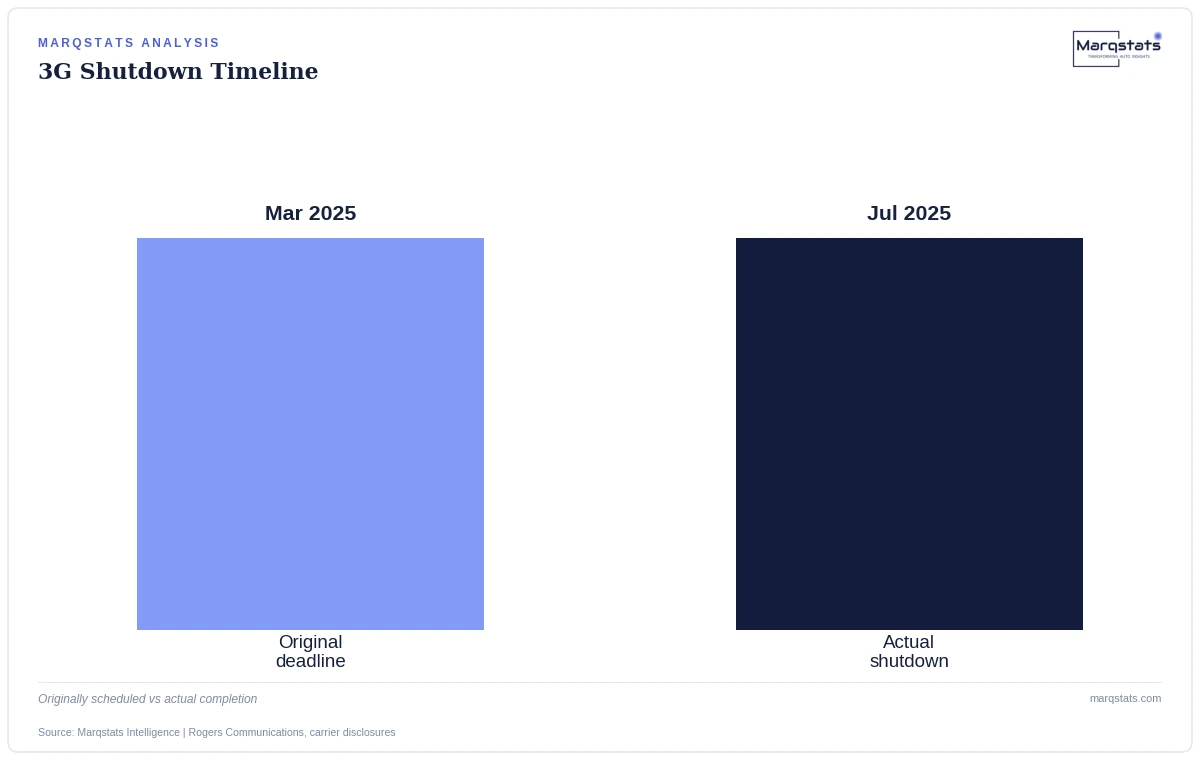
Three signals suggest your vehicle might be running legacy hardware. First, model year: vehicles built roughly 2018 to 2020, the period when embedded telematics were becoming standard but before most manufacturers had moved to 4G LTE as a baseline, are the highest-risk cohort. Second, feature behaviour: if remote-start, vehicle-locate or emergency-call features that used to work have silently stopped responding since mid-2025, a 3G-dependent modem is a plausible cause. Third, directly asking your dealer or fleet telematics provider whether your specific hardware generation was flagged for the 3G transition is the most reliable way to confirm.
What Fixing It Actually Involves
For factory-embedded systems, the fix is typically a dealership hardware replacement, since the telematics control unit itself, not just a SIM card, needs to support 4G LTE or 5G. For aftermarket commercial fleet devices — the kind Geotab, Isaac Instruments and Fleet Complete deploy — a straightforward unit swap is usually available, since these providers actively manage device generations across large customer fleets and typically proactively contacted affected customers well ahead of the July 2025 deadline.
Why the Deadline Moved From March to July
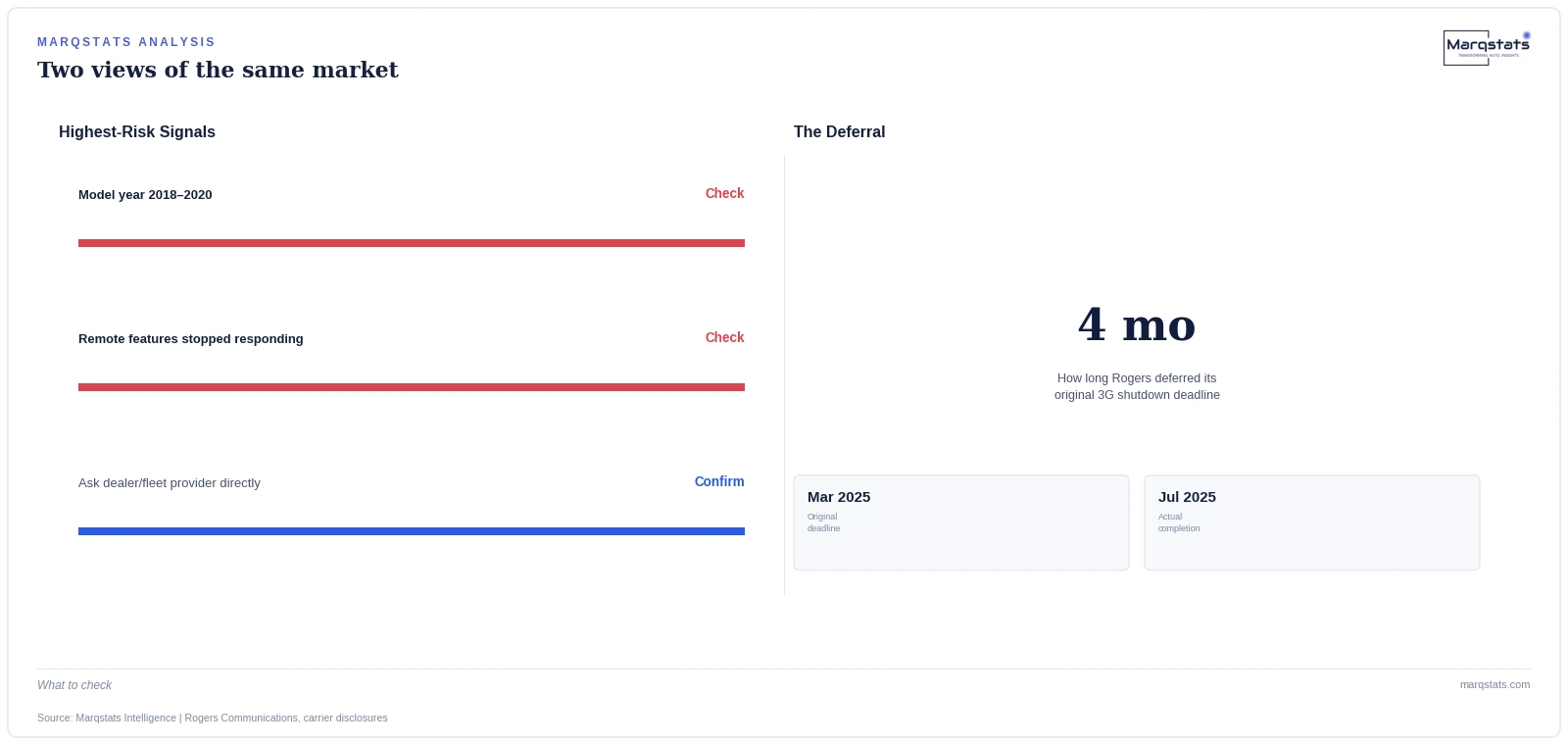
Rogers originally targeted a March 31, 2025 shutdown date before deferring to July 31. That four-month extension was not arbitrary — network shutdowns of this scale typically get pushed back when a meaningful volume of dependent devices, including connected-car hardware, emergency call systems, and industrial IoT sensors, are found still active on the legacy network closer to the original deadline than expected. The deferral gave vehicle owners and fleet operators additional time to complete hardware transitions, but it also means anyone who assumed the original March date and checked their vehicle's status before then may have incorrectly concluded they were unaffected, when in fact the shutdown had simply not happened yet.
What This Means If You're Buying a Used Vehicle
A used-car buyer specifically should treat 3G compatibility as a checklist item alongside the usual inspection points, particularly for vehicles from the 2018-to-2020 model years where 4G adoption was inconsistent across trims and manufacturers. A vehicle advertised with "remote start" or "connected app" features as a selling point is only worth that premium if the underlying hardware can still actually connect — a detail no visual inspection will reveal, making a direct dealer or manufacturer confirmation the only reliable check before purchase.
Commercial Fleets Had More Warning Than Individual Owners
The gap between commercial and consumer preparedness for this transition was real. Fleet operators running Geotab, Isaac Instruments or Fleet Complete hardware typically received direct account-manager communication well ahead of the deadline, because those providers have a commercial incentive to keep every device in a customer's fleet reporting continuously. An individual vehicle owner with a factory-installed system has no equivalent relationship prompting a proactive warning — the first sign of a problem is often simply a feature quietly no longer working, discovered only when the owner happens to try using it.