Why Canada's Connected Car Market Didn't Slow Down When EV Sales Fell 35.7%
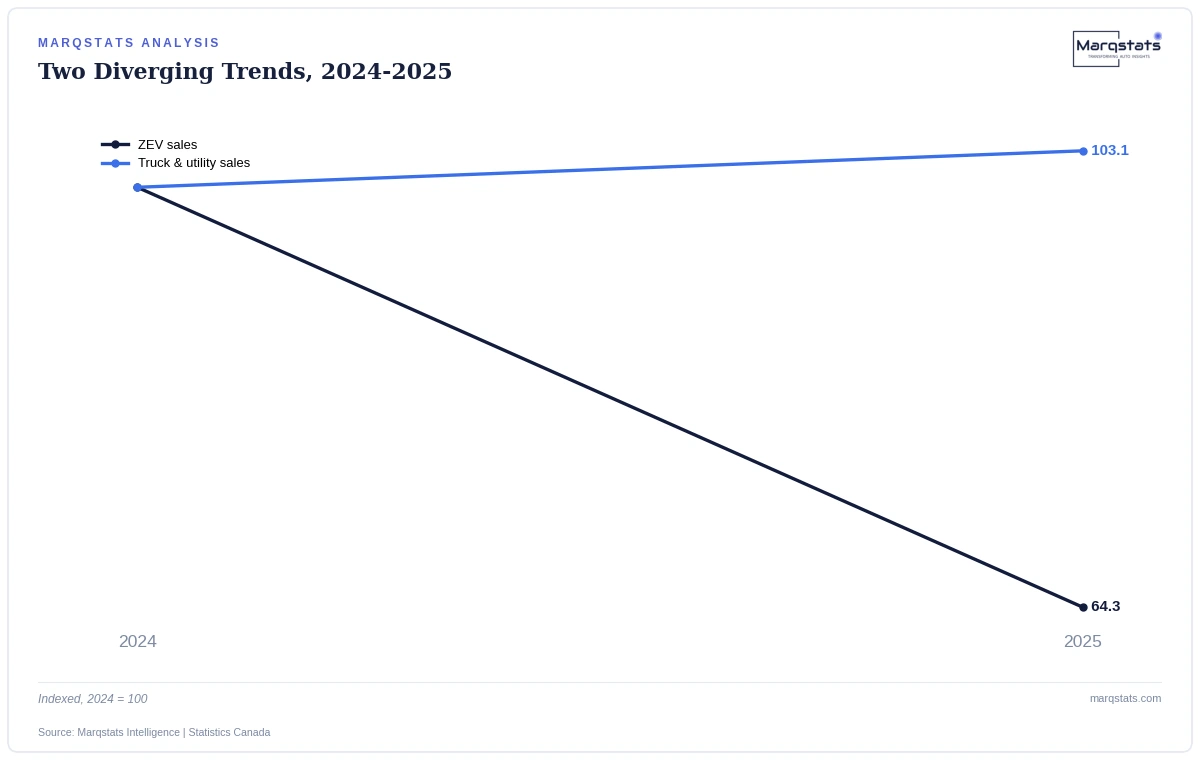
Because the two numbers measure entirely different things. Canada's zero-emission vehicle sales collapsed 35.7% in 2025, to 169,972 units from 264,277 in 2024, after federal and Quebec incentive programs were reduced. A reasonable assumption would be that a connected-car market this associated with electrification took a comparable hit. It did not — because EV sales measure a powertrain choice, and this market's growth is driven by a completely different variable: what kind of vehicle body Canadians are actually buying, regardless of what powers it.
What Actually Happened to EV Sales
The federal government suspended its Incentives for Zero-Emission Vehicles program in January 2025, and Quebec reduced its own Roulez Vert rebates around the same time. Zero-emission sales fell from a 13.77% national market share in 2024 to 8.68% in 2025. The deceleration did not stop there: January 2026 data shows ZEV sales down a further 39.3% year-on-year, with share falling to 7.7% from 12.0% a year earlier. By any measure, this was a real, sustained pullback in electric-vehicle demand, not a one-quarter blip. Provincial incentive design matters specifically because Quebec and the federal government moved on similar timelines, compounding rather than offsetting each other's effect on national ZEV demand overall.
Why Connectivity Kept Growing Anyway
Two separate mechanisms explain the divergence, and both are worth spelling out in detail. First, every electrified vehicle that does sell still ships with a 100% embedded-connectivity fitment rate — EVs require continuous cellular links for battery state-of-health tracking, remote thermal preconditioning and over-the-air battery management calibration, so connectivity fitment on EVs was never something that could fall below 100% regardless of unit volume. Fewer EVs sold means fewer EV-driven connected units, but not a lower fitment rate on the ones that did sell.
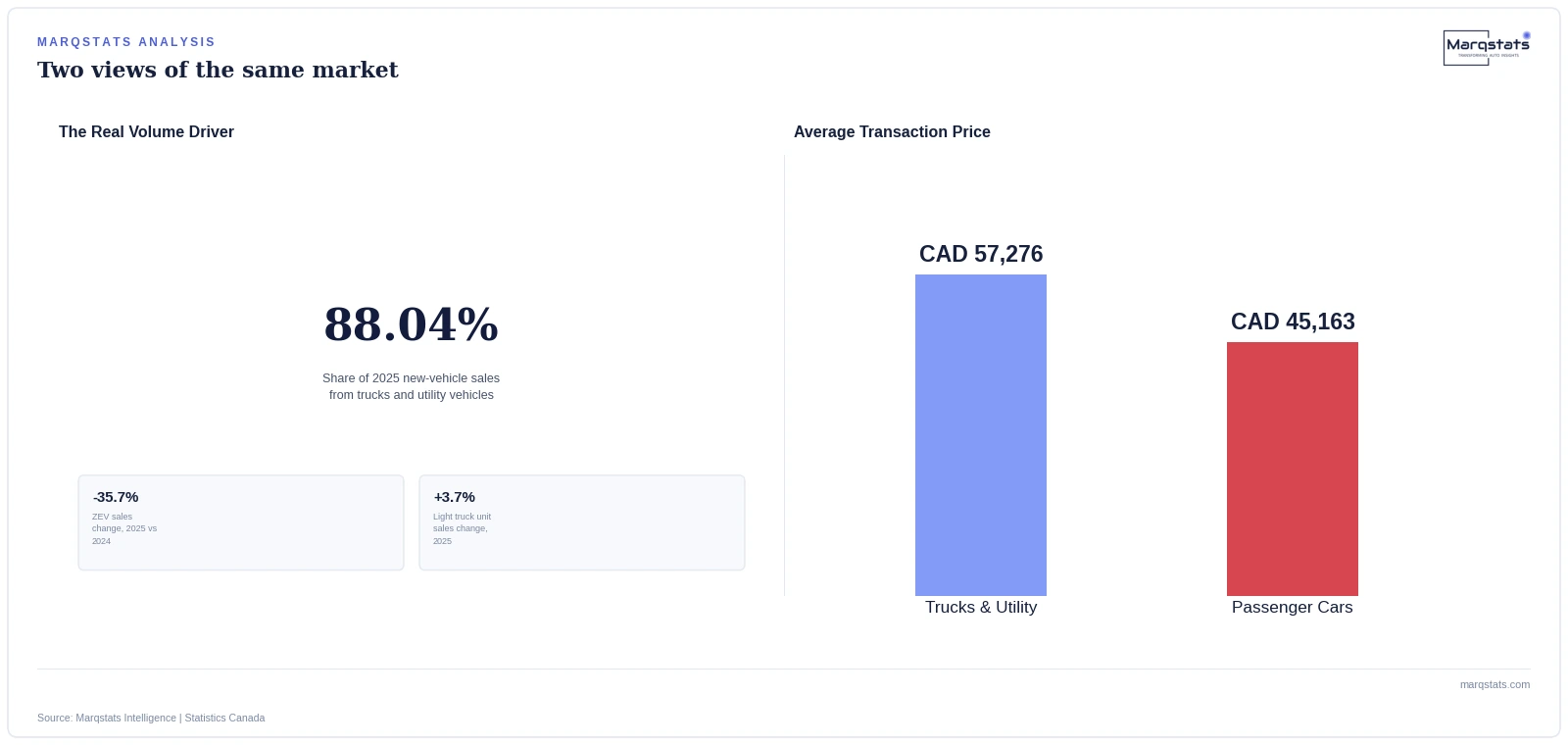
Second, and more important: EVs were never the primary driver of this market's growth in the first place. Trucks and utility vehicles — the overwhelming majority still combustion-powered — made up 88.04% of 2025 new-vehicle sales, and that volume has nothing to do with EV incentive programs. Ford, General Motors, Stellantis and Toyota are standardizing embedded telematics control units across their truck and SUV lineups because those vehicles carry a transaction price high enough to absorb the hardware cost, a decision made independently of whether the powertrain underneath is a combustion engine or a battery pack.
What This Means for Reading Any Connected-Car Forecast
A forecaster who treats Canada's connected-car trajectory as a proxy for its EV adoption trajectory will systematically mis-time the market. The two series can move in opposite directions in the same year, as they did in 2025, because they respond to different triggers: EV sales respond to incentive-program timing, while connected-vehicle fitment responds to which body style and price tier Canadians are buying overall.
The practical test is simple: does a given data series move when a government changes an EV rebate program, or does it move when consumer preference shifts between vehicle body styles? A series that tracks the rebate program is measuring electrification, not connectivity, even if both numbers happen to be reported in the same industry briefing.
The Counter-Case: EVs Still Matter, Just Not for Volume
None of this means EV sales are irrelevant to the connected-car market — they matter specifically for the intensity of connectivity use, not the count of connected vehicles. An EV's battery management, charging-route planning and thermal preconditioning functions generate far more telemetry traffic and higher-value data services than a combustion truck's baseline safety and diagnostic connection. A market model tracking data volume or average revenue per connected vehicle should weight EV sales heavily; a model tracking the count of connected vehicles should weight truck volume instead.
How Quebec's Numbers Illustrate the Split
Quebec is the clearest example of the two variables moving independently within the same province. Quebec accounted for 53.90% of Canada's zero-emission vehicle deliveries in 2024, giving it the country's highest EV-driven connectivity intensity per vehicle. But Quebec's overall connected-car market value share, 23.13% nationally, is driven by its total vehicle parc and truck mix just as much as by its EV leadership — a province could, in principle, lead the country on EV adoption and still see its connected-car market value driven primarily by combustion trucks, exactly the pattern this national-level divergence describes playing out at smaller scale.
What a Model Gets Wrong If It Conflates the Two
A forecasting error compounds specifically when EV incentive-program changes are treated as a leading indicator for the connected-car market as a whole. Incentive programs are politically contingent and can change on a budget cycle, as the January 2025 federal suspension demonstrated; truck and utility vehicle demand responds to a much slower-moving set of consumer preferences and manufacturer product strategy. A model that ties its connected-car forecast too tightly to EV policy risk inherits volatility the underlying connectivity market does not actually have.
A Named Comparison: The United States Shows the Same Split
Canada is not unique in this divergence. In the United States, light truck and SUV sales have carried a comparable majority share of new-vehicle volume for years, and the American EV market has seen its own incentive-driven volatility following changes to federal tax credit eligibility. The same underlying logic applies on both sides of the border: a connected-vehicle market anchored on truck-body-style volume is structurally less exposed to EV policy swings than a market where passenger sedans and EVs make up a larger combined share of what is actually sold.
That parallel is worth taking seriously for anyone building a North American connected-car model rather than a Canada-only one: the truck-versus-EV divergence described here is not a Canadian quirk driven by one country's specific incentive design, but a structural pattern that shows up wherever combustion trucks dominate new-vehicle volume and EV incentive programs remain politically contingent.
What This Means for a Sizing or Sourcing Model
Anyone forecasting Canadian connected-vehicle volume should separate the EV adoption question from the vehicle-body-style question entirely — they are answered by different data series with different drivers. The full truck-versus-passenger-car reconciliation this piece draws on is set out in the Marqstats analysis linked below, including the segment-level detail behind each of the vehicle classes discussed above in this piece.
Related reportCanada Connected Car Market Size, Share & Forecast 2026 – 2030