
Why Does One Province Set the Bar for Canada's Connected Car Privacy Rules?
In brief: Quebec's Law 25 requires any automaker or telematics provider transmitting a Quebec-registered vehicle's telemetry outside the province to complete formal privacy impact assessments and implement granular consent workflows, backed by substantial administrative monetary penalties. Because building two separate data architectures is usually more expensive than building one to the stricter standard, Law 25 has become a de facto national compliance floor for Canadian connected-car data governance — despite applying, in law, to only one of ten provinces.
The mechanism is not unique to Canada's automotive sector — the same logic drives compliance decisions across any industry where one jurisdiction inside a larger market adopts a materially stricter standard than its neighbours. What makes Quebec's case particularly consequential for connected vehicles specifically is that telemetry data, by its nature, routinely crosses provincial borders as part of normal vehicle operation — a Quebec-registered truck making a delivery run into Ontario generates data that must be handled correctly regardless of which province the vehicle happens to be driving through at the moment of collection.
What Law 25 Actually Requires
Quebec's Act Respecting the Protection of Personal Information in the Private Sector, commonly known as Law 25, imposes some of the strictest data-governance requirements in North America. Any organization collecting personal information from a Quebec resident, including connected-vehicle telemetry, must conduct a privacy impact assessment before disclosing that data outside the province, demonstrate that the receiving jurisdiction offers equivalent protection, and provide residents with clear, specific consent mechanisms rather than blanket terms-of-service acceptance.
The law also carries genuinely significant financial exposure. Administrative monetary penalties under Law 25 can reach into the millions of dollars for serious or repeated violations, a scale that makes the law a board-level compliance risk for any automaker with meaningful Quebec sales volume, not merely a legal-department paperwork exercise.
The Automaker's Actual Choice
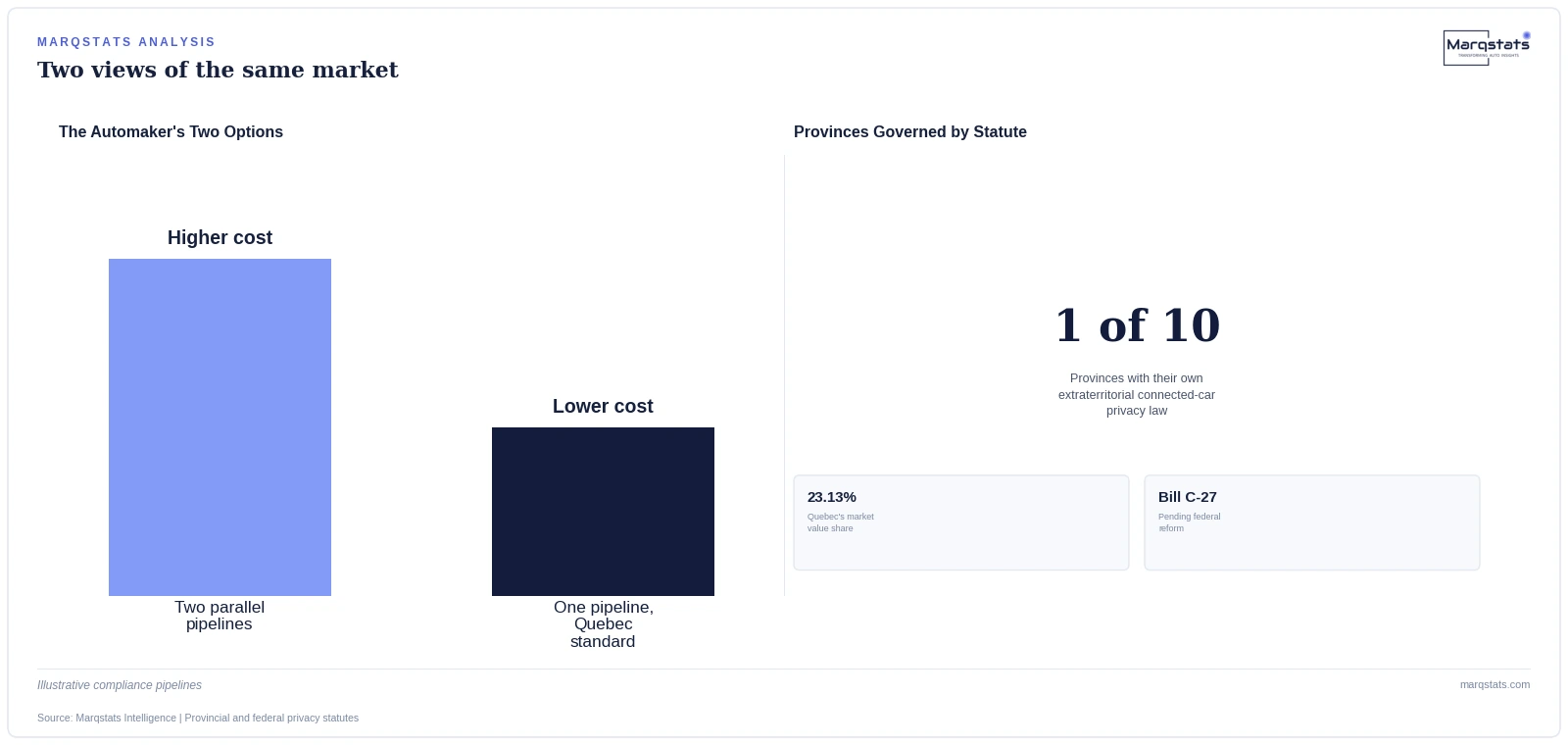
An automaker selling connected vehicles in Quebec faces a binary decision, not a spectrum. Building a Quebec-specific data pipeline — separate consent flows, separate privacy impact documentation, separate data-localization infrastructure — adds engineering and compliance overhead that scales with every additional jurisdiction-specific requirement layered on top. Applying Law 25's stricter standard to all ten provinces means building one pipeline once. For most global automakers already managing similarly strict requirements under the EU's GDPR, extending an existing high-compliance architecture to cover Quebec is simpler than maintaining a parallel lighter-touch Canadian pipeline specifically for the other nine provinces.
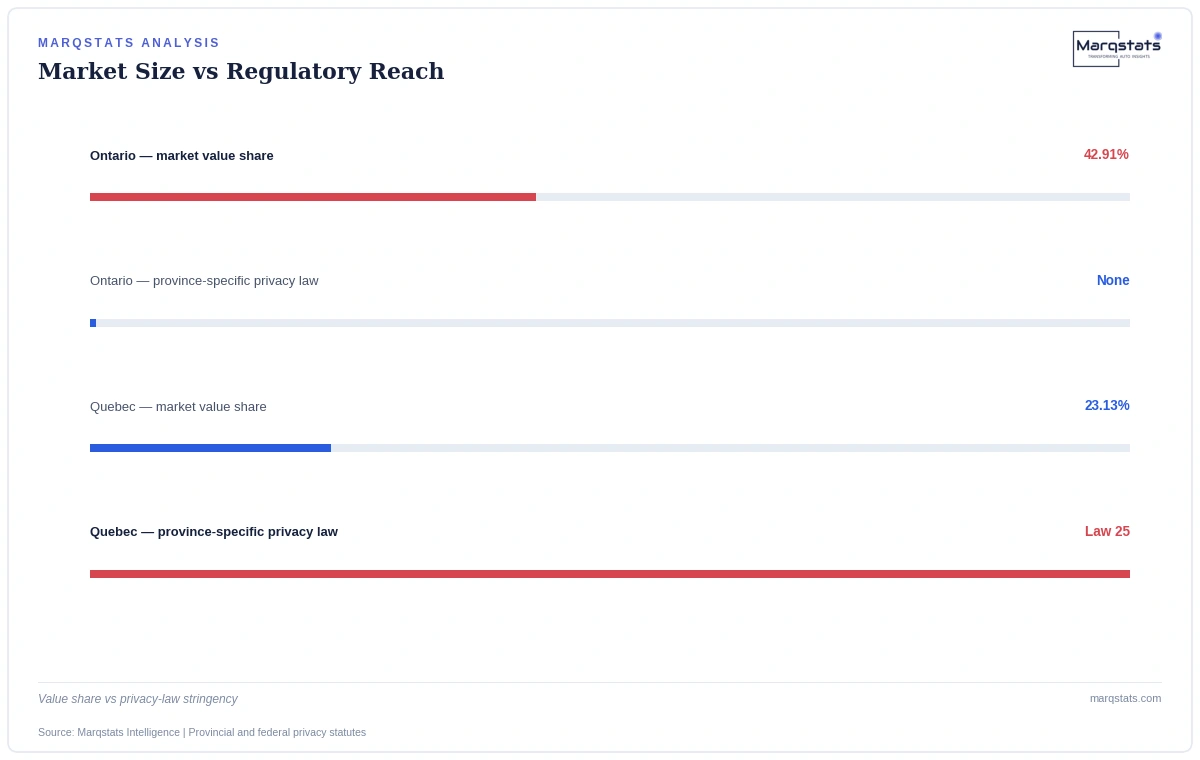
Quebec represents 23% of the market by value and effectively sets data-governance policy for 100% of it.
— Marqstats Analyst Team
Why Quebec Specifically, Not Ontario or BC
Ontario carries the largest share of Canada's connected-car market by value — 42.91% against Quebec's 23.13% — yet it is Quebec's law, not Ontario's larger market, that shapes national compliance architecture. That is because Ontario has not enacted an equivalent province-specific privacy statute; connected-vehicle data originating in Ontario falls under the federal PIPEDA framework, which does not impose Law 25's extraterritorial transfer restrictions. Regulatory stringency, not market size, is what determines which province's rules become the national de facto standard.
British Columbia presents a similar picture from a different angle: its 2024 Motor Vehicle Act amendments regulate automated-driving operation specifically, not data privacy, so BC's regulatory profile shapes automated-vehicle testing strategy without touching the telemetry-privacy question Law 25 governs. A single province can set the de facto national standard on one regulatory dimension while having no equivalent influence on another — Quebec on privacy, Ontario on manufacturing and testing infrastructure, BC on automated-driving permissions — and none of the three maps cleanly onto market size alone.
What Federal Reform Could Change
Bill C-27, incorporating the proposed Consumer Privacy Protection Act and Artificial Intelligence and Data Act, would establish a unified federal privacy baseline that could narrow the gap between Quebec's requirements and the rest of the country. This report's own Base Case scenario assumes federal privacy reform succeeds in tempering the regulatory friction Law 25 currently creates; its Downside Case assumes the opposite — that provincial privacy fragmentation persists or worsens, forcing automakers to disable connected features in specific jurisdictions rather than standardize nationally.
A Comparable Case: How the EU's GDPR Shaped Global Compliance
Quebec's de facto national reach mirrors a pattern already familiar from the EU's General Data Protection Regulation, which governs one regulatory bloc but has shaped data-handling practices for companies operating far outside Europe, simply because building GDPR-grade compliance once and applying it everywhere is cheaper than maintaining parallel lighter-touch systems elsewhere. Quebec's Law 25 is explicitly modelled on GDPR's structure, and automakers already managing GDPR compliance for their European operations often find extending that same architecture to cover Quebec a comparatively small incremental step — which is part of why Law 25's practical reach has extended well beyond its legal jurisdiction so quickly.
Which Automakers Have the Furthest to Go
The compliance burden is not evenly distributed across the automotive industry. Global manufacturers with existing GDPR-compliant architectures — typically European and increasingly Japanese and Korean OEMs selling into both markets — face a comparatively small incremental cost extending that framework to Quebec. Automakers whose primary compliance experience is built around the more permissive United States regulatory environment, where no equivalent federal privacy law exists, face a larger architectural gap to close, since they may be building Quebec-grade consent and data-localization capability from a much lower baseline.
What This Means for a Smaller Telematics Provider
A domestic Canadian telematics provider without a global GDPR-compliant architecture to extend faces the steepest relative cost in this entire compliance picture. Building Law 25-grade consent management and data-localization capability from scratch is a meaningful engineering investment for a smaller company, and it is also, increasingly, table stakes for selling into the Canadian market at all — not a competitive differentiator, but a cost of participation that larger, already-GDPR-compliant competitors absorb more easily. That dynamic favours consolidation and scale in the Canadian telematics software market over time, independent of any single provider's technical capability.
This is precisely the kind of structural cost that tends to reward incumbents with existing global compliance infrastructure over new entrants, regardless of how strong a new entrant's underlying telematics technology might be. A well-engineered product built by a small Canadian team still needs the same privacy-impact-assessment machinery a multinational competitor already has amortised across dozens of other jurisdictions, and that fixed cost does not shrink just because the underlying company is smaller.
A Named Comparison: How This Plays Out for Insurance
Usage-based insurance telematics, which relies on the same underlying vehicle telemetry this briefing has focused on, faces an identical compliance calculus. An insurer offering pay-how-you-drive policies to Quebec residents must build Law 25-compliant consent and data-handling infrastructure regardless of whether it operates nationally or only in Quebec, and the same economics that push automakers toward a single national architecture apply just as directly to insurers building driving-behaviour risk models on connected-vehicle data.
The Government Buyer Behind the Law
It is worth noting who actually enforces Law 25: the Commission d'accès à l'information, Quebec's provincial privacy regulator, rather than the federal Office of the Privacy Commissioner that oversees PIPEDA elsewhere in Canada. That means an automaker facing a Law 25 investigation deals with a different regulator, different enforcement priorities and a different penalty schedule than it would for an equivalent federal privacy matter — one more reason automakers prefer building a single compliant architecture rather than managing two separate regulatory relationships simultaneously.
Outlook: One Trigger, Not Three
This market does not support a three-scenario outlook on the privacy-compliance question specifically. The single evidenced trigger is whether Bill C-27 passes in a form that establishes a genuinely unified national baseline, or stalls, leaving Quebec's stricter standard as the only consistent national reference point automakers can build to with any real confidence.
Until that legislative outcome is known, the safest planning assumption for any automaker, carrier or telematics vendor entering the Canadian market is that Quebec's standard is the effective national floor, not a provincial exception — building to anything less risks a costly re-architecture later if federal reform stalls and provincial fragmentation is left to persist indefinitely across the remaining nine provinces and territories.