Use 22.61 million, not 31.436 million, as the base for China's connected cars
A connected car model for China should start from 22.61 million domestic passenger car sales in 2024, not the 31.436 million vehicles the China Association of Automobile Manufacturers (CAAM) headlines. The larger figure includes 3.873 million commercial vehicles and 4.955 million exported passenger cars. Choosing the wrong base moves an Asia Pacific total by 15%.
The error is easy to make because every figure is real. CAAM reported production of 31.282 million vehicles and sales of 31.436 million in 2024, up 3.7% and 4.5%, and the State Council and China Daily both carried the headline. Nothing in the release is wrong. The trouble starts when an analyst multiplies a fitment rate measured on Chinese buyers by a total that includes cars built for other countries.
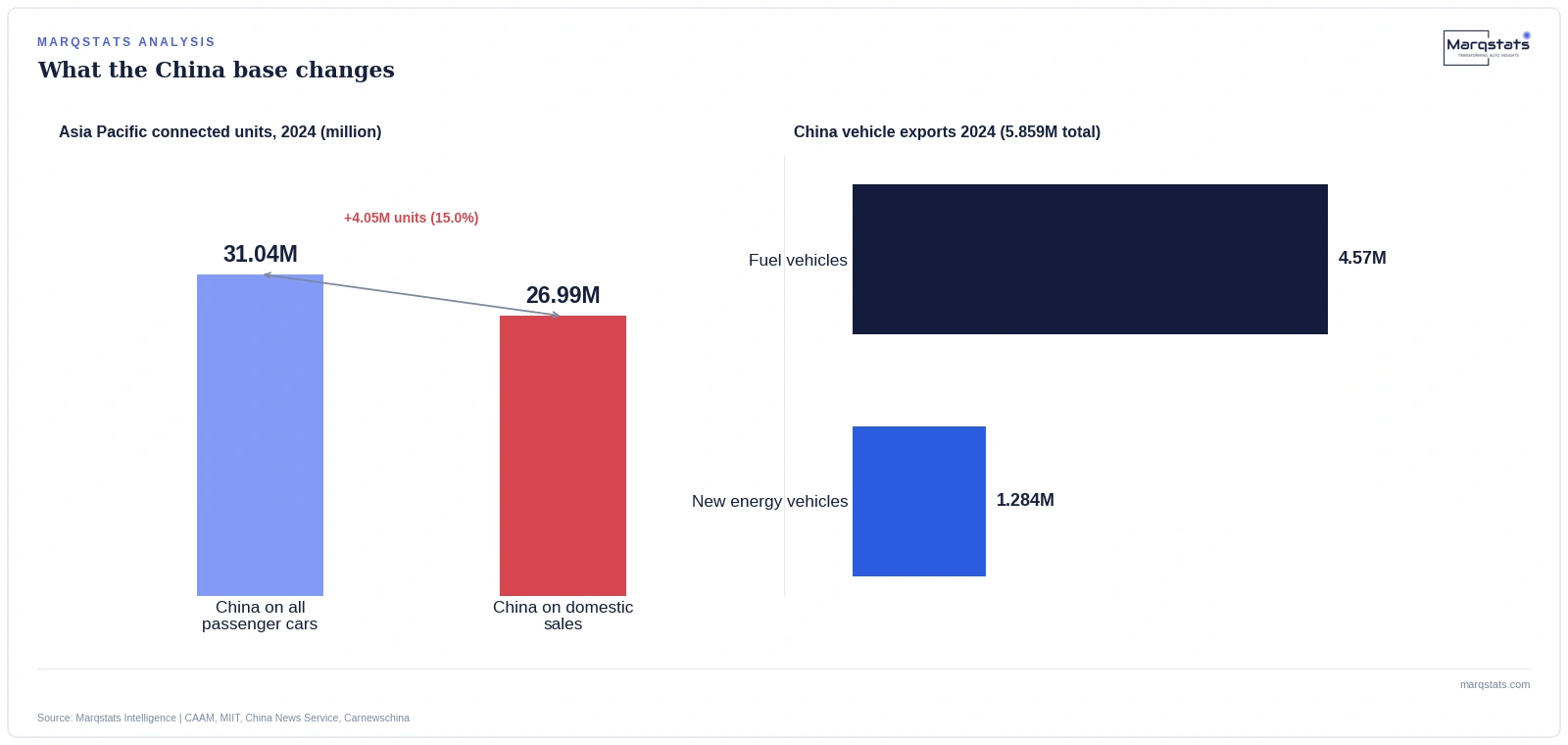
Marqstats applies its 81.80% fitment coefficient to the 22.61 million domestic figure only. Applying it to all 27.563 million passenger cars would add 4.05 million connected units to the Asia Pacific total, a 15.0% overstatement, and USD 1.16 billion of hardware revenue.
Four numbers describe 2024, and only one describes domestic demand
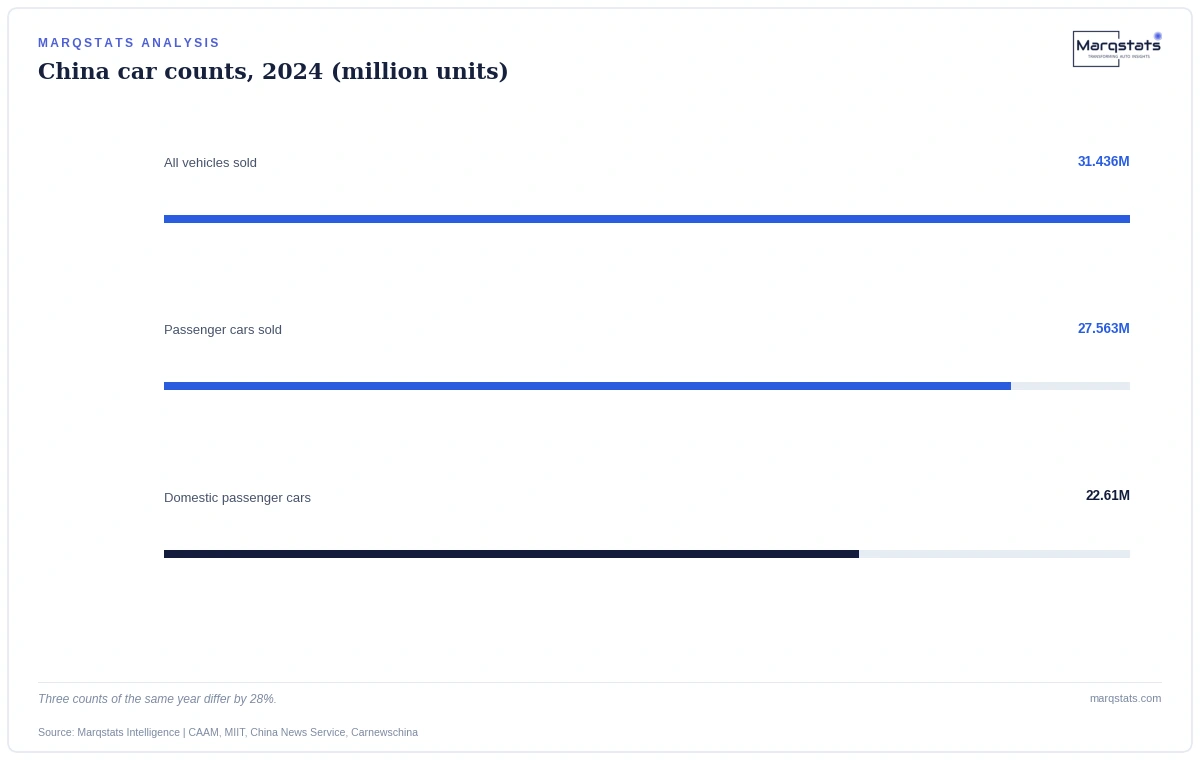
The ladder has three rungs. All vehicle sales were 31.436 million. Subtract 3.873 million commercial vehicles and passenger car sales were 27.563 million, up 5.8%. Subtract 4.955 million passenger cars exported and domestic passenger car sales were 22.61 million, up 3.1%. From top to bottom the count falls by 8.826 million, or 28.1%.
The lowest rung is the right base for any measure that depends on Chinese buyers, Chinese networks or Chinese regulation. A domestic buyer's car connects to a domestic carrier, stores data on a domestic cloud node and falls under Cyberspace Administration of China rules. An exported car does none of those things.
The choice of rung is not cosmetic. Apply the same 81.80% fitment coefficient to each base and the answer is 25.72 million, 22.55 million or 18.49 million connected cars. The spread between top and bottom is 7.22 million units for one year and one rate. A model that quotes only its output and not its base cannot be reconciled with any other, and a reader cannot tell which of the three was used.
Exports are growing six times faster than domestic sales, and they drive the growth
Passenger car exports grew 19.7% in 2024 against 3.1% for domestic passenger car sales, a ratio of 6.4 to 1. Total vehicle exports reached 5.859 million, up 19.3%. NCFChina calculated that exports supplied 949,000 of the 1.34 million vehicles added to Chinese sales between 2023 and 2024, about 70% of the increase.
The export mix is not what most models assume. Fuel vehicles made up 4.57 million of the exports, up 23.5%, and new energy vehicles 1.284 million, up 6.7%. BYD Company Limited exported 433,000 vehicles, up 71.8%, while Chery, SAIC Motor, Changan, Geely and JAC were among the top exporters that CAAM named. A model that treats every Chinese car as an electric, software-rich, connected vehicle is describing the domestic half of the market only.
The domestic half is also the more electric half, which matters for connected content. New energy vehicles were 40.9% of all Chinese vehicle sales in 2024, up 9.3 percentage points, at 12.866 million units. Removing the 1.284 million exported leaves 11.582 million on 25.577 million domestic vehicle sales, a share of 45.3% against 21.9% in exports. That is a Marqstats calculation from CAAM totals, and it shows that the cars carrying the most software are the ones that stay at home.
Domestic brands hold 65.2% of Chinese passenger car sales, with 17.97 million cars sold in 2024, up 23.1%, so the same manufacturers build the connected stack and control the customer. Exports move that content abroad only where a destination network, a data law and an activation process allow it.
A fitment rate measured on Chinese buyers cannot be applied to cars built for someone else's roads.
— Marqstats analysis
The 64.9% figure measures driver assistance on domestic cars, so it cannot size connectivity
The Ministry of Industry and Information Technology (MIIT) said in September 2026 that combined driver-assistance penetration in domestic passenger cars rose from 16.2% in 2020 to 64.9% in 2025, and that new energy vehicle sales grew from 1.367 million to 16.49 million over the same years. The figure is domestic by construction and it counts driver assistance, not embedded cellular modems.
Marqstats therefore treats it as a signal of software content, not as a connectivity rate. The Marqstats coefficient for China is 81.80% of domestic passenger car sales, which gives 18,494,980 connected units. That coefficient is a Marqstats construction applied to the CAAM domestic series, and the value model is more sensitive to it than to any other input.
MIIT's plan matters for the base as well as the rate. The 15th Five-Year Plan for the Development of the Intelligent Connected New Energy Vehicle Industry, issued as MIIT Joint Regulation Letter [2026] No. 305, sets 2030 targets of 70% new energy share of passenger car sales and 40% of commercial vehicle sales. Both are domestic targets, so any forecast that uses them should also use a domestic base.
One point of the China coefficient moves the region more than most countries do
Sensitivity shows why the base matters so much. On a 22.61 million domestic base, one percentage point of fitment is 226,100 connected cars, or 0.84% of the 26,990,432 units Marqstats counts for the region. That single point outweighs the entire connected base of some smaller markets in the study. It is also worth USD 64 million of hardware revenue at USD 285 of content per vehicle, a Marqstats construction.
The coefficient is a Marqstats construction and cannot be tested against a statutory count. The base can be tested, which is why Marqstats fixes it to CAAM's domestic ladder and lets the coefficient carry the uncertainty openly.
The strongest case for the larger base is a supply-side view, and it deserves an answer
A supplier of modules to Chinese assemblers can fairly say that exported cars are still connected cars built by Chinese firms, and that its revenue follows production, not domestic registration. On that view the correct base is 27.563 million passenger cars, and the Asia Pacific total would be 31.04 million units, 15.0% higher than Marqstats reports.
Marqstats disagrees for a demand-side market definition because exported cars are activated, billed and regulated in the destination country, and because the export fitment rate is likely to differ from the domestic one. The disagreement is one of purpose, not arithmetic. Both bases are correct for different questions, and a model should say which question it answers.
Match the base to the question before applying any rate
Three rules follow. Use 22.61 million for connected cars operating on Chinese networks. Use 27.563 million for passenger car supply and module demand. Use 31.436 million only for total industry output, which includes buses and trucks. Any published penetration rate should be checked for which of the three it was measured against.
A quick test helps when a third-party figure arrives without its definition. Ask what the numerator counts, whether the denominator includes commercial vehicles, and whether exports are inside it. If any of the three is unstated, treat the figure as unusable for connected car sizing until it is reconciled to CAAM's published ladder.