Automaker-run operators now sell 76.59% of South Korea's vehicle lines
In brief
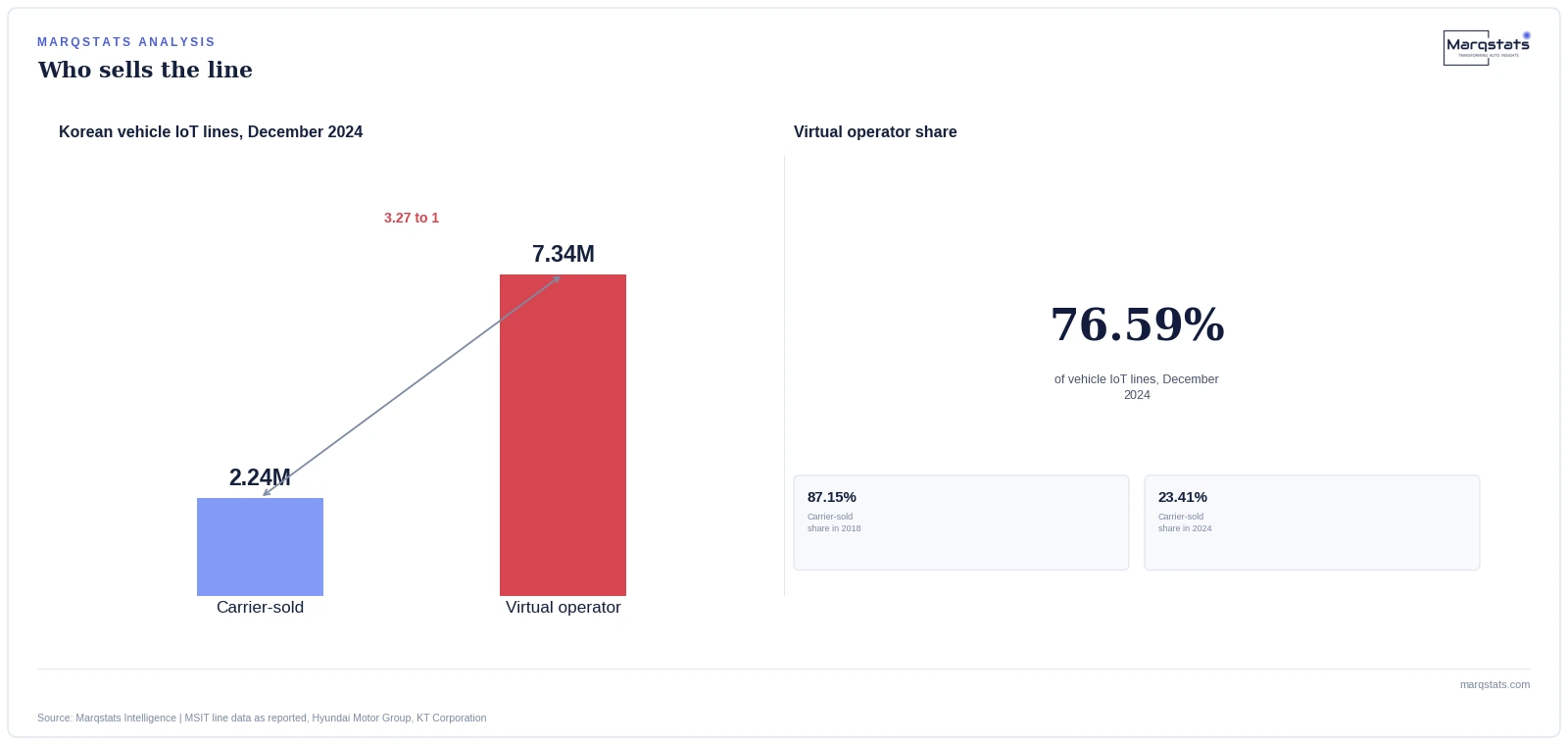
- The Ministry of Science and ICT (MSIT) counted 9,582,898 vehicle IoT lines in December 2024. Of these, 7,340,000 (76.59%) were mobile virtual network operator lines and 2,242,898 (23.41%) were sold by carriers.
- Carrier-sold lines grew 43.8%, from 1.56 million in 2018, while the whole market grew 435% from 1.79 million. Carriers lost share, not volume.
- The automaker now decides which carrier carries its traffic. In August 2026 KT Corporation retook the lead in virtual operator lines on its network after securing supply for Hyundai Motor Group's new vehicle lines.
South Korea's regulator publishes a vehicle-specific line count, which lets Marqstats measure who owns the customer. The answer changed on a single day in 2020. Since then the carriers, SK Telecom Co., Ltd., KT Corporation and LG Uplus Corp., have supplied the network while automakers have supplied the subscription, the billing and the customer relationship.
The switch happened on one date, 10 September 2020
On 10 September 2020 MSIT announced that Hyundai Motor Company and Kia Corporation had changed their registration to mobile virtual network operators. Hyundai took the KT Corporation network and Kia the SK Telecom network. At the end of July 2020, automakers running vehicle control services this way, including Hyundai, Kia, Mercedes-Benz Korea, Renault Samsung, SsangYong and Tesla Korea, carried 1.4 million lines. BMW and the Audi and Volkswagen group still served Korean cars through roaming on foreign carriers.
Set against the 7.34 million operator lines of December 2024, that is a rise of 5.2 times in four years and five months. The two counts come from different MSIT releases and Marqstats treats the comparison as indicative, not exact. The direction is not in doubt.
Regulation helped automakers become operators, and it did so deliberately
The 2020 announcement was not only a registration. MSIT said at the time that it would expand its data pre-purchase system and its volume-purchase discounts, which lower the wholesale price a virtual operator pays, so that voice-focused budget operators could extend into data-only business for automakers and other non-telecom companies. Policy therefore lowered the cost of the very move that shifted the customer.
Mercedes-Benz Korea, Renault Samsung, SsangYong and Tesla Korea were already delivering vehicle control services as virtual operators when Hyundai and Kia registered. The structure that resulted has three parts: automakers that own the subscription, carriers that own the network, and foreign brands such as BMW and the Audi and Volkswagen group that still roam on overseas carriers.
The line count took off in the years after the registration
On the MSIT series as reported, Korean vehicle IoT lines rose from 1.79 million in 2018 to 2.52 million in 2020, 7.46 million in 2023 and 9.58 million in 2024, a compound rate of 32.26% a year over six years. The steepest stretch was 2020 to 2023, when lines grew 2.96-fold, and 2024 added 28.4%. That timing is consistent with automakers scaling connected services once they owned the subscription.
Consistency is not proof. Rising 4G coverage, new vehicle platforms and the spread of over-the-air services all pushed lines up in the same years. Marqstats reads the registration as an enabling condition, not as the sole cause, and the ownership split is the part that the data show directly.
Carriers were not displaced; they were re-priced from retailer to wholesaler
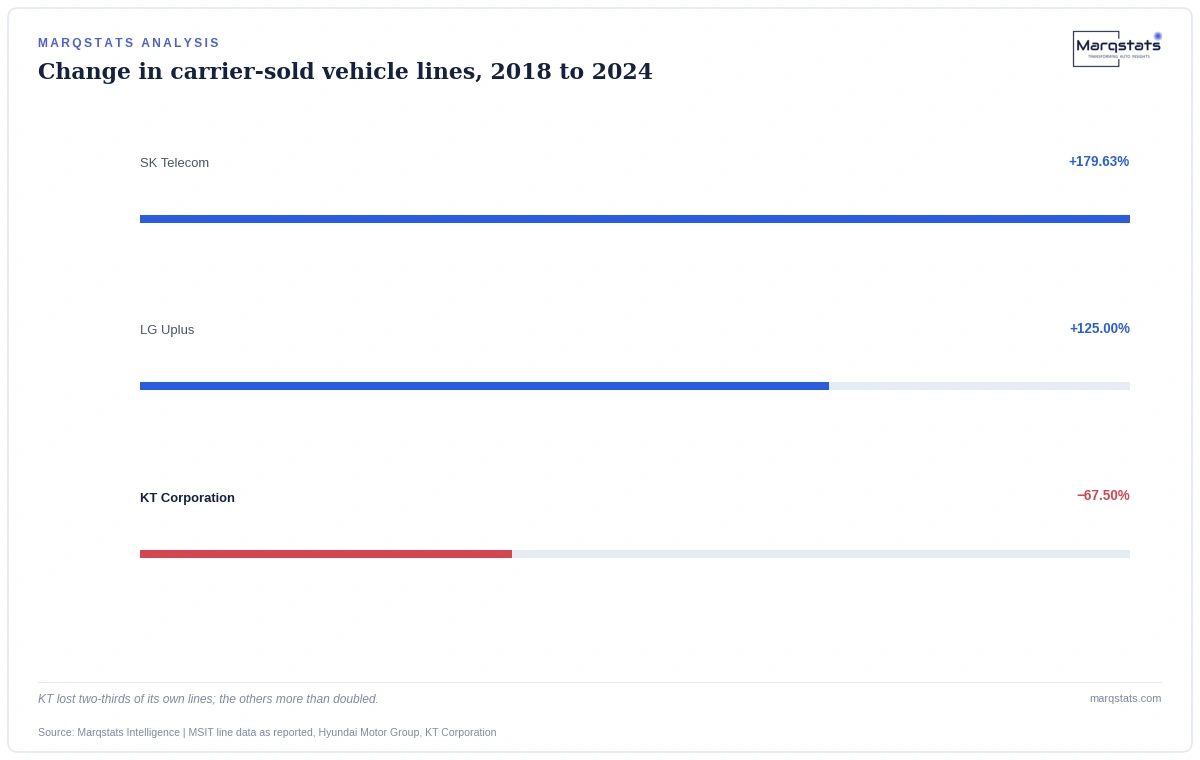
The line-by-line record from MSIT, as reported, shows why the picture is often misread. KT Corporation's own vehicle lines fell 67.5%, from 800,000 in 2018 to 260,000 in December 2024. SK Telecom rose 179.63% to 1,510,000 and LG Uplus rose 125.00% to 450,000. The three carriers together hold 2,220,000 lines against a carrier-sold total of 2,242,898, so 22,898 lines are unallocated in the published series and Marqstats does not assign them.
KT's fall is the automaker effect in miniature. The 2020 registration put Hyundai's lines on KT's network under Hyundai's own billing, so KT's own vehicle lines fell while the traffic stayed. Which carrier carries Hyundai's lines has since moved, as the August 2026 data shows.
The automaker, not the carrier, now decides who carries the traffic
In August 2026 carrier line data showed KT Corporation retaking the lead in virtual operator lines carried on its network, after net additions of more than 300,000 lines in each of four consecutive quarters. LG Uplus Corp. recorded two consecutive quarters of net decline after losing the Hyundai contract to KT. The decisive factor was KT securing exclusive supply for Hyundai Motor Group's new vehicle lines the year before.
The line counts in that report cover all virtual operator lines, including phones and machine-to-machine lines, so they are not a vehicle count. The mechanism is the finding. A single automaker's wholesale award moved a carrier from second to first, and moved another into decline, within four quarters.
Reading across the two dates, the automaker has three things a carrier does not. It has the customer's account, so it sets the subscription price. It has the vehicle platform, so it decides which modem and SIM go in. And it has the contract, so it can move a whole model line from one network to another without asking the driver. Each one is a form of control, and none of them depends on owning a tower.
Lines, subscribers and paying subscribers are three different counts
MSIT counts lines. Hyundai Motor Group counts registered subscribers. Paying subscribers after the complimentary trial are a Marqstats estimate. A reader who mixes the three can reach any conclusion, and Marqstats keeps them apart. The 9,582,898 lines are a network measure, the 10 million subscribers are a registration measure, and the revenue case rests on the third.
The strongest counter-argument is that carriers still win on revenue
Wholesale revenue is earned on every line whoever sells it, and reporting on the August 2026 data notes that connected car lines command higher per-line prices because they use more data. Carrier-sold lines also rose 43.8%. On that view carriers gave up a retail margin and kept the volume, and a fall in direct share is a change of business model, not a loss.
The evidence supports part of the argument and not the conclusion. The same reporting says KT's growth was concentrated in low-average-revenue IoT lines. And a wholesale price is set in a contract the automaker awards, so the carrier's revenue depends on a customer that can move a fleet. Marqstats reads that as a shift in pricing power from carrier to automaker.
Each party should act on who controls the contract
- Carriers should price for the automaker's connectivity team, not for the driver. Exclusive supply for a new vehicle line moved KT to the front of the table, so the award is the market.
- Automakers should treat the end of the complimentary trial as the point where an owned subscriber becomes revenue. Hyundai Motor Group counted 10 million subscribers in June 2023 and targets 20 million by the end of 2026, which needs 238,095 net additions a month, or 21.90% compound annual growth.
- Read the automaker's subscriber target against its own history. Hyundai Motor Group reached 5 million subscribers in August 2021 and 10 million in June 2023, a doubling in 22 months that annualises at 45.9%. Reaching 20 million by the end of 2026 needs only 21.90% a year, so the target assumes growth at less than half the earlier pace. Registered subscribers are cheap to add. Paying subscribers are the number that decides whether an owned customer is worth owning.
- Suppliers and investors should map exposure by contract, not by carrier share, because a single award reshuffled the ranking in four quarters.
Three indicators show whether the split is moving
- The next MSIT line release, which shows whether the virtual operator share stays above 70% of the 9,582,898-line base.
- Quarterly net line additions at KT Corporation and LG Uplus Corp., where more than 300,000 a quarter for four quarters marked the August 2026 shift.
- Hyundai Motor Group's year-end subscriber disclosure against its 20 million target, and whether it discloses paying subscribers for the first time.
Outlook: the split holds unless a named contract moves
Marqstats expects virtual network operators to remain above 70% of Korean vehicle IoT lines at the next MSIT release, and holds that view with high confidence because the registrations date from 2020 and the awards keep flowing to operators. The observable trigger is the next wholesale award by Hyundai Motor Group, after which the quarterly line additions of KT and LG Uplus show who won.
No second trigger is evidenced. There is no record of an automaker moving a fleet back to carrier-sold plans, so Marqstats does not build a downside case for the ownership split. The Korean line counts are MSIT figures as reported and are not independently verified by Marqstats.