Market Snapshot
Middle bar: base-year value × (1 + CAGR), rounded to two decimals. This is a calculated illustration, not a separately researched annual estimate.
The global in-vehicle infotainment (IVI) market was valued at USD 24.50 billion in 2025 and is projected to reach USD 38.80 billion by 2030, expanding at a CAGR of 9.62% during the forecast period 2026–2030. IVI is no longer a discrete dashboard screen category. It is a regulated digital services stack encompassing vehicle hardware, embedded operating systems and app runtimes, identity and payment integration, persistent connectivity, backend cloud services, and over-the-air (OTA) lifecycle operations. This stack is increasingly governed by law—data access regulation (EU Data Act applicable from September 2025), privacy frameworks, and type-approval regimes (cybersecurity under UN R155, software update management under UN R156)—and by competitive pressure from smartphone ecosystems seeking deeper cockpit integration.
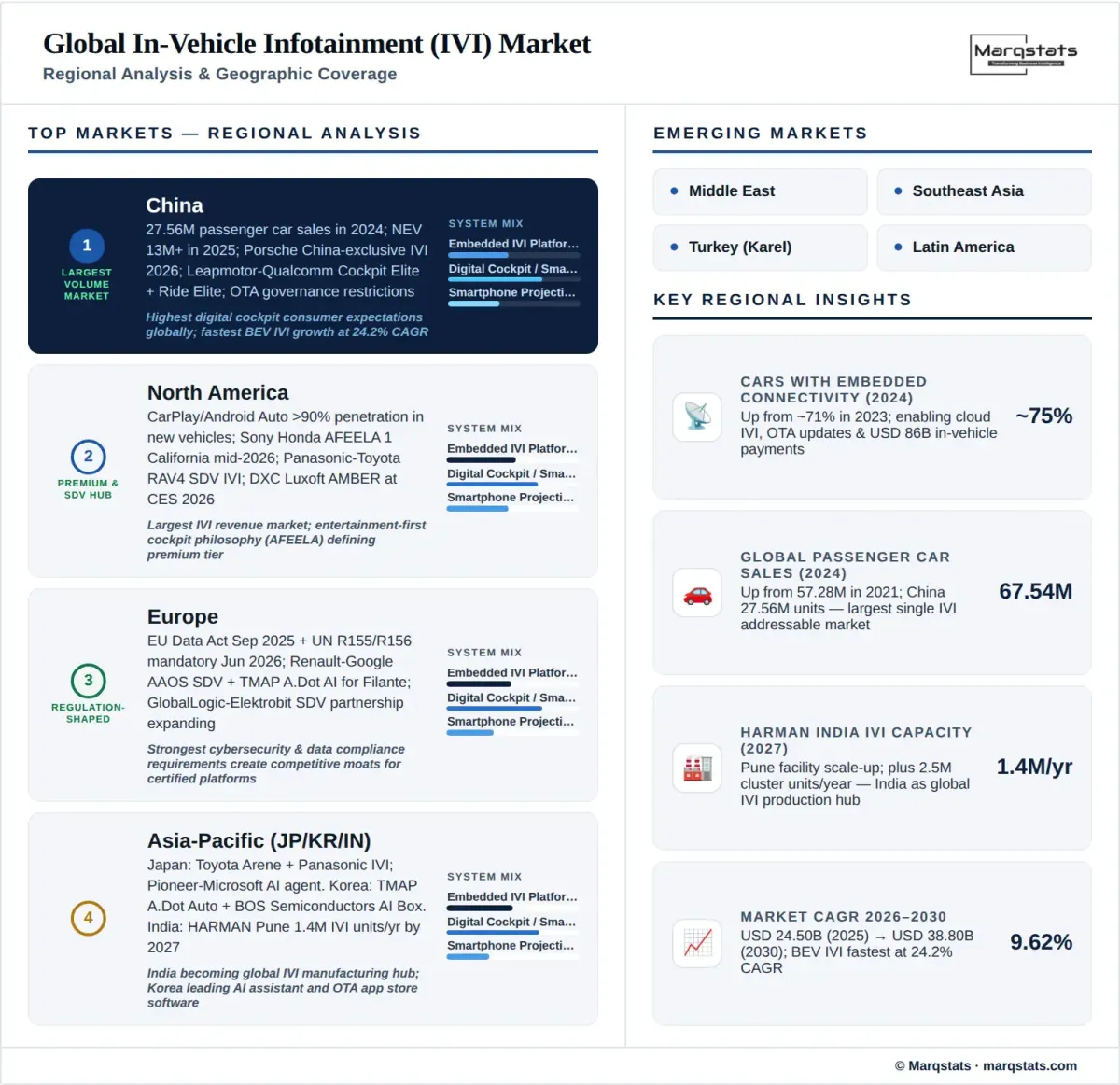
The addressable annual new-vehicle base continues to expand: global passenger car sales rose from 57.28 million units in 2021 to 67.54 million in 2024, with China alone growing from 21.52 million to 27.56 million units. In 2024, approximately 75% of cars sold had embedded cellular connectivity (up from 71% in 2023), expanding the installed base for cloud-connected IVI, OTA feature delivery, and telematics-linked services. The competitive centre of gravity is shifting from head unit hardware toward platform and ecosystem control: OS choice, app frameworks, cloud integration, and AI-powered personalisation now dominate differentiation and lifecycle monetisation. Google announced in March 2026 that it will release AAOS SDV—an open-source Android Automotive OS for Software-Defined Vehicles—developed with Renault and Qualcomm, extending IVI platform capabilities beyond infotainment to body control, climate, seating, and lighting.
Central compute architectures are becoming mainstream because they reduce ECU fragmentation and improve OTA consistency, but they increase cybersecurity and functional safety compliance burden. Consumer preference for smartphone ecosystems remains powerful: Apple’s CarPlay Ultra began rolling out in 2025 with Aston Martin, expanding beyond the centre display into deeper cockpit integration including instrument cluster and environmental controls. This strategic tension—OEMs wanting UI control and recurring revenue versus consumer ecosystems demanding deeper integration—defines the IVI competitive landscape for 2026–2030.
Key Takeaways
Market Overview & Analysis
Report Summary
The in-vehicle infotainment market encompasses cockpit-facing hardware and software delivering navigation, media, voice and agent interfaces, connectivity services, and app ecosystems. In modern software-defined vehicles, IVI increasingly shares compute with instrument cluster, head-up display, and ADAS domains through central computer or cockpit domain controller architectures. The market covers embedded IVI platforms, smartphone projection systems (Apple CarPlay, Android Auto), digital cockpit solutions, cockpit domain controllers, AI-powered voice and contextual assistants, premium audio and rear-seat entertainment, OTA update infrastructure, and the semiconductor and middleware supply chain that underpins these systems.
The IVI market should be analysed as a regulated digital services stack rather than a standalone hardware category. On the demand side, IVI feature adoption is pulled by consumer expectations: large high-definition displays, voice assistants, streaming content, personalised profiles, and seamless smartphone integration. On the supply side, the economic centre of gravity is shifting toward SoC and platform providers and software middleware vendors capable of supporting multi-display, multi-domain workloads and secure updates. Qualcomm’s 2025–2026 announcements emphasise centralised computing and SDV developer tooling, signalling that major silicon players see IVI as a long-cycle platform business rather than a one-off component sale.
Monetisation via subscriptions is constrained by user backlash and conversion limits; many OEM strategies are evolving toward mixed models combining bundled trials with optional paid tiers or one-time feature unlocks. In-vehicle payment volumes are projected to reach USD 86 billion by end-2025, with 56% of drivers prioritising payment capabilities among connected car features. The integration of vehicle telematics with third-party services enables predictive maintenance, usage-based insurance, and personalised recommendations that extend beyond traditional automotive boundaries. However, regulatory constraints—EU Data Act, China’s OTA governance restrictions, and UK R155/R156 type approval requirements—increasingly shape what is feasible and profitable.
Market Dynamics
Key Drivers
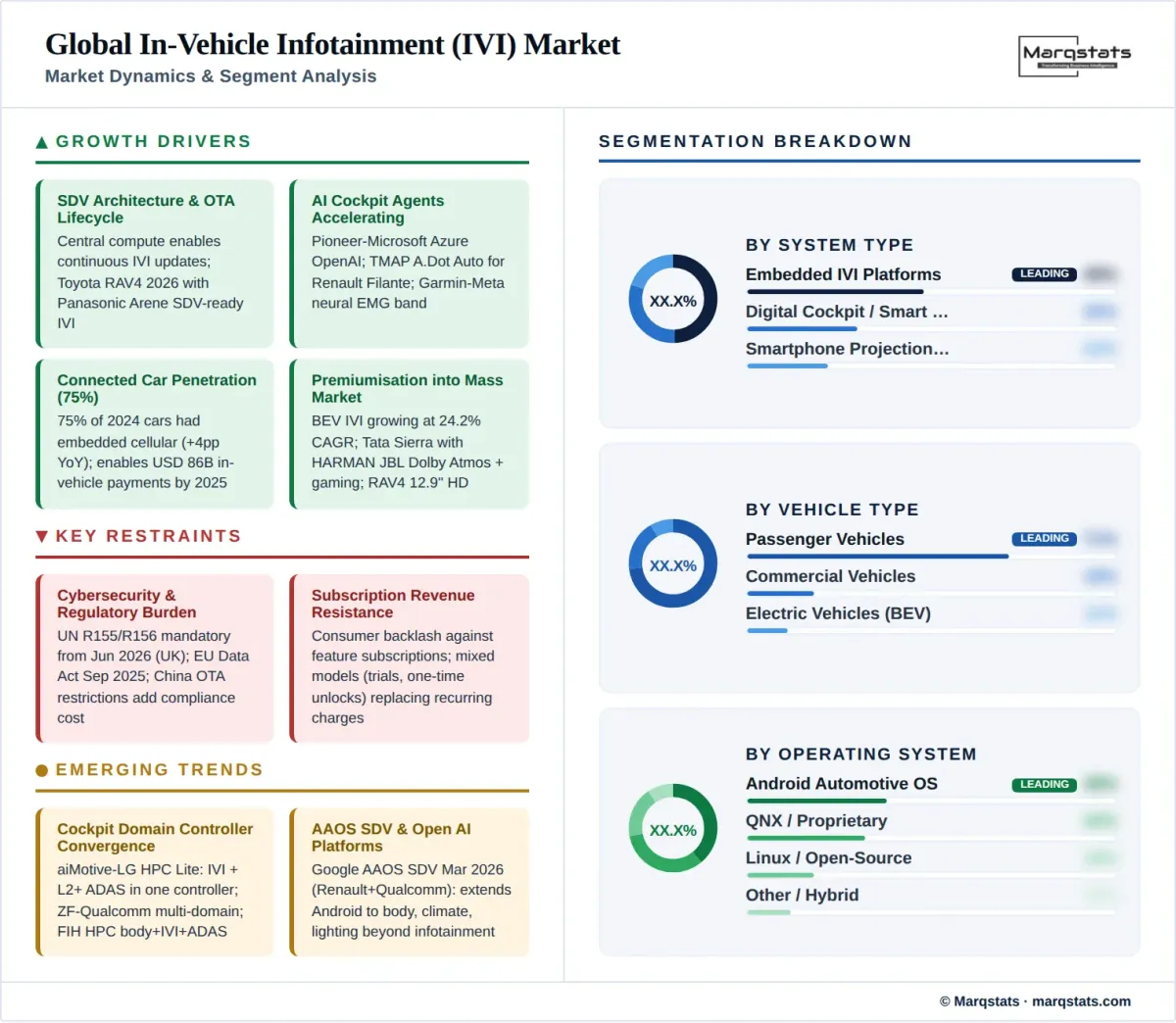
- Software-defined vehicle architecture enabling continuous IVI evolution: The transition from fixed-function ECUs to centralised compute platforms enables IVI systems to receive continuous feature updates, bug fixes, and new application deployments throughout the vehicle lifecycle. Toyota’s adoption of its Arene software platform in the 2026 RAV4—with Panasonic Automotive Systems (rebranding to Mobitera in April 2027) providing the IVI system—demonstrates how major OEMs are building SDV-ready infotainment architectures that support OTA updates to both multimedia and ADAS functions.
- AI-powered cockpit experiences transforming user interaction: AI voice assistants and contextual agents are moving from simple voice commands to proactive, personalised in-cabin experiences. Pioneer developed an AI agent with Microsoft Foundry integrating Azure OpenAI for natural voice control of air conditioning, navigation, music, and messaging across entry-to-premium vehicles. TMAP Mobility’s A.Dot Auto AI agent for the Renault Filante analyses driving history and location to provide personalised guidance. Garmin and Meta’s neural band proof-of-concept enables gesture-based infotainment control via electromyography. Liquid AI joined SOAFEE to scale efficient on-device AI for infotainment and navigation.
- Android Automotive OS expansion creating open platform ecosystem: Google’s March 2026 announcement of AAOS SDV—an open-source Android Automotive platform for software-defined vehicles developed with Renault and Qualcomm—extends IVI capabilities to body control, climate, seating, and lighting. Karel in Turkey developed the first domestically produced Android IVI system for Ford F-MAX trucks, entering mass production in 2025. This expansion of Android Automotive from infotainment into broader vehicle control creates a platform ecosystem analogous to mobile, attracting app developers and service providers.
- Premiumisation extending advanced IVI beyond luxury segments: Advanced cockpit features including large HD displays, premium audio (Dolby Atmos, JBL, Harman), rear-seat entertainment, and connected services are migrating from luxury vehicles into mass-market segments. The 2026 Toyota RAV4 features a 12.9-inch HD display, wireless CarPlay/Android Auto, cloud navigation, and ADAS-integrated camera recording. The Tata Sierra SUV integrates HARMAN Ready Connect TCU, JBL 12-speaker Dolby Atmos audio, gaming support with controller compatibility, and Surround View System. This premiumisation expands the addressable market significantly.
- Connected car penetration enabling data-driven services: With 75% of cars sold in 2024 having embedded cellular connectivity, the installed base for cloud-connected IVI services is growing rapidly. Connected features enable predictive maintenance, usage-based insurance, personalised recommendations, in-vehicle payments (projected USD 86 billion by 2025), and contextual advertising. BEVs demonstrate the highest infotainment growth potential at 24.2% CAGR to 2030, driven by inherent dependency on sophisticated systems for energy management, charging optimisation, and range display.
Key Restraints
- Cybersecurity and regulatory compliance increasing development costs: UN R155 (cybersecurity) and R156 (software update management) become mandatory from June 2026 for new vehicle types in the UK. China restricted OTA updates to driver-assistance software without government approval. The EU Data Act (applicable September 2025) creates data-access obligations for connected products including vehicles. These regulatory layers increase development costs, certification timelines, and ongoing compliance burden for OEMs and suppliers.
- Consumer subscription resistance limiting recurring revenue models: OEM attempts to monetise IVI features through subscriptions face consumer pushback. Many drivers view navigation, remote start, and heated seats as features that should be included in the purchase price rather than recurring charges. OEM strategies are evolving toward mixed models (bundled trials, one-time unlocks, tiered services), but the subscription monetisation thesis remains unproven at scale.
- Smartphone ecosystem competition constraining OEM platform control: Apple CarPlay Ultra’s expansion into instrument cluster and environmental controls directly challenges OEM ambitions for exclusive UI ownership. Consumers overwhelmingly prefer their phone ecosystem experiences, creating pressure for deeper smartphone integration. OEMs face a strategic dilemma: resisting projection to maintain data and revenue control versus embracing it to meet consumer demand and competitive benchmarks.
- Automotive-grade semiconductor availability and certification timelines: IVI roadmaps can be delayed by compute availability (automotive-grade SoCs) and certification timelines. The shift toward centralised cockpit domain controllers increases dependency on advanced SoCs from Qualcomm, Samsung, NXP, and others, with lead times of 12–18 months for automotive qualification. BOS Semiconductors’ AI Box concept—an external AI computing module allowing OEMs to add AI capabilities without replacing existing IVI systems—addresses this constraint for facelifted models.
Key Trends
- Cockpit domain controller convergence integrating IVI, ADAS, and cluster: aiMotive and LG unveiled an HPC Lite platform at CES 2026 integrating IVI and ADAS in a single controller with Level 2+ automated driving and advanced HMI. FIH (Foxconn) presented an HPC platform supporting body control, IVI, and ADAS integration using zone control units. ZF and Qualcomm partnered on a scalable ADAS solution combining ZF ProAI with Snapdragon Ride, with plans for multi-domain mixed-criticality IVI/ADAS solutions. This convergence reshapes the supplier landscape from module providers toward platform integrators.
- Open automotive AI cockpit platforms challenging proprietary systems: MUTUALISM, an open automotive AI cockpit initiative led by iNAGO, selected Ottawa Infotainment’s DragonFire Pro as hardware partner for a mid-2026 large-scale initiative. DXC Luxoft launched AMBER, a next-generation automotive software platform with modular components for infotainment, instrument clusters, and connectivity at CES 2026. GlobalLogic expanded its partnership with Elektrobit to accelerate SDV platform development including IVI systems. These open platform initiatives offer OEMs alternatives to closed proprietary stacks.
- Regional IVI differentiation accelerating, especially China: Porsche announced a next-generation IVI system exclusively for the Chinese market in 2026, reflecting how Chinese consumer expectations for digital cockpit features exceed global baselines. China’s passenger car sales reached 27.56 million in 2024, making it the largest single market for cockpit platform volume. Chinese OEMs like Leapmotor partnered with Qualcomm on central computers combining Snapdragon Cockpit Elite and Ride Elite platforms, illustrating cockpit/ADAS convergence at Chinese manufacturing speed.
- AFEELA 1 and Sony Honda signalling entertainment-first cockpit design: Sony Honda Mobility initiated trial production of AFEELA 1 in January 2026, with Quality Gate inspections specifically verifying IVI system operation, sensor functionality, and connectivity stability alongside traditional manufacturing quality. AFEELA represents an entertainment-first cockpit philosophy where the infotainment system is a core brand differentiator rather than a commodity module, targeting California deliveries mid-2026.
Market Segmentation
Embedded IVI systems run natively on the vehicle’s compute hardware using automotive operating systems (Android Automotive OS, QNX, Linux, proprietary). These platforms offer deep vehicle integration, support OTA updates, and enable recurring service monetisation. Google’s AAOS SDV announcement extends embedded platforms beyond infotainment to body and cabin control. Embedded platforms are increasingly the strategic choice for OEMs seeking data ownership and UI control.
Apple CarPlay and Android Auto project smartphone apps onto the vehicle display. CarPlay Ultra’s 2025 rollout expands projection into instrument cluster and environmental controls, blurring the boundary between projection and embedded. The strategic tension between OEM-controlled embedded platforms and consumer-preferred projection ecosystems defines the competitive landscape. VNC Automotive’s Cobalt Link+ launched at CES 2026 adds CarPlay and Android Auto to SPARQ OS-powered IVI systems, reflecting demand for coexistence rather than exclusive choice.
Digital cockpit solutions integrate multiple displays (centre, cluster, HUD, rear-seat), voice/AI assistants, and driver monitoring into a unified cockpit experience managed by a cockpit domain controller. The aiMotive-LG HPC Lite platform (IVI + ADAS in single controller), FIH’s HPC platform (body + IVI + ADAS), and Qualcomm’s Snapdragon Cockpit platforms represent this convergence. HARMAN’s expanded infotainment production capacity in India (1.4M IVI units/year by 2027, 2.5M cluster units/year by 2027) indicates Tier-1 scaling for this segment.
Passenger vehicles represent the primary IVI market, with global sales of 67.54 million units in 2024. The premiumisation trend is driving advanced IVI features (large displays, AI assistants, premium audio, connected services) from luxury into mass-market segments. BEVs show the highest IVI growth potential at 24.2% CAGR, driven by inherent dependency on sophisticated infotainment for energy management, charging, and range optimisation. The Toyota RAV4-Panasonic SDV-ready IVI system and Tata Sierra-HARMAN integration illustrate mass-market premiumisation.
Commercial vehicle IVI is a growing segment driven by fleet telematics integration, driver productivity, and regulatory compliance. Karel’s Android IVI system for the Ford F-MAX truck (entering mass production 2025) demonstrates the extension of smartphone-grade infotainment into heavy-duty commercial vehicles. Commercial IVI systems increasingly integrate with fleet management, route optimisation, and driver behaviour monitoring. Global commercial vehicle sales reached 27.77 million units in 2024.
By Geography
China
China is the largest single IVI market with 27.56 million passenger car sales in 2024. Chinese consumers demand the most advanced digital cockpit features globally, pushing OEMs to localise IVI development. Porsche announced a China-exclusive next-generation IVI system for 2026. Leapmotor-Qualcomm’s central computer combining Cockpit Elite and Ride Elite platforms was presented at CES 2026. China’s OTA governance—restricting updates to driver-assistance software without approval—shapes how OEMs deploy and manage IVI features. China’s NEV sales topped 13 million in 2025, creating a massive and growing BEV IVI addressable market.
Europe
Europe is the most regulation-shaped IVI market. The EU Data Act (applicable September 2025) creates data-access obligations for connected vehicles. UK type approval incorporates UN R155 (cybersecurity) and R156 (software updates) with mandatory dates from June 2026. Apple CarPlay Ultra launched with Aston Martin in the US/Canada. Renault partnered with Google on AAOS SDV and with TMAP Mobility on AI-powered IVI for the Filante. GlobalLogic-Elektrobit expanded their SDV partnership. Europe’s emphasis on data privacy and cybersecurity compliance creates both barriers and competitive moats for IVI platform providers.
North America
North America is defined by smartphone ecosystem dominance (CarPlay/Android Auto penetration exceeding 90% in new vehicles), premium vehicle demand, and the emerging SDV transition. Panasonic Automotive Systems’ IVI debuted in the 2026 Toyota RAV4 across North American dealerships. Sony Honda Mobility’s AFEELA 1 began trial production in Ohio with California deliveries planned mid-2026. Garmin provides IVI solutions to BMW, Ford, Honda, Mercedes-Benz, Nissan, and Toyota. DXC Luxoft launched AMBER at CES 2026. The US represents the largest single-country IVI revenue market.
Asia-Pacific (Japan, South Korea, India)
Japan’s IVI market is shaped by Toyota’s Arene SDV platform adoption (RAV4 with Panasonic IVI) and Pioneer’s AI agent development with Microsoft. South Korea’s TMAP Mobility provides IVI services for Renault Korea’s Filante with AI agent and OTA app store. BOS Semiconductors (Korea) showcased the AI Box external computing module at CES 2026. India is emerging as a manufacturing hub: HARMAN expanded IVI production in Pune (1.4M units/year by 2027) and supplies the Tata Sierra. TMAP’s ADAS maps and A.Dot AI agent demonstrate Korea’s IVI software and services leadership.
How Competition Is Evolving
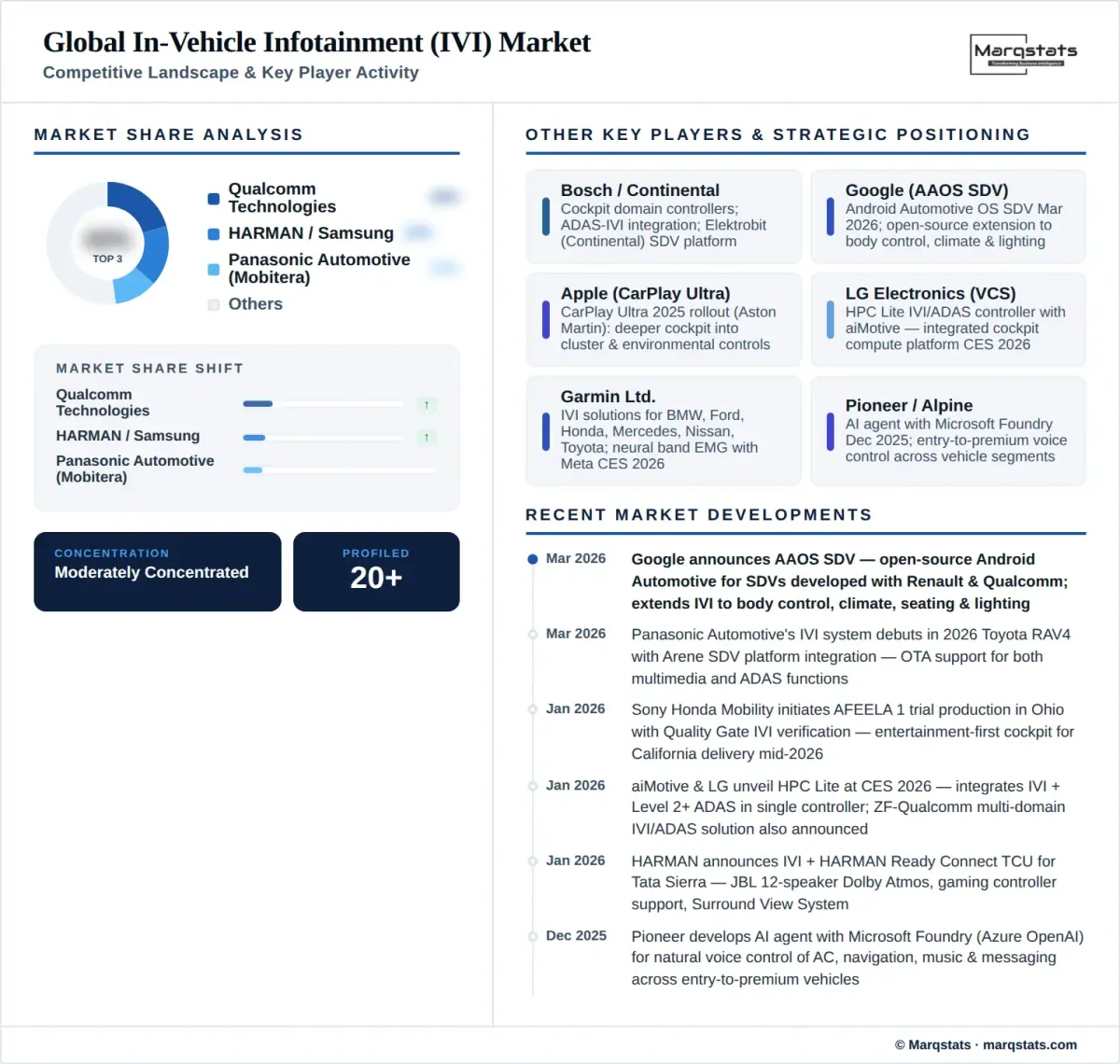
The IVI competitive landscape operates across four layers: semiconductor and compute platform providers, Tier-1 cockpit system integrators, automotive OS and software platform players, and app ecosystem providers. Among silicon suppliers, Qualcomm dominates with Snapdragon Cockpit and Ride platforms, including the Leapmotor central computer and ZF ProAI collaboration. Among Tier-1 integrators, Panasonic Automotive Systems (rebranding to Mobitera), HARMAN International (Samsung), Bosch, Continental, and DENSO are scaling cockpit domain controller and IVI production. LG and aiMotive’s integrated IVI/ADAS controller and FIH’s (Foxconn) HPC platform signal new entrants from consumer electronics into automotive cockpit.
On the software platform layer, Google’s AAOS SDV expansion, Apple’s CarPlay Ultra deepening, and QNX/BlackBerry’s Alloy Kore (evaluated by Mercedes-Benz) define the OS competitive dynamics. DXC Luxoft’s AMBER, GlobalLogic-Elektrobit’s SDV partnership, and MUTUALISM’s open AI cockpit initiative represent middleware and integration platforms. Pioneer’s AI agent with Microsoft, TMAP’s A.Dot AI, and Liquid AI’s SOAFEE membership indicate that AI assistant capability is becoming a core competitive differentiator. The market is evolving from hardware module competition toward platform control and user experience ownership, where the winners control the software stack, data flows, and monetisation layer rather than just the display module.
Companies Covered
Companies covered in the report include:
Recent Market Activity
Table of Contents
Coverage & Segmentation
This report provides a comprehensive analysis of the global in-vehicle infotainment market covering the historical period 2021–2025 and forecast period 2026–2030, with 2025 as the base year. The study examines market size in value (USD billion), segmented by system type (embedded IVI, smartphone projection, digital cockpit/smart cockpit), component (display, audio, navigation, communication, cockpit domain controller), operating system (Android Automotive, QNX, Linux, proprietary), vehicle type (passenger, commercial), and geography (China, Europe, North America, Asia-Pacific). The competitive landscape profiles 20 leading semiconductor providers, Tier-1 integrators, OS platforms, and software players.
Primary research includes structured interviews with 40+ industry stakeholders spanning IVI Tier-1 suppliers, semiconductor companies, automotive OS providers, OEM cockpit teams, AI/voice platform developers, and cybersecurity compliance specialists. Secondary research draws from OICA vehicle sales data, independent connectivity research, regulatory sources (EU Data Act, UK VCA R155/R156), CES 2026 announcements, and company disclosures. All market estimates represent Marqstats Intelligence proprietary calculations.