Market Snapshot
Middle bar: base-year value × (1 + CAGR), rounded to two decimals. This is a calculated illustration, not a separately researched annual estimate.
The India flex-fuel vehicle (FFV) market was valued at approximately USD 60 million in 2025 and is projected to reach USD 800 million by 2030, expanding at a CAGR of 67.88% over 2026–2030. The market is at a pre-commercial inflection in the base year, and growth is attributed to a decisive regulatory step-change: India achieved 20% ethanol blending (E20) in 2025, five years ahead of target, and granted 100% ethanol (E100) full legal recognition as an automotive fuel in June 2026 under rules framed by the Ministry of Road Transport and Highways.
Flex-fuel vehicles carry powertrains engineered to run on high ethanol blends from E20 through E85 and E100, requiring upgraded fuel lines, injectors, seals, and recalibrated engine control units. The first mass-market flex-fuel vehicles reached production in 2026, led by the Maruti Suzuki Wagon R Flex Fuel and Hero MotoCorp's flex-fuel motorcycles. Demand is increasing owing to statutory blending targets, excise-duty exemptions on E22 to E30 blends, and a structural ethanol surplus.
The India flex-fuel vehicle market spans two-wheelers, passenger vehicles, and commercial vehicles. Volumes remain modest through the late 2020s, consistent with OEM guidance, and the forecast is penetration-driven and scenario-sensitive. Market value is anchored in full-vehicle sales, with a per-vehicle flex-fuel hardware content increase of ₹40,000–50,000 for upgraded fuel systems and engine-control recalibration.
The base-year estimate reflects pilot fleets, early flex-fuel two-wheeler production, and government and OEM demonstration vehicles rather than large-scale retail sales. A larger inflection is expected beyond 2030 under a path toward ethanol parity with established flex-fuel markets, as set out in the NITI Aayog ethanol roadmap. Near-term adoption is governed by E85 and E100 retail availability, which expands from a small dispenser base toward a planned national network by the end of 2027.
The demand mathematics reinforce the direction of travel. Government estimates indicate that each one percentage point of flex-fuel adoption within a single ethanol-supply-year of petrol-vehicle sales translates into about 4 crore litres of additional ethanol demand and material foreign-exchange savings. On the consumer side, with E85 priced below E20, the payback on the flex-fuel vehicle premium is estimated at around three years. These economics, combined with a per-vehicle hardware content of ₹40,000–50,000, frame the market as a value opportunity that scales with penetration rather than with a single launch event.
Key Takeaways
Market Overview & Analysis
Report Summary
The India flex-fuel vehicle market covers vehicles with ethanol-capable powertrains spanning two-wheelers, passenger vehicles, and commercial vehicles, together with the flex-fuel hardware — fuel delivery systems, sensors, and recalibrated engine control units — that distinguishes them from conventional petrol vehicles. Scope covers vehicles capable of high ethanol blends from E20 through E85 and E100. Upstream ethanol supply is treated as a demand driver rather than as part of the market value, an adjacency to the Marqstats India passenger car market report.
India's ethanol blending programme is the structural foundation of the market. Blending rose from 1.53% in 2014 to 20% in 2025, and from April 2026 all petrol sold in India meets an E20 specification with a minimum RON of 95. The programme has saved an estimated ₹1.84 lakh crore in foreign exchange since 2014 and substituted a material share of crude imports, against an annual fossil-fuel import bill of about ₹22 lakh crore, according to Press Information Bureau data.
The vehicle side moved from prototype to production in 2026. The Maruti Suzuki Wagon R Flex Fuel became the first flex-fuel passenger vehicle in production, homologated for E85 and compliant with E100, while Hero MotoCorp introduced flex-fuel commuter motorcycles, an adjacency to the Marqstats India electric scooter and motorcycle market report. Growth is attributed to the alignment of fuel policy, vehicle availability, and a planned expansion of E85 and E100 retail infrastructure.
Market structure follows the penetration curve. In the base year, flex-fuel vehicles account for a fraction of a percent of new-vehicle sales, and the market value reflects early production and demonstration volumes. As mass-market platforms scale across two-wheelers and small cars, value is driven by the blend of high-volume commuter motorcycles and higher-priced passenger vehicles, together with the flex-fuel hardware content that each unit carries. This combination underpins the reconciled estimate of USD 60 million in 2025 rising toward USD 800 million by 2030, with the pace set by retail-infrastructure expansion and OEM launch cadence rather than by ethanol supply, which is already in surplus.
Market Dynamics
The India flex-fuel vehicle market is shaped by the interaction of three forces: a fuel-supply surplus that enables higher blends, a regulatory framework that legalises and incentivises them, and a vehicle-availability ramp that remains early. The dynamics below separate the policy and supply drivers from the infrastructure and affordability constraints that govern the pace of adoption.
Key Drivers
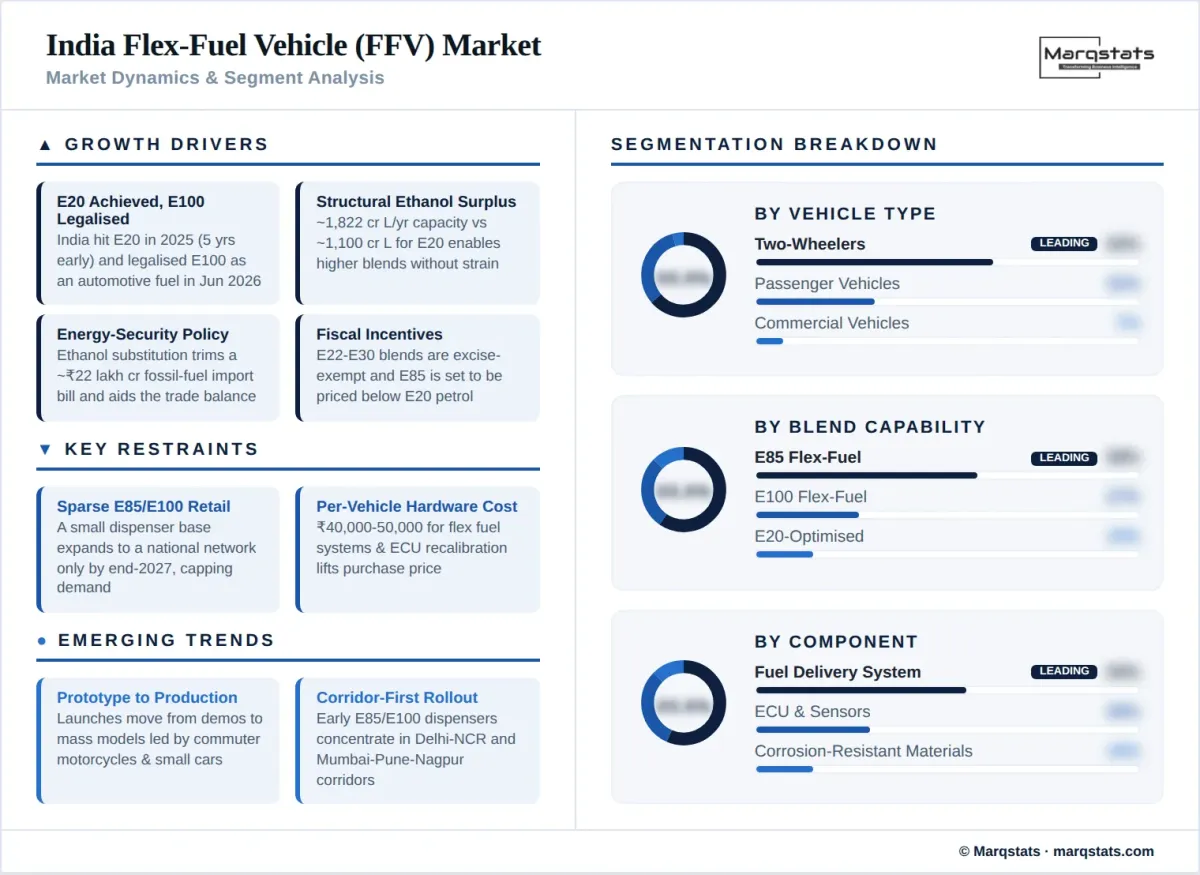
- Ethanol blending programme reached E20 in 2025, five years ahead of target, and the government has legalised E100, establishing a clear path from E20 to E27 and E100.
- Structural ethanol surplus, with production capacity of about 1,822 crore litres per year against roughly 1,100 crore litres needed for E20, enables higher blends without supply strain.
- Energy-security policy anchors the programme, as ethanol substitution reduces a fossil-fuel import bill of about ₹22 lakh crore per year and improves the trade balance.
- Fiscal incentives support adoption, as BIS-notified E22 to E30 blends are exempt from excise duty and E85 is set to be priced below E20 petrol.
- Farmer-income and rural-economy benefits reinforce political support, with an estimated ₹1.58 lakh crore paid to farmers under the programme since 2014.
Key Restraints
- Limited E85 and E100 retail availability, with a small dispenser base expanding toward a planned national network only by end-2027, constrains near-term adoption.
- Higher fuel consumption on high ethanol blends, owing to ethanol's lower energy content, raises running-cost concerns unless offset by favourable ethanol pricing.
- Per-vehicle hardware cost of ₹40,000–50,000 for flex-fuel fuel systems and ECU recalibration raises the purchase price relative to conventional models.
- OEM caution on volumes, with manufacturers indicating flex-fuel demand remains modest through the late 2020s and becomes material over a five-to-ten-year horizon.
Key Trends
- Migration from prototype demonstrations to production launches across two-wheelers and passenger vehicles, led by commuter motorcycles and small cars.
- Homologation to E85 with E100 compliance, allowing a single vehicle to run on any blend from E20 to E100 as fuel availability expands.
- Corridor-first retail rollout, concentrating early E85 and E100 dispensers in the Delhi-NCR and Mumbai-Pune-Nagpur corridors.
- Shift of ethanol feedstock toward grain and maize alongside sugar, broadening the supply base for higher blends.
Market Segmentation
Vehicle-type segmentation separates the mass-volume two-wheeler opportunity from the higher-value passenger-vehicle opportunity and the niche commercial-vehicle segment. Two-wheelers drive unit volume, while passenger vehicles anchor market value owing to higher average selling prices.
Two-wheelers represent the fastest route to volume, as flex-fuel commuter motorcycles reach mass-market price points. Hero MotoCorp's flex-fuel Splendor and HF Deluxe models, capable of E20 to E85, target the largest vehicle segment in India by units. The active two-wheeler fleet exceeds 300 million, and annual registrations surpassed 20 million in FY2026, giving the segment substantial reach. Owing to lower incremental hardware cost and price sensitivity, two-wheelers are the most likely category to reach meaningful flex-fuel penetration first.
Passenger vehicles anchor market value owing to higher average selling prices and richer flex-fuel hardware content. The Maruti Suzuki Wagon R Flex Fuel, homologated for E85 and compliant with E100, is the first production flex-fuel car, with the Fronx, Tata Punch, and Toyota and Hyundai models following. Passenger-vehicle adoption is governed by E85 and E100 retail availability in the launch corridors. Passenger vehicles carry richer fuel-system content and therefore contribute disproportionately to market value as penetration rises.
Commercial vehicles form a smaller near-term segment, addressed through ethanol-capable engines for light and medium applications. Growth is attributed to fleet operators seeking fuel-cost and emission benefits where ethanol pricing is favourable. The segment scales more slowly, as duty cycles and refuelling patterns require broader E85 and E100 availability. Ethanol-capable engines for light and medium trucks extend the addressable base where fleet fuel economics favour higher blends.
Blend capability distinguishes vehicles optimised for the E20 base fuel from flex-fuel vehicles capable of E85 and E100. The market value in this report centres on flex-fuel vehicles rather than E20-optimised models, which are already the material standard.
E20-optimised vehicles are engineered for the 20% ethanol base fuel that became the national standard from April 2026. These models use ethanol-compatible materials without full flex capability. They form the reference base from which flex-fuel penetration is measured.
E85 flex-fuel vehicles run on blends up to 85% ethanol and represent the initial commercial flex-fuel category. Homologation to E85 with E100 compliance allows operation on any blend as fuel availability expands. This category anchors near-term flex-fuel volume.
E100 flex-fuel vehicles operate on fuel containing close to 100% ethanol, legalised in June 2026. Adoption is governed by dedicated E100 dispensing infrastructure and cold-start calibration. The category represents the long-run direction of the market toward ethanol parity. Uptake tracks the build-out of dedicated E100 dispensing and the maturation of cold-start and cold-climate calibration.
Component segmentation isolates the flex-fuel hardware that differentiates FFVs. The fuel delivery system and engine control unit carry most of the incremental content, while corrosion-resistant materials address ethanol's chemical characteristics.
The fuel delivery system — comprising ethanol-compatible fuel lines, injectors, pump, and tank — carries the largest share of flex-fuel hardware value. Ethanol's corrosive and moisture-absorbing properties require upgraded materials throughout the fuel path. This subsystem accounts for the majority of the ₹40,000–50,000 per-vehicle content increase.
The engine control unit and associated sensors manage combustion across variable ethanol concentrations. Recalibration and blend-detection logic allow a single powertrain to run on any blend from E20 to E100. This electronic content is central to flex-fuel capability.
Corrosion-resistant materials protect fuel-system components from ethanol's chemical effects and moisture absorption. Seals, gaskets, and coatings are upgraded to prevent degradation. Material selection determines durability and warranty performance on high ethanol blends.
By Geography
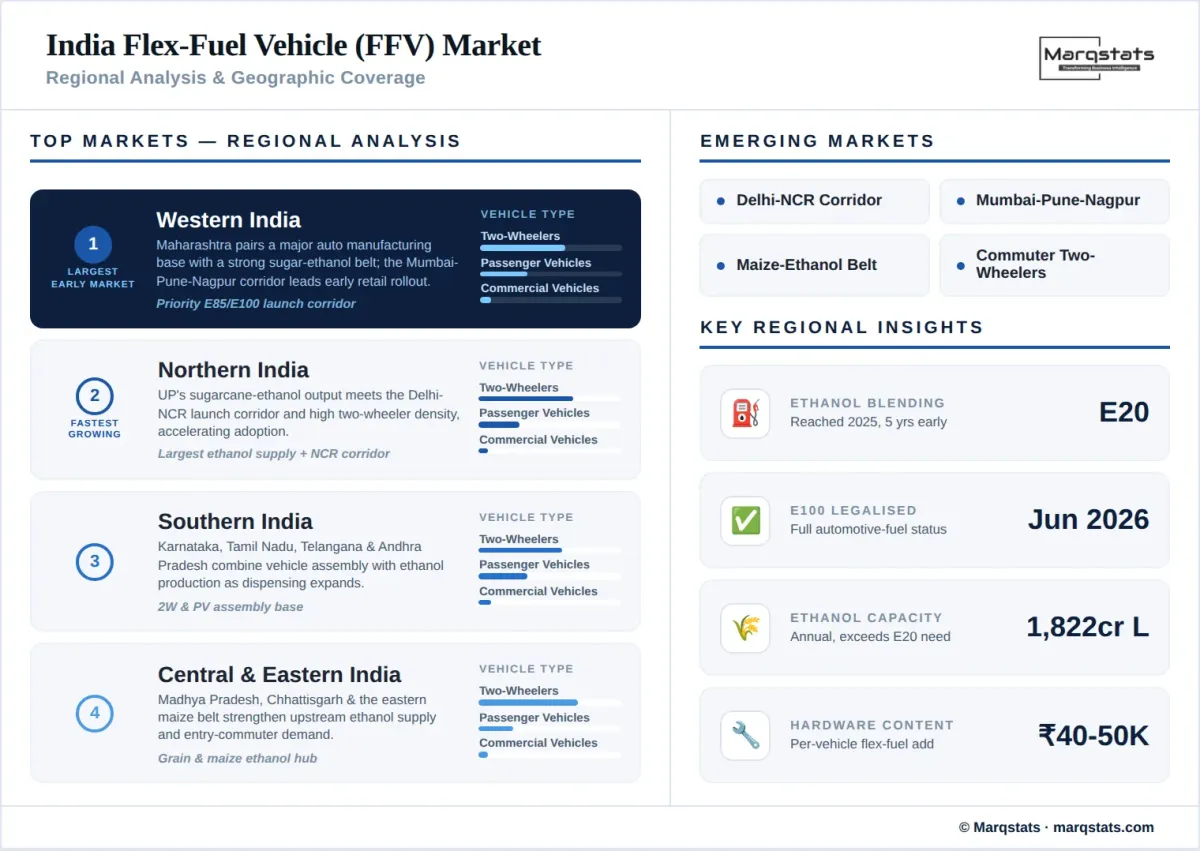
Regional distribution reflects the overlap of two geographies: ethanol production, concentrated in the sugar and grain belts, and vehicle demand, weighted toward high-density two-wheeler and passenger-vehicle markets. Early flex-fuel activity concentrates where ethanol supply and retail infrastructure coincide with the launch corridors. As E85 and E100 dispensing extends beyond the initial corridors toward a national network, regional demand is expected to broaden from the western and northern belts into southern and central markets.
Western India
Western India, anchored by Maharashtra, combines a major automotive manufacturing base with a strong sugar-ethanol supply belt. The Mumbai-Pune-Nagpur corridor is a priority for early E85 and E100 retail rollout. Western India therefore holds the largest share of early flex-fuel activity.
Northern India
Northern India, covering Uttar Pradesh, Haryana, Punjab, Rajasthan, and Delhi-NCR, pairs the country's largest sugarcane-ethanol production in Uttar Pradesh with the Delhi-NCR launch corridor. Growth is attributed to fuel availability in the corridor and high two-wheeler density. The region is among the fastest-growing for flex-fuel adoption.
Southern India
Southern India, spanning Karnataka, Tamil Nadu, Telangana, and Andhra Pradesh, contributes both vehicle manufacturing and ethanol production. The region hosts significant two-wheeler and passenger-vehicle assembly. Adoption follows the expansion of E85 and E100 dispensing beyond the initial corridors.
Central India
Central India, comprising Madhya Pradesh and Chhattisgarh, is a growing grain and maize ethanol hub. The feedstock shift toward maize strengthens the region's ethanol supply. Central India supports the upstream base that enables higher blends.
Eastern India
Eastern India, including Bihar, West Bengal, Odisha, and Jharkhand, is an emerging maize-ethanol region weighted toward entry commuter vehicles. Flex-fuel two-wheeler adoption defines the early demand shift. The region scales as ethanol supply and retail infrastructure develop.
How Competition Is Evolving
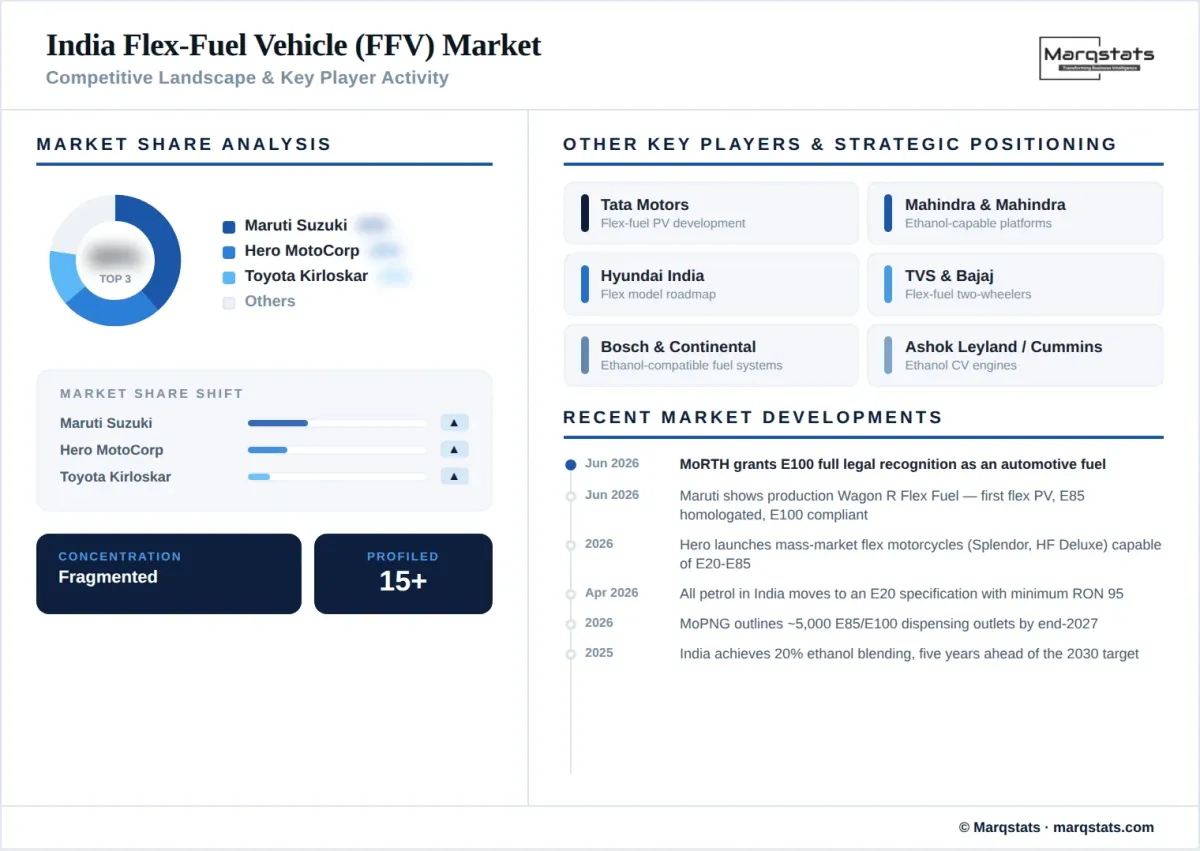
The India flex-fuel vehicle market is fragmented and early-stage, with competition centred on OEM product launches and powertrain readiness. Maruti Suzuki became the first manufacturer to place a flex-fuel passenger vehicle into production, while Hero MotoCorp introduced the first mass-market flex-fuel motorcycles. Toyota, Tata Motors, Mahindra, Hyundai, TVS, and Bajaj are developing or showcasing flex-fuel models.
Competition centres on engine calibration, fuel-system engineering, and the timing of commercial launches against fuel-infrastructure availability. Fuel-system suppliers such as Robert Bosch and Continental provide ethanol-compatible injection and delivery hardware. Growth is attributed to OEMs that pair flex-fuel readiness with mass-market price points, as flex-fuel commuter motorcycles reach the largest addressable base.
The competitive structure is expected to consolidate as retail infrastructure expands and volumes rise. Near-term positioning favours manufacturers with production-ready flex-fuel platforms and established distribution. OEM guidance that volumes remain modest through the late 2020s tempers near-term competition, and the segment rewards early platform investment and calibration expertise.
Two-wheeler manufacturers hold an advantage in reaching volume, as commuter motorcycles carry lower incremental hardware cost and address the largest fleet base. Passenger-vehicle manufacturers compete on engine calibration and the ability to homologate a single platform across the E20-to-E100 range. Commercial-vehicle and engine suppliers address fleet applications where fuel-cost economics are strongest. Fuel-system Tier-1 suppliers compete on ethanol-compatible injection, delivery, and material technology, and their capacity to localise flex-fuel hardware influences the cost position of OEM platforms across every vehicle segment.
Companies Covered
Companies covered in the report include:
Recent Market Activity
Table of Contents
Coverage & Segmentation
This report provides a comprehensive analysis of the India flex-fuel vehicle market for the historical period 2021–2025 and the forecast window 2026–2030, with 2025 as the base year. Coverage spans two-wheelers, passenger vehicles, and commercial vehicles with ethanol-capable powertrains from E20 through E85 and E100, together with flex-fuel hardware comprising fuel delivery systems, sensors, and recalibrated engine control units. The study examines market sizing by value, segment-level forecasts by vehicle type, blend capability, and component, regional distribution across Indian zones, competitive positioning, and the ethanol-supply and regulatory drivers that govern adoption. Upstream ethanol production is analysed as a driver rather than as part of the market value.
The base year reflects a pre-commercial market, and the forecast is penetration-driven with explicit scenario sensitivity. A conservative path follows OEM guidance that volumes remain modest through the late 2020s, while an accelerated path assumes faster retail-infrastructure expansion toward ethanol parity with established flex-fuel markets. Deliverables include market sizing and forecasts, segment and regional splits, company profiles, a regulatory and fuel-policy assessment, and scenario analysis. The report is intended for OEM strategy teams, fuel-system suppliers, ethanol producers, investors, and policy stakeholders.
The forecast provides annual estimates across the 2026–2030 window with sensitivity to three variables: E85 and E100 retail-outlet expansion, the price of ethanol relative to petrol, and flex-fuel penetration by vehicle type. The report also connects the fuel-supply surplus to the vehicle-hardware opportunity as a single value chain, from ethanol production and blending policy through vehicle availability to flex-fuel component demand. This value-chain view distinguishes the analysis from vehicle-only or fuel-only assessments and supports investment decisions across the ethanol and automotive supply base.