Market Snapshot
Middle bar: base-year value × (1 + CAGR), rounded to two decimals. This is a calculated illustration, not a separately researched annual estimate.
The UAE electric vehicle market — covering Battery Electric Vehicles (BEV), Hybrid Electric Vehicles (HEV), Plug-in Hybrid Electric Vehicles (PHEV), and Fuel Cell Electric Vehicles (FCEV) across passenger cars, commercial vehicles, and two-wheelers — was valued at approximately USD 1.85 billion in 2025 and is projected to reach approximately USD 5.60 billion by 2030, expanding at a CAGR of approximately 24.78% during the 2026–2030 forecast period. In volume terms, the market is estimated at approximately 24,800 units in 2025 and projected to reach approximately 98,000 units by 2030. The UAE is the most advanced EV adoption market in the Gulf Cooperation Council (GCC) by absolute volume, supported by the world's most comprehensive suite of EV incentives relative to GDP per capita, a government-mandated target of 50% EVs on UAE roads by 2050, and Dubai's specific goal of converting its entire taxi and public bus fleet to electric or hydrogen power by 2040 and 2050 respectively.
The market is defined by three structural characteristics that distinguish it from all other Middle East markets and most global EV markets. First, extremely high average vehicle selling prices — with the dominant volume concentrated in the AED 130,000–180,000 (approximately USD 35,400–49,000) price band — reflecting the UAE's status as a luxury vehicle market where average GDP per capita exceeds USD 50,000 and where passenger cars are the primary personal mobility asset. Second, HEV dominance — Hybrid Electric Vehicles account for the majority of the electric vehicle market by value, led by Toyota Motor Corporation's commanding position; Toyota (inclusive of Lexus) accounts for an estimated 46% of the total hybrid and electric vehicle market, powered by the RAV4 Hybrid, Corolla Cross Hybrid, Camry Hybrid, and Highlander Hybrid. Third, BEV rapid acceleration — Battery Electric Vehicles are the fastest-growing sub-segment at an estimated CAGR of approximately 48% between 2025–2030, led by Tesla (approximately 38% of BEV sales in 2023) with strong contributions from Mercedes-Benz, Porsche, BMW, and rapidly expanding Chinese OEMs including BYD.
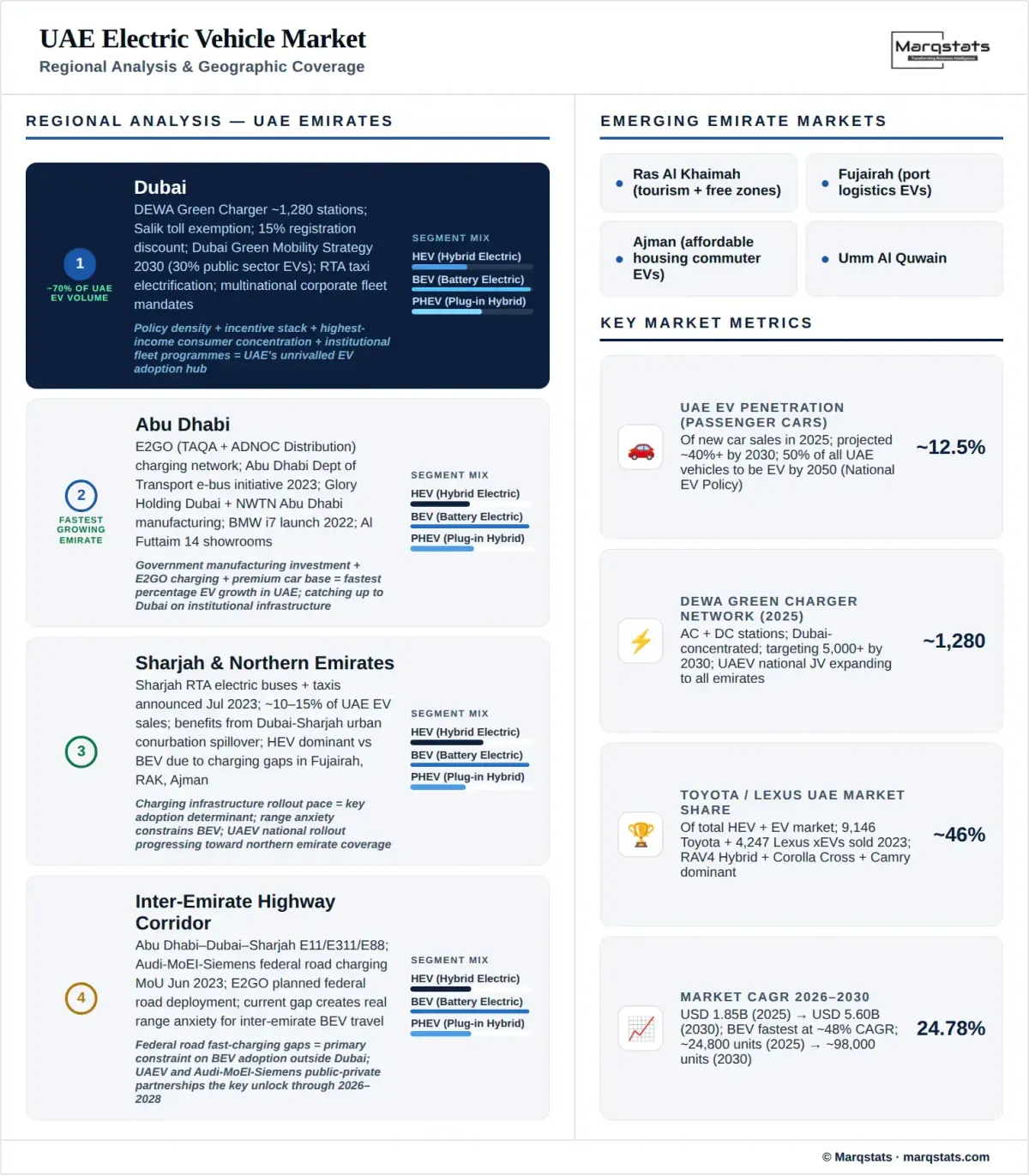
The UAE's EV policy architecture — encompassing Salik toll exemptions, 15% vehicle registration fee discounts, DEWA's Green Charger programme, UAE National Electric Vehicles Policy targeting 50% EV penetration by 2050, and the PM e-DRIVE equivalent of UAE's TAQA-ADNOC Distribution E2GO venture for charging infrastructure — creates a policy environment where EV total cost of ownership is structurally lower than ICE equivalents for most buyer profiles. This is reinforced by the UAE's low electricity tariff for EV charging relative to regional benchmarks and the RTA's active fleet electrification programme. EV penetration of passenger car sales is estimated at approximately 12.5% in 2025, against a backdrop of approximately 10–11 million population of whom approximately 90% are expatriates concentrated in Abu Dhabi and Dubai — a demographic that is disproportionately high-income, auto-dependent, and receptive to premium EV technology.
Key Takeaways
Market Overview & Analysis
Report Summary
The UAE electric vehicle market covers all electrified vehicles — BEV, HEV, PHEV, FCEV — across passenger cars (the dominant segment at approximately 97% of market value), commercial vehicles (buses, heavy-duty trucks, light commercial trucks and vans, medium-duty trucks), and electric two-wheelers, across all seven emirates with particular market concentration in Dubai and Abu Dhabi. The study period is 2021–2030 with 2025 as base year. The UAE represents a unique global EV market: a high-income, high-vehicle-ownership, high-technology-adoption environment where government-mandated EV targets are ambitious, EV incentives are comprehensive, vehicle ownership is aspirational and status-linked, and the luxury vehicle segment is proportionally larger than in any comparable market globally. Toyota's hybrid dominance reflects the UAE consumer's prioritisation of fuel efficiency and reliability over pure electrification; Tesla's BEV leadership reflects the premium tech consumer base; and Chinese OEM entry (BYD, Geely Geometry, MG/SAIC) is beginning to address the price-competitive mid-market that European and American OEMs have historically under-served in the region.
The historical CAGR between 2021 and 2025 reflects the market's explosive early growth from a very low base — driven by COVID-era environmental awareness, the RTA taxi electrification programme, and the introduction of Tesla as a mainstream retail brand through dedicated stores in Dubai, Abu Dhabi, and Sharjah. The forecast CAGR of approximately 24.78% for 2026–2030 reflects continued strong momentum against a progressively larger base, underpinned by the expansion of charging infrastructure (from 1,280 stations in 2025 toward 5,000+ by the end of the decade per government targets), declining battery pack prices (from approximately USD 138/kWh in 2025 to approximately USD 90/kWh by 2030), broadening OEM model availability, and a deepening fleet electrification programme.
The UAE's EV market is also developing a domestic manufacturing dimension. Glory Holding Group opened a 1.5 billion AED EV manufacturing facility in Dubai Industrial City capable of producing 55,000 EVs annually. NWTN, a UAE-based company, is expanding its Abu Dhabi factory with an integrated EV production line targeting the domestic and regional market. Al Futtaim introduced BYD to the UAE market and announced a collaboration to install 3,000 EV chargers across the country. The Shahin-NEV Enterprise agreement was signed for a charging station manufacturing facility in Abu Dhabi. These domestic industrial investments represent a structural shift from pure import dependency to emerging local value chain participation, which will progressively improve EV price competitiveness in the UAE and position the country as a regional EV production hub.
Market Dynamics
Key Drivers
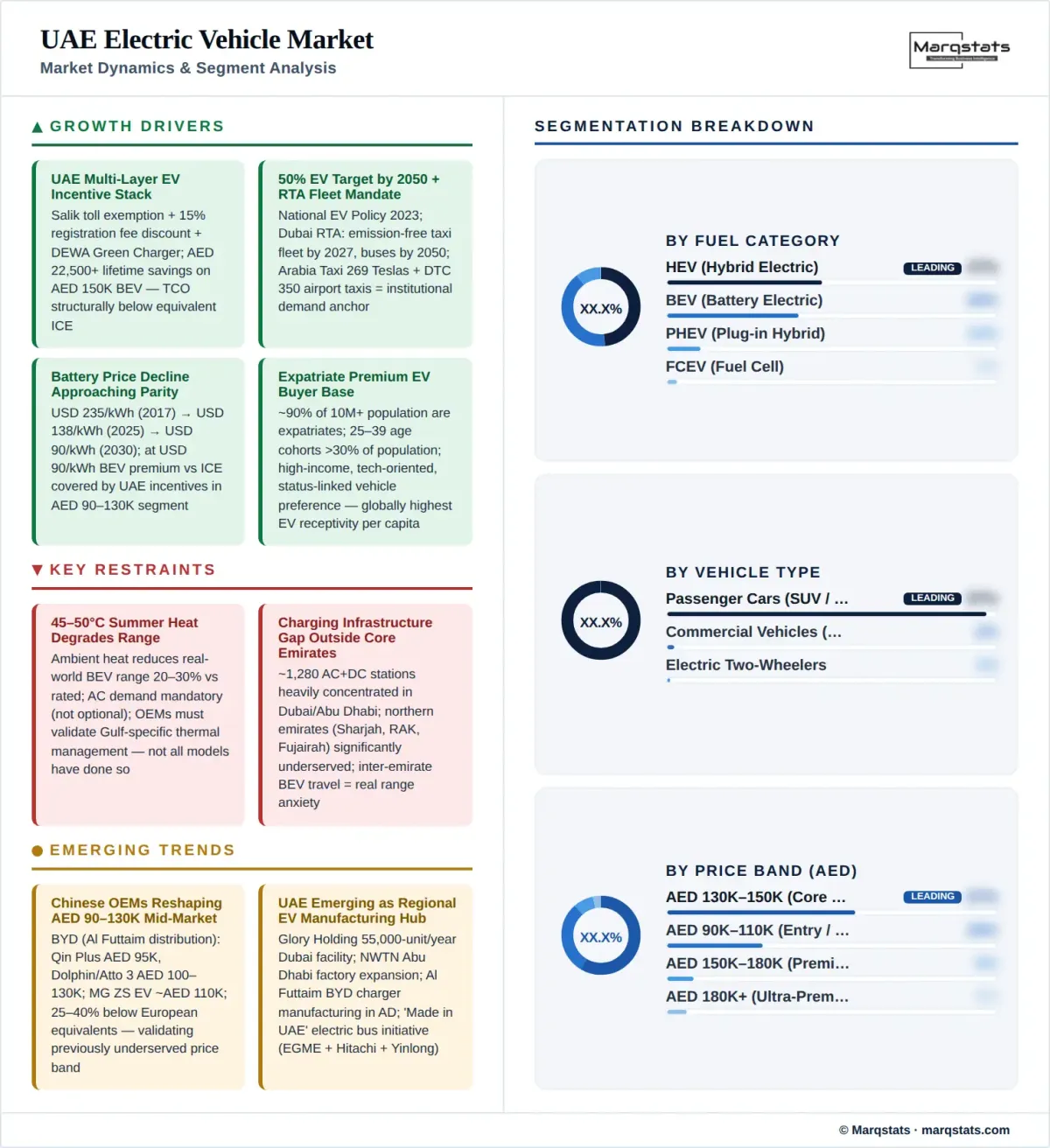
- National EV policy architecture delivering multi-layered purchase cost reduction: The UAE has built the GCC's most comprehensive EV incentive stack. In Dubai: Salik toll road exemption for all EV owners; 15% discount on vehicle registration and renewal fees; DEWA's Green Charger programme offering subsidised AC and DC charging. Nationally: the UAE National Electric Vehicles Policy (2023) targets 50% EVs on UAE roads by 2050; UAE Ministry of Energy and Infrastructure (MoEI) signed cooperation agreements with BMW, Audi, and other OEMs to expand charging capacity on federal roads; MoEI and Etihad WE launched UAEV, a joint venture to develop EV charging infrastructure across all emirates. The practical financial impact: an EV buyer in Dubai purchasing a AED 150,000 BEV benefits from approximately AED 22,500 in registration savings over vehicle lifetime plus free toll exemptions, lowering total cost of ownership substantially below the equivalent ICE vehicle.
- Battery pack price decline improving EV economics across all vehicle segments: Battery pack prices in the UAE market declined from approximately USD 235/kWh in 2017 to an estimated USD 138/kWh in 2025 and are projected to reach approximately USD 90/kWh by 2030. This decline directly translates to vehicle retail price reduction — with each USD 10/kWh reduction in battery cost lowering EV acquisition cost by approximately AED 3,500–7,000 per vehicle depending on battery capacity. At USD 90/kWh, the BEV price premium over equivalent ICE vehicles narrows to the point where UAE government incentives cover the full premium for many mid-market configurations, effectively delivering price parity in the AED 90,000–130,000 segment — the highest-volume price band in the overall vehicle market.
- Dubai RTA fleet electrification programme creating institutional fleet demand: The Roads and Transport Authority in Dubai's commitment to convert its entire taxi fleet to electric and hydrogen-powered vehicles by 2027 and to make public transport emission-free by 2050 represents a massive institutional procurement anchor for the UAE EV market. In February 2024, Dubai Taxi Company (DTC) expanded its taxi fleet at Dubai Airports by 100% with 350 new environmentally friendly taxis. A 269-vehicle Tesla Model 3 fleet order from Arabia Taxi Dubai in April 2023 was the first large-scale fleet EV procurement in the UAE taxi sector. In December 2023, Autostrad, a car rental company, incorporated 200 NWTN 'Rabdan One' electric cars, becoming the UAE's largest electric vehicle fleet provider. MaaS operators (Hertz, Avis, Sixt, Careem, Uber) are actively incorporating EVs into their fleets, driven by both sustainability mandates and operating cost advantages.
- Expanding OEM model portfolio addressing higher-income and mid-market segments simultaneously: The UAE's EV OEM landscape expanded dramatically between 2022 and 2025, with 6 new xEV passenger car models announced in 2023 alone. Toyota's hybrid dominance (9,146 units, 2023) is being challenged by new entrants across all price points. In the BEV premium segment, Mercedes-Benz's EQA, EQB, EQE, EQS series (13.7% BEV market share in 2023), Porsche Taycan (9.5% BEV share), and BMW i4, i5, i7, iX series (6.9% BEV share) serve high-income UAE buyers. In the mid-market, BYD (Qin Plus at AED 95,000, Atto 3 as compact SUV), SAIC/MG (ZS EV at AED 110,000), and Hyundai (Ioniq 5 at AED 152,000) are expanding the addressable BEV buyer base. Volkswagen's ID.3 (from AED 130,000) and Polestar 2 (from AED 199,900) serve the premium-tech segment. This portfolio expansion is progressively filling the AED 90,000–150,000 volume band that currently generates the highest EV sales concentration.
- Expatriate demographic driving premium EV adoption above global average: UAE's expatriate population — approximately 90% of the total population of over 10 million — represents the primary EV buyer base. The 25–34 and 30–39 age cohorts, which each account for over 15% of the total population, are concentrated in high-income professional roles in Dubai and Abu Dhabi. This demographic — tech-savvy, environmentally aware, high disposable income, and responsive to status-linked vehicle technology — is structurally more receptive to premium BEV adoption than equivalent demographic cohorts in other GCC markets. The UAE's global business hub status also means that multinational corporate sustainability mandates (particularly from European and North American parent companies) are directly influencing corporate fleet electrification in the UAE, adding an institutional demand layer to organic private consumer adoption.
Key Restraints
- Extreme summer heat (45–50°C ambient) degrading EV battery performance and range: The UAE's climate presents a real technical challenge for EV batteries and charging systems. Ambient summer temperatures of 45–50°C accelerate battery capacity degradation, reduce real-world driving range by 20–30% versus the rated range (which is typically measured at moderate temperatures), and require active thermal management that draws additional power from the battery pack. EV buyers in the UAE routinely experience the conflict between air conditioning demand (essential rather than optional in summer months) and range reduction, reducing effective range below the threshold that generates confident adoption. EV charging in high-temperature conditions also introduces additional thermal management requirements. OEMs targeting UAE market growth must specifically validate their thermal management systems for Gulf conditions — a design and certification investment that not all models have made.
- Charging infrastructure density insufficient outside Dubai and Abu Dhabi: While Dubai is targeting 1,000 public EV charging stations by 2025 and DEWA's Green Charger network has reached approximately 1,280 AC and DC total stations across the UAE, the geographic distribution is heavily concentrated in Dubai and Abu Dhabi — leaving inter-emirate travel and the northern emirates (Sharjah, Ajman, Fujairah, Ras Al Khaimah, Umm Al Quwain) significantly underserved. UAE residents and businesses requiring reliable vehicle performance for Sharjah-Dubai, Dubai-Abu Dhabi, or longer-distance travel face genuine range anxiety, particularly for BEV models with real-world ranges reduced by climate conditions. This charging distribution gap constrains BEV adoption in the non-premium market segment, where buyers cannot afford both a BEV and a second ICE vehicle for longer-distance travel.
- High vehicle replacement cost creating consumer hesitation at mid-market price points: The UAE's vehicle market is dominated by high vehicle prices — total passenger car models in the AED 90,000–180,000 range number approximately 250 — and BEV models in this range total approximately 68 units. For consumers in the AED 90,000–130,000 segment where MaaS operators, government employees, and price-sensitive private buyers concentrate, BEV acquisition carries an implicit premium of AED 20,000–50,000 over a comparable ICE model. Without a UAE equivalent of Europe's purchase subsidy programmes (the UAE primarily offers operational rather than purchase incentives), this premium constrains BEV penetration in the high-volume sub-AED 130,000 price bands.
- Absence of domestic EV manufacturing scale maintaining import price premium: The UAE's domestic EV manufacturing capacity — Glory Holding (55,000 EV/year facility), NWTN (Abu Dhabi expansion) — remains at early production scale, insufficient to significantly reduce retail prices versus fully imported vehicles. The majority of EVs sold in the UAE are manufactured in Europe (Mercedes-Benz, BMW, Audi, Volkswagen, Porsche, Polestar), the United States (Tesla), Japan (Toyota, Honda), South Korea (Hyundai), or China (BYD, Geely/Geometry, SAIC/MG) — meaning UAE consumers bear full import costs, dealer margins, and cross-border logistics, maintaining a structural price premium versus markets with local manufacturing. As Chinese OEM exports to the GCC scale (BYD, MG/SAIC offering attractive price-performance ratios), this import premium is being progressively eroded at the entry-level end of the market.
Key Trends
- Chinese EV OEM entry reshaping mid-market competitive dynamics: Chinese EV brands — BYD, SAIC/MG, Geely Geometry — entered the UAE EV market between 2021 and 2024 and are offering BEV models at price points 25–40% below equivalent European and American competitors. BYD's UAE entry through Al Futtaim (an established Toyota and Honda distributor) gives it access to premium dealer infrastructure at competitive price points: BYD Qin Plus at AED 95,000, BYD Dolphin and Atto 3 in the AED 100,000–130,000 range. MG ZS EV at approximately AED 110,000 is the most affordable compact electric SUV from a mainstream OEM available in the UAE. Geometry C (64 units sold in 2023) represents another Chinese entrant gaining traction. This Chinese entry is progressively validating the sub-AED 130,000 BEV segment — which Marqstats analysis indicates accounts for approximately 28.5% of EV volume but was previously dominated by ICE models due to lack of affordable BEV alternatives.
- UAE emerging as regional EV manufacturing hub alongside import market: The UAE's industrial strategy is simultaneously building a domestic EV manufacturing base alongside its import-dependent retail market. Glory Holding's Dubai Industrial City facility (opened 2022) targets 55,000 EVs annually — comparable to mid-sized European EV factories. NWTN is expanding its Abu Dhabi integrated EV production line. 'Made in UAE' electric bus collaboration (Emirates Global Motor Electric, Hitachi Energy, Yinlong Energy) announced in 2022 represents the first integrated EV manufacturing partnership for public transport vehicles. Al Futtaim's announcement of a BYD EV charger manufacturing facility in Abu Dhabi adds a domestic supply chain layer. These manufacturing investments position the UAE as a GCC production base for regional EV deployment — particularly relevant as Gulf EV demand scales and proximity to market creates logistics cost advantages over Asian exports.
- Fleet electrification expanding from taxis to corporate, hotel, and logistics sectors: The UAE EV fleet market is moving beyond the RTA taxi programme into corporate and institutional sectors. Major hotel chains (Marriott, Hilton, Accor) are electrifying guest transport fleets. Corporate campuses and multinationals are deploying EV fleets aligned with parent company sustainability mandates. Sharjah RTA announced electric buses and taxis in July 2023. Abu Dhabi Department of Transport announced an electric bus initiative in 2023. Cemex UAE partnered with Thrifty Car Rental to convert 13 vehicles to Polestar EVs. This institutional fleet expansion creates a parallel demand channel to retail consumer sales and generates high-volume, predictable procurement that rewards OEMs with fleet management capability, extended warranty programmes, and dedicated service networks.
- Vehicle-to-grid (V2G) pilot programmes preparing UAE grid for bidirectional EV integration: Dubai Electricity and Water Authority (DEWA) has begun pilot programmes integrating EV charging with smart grid management, anticipating the energy storage role that a growing EV fleet (projected at 98,000 vehicles by 2030) can play in peak demand management. The UAE's solar energy expansion (targeting 44% clean energy by 2050 under UAE Energy Strategy 2050) creates natural synergy between EV charging demand and solar generation peaks — a V2G opportunity that several UAE utilities and tech companies are beginning to commercialise. Nuvve-equivalent UAE V2G services are in early development, but the infrastructure investment being made in EV charging architecture (UAEV joint venture, E2GO network) is being designed to accommodate bidirectional energy flow from the outset.
Market Segmentation
Passenger cars represent the overwhelming majority of the UAE's electric vehicle market at an estimated 97.2% of total market value in 2025. This dominance reflects the structural characteristic of the UAE's vehicle market: personal car ownership is the primary mobility mode for the UAE's working-age adult population, public transportation usage is limited compared to global standards, and cars carry significant status and identity significance in a high-income, luxury-oriented consumer culture. The passenger EV segment is projected to grow from approximately USD 1.62 billion in 2025 to approximately USD 4.60 billion by 2030. Within passenger cars, the SUV body type is the largest and fastest-growing — reflecting the UAE consumer's strong preference for high-riding, spacious vehicles suited to both urban driving and the occasional off-road or highway journey. SUV value in the UAE hybrid and EV segment is projected to grow from approximately USD 0.94 billion in 2025 to approximately USD 3.31 billion by 2030. By fuel type within passenger cars, HEV retains the majority of value at approximately 57% in 2025 (declining toward 26% by 2030 as BEV penetrates more aggressively), while BEV grows from approximately 40% in 2025 toward 70% by 2030.
Commercial electric vehicles in the UAE are at the earliest stage of market development but on a steep growth trajectory. Total commercial EV volume is estimated at approximately 590 units in 2024, growing toward 8,775 units by 2030. The segment includes electric buses (RTA fleet conversion programme, Abu Dhabi Department of Transport initiative, Sharjah electric bus deployment), medium-duty commercial trucks (the largest near-term opportunity driven by logistics and construction sector electrification), light commercial vans (ideal for last-mile delivery in urban Dubai and Abu Dhabi), light commercial trucks (Amazon UAE, Noon, and Careem logistics fleet programmes), and heavy-duty commercial trucks (early adoption phase, expected 500 units by 2030). The 'Made in UAE' electric bus initiative (Emirates Global Motor Electric, Hitachi Energy, and Yinlong Energy) aims to establish domestic electric bus manufacturing. Dubai RTA's fleet conversion targets — emission-free buses by 2050 — create long-term structured demand for electric commercial vehicles that will anchor UAE market development.
Electric two-wheelers represent the smallest segment of the UAE electric vehicle market at approximately USD 2.14 million in 2024 and projected at USD 3.94 million by 2030. The category covers electric scooters, motorcycles, and mopeds. Two-wheeler EV penetration of total two-wheeler sales is estimated at approximately 7.5% in 2025 and projected at approximately 12.7% by 2030 — reflecting a structural constraint in the UAE where two-wheelers are primarily used by delivery workers and lower-income expatriates in hot conditions that create distinct challenges for electric two-wheelers (battery thermal management, rider comfort). The growth will be anchored by last-mile delivery platform electrification (Deliveroo, Talabat, Careem Now) and by tourism and leisure electric scooter programmes in waterfront zones such as Dubai Marina, JBR, and Yas Island.
Hybrid Electric Vehicles dominate the UAE electric vehicle market by value at approximately 47% in 2025, driven entirely by Toyota Motor Corporation's commanding presence. Toyota's HEV lineup (Corolla Cross Hybrid from AED 94,900, Camry Hybrid, Highlander Hybrid at AED 167,400, Innova Hybrid at AED 126,900, C-HR Hybrid at AED 102,900, RAV4 Hybrid at AED 115,000) covers every major passenger car segment from compact hatchback to full-size SUV and commands the highest dealer network penetration, parts availability, and after-sales infrastructure of any OEM in the UAE. Lexus (Toyota's luxury brand, sold 4,247 units in 2023 — Lexus ES, NX, RX hybrids) reinforces Toyota's dominance in the premium HEV segment. Honda's Accord e:HEV and CR-V Hybrid add a secondary Japanese HEV presence. The HEV segment's dominance is expected to moderate progressively as BEV expands, declining toward an estimated 26% of passenger car value by 2030 — but this moderation represents share dilution rather than absolute volume decline.
Battery Electric Vehicles are the UAE electric vehicle market's fastest-growing segment, estimated at approximately 48% CAGR between 2025–2030. Tesla leads BEV sales with an estimated 38% of total BEV volume, offering Model 3 (from AED 174,990 for RWD, AED 204,990 for Long Range), Model Y, Model X, and Model S from stores in Dubai, Abu Dhabi, and Sharjah. Tesla's acceptance of a 269-vehicle Model 3 fleet order from Arabia Taxi Dubai in April 2023 and the 2024 Model 3 refresh launch signal aggressive UAE market investment. Mercedes-Benz is the second-largest BEV player at approximately 13% market share (2023 data), offering the full EQA-EQB-EQE-EQS SUV and sedan range, with plans for all new architectures from 2025 to be exclusively electric. Porsche's Taycan (from AED 300,000+) holds the third BEV position at approximately 9% share, anchoring the ultra-premium performance BEV segment. BMW's i4, i5, i7 range, Hyundai Ioniq 5 (AED 152,000), Audi Q8 e-tron and e-tron GT, BYD's expanding lineup (from AED 95,000), and MG ZS EV (approximately AED 110,000) collectively constitute a broad BEV competitive landscape.
Plug-in Hybrid Electric Vehicles (PHEV) represent a niche segment in the UAE at approximately 3% of passenger car value in 2025, reflecting the limited model availability and the market's bifurcation between full HEV (pragmatic hybrid, no charging required, Toyota-dominated) and BEV (full electric, Tesla/European-dominated). PHEV models available in the UAE include the Porsche Cayenne E-Hybrid, Porsche Panamera 4 E-Hybrid, Mitsubishi Outlander PHEV, Land Rover Range Rover Sport PHV, and Jaguar I-Pace (as BEV). The PHEV segment appeals to a specific buyer profile: owners who value electric driving capability for short daily commutes but require the range security of a petrol engine for inter-emirate travel and longer journeys — a profile relevant to UAE buyers given the country's relatively limited charging infrastructure outside core urban areas.
Marqstats analysis of the UAE's EV transaction data for 2023 — covering the AED 90,000–180,000 price band which represents the primary EV volume market — reveals a distinctive pricing architecture that differs materially between the overall vehicle market (ICE + EV) and the EV-only segment. The total passenger car model count in this price band is approximately 250 models (ICE + EV), of which approximately 68 are electric variants. The four price sub-segments exhibit very different EV volume and model distribution patterns.
The AED 130,001–150,000 sub-segment accounts for the highest EV volume share at approximately 57% of total EV transactions in the AED 90K–180K range. This sub-segment corresponds to the core Toyota Hybrid/Lexus hybrid pricing zone (RAV4 Hybrid at AED 115,000–145,000, Camry Hybrid, Innova Hybrid, Hyundai Ioniq 5 at AED 152,000) — the largest individual model volume cluster in the UAE EV market and the primary target of mid-career professionals and balanced comfort-seekers. This segment also holds the highest EV model count share at approximately 37%, reflecting broad product availability from Toyota, Honda, Hyundai, BYD, MG, and mid-range European hybrids. Customer profiles in this segment are mid-career professionals seeking business-class comfort, balanced luxury, and efficient performance — the UAE's most commercially mature EV buyer cohort.
The AED 90,001–110,000 sub-segment accounts for approximately 28.5% of EV volume transactions — the second-largest EV volume band — representing entry-level EVs and efficient hybrids accessible to younger professionals, MaaS operators (ride-hailing, taxi companies prioritising operating cost reduction), and cost-conscious private buyers. MaaS companies significantly prefer this price band due to lower purchase cost, lower operating cost, and high vehicle turnover in ride-hailing applications. Hotel chains, government agency fleets, and small private businesses also concentrate in this range. Models include BYD Qin Plus (AED 95,000), MG ZS EV (approximately AED 110,000), Toyota Corolla Cross Hybrid (AED 94,900), and entry-level Toyota C-HR Hybrid (AED 102,900). The AED 150,001–180,000 sub-segment represents approximately 8% of EV volume but the highest-ticket luxury performance sub-segment — Tesla Model 3 Long Range, Mercedes-Benz EQA/EQB, BMW iX1, Polestar 2 (AED 199,900), Volkswagen ID.4 — appealing to high-income early adopters, luxury enthusiasts, and premium tech buyers.
By Geography
Dubai — Primary Market (~70% of Total UAE EV Volume)
Dubai is the UAE's primary electric vehicle market, estimated at approximately 65–70% of total national EV volume. Dubai's EV leadership is driven by the Roads and Transport Authority's aggressive fleet electrification programme, DEWA's Green Charger infrastructure expansion toward 1,000 public charging stations by 2025, the Salik toll exemption incentive that directly reduces operating costs for frequent city drivers, the 15% vehicle registration fee discount, and the concentration of the UAE's highest-income consumer base and multinational corporate headquarters in the emirate. Dubai's mobility ecosystem — high ride-hailing activity, large taxi fleet, hotel sector, corporate campus mobility — creates multiple institutional procurement channels that amplify individual consumer demand. The Dubai Green Mobility Strategy 2030, targeting 30% of public sector vehicles and 10% of all vehicle sales to be electric and hybrid by 2030, provides a clear institutional procurement roadmap.
Abu Dhabi — Second Market, Fastest Growing
Abu Dhabi is the UAE's second EV market by volume and is growing faster than Dubai in percentage terms as the emirate's institutional infrastructure programme matures. TAQA and ADNOC Distribution's E2GO joint venture is building and operating EV charging infrastructure across Abu Dhabi and the broader UAE. The Abu Dhabi Department of Transport's 2023 electric bus initiative signals the beginning of public transport electrification. BMW, Toyota, and Honda all operate Abu Dhabi-specific dealership and service infrastructure. Abu Dhabi Motors, the official BMW importer for Abu Dhabi and Al Ain, launched the BMW i7 and BMW 7 Series in 2022, demonstrating the emirate's premium vehicle buyer base. Toyota Al Futtaim operates 14 showrooms across the UAE, with significant Abu Dhabi presence. Glory Holding's EV manufacturing facility in Dubai Industrial City and NWTN's Abu Dhabi factory will progressively create domestic supply chain linkages that benefit both Dubai and Abu Dhabi as the largest vehicle markets.
Northern Emirates — Emerging Markets
Sharjah, Ajman, Ras Al Khaimah, Fujairah, and Umm Al Quwain collectively represent approximately 10–15% of UAE EV sales. Sharjah is the most active EV market in the northern emirates — sharing the Dubai-Sharjah urban conurbation and benefiting from spillover of Dubai's charging infrastructure into the border zones. Sharjah RTA announced its own electric bus and taxi initiative in July 2023, indicating institutional commitment to fleet electrification. The northern emirates face greater charging infrastructure gaps than Dubai and Abu Dhabi, creating range anxiety that constrains BEV adoption and favours HEV models that do not require charging. As the national E2GO and UAEV charging network expansion progresses through 2030, the northern emirates' EV adoption is projected to accelerate proportionally more than the two major emirates.
How Competition Is Evolving
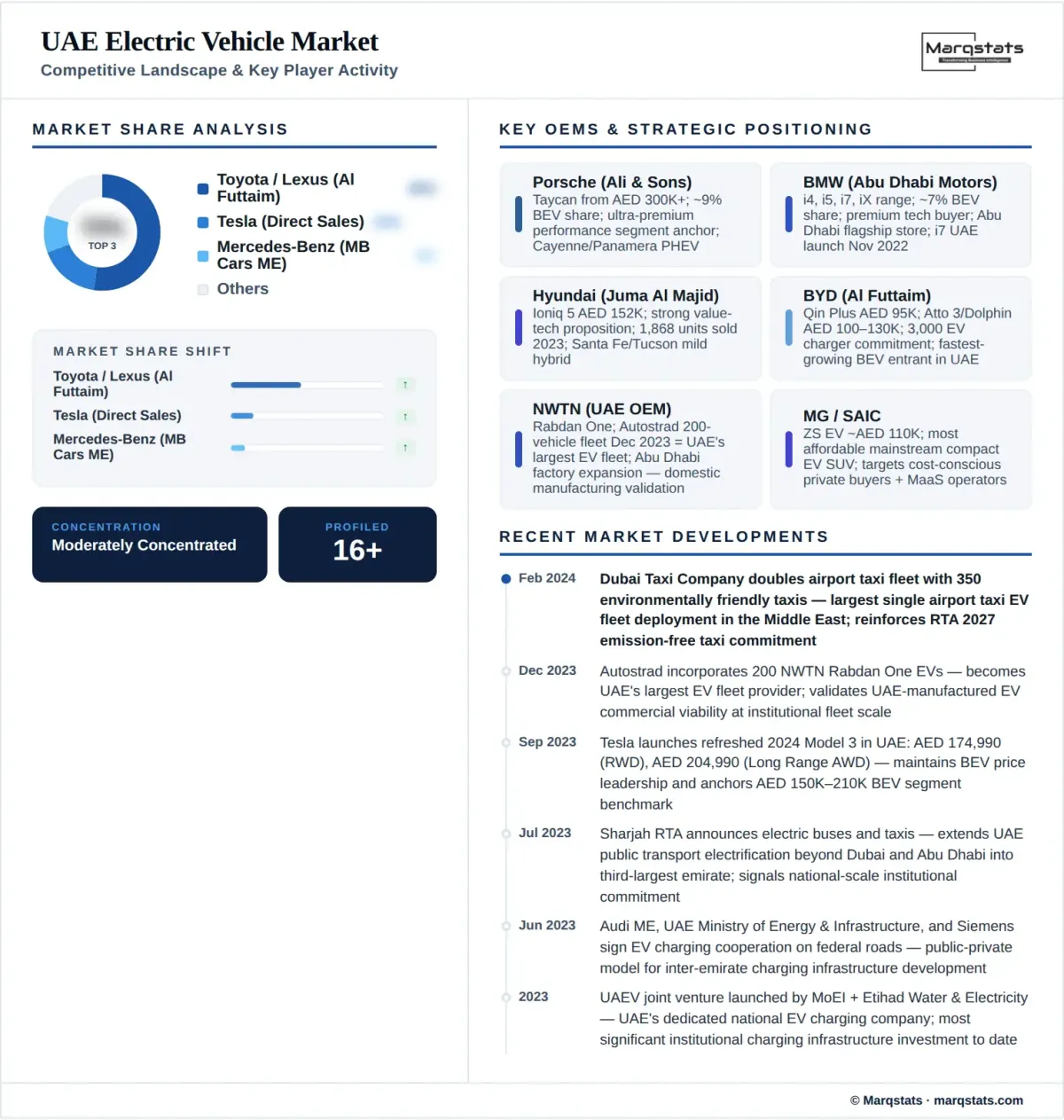
The UAE electric vehicle market's competitive landscape is structured around three tiers by powertrain type. In the HEV segment, Toyota Motor Corporation commands an estimated 46% overall market share — uncontested dominance built over 25+ years of hybrid technology introduction starting with the UAE's first hybrid vehicles in the early 2000s, a 14-showroom Al Futtaim dealer network, and a model portfolio covering every mainstream price point from AED 94,900 (Corolla Cross Hybrid) to AED 167,400 (Highlander Hybrid). Lexus (Toyota's luxury division) reinforces this dominance in the premium HEV segment with the ES, NX, and RX hybrids. Honda (Accord e:HEV at AED 154,900 starting price, CR-V Hybrid) and Hyundai/Genesis (Santa Fe, Tucson mild hybrid, Genesis G80) are the secondary HEV players at significantly lower market shares.
In the BEV segment, Tesla leads at approximately 38% of BEV volume through its Model 3, Y, X, and S lineup, benefiting from its direct-to-consumer sales model (no dealer network cost), over-the-air software updates, Supercharger infrastructure, and strong brand identity among the UAE's tech-oriented premium consumer base. Mercedes-Benz (~13% BEV share) and Porsche (~9%) represent the European luxury BEV tier. BMW, Audi, Hyundai Ioniq, Volkswagen, and Renault complete the European and Korean BEV mid-market. Chinese OEMs — BYD (2.6% BEV share in 2023, growing rapidly through Al Futtaim distribution), Geometry C, and MG/SAIC — are the fastest-growing competitive tier, capturing the under-AED 130,000 price band that premium Western OEMs have historically left unaddressed. BYD's plan to install 3,000 EV chargers across the UAE alongside its vehicle entry is a particularly significant strategic move — replicating the infrastructure integration strategy that Tesla pioneered globally. Independent assessments suggest that BYD could reach 8–12% of BEV volume share in the UAE by 2030 as its product range and dealer infrastructure mature.
Companies Covered
Companies covered in the report include:
Recent Market Activity
Table of Contents
Coverage & Segmentation
This report provides a comprehensive analysis of the UAE electric vehicle market covering BEV, HEV, PHEV, and FCEV across passenger cars, commercial vehicles (buses, heavy-duty trucks, light commercial trucks and vans, medium-duty trucks), and electric two-wheelers, across all seven UAE emirates with particular focus on Dubai, Abu Dhabi, and Sharjah. The study period is 2021–2030 with 2025 as base year. Market sizing covers new EV and hybrid vehicle sales, charging infrastructure deployment, and fleet electrification programmes. Policy analysis covers the UAE National Electric Vehicles Policy, Dubai Green Mobility Strategy 2030, RTA Fleet Conversion programme, DEWA Green Charger initiative, MoEI EV cooperation agreements, TAQA-ADNOC Distribution E2GO joint venture, UAEV national charging company, and UAE-specific EV financial incentives (Salik exemption, registration fee discounts). Competitive landscape covers OEM-level market shares by BEV and total hybrid-electric segment, pricing strategy analysis across the AED 90,000–180,000 primary volume band, customer segment profiles (MaaS, hotel/institution, government, private, travel/tourism, airport pickup), and domestic manufacturing capacity development. Primary research includes 40+ interviews with OEM UAE/GCC commercial team representatives, fleet procurement managers, charging infrastructure operators, government transport authority officials, and consumer cohorts across Dubai and Abu Dhabi.