Statistics & Highlights

Market Snapshot

Market size in USD Billion
$9.61B
2025
Base year
$10.14B
2026
Estimated
  
$12.58B
2030
Forecast
Largest market
East China (Yangtze River Delta)
Fastest growing
Central & West China (Chengdu-Chongqing)
Dominant segment
Manual / Hand Wash (Wash-and-Beauty Shops)
Concentration
Fragmented
CAGR
5.52%
2026 – 2030
GROWTH
+$2.97B
Absolute
STUDY PARAMETERS
Base year2025
Historical period2021 – 2025
Forecast period2026 – 2030
Units consideredValue (USD BN)
REPORT COVERAGE
Segments covered4 segments
Regions covered5 regions
Companies profiled16++
Report pages280+
DeliverablesPDF, Excel, PPT
Executive Summary

Key Takeaways

China car wash services market valued at USD 9.61 billion in 2025, projected to reach USD 12.58 billion by 2030 at a 5.52% CAGR.
An automobile parc of roughly 353 million (end-2024, Ministry of Public Security) anchors demand at about 10 paid washes per vehicle each year.
Manual wash-and-beauty shops dominate with about 60% of 2025 revenue, declining toward 52% by 2030 as automation accelerates.
Prepaid memberships reach about 29% of 2025 revenue, the highest of any major market, rising toward 38% by 2030.
Unmanned smart-wash stations wash a car in about three minutes for as little as RMB 10, cutting water use by roughly two-thirds.
O2O platforms — Tuhu, Tmall Yangche, JD, and Meituan — and fuel retailers Sinopec and PetroChina organize a historically fragmented market.
Market Insights

Market Overview & Analysis

Report Summary

The China car wash services market comprises professional operators cleaning passenger and light commercial vehicles across four service formats — manual wash-and-beauty shops, in-bay automatic (roll-over), tunnel/conveyor, and self-service — monetized through pay-per-wash tickets and prepaid memberships. The 2025 market of USD 9.61 billion sits against the world's largest automobile parc, roughly 353 million vehicles at the end of 2024, with paid-wash penetration near 55% and frequency of about 10 washes per vehicle each year, supported by low tickets near RMB 33.

The market's structure reflects China's automotive aftermarket. Hundreds of thousands of small wash-and-beauty shops, alongside 4S dealer workshops, deliver the majority of washes manually, holding about 60% of 2025 revenue. Organized and automated capacity is expanding rapidly from this base: roll-over machines spread across fuel-station forecourts and standalone sites, express tunnels enter major metros, and unmanned smart-wash stations bring three-minute, app-paid washing to parking lots and station forecourts. The manual share declines steadily toward 52% by 2030 while every automated format gains.

Two forces organize the market. First, O2O platforms — Tuhu with its nationwide franchised workshop network, Alibaba's Tmall Yangche, JD's auto-care network, and Meituan's local-services listings — standardize pricing, ratings, and membership across independent stores. Second, fuel retailers Sinopec and PetroChina, operating the country's largest station networks, expand forecourt washing bundled with fuel and convenience retail through their Easy Joy and uSmile ecosystems. Together these channels lift the organized share of a market that remains highly fragmented at the store level.

China's membership culture is the market's most distinctive financial feature. Prepaid stored-value cards have long been standard at wash-and-beauty shops, and app-based unlimited or discounted-wash plans extend the model, taking membership to about 29% of 2025 revenue — the highest of any major market and nearly quadruple European levels. Wash intensity per vehicle nonetheless sits near USD 25, only about 38% of the United States level, framing substantial headroom as automation, organized chains, and rising tickets lift revenue per vehicle. The rapid growth of new energy vehicles, whose parc exceeded 31 million by the end of 2024, adds demand for sensor-safe, touch-free washing.

Unit economics explain the automation race. Manual shops face rising labour costs against tickets that low inflation keeps near RMB 33, compressing margins on every wash. Automated formats invert the equation: roll-overs and tunnels cut labour per wash to a fraction of manual levels, and unmanned stations remove it almost entirely, sustaining profitability at RMB 10 to 20 price points that undercut manual shops while recovering equipment costs through volume. Domestic equipment supply at globally low prices, combined with universal mobile payment through WeChat Pay and Alipay, removes the two frictions — capital cost and payment handling — that slow automation elsewhere.

Market Dynamics

Key Drivers

  • Parc growth of roughly 3% per year on a 353-million-vehicle base adds more vehicles annually than most national parcs contain.
  • The organized and automated shift converts manual demand into roll-over, tunnel, and unmanned capacity, adding about 1.5 percentage points of annual growth.
  • Membership deepening through prepaid cards and app-based plans converts episodic demand into recurring revenue at the highest rate of any major market.
  • O2O platforms channel demand into rated, standardized stores, raising utilization and enabling chain and franchise expansion.
  • Fuel retailers Sinopec and PetroChina expand forecourt washing across the world's largest station networks.
  • New energy vehicle growth, with the NEV parc above 31 million, lifts demand for sensor-safe, touch-free automated washing.

Key Restraints

  • Low blended tickets near RMB 33 in a low-inflation environment cap revenue per wash and slow premiumization.
  • Intense fragmentation among hundreds of thousands of small shops limits pricing power and brand differentiation.
  • Water-use restrictions and recycled-water requirements in northern cities raise compliance costs for water-intensive formats.
  • Labour-cost inflation pressures the manual wash-and-beauty model that still generates the majority of revenue.

Key Trends

  • Unmanned smart-wash stations scale across cities, offering three-minute washes at RMB 10 to 20 with app payment and two-thirds lower water use.
  • Domestic equipment makers, including Autobase and Shinewash, expand tunnel and roll-over installations at home and in export markets.
  • Platform membership programs from Tuhu, Tmall Yangche, and JD bundle washing with maintenance, tires, and detailing.
  • Touch-free and high-pressure systems gain share as NEV owners seek sensor- and coating-safe washing.
  • Water reclamation and recycled-water systems spread in response to municipal water tariffs and northern-city mandates.
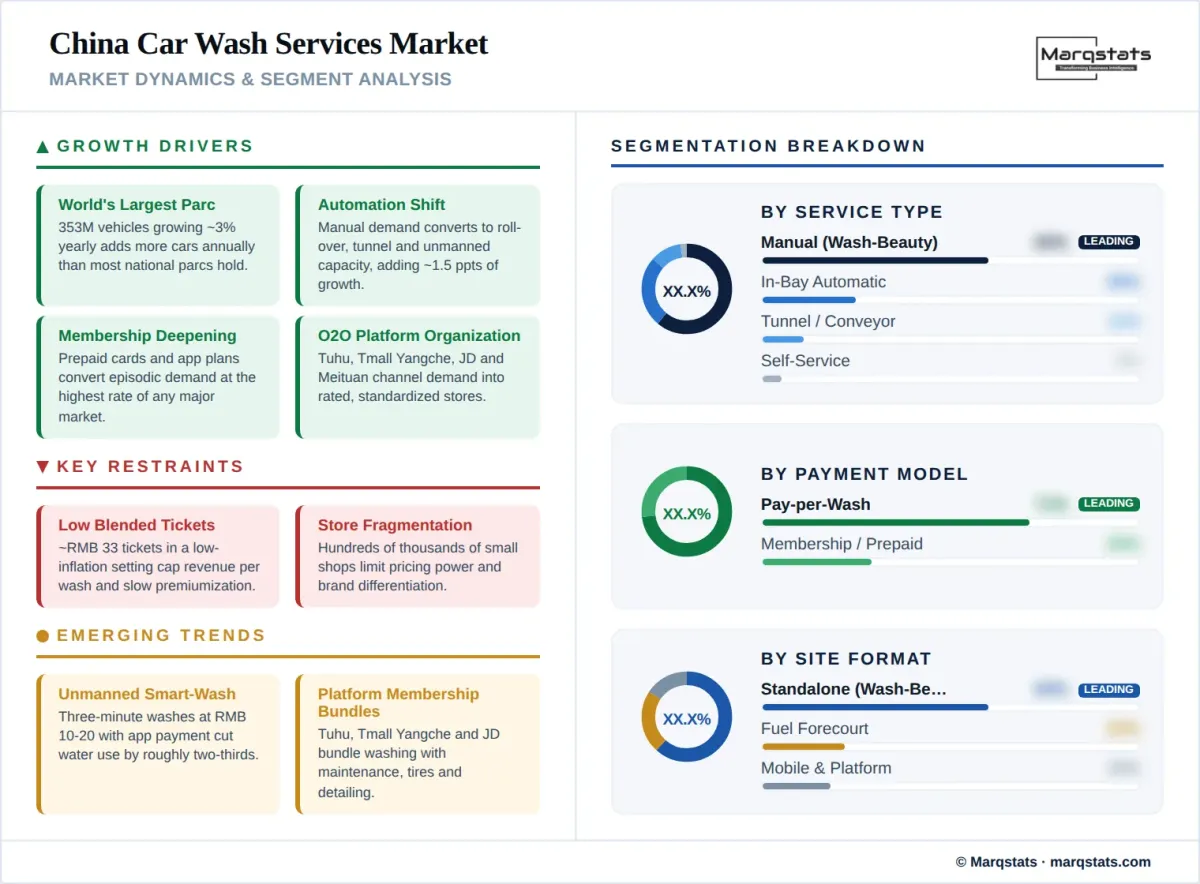
China Car Wash Services Market Market Dynamics Segment Analysis Infographic
Segment Analysis

Market Segmentation

Manual / Hand Wash (Wash-and-Beauty Shops)
Leading

Manual washing at wash-and-beauty shops holds the dominant revenue share at about 60% in 2025, equal to USD 5.75 billion, delivered by hundreds of thousands of small stores and 4S dealer workshops. The segment grows modestly in absolute terms yet cedes share steadily, declining toward 52% by 2030 as automated formats expand. Labour-cost inflation and platform standardization push shops toward semi-automated equipment, memberships, and bundled beauty and detailing services to defend margins, while platform ratings concentrate demand in better-run stores and accelerate exit among the weakest.

In-Bay Automatic (Roll-over)

In-bay automatic roll-overs hold about 25% of 2025 revenue, USD 2.37 billion, and rise toward 28% by 2030, the largest automated format. Machines spread across Sinopec and PetroChina forecourts, standalone wash parks, and dealer sites, supplied increasingly by domestic makers such as Autobase and Shinewash. Compact footprints and falling equipment costs make roll-overs the default automation step for existing sites, and touch-free high-pressure configurations answer NEV owners' sensor and coating concerns.

Tunnel / Conveyor

Tunnel/conveyor washes hold about 11% of 2025 revenue, USD 1.03 billion, and rise toward 14% by 2030, the fastest-growing service format at roughly 11% annually. Express tunnels concentrate in major metros and new wash parks, where throughput and membership economics justify the capital cost, and unmanned tunnel configurations reduce labour to near zero. Domestic equipment supply keeps installation costs well below international levels, supporting rapid rollout by wash parks, dealer groups, and forecourt operators.

Self-Service

Self-service bays hold about 5% of 2025 revenue, USD 0.47 billion, rising toward 6% by 2030. The format grows from a small base in residential compounds, parking lots, and lower-tier cities, offering app-paid, coin-free washing at the lowest price points in the market.

Pay-per-Wash
Leading

Single-visit payment accounts for about 71% of 2025 revenue, USD 6.82 billion, and declines toward 62% by 2030. Walk-in demand remains substantial at forecourts and independent shops, and app-based single payments via WeChat Pay and Alipay dominate transactions even where membership has not been adopted, keeping payment friction near zero across every format and city tier.

Membership / Subscription

Prepaid memberships reach about 29% of 2025 revenue, USD 2.80 billion, and grow near 11% annually to 38% of revenue by 2030, worth USD 4.78 billion. Stored-value cards at wash-and-beauty shops, platform membership plans from Tuhu and Tmall Yangche, and unlimited app passes at unmanned stations make China the most membership-penetrated major market, with recurring revenue the primary lever operators use to lock in demand. Prepayment also finances store working capital, a long-standing feature of the wash-and-beauty model that platforms are now formalizing with refundable, app-managed balances.

Standalone (Wash-and-Beauty Shops)
Leading

Standalone wash-and-beauty shops hold about 60% of 2025 revenue, USD 5.79 billion, forming the market's backbone across every city tier. The share eases toward 58% by 2030 as forecourt and platform-organized formats expand, while the segment itself consolidates gradually around franchised and platform-rated stores.

Fuel-Station Forecourt

Forecourt washes hold about 22% of 2025 revenue, USD 2.09 billion, and gain share toward 24% by 2030, the fastest-growing site format. Sinopec's roughly 30,000-station network and PetroChina's uSmile ecosystem anchor the channel, bundling roll-over and unmanned washing with fuel, EV charging, and convenience retail. As fuel demand plateaus with electrification, both retailers treat washing as a core non-fuel revenue line, accelerating machine installation across their networks.

Others (Mobile, Parking-Lot, Platform)

Mobile, parking-lot, and platform-direct formats hold about 18% of 2025 revenue, USD 1.73 billion. Unmanned smart-wash stations in parking lots and residential compounds, on-demand mobile washing booked through apps, and platform-fulfilled services make this the most technology-driven channel in the market, and the natural home of the unmanned model as it scales beyond forecourts.

Passenger Cars
Leading

Passenger vehicles generate about 88% of 2025 revenue, USD 8.42 billion, reflecting the consumer orientation of wash-and-beauty and membership models. The share eases slightly across the forecast period as commercial washing grows faster.

Commercial Vehicles (incl. Fleet & Ride-Hail)

Commercial washing, including logistics and ride-hailing fleets, holds about 12% of 2025 revenue, USD 1.20 billion, rising toward 13% by 2030. Ride-hailing and mobility-as-a-service operators maintain high wash frequency to meet platform cleanliness standards, and logistics fleets add depot and contract washing demand across major metros.

Regional Analysis

By Geography

East China (Shanghai & Yangtze River Delta)

East China, centred on Shanghai, Hangzhou, Nanjing, and Suzhou, is the largest regional market, combining the densest vehicle parc with the highest organized penetration. Hangzhou anchors the unmanned smart-wash sector, home to Yigongli and Alibaba's automotive aftermarket ventures, and the region leads platform membership adoption and express-tunnel development. High incomes across the Yangtze River Delta support premium wash-and-beauty services alongside the region's automation frontier.

South China (Guangdong & Greater Bay Area)

South China, led by Guangzhou and Shenzhen in the Greater Bay Area, is a large, year-round market where warm, humid conditions and high NEV density sustain frequent washing. Shenzhen's electrified ride-hailing and logistics fleets support commercial washing, and touch-free automated formats spread quickly among coating- and sensor-conscious NEV owners. The region's technology economy also seeds early adoption of app-paid unmanned stations across office parks and residential compounds.

North China (Beijing-Tianjin-Hebei)

North China, anchored by Beijing and Tianjin, is a major market shaped by water scarcity. Municipal rules impose high water tariffs and recycled-water requirements on car wash businesses, favouring reclamation-equipped automated sites and low-water unmanned stations. Winter dust and road treatment sustain exterior-wash frequency across the region, and compliance economics make North China the proving ground for water-efficient wash technology nationally.

Central & West China (Chengdu-Chongqing)

Central and West China, led by the Chengdu-Chongqing corridor together with Wuhan and Xi'an, is the fastest-growing region as vehicle ownership and organized capacity expand from a lower base. Rapid urbanization and platform expansion into second-tier metros drive new roll-over and tunnel installations across the region, and rising incomes lift wash frequency toward coastal levels.

Lower-Tier Cities & County Markets

Third-tier and county markets hold a large share of the national parc and remain dominated by low-cost manual shops. Franchise networks and platform ratings are extending organized standards into these markets, and compact roll-over and self-service formats suit their site economics, making lower-tier penetration a structural growth lever through 2030. Tuhu and platform rivals concentrate new store openings in these cities, where competition is thinner and franchise economics are strongest.
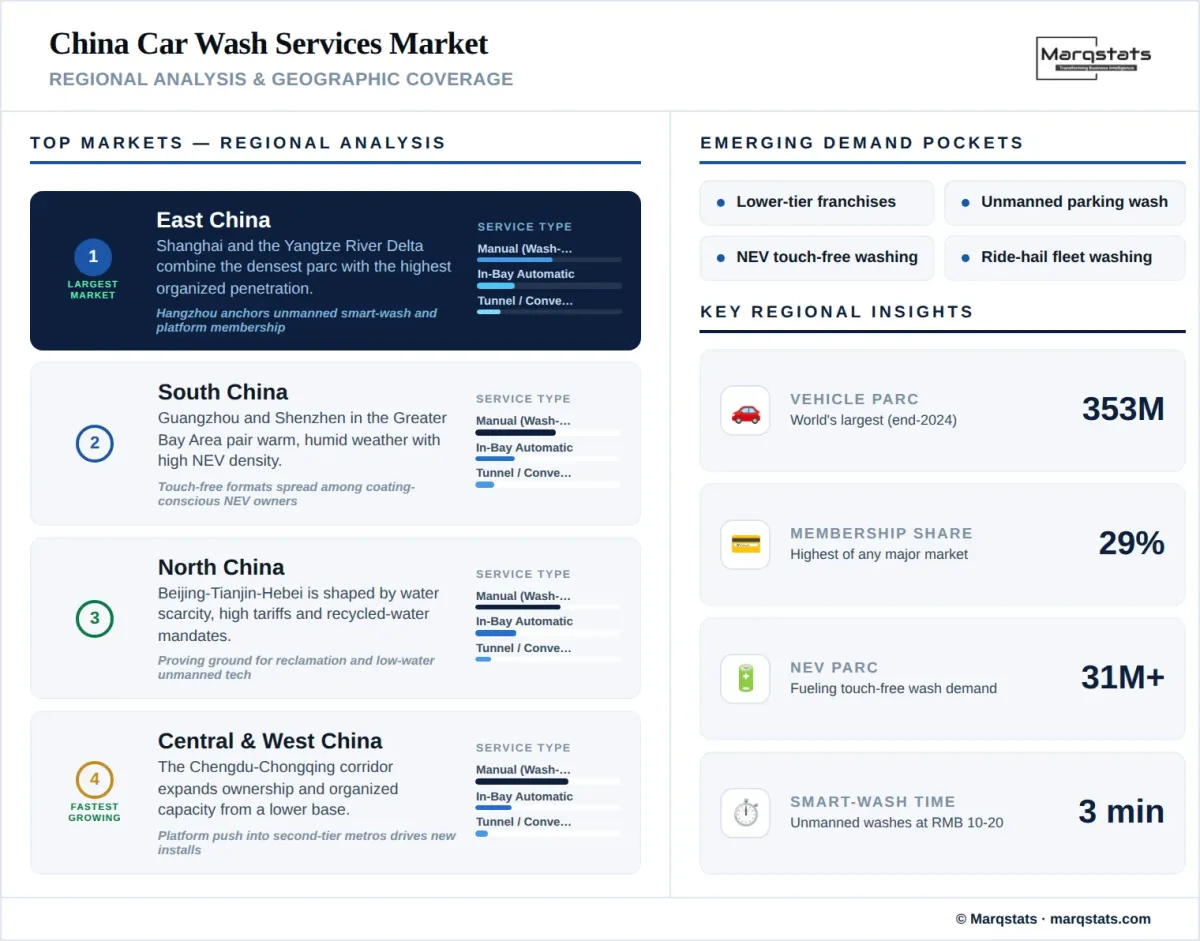
China Car Wash Services Market Regional Analysis Geographic Coverage Infographic
Competitive Landscape

How Competition Is Evolving

The China car wash services market is intensely fragmented at the store level, with hundreds of thousands of independent wash-and-beauty shops and no operator holding a material national share of washes. Organization happens through platforms rather than ownership: Tuhu operates a nationwide franchised workshop network exceeding 6,000 stores, Alibaba's Tmall Yangche and JD's auto-care network franchise thousands more, and Meituan's local-services listings rate and route demand across independent stores.

Fuel retailers form the second organizing force. Sinopec, with roughly 30,000 stations and its Easy Joy non-fuel ecosystem, and PetroChina, with its uSmile convenience network, operate the widest forecourt wash footprints, adding roll-over and unmanned machines alongside fuel, EV charging, and retail. International oil brands, including Shell and BP through their Chinese station ventures, add further forecourt capacity in coastal provinces.

Technology players define the market's frontier. Yigongli, backed by Alibaba, pioneered unmanned smart-wash stations that wash a car in about three minutes for RMB 10 to 20 while cutting water use by roughly two-thirds, and domestic equipment makers Autobase and Shinewash supply roll-over and tunnel systems at costs that accelerate automation nationwide and increasingly in export markets. Competition across all tiers turns on membership penetration, platform ratings, water efficiency, and automation economics, with the organized share expected to rise steadily while the long tail of manual shops keeps the market fragmented through 2030.
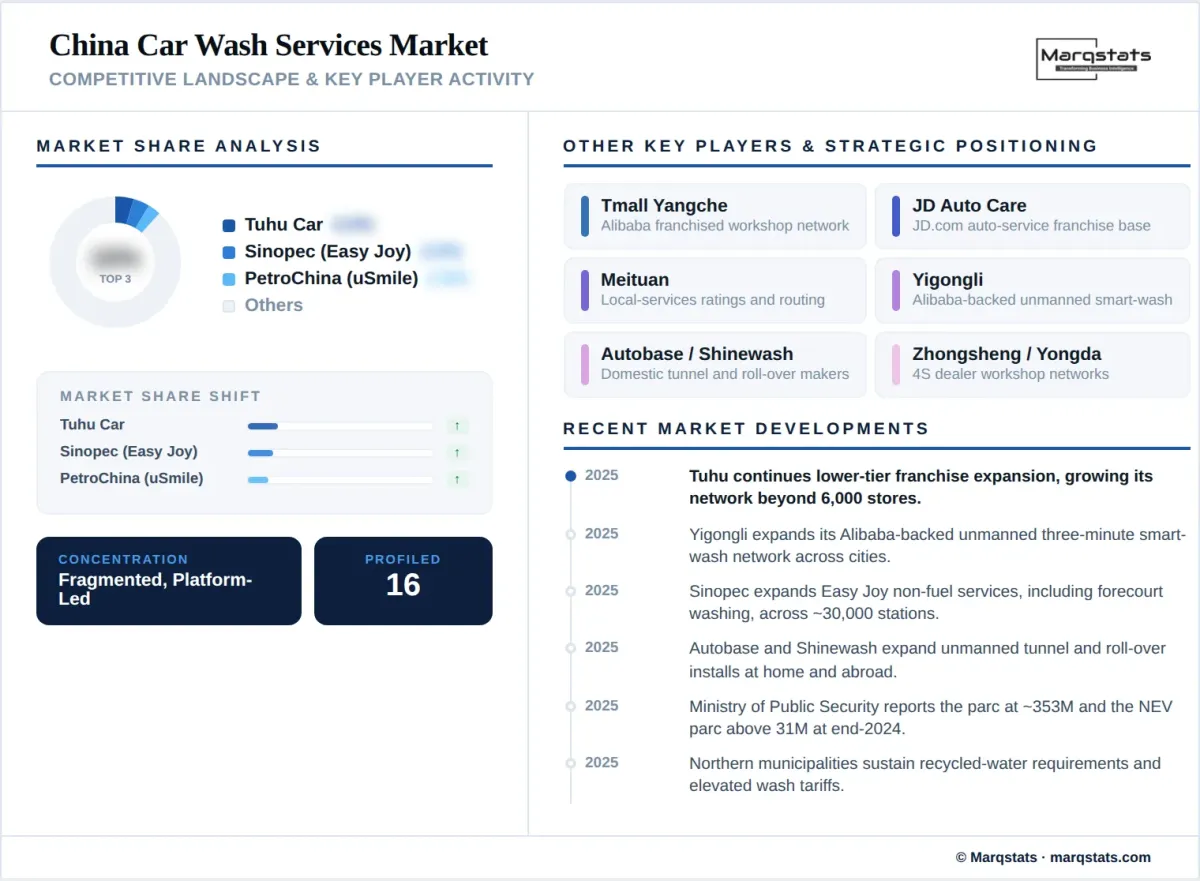
China Car Wash Services Market Competitive Landscape Key Player Activity Infographic
Major Players

Companies Covered

The report profiles 16++ companies with full strategy and financials analysis, including:

Tuhu Car Inc.
Tmall Yangche / New Carzone (Alibaba Group)
JD Auto Care (JD.com, Inc.)
Meituan (Local Services Platform)
Yigongli Smart Car Wash
China Petroleum & Chemical Corporation (Sinopec — Easy Joy Car Wash)
PetroChina Company Limited (uSmile)
Shell (China) Limited
BP China
Autobase Technology Group
Zhengzhou Shinewash Technology Co., Ltd.
Alfred Karcher (China)
WashTec (Shanghai) Cleaning Systems
Bosch Automotive Service Solutions (China)
Zhongsheng Group Holdings Limited (4S Dealer Network)
China Yongda Automobiles Services Holdings (4S Dealer Network)
Note: Full company profiles include revenue analysis, product portfolio, SWOT, and recent strategic developments.
Latest Developments

Recent Market Activity

2025
Tuhu Car continued franchise expansion across lower-tier cities, growing its nationwide workshop network beyond 6,000 stores.
2025
Yigongli expanded its unmanned smart-wash network across Chinese cities, building on Alibaba-backed deployment of three-minute automated washes.
2025
Sinopec expanded Easy Joy non-fuel services, including forecourt car washing, across its roughly 30,000-station network.
2025
Domestic equipment makers Autobase and Shinewash expanded unmanned tunnel and roll-over installations in China and export markets.
2025
The Ministry of Public Security reported China's automobile parc at roughly 353 million and the NEV parc above 31 million at end-2024.
2025
Northern municipalities, including Beijing, sustained recycled-water requirements and elevated tariffs for car wash businesses.
Report Structure

Table of Contents

1. Introduction
1.1 Study Assumptions & Market Definition
1.1.1 Scope — Professional Car Wash Services (Passenger & Light Commercial)
1.1.2 Formats Covered — Wash-and-Beauty Manual, In-Bay Automatic, Tunnel, Self-Service
1.1.3 Inclusions — Basic Interior Cleaning, Tickets, Prepaid Memberships
1.1.4 Exclusions — Full Detailing, Equipment & Chemical Sales
1.1.5 Market Metric — Annual Service Revenue (USD Billion)
1.2 Scope of the Study
1.3 Currency, FX Treatment & Base Year (2025)
1.4 Key Definitions & Industry Terminology
1.4.1 Wash-and-Beauty (Qiche Meirong) Shops & 4S Workshops
1.4.2 Unmanned Smart-Wash Stations
1.4.3 Prepaid Stored-Value & App Memberships
1.4.4 O2O Platform Organization
2. Research Methodology
2.1 Analysis Framework
2.2 Bottom-Up Base — Parc × Penetration × Frequency × Ticket
2.2.1 MPS Automobile Parc (336M 2023; ~353M End-2024)
2.2.2 Paid-Wash Penetration (~55%)
2.2.3 Wash Frequency (~10/Vehicle/Yr) & Blended Ticket (~RMB 33)
2.3 Aftermarket References — CADA & Industry Data
2.4 FX Treatment — USD Terms, RMB Effects, Constant-FX Forecast
2.5 Wash-Intensity Cross-Check vs. United States (~38%)
2.6 Primary Research — 40+ Interviews
2.7 Assumptions & Limitations
3. Executive Summary
3.1 Market Size & Forecast Snapshot 2021–2030
3.2 Key Findings & Analyst Takeaways
3.3 Manual-Dominant Structure & Fastest Automation Shift
3.4 Deepest Membership Culture of Any Major Market (~29%)
3.5 Platform & Fuel-Retailer Organization
4. Market Overview & Definitions
4.1 Industry Structure & Universe of Operators
4.1.1 Hundreds of Thousands of Wash-and-Beauty Shops & 4S Workshops
4.1.2 Organized & Automated Capacity Expansion
4.1.3 Fragmentation & Platform-Led Organization
4.2 Value Chain & Ecosystem
4.2.1 O2O Platforms — Tuhu, Tmall Yangche, JD, Meituan
4.2.2 Fuel Retailers — Sinopec Easy Joy & PetroChina uSmile
4.2.3 Domestic Equipment Makers — Autobase, Shinewash
4.2.4 Mobile Payment Rails — WeChat Pay & Alipay
4.3 Consumer Behavior & Paid-Wash Penetration (~55%)
4.4 Unit Economics — Manual vs. Automated vs. Unmanned
5. Market Dynamics
5.1 Key Drivers
5.1.1 Parc Growth (~3%/Yr on 353M Base)
5.1.2 Organized & Automated Shift
5.1.3 Membership Deepening (Prepaid & App Plans)
5.1.4 O2O Platform Standardization & Demand Routing
5.1.5 Fuel-Retailer Forecourt Expansion
5.1.6 NEV Growth & Sensor-Safe Wash Demand (31M+ NEVs)
5.2 Key Restraints
5.2.1 Low Tickets (~RMB 33) in a Low-Inflation Environment
5.2.2 Intense Store-Level Fragmentation
5.2.3 Northern Water Restrictions & Recycled-Water Mandates
5.2.4 Labour-Cost Inflation in the Manual Model
5.3 Key Trends
5.3.1 Unmanned Smart-Wash Scaling (3-Minute, RMB 10–20 Washes)
5.3.2 Domestic Equipment Expansion at Home & in Export Markets
5.3.3 Platform Membership Bundling (Wash + Maintenance + Tires)
5.3.4 Touch-Free & High-Pressure Systems for NEVs
5.3.5 Water Reclamation & Recycled-Water Systems
5.4 Porter's Five Forces Analysis
5.5 Industry Value Chain Analysis
6. Regulatory & Environmental Framework
6.1 Municipal Water Tariffs & Recycled-Water Requirements
6.2 Northern-City Water-Scarcity Rules (Beijing, Tianjin)
6.3 Wastewater Discharge & Reclamation Standards
6.4 Prepaid-Card & Consumer-Protection Rules
6.5 Aftermarket Service Standards & Platform Ratings
7. Technology & Format Innovation
7.1 Unmanned Smart-Wash Stations & App Operation
7.2 Roll-Over & Tunnel Systems from Domestic Makers
7.3 Touch-Free & High-Pressure NEV-Safe Washing
7.4 Water Reclamation & Low-Water Technology
7.5 Platform Integration, Ratings & Mobile Payment
8. Membership & Prepaid Economics
8.1 Stored-Value Card Culture & App Memberships
8.2 Membership Penetration Trend 2021–2030 (22% → 38%)
8.3 Platform Plans — Tuhu, Tmall Yangche, Unlimited App Passes
8.4 Prepayment, Working Capital & Consumer Protection
9. China Car Wash Services Market Sizing & Forecast
9.1 Total Market Size & Forecast 2021–2030
9.1.1 Historical Revenue 2021–2025 (incl. FX Effect)
9.1.2 Forecast Revenue 2026–2030 (Constant FX)
9.1.3 CAGR & Absolute Growth
9.2 Growth Driver Decomposition
9.2.1 Parc-Growth Contribution
9.2.2 Organized/Automated-Shift Contribution
9.2.3 Pricing Contribution
9.2.4 Membership-Deepening Contribution
10. Market Segmentation — By Service Type
10.1 Manual / Hand Wash (Wash-and-Beauty Shops)
10.1.1 Revenue & Share 2021–2030 (66% → 52%)
10.1.2 Store Economics, Platform Ratings & Consolidation
10.2 In-Bay Automatic (Roll-over)
10.2.1 Revenue & Share 2021–2030 (22% → 28%)
10.2.2 Forecourt, Wash-Park & Dealer Installations
10.3 Tunnel / Conveyor
10.3.1 Revenue & Share 2021–2030 (8% → 14%)
10.3.2 Express & Unmanned Tunnel Configurations
10.4 Self-Service
10.4.1 Revenue & Share 2021–2030 (4% → 6%)
11. Market Segmentation — By Payment Model
11.1 Pay-per-Wash
11.1.1 Revenue & Share 2021–2030 (78% → 62%)
11.1.2 WeChat Pay & Alipay Transaction Rails
11.2 Membership / Subscription
11.2.1 Revenue & Share 2021–2030 (22% → 38%)
11.2.2 Recurring-Revenue Growth (~11% CAGR)
12. Market Segmentation — By Site Format
12.1 Standalone (Wash-and-Beauty Shops)
12.1.1 Revenue & Share 2021–2030 (62% → 58%)
12.2 Fuel-Station Forecourt
12.2.1 Revenue & Share 2021–2030 (20% → 24%)
12.2.2 Sinopec Easy Joy & PetroChina uSmile Networks
12.3 Others (Mobile, Parking-Lot, Platform)
12.3.1 Revenue & Share 2021–2030 (~18%)
12.3.2 Unmanned Stations in Parking Lots & Compounds
13. Market Segmentation — By Vehicle Type
13.1 Passenger Cars
13.1.1 Revenue & Share 2021–2030 (~88%)
13.2 Commercial Vehicles (incl. Fleet & Ride-Hail)
13.2.1 Revenue & Share 2021–2030 (12% → 13%)
13.2.2 Ride-Hailing & Logistics Fleet Demand
14. Regional Analysis
14.1 East China (Shanghai & Yangtze River Delta) — Largest Market — Organized & Unmanned Frontier
14.1.1 Market Size & Forecast 2021–2030
14.1.2 Demand Drivers & Key Operators
14.2 South China (Guangdong & Greater Bay Area) — NEV Density & Year-Round Demand
14.2.1 Market Size & Forecast 2021–2030
14.2.2 Demand Drivers & Key Operators
14.3 North China (Beijing-Tianjin-Hebei) — Water Scarcity & Recycled-Water Mandates
14.3.1 Market Size & Forecast 2021–2030
14.3.2 Demand Drivers & Key Operators
14.4 Central & West China (Chengdu-Chongqing) — Fastest Growing — Second-Tier Expansion
14.4.1 Market Size & Forecast 2021–2030
14.4.2 Demand Drivers & Key Operators
14.5 Lower-Tier Cities & County Markets — Franchise & Platform Penetration Lever
14.5.1 Market Size & Forecast 2021–2030
14.5.2 Demand Drivers & Key Operators
15. Competitive Landscape
15.1 Market Structure & Store-Level Fragmentation
15.2 Platform Organization — Tuhu, Tmall Yangche, JD, Meituan
15.3 Fuel-Retailer Channels — Sinopec & PetroChina
15.4 Unmanned & Equipment Frontier — Yigongli, Autobase, Shinewash
15.5 Competitive Variables — Membership, Ratings, Water & Automation Economics
16. Company Profiles
16.1 Tuhu Car Inc.
16.1.1 Company Overview
16.1.2 Format & Service / Platform Portfolio
16.1.3 Network Footprint & Regional Presence
16.1.4 Membership / Technology / Water-Efficiency Approach
16.1.5 Recent Strategic Developments
16.2 Tmall Yangche / New Carzone (Alibaba Group)
16.2.1 Company Overview
16.2.2 Format & Service / Platform Portfolio
16.2.3 Network Footprint & Regional Presence
16.2.4 Membership / Technology / Water-Efficiency Approach
16.2.5 Recent Strategic Developments
16.3 JD Auto Care (JD.com, Inc.)
16.3.1 Company Overview
16.3.2 Format & Service / Platform Portfolio
16.3.3 Network Footprint & Regional Presence
16.3.4 Membership / Technology / Water-Efficiency Approach
16.3.5 Recent Strategic Developments
16.4 Meituan (Local Services Platform)
16.4.1 Company Overview
16.4.2 Format & Service / Platform Portfolio
16.4.3 Network Footprint & Regional Presence
16.4.4 Membership / Technology / Water-Efficiency Approach
16.4.5 Recent Strategic Developments
16.5 Yigongli Smart Car Wash
16.5.1 Company Overview
16.5.2 Format & Service / Platform Portfolio
16.5.3 Network Footprint & Regional Presence
16.5.4 Membership / Technology / Water-Efficiency Approach
16.5.5 Recent Strategic Developments
16.6 China Petroleum & Chemical Corporation (Sinopec — Easy Joy Car Wash)
16.6.1 Company Overview
16.6.2 Format & Service / Platform Portfolio
16.6.3 Network Footprint & Regional Presence
16.6.4 Membership / Technology / Water-Efficiency Approach
16.6.5 Recent Strategic Developments
16.7 PetroChina Company Limited (uSmile)
16.7.1 Company Overview
16.7.2 Format & Service / Platform Portfolio
16.7.3 Network Footprint & Regional Presence
16.7.4 Membership / Technology / Water-Efficiency Approach
16.7.5 Recent Strategic Developments
16.8 Shell (China) Limited
16.8.1 Company Overview
16.8.2 Format & Service / Platform Portfolio
16.8.3 Network Footprint & Regional Presence
16.8.4 Membership / Technology / Water-Efficiency Approach
16.8.5 Recent Strategic Developments
16.9 BP China
16.9.1 Company Overview
16.9.2 Format & Service / Platform Portfolio
16.9.3 Network Footprint & Regional Presence
16.9.4 Membership / Technology / Water-Efficiency Approach
16.9.5 Recent Strategic Developments
16.10 Autobase Technology Group
16.10.1 Company Overview
16.10.2 Format & Service / Platform Portfolio
16.10.3 Network Footprint & Regional Presence
16.10.4 Membership / Technology / Water-Efficiency Approach
16.10.5 Recent Strategic Developments
16.11 Zhengzhou Shinewash Technology Co., Ltd.
16.11.1 Company Overview
16.11.2 Format & Service / Platform Portfolio
16.11.3 Network Footprint & Regional Presence
16.11.4 Membership / Technology / Water-Efficiency Approach
16.11.5 Recent Strategic Developments
16.12 Alfred Kärcher (China)
16.12.1 Company Overview
16.12.2 Format & Service / Platform Portfolio
16.12.3 Network Footprint & Regional Presence
16.12.4 Membership / Technology / Water-Efficiency Approach
16.12.5 Recent Strategic Developments
16.13 WashTec (Shanghai) Cleaning Systems
16.13.1 Company Overview
16.13.2 Format & Service / Platform Portfolio
16.13.3 Network Footprint & Regional Presence
16.13.4 Membership / Technology / Water-Efficiency Approach
16.13.5 Recent Strategic Developments
16.14 Bosch Automotive Service Solutions (China)
16.14.1 Company Overview
16.14.2 Format & Service / Platform Portfolio
16.14.3 Network Footprint & Regional Presence
16.14.4 Membership / Technology / Water-Efficiency Approach
16.14.5 Recent Strategic Developments
16.15 Zhongsheng Group Holdings Limited (4S Dealer Network)
16.15.1 Company Overview
16.15.2 Format & Service / Platform Portfolio
16.15.3 Network Footprint & Regional Presence
16.15.4 Membership / Technology / Water-Efficiency Approach
16.15.5 Recent Strategic Developments
16.16 China Yongda Automobiles Services Holdings (4S Dealer Network)
16.16.1 Company Overview
16.16.2 Format & Service / Platform Portfolio
16.16.3 Network Footprint & Regional Presence
16.16.4 Membership / Technology / Water-Efficiency Approach
16.16.5 Recent Strategic Developments
17. Investment, Automation & Platform Analysis
17.1 Automation Capex & Unmanned Economics
17.2 Platform & Franchise Network Investment
17.3 Fuel-Retailer Non-Fuel Revenue Strategy
17.4 Water-Reclamation & Compliance Capex
18. Opportunities, Risks & Strategic Recommendations
18.1 Growth Opportunities by Region & Format
18.2 Ticket, Fragmentation & Water Risk Assessment
18.3 Membership, Automation & Lower-Tier Strategy
18.4 Strategic Recommendations for Operators & Investors
19. Appendix
19.1 Research Methodology Detail
19.2 Data Triangulation & Confidence Flags
19.3 Abbreviations & Glossary
19.4 List of Tables
19.5 List of Figures
19.6 Disclaimer & Legal Notice
Study Scope & Focus

Coverage & Segmentation

This report provides a comprehensive analysis of the China car wash services market covering the historical period 2021 to 2025 and the forecast period 2026 to 2030, with 2025 as the base year. The study defines the market as annual revenue earned by professional operators cleaning passenger and light commercial vehicles through manual wash-and-beauty, in-bay automatic, tunnel/conveyor, and self-service formats, inclusive of basic interior cleaning; full detailing and equipment or chemical sales are excluded. Market size is presented in value terms (USD billion), with historical figures reflecting renminbi exchange effects and forecasts assuming constant exchange rates.

The study segments the market by service type, payment model, site format, and vehicle type, and examines regional demand across East China, South China, North China, Central and West China, and lower-tier city markets, alongside platform organization, fuel-retailer channels, and automation. Market sizing uses a bottom-up model anchored to Ministry of Public Security vehicle-parc data and industry aftermarket references, cross-checked against wash intensity per vehicle. The competitive section profiles 16 platforms, operators, fuel retailers, and equipment makers spanning the market's organizing tiers.
Frequently Asked Questions

FAQs About the China Car Wash Services Market

The China car wash services market is valued at approximately USD 9.61 billion in 2025 and is projected to reach USD 12.58 billion by 2030, expanding at a 5.52% CAGR over the forecast period.
The market is expected to grow at a 5.52% CAGR between 2025 and 2030, driven by vehicle-parc expansion on a 353-million base, the organized and automated shift, and membership deepening.
Manual wash-and-beauty shops dominate with about 60% of 2025 revenue, declining toward 52% by 2030 as in-bay automatic roll-overs (25% → 28%) and tunnels (11% → 14%) expand; tunnels are the fastest-growing format.
Prepaid memberships reach about 29% of 2025 revenue — the highest of any major market — rising toward 38% by 2030, built on stored-value cards, platform membership plans, and unlimited app passes at unmanned stations.
Major players include O2O platforms Tuhu, Tmall Yangche, JD Auto Care, and Meituan; unmanned pioneer Yigongli; fuel retailers Sinopec (Easy Joy) and PetroChina (uSmile); and equipment makers Autobase, Shinewash, Kärcher, and WashTec.
Unmanned smart-wash stations, deployed in parking lots and forecourts, wash a car in about three minutes for RMB 10 to 20 with app-based payment, cutting water use by roughly two-thirds and removing labour costs almost entirely.
The report is delivered as a PDF report (280+ pages), Excel data tables with market sizing across 2021–2030 by segment and region, and a PowerPoint summary deck, with analyst email support included in every licence tier.