Market Snapshot
Key Takeaways
Market Overview & Analysis
Report Summary
This report sizes the Türkiye electric three-wheeler market — battery-electric L2e and L5e tricycles registered in the country for cargo, municipal, passenger and intralogistics duties. It is the smallest market in this electrification research series by a wide margin, and reporting that plainly is part of the analysis: a reader deciding whether to enter this category needs to know its true dimensions before its growth rate.
The structural explanation begins with what Türkiye already bought. Between 2002 and June 2026 the national motorcycle park expanded from 1,047,907 to 7,436,710 vehicles, a 610% increase that raised motorcycles from roughly 12% of all registered vehicles to 21.5% — one in five. Around 3.3 million of those motorcycles arrived between 2022 and 2026, and second-hand transfers ran at roughly 853,000 a month in the first half of 2026. Türkiye's courier and food delivery economy was built on this fleet. Where South Asian cities solved goods movement with three-wheelers, Turkish cities solved it with motorcycles, so the tricycle never established the installed base that electrification elsewhere converts.
The second constraint is the substitute. A Turkish operator wanting an electric goods vehicle today most often buys an L7e quadricycle — a microcar-class electric van marketed locally as an elektrikli kamyonet — rather than an L5e tricycle. The L7e offers four wheels, a closed cab, better stability and comparable payload at a similar price, and it is excluded from this report's scope. Any published figure for Turkish electric cargo vehicles that appears large is almost certainly counting L7e volume, and comparing it against this series will overstate the tricycle market by a wide margin.
What remains is a real but specific market. Electric tricycles win in Türkiye where their narrow track and tight turning circle are the point: municipal park and market-area services, historic city centres in Aegean and Mediterranean tourism towns, campus and industrial-site intralogistics, and the segment of last-mile delivery working streets a van cannot enter. Those applications support 9,200 registrations a year by 2030 — a genuine market with a defensible niche, and a fraction of what a three-wheeler market looks like in a country where the category took hold early.
Charging is not a constraint in this market, which distinguishes it from almost every other in this series. An electric tricycle carries a battery small enough to charge from an ordinary domestic socket overnight, and municipal depots, hotel compounds and industrial sites already have the power available where the vehicles sleep. No dedicated charging investment is required to grow this market, and none of the infrastructure programmes shaping Turkish passenger electric vehicle adoption affect it. The binding constraints here are commercial and categorical, not electrical.
Market Dynamics
Key Drivers
Türkiye's delivery economy is large and still growing. The courier and food delivery sector that absorbed 3.3 million motorcycles between 2022 and 2026 is now trialling electric tricycles for routes where a motorcycle's payload is insufficient and a van cannot park.
Municipal procurement is unusually important at 24% of registrations. Turkish municipalities buy electric tricycles for park maintenance, waste collection in narrow streets and market-area servicing, and these are budgeted purchases insulated from consumer credit conditions.
Historic city centres favour narrow vehicles. Aegean and Mediterranean tourism towns restrict vehicle access in old quarters, and a three-wheeler is often the largest powered vehicle permitted — a structural advantage no four-wheeled alternative can compete away.
Type approval is harmonised and predictable. Three-wheelers fall under the EU-derived L-category framework transposed into Turkish law, so vehicles homologated for European markets can be certified in Türkiye without a separate engineering programme.
Operating costs favour electric decisively at Turkish fuel prices. A tricycle covering short urban routes on domestic electricity undercuts a petrol equivalent per kilometre by a wide margin, and the duty cycle rarely tests battery range.
Key Restraints
The category has no incumbent base to convert. Türkiye's light goods movement runs on 7.44 million motorcycles, not tricycles, so electrification here means creating a vehicle category rather than converting one — a slower and more expensive proposition.
The L7e quadricycle is a superior substitute for most buyers. Four wheels, a closed cab, better stability and comparable payload at a similar price mean the microcar-class electric van wins nearly every comparison a Turkish fleet buyer actually runs.
The market is too small to attract domestic manufacturing. At under ten thousand annual registrations by 2030, no Turkish manufacturer can justify a dedicated tricycle production line, leaving the market dependent on imports and on locally assembled Chinese and Indian platforms.
There is no purchase incentive specific to the class. Türkiye's electric vehicle support has concentrated on passenger cars and charging infrastructure, and three-wheelers benefit from no dedicated grant, tax relief or procurement mandate.
Key Trends
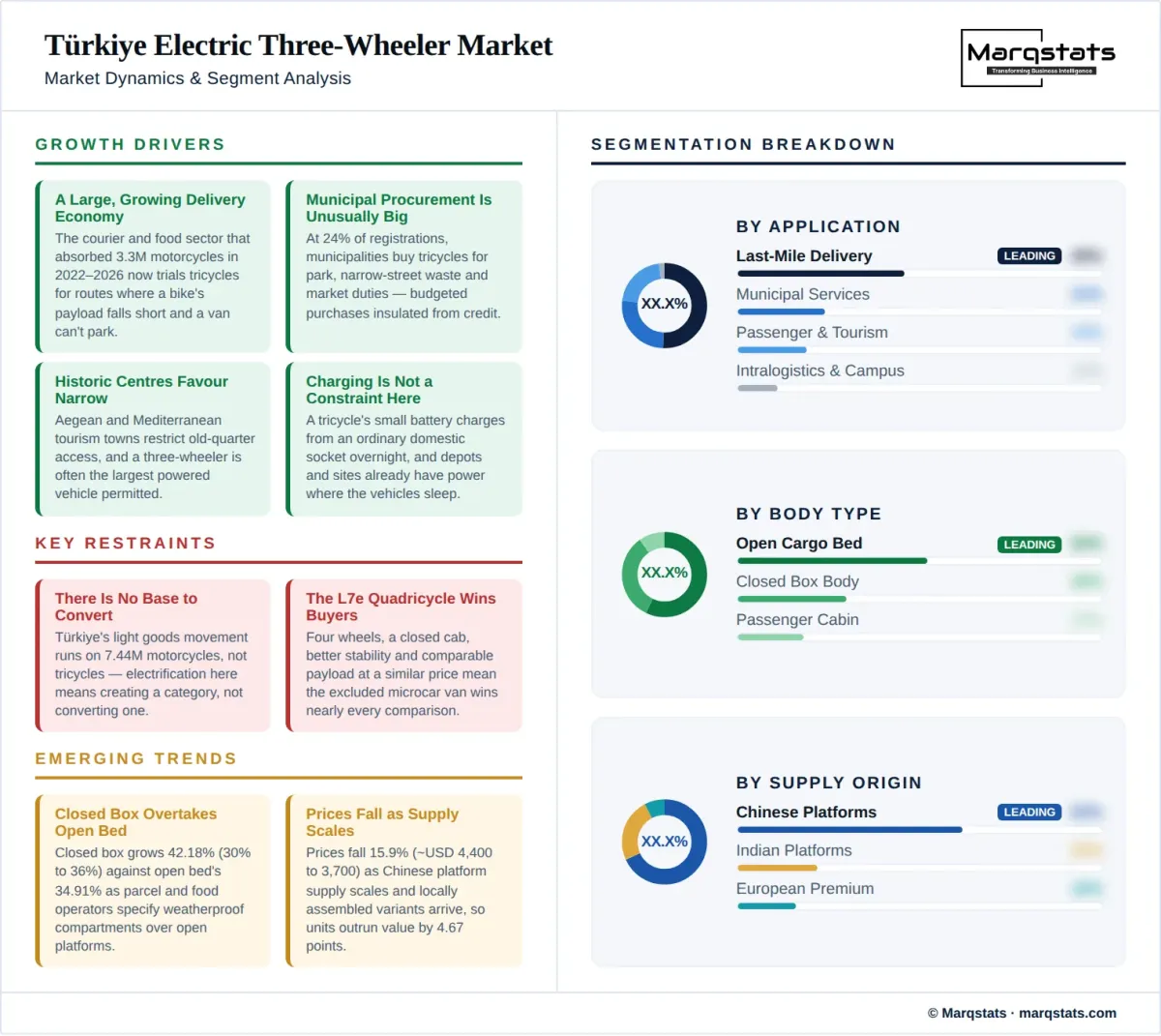
Closed box bodies overtake open beds in growth terms at 42.18% against 34.91%, rising from 30% of registrations to 36% as parcel and food delivery operators specify weatherproof compartments over the open platforms municipalities prefer.
Last-mile delivery consolidates as the largest application, from 46% of registrations to 50% at 39.40%, as courier operators identify the specific routes where a tricycle beats both a motorcycle and a van.
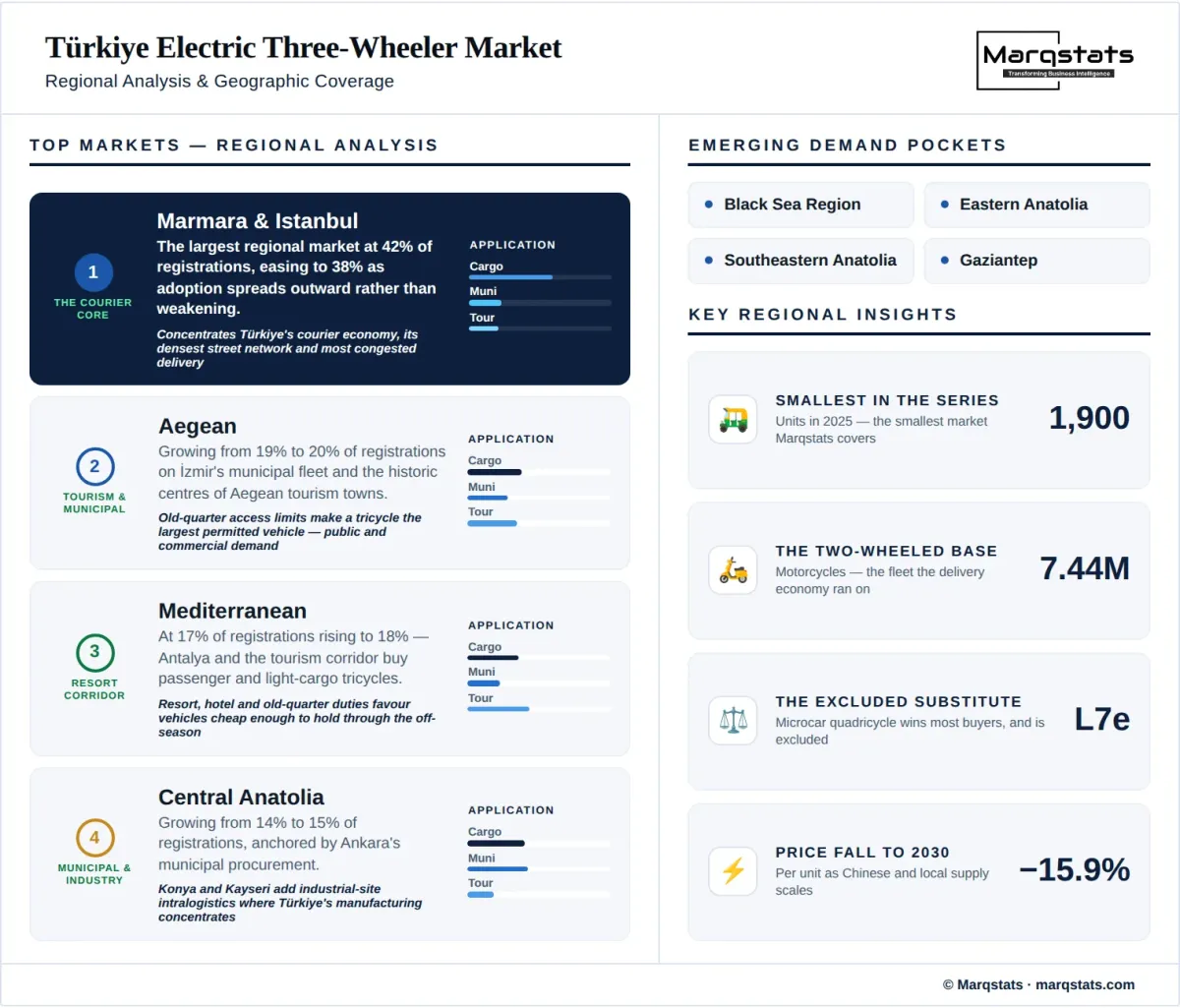
Adoption disperses out of Istanbul, whose share falls from 42% to 38%, while every other region gains — the rest of Türkiye grows fastest at 40.36% as municipalities and tourism operators outside the largest metros place first orders.
Prices fall 15.9% across the forecast, from roughly USD 4,400 to USD 3,700, as Chinese platform supply scales and locally assembled variants reach the market — which is why unit growth outruns value growth by 4.67 points.
Market Segmentation
The largest application at 46% of 2025 registrations rising to 50% by 2030, growing at 39.40%. Courier and food delivery operators deploy electric tricycles on routes where a motorcycle cannot carry the load and a van cannot park, and this narrow but real operating window is what the segment's growth depends on.
At 24% of registrations easing to 22%, growing at 34.73% — an unusually large share for this vehicle class. Turkish municipalities buy tricycles for park maintenance, narrow-street waste collection and market-area servicing, and their budgeted procurement makes this the market's most predictable demand line.
At 19% of registrations easing to 17% at 34.07%. Tourism operators in Aegean and Mediterranean historic centres run electric passenger tricycles where vehicle access is restricted, and hotel and resort shuttle duties add volume in the same geographies.
Steady at 11% of registrations, growing at 37.09% in line with the market. Industrial sites, universities, hospitals and large facilities use electric tricycles for internal material movement, where the vehicle never enters public roads and homologation requirements are lighter.
The largest body type at 52% of 2025 registrations, easing to 48% by 2030 at 34.91%. Open platforms suit municipal work — loading bulky or irregular items, tipping waste, carrying tools — and remain the default specification for public sector buyers.
The fastest-growing body type at 42.18%, rising from 30% of registrations to 36%. Parcel, pharmacy and food delivery operators need weatherproof, securable cargo compartments, and as commercial applications outgrow municipal ones this body type follows them.
At 18% of registrations easing to 16% at 33.90%. Passenger-configured tricycles serve tourism and shuttle duties, and the segment's growth tracks Aegean and Mediterranean tourism capacity rather than the delivery economy driving the rest of the market.
By Geography
Marmara and Istanbul
The largest regional market at 42% of 2025 registrations, easing to 38% by 2030 at 34.37%. Istanbul concentrates Türkiye's courier economy, its densest street network and its most congested delivery conditions, and its declining share reflects adoption spreading outward rather than any local weakening.
Aegean
Growing at 38.50% from 19% of registrations to 20%. İzmir's municipal fleet and the historic centres of Aegean tourism towns — where vehicle access restrictions make a tricycle the largest permitted vehicle — give the region both public and commercial demand.
Mediterranean
At 17% of registrations rising to 18% at 38.67%. Antalya and the Mediterranean tourism corridor buy passenger and light cargo tricycles for resort, hotel and old-quarter service duties, and the region's seasonal peaks favour vehicles cheap enough to hold through the off-season.
Central Anatolia
Growing at 39.00% from 14% of registrations to 15%. Ankara's municipal procurement anchors the region, and Konya and Kayseri add industrial-site intralogistics demand where Türkiye's manufacturing base concentrates.
Rest of Türkiye
The fastest-growing region at 40.36%, from 8% of registrations to 9%. Black Sea, Eastern and Southeastern Anatolian municipalities and operators are placing first orders, and growth from a base this small carries the widest uncertainty band in the report.
How Competition Is Evolving
The Türkiye electric three-wheeler market is supplied almost entirely by imports and local assembly of foreign platforms, and its size is the reason. At under ten thousand annual registrations by 2030, no manufacturer can justify a dedicated Turkish tricycle production line, so the competitive field consists of Chinese and Indian platform builders selling through Turkish distributors, alongside European specialists at the premium end.
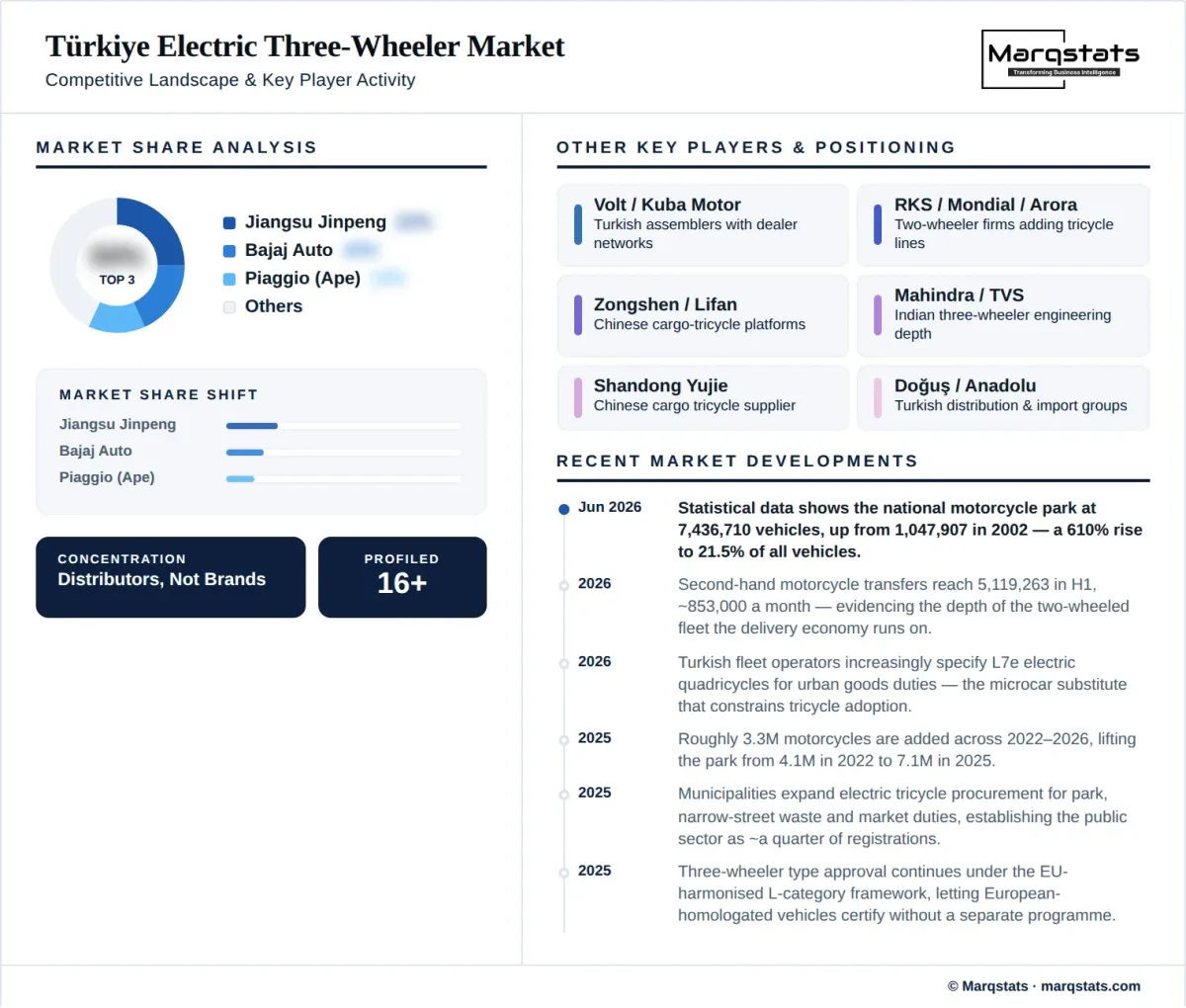
Chinese manufacturers hold the volume position. Jiangsu Jinpeng, Zongshen and Lifan supply cargo tricycle platforms at prices Turkish assemblers and distributors can build a business on, and their vehicles serve the municipal and light cargo segments where specification demands are modest. Indian manufacturers — Bajaj, Mahindra and TVS — bring the deepest three-wheeler engineering experience in the world to a market that has barely used it, and their entry is the most credible route to a step change in Turkish tricycle quality. Piaggio occupies the premium and passenger positions its Ape platform has held in Mediterranean markets for decades.
Concentration is low but the market is too small for share to be meaningful. At 1,900 registrations in 2025 spread across importers, assemblers and a handful of municipal tender winners, a single fleet order can move a supplier several percentage points in a year. Competitive position in this market is therefore better described by which distributors carry a tricycle line at all than by share tables, and the report treats it that way.
The Turkish layer is distribution and assembly rather than manufacture. Volt Motor, Kuba Motor, RKS, Mondial and Arora built businesses on two-wheelers and have the dealer networks, service capability and homologation experience that three-wheeler importers need — and their willingness to add tricycle lines is the variable that decides how fast this market can scale. The strategic question is straightforward: this category will be built by whoever concludes that a market of nine thousand annual units justifies a dedicated dealer and service commitment, and today that calculation is marginal for everyone in it.
Companies Covered
The report profiles 16+ companies with full strategy and financials analysis, including:
Recent Market Activity
Table of Contents
Coverage & Segmentation
This study covers new battery-electric three-wheeled vehicles registered in Türkiye across 2021 to 2030, measured at vehicle value in US dollars. Segmentation runs across four applications, three body types and five regional markets. The scope is L2e and L5e class vehicles. Two-wheelers, electric bicycles and cargo bicycles, and L7e electric quadricycles and microcars are excluded throughout.
The L7e exclusion requires emphasis because it is the single most likely source of error in using this report. Turkish operators buying an electric goods vehicle predominantly choose an L7e quadricycle — a four-wheeled microcar-class van sold locally as an elektrikli kamyonet — rather than a three-wheeler, and published figures for Turkish electric commercial or cargo vehicles typically count that class. Any such figure will be substantially larger than this report's series and is not comparable to it. Similarly, Türkiye's 7.44 million motorcycle park is two-wheeled and belongs to a different market entirely; it appears here as context for why the three-wheeler category is small, never as an addressable base.
Vehicle values are stated per registered unit in US dollars and fall from roughly USD 4,400 in 2025 to USD 3,700 by 2030. The decline reflects Chinese platform supply reaching scale and locally assembled variants entering the market, and it is why unit registrations compound at 37.09% against 32.42% on value. Lira-denominated prices move with exchange rates and domestic inflation on a different path from the dollar series, so Turkish buyers should not read the dollar price decline as a lira price decline.