Market Snapshot
Key Takeaways
Market Overview & Analysis
Report Summary
The India electric 2W and 3W fast charging equipment market comprises direct-current and combined alternating-current and direct-current fast-charging hardware for electric scooters, electric motorcycles and electric three-wheelers. The defined scope includes 3 kW, 6 kW and 12 kW fast chargers, Type 6 and Type 7 LECCS connectors, charging guns and power modules, control and communication systems, protection and metering hardware, payment-enabled charging units, and public and semi-public installations at retail sites, workplaces, campuses, fleet hubs, highways and fuel stations. Basic portable home chargers, 5 A and 15 A domestic sockets, four-wheeler combined-charging-system hardware, bus chargers and battery-swap stations fall outside the scope unless analyzed as adjacent infrastructure.
India sold approximately 12.09 lakh electric two-wheelers in FY2024-25, equal to 6.2% of total two-wheeler sales, and recorded a record electric two-wheeler year in FY2025-26. Electric three-wheeler sales approached 8 lakh units in 2025, keeping India the largest electric three-wheeler market globally for the third consecutive year, with segment penetration near 32%. Two- and three-wheelers together form the largest vehicle base requiring public and semi-public fast charging, which links equipment demand directly to vehicle volume and fleet utilization.
The 2025 market is estimated at USD 60 million, weighted toward 3 kW and 6 kW chargers for two-wheeler public charging, with 12 kW units serving three-wheelers and high-utilization fleets. Demand is increasing owing to vehicle-base expansion, fleet electrification and government-funded charger deployment. Forecast value reaches USD 310 million by 2030 as the public charging base expands toward the PM E-DRIVE target of 48,400 two- and three-wheeler fast chargers and Type 7 LECCS adoption standardizes the connector base.
Fast charging differs from home charging in power, location and use case. Home and portable chargers deliver low-power overnight charging at 5 A and 15 A sockets, while fast-charging equipment delivers 3 kW to 12 kW direct-current charging at public and semi-public sites for quick top-ups. Product evidence confirms commercial deployment: the Bolt.Earth Blaze DC range supports Type 6 and Type 7 connectors at 3 kW, 6 kW and 12 kW, claiming 40, 80 and 120 kilometers of range in 15 minutes respectively, while Ather Grid claims 30 kilometers of range in 10 minutes. These ratings position fast charging as a convenience and fleet solution rather than a home replacement.
The value chain spans power-electronics and module suppliers, charger manufacturers, network operators and site hosts. Charger manufacturers such as Exicom Tele-Systems Limited, Servotech Renewable Power Systems Limited and Delta Electronics India Private Limited produce fast-charging hardware, network-led original-equipment manufacturers such as Ather Energy Limited and Ola Electric Mobility Limited deploy proprietary networks, and charge point operators such as Bolt.Earth, Kazam EV Tech Private Limited and Massive Mobility Private Limited install and operate equipment across sites.
Standards and Regulatory Framework
India's conductive charging requirements are standardized by the Bureau of Indian Standards under the IS 17017 series. IS 17017 Part 2 Section 6 defines the Type 6 connector for low-voltage direct-current charging of light electric vehicles, while IS 17017 Part 2 Section 7 defines the Type 7 Light Electric Combined Charging System. IS 17017 Part 25 covers low direct-current power below 7 kW for light electric vehicles, which frames the technical envelope for two- and three-wheeler fast chargers. The Type 7 LECCS connector, developed indigenously and approved as India's first connector standard for two- and three-wheelers, supports combined alternating-current and direct-current charging in a single connector with CAN 2.0 communication.
Charging-station deployment is governed by Ministry of Power guidelines that target safe, reliable, accessible and affordable charging. The guidelines require electricity connections for public charging stations within 7 days in metropolitan cities, 15 days in other municipal areas and 30 days in rural areas, and direct state governments to fix the ceiling on service charges. Charging-station setup is notified as an unlicensed activity, which lowers entry barriers for private equipment deployment across retail, workplace and fleet sites.
Market Dynamics
Key Drivers
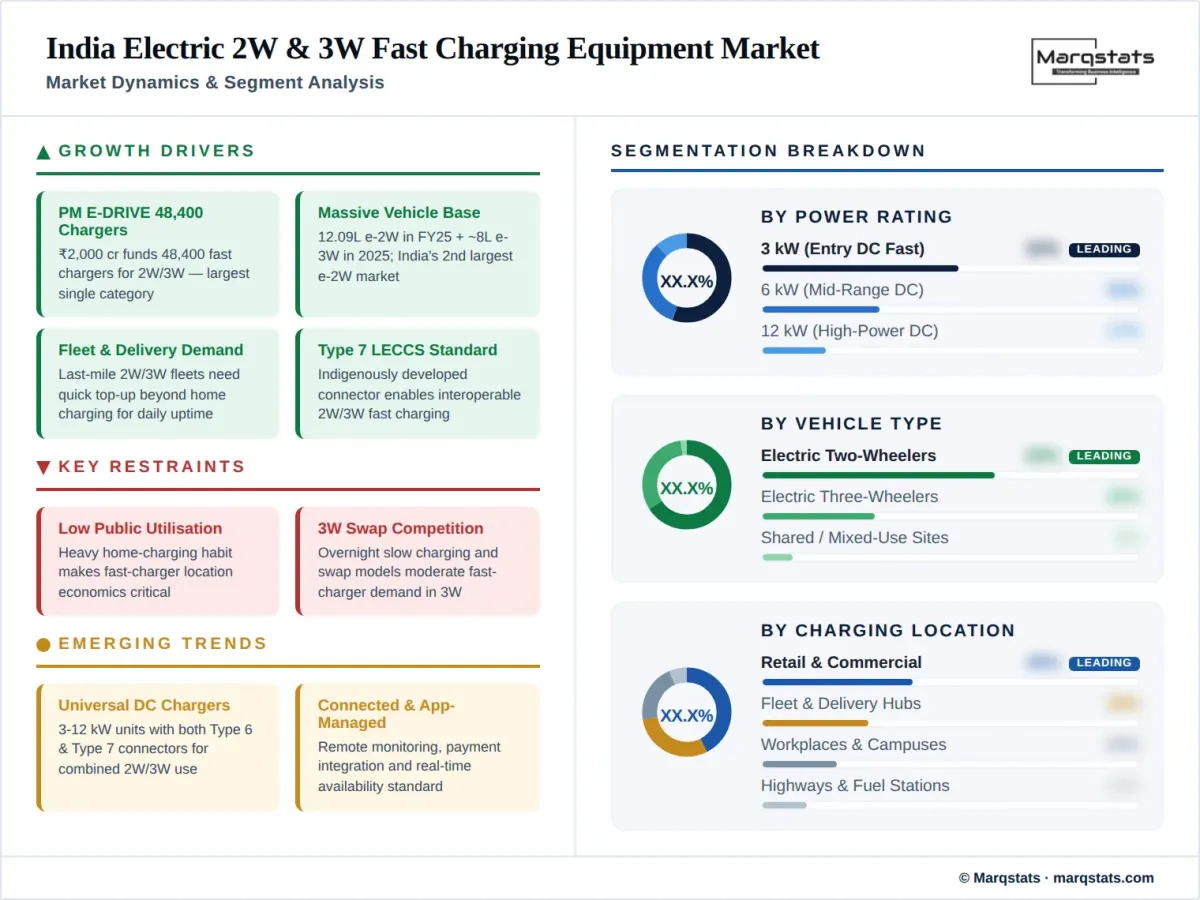
- India sold approximately 12.09 lakh electric two-wheelers in FY2024-25 and close to 8 lakh electric three-wheelers in 2025, creating the largest vehicle base requiring public and semi-public fast charging.
- PM E-DRIVE allocates ₹2,000 crore for public charging infrastructure and targets 48,400 fast chargers for two- and three-wheelers, the largest charger-count category under the scheme.
- Fleet and delivery electrification, including last-mile two- and three-wheelers, requires quick top-up fast charging to sustain high daily utilization beyond home charging.
- The Type 7 LECCS connector, approved as India's first indigenous two- and three-wheeler connector standard, supports interoperable charging and a common equipment platform across original-equipment manufacturers.
- Charging-station setup notified as an unlicensed activity, combined with defined connection timelines, lowers entry barriers and accelerates private fast-charger deployment.
- India installed 29,151 public charging stations by February 2026, with a recent ₹503.86 crore approval for 4,874 additional stations under PM E-DRIVE.
Key Restraints
- Utilization remains uneven, owing to electric scooters being heavily home-charged, which makes public fast-charger location economics critical to viability.
- Many existing public stations report low utilization, shifting policy toward strategic deployment rather than unselective charger addition.
- Three-wheeler operators frequently use slow overnight charging or battery swapping, which moderates fast-charging equipment demand in parts of the segment.
- Service-charge ceilings and site-host economics constrain charge point operator returns, slowing private equipment investment at low-traffic locations.
Key Trends
- Universal 3 kW to 12 kW direct-current chargers supporting both Type 6 and Type 7 connectors are entering the market for combined two- and three-wheeler use.
- Convenience charging at malls, cafes, offices, campuses, fuel stations and parking sites is expanding to serve high-utilization riders and fleets.
- Connected, application-managed fast chargers with remote monitoring and payment integration are becoming standard across public installations.
- Standardization on Type 7 LECCS is consolidating connector fragmentation and enabling multi-original-equipment-manufacturer charging at shared sites.
Market Segmentation
The 3 kW band holds the largest share of unit volume, serving entry-level two-wheeler public charging at retail and workplace sites. The Bolt.Earth Blaze DC 3 kW charger, supporting Type 6 and Type 7 connectors, claims 40 kilometers of range in 15 minutes. Low installation cost and broad two-wheeler compatibility make this the most widely deployed fast-charging equipment band.
The 6 kW band serves higher-throughput two-wheeler sites and lighter three-wheelers, balancing charging speed against installation cost. The Bolt.Earth Blaze DC 6 kW unit claims 80 kilometers of range in 15 minutes. The band grows as commercial sites and fleets seek faster turnaround than entry chargers provide.
The 12 kW band serves three-wheelers, cargo fleets and high-utilization hubs, carrying the highest unit value in the market. The Bolt.Earth Blaze DC 12 kW unit claims 120 kilometers of range in 15 minutes. Higher power and price concentrate disproportionate value in this band relative to its unit volume.
Electric two-wheelers account for the largest share of fast-charging equipment demand, anchored by about 12.09 lakh FY2024-25 sales and a record FY2025-26. Dedicated networks such as Ather Grid and Ola Hypercharger serve scooters and motorcycles at public sites, with 3 kW and 6 kW chargers forming the core equipment. Convenience and fleet charging drive demand beyond home charging.
Electric three-wheelers form the fastest-growing vehicle segment, with India the largest e-3W market globally and about 8 lakh units in 2025 at near 32% penetration. Passenger and cargo three-wheelers in last-mile mobility favor 6 kW and 12 kW fast charging at fleet hubs, broadening the equipment base. Major manufacturers including Mahindra Last Mile Mobility Limited, Bajaj Auto Limited and YC Electric Vehicle anchor a fleet base that increasingly adopts hub and corridor fast charging for cargo and passenger operations. The PM E-DRIVE electric three-wheeler target of 288,000 units was met ahead of schedule, with incentivization closed after December 2025.
The Type 6 low-voltage direct-current connector, defined under IS 17017 Part 2 Section 6, serves direct-current charging for light electric vehicles up to 120 V. It anchors the installed base of two-wheeler fast chargers and remains widely supported across equipment.
The Type 7 Light Electric Combined Charging System, defined under IS 17017 Part 2 Section 7 and developed indigenously, combines alternating-current and direct-current charging in a single connector for two- and three-wheelers. Approved as India's first connector standard for the segment, it is the fastest-growing connector type and the basis for interoperable charging.
Proprietary original-equipment-manufacturer connectors persist in network-led deployments, particularly within Ola and earlier Ather charging hardware. Their share is declining as Type 7 LECCS standardization consolidates the connector base.
Retail and commercial sites, including malls, cafes and high-street stores, host the largest share of fast chargers, serving convenience charging for two-wheeler riders. Footfall and dwell time make these sites attractive for 3 kW and 6 kW equipment.
Workplaces, offices and educational campuses host fast chargers for daytime top-ups, supporting employee and institutional two-wheeler fleets. Predictable dwell time supports utilization at these sites, and corporate sustainability commitments increasingly fund on-site charging.
Fleet and delivery hubs concentrate high-utilization two- and three-wheeler charging, favoring 6 kW and 12 kW equipment for fast turnaround. Last-mile delivery and cargo operations anchor demand at these sites.
Highways and fuel stations host fast chargers for intercity and corridor two- and three-wheeler charging. Deployment expands under PM E-DRIVE highway-corridor funding and oil-marketing-company retail networks.
By Geography
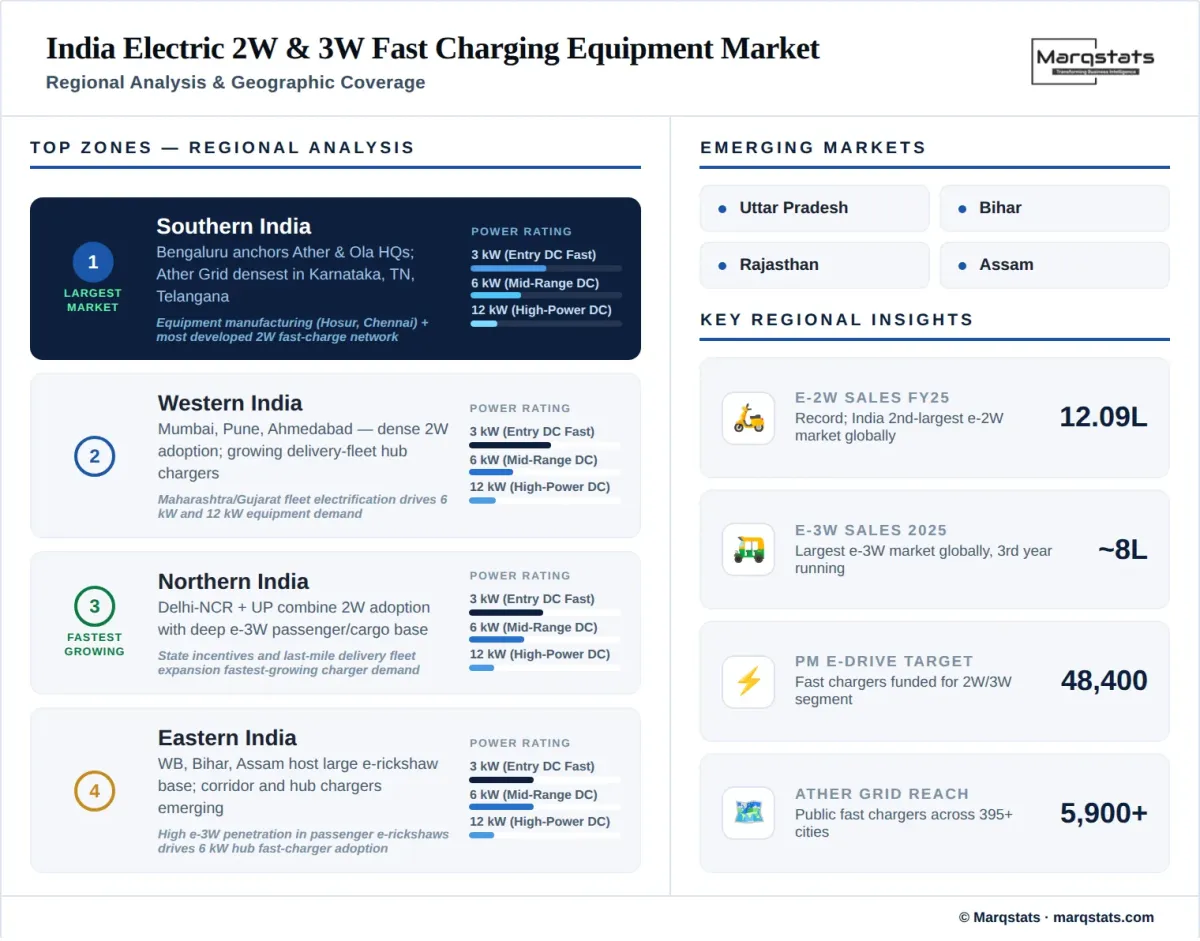
Southern India
Southern India holds the largest share, anchored by Bengaluru as the headquarters of Ather Energy Limited and Ola Electric Mobility Limited and dense two-wheeler fast-charging deployment across Karnataka, Tamil Nadu and Telangana. The region combines equipment manufacturing capacity with the country's most developed dedicated two-wheeler charging networks, supporting both retail and fleet charging.
Western India
Western India anchors strong demand across Maharashtra and Gujarat, with Mumbai, Pune and Ahmedabad recording dense two-wheeler adoption and growing fleet charging. The region combines urban convenience charging with delivery-fleet hubs, supporting 6 kW and 12 kW equipment demand.
Northern India
Northern India records the fastest growth, anchored by Delhi-NCR and Uttar Pradesh. The region combines two-wheeler adoption with a deep electric three-wheeler base in passenger and cargo mobility, broadening fast-charging equipment demand across both vehicle types. State incentives and last-mile delivery sustain deployment.
Eastern and Rest of India
Eastern and remaining states form a growing share, with West Bengal, Bihar and Assam anchoring a large electric three-wheeler base concentrated in passenger e-rickshaw and cargo mobility. Fast-charging equipment demand develops as fleet operators and site hosts add chargers beyond metropolitan corridors under central charging-infrastructure funding, while a share of three-wheeler operators continues to rely on overnight and swap-based charging.
How Competition Is Evolving
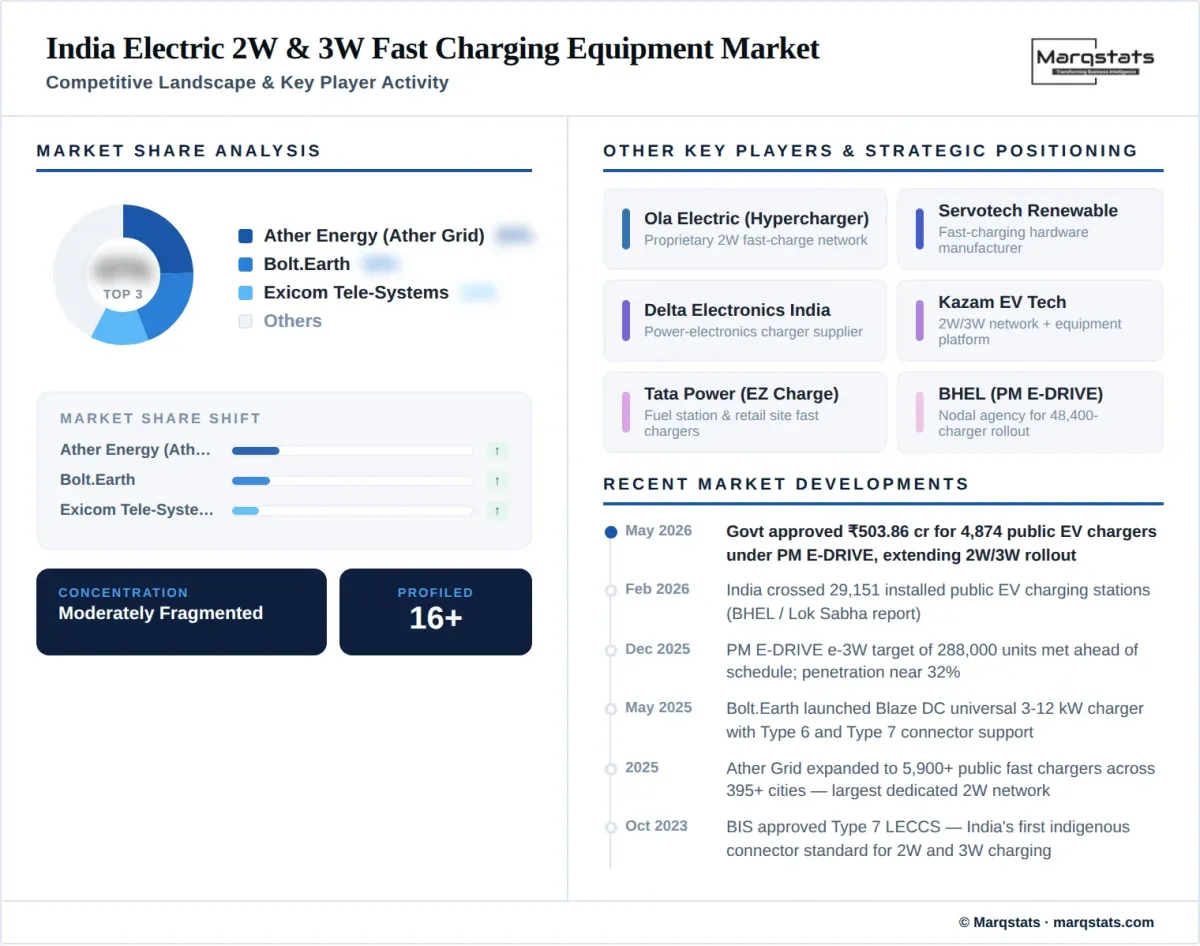
The market is moderately fragmented and stratifies into four groups: network-led original-equipment manufacturers, charging-equipment and network companies, charger manufacturers, and government-backed deployment channels. Network-led original-equipment manufacturers operate proprietary fast-charging networks, equipment and network companies install and operate chargers across sites, charger manufacturers supply hardware, and government channels deploy chargers under PM E-DRIVE.
Ather Energy Limited operates the largest dedicated two-wheeler fast-charging network, Ather Grid, with more than 5,900 public fast chargers across 395-plus cities, claiming 30 kilometers of range in 10 minutes. Ola Electric Mobility Limited operates the Ola Hypercharger network for its scooters. Ather Energy Limited also developed the Type 7 LECCS connector standard, which positions it at the center of two- and three-wheeler charging standardization and interoperability.
Bolt.Earth supplies commercial fast-charging equipment, with its Blaze DC range spanning 3 kW, 6 kW and 12 kW for two- and three-wheelers, and operates a network of more than 100,000 chargers across 2,000-plus cities serving over 466,000 active users. Kazam EV Tech Private Limited and Massive Mobility Private Limited provide charging equipment and operate networks across retail and fleet sites. Charger manufacturers including Exicom Tele-Systems Limited, Servotech Renewable Power Systems Limited and Delta Electronics India Private Limited supply fast-charging hardware to networks and operators.
Charge point operators and site-host partners, including Statiq, ChargeZone Energy Private Limited, Tata Power Company Limited and Reliance BP Mobility Limited, deploy fast chargers across retail, workplace and fuel-station sites. Government-backed deployment under PM E-DRIVE, coordinated through Bharat Heavy Electricals Limited, expands the charger base toward the 48,400 two- and three-wheeler fast-charger target. Competition centers on connector standardization, charging speed, network coverage and equipment cost, with Type 7 LECCS adoption consolidating the platform across original-equipment manufacturers.
Companies Covered
The report profiles 16++ companies with full strategy and financials analysis, including:
Recent Market Activity
Table of Contents
Coverage & Segmentation
This report analyzes the India electric 2W and 3W fast charging equipment market across the 2021–2025 historical period, a 2025 base year, and the 2026–2030 forecast period. The study quantifies market size in value, segments demand by power rating, vehicle type, connector type and charging location, and profiles network-led original-equipment manufacturers, charging-equipment companies, charger manufacturers and deployment channels. Market sizing follows a bottom-up approach calibrated to the electric two- and three-wheeler base, charger deployment and equipment pricing, validated against top-down estimates. Forecasts present base, conservative and accelerated scenarios reflecting vehicle penetration, charger funding and connector standardization.
The scope covers 3 kW, 6 kW and 12 kW fast chargers, Type 6 and Type 7 LECCS connectors, charging guns and power modules, control and communication systems, protection and metering hardware, and payment-enabled public and semi-public installations for two- and three-wheelers. Coverage includes the IS 17017 standards series, the Ministry of Power charging guidelines and PM E-DRIVE charging-infrastructure policy. The report excludes portable home chargers, domestic charging sockets, four-wheeler combined-charging-system hardware, bus chargers and battery-swap stations except where analyzed as adjacent infrastructure.