Statistics & Highlights

Market Snapshot

Market size in Thousand Units
175K Units
2025
Base year
189K Units
2026
Estimated
  
261K Units
2030
Forecast
Largest market
North (NW / NE / NC)
Fastest growing
Electric (Fuel Type)
Dominant segment
Passenger Carrier
Concentration
Moderately Concentrated
CAGR
7.70%
2026 – 2030
GROWTH
+86K Units
Absolute
STUDY PARAMETERS
Base year2025
Historical period2021 – 2025
Forecast period2026 – 2030
Units consideredVolume (Thousand Units)
REPORT COVERAGE
Segments covered4
Regions covered1
Companies profiled16+
Report pages280+
DeliverablesPDF, Excel, PPT
Executive Summary

Key Takeaways

Nigeria three wheeler market recorded 175.07 thousand units in 2025, projected to reach 261.42 thousand units by 2030 at 7.70% CAGR.
Market value stood at USD 803.30 million in 2025 and is forecast to reach USD 1301.49 million by 2030 at 9.47% CAGR.
Nigeria is Africa's largest three wheeler market at 34.80% of continental volume, anchored by the keke as the default urban taxi.
CNG/LPG reached 39.00% of 2025 volume, the continent's highest gas share, via a programme that converted 100,000+ vehicles across 22 states.
Electric three wheelers are the fastest growing segment at 34.24% CAGR, lifted by a 10,000-unit federal rollout from August 2026.
Passenger carriers held 78.00% of 2025 volume, while load carriers grow faster at 10.02% CAGR on last-mile logistics demand.
Market Insights

Market Overview & Analysis

Report Summary

The Nigeria three wheeler market covers passenger-carrier and load-carrier three wheeled vehicles sold nationally, spanning petrol, diesel, CNG/LPG, and electric powertrains. The study quantifies the market in volume (thousand units) and value (USD million) across 2021-2025 historical and 2026-2030 forecast horizons, with 2025 as the base year. Nigeria is an import-dependent market supplied principally from India, with Bajaj, TVS, and Piaggio product landed through distributors and increasingly complemented by local CKD assembly and a growing bi-fuel and electric conversion ecosystem.

Demand fell to 154.95 thousand units in 2024 as the naira devaluation pushed retail keke prices toward NGN 3.5 million and compressed operator affordability, before recovering to 175.07 thousand units in 2025 on currency stabilization and restocking. India shipped 50,655 three wheeler export units in April 2026 alone, nearly double the prior-year month, according to SIAM production and export statistics, with African demand recovery a principal driver. Marqstats reconciles continental demand against these dispatch flows, national registration records, and distributor channel checks to produce the volume series underlying this report. Value growth outpaces volume growth over the forecast period owing to powertrain mix enrichment toward CNG and electric variants carrying higher average selling prices on a 2025 blended base near USD 4,589 per unit.

The forecast period is shaped by a state-driven powertrain transition. The Presidential Initiative on CNG, expanded in March 2026 to include electric vehicles, coordinates conversion kits, refuelling stations, and financing through partners such as CreditCorp, while the North East Development Commission leads a federal electric tricycle rollout from August 2026 with approved replication through other regional commissions. The market adds 86.35 thousand annual units between 2025 and 2030, with CNG and electric platforms contributing a disproportionate share of incremental demand and displacing petrol's historical dominance.

Financing and currency conditions govern effective demand. Retail keke prices remain sensitive to exchange-rate movements given the import-dependent supply base, and hire-purchase arrangements through distributors and empowerment schemes determine purchase capacity for owner-drivers. CNG conversion economics reset the operating-cost calculus, with the initiative reporting fuel-cost reductions exceeding 60% versus petrol, shortening payback and sustaining conversion demand independent of new-unit sales.

The gas transition rewrites unit economics at the operator level. A keke converted to CNG through a certified centre trades a modest conversion outlay for running-cost savings exceeding 60% versus petrol, delivering payback within months of commercial operation and materially raising daily take-home earnings for owner-drivers. This economic logic, rather than environmental preference, drives conversion demand, and it insulates gas-share growth from the currency swings that govern new-unit imports, since a converted vehicle keeps earning on cheaper domestic gas regardless of the exchange rate applied to the next tricycle shipment.

Market Dynamics

Key Drivers

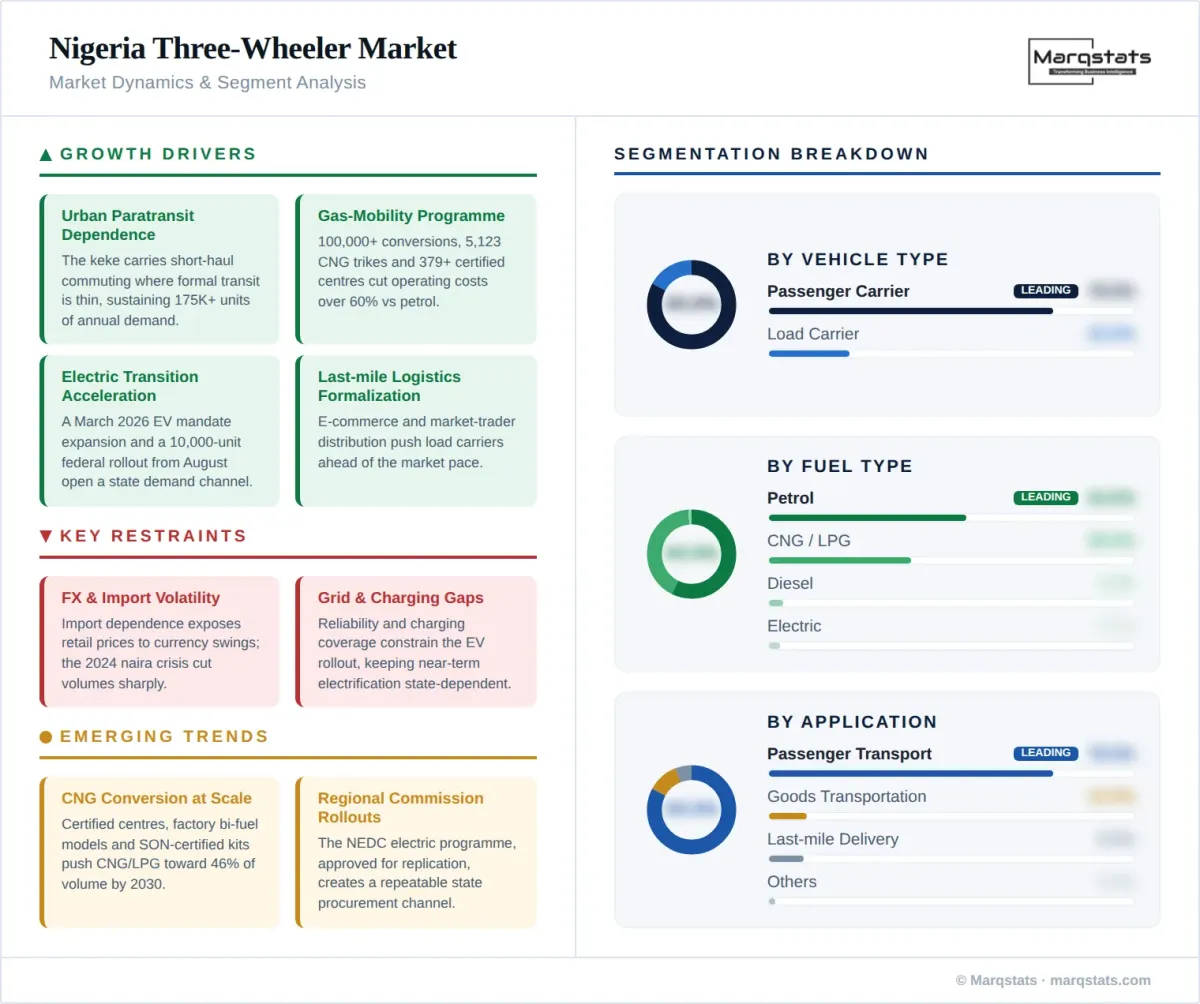
  • Urban paratransit dependence: with formal bus networks covering a fraction of trips, the keke carries a large share of short-haul passenger movement across Nigerian cities, sustaining replacement and expansion demand above 175 thousand units annually.
  • Gas-mobility programme: the Presidential Initiative on CNG has converted more than 100,000 vehicles, deployed 5,123 CNG tricycles, trained 7,700 auto-technicians, and built 379+ certified centres and 75 refuelling stations, cutting operating costs by over 60% versus petrol.
  • Electric transition acceleration: the March 2026 expansion of the initiative's mandate to electric vehicles and the 10,000-unit federal electric tricycle rollout from August 2026 open a state-anchored electric demand channel.
  • Currency recovery: naira stabilization from late 2024 restored dealer restocking and operator affordability, lifting volumes 13.0% in 2025 after the 2024 contraction.
  • Last-mile logistics formalization: e-commerce and market-trader distribution push load-carrier demand at a 10.02% CAGR, ahead of the 7.70% market average.

Key Restraints

  • Foreign-exchange volatility: import-dependent supply exposes retail prices to currency swings, as the 2024 naira crisis demonstrated when keke prices climbed toward NGN 3.5 million and volumes fell.
  • Electricity and infrastructure gaps: grid reliability and charging coverage constrain the electric tricycle rollout, a concern raised publicly around the 10,000-unit programme, keeping near-term electrification dependent on state support.
  • Financing gaps: high interest rates and thin credit histories limit formal lending to owner-drivers, keeping much purchase activity in cash or informal hire-purchase channels.
  • Urban operating restrictions: several state and city authorities restrict keke operation on major highways or in central districts, capping addressable passenger demand in affected corridors.

Key Trends

  • CNG conversion at scale: certified conversion centres, factory bi-fuel models, and SON-certified kits shift the installed base toward gas, with CNG/LPG projected to reach 46.00% of volume by 2030.
  • Integrated logistics vision: the federal transport agenda positions tricycles within an unbroken chain linking ports, rail, CNG trucks, and traders, embedding three wheelers in national logistics policy.
  • Regional commission rollouts: the North East Development Commission electric tricycle programme, approved for replication through other regional commissions, creates a repeatable state procurement channel.
  • Local assembly and financing: CKD assembly and structured conversion financing through CreditCorp and financial partners deepen localization and widen the addressable buyer base.
Nigeria Three Wheeler Market Market Dynamics Segment Analysis Infographic
Segment Analysis

Market Segmentation

Passenger Carrier
Leading

Passenger carriers accounted for 78.00% of 2025 volume at 136.55 thousand units and are projected to reach 197.37 thousand units by 2030 at a 7.00% CAGR. The keke NAPEP anchors the segment as the default urban taxi across Nigerian cities, with three-to-four passenger configurations serving short-haul commuting and replacement cycles of five to seven years sustaining a deep recurring demand base.

Load Carrier

Load carriers held 22.00% of 2025 volume at 38.52 thousand units and grow faster at a 10.02% CAGR to 64.05 thousand units by 2030. Demand is propelled by market-trader distribution in commercial hubs such as Aba and Onitsha, construction material movement, waste collection contracts, and the expansion of structured last-mile delivery networks in major cities.

Petrol
Leading

Petrol remained the largest fuel segment at 54.00% of 2025 volume, or 94.54 thousand units, yet grows slowest at a 1.25% CAGR as subsidy removal and the gas-conversion programme push operators toward CNG; its share declines sharply to 40.00% of volume by 2030, the fastest powertrain-share erosion in the continental market.

Diesel

Diesel is a legacy niche at 4.00% of 2025 volume and contracts at a 0.05% CAGR through 2030 as emissions considerations, fuel costs, and the withdrawal of diesel tricycle variants from exporter portfolios erode the segment.

CNG/LPG

CNG/LPG is the market's structural growth story, reaching 39.00% of 2025 volume at 68.28 thousand units and expanding at a 11.25% CAGR to 120.25 thousand units by 2030. The Presidential Initiative on CNG has built 379+ certified conversion centres across 22 states, commissioned 75 refuelling stations, deployed 5,123 CNG tricycles, and activated the Northern Green Transport Corridor in Kano in May 2026, driving CNG/LPG toward 46.00% of volume by 2030.

Electric

Electric three wheelers are the fastest growing segment, expanding from 5.25 thousand units in 2025 to 29.28 thousand units by 2030 at a 34.24% CAGR. The March 2026 expansion of the Presidential Initiative's mandate to electric vehicles, the 10,000-unit North East Development Commission rollout from August 2026, and approved replication through other regional commissions establish a state-anchored electric demand channel, subject to grid and charging constraints that shape the near-term pace.

Passenger Transport
Leading

Passenger transport represented 78.00% of 2025 volume, mirroring the passenger-carrier base, and grows at a 7.00% CAGR. The keke remains the most affordable motorized mode for 2-10 kilometre urban trips across the country.

Last-mile Delivery/Logistics

Last-mile delivery is the fastest growing application at a 12.72% CAGR, rising from 16.63 thousand units in 2025 to 31.37 thousand units by 2030 as e-commerce platforms, food delivery services, and courier networks in Lagos, Abuja, and commercial hubs contract dedicated tricycle fleets.

Goods Transportation

General goods transportation accounted for 10.50% of 2025 volume at 18.38 thousand units, growing at a 7.70% CAGR on market-trader haulage in wholesale centres, agricultural produce evacuation, and construction supply movement.

Others

Other applications, including municipal services, waste management, and mobile vending, held 2.00% of 2025 volume and grow at a 7.70% CAGR as state and local governments contract tricycles for sanitation and utility functions.

Individual Owner/Drivers
Leading

Individual owner-drivers purchased 68.00% of 2025 volume at 119.05 thousand units, growing at a 6.39% CAGR. Ownership remains the dominant livelihood model, typically financed through hire-purchase arrangements with distributors, cooperatives, or empowerment schemes.

Fleet Operators

Fleet operators accounted for 28.50% of 2025 volume and outpace the market at a 9.85% CAGR to 82.35 thousand units by 2030, as delivery aggregators, ride-hailing platforms, and asset-financing companies build professionally managed tricycle fleets with telematics and structured maintenance.

Government/Institutional Purchases

Government and institutional purchases held 3.50% of 2025 volume and grow at a 13.10% CAGR, the highest institutional share in the pack, reflecting empowerment-programme distributions and the federal and regional-commission electric tricycle rollouts.

Regional Analysis

By Geography

South West and Lagos

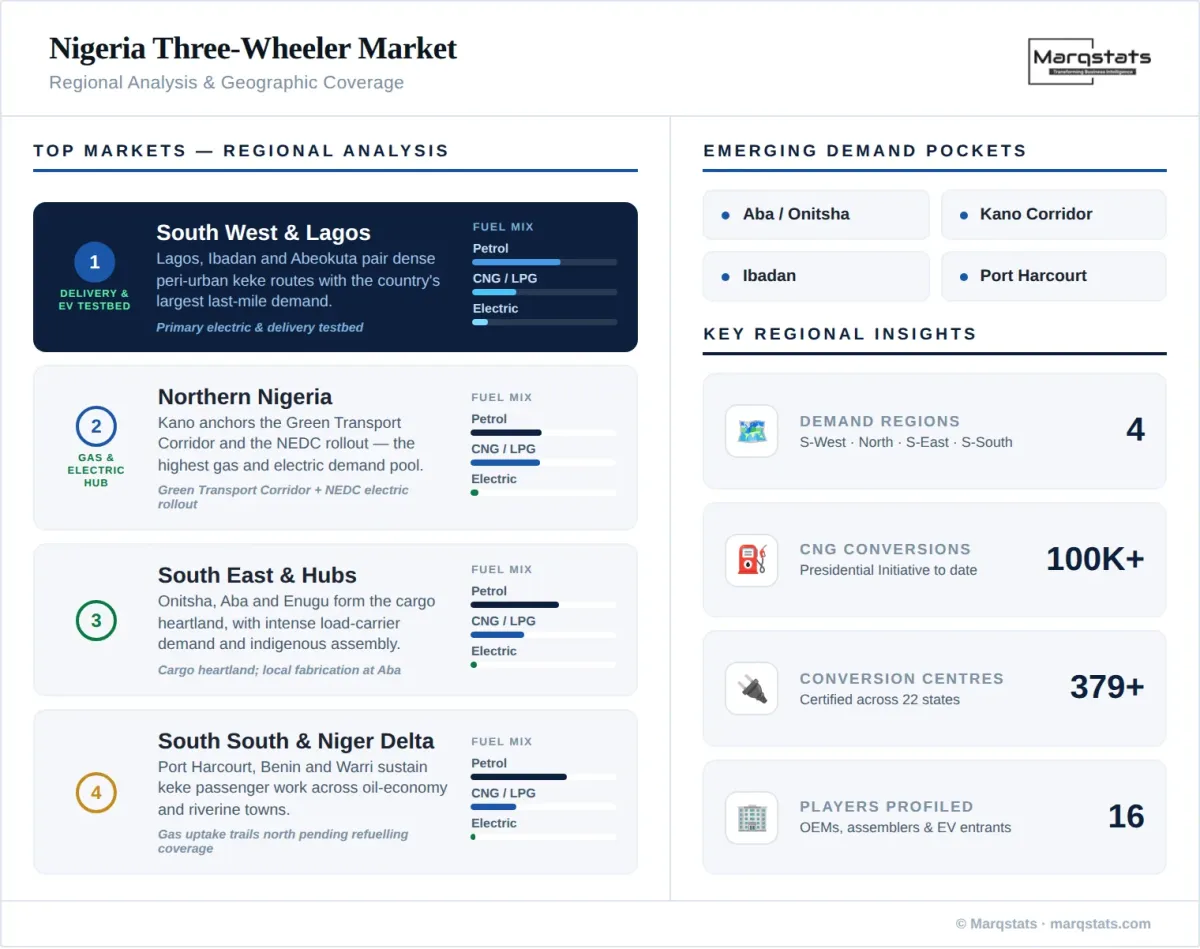
The South West, anchored by Lagos, Ibadan, and Abeokuta, combines dense passenger keke operations in peri-urban corridors with the country's largest last-mile delivery demand. Lagos state operating restrictions in central districts push tricycle activity toward feeder routes and suburban commuting, while the megacity's e-commerce and logistics ecosystem drives cargo and fleet applications, positioning the region as the primary electric and delivery testbed.

North (North West, North East, North Central)

The northern regions are the epicentre of the gas transition and the electric rollout. Kano anchors the Northern Green Transport Corridor activated in May 2026, and the North East Development Commission leads the 10,000-unit electric tricycle programme from August 2026. Dense keke passenger operations in Kano, Kaduna, Maiduguri, and Abuja combine with strong agricultural and trade haulage, making the north the highest-volume gas and electric demand pool.

Public reaction to the electric rollout has flagged grid reliability and security as execution risks, and the base-case forecast weights the electric ramp toward the second half of the period accordingly, with CNG carrying the near-term transition load where refuelling infrastructure is already operational. The regional development commission structure gives the north a procurement channel unavailable elsewhere, and its replication mandate makes northern deployment the template against which the national electric tricycle programme will be judged.

South East and Commercial Hubs

The South East, centred on Onitsha, Aba, and Enugu, is the commercial and cargo heartland. Wholesale markets such as Ariaria and Onitsha Main Market generate intense load-carrier demand for goods distribution, and the region hosts local assembly activity through indigenous manufacturers, supporting both passenger and cargo tricycle sales. Aba's status as a manufacturing and trading centre gives the region a distinctive dual demand, with locally fabricated cargo bodies mounted on imported driveline platforms and a dense repair economy that extends vehicle service lives well beyond the national norm.

South South and Niger Delta

The South South, including Port Harcourt, Benin City, and Warri, sustains keke passenger operations across oil-economy urban centres and riverine towns. Demand tracks regional commercial activity, with cargo tricycles serving market distribution and passenger units filling public transport gaps in secondary cities across the delta. Riverine geography and dispersed settlements sustain a durable keke passenger base where road-based paratransit is the practical alternative to water transport, and gas-conversion uptake trails the north pending refuelling-station coverage in the region.
Nigeria Three Wheeler Market Regional Analysis Geographic Coverage Infographic
Competitive Landscape

How Competition Is Evolving

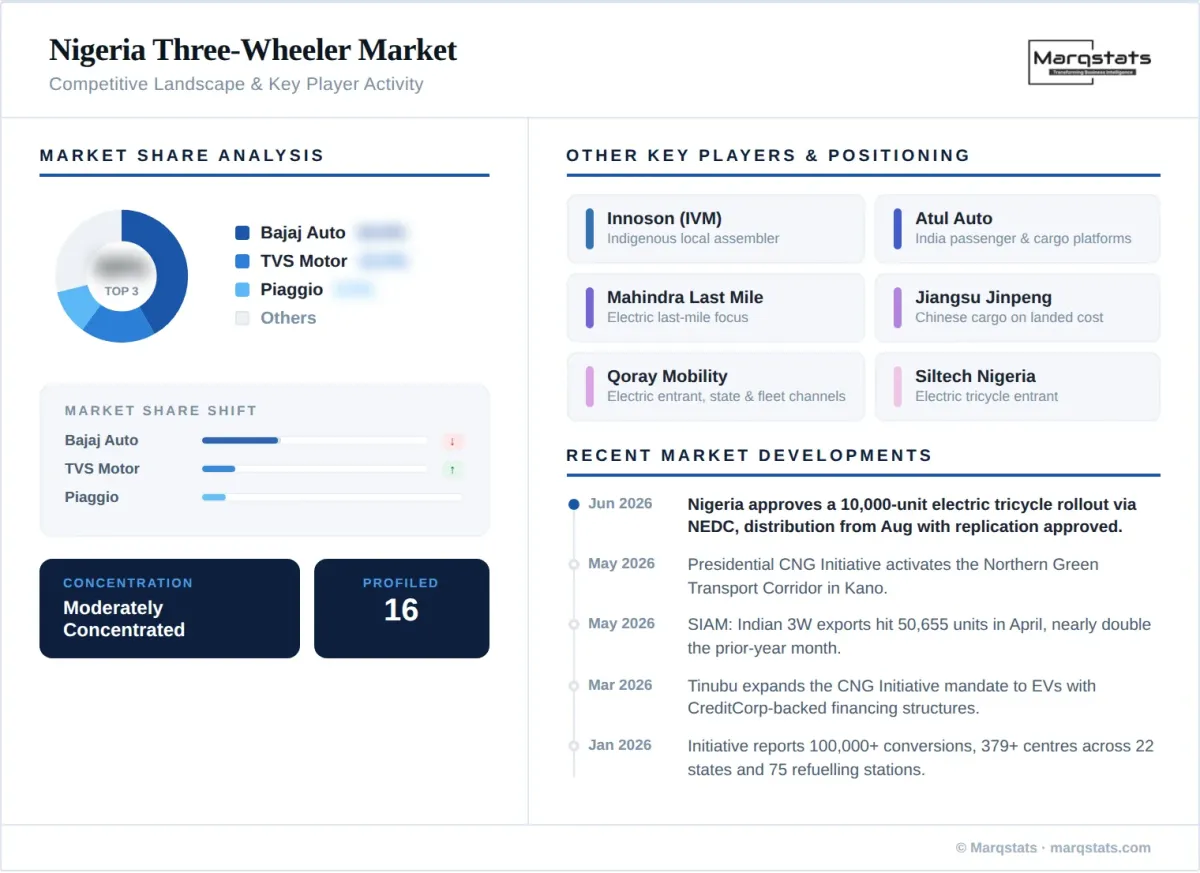
The market is moderately concentrated around Indian-manufactured franchises supplemented by local assembly and a rapidly expanding conversion ecosystem. Bajaj Auto Limited holds the foremost position through the RE and Maxima platforms, supported by deep distributor coverage and spare-parts penetration; the brand anchors the keke segment nationally. TVS Motor Company Limited gains ground through factory CNG variants aligned to the gas programme, and Piaggio holds niches through its Ape franchise, while indigenous assembler Innoson Vehicle Manufacturing builds local presence.

The gas and electric transition is reshaping competition. SON-certified conversion-kit suppliers, factory bi-fuel OEM models, and the Presidential Initiative's certified-centre network create a parallel powertrain-services market, while electric entrants such as Qoray Mobility and Siltech pursue the state rollout and fleet channels. Chinese manufacturers, including Jiangsu Jinpeng, compete on landed cost in cargo segments, and asset financiers and ride-hailing platforms aggregate fleet demand.

Competition centres on powertrain positioning, financing access, and distribution depth. Alignment with the CNG and electric programmes confers a demand advantage, as state procurement and conversion subsidies favour compliant OEMs and kit suppliers. Distributor networks and after-sales coverage remain the incumbents' moat, and new powertrain entrants pursue programme partnerships and fleet contracts rather than open retail to reach operators at scale.
Nigeria Three Wheeler Market Competitive Landscape Key Player Activity Infographic
Major Players

Companies Covered

The report profiles 16+ companies with full strategy and financials analysis, including:

Bajaj Auto Limited
TVS Motor Company Limited
Piaggio & C. S.p.A.
Atul Auto Limited
Mahindra Last Mile Mobility Limited
Greaves Cotton Limited
Innoson Vehicle Manufacturing Co. Ltd.
Jiangsu Jinpeng Group Co., Ltd.
Chongqing Zongshen Automobile Industry Co., Ltd.
Loncin Motor Co., Ltd.
Luoyang Dayang Trike Locomotive Co., Ltd.
Qoray Mobility Limited
Siltech Nigeria Limited
Omega Seiki Mobility Private Limited
NEV Motors Limited
PowerCycle Mobility Limited
Note: Full company profiles include revenue analysis, product portfolio, SWOT, and recent strategic developments.
Latest Developments

Recent Market Activity

Jun 2026
Nigeria approved a nationwide rollout of 10,000 electric tricycles through the North East Development Commission, with distribution commencing from August 2026 before replication through other regional development commissions.
May 2026
The Presidential Initiative on CNG activated the Northern Green Transport Corridor in Kano, extending certified conversion and refuelling infrastructure across northern commercial routes.
May 2026
SIAM data showed Indian three wheeler exports of 50,655 units in April 2026, nearly double the prior-year month, with African demand recovery cited as a principal driver.
Mar 2026
President Tinubu expanded the Presidential Initiative on CNG mandate to include electric vehicles, directing coordinated conversion-kit deployment and CreditCorp-backed financing structures nationwide.
Jan 2026
The Presidential Initiative reported over 100,000 vehicles converted, 5,123 CNG tricycles and 655 CNG buses deployed, 379+ certified centres across 22 states, and 75 refuelling stations across 20 states.
Report Structure

Table of Contents

1. Introduction
1.1 Study Assumptions & Definitions
1.2 Research Scope
1.3 Market Definition — Passenger & Load Carrier Three-Wheelers (Keke)
1.4 Currency, Units & Conversion Basis
1.5 Years Considered — Historical 2021–2025, Forecast 2026–2030
2. Research Methodology
2.1 Research Framework
2.2 Secondary Research — Registration, Export Dispatch & Programme Data
2.3 Primary Research — 40+ Stakeholder Interviews
2.4 Market Estimation — Bottom-Up Volume Model
2.5 Segment Derivation — Marqstats-Reconciled Share Basis
2.6 Data Triangulation & Validation
2.7 Reconciliation Notes — FX-Driven 2024 Reset & CNG-Share Corroboration
2.8 Assumptions & Limitations
3. Executive Summary
3.1 Market Snapshot — Volume & Value
3.2 Key Findings by Segment
3.3 Key Findings by Region
3.4 CXO Perspective — Africa's Largest, Gas-Led 3W Market
3.5 Analyst Recommendations
4. Market Dynamics
4.1 Market Drivers
4.1.1 Urban Paratransit Dependence & the Keke Economy
4.1.2 Presidential Initiative on CNG — Conversion & Refuelling Scale
4.1.3 Electric Transition Acceleration — PiCNG & EV Mandate
4.1.4 Currency Recovery & Import Affordability
4.1.5 Last-Mile Logistics Formalization
4.2 Market Restraints
4.2.1 Foreign-Exchange Volatility & Landed-Cost Pass-Through
4.2.2 Electricity & Charging Infrastructure Gaps
4.2.3 Financing Gaps for Owner-Drivers
4.2.4 Urban Operating Restrictions
4.3 Market Trends
4.3.1 CNG Conversion at Scale & Factory Bi-Fuel Models
4.3.2 Integrated Logistics Chain Vision
4.3.3 Regional Commission Electric Rollouts
4.3.4 Local Assembly & Structured Conversion Financing
4.4 Market Opportunities
4.4.1 Electric Tricycle Deployment Programmes
4.4.2 Conversion-Kit & Refuelling Services Market
4.4.3 Fleet & Institutional Procurement
4.5 Industry Value Chain Analysis
4.6 Porter's Five Forces Analysis
4.6.1 Bargaining Power of Suppliers
4.6.2 Bargaining Power of Buyers
4.6.3 Threat of New Entrants
4.6.4 Threat of Substitutes
4.6.5 Intensity of Competitive Rivalry
5. Nigeria Three-Wheeler Market Size & Growth Analysis
5.1 Market Size in Volume, Thousand Units (2021–2030)
5.2 Market Size in Value, USD Million (2021–2030)
5.3 Volume vs Value Growth Decomposition
5.4 Average Selling Price Analysis by Powertrain
5.5 Growth — Absolute & CAGR Bridge (2026–2030)
6. Nigeria Three-Wheeler Market, By Vehicle Type
6.1 Segment Overview & Share Analysis (2025 vs 2030)
6.2 Passenger Carrier
6.2.1 Market Size in Volume, Thousand Units (2021–2030)
6.2.2 Market Size in Value, USD Million (2021–2030)
6.2.3 Keke NAPEP Operating Models & Replacement Cycles
6.3 Load Carrier
6.3.1 Market Size in Volume, Thousand Units (2021–2030)
6.3.2 Market Size in Value, USD Million (2021–2030)
6.3.3 Cargo Configurations — Flatbed, Box Body & Locally Fabricated Bodies
7. Nigeria Three-Wheeler Market, By Fuel Type
7.1 Segment Overview & Share Analysis (2025 vs 2030)
7.2 Petrol
7.2.1 Market Size in Volume, Thousand Units (2021–2030)
7.2.2 Market Size in Value, USD Million (2021–2030)
7.2.3 Subsidy Removal & Share Erosion Drivers
7.3 Diesel
7.3.1 Market Size in Volume, Thousand Units (2021–2030)
7.3.2 Market Size in Value, USD Million (2021–2030)
7.3.3 Legacy Niche Contraction
7.4 CNG/LPG
7.4.1 Market Size in Volume, Thousand Units (2021–2030)
7.4.2 Market Size in Value, USD Million (2021–2030)
7.4.3 Certified Conversion Centres & SON-Certified Kits
7.4.4 Refuelling Network & Northern Green Transport Corridor
7.5 Electric
7.5.1 Market Size in Volume, Thousand Units (2021–2030)
7.5.2 Market Size in Value, USD Million (2021–2030)
7.5.3 NEDC Rollout & Regional Commission Replication
7.5.4 Grid & Charging Constraints on Adoption Pace
8. Nigeria Three-Wheeler Market, By Application Type
8.1 Segment Overview & Share Analysis (2025 vs 2030)
8.2 Passenger Transport
8.2.1 Market Size in Volume, Thousand Units (2021–2030)
8.2.2 Market Size in Value, USD Million (2021–2030)
8.2.3 Urban & Peri-Urban Keke Route Structures
8.3 Last-mile Delivery/Logistics
8.3.1 Market Size in Volume, Thousand Units (2021–2030)
8.3.2 Market Size in Value, USD Million (2021–2030)
8.3.3 Lagos & Abuja E-Commerce & Courier Fleets
8.4 Goods Transportation
8.4.1 Market Size in Volume, Thousand Units (2021–2030)
8.4.2 Market Size in Value, USD Million (2021–2030)
8.4.3 Ariaria & Onitsha Wholesale-Market Haulage
8.5 Others (Municipal, Waste, Vending)
8.5.1 Market Size in Volume, Thousand Units (2021–2030)
8.5.2 Market Size in Value, USD Million (2021–2030)
8.5.3 State & Local Government Service Contracts
9. Nigeria Three-Wheeler Market, By End-User Ownership Model
9.1 Segment Overview & Share Analysis (2025 vs 2030)
9.2 Individual Owner/Drivers
9.2.1 Market Size in Volume, Thousand Units (2021–2030)
9.2.2 Market Size in Value, USD Million (2021–2030)
9.2.3 Hire-Purchase, Cooperative & Empowerment-Scheme Financing
9.3 Fleet Operators
9.3.1 Market Size in Volume, Thousand Units (2021–2030)
9.3.2 Market Size in Value, USD Million (2021–2030)
9.3.3 Delivery Aggregators & Ride-Hailing Fleets
9.3.4 Telematics & Managed Maintenance
9.4 Government/Institutional Purchases
9.4.1 Market Size in Volume, Thousand Units (2021–2030)
9.4.2 Market Size in Value, USD Million (2021–2030)
9.4.3 Empowerment Distributions & Electric Tricycle Rollouts
10. Nigeria Three-Wheeler Market, By Region
10.1 Regional Share Analysis — Volume (2025 vs 2030)
10.2 Regional Growth Matrix — CAGR vs Fleet Size
10.3 Import Routing, Ports & Local Assembly Clusters
11. North Region Deep Dive
11.1 Market Context — Highest-Volume Gas & Electric Pool
11.1.1 Fleet Size & Renewal Estimates (2021–2030)
11.1.2 Kano, Kaduna, Maiduguri & Abuja Demand Structure
11.2 Northern Green Transport Corridor & CNG Infrastructure
11.2.1 Conversion Economics — Petrol vs CNG Cost per Kilometre
11.2.1.1 Certified-Centre Coverage & Kit Certification
11.2.1.2 Operator Payback & Take-Home Earnings Uplift
11.3 NEDC Electric Tricycle Rollout
11.3.1 10,000-Unit Deployment Structure & Timeline
11.3.2 Grid, Security & Execution Risk Assessment
12. South West & Lagos Deep Dive
12.1 Regulatory Setting — Central-District Restrictions & Feeder Routes
12.2 Last-Mile Delivery & Fleet Demand
12.3 Electric & Delivery Testbed Dynamics
13. South East & South South Regions
13.1 Onitsha, Aba & Enugu — Commercial & Cargo Heartland
13.1.1 Wholesale-Market Load-Carrier Demand
13.1.2 Local Assembly & Body-Fabrication Cluster
13.2 Port Harcourt, Benin & Warri — Niger Delta Demand
13.3 Riverine Geography & Paratransit Substitution
14. Policy & Programme Environment
14.1 Presidential Initiative on CNG & EV — Mandate & Milestones
14.1.1 CNG Infrastructure — Stations, MRUs & Conversion Centres
14.1.2 Electric Vehicle Mandate Expansion (March 2026)
14.2 Financing Structures — CreditCorp & Partner Institutions
14.3 Import Regime, Local Assembly & Localization Incentives
14.4 State & Local Operating Regulations
14.5 Standards & Certification (SON)
15. Powertrain Transition Economics
15.1 Total Cost of Ownership — Petrol vs CNG vs Electric
15.1.1 Acquisition & Conversion Cost Comparison
15.1.2 Running Cost per Kilometre by Powertrain
15.1.3 Payback Analysis for Keke Operators
15.1.3.1 Petrol-to-CNG Conversion Payback Scenario
15.1.3.2 Electric Deployment Cost Scenario
15.2 Conversion-Kit Supply Chain & Certification
15.3 Charging & Refuelling Infrastructure Coverage Mapping
15.4 Powertrain Mix Forecast Scenarios to 2030
16. Import & Supply Chain Analysis
16.1 India Export Dispatch Flows & Landed Cost Structure
16.1.1 Freight, Duty & FX Pass-Through to Showroom Price
16.1.2 CKD Assembly & Local Fabrication
16.2 Port Handling & Inland Distribution
16.2.1 Lagos & Eastern Ports — Clearance & Routing
16.2.2 Inland Logistics to Regional Hubs
16.3 Distributor & Dealer Network Structure
16.3.1 National Dealer Coverage & Regional Concentration
16.3.2 Hire-Purchase & Empowerment-Scheme Channels
16.4 Spare Parts, Conversion & After-Sales Ecosystem
17. Competitive Landscape
17.1 Market Share Analysis — National & Regional (2025)
17.2 Competitive Positioning Matrix
17.3 Powertrain Alignment Benchmarking — Petrol, CNG & Electric
17.4 Pricing & Financing Strategy Comparison
17.5 Strategic Developments — Programmes, Launches & Partnerships (2024–2026)
18. Company Profiles
18.1 Bajaj Auto Limited
18.1.1 Company Overview & Nigeria Footprint
18.1.2 Product Portfolio — Three-Wheeler Platforms
18.1.3 Recent Developments & Strategy
18.2 TVS Motor Company Limited
18.2.1 Company Overview & Nigeria Footprint
18.2.2 Product Portfolio — Three-Wheeler Platforms
18.2.3 Recent Developments & Strategy
18.3 Piaggio & C. S.p.A.
18.3.1 Company Overview & Nigeria Footprint
18.3.2 Product Portfolio — Three-Wheeler Platforms
18.3.3 Recent Developments & Strategy
18.4 Atul Auto Limited
18.4.1 Company Overview & Nigeria Footprint
18.4.2 Product Portfolio — Three-Wheeler Platforms
18.4.3 Recent Developments & Strategy
18.5 Mahindra Last Mile Mobility Limited
18.5.1 Company Overview & Nigeria Footprint
18.5.2 Product Portfolio — Three-Wheeler Platforms
18.5.3 Recent Developments & Strategy
18.6 Greaves Cotton Limited
18.6.1 Company Overview & Nigeria Footprint
18.6.2 Product Portfolio — Three-Wheeler Platforms
18.6.3 Recent Developments & Strategy
18.7 Innoson Vehicle Manufacturing Co. Ltd.
18.7.1 Company Overview & Nigeria Footprint
18.7.2 Product Portfolio — Three-Wheeler Platforms
18.7.3 Recent Developments & Strategy
18.8 Jiangsu Jinpeng Group Co., Ltd.
18.8.1 Company Overview & Nigeria Footprint
18.8.2 Product Portfolio — Three-Wheeler Platforms
18.8.3 Recent Developments & Strategy
18.9 Chongqing Zongshen Automobile Industry Co., Ltd.
18.9.1 Company Overview & Nigeria Footprint
18.9.2 Product Portfolio — Three-Wheeler Platforms
18.9.3 Recent Developments & Strategy
18.10 Loncin Motor Co., Ltd.
18.10.1 Company Overview & Nigeria Footprint
18.10.2 Product Portfolio — Three-Wheeler Platforms
18.10.3 Recent Developments & Strategy
18.11 Luoyang Dayang Trike Locomotive Co., Ltd.
18.11.1 Company Overview & Nigeria Footprint
18.11.2 Product Portfolio — Three-Wheeler Platforms
18.11.3 Recent Developments & Strategy
18.12 Qoray Mobility Limited
18.12.1 Company Overview & Nigeria Footprint
18.12.2 Product Portfolio — Three-Wheeler Platforms
18.12.3 Recent Developments & Strategy
18.13 Siltech Nigeria Limited
18.13.1 Company Overview & Nigeria Footprint
18.13.2 Product Portfolio — Three-Wheeler Platforms
18.13.3 Recent Developments & Strategy
18.14 Omega Seiki Mobility Private Limited
18.14.1 Company Overview & Nigeria Footprint
18.14.2 Product Portfolio — Three-Wheeler Platforms
18.14.3 Recent Developments & Strategy
18.15 NEV Motors Limited
18.15.1 Company Overview & Nigeria Footprint
18.15.2 Product Portfolio — Three-Wheeler Platforms
18.15.3 Recent Developments & Strategy
18.16 PowerCycle Mobility Limited
18.16.1 Company Overview & Nigeria Footprint
18.16.2 Product Portfolio — Three-Wheeler Platforms
18.16.3 Recent Developments & Strategy
19. Appendix
19.1 Abbreviations & Glossary
19.2 List of Tables
19.3 List of Figures
19.4 Sources & References
19.5 Customization Options
19.6 Disclaimer
Study Scope & Focus

Coverage & Segmentation

This report quantifies the Nigeria three wheeler market in volume (thousand units) and value (USD million) across a 2021-2025 historical period and a 2026-2030 forecast period, with 2025 as the base year. Segmentation covers vehicle type (passenger carrier, load carrier), fuel type (petrol, diesel, CNG/LPG, electric), application (passenger transport, last-mile delivery/logistics, goods transportation, others), and end-user ownership model (individual owner/drivers, fleet operators, government/institutional purchases), with regional assessment across the South West and Lagos, the North, the South East, and the South South. The competitive assessment profiles 16 manufacturers, assemblers, and electric entrants. Nigeria's demand structure is assessed alongside continental patterns documented in the Africa two wheeler market, whose import, financing, and electrification dynamics closely parallel the tricycle segment.

The study evaluates the CNG and electric programme trajectories, powertrain transition economics, import and assembly flows, financing models, and competitive positioning to support procurement, market-entry, localization, and portfolio decisions by OEMs, distributors, kit suppliers, financiers, and government institutions. Forecasts incorporate announced policy commitments with funded programmes and published deployment schedules; speculative initiatives without funding are excluded from the base case, and the electric path is modelled against grid and charging constraints.
Frequently Asked Questions

FAQs About the Nigeria Three-Wheeler Market

The Nigeria three-wheeler market recorded 175.07 thousand units in 2025 and is projected to reach 261.42 thousand units by 2030. In value terms, the market stood at USD 803.30 million in 2025, reaching USD 1,301.49 million by 2030. It is Africa's largest three-wheeler market at 34.80% of continental volume.
The market expands at a 7.70% volume CAGR during 2026–2030, with value growing faster at 9.47% owing to powertrain mix enrichment toward CNG and electric variants.
Passenger carriers (the keke NAPEP) dominate with 78.00% of 2025 volume, while load carriers grow faster at a 10.02% CAGR on last-mile logistics demand.
CNG/LPG reached 39.00% of 2025 volume — the highest gas share on the continent — and grows at an 11.25% CAGR to 46.00% by 2030. The Presidential Initiative on CNG has converted 100,000+ vehicles across 22 states and cut operating costs by over 60% versus petrol.
Electric three-wheelers are the fastest growing segment at a 34.24% CAGR, rising from 3.00% of volume in 2025 to 11.20% by 2030, lifted by a 10,000-unit federal rollout through the North East Development Commission from August 2026 and the March 2026 expansion of the CNG initiative's mandate to electric vehicles.
Bajaj Auto Limited, TVS Motor Company Limited, Piaggio & C. S.p.A., Atul Auto Limited, Mahindra Last Mile Mobility Limited, Greaves Cotton Limited, Innoson Vehicle Manufacturing Co. Ltd., Jiangsu Jinpeng Group Co., Ltd., Chongqing Zongshen Automobile Industry Co., Ltd., Loncin Motor Co., Ltd., Luoyang Dayang Trike Locomotive Co., Ltd., Qoray Mobility Limited, Siltech Nigeria Limited, Omega Seiki Mobility Private Limited, NEV Motors Limited, and PowerCycle Mobility Limited.
The report is delivered as a PDF (280+ pages), Excel data tables, and a PPT summary deck with analyst email support. Marqstats offers 20% complimentary customization on additional segments, regions, or data.