Market Snapshot
Key Takeaways
Market Overview & Analysis
Report Summary
The Thailand EV battery market is two industries sharing a name and separated by about four years. One manufactures cells, packs and materials for vehicles being built now, is capitalised almost entirely by Chinese groups, and is already at scale. The other manages what comes back, has a published threshold, a forecast surge dated 2028 to 2030 and almost no installed capacity, and it is the one where the commercial positions are still open.
The measure is the value of electric vehicle battery cells, modules, packs, materials and end-of-life processing produced or performed in Thailand, expressed at pack-equivalent value per kilowatt-hour for manufacturing and at processing value for end-of-life. Complete vehicles are excluded and belong to the vehicle markets that carry them, as does charging equipment, which has its own page. Stationary storage is included only where it consumes repurposed vehicle batteries.
The analysis is written for cell and materials suppliers sizing Thai capacity against a domestic demand base that is largely captive to Chinese manufacturers, recyclers and energy companies timing entry against a dated feedstock surge, regulators setting standards ahead of that surge, and investors distinguishing a manufacturing market that is already allocated from an end-of-life market that is not.
Thailand EV Battery Market Size and Forecast
Installed battery capacity is estimated at 4.48 GWh in 2025 and 13.96 GWh by 2030, an increase of 9.48 GWh, taking market value from USD 537.08 million to USD 1,228.57 million. Pack value per kilowatt-hour falls from USD 119.88 to USD 88.01, a decline of 26.59% that is the single reason the two series diverge.
Two growth rates apply and both are high. The five-year value rate connecting 2025 and 2030 is 18.00%, while capacity compounds at 25.52%, a 7.52-point gap driven entirely by pack price deflation rather than by mix. A supplier planning tooling on capacity and revenue on the same rate will be roughly a quarter out by 2030.
The end-of-life series is published separately because it behaves nothing like the other two. Batteries reaching end of first life rise from an estimated 2,600 units in 2025 to 78,000 by 2030, a 97.44% compound rate, reaching roughly 3.90 GWh of returning capacity. Split at the 70% state-of-health threshold, that implies about 2.42 GWh available for repurposing and 1.48 GWh for recycling in 2030 alone.
The feedstock pool makes the trajectory assessable rather than speculative. Thailand had 387,000 cumulative battery electric vehicle registrations as of August 2026, carrying roughly 19.35 GWh of installed capacity, and battery electric vehicles reached 30% of total vehicle sales in the first half of 2026. The end-of-life forecast is a vintage calculation against a parc that already exists.
A sizing range is published rather than a point. The 2030 figure sits within a band of USD 940.00 million to USD 1,510.00 million against 11.20 to 16.80 GWh, corresponding to rates of 11.84% and 22.95%, and the spread turns on whether announced plant capacity converts to output at the utilisation rates the vehicle market can actually absorb.
The Disposal Surge Has a Date and a Threshold
The Board of Investment expects large volumes of used electric vehicle batteries to enter the Thai system between 2028 and 2030. That window sits inside this forecast period, which makes end-of-life capacity a near-term investment question rather than a distant one, and it arrives against a parc of 387,000 battery electric vehicles already registered.
The technical threshold is set and published. The Electricity Generating Authority of Thailand and the National Science and Technology Development Agency announced in August 2026 that batteries retaining above 70% state of health will be repurposed into 100 kWh and 20 kWh stationary storage systems, while those below 70% go to recycling, supported by a black-mass prototype facility developed with Thammasat University and a circular industrial estate study with the Industrial Estate Authority.
Institutional machinery is being assembled ahead of the volume rather than after it. The Thailand Automotive Institute held an electric vehicle battery passport workshop in July 2026 and set site criteria for battery recycling industrial estates, following a June field study with WHA, Sunwoda Automotive Energy Technology, CH. Chana Karnchang and the Bangpoo Environmental Complex. The Board of Investment convened a Thai-Chinese meeting on battery management and recycling in August 2026 at which Huayou Cobalt, Rikomay and Qingshan shared technologies.
Disposal Uncertainty Has Already Killed One Policy
The clearest evidence that end-of-life capacity is a binding constraint rather than a future concern is that it has already blocked a vehicle policy. The Finance Ministry dropped its proposed old-car trade-in scheme in June 2026 over unresolved battery disposal questions, which means a demand-side measure aimed at fleet renewal failed on a waste-management gap.
Producer responsibility is the direction of travel. The Electricity Generating Authority and the Thailand Development Research Institute are proposing battery passport and extended producer responsibility rules, and the Electric Vehicle Board's supply-chain subcommittee has been tasked with setting battery management and end-of-life vehicle standards. Each of these shifts cost from the state to the manufacturer, and none of them is priced into current pack economics.
Standards arrive first and they arrive soon. Mandatory standards for electric vehicle and electric motorcycle batteries take effect by March 2027, within a framework of 214 established electric vehicle standards of which only 6 are currently mandatory, alongside five further mandatory standards approved on chargers and occupant protection. A manufacturer selling in Thailand in 2027 faces a compliance requirement that did not exist when its current models were homologated.
The Manufacturing Half Is Already Allocated
Cell and pack supply in Thailand is anchored by Chinese groups and was largely settled before the market matured. SVOLT supplies Great Wall Motor's high-voltage batteries locally, Sunwoda operates a Thai automotive battery plant that exports, Omoda and Jaecoo's Rayong plant produces new energy vehicle batteries alongside vehicles, and NV Gotion, the PTT and Gotion High-tech venture, offers lithium iron phosphate and nickel manganese cobalt technology through PLANET to both vehicle and storage customers.
The plant commitments behind that position are large and dated. Omoda and Jaecoo opened a Rayong facility on 20 April 2026 costing over THB 5 billion with 80,000 units of annual capacity and local content of 40% to 50% rising to 70% to 80% within five years. Changan committed over THB 10 billion to an integrated Rayong new energy vehicle plant, and Great Wall Motor has invested over THB 20 billion with at least THB 10 billion more planned. Chinese manufacturer capacity in Thailand is expected to exceed 500,000 units a year.
Non-Chinese entrants are present but small. Hyundai Mobility Manufacturing Thailand's THB 1 billion Samut Prakan facility runs 5,000 units of annual capacity across 28,500 square metres with a supporting battery plant under EV3.5, sources 46% of electric vehicle component costs locally at roughly 100 Ioniq 5 units a month, and begins battery electric exports to Australia in the fourth quarter of 2026.
Thai Participation Is the Gap the Policy Has Not Closed
Local ownership of this value chain is marginal and moving the wrong way. Energy Absolute's lithium-ion battery revenue fell 56.2% year on year to THB 20.87 million in the first quarter of 2026 on lower intra-group demand, even as its electric vehicle segment revenue rose 274% to THB 429.00 million on 64 vehicles delivered. The country's largest independent automotive parts group is pursuing joint ventures in batteries, motors and inverters rather than building its own capacity.
Materials localisation is at the invitation stage rather than the construction stage. Tinci Materials signed an agreement with Energy Absolute in June 2026 to build a lithium battery electrolyte production and processing project in Thailand, which is the first confirmed materials project. The Board of Investment has approached Imerys for graphite and carbon black and A123 Systems separately, within French investment applications of 93 projects worth over THB 29 billion since 2021, and Thailand is studying Kazakh rare earth supply across roughly 15 deposits.
Policy is pushing localisation through vehicle rules rather than through battery rules, which is an indirect instrument. The EV3.5 framework requires 40% local content on electric vehicle components in 2026, and the mild hybrid scheme requires batteries manufactured in Thailand from 2026 as a condition of excise fixed at 10% up to 100 g/km or 12% from 101 to 120 g/km through 2032, against a minimum THB 5 billion of investment. Compliant battery electric vehicles pay excise as low as 2%.
Safety Is the Risk the Panel Does Not Carry
Battery safety became a live commercial issue in Thailand in 2026 and the precedent it set is unhelpful for every participant. Volvo Car Thailand suspended EX30 sales in May 2026 after battery overheating fires, recalling 1,668 units against 45 complaints, with the Consumer Protection Board summoning the company, ordering testing within 30 days and owners advised to limit charging to 70%.
Certification is becoming a differentiator rather than a formality. MG stated in June 2026 that it is the first and only brand in Thailand certified under TIS 3026-2020 for electric powertrain and high-voltage safety, with four locally built models certified and batteries tested to UN ECE R100 and GB 38031. A single brand holding a national certification alone is a competitive fact, not a regulatory one.
Chemistry choice now carries reputational as well as economic weight. The 2026 launch mix is lithium iron phosphate heavy at entry and mid price bands, with the Chery Q at 42.7 kWh, NIO firefly at 42.1 kWh, Changan NEVO Q05 at 51.9 kWh, BAW M8 at 81 kWh and the Geely Starray range extender at 18.4 kWh, while premium models carry 100 to 120 kWh packs including the MG IM5, Hongqi E-HS9 and the BMW iX3 at 113.4 kWh.
Market Dynamics
Key Drivers
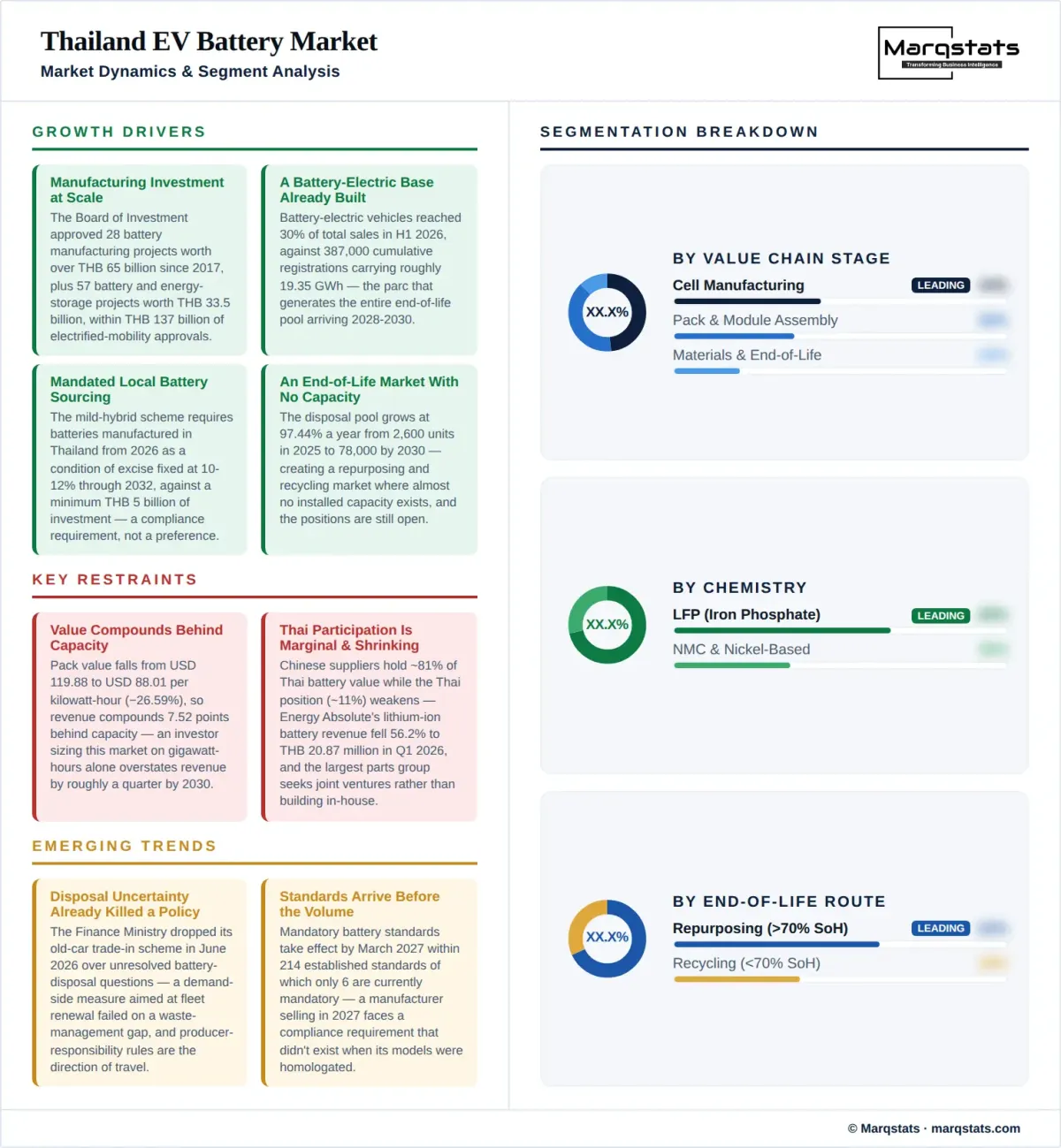
- The Board of Investment has approved 28 electric vehicle battery manufacturing projects worth over THB 65 billion since 2017, plus 57 battery and energy storage projects worth THB 33.5 billion as of May 2026.
- Battery electric vehicles reached 30% of total vehicle sales in the first half of 2026, against cumulative registrations of 387,000 units carrying roughly 19.35 GWh of installed capacity.
- The mild hybrid scheme requires batteries manufactured in Thailand from 2026 as a condition of excise fixed at 10% or 12% by carbon dioxide band through 2032, converting a supplier preference into a compliance requirement.
- A clean-energy vehicle support budget of THB 200 billion sits within a THB 400 billion borrowing programme, alongside compliant battery electric excise as low as 2%.
- The end-of-life pool grows at 97.44% a year from 2,600 units in 2025 to 78,000 by 2030, creating a repurposing and recycling market where almost no installed capacity exists.
Key Restraints
- Pack value falls from USD 119.88 to USD 88.01 per kilowatt-hour, down 26.59%, so revenue compounds 7.52 points behind the capacity a supplier has to install.
- Thai-owned participation is marginal and shrinking, with Energy Absolute's lithium-ion battery revenue down 56.2% to THB 20.87 million in the first quarter of 2026.
- Battery disposal uncertainty has already blocked policy, with the Finance Ministry dropping its old-car trade-in scheme in June 2026 over unresolved end-of-life questions.
- Safety incidents carry regulatory consequences, with Volvo suspending EX30 sales in May 2026 and recalling 1,668 units against 45 complaints under a 30-day testing order.
Key Trends
- End-of-life responsibility is shifting to producers, with battery passport and extended producer responsibility rules proposed and the Electric Vehicle Board's supply-chain subcommittee tasked with battery management standards.
- Mandatory battery standards arrive by March 2027 within 214 established electric vehicle standards of which only 6 are currently mandatory, making certification a near-term gate.
- Materials localisation has started with the Tinci and Energy Absolute electrolyte agreement of June 2026, with Imerys approached for graphite and carbon black and Kazakh rare earth supply under study across roughly 15 deposits.
- Local content commitments are deepening inside Chinese plants, with Omoda and Jaecoo's Rayong site targeting 70% to 80% local content within five years from 40% to 50% at its April 2026 opening.
Market Segmentation
Cell manufacturing accounts for an estimated USD 236.32 million in 2025, or 44.00% of market value, and is the stage with the highest capital intensity and the narrowest ownership. SVOLT, Sunwoda and NV Gotion carry most of it, and the Board of Investment's 28 approved battery manufacturing projects worth over THB 65 billion sit predominantly at this stage.
Pack and module assembly accounts for an estimated USD 193.35 million in 2025, or 36.00%, and is where vehicle manufacturers integrate directly. Omoda and Jaecoo's Rayong plant produces new energy vehicle batteries alongside 80,000 units of vehicle capacity, and Hyundai's THB 1 billion Samut Prakan site runs a supporting battery plant under EV3.5 at 46% local component cost.
Battery materials account for an estimated USD 96.67 million in 2025, or 18.00%, and are the least localised stage in the chain. Tinci Materials' June 2026 electrolyte agreement with Energy Absolute is the first confirmed project, against Board of Investment approaches to Imerys for graphite and carbon black and a study of roughly 15 Kazakh rare earth deposits.
End-of-life management accounts for an estimated USD 10.74 million in 2025, or 2.00%, the smallest stage and the fastest-growing by a wide margin. It processes about 2,600 packs in 2025 against 78,000 by 2030, and it is the only stage where the competitive positions are still genuinely open.
Lithium iron phosphate accounts for an estimated 62.00% of installed capacity in 2025 and dominates entry and mid price bands, with the Chery Q at 42.7 kWh, NIO firefly at 42.1 kWh, Changan NEVO Q05 at 51.9 kWh and BAW M8 at 81 kWh. The chemistry's cost position and thermal stability make it the default for a market where compliant battery electric vehicles already pay excise as low as 2%.
Nickel manganese cobalt accounts for an estimated 33.00% of installed capacity in 2025, concentrated in premium models carrying 100 to 120 kWh packs including the MG IM5, Hongqi E-HS9 and the BMW iX3 at 113.4 kWh. NV Gotion offers both chemistries through PLANET, which is what allows a single supplier to serve vehicle and stationary customers from one Thai position.
Other and emerging chemistries account for an estimated 5.00% of installed capacity in 2025, covering range-extender packs such as the Geely Starray at 18.4 kWh and early sodium-ion and semi-solid evaluations. The segment matters less for current volume than for what it implies about recycling, since a diversifying chemistry mix raises the cost of a single black-mass process route.
Passenger battery electric vehicles account for an estimated 78.00% of installed capacity in 2025, tracking a segment that reached 30% of total vehicle sales in the first half of 2026 against 387,000 cumulative registrations. This is the application that generates essentially the whole end-of-life pool arriving between 2028 and 2030.
Commercial vehicles and buses account for an estimated 15.00% of installed capacity in 2025 and carry a disproportionate share of gigawatt-hours relative to unit count, because a bus or heavy truck pack is several times a passenger pack. Contemporary Amperex packs supplied into commercial platforms including the CP Foton eView and SAIC Hongyan sit here.
Stationary energy storage and second-life applications account for an estimated 7.00% of installed capacity in 2025 and are the destination for repurposed packs above 70% state of health, in the 100 kWh and 20 kWh formats the Electricity Generating Authority and the National Science and Technology Development Agency specified in August 2026. NV Gotion already serves both vehicle and storage customers from the same Thai position.
Repurposing accounts for an estimated 62.00% of returning packs, or roughly 2.42 GWh of the 3.90 GWh reaching end of first life in 2030. The route is defined by a published threshold and two specified formats, 100 kWh and 20 kWh stationary storage systems, which is an unusually concrete specification for a market that barely exists yet.
Recycling accounts for an estimated 38.00% of returning packs, or roughly 1.48 GWh in 2030, and is supported by a black-mass prototype facility developed with Thammasat University and a circular industrial estate study with the Industrial Estate Authority. Huayou Cobalt, Rikomay and Qingshan presented recycling technologies at the August 2026 Thai-Chinese meeting convened by the Board of Investment.
Chinese suppliers account for an estimated 81.00% of Thai battery value in 2025 and the position was largely settled before the market matured. SVOLT supplies Great Wall Motor locally within over THB 20 billion invested and at least THB 10 billion more planned, Sunwoda operates an exporting Thai plant, and BYD's Blade Battery and Contemporary Amperex packs dominate imported chemistry.
Thai manufacturers account for an estimated 11.00% of value in 2025, largely through the PTT side of NV Gotion and PLANET, and the independent Thai position is weakening rather than building. Energy Absolute's lithium-ion battery revenue fell 56.2% to THB 20.87 million in the first quarter of 2026, and AAPICO is seeking joint ventures rather than in-house production.
International materials suppliers account for an estimated 8.00% of value in 2025 and are the group Thailand is actively courting. Tinci Materials committed to an electrolyte project with Energy Absolute in June 2026, and the Board of Investment has approached Imerys for graphite and carbon black and A123 Systems separately, within 93 French applications worth over THB 29 billion since 2021.
By Geography
Rayong
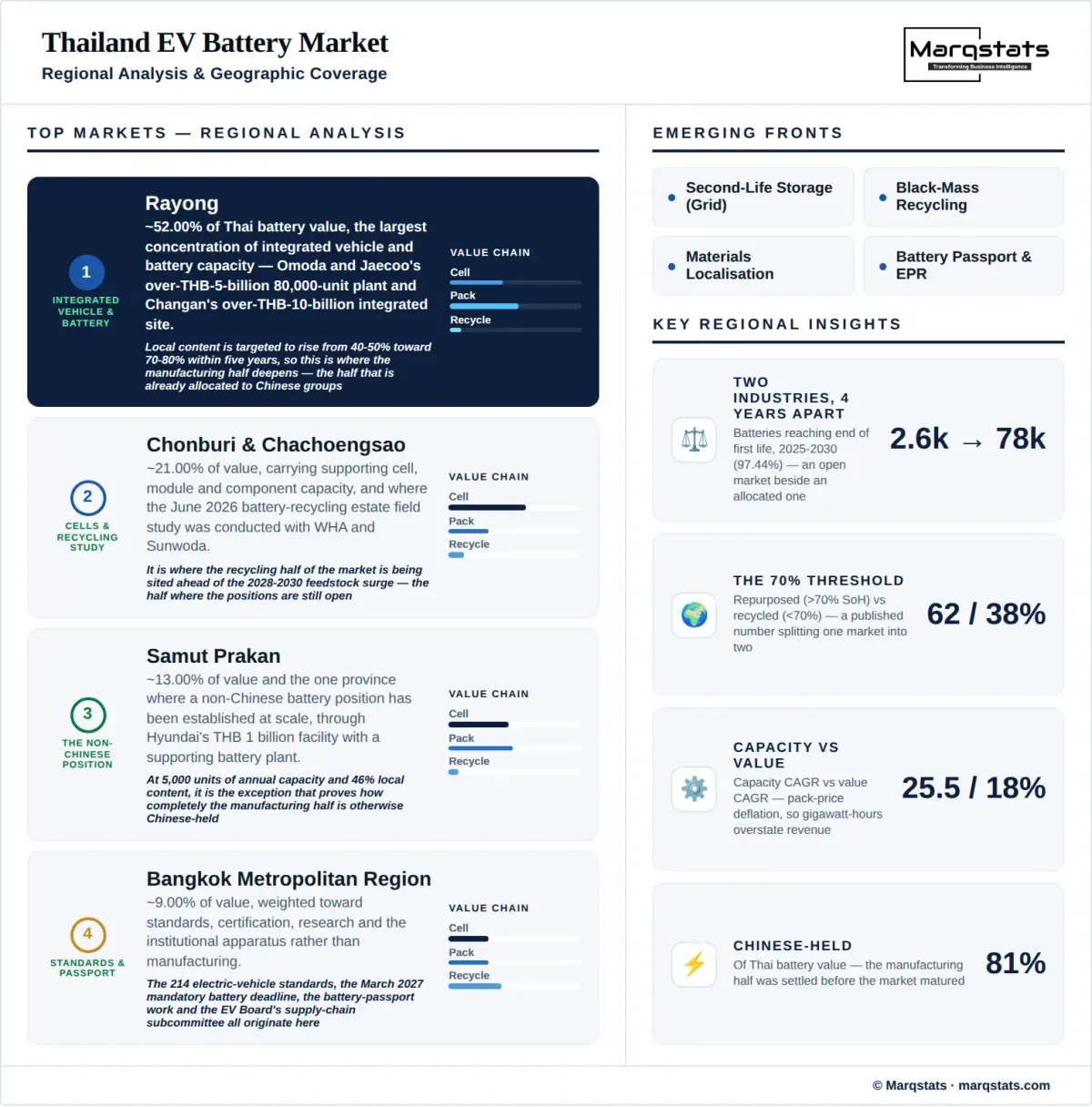
Rayong accounts for an estimated 52.00% of Thai battery value in 2025 and holds the largest concentration of integrated vehicle and battery capacity in the country. Omoda and Jaecoo opened a facility here on 20 April 2026 costing over THB 5 billion at 80,000 units of capacity with local content rising from 40% to 50% toward 70% to 80%, and Changan committed over THB 10 billion to an integrated new energy vehicle plant.
Chonburi and Chachoengsao
Chonburi and Chachoengsao account for an estimated 21.00% of value, carrying supporting cell, module and component capacity across the eastern industrial estates. The cluster is where the Thailand Automotive Institute's June 2026 field study on battery recycling estate criteria was conducted with WHA, Sunwoda, CH. Chana Karnchang and the Bangpoo Environmental Complex.
Samut Prakan
Samut Prakan accounts for an estimated 13.00% of value and is the one province where a non-Chinese battery position has been established at scale. Hyundai Mobility Manufacturing Thailand operates a THB 1 billion facility across 28,500 square metres at 5,000 units of annual capacity with a supporting battery plant, 46% local electric vehicle component cost and around 100 Ioniq 5 units a month.
Bangkok Metropolitan Region
Greater Bangkok accounts for an estimated 9.00% of value, weighted toward standards, certification, research and the institutional apparatus rather than manufacturing. The Ministry of Industry's 214 electric vehicle standards, the March 2027 mandatory battery deadline, the Thailand Automotive Institute's battery passport work and the Electric Vehicle Board's supply-chain subcommittee all originate here.
Other Provinces
The remaining provinces account for an estimated 5.00% of value, covering materials processing, waste handling and the early second-life installations that follow grid rather than industrial geography. The Electricity Generating Authority's repurposing programme into 100 kWh and 20 kWh storage systems will distribute capacity according to where generation and demand require it rather than where vehicles are built.
How Competition Is Evolving
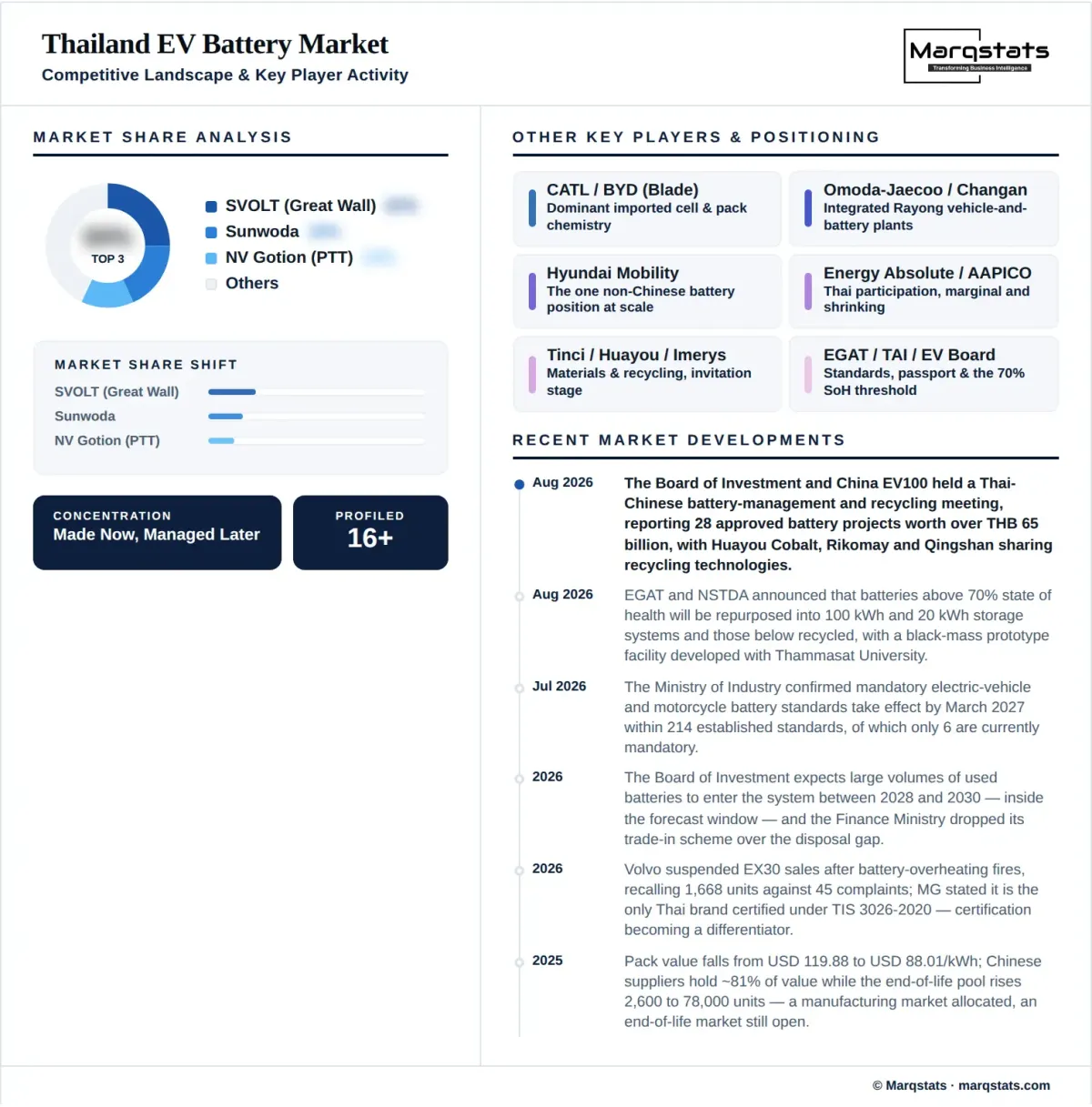
The Thailand EV battery market is highly concentrated in manufacturing and almost entirely unoccupied in end-of-life, and treating it as a single competitive field misreads both. Chinese suppliers hold an estimated 81.00% of battery value, and their positions were secured through vehicle plant investments rather than through battery competition: SVOLT arrived with Great Wall Motor, Omoda and Jaecoo build packs alongside their own vehicles, and Changan's over THB 10 billion Rayong commitment is an integrated plant rather than a merchant cell facility.
That structure leaves very little merchant market to compete for. A Thai or international cell maker cannot win a Chinese manufacturer's battery business, because that business is not tendered; it arrives with the vehicle programme. The only genuinely contestable manufacturing position is materials, where Thailand has one confirmed project in the Tinci and Energy Absolute electrolyte agreement and an open invitation list including Imerys and A123 Systems, and where 93 French applications worth over THB 29 billion since 2021 show the courtship is active.
End-of-life is the opposite situation and the more interesting one. The threshold is published at 70% state of health, the formats are specified at 100 kWh and 20 kWh, the feedstock surge is dated to 2028 through 2030, the institutional framework is being built through battery passport and extended producer responsibility proposals, and almost no processing capacity exists. Huayou Cobalt, Rikomay and Qingshan presented at the August 2026 Board of Investment meeting, which is a scouting posture rather than an established position. A participant entering now competes against intentions rather than against plants.
Companies Covered
The report profiles 15+ companies with full strategy and financials analysis, including:
Recent Market Activity
Table of Contents
Coverage & Segmentation
This analysis measures the value of electric vehicle battery cells, modules, packs, materials and end-of-life processing produced or performed in Thailand from 2021 to 2030, with 2025 as the base year and 2026 to 2030 as the forecast period, expressed at pack-equivalent value per kilowatt-hour for manufacturing stages and at processing value for end-of-life stages. Complete vehicles are excluded and belong to the vehicle markets that carry them, as is charging equipment, which is covered separately. Stationary energy storage is included only where it consumes repurposed vehicle batteries. Values are expressed in USD at a disclosed constant THB 32.5 per USD.
Coverage spans four value chain stages, three chemistries, three applications, two end-of-life routes and three supplier origin groups, with five provincial clusters analysed on installed and announced capacity. Installed battery capacity is carried as the volume series at 4.48 GWh in 2025, and packs reaching end of first life are published as a third series at 2,600 units, because a market whose manufacturing and disposal halves are separated by roughly four years cannot be represented by a single curve. Fifteen entities are profiled across cell makers, materials suppliers, recyclers, manufacturer-integrated operations and the utility driving second-life demand.