Market Snapshot
Key Takeaways
Market Overview & Analysis
Report Summary
The Thailand tire market is two markets sharing a country, and almost every published view of it collapses them into one. By unit volume it is a motorcycle market, with more than half of all tyres fitted to two wheels. By revenue it is a passenger car and light truck market, with those formats taking more than three quarters of value from under half the units. A manufacturer that optimises for one is structurally disadvantaged in the other, and Thailand is one of the few markets where both are large enough to matter.
The measure is the value of tyres fitted to vehicles produced in Thailand and tyres sold into Thai replacement demand, across passenger cars and sport utility vehicles, pickups and light trucks, trucks, buses and commercial vehicles, and motorcycles, together with tyre reinforcement materials, valves and fitting components, retreading and end-of-life management. Standalone tyre exports shipped loose are excluded, though tyres leaving the country fitted to an exported vehicle are counted as original equipment. The vehicles themselves belong to the vehicle markets that carry them.
The analysis is written for tyre manufacturers sizing Thai capacity against two demand curves moving at different speeds, reinforcement and component suppliers entering a chain that is changing hands, fleet operators and retreaders pricing an end-of-life obligation that is becoming formal, and investors assessing an export base under active trade investigation.
Thailand Tire Market Size and Forecast
Tyre demand is estimated at 41.68 million units in 2025, 42.42 million in 2026 and 46.30 million by 2030, an increase of 4.62 million tyres a year. Market value moves from USD 1,319.69 million through USD 1,362.93 million in 2026 to USD 1,676.00 million, on blended value per tyre rising from USD 31.66 to USD 36.20 at a disclosed constant THB 32.5 per USD.
Two growth rates apply and they are unusually close together. The five-year value rate connecting 2025 and 2030 is 4.90%; the four-year rate connecting 2026 and 2030 is 5.31%. The 0.41-point gap reflects a flat 2026 in which volume rises 1.77% and value 3.28%, with no policy step in this market of the kind that shapes the powertrain pages.
Value compounds 2.77 points ahead of volume at 4.90% against 2.12%, and the mechanism is specification rather than price inflation. Electric vehicles carry more mass over the same footprint and demand higher load indices, lower rolling resistance and noise-cancelling construction, while radial motorcycle tyres displace bias-ply at a materially higher unit price. Across the narrower window volume compounds at 2.21% against a 5.31% value rate.
The channel split is the series that makes the forecast assessable. Replacement demand is 30.20 million tyres or 72.46% of volume against original equipment at 11.48 million or 27.54%, so the panel is driven mainly by a vehicle parc that turns over on its own schedule rather than by assembly volume. That is why a market whose pickup segment has halved still grows.
A sizing range is published rather than a point. The 2030 figure sits within a band of USD 1,520.00 million to USD 1,845.00 million against 44.10 to 48.60 million tyres, corresponding to rates of 2.87% and 6.93%, and the spread turns on replacement turnover assumptions and on whether the Section 301 investigation results in measures that reduce the Thai production base.
Half the Units, a Fifth of the Value
Motorcycle tyres account for an estimated 22.55 million units in 2025, or 54.11% of volume, and USD 300.88 million, or 22.80% of value. Four-wheel formats account for 19.12 million units at 45.89% and USD 1,018.80 million at 77.20%. The same market therefore looks entirely different depending on which series a planner opens.
The demand base behind the motorcycle half is genuinely large and it is growing. Thailand produced 1,464,130 motorcycles in January to July 2026, down 0.5%, while domestic motorcycle sales rose 5.2% to 1,105,154 units, against full-year 2025 production of 2,476,747 units, up 2.1%, and domestic sales of 1,711,846, up 1.7%. Motorcycle output is roughly 1.7 times four-wheel vehicle output.
A definitional trap sits inside the forecast data and it is worth naming. The Federation of Thai Industries raised its 2026 motorcycle production forecast to 2.05 million units from 2 million, with 400,000 for export and 1.65 million for domestic sale. Read against full-year 2025 output of 2,476,747 units that implies a 17% collapse, which is not happening: 2025 output was 1,972,902 completely built up plus 503,845 knocked down, and January to July 2026 completely built up production of 1,190,278 units annualises to roughly 2.04 million. The forecast tracks the completely built up series, not the total.
The Largest Investment Targets the Lowest-Value Half
Continental inaugurated the expansion of its Rayong tyre plant on 22 May 2026, investing over EUR 300 million, about THB 13 billion, to add 3 million passenger car and light truck tyres a year while introducing local radial motorcycle tyre production and creating around 600 jobs. It is the largest single tyre commitment in the country and the only one aimed squarely at the segment that carries more than half the units.
The strategic logic is a value-per-tyre argument rather than a volume one. Radial motorcycle construction displaces bias-ply at a materially higher price on a fitment that is currently the cheapest in the market, so a manufacturer that localises radial motorcycle production is not chasing the 22.80% of value that segment represents today, it is changing what that percentage can become.
Local supply relationships are already documented at the vehicle end. Great Wall Motor stated in March 2026 that its Thai-built vehicles use locally made parts from suppliers including Continental and Goodyear, against cumulative Thai sales of 53,619 units over five years, a 2026 target of 25,000 units and a pledge of at least THB 10 billion of additional investment.
The Pickup Collapse Costs More Value Than Volume
Pickups fell from 46% of the Thai light vehicle market in 2022 to 35% in 2023, 29% in 2024 and 23% in 2025, and one-ton sales reached 144,000 units in 2025 against a peak of 593,000 in 2012. Monthly internal combustion pickup sales now run near 10,000 units, with 10,686 in July 2026, against more than 30,000 previously, and January to July 2026 domestic sales of 80,823 units split 37,369 one-ton and 43,454 double-cab.
The tyre consequence is disproportionate because of what pickups fit. Light truck construction carries higher load ratings, deeper tread and more material than a passenger radial of the same rim diameter, so every pickup that leaves the mix removes more value than a passenger car would. Original equipment value therefore contracts faster than original equipment units across the segment. The wider production base behind it reached 596,821 units in January to May 2026, down 0.4%, with July output of 117,383 units up 6.1% and roughly 38% destined for domestic sale against 62% for export.
The supply base behind pickups is the most exposed part of the industry. Roughly 90% of pickup parts are locally produced and capacity utilisation across that chain runs below 60%, so the most Thai portion of the vehicle is attached to the most idle portion of the plant. Isuzu anchors 385,000 units of annual capacity across two plants with over 90% of parts sourced locally, and Ford runs over 270,000 units a year with about 90% exported.
The Supply Chain Is Being Bought Rather Than Built
Tyre reinforcement changed hands in 2026. Bekaert agreed on 28 January 2026 to acquire Bridgestone's tyre reinforcement business in China and Thailand, including two captive tyre cord plants and a long-term supply arrangement, with closing expected in the first half of 2026. A captive input became a merchant one, which changes the cost structure for every tyre maker in the country that does not own its own cord.
Fitting components arrived the same way. Topseal Auto Parts, a site of Shanghai Baolong Automotive, began producing rubber and metal tyre valve stems at Wyncoast Industrial Park in Chachoengsao from 30 March 2026 on registered capital of THB 59.85 million, having registered the entity on 8 August 2025.
The investment climate around those moves is expanding faster than the automotive share of it. The Board of Investment recorded first-quarter 2026 automotive and parts applications of THB 13,328 million, about USD 416.5 million, across 63 projects including tyre manufacturing, within total applications of THB 1,016,962 million across 624 projects, roughly 2.4 times the prior year by value. French investment applications, among which Michelin is a Thai operator, reached 93 projects worth over THB 29 billion since 2021.
End-of-Life Tyres Are Becoming a Formal Market
Thailand's used tyre problem is moving from disposal to management. NX Logistics Thailand and Thai Bridgestone signed a memorandum dated 17 June 2026 covering management and recycling of used tyres, use of retreadable tyres, recycling of end-of-life tyres, and joint studies on tyre condition analysis and lifespan extension, which is the first formal industrial arrangement of its kind disclosed in the market.
The arithmetic behind it is unavoidable. A market consuming 41.68 million tyres a year discards a comparable number, and roughly 54.11% of those are motorcycle tyres, which are the smallest, the most numerous and the hardest to collect economically. Retreading addresses the truck and bus fraction, which is only 4.89% of units, so the volume problem and the retreading solution do not overlap.
The commercial opening is in collection and processing rather than in retreading. Retreading and end-of-life management is an estimated USD 25.92 million or 1.96% of market value in 2025, which is small enough that a single industrial arrangement moves the segment, and the Bridgestone agreement is precisely that.
Market Dynamics
Key Drivers
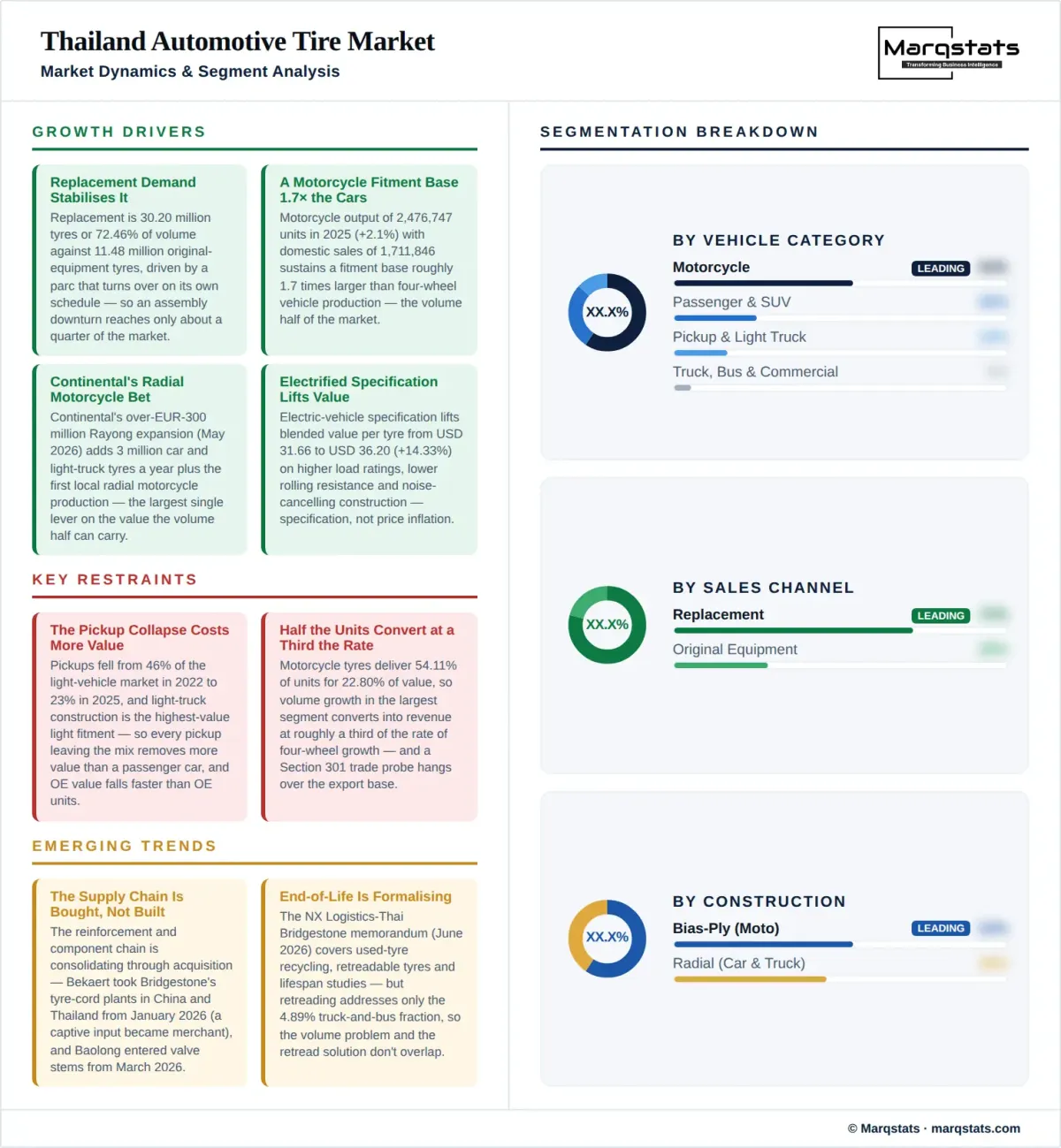
- Replacement demand at 30.20 million tyres or 72.46% of volume is driven by a vehicle parc that turns over independently of assembly, which insulates the market from the production downturn hitting original equipment.
- Motorcycle output of 2,476,747 units in 2025, up 2.1%, with domestic sales of 1,711,846, up 1.7%, sustains a fitment base roughly 1.7 times larger than four-wheel vehicle production.
- Continental's over EUR 300 million Rayong expansion from 22 May 2026 adds 3 million car and light truck tyres a year plus the first local radial motorcycle production and around 600 jobs.
- Electric vehicle specification lifts blended value per tyre from USD 31.66 to USD 36.20, up 14.33%, on higher load ratings, lower rolling resistance and noise-cancelling construction.
- Chinese manufacturer capacity in Thailand is expected to exceed 500,000 vehicles a year, adding original equipment fitment demand from platforms with no established Thai tyre relationships.
Key Restraints
- Pickups fell from 46% of the light vehicle market in 2022 to 23% in 2025 with one-ton sales at 144,000 units against a 593,000 peak, and they carry the highest-value light fitment.
- Vehicle production reached only 834,595 units in January to July 2026, down 0.1%, with pickup parts capacity utilisation below 60% on a chain that is roughly 90% locally produced.
- The United States Trade Representative opened a Section 301 investigation in March 2026 covering rubber and auto parts exports from 16 partners including Thailand, citing a USD 51 billion Thai surplus in 2025.
- Motorcycle tyres deliver 54.11% of units for 22.80% of value, so volume growth in the largest segment converts into revenue at roughly a third of the rate of four-wheel growth.
Key Trends
- Radial construction is displacing bias-ply in motorcycle fitment, which is the single largest available lever on blended value per tyre given the segment's 54.11% share of units.
- The reinforcement and component chain is consolidating through acquisition, with Bekaert taking Bridgestone's tyre cord plants in China and Thailand from January 2026 and Baolong entering valve stems from March 2026.
- End-of-life management is formalising, with the NX Logistics and Thai Bridgestone memorandum of 17 June 2026 covering used tyre recycling, retreadable tyres and lifespan extension studies.
- Original equipment demand is shifting toward Chinese platforms, with over 500,000 units of expected annual capacity and named local suppliers including Continental and Goodyear serving Great Wall Motor.
Market Segmentation
Motorcycle tyres account for an estimated 22.55 million units in 2025, or 54.11% of volume, against USD 300.88 million or 22.80% of value. The fitment base is Thailand's largest by a wide margin, with 2,476,747 motorcycles produced in 2025 and 1,711,846 sold domestically, and it is the segment Continental's Rayong expansion targets with local radial production for the first time.
Passenger car and sport utility tyres account for an estimated 10.42 million units in 2025, or 25.00% of volume, and carry the fastest value growth of any category. Battery electric platforms concentrate here, and the specification premium they demand on load rating, rolling resistance and noise is the main reason blended value per tyre rises 14.33% across the forecast.
Pickup and light truck tyres account for an estimated 6.67 million units in 2025, or 16.00% of volume, and this is the category losing ground fastest. Pickups fell from 46% of the light vehicle market in 2022 to 23% in 2025, and because light truck construction carries the highest value of any light fitment, the value loss exceeds the unit loss.
Truck, bus and commercial tyres account for an estimated 2.04 million units in 2025, or 4.89% of volume, the smallest category by units and the highest by value per tyre. It is also the only category where retreading is economically routine, which is why the retreading opportunity and the end-of-life volume problem do not overlap.
Replacement demand accounts for an estimated 30.20 million tyres in 2025, or 72.46% of volume and USD 952.00 million of value. It is driven by the installed parc rather than by assembly, which is what allows the market to grow at 2.12% while vehicle production runs at 834,595 units for January to July 2026, down 0.1%.
Original equipment demand accounts for an estimated 11.48 million tyres in 2025, or 27.54% of volume and USD 367.68 million of value, split 6.53 million four-wheel fitments and 4.95 million motorcycle fitments. It is the channel exposed to the pickup decline and to the arrival of Chinese platforms carrying over 500,000 units of expected annual capacity.
Motorcycle construction accounts for an estimated 22.55 million units in 2025, or 54.11% of volume, and remains predominantly bias-ply. Continental's introduction of local radial motorcycle production at Rayong from May 2026 is the first domestic radial capacity in the format and is the clearest available lever on the segment's 22.80% share of market value.
Passenger and light truck radials account for an estimated 17.09 million units in 2025, or 41.00% of volume, and take the largest share of value at any given volume. Continental's Rayong expansion adds 3 million units a year of this construction, which is the capacity most directly aimed at the replacement channel that carries 72.46% of demand.
Truck and bus radials account for an estimated 2.04 million units in 2025, or 4.89% of volume, and carry value per tyre several times the passenger average. The category depends on freight activity rather than vehicle sales, which partly decouples it from a domestic vehicle market where exports reached 495,313 units in January to July 2026, down 6.9%.
Tyre manufacturing accounts for an estimated USD 1,175.00 million in 2025, or 89.04% of market value, and is where the capital is concentrated. Continental's over EUR 300 million Rayong commitment sits here, alongside established Bridgestone, Michelin, Goodyear and Chinese capacity, and the Board of Investment's first-quarter 2026 automotive and parts applications of THB 13,328 million across 63 projects explicitly include tyre manufacturing.
Tyre reinforcement materials account for an estimated USD 79.18 million in 2025, or 6.00% of value, and the segment changed ownership in 2026. Bekaert agreed on 28 January 2026 to acquire Bridgestone's tyre reinforcement business in China and Thailand, including two captive tyre cord plants and a long-term supply arrangement, converting a captive input into a merchant one.
Valves, rims and fitting components account for an estimated USD 39.59 million in 2025, or 3.00% of value, and the segment gained a dedicated Chinese entrant. Topseal Auto Parts, a Shanghai Baolong site, began producing rubber and metal valve stems at Wyncoast Industrial Park in Chachoengsao from 30 March 2026 on registered capital of THB 59.85 million.
Retreading and end-of-life management account for an estimated USD 25.92 million in 2025, or 1.96% of value, the smallest position and the one most likely to be reshaped by a single agreement. The NX Logistics Thailand and Thai Bridgestone memorandum dated 17 June 2026 covers used tyre management, retreadable tyres, end-of-life recycling and joint studies on tyre condition and lifespan extension.
Internal combustion and hybrid platforms account for an estimated 38.55 million tyres in 2025, or 92.49% of volume, and remain the base the industry is tooled around. The segment declines slowly in share rather than in absolute units, because the parc turns over across many years and replacement is 72.46% of demand.
Battery electric platforms account for an estimated 3.13 million tyres in 2025, or 7.51% of volume, and carry the highest value per tyre in the market. Thailand recorded 147,522 electric mobility registrations in 2025, up 52.7%, including 123,334 four-wheel and above, and each of those vehicles demands a specification premium that lifts blended value per tyre across the whole panel.
By Geography
Bangkok Metropolitan Region
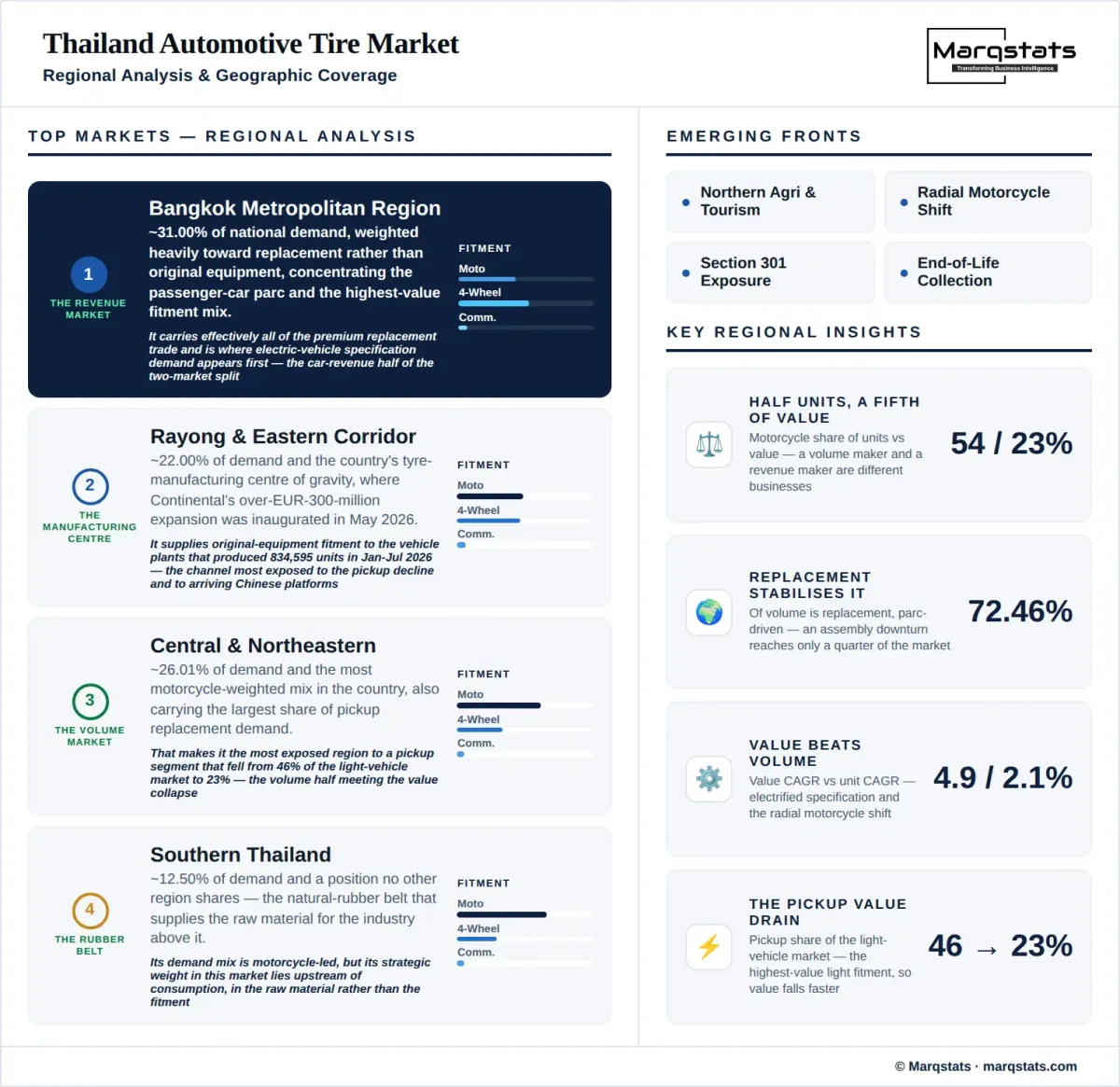
Greater Bangkok accounts for an estimated 12.92 million tyres in 2025, or 31.00% of national demand, weighted heavily toward replacement rather than original equipment. The region concentrates the passenger car parc, the highest-value fitment mix and effectively all of the premium replacement trade, and it is where electric vehicle specification demand appears first.
Rayong and the Eastern Economic Corridor
Rayong and the eastern corridor account for an estimated 9.17 million tyres in 2025, or 22.00%, and hold the country's manufacturing centre of gravity. Continental's over EUR 300 million expansion was inaugurated here on 22 May 2026, and the region supplies original equipment fitment to the vehicle plants that produced 834,595 units in January to July 2026.
Central and Northeastern Thailand
Central and northeastern Thailand account for an estimated 10.84 million tyres in 2025, or 26.01%, and the mix is the most motorcycle-weighted in the country. The region also carries the largest share of pickup replacement demand, which makes it the most exposed to a segment that fell from 46% of the light vehicle market in 2022 to 23% in 2025.
Southern Thailand
Southern Thailand accounts for an estimated 5.21 million tyres in 2025, or 12.50%, and occupies a position no other region shares: it is the natural rubber belt that supplies the raw material for the industry above it. The region's demand mix is motorcycle-led, and its strategic weight in this market lies upstream of consumption rather than in it.
Northern Thailand
Northern Thailand accounts for an estimated 3.54 million tyres in 2025, or 8.49%, the smallest cluster and the most seasonal. Demand concentrates in motorcycle replacement and in light commercial fitment serving agriculture and tourism, and the region carries the lowest blended value per tyre of any in the country.
How Competition Is Evolving
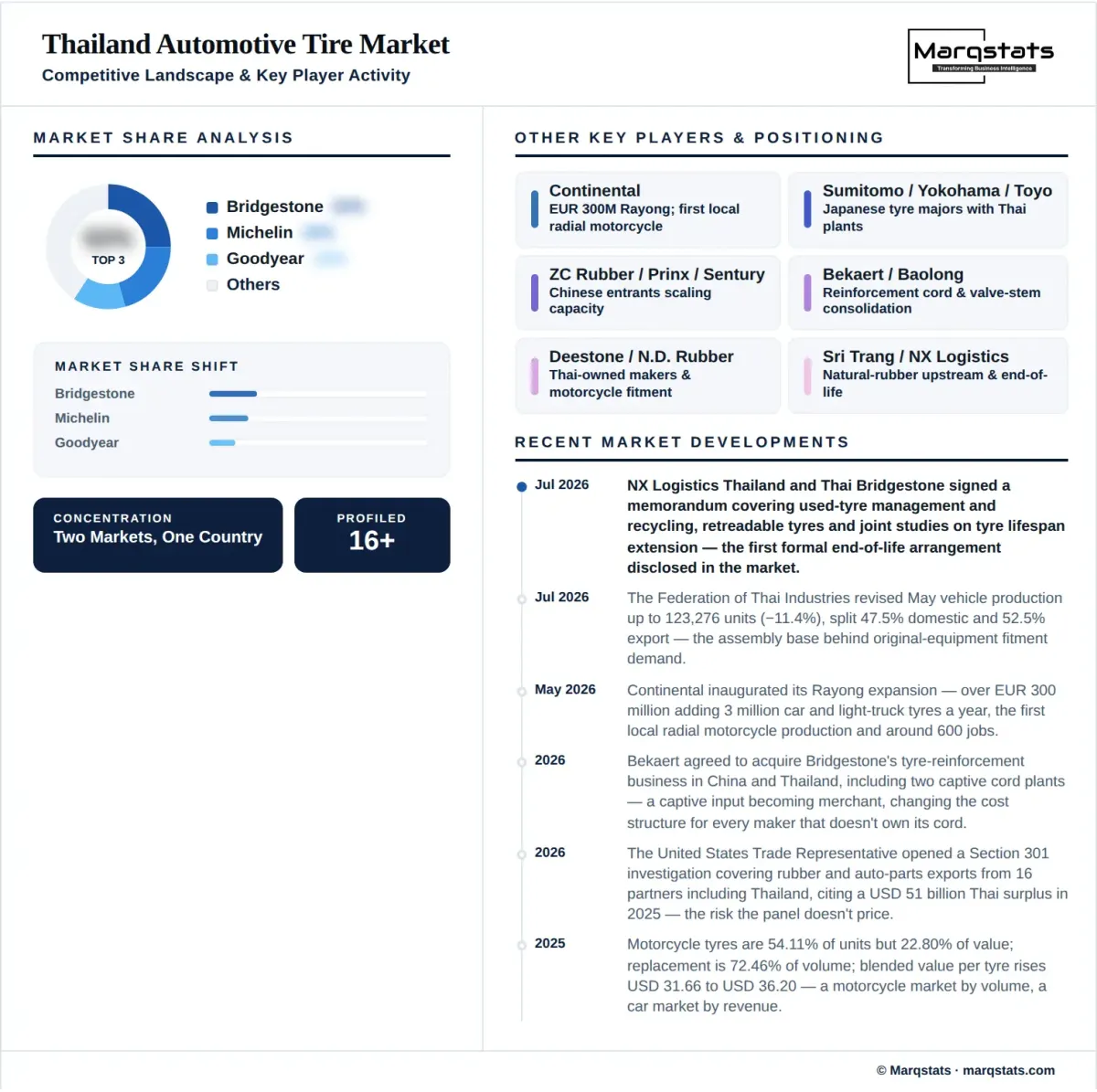
The Thailand tire market is moderately concentrated at manufacturing and fragmented at distribution, and the structure differs by segment in a way that most competitive analysis misses. Four-wheel manufacturing is held by the global majors with long-established Thai plants, while motorcycle fitment, more than half the units, has historically been served by lower-cost bias-ply capacity with no single dominant supplier. Continental's introduction of local radial motorcycle production in May 2026 is the first serious attempt to consolidate that half on a premium technology.
Chinese manufacturers occupy the position between those two, and they arrived with capacity rather than with brands. Zhongce, Prinx Chengshan and Sentury all operate Thai plants built primarily for export, and their presence sets the price floor in domestic replacement even where their retail share is modest. That is why the Section 301 investigation matters to domestic pricing as well as to exports: measures that reduce the export outlet push that capacity toward the local market.
The most consequential competitive movement in 2026 was upstream of tyres entirely. Bekaert's acquisition of Bridgestone's tyre reinforcement business in China and Thailand converts two captive cord plants into a merchant supply arrangement, which changes the input cost structure for every Thai tyre maker that does not own cord capacity. Baolong's valve stem entry at Chachoengsao does the same at smaller scale in fitting components. The tyre industry's competitive map is being redrawn by what sits inside the tyre rather than by what is printed on it.
Companies Covered
The report profiles 15+ companies with full strategy and financials analysis, including:
Recent Market Activity
Table of Contents
Coverage & Segmentation
This analysis measures the value of tyres fitted to vehicles produced in Thailand and tyres sold into Thai replacement demand from 2021 to 2030, with 2025 as the base year and 2026 to 2030 as the forecast period, across passenger cars and sport utility vehicles, pickups and light trucks, trucks, buses and commercial vehicles, and motorcycles, together with tyre reinforcement materials, valves and fitting components, retreading and end-of-life management. Tyres leaving the country fitted to an exported vehicle are counted as original equipment; standalone tyres shipped loose for sale abroad are excluded. The vehicles themselves belong to the vehicle markets that carry them and are never added to this panel. Bicycle tyres, industrial and off-highway tyres and aircraft tyres are excluded. Values are expressed in USD at a disclosed constant THB 32.5 per USD.
Coverage spans four vehicle categories, two sales channels, three construction and product groups, four value chain positions and two powertrain platforms served, with five regional clusters analysed on demand concentration and fitment mix. Tyre units are carried as the volume series at 41.68 million in 2025 and blended value per tyre as a derived series at USD 31.66, and both are published alongside the value panel because a market whose largest unit segment is its smallest value segment cannot be represented by either alone. Fifteen entities are profiled across global tyre manufacturers, Chinese producers with Thai plants, reinforcement and component suppliers and Thai rubber and tyre companies.