Market Snapshot
Middle bar: base-year value × (1 + CAGR), rounded to two decimals. This is a calculated illustration, not a separately researched annual estimate.
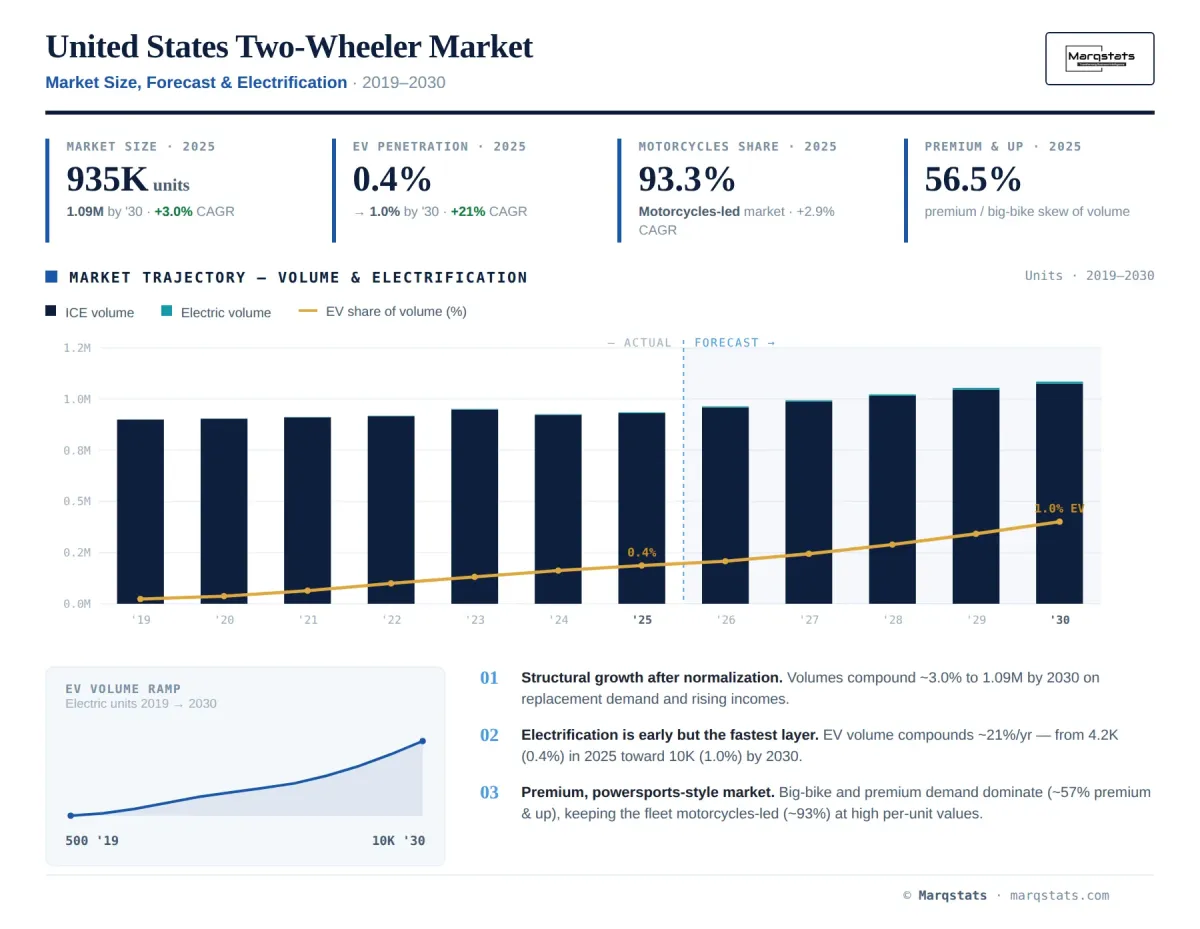
The United States two-wheeler market reached 935,000 units in 2025 and is projected to reach 1.09 million units by 2030, expanding at a 3.01% CAGR across the 2026–2030 forecast period; Marqstats estimates the market's value at approximately USD 12.0 billion in 2025, rising toward USD 14.6 billion by 2030. The United States is the world's highest-value two-wheeler market by average selling price, a leisure and recreational market defined by large-displacement cruiser, touring, and adventure motorcycles rather than the commuting demand that drives most global markets.
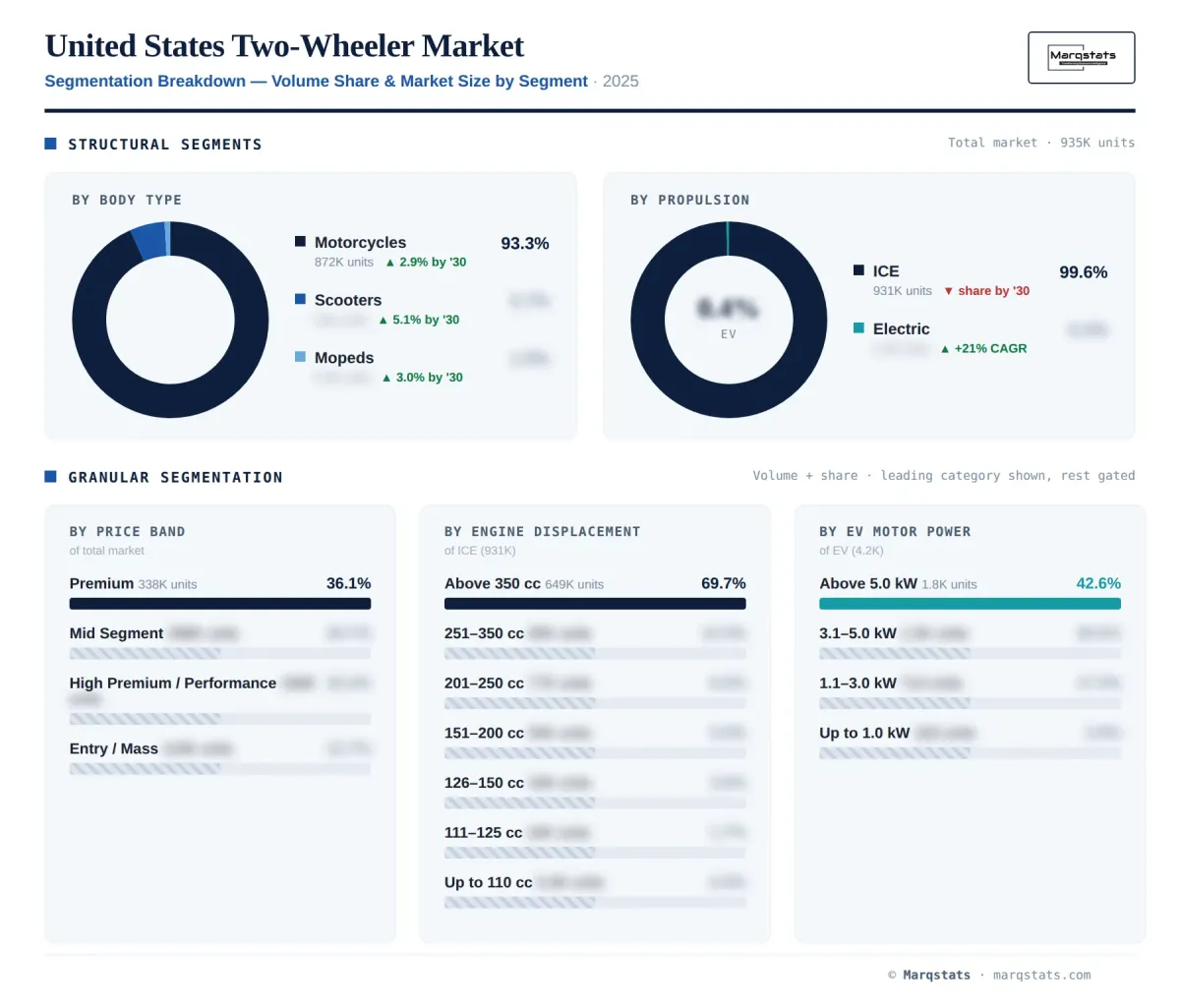
Motorcycles account for about 93% of volume, and machines above 350cc alone represent roughly 69% of units, anchoring a market where premium and high-premium models dominate both volume and value. Demand is overwhelmingly private, with recreational riders, often older and affluent, forming the core buyer base. Small-displacement commuter classes are in structural decline, and scooters remain a minor share, underscoring the market's leisure orientation and its reliance on discretionary spending rather than everyday mobility needs.
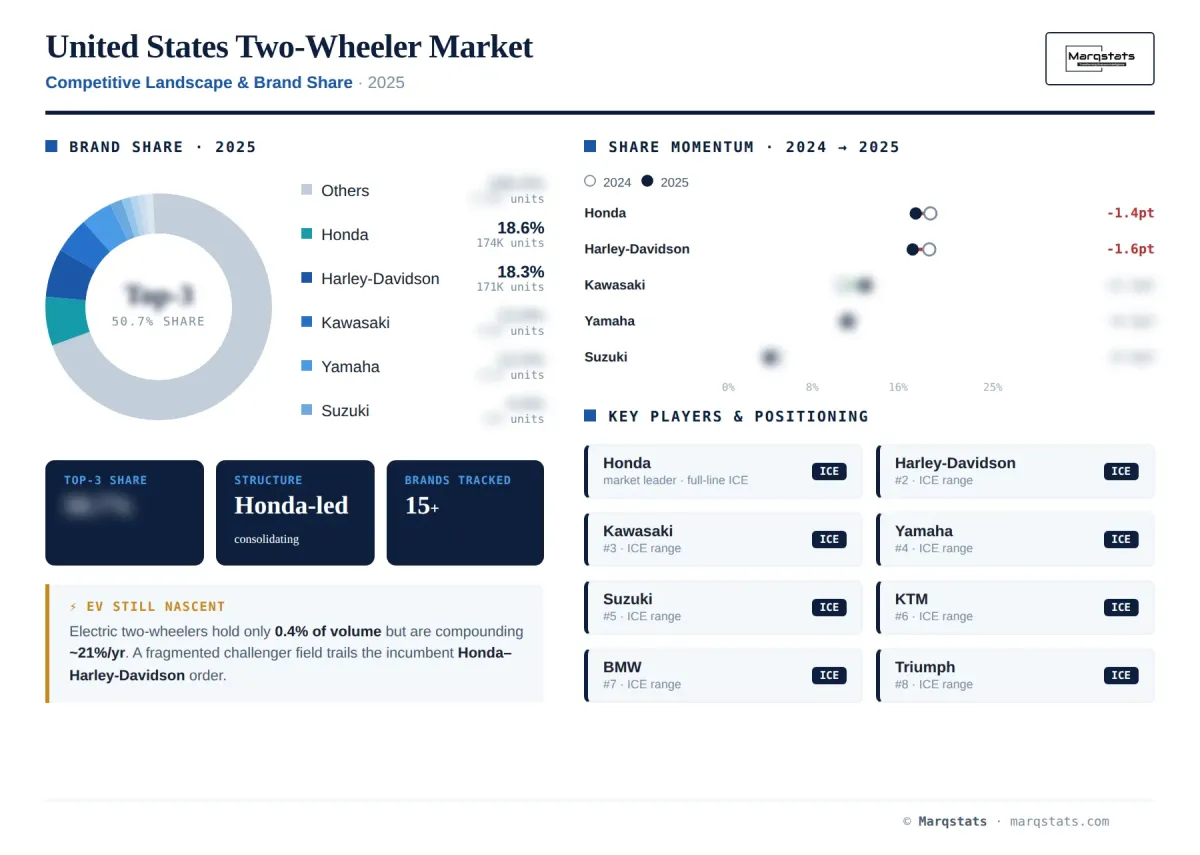
The market is moderately concentrated. Honda and Harley-Davidson each hold close to a fifth of unit sales, with Kawasaki rising strongly, and the field extends to Yamaha, Suzuki, and a wide set of European, Indian, and Chinese brands, as tracked by the Motorcycle Industry Council. Growth is driven by premiumisation, recreational demand, and a resilient touring segment, tempered by an aging rider base, high interest rates, and tariff pressures, while electric two-wheelers remain the smallest share among major markets.
Key Takeaways
Market Overview & Analysis
Report Summary
The United States two-wheeler market comprises motorcycles, scooters, and mopeds sold for personal and commercial use across internal combustion and electric propulsion, spanning on-road and off-road machines. This study segments demand by vehicle type, propulsion type, engine displacement and motor power, price band, end user, sales channel, and brand, with a 2025 base year, historical coverage from 2021 to 2025, and forecasts to 2030. Unlike most global markets, two-wheelers in the United States are primarily recreational and lifestyle purchases rather than everyday transport, and the market is most clearly understood through the lens of discretionary consumer spending, brand heritage, and enthusiast culture rather than mobility economics.
Value is concentrated in large, expensive machines. Because average selling prices are high, the United States is the world's most valuable two-wheeler market despite modest unit volumes, and Marqstats reconciles market value to approximately USD 12.0 billion in 2025 from segment- and brand-level analysis. Large-displacement cruisers, touring motorcycles, and adventure bikes generate the majority of revenue, while the smallest commuter classes have limited relevance to American buyers.
The market's character sets it apart from every large emerging market. Where India, Brazil, and Southeast Asia run on small, affordable commuter motorcycles bought as essential transport, the United States buys large, premium machines as discretionary lifestyle purchases. Average selling prices are the highest of any major market, unit volumes are modest relative to population, and demand tracks consumer confidence, interest rates, and the health of discretionary spending rather than urbanisation or the cost of mobility. This makes the market resilient in value terms yet sensitive to macroeconomic cycles, and it concentrates growth in premium products rather than unit expansion.
Supply spans domestic and imported brands. Honda leads by volume, Harley-Davidson remains the defining premium and cruiser brand, and Kawasaki has risen strongly, while Yamaha, Suzuki, and a broad set of European and Indian marques compete across segments. Off-road and powersports demand connects closely with adjacent categories such as the global electric ATV and UTV market, and electric two-wheelers remain nascent, led by LiveWire and Zero Motorcycles from a very small base.
Market Dynamics
Key Drivers
- Growth is driven by premiumisation and the touring and cruiser segments, as affluent riders sustain demand for high-value large-displacement motorcycles that command the highest selling prices of any market.
- Recreational and lifestyle riding underpins demand, with motorcycling positioned as a leisure pursuit and a form of self-expression rather than utilitarian transport.
- The adventure and dual-sport category expands, drawing riders toward versatile machines suited to touring and off-road use, and connecting closely with the broader powersports market.
- Rising value per unit lifts the market, as buyers favour premium and high-premium models even where unit volumes grow slowly.
Key Restraints
- An aging rider base limits structural growth, as the core buyer demographic skews older and new-rider entry is slow, making rider recruitment a strategic priority for manufacturers.
- High interest rates weigh on big-ticket discretionary purchases, dampening demand for expensive motorcycles.
- Tariffs on steel, aluminum, and imported machines raise costs across an import-reliant market, pressuring pricing and prompting manufacturers to reassess sourcing and guidance.
Key Trends
- Electrification remains nascent and slow, with electric two-wheelers under 1% of volume; the Thailand electric two-wheeler market illustrates the faster adoption seen elsewhere.
- Small-displacement commuter classes decline sharply, with sub-125cc segments contracting as American demand concentrates on larger machines.
- Value-focused entrants gain share, as Chinese brand CFMoto and select European marques expand in the mid and premium segments.
- Online research and sales grow steadily, with the digital channel expanding at an 11% CAGR.
Market Segmentation
Motorcycles dominate at about 93% of 2025 volume, roughly 872,000 units, growing at a 2.88% CAGR. The category spans cruisers, touring motorcycles, sport bikes, and adventure machines, and it concentrates in large displacements. This is the heart of the American market, where brand, heritage, and riding experience matter more than running cost or utility. Cruisers and touring motorcycles anchor the category, adventure and dual-sport models are the fastest-growing sub-segment, and sport bikes retain a dedicated following, together defining a market shaped by leisure and lifestyle rather than everyday mobility.
Scooters account for about 54,000 units in 2025, roughly 6% of volume, growing faster at a 5.15% CAGR. Demand centres on urban commuting in dense cities and among cost-conscious riders, and the segment remains a minor part of a market oriented toward larger recreational motorcycles. Scooters see their strongest demand in coastal cities and campus towns, where parking, congestion, and short trips favour compact machines, though the segment stays small relative to the recreational core.
Mopeds account for about 9,000 units in 2025, a very small share. The category serves niche urban and short-distance use and overlaps with light electric models at the lowest-power tier, where low-power mopeds and entry electric two-wheelers compete for a limited pool of cost-sensitive and short-trip riders.
Large-displacement machines above 350cc are the defining segment at about 69% of 2025 volume, roughly 649,000 units, growing at a 3.08% CAGR. Cruisers, touring bikes, and adventure motorcycles fall here, generating the large majority of market value. The dominance of this band is the single most distinctive feature of the American market. It reflects a riding culture built around long-distance touring, weekend recreation, and heavyweight cruisers, and it is the reason the United States commands the highest average selling prices of any major market, with buyers routinely spending tens of thousands of dollars on a single machine and its accessories.
Mid-displacement classes from 151cc to 350cc together account for a meaningful minority of volume, serving entry enthusiasts, sport riders, and dual-sport buyers. These bands grow modestly and provide an on-ramp toward the larger machines that dominate the market. They also host much of the value-brand competition, as Chinese and select Japanese and European models target riders seeking capable machines at accessible prices, and they are central to manufacturers' efforts to attract younger and newer riders into motorcycling.
Small-displacement classes up to 125cc are in structural decline, contracting at roughly 18% a year, as American riders show little appetite for the small commuter motorcycles that dominate emerging markets. These segments now represent a marginal share of demand. Electric two-wheelers, still under 1% of the market, sit largely within the light and mid-power tiers and grow quickly in percentage terms from this small base, led by specialist brands rather than the mass adoption seen in Asia and Europe.
Premium is the largest price band at about 36% of 2025 volume, roughly 338,000 units, while the high-premium and performance band adds a further 20%. Together, premium and above account for well over half of units and the majority of value, reflecting a market where buyers pay for brand, capability, and craftsmanship. This premium skew is unmatched among major markets and explains why the United States commands the highest average selling prices worldwide, with heavyweight cruisers, touring flagships, and performance machines routinely priced well above mass-market motorcycles elsewhere.
The mid segment holds about 31% of volume and grows steadily, while the entry and mass band is small and flat at about 13%, its share eroding as demand concentrates upmarket. Affordability matters less here than in any other major market.
Private consumers account for about 94% of 2025 volume, the defining characteristic of a recreational market. Ownership is discretionary and lifestyle-driven, weighted toward enthusiasts, returning riders, and touring communities rather than commercial or first-time utility buyers. The private buyer base skews older and more affluent than in most markets, and demand is closely tied to consumer confidence and discretionary spending, so the market is more exposed to economic sentiment than to the mobility needs that drive commuter-led markets elsewhere.
Commercial demand is small yet growing. Delivery and logistics expands at a 7.6% CAGR as urban courier use rises, and fleet, rental, and tourism applications add modest demand, though the United States remains far less commercially driven than emerging two-wheeler markets. Rental and guided-tour operators serve the recreational touring market in scenic regions, adding a distinctive American commercial niche alongside the small yet expanding urban delivery segment.
Franchised dealerships dominate, handling the large majority of sales and providing the financing, service, customisation, and brand community central to premium motorcycle ownership. Dealer relationships remain decisive in a market built on heritage brands and high-value machines.
The online channel grows fastest at an 11% CAGR, as buyers research models, compare specifications, arrange financing, and increasingly transact digitally. Online activity complements the dealer network, particularly for accessories, apparel, used machines, and pre-purchase research. Even so, the franchised dealer relationship remains central to the American market, where test rides, servicing, customisation, and brand community continue to anchor high-value purchases and after-sales revenue.
By Geography
West
The West, led by California, is among the largest regional markets, supported by year-round riding weather, strong enthusiast and adventure communities, and early adoption of electric and premium models. The region combines dense urban demand with extensive recreational riding across varied terrain. California's scale, affluence, and emissions leadership also make it the most important test bed for electric and low-emission two-wheelers, while its mountains, coast, and deserts sustain a large adventure and touring following.
South & Sun Belt
The South and Sun Belt, including Texas and Florida, form a large and growing market, favoured by warm climates, open roads, and a strong cruiser and touring culture. Year-round usability and population growth make the region a demand centre for large-displacement motorcycles. Migration and economic growth across the Sun Belt continue to expand the rider base, reinforcing the region's importance to national demand for premium and heavyweight machines.
Midwest
The Midwest is the heartland of American cruiser and touring culture and the historic home of Harley-Davidson, with heavyweight motorcycles produced in Wisconsin, Pennsylvania, and Missouri. Riding is strongly seasonal, concentrating demand and events in warmer months. The region's deep association with the cruiser tradition and domestic manufacturing gives it outsized cultural influence over the American motorcycle market.
Northeast
The Northeast sustains steady demand across urban and recreational riders, with seasonality shaping purchasing and usage. Dense cities support scooter and commuter niches, while touring and premium demand tracks the national pattern. The region's affluent metropolitan markets sustain strong premium and touring sales during the riding season, and its compact urban centres provide some of the country's most receptive markets for scooters and light electric two-wheelers.
How Competition Is Evolving
The United States two-wheeler market is moderately concentrated, without a single dominant player. Honda leads by unit volume with about a fifth of the market, closely matched by Harley-Davidson, the defining premium and cruiser brand, while Kawasaki has risen strongly on value-priced models to challenge for the top position. Yamaha and Suzuki follow, and together the major Japanese brands and Harley-Davidson account for the large majority of sales, with a meaningful tail of specialist and imported marques. The absence of a runaway leader, combined with the strength of several well-resourced global brands, keeps competition intense across every segment of the market.
Competition is intense across the premium and performance segments. European brands including BMW Motorrad, KTM, Triumph, and Ducati compete in touring, adventure, and sport categories, Polaris-owned Indian Motorcycle contests the American cruiser space, and Chinese brand CFMoto has gained share rapidly with value offerings. Electric competition is small and specialised, led by LiveWire, the Harley-Davidson-controlled and publicly traded electric brand, and Zero Motorcycles, both operating from a very low base.
The competitive environment reflects premium, brand-led dynamics. Growth is attributed to manufacturers that combine strong touring and adventure portfolios with disciplined pricing, moreover rewarding brands that navigate tariff pressures and shifting demand. Harley-Davidson's turnaround, marked by new leadership, a strategy review, and a planned return to smaller-displacement and classic models, sits alongside Kawasaki's momentum and the steady expansion of European and Chinese challengers, so heritage, product breadth, and value increasingly determine competitive position.
Brand heritage remains a powerful asset yet no longer guarantees share. Harley-Davidson's decades of dominance in the cruiser segment have eroded as its core buyers age and value-focused rivals expand, prompting a strategic reset toward more accessible models and cost discipline. Kawasaki's rise on competitively priced sport and adventure machines, Honda's breadth across the range, and CFMoto's rapid value-led entry all illustrate a market where riders increasingly weigh price and capability against badge loyalty. The result is a slowly rebalancing field in which incumbents defend premium positions while challengers compete on value and product freshness.
Companies Covered
Companies covered in the report include:
Recent Market Activity
Table of Contents
Coverage & Segmentation
This report provides a comprehensive assessment of the United States two-wheeler market across a 2025 base year, historical data from 2021 to 2025, and forecasts spanning 2026 to 2030. Market sizing is presented in unit-volume terms and complemented by value analysis, with market value reconciled by Marqstats to independent estimates from segment- and brand-level analysis. Segmentation covers vehicle type, propulsion type, engine displacement and motor power, price band, end user, sales channel, and brand, and brand-level shares, segment growth rates, and competitive positioning are quantified to support commercial and investment decisions.
The scope covers demand drivers, restraints, and structural trends, with particular focus on premiumisation and the large-displacement segment, the recreational nature of demand, the decline of small-displacement classes, tariff and macroeconomic pressures, and the early electrification transition. Competitive analysis quantifies brand shares and profiles incumbents, importers, and electric entrants, while segment forecasts identify where the market's modest volume growth and stronger value growth concentrate through 2030. An extended forecast to 2035 is available under customization for subscribers requiring a longer planning horizon, alongside deeper cuts by region, brand, or channel on request.