Market Snapshot
Key Takeaways
Market Overview & Analysis
Report Summary
The Rwanda two-wheeler market comprises motorcycles, scooters and mopeds used for personal transport, commercial moto-taxi services and delivery across internal combustion and electric propulsion. Rwanda is an East African nation of about 13 million people, and motorcycles are the dominant mode of public transport, accounting for a majority of the vehicle stock on the road. The moto-taxi sector provides affordable mobility and income for a large number of riders, and demand concentrates in Kigali, one of Africa's fastest-growing and most orderly cities.
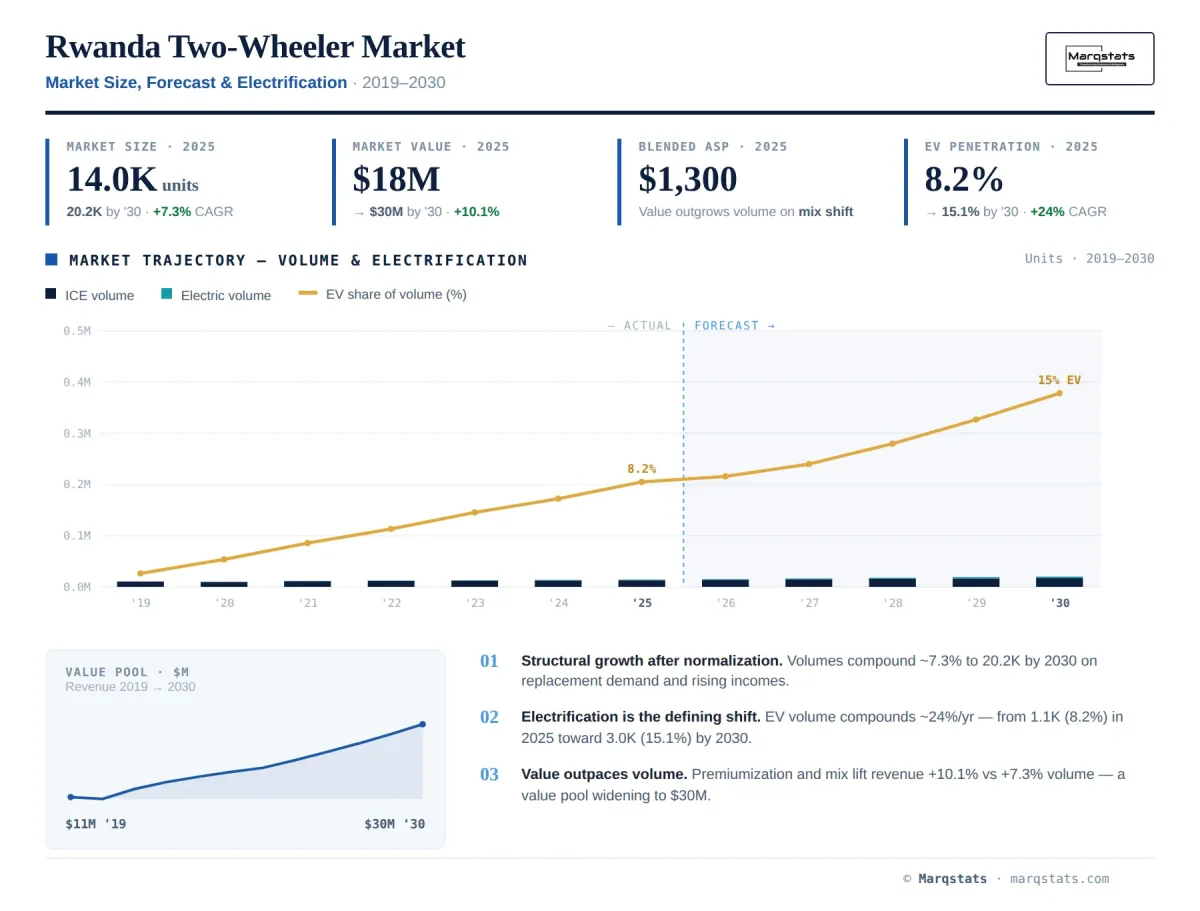
Between 2019 and 2025 the market grew from about 10,500 units to about 14,030 units, and 2025 sales rose sharply against the prior year as demand strengthened and electric adoption accelerated. The market's defining feature is policy: Rwanda has become the regional leader in electric-mobility regulation, and its decision to require new commercial moto-taxis in Kigali to be electric marks the most decisive such measure on the continent. Growth over the forecast period combines steady unit expansion with two structural shifts: the maturation of the moto-taxi fleet alongside rising private ownership, and rapid electrification from an already comparatively high base.
Rwanda sits within the Africa two-wheeler market, where moto-taxis anchor mobility and Indian and Chinese OEMs supply most internal combustion volume, yet Rwanda is distinguished by the prominence of homegrown electric manufacturers and battery-swap operators. Electrification is advancing owing to a Kigali registration rule favouring electric commercial motorcycles, a national target to electrify a substantial share of the fleet by 2030, and incentives spanning import-tariff relief, reduced charging tariffs and financing support, and is moderated by charging-infrastructure gaps outside the capital and the upfront cost of electric machines.
Two features define Rwanda's market. First, it is overwhelmingly a moto-taxi market: motorcycles dominate demand, financing and brand preference, favouring durable, affordable commuter machines from Indian brands. Second, it is the region's policy pioneer on electrification: a homegrown electric-motorcycle industry, battery-swap networks and decisive regulation have combined to give Rwanda the highest electric share among comparable markets, positioning it as a continental testbed for the transition.
The policy dimension is what most distinguishes Rwanda from its neighbours. Where other markets have leaned on incentives and voluntary adoption, Rwanda has paired incentives with a firm registration rule: new commercial moto-taxis in Kigali must be electric, a measure the government has signalled it will extend nationwide alongside a target to electrify a substantial share of the fleet by 2030. Existing petrol machines continue to operate, so the transition is phased rather than abrupt, which protects rider livelihoods while steering new demand toward electric models. This regulatory clarity gives manufacturers and financiers the confidence to invest in local assembly and battery-swap infrastructure, and it is the main reason Rwanda's electric share already exceeds that of larger regional markets despite its modest absolute size.
Market Dynamics
Key Drivers
- Market is driven by the moto-taxi economy, in which motorcycles are the dominant public transport and a primary source of rider incomes.
- Rising private ownership is expanding fast at a 22.10% CAGR as households acquire motorcycles for personal transport beyond taxi use.
- Electrification is accelerating owing to a Kigali rule requiring new commercial moto-taxis to be electric, with a planned national rollout.
- Government incentives, spanning import-tariff relief, reduced charging tariffs, tax breaks and financing support, are unlocking electric adoption.
- A homegrown electric-motorcycle and battery-swap industry, anchored in Kigali, is scaling supply and lowering rider running costs.
Key Restraints
- Charging and battery-swap infrastructure remains concentrated in Kigali, limiting electric adoption in secondary towns and rural areas.
- The upfront cost of electric machines remains a barrier for many riders despite lower running costs and financing support.
- Demand is sensitive to low incomes, financing terms and interest costs in a credit-driven market.
- Electric momentum depends partly on incentives and grid capacity that must scale alongside deployment.
Key Trends
- New commercial moto-taxis in Kigali are shifting to electric owing to the January 2025 registration rule, seeding a fleet-wide transition.
- The moto-taxi fleet is maturing at a 3.50% negative CAGR while private ownership rises, shifting the demand mix.
- Solar-powered battery-swap stations are being piloted, moreover extending electric feasibility beyond the grid.
- Online sales are rising fastest at a 40.50% CAGR from a small base as digital sales and financing platforms spread.
Market Segmentation
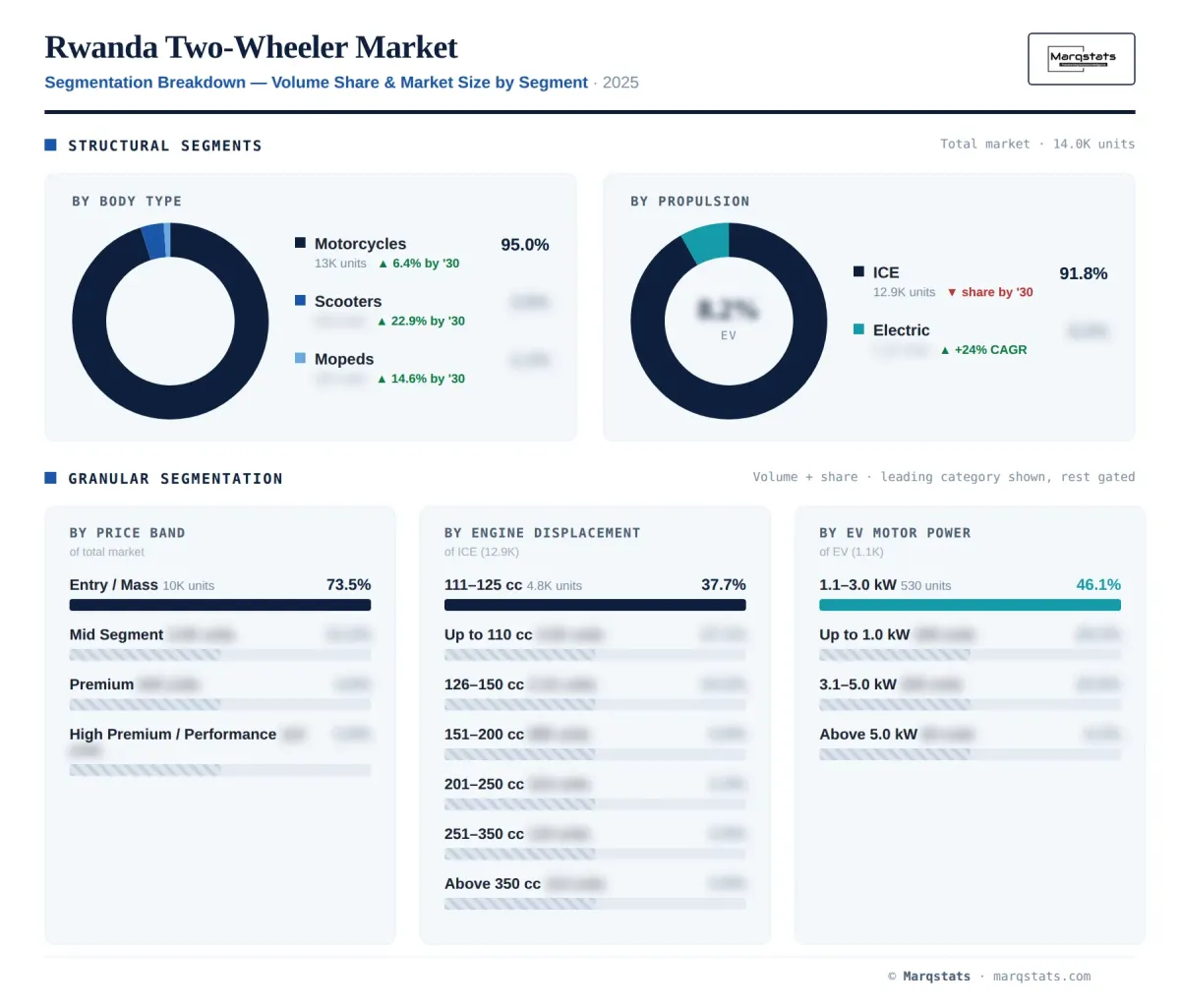
Motorcycles accounted for about 95% of 2025 volume, at roughly 13.33 thousand units, and are forecast to reach about 18.46 thousand units by 2030 at a 6.40% CAGR. They are the foundation of Rwandan mobility, used overwhelmingly for moto-taxi services, personal transport and delivery, and demand concentrates in affordable, durable commuter classes. Motorcycles drive nearly all of the market's absolute growth and are the focus of the country's electrification policy.
Scooters accounted for about 3.8% of 2025 volume, at roughly 0.54 thousand units, growing fastest to about 1.39 thousand units by 2030 at a 22.90% CAGR. Uptake is increasing owing to urban commuting in Kigali and the arrival of electric scooter models, and the segment is a focal point for early electric adoption despite its small base.
Mopeds accounted for about 1.1% of 2025 volume, at roughly 0.16 thousand units, growing to about 0.31 thousand units by 2030 at a 14.60% CAGR. The segment remains small, serving low-cost short-trip mobility, and overlaps increasingly with entry-level electric models in urban use.
ICE two-wheelers supplied about 92% of 2025 volume, at roughly 12.88 thousand units, and grow more slowly to about 17.13 thousand units by 2030 at a 5.40% CAGR. Petrol motorcycles remain the base of the fleet owing to affordability and established servicing, however their share erodes steadily as the Kigali policy channels new commercial registrations toward electric machines and as incentives tilt economics toward zero-emission models.
Electric two-wheelers accounted for about 8% of 2025 volume, at roughly 1.15 thousand units — the highest electric share among comparable markets — expanding to about 3.05 thousand units by 2030 at a 23.50% CAGR. Adoption is driven by the Kigali registration rule, homegrown assemblers and battery-swap operators, and compelling running-cost savings for high-mileage riders, and is moderated by charging gaps outside the capital and upfront costs.
Within ICE machines, the 111–125cc class was the largest displacement band in 2025 at about 4.85 thousand units — the moto-taxi commuter core — followed by the up-to-110cc class at about 3.49 thousand units and the 126–150cc class at about 3.12 thousand units. The 251–350cc band grows fastest at a 17.80% CAGR from a small base, while the 201–250cc and 151–200cc classes also grow strongly. Across electric motor-power bands, the 1.1–3.0 kW class leads volume and the up-to-1.0 kW category grows fastest at a 31.90% CAGR, reflecting entry-level electric taxi and commuter demand.
The displacement mix reflects the market's moto-taxi core. Sub-150cc machines dominate because they balance purchase price, fuel economy and durability for daily taxi and commuting use, and they anchor the entry and mass price band. Larger classes remain small, serving utility and niche leisure roles, however their faster growth and higher prices lift the blended average value, which is why revenue grows at a 10.10% CAGR against a 7.30% volume CAGR. On the electric side, mid-power models suited to taxi duty cycles lead adoption, with battery-swap economics central to rider uptake.
The entry and mass band dominated 2025 volume at about 10.31 thousand units, or roughly 74% of the market, and grows at a 6.00% CAGR. The mid segment followed at about 2.97 thousand units and grows faster at 10.10%, while the premium and high-premium/performance bands, at about 0.64 thousand and 0.11 thousand units, grow at 13.70% and 10.70% CAGRs. This structure confirms an affordability-led market, however the faster growth of higher bands, alongside higher-priced electric machines, drives the wide gap between value and volume growth.
The moto-taxi segment — ride-hail, rental and tourism use — was the largest end use in 2025 at about 7.55 thousand units, or roughly 54% of volume, however it eases at a 3.50% negative CAGR as the fleet matures and as policy reshapes new registrations. Private B2C ownership, at about 3.25 thousand units, grows fastest at a 22.10% CAGR as households acquire motorcycles for personal transport, while delivery and logistics use, at about 1.9 thousand units, grows at 5.90%. B2B and fleet demand grows at 13.50%, and government and institutional use expands quickly from a low base.
This end-user pattern captures a market in transition. For years the moto-taxi trade defined demand, yet its share is now easing as the fleet matures and as households increasingly buy motorcycles for private use, a shift reflected in the fast growth of the B2C segment. Delivery and logistics remain a meaningful and steady use case, reinforced by electric fleets, while fleet and institutional demand broadens the commercial base. The net effect is a gradual rebalancing from taxi-led toward more diversified ownership, occurring alongside the propulsion shift to electric.
Offline dealerships retained about 97% of 2025 volume, at roughly 13.57 thousand units, and grow at a 5.30% CAGR, reflecting the central role of physical dealers, financiers and service networks in a credit-driven market. Online channels, though only about 3% of volume at roughly 0.46 thousand units, grow fastest at a 40.50% CAGR as digital sales and financing platforms expand access.
The channel structure reflects how motorcycles are financed and serviced in Rwanda. Because most purchases are made through instalment financing, physical dealers and finance partners remain central to the transaction, particularly for taxi riders, and electric operators add battery-swap subscriptions to the ownership model. Digital platforms are growing quickly by streamlining loan applications and fleet management, and over the forecast period online tools are expected to complement rather than replace the dealer-and-financier model that underpins the market.
By Geography
Two-wheeler demand in Rwanda concentrates heavily in Kigali, which holds the largest share of population, commerce, moto-taxi activity and charging infrastructure, and extends across secondary towns and rural districts. Regional differences are shaped by urbanisation, road access and charging availability, and these factors determine where electric models and commercial fleets are most prevalent. The capital is the focal point of both demand and the electric transition.
Kigali
Kigali is the dominant demand centre, concentrating moto-taxi activity, commerce, delivery and the densest dealer, financing and battery-swap networks. The capital is where the electric-only registration rule for new commercial moto-taxis applies, and it hosts the assembly and swap operations of homegrown electric manufacturers. Kigali anchors both taxi and private demand and leads electric adoption and online sales.
Secondary Towns
Towns such as Huye, Musanze, Rubavu and Muhanga form a secondary base of commuter and commercial demand, connected to Kigali by improving road corridors. Electric adoption is beginning to extend to these centres as battery-swap networks expand, though internal combustion machines still dominate outside the capital.
Rural Districts
Rural districts rely on motorcycles for transport across hilly terrain and mixed road conditions, with demand skewed toward the most affordable, durable commuter classes. Electrification lags here owing to sparser charging access, and growth is attributed to rising incomes, financing reach and gradual infrastructure and grid improvement, including solar-powered swap pilots.
How Competition Is Evolving
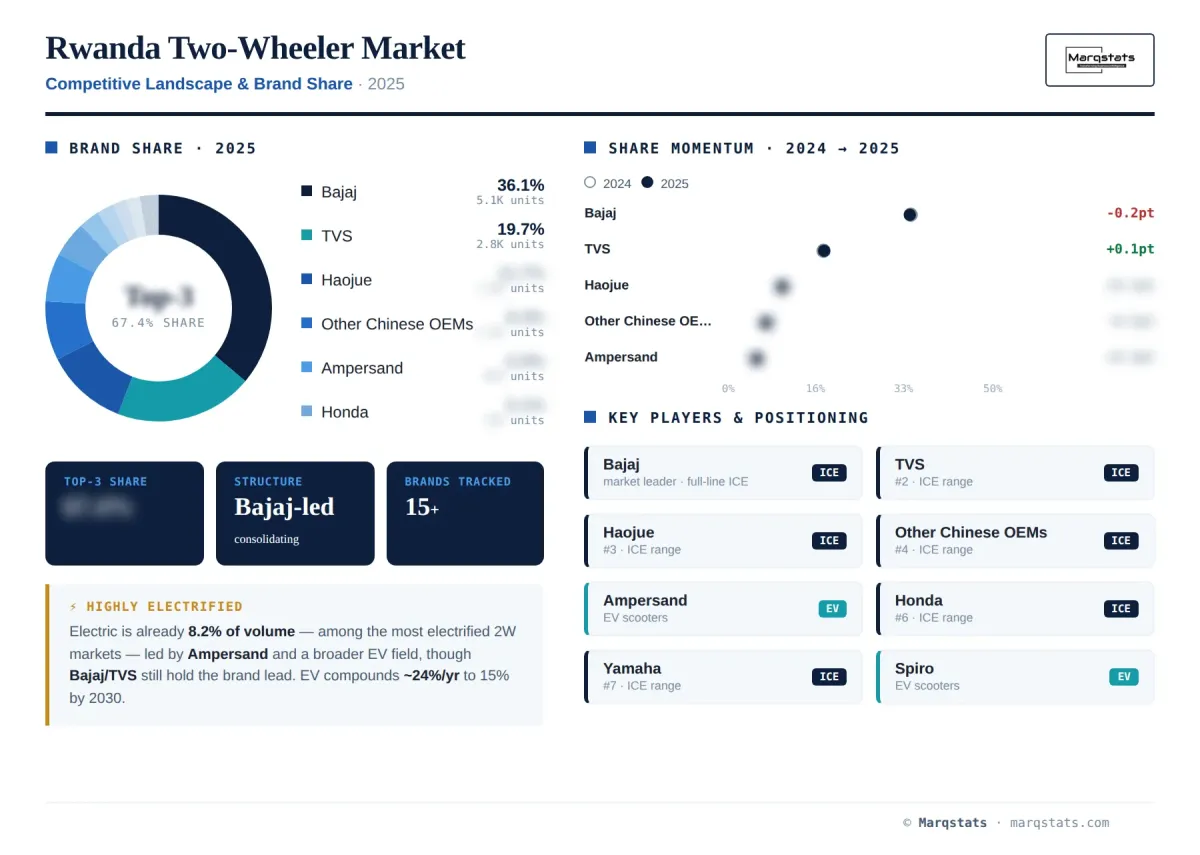
The Rwanda two-wheeler market is moderately concentrated and dominated by Indian brands, with Bajaj holding about 36% of volume and TVS about 20%, together more than half the market. Chinese brand Haojue, homegrown electric manufacturer Ampersand, Japanese brands Honda, Yamaha and Suzuki, and electric players Spiro and Yadea fill out the field. Competition centres on price, durability, financing availability and, increasingly, electric propulsion and battery-swap access.
Bajaj's dominance rests on the durability and low running costs of its commuter models, which suit moto-taxi economics, backed by wide dealer, spare-parts and financing coverage, with TVS a strong second on a similar proposition. What sets Rwanda apart is the prominence of homegrown electric supply: Ampersand ranked fourth by volume ahead of Honda, and together with Spiro, Safi Universal Link and Rwanda Electric Motors it anchors a domestic electric industry spanning assembly, battery-swap and retrofit conversion. Japanese brands compete on reputation, and Chinese brands add value options.
At the brand level, the Indian incumbents compete primarily on affordability, coverage and financing, which sustain their dominance in the internal combustion base. Electric operators differentiate through battery-swap economics, local assembly and alignment with national policy, and their position is strengthened by the Kigali registration rule that steers new commercial demand toward electric machines. Over the forecast period, the internal combustion leaders are expected to retain the largest share of the installed fleet, however homegrown electric players are positioned to capture a rising share of new commercial sales.
Companies Covered
The report profiles 16+ companies with full strategy and financials analysis, including:
Recent Market Activity
Table of Contents
Coverage & Segmentation
This report provides a comprehensive analysis of the Rwanda two-wheeler market across a 2025 base year, historical data from 2021 to 2025, and forecasts spanning 2026 to 2030. The study sizes the market in both volume (thousand units) and value (USD million) and segments it by vehicle type (motorcycles, scooters and mopeds), propulsion type (internal combustion engine, electric), engine displacement and motor power, price band, end user, and sales channel. Brand-level analysis covers the Indian leaders, Chinese and Japanese OEMs, and the homegrown electric manufacturers that shape Rwandan supply.
The study examines market drivers, restraints and trends, segment-level growth, regional demand across Kigali and the wider country, competitive structure, and forward catalysts including the moto-taxi economy, electric-mobility policy, battery-swap infrastructure and asset financing. All market estimates represent Marqstats-reconciled figures derived from a bottom-up methodology validated against top-down benchmarks, using national statistics, trade indicators and registration data rather than any single external source.
The report is designed for two-wheeler manufacturers, importers, assemblers and distributors, electric-mobility operators, fleet and delivery platforms, financiers, battery and component suppliers, and policymakers assessing Rwanda's mobility and electrification path. It supports market sizing, brand and channel benchmarking, and scenario planning around electrification policy, financing and infrastructure. Volume and value forecasts are provided at segment level for the 2026–2030 window, with 2021–2025 historical context, enabling comparison against neighbouring East African markets.