Market Snapshot
Key Takeaways
Market Overview & Analysis
Report Summary
The Russia two-wheeler market covers motorcycles, scooters, and mopeds sold for private, commercial, and institutional use. The study measures demand in unit volumes and revenue across 2021 to 2025 historical years and 2026 to 2030 forecast years, with 2025 as the base year. Coverage spans propulsion type, engine displacement and motor power, price band, end user, sales channel, and brand.
Russia is a recreational and utility motorcycle market with a broad displacement mix. Unlike commuter-driven emerging markets, it carries prominent mid and large-displacement segments alongside entry models, and average selling prices sit at a mid-range level. The market realigned after 2022, and it is now supplied mainly by Chinese brands and by Russian companies that assemble and distribute Chinese-designed models.
Import and currency exposure shape pricing. Almost all units and major components are imported, so landed cost tracks the exchange rate and freight conditions. Currency movements pushed prices higher across the period, which is why revenue grows far faster than volume. Russian assemblers that localize part of production manage cost and supply better than pure importers, however domestic manufacturing of larger machines remains limited.
Growth is attributed to the arrival of affordable models, a multi-year recovery in demand, and the renewal of an aging fleet. Off-road and adventure riding is a notable feature of the market, which links demand to the recreational powersports segment tracked in the global electric ATV and UTV market. Revenue grows far faster than units, owing to currency movements and rising import costs.
Market Dynamics
Key Drivers
- Affordable Chinese and domestic models widened access after 2022, which supported a multi-year recovery in demand.
- Renewal of an aging fleet supports replacement demand across the forecast period.
- Off-road, enduro, and adventure riding sustains demand for mid and large-displacement machines.
- Rising car costs and traffic in major cities support two-wheeler use for commuting and leisure.
- Delivery and courier demand adds a commercial layer, owing to e-commerce and food delivery in large cities.
Key Restraints
- A short riding season in most regions concentrates demand in warmer months.
- Currency depreciation raises import costs, owing to near-total reliance on imported units and components.
- Limited domestic manufacturing constrains supply of larger machines and premium models.
- Reduced availability of European, Japanese, and American brands narrows premium choice.
Key Trends
- Chinese brands consolidate their share, and newer entrants widen the model range in mid and large-displacement classes.
- Domestic brands assemble and distribute Chinese-designed models, and local electric production has begun.
- Electric two-wheelers grow rapidly from a very small base, supported by emerging local manufacturing.
- Online retail scales slowly, however offline dealerships remain strongly dominant through the forecast period.
Market Segmentation
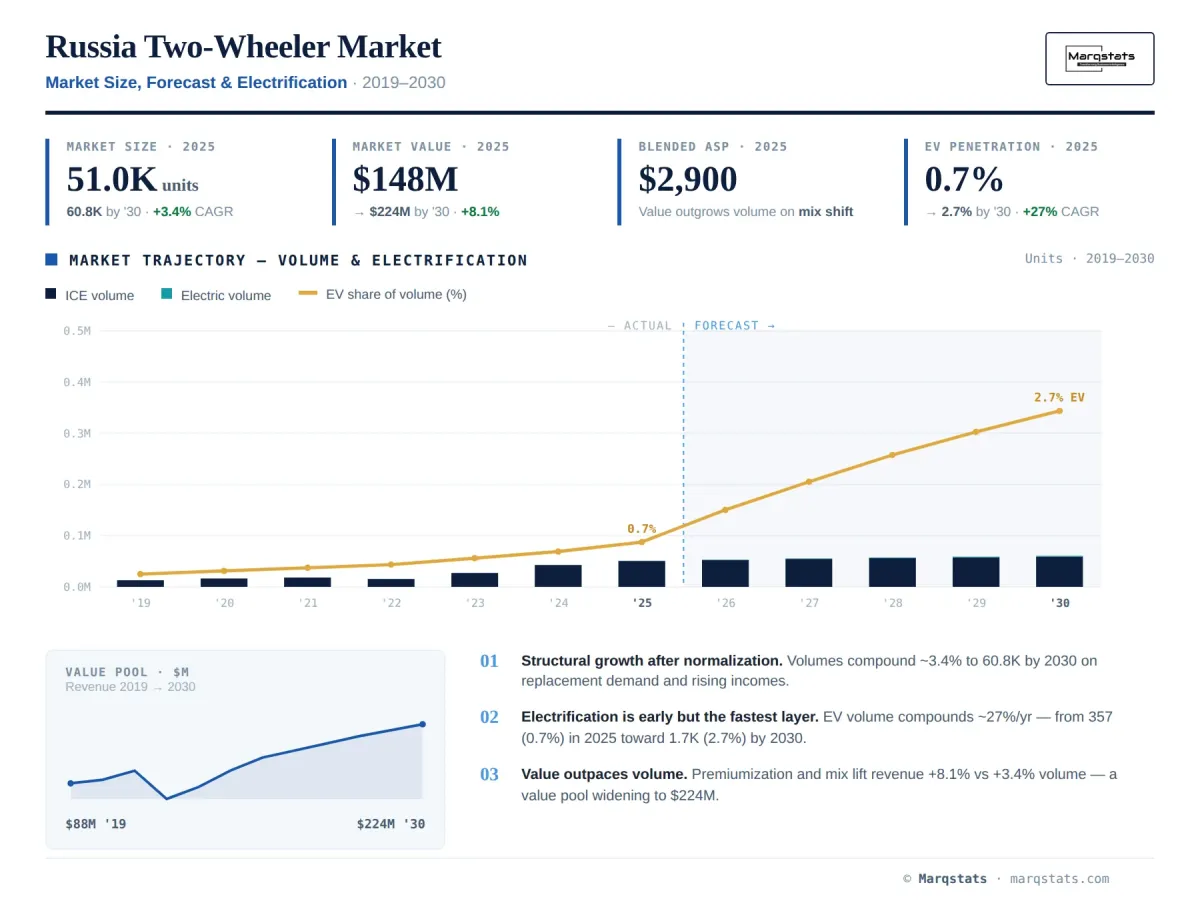
Motorcycles overwhelmingly dominate, at about 97% of unit sales in 2025. Volumes reach 49.5 thousand units in 2025 and are projected to reach 59.14 thousand units by 2030, a 3.42% CAGR. The category spans entry commuter models, mid-capacity machines, and large-displacement adventure and touring motorcycles, which gives it a broad structure spanning budget commuting and recreational riding.
Scooters and mopeds form a small combined category, at about 3% of units in 2025. Volumes rise from 1.5 thousand units in 2025 to 1.64 thousand units by 2030, a 1.59% CAGR. Urban commuters in the largest cities drive most demand, and this category grows slowly relative to motorcycles.
Scooters and mopeds see limited uptake in a market oriented toward motorcycles, and cold winters and a short season further limit their appeal. The category grows modestly, mainly for short-trip urban use in the largest cities.
Combustion models held about 99% of units in 2025. Volumes move from 50.64 thousand units in 2025 to 59.11 thousand units by 2030, a 2.96% CAGR. Combustion dominates the market through the forecast period, owing to touring range, refueling access, and limited electric supply.
Electric two-wheelers are the fastest-growing propulsion type from a very small base. Volumes rise from 0.36 thousand units in 2025 to 1.67 thousand units by 2030, a 27.10% CAGR, and revenue expands at a 32.86% CAGR. Growth is supported by emerging domestic production and a widening model range. Electric share of units is projected to reach about 3% by 2030.
Local production is an emerging feature. A Kaliningrad plant began serial electric-motorcycle production, and a domestic manufacturer introduced electric models under an established brand. These steps support supply and price competitiveness for electric models, however adoption remains constrained by charging infrastructure, cold-climate range, and a short riding season.
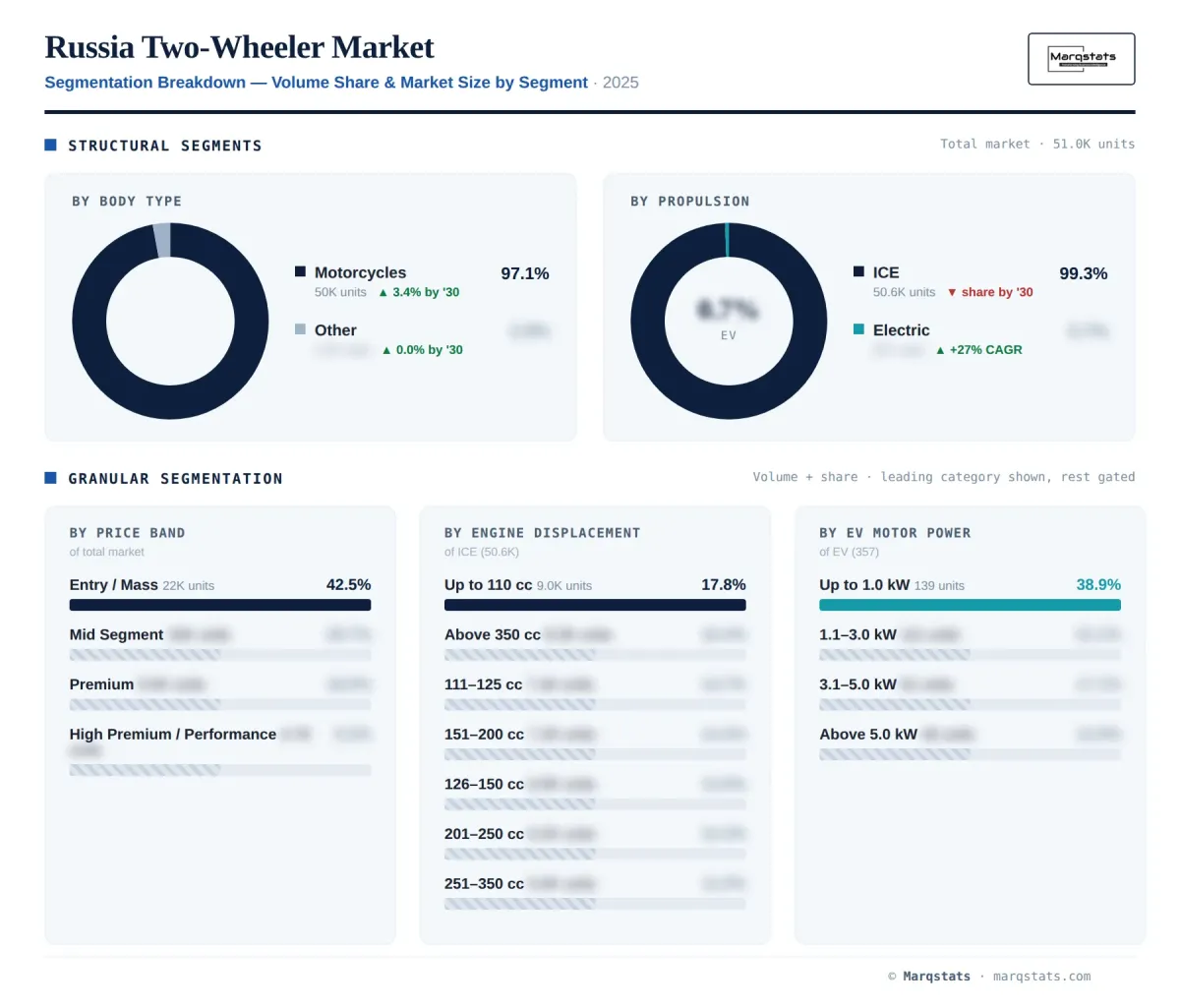
Entry and small-displacement models form a substantial base, with engines up to 150 cc accounting for about 46% of combustion units. The up to 110 cc band reached 9.01 thousand units in 2025, and the 111 to 125 cc band added 7.45 thousand units. These models serve commuting, learning riders, and budget buyers.
Entry displacement models remain important for new riders and budget buyers, however the market’s center of gravity sits higher than in commuter-driven markets. Affordable Chinese and domestic brands supply most of this tier.
Mid-capacity motorcycles are prominent and span commuting, sport, and off-road use. The 151 to 200 cc band reached 7.17 thousand units and the 201 to 250 cc band 6.24 thousand units in 2025. This range grows steadily, owing to enduro and adventure demand.
The 251 to 350 cc band reached 5.58 thousand units in 2025 and serves sport and touring riders. Together the mid bands form a large share of the market, which reflects a rider base oriented toward recreation as much as basic transport. Chinese brands supply most of this range, and popular models cluster around 300 cc, the most common displacement in the market.
Large-displacement machines form a notable premium layer, at 8.29 thousand units in 2025, close to 16% of combustion units. Touring, adventure, and performance models anchor this band, and it generates a large share of revenue. This premium presence is larger than in commuter-driven markets.
Large-displacement demand reflects an established touring and adventure culture, and it concentrates in Moscow, St. Petersburg, and the warmer southern regions. Reduced availability of European, Japanese, and American models has shifted some of this demand toward Chinese large-displacement machines and parallel-imported premium bikes.
Within electric two-wheelers, higher-power bands grow fastest, with the above 5.0 kW class expanding at a 30.21% volume CAGR. Demand spans urban commuting and emerging recreational use, with higher-power models suited to touring and off-road riding as the segment matures.
The entry tier is the largest price band, at about 43% of units in 2025 with 21.67 thousand units, growing at a 2.96% CAGR. Budget buyers and first-time riders sustain this tier, and affordable Chinese and domestic models hold strong positions here.
The mid segment held about 30% of units in 2025 with 15.17 thousand units, growing at a 2.97% CAGR. Riders trade up from entry models for more capable machines, and mid-capacity sport and adventure models sit here.
Premium and high-premium tiers together held about 28% of units in 2025, at 9.46 thousand and 4.71 thousand units. The high-premium tier grows fastest at a 5.17% CAGR. These tiers lift average revenue and reflect touring and performance demand.
The premium tiers are supplied partly through parallel imports of European and Japanese brands and partly by Chinese large-displacement models. This mix keeps premium demand alive despite the withdrawal of official brand representation, and it supports the market’s mid-range average price.
Private consumers are the dominant end user, at roughly 83% of demand with 42.26 thousand units in 2025. Purchases serve commuting, recreation, and touring. This base grows at a 3.23% CAGR through the forecast period, supported by commuting, recreation, and an established riding community in the major cities.
Commercial and fleet demand accounts for about 17% of units and grows faster than private demand. Delivery and logistics is the largest commercial use at 6.36 thousand units, growing at a 4.32% CAGR, and government and institutional demand adds 2.06 thousand units. Delivery operators drive much of this growth.
Delivery and courier demand grows in large cities, supported by e-commerce and food delivery. Government and institutional purchases add steady volumes, and both segments support commercial demand across the forecast period.
Fleet buyers favor durable, easily serviced models with available parts, which aligns with the strengths of domestic assemblers and established Chinese brands. This keeps commercial demand concentrated among a small set of proven, lower-displacement models across the country.
Dealerships and physical retailers held about 86% of units in 2025 with 43.62 thousand units. Offline volumes grow modestly at a 2.26% CAGR and remain strongly dominant through the forecast period. Physical dealers retain value for service, financing, and brand experience, especially for higher-priced touring and adventure machines.
Online retail is the fastest-growing channel from a small base. Volumes rise from 7.38 thousand units in 2025 to 11.59 thousand units by 2030, an 8.87% CAGR, and revenue grows at a 13.93% CAGR. Online share reaches about 19% of unit volume by 2030, a lower level than in most markets.
Online adoption is lower than in many markets, owing to the value of physical inspection, service, and financing for higher-priced machines. Dealerships remain central to sales and after-sales support, and they anchor brand presence across a large country. Online channels grow steadily, supported by marketplaces and dealer websites.
By Geography
Central Russia and Moscow
Central Russia, led by Moscow and the Moscow region, is the largest demand center, at about 21% of national sales. Economic and population data from the national statistics service (rosstat.gov.ru) records the largest concentration of buyers and dealerships here. Commuting, recreation, and delivery demand all concentrate in the capital region, which makes it the reference market for new-model launches.
Northwestern Russia and St. Petersburg
Northwestern Russia, led by St. Petersburg, is the second-largest market. Demand spans urban commuting, recreation, and touring. Both entry and mid-capacity models sell here, alongside a premium touring segment.
St. Petersburg and the surrounding region host an active riding community, and demand spans commuting, touring, and recreation. The region is a secondary reference market for new-model launches after Moscow, and its riders favor touring and sport machines.
Southern Russia
Southern Russia, including the Krasnodar Territory, benefits from a warmer climate and a longer riding season. This supports recreational and touring demand, and adventure and large-displacement models are more common here than in colder regions.
The longer riding season in the south lifts annual mileage and supports a broader mix of recreational machines. Coastal and mountain routes attract touring and adventure riders, which sustains demand for mid and large-displacement models.
Volga, Urals and Siberia
The Volga, Urals, and Siberian regions, including the Sverdlovsk region, add demand around major cities. Off-road, hunting, and utility use is common, owing to terrain and long distances, and durable mid-capacity models suit these conditions. Colder winters shorten the riding season and concentrate sales into the warmer months across these regions.
How Competition Is Evolving
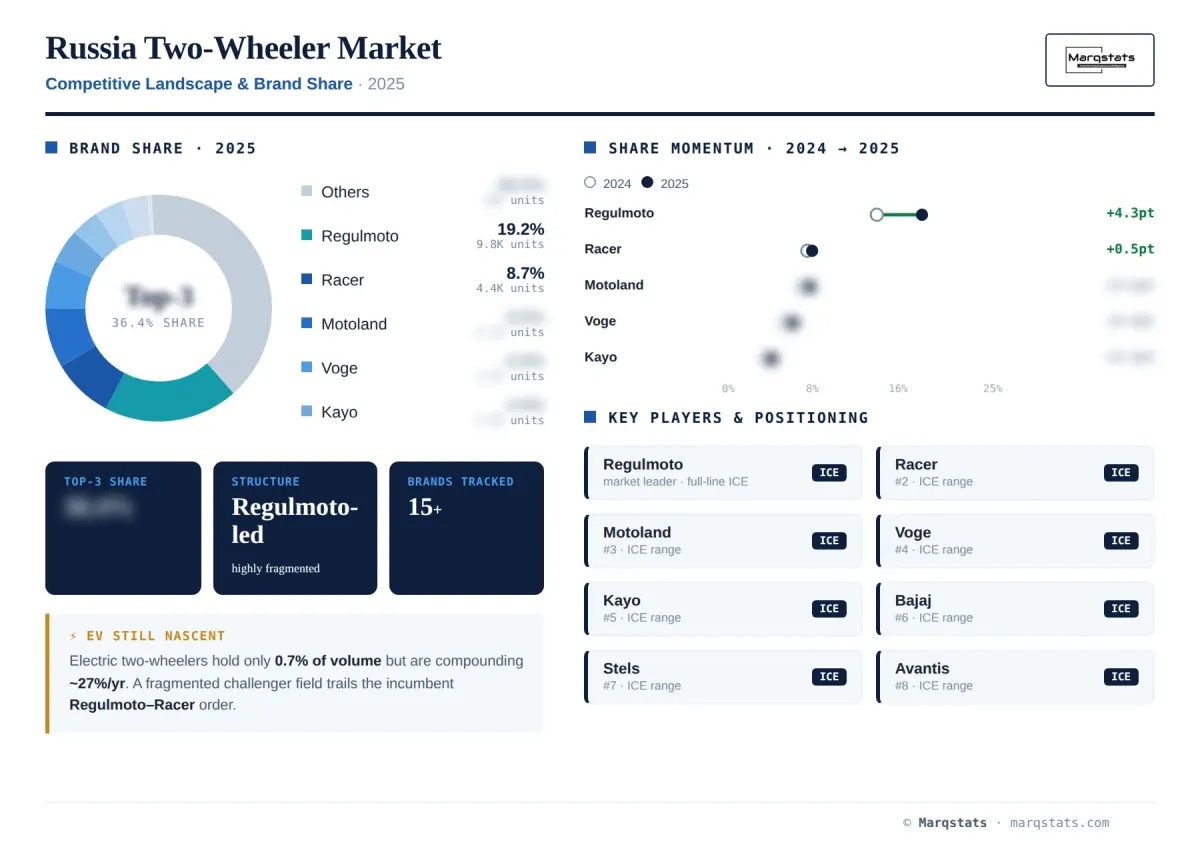
The Russia two-wheeler market is moderately fragmented, with a broad field of Chinese and domestic brands. The domestic brand Regulmoto led with about 19% of unit volume in 2025, ahead of Racer, Motoland, Voge, and Kayo. The five largest brands held close to 48% of volume, and Chinese brands together held about 72% of the market.
Competition centers on price, model range, dealer coverage, and availability. Russian companies that assemble and distribute Chinese-designed models lead the entry and mid tiers, owing to established dealer networks and local support. Chinese brands compete on price and a widening model range, and newer entrants target mid and large-displacement classes. The Indian brand Bajaj holds a steady position in the commuter and entry tiers.
European, Japanese, and American brands hold a small share, mainly through parallel imports, which raises their prices and limits availability. Distribution favors brands with strong dealer networks and parts supply. Domestic electric production is emerging, and it positions local manufacturers for the nascent electric segment. Parts and service availability remain decisive across a large country.
Brand strategy also reflects the shift toward local assembly and electric models. Domestic assemblers defend share through dealer coverage and local support, while Chinese brands expand model ranges and newer entrants target the mid and large-displacement classes. Brands that pair competitive pricing with reliable parts supply hold share most effectively during periods of currency depreciation.
Companies Covered
The report profiles 16+ companies with full strategy and financials analysis, including:
Recent Market Activity
Table of Contents
Coverage & Segmentation
This report provides a comprehensive analysis of the Russia two-wheeler market across 2021 to 2030, with 2025 as the base year and 2026 to 2030 as the forecast period. The study measures market size in unit volumes and revenue, and it segments demand by vehicle type, propulsion type, engine displacement and motor power, price band, end user, sales channel, and brand.
The report examines demand drivers, restraints, and trends, along with competitive structure and brand positioning. Regional coverage spans Central Russia, Northwestern Russia, Southern Russia, and the Volga, Urals, and Siberian regions. The analysis integrates registration and import data, national statistics, and primary interviews to reconcile brand-level and category-level estimates into a single market view. Brand-origin shares are stated on a reconciled basis to reflect the post-2022 realignment.
The study also assesses the brand realignment, currency-driven pricing, the displacement mix, and the balance between private and commercial demand. Forecasts are built at the segment level and reconciled to the total market, so that vehicle type, propulsion, displacement, price band, end user, and channel views remain internally consistent across the historical and forecast periods.