Market Snapshot
Middle bar: base-year value × (1 + CAGR), rounded to two decimals. This is a calculated illustration, not a separately researched annual estimate.
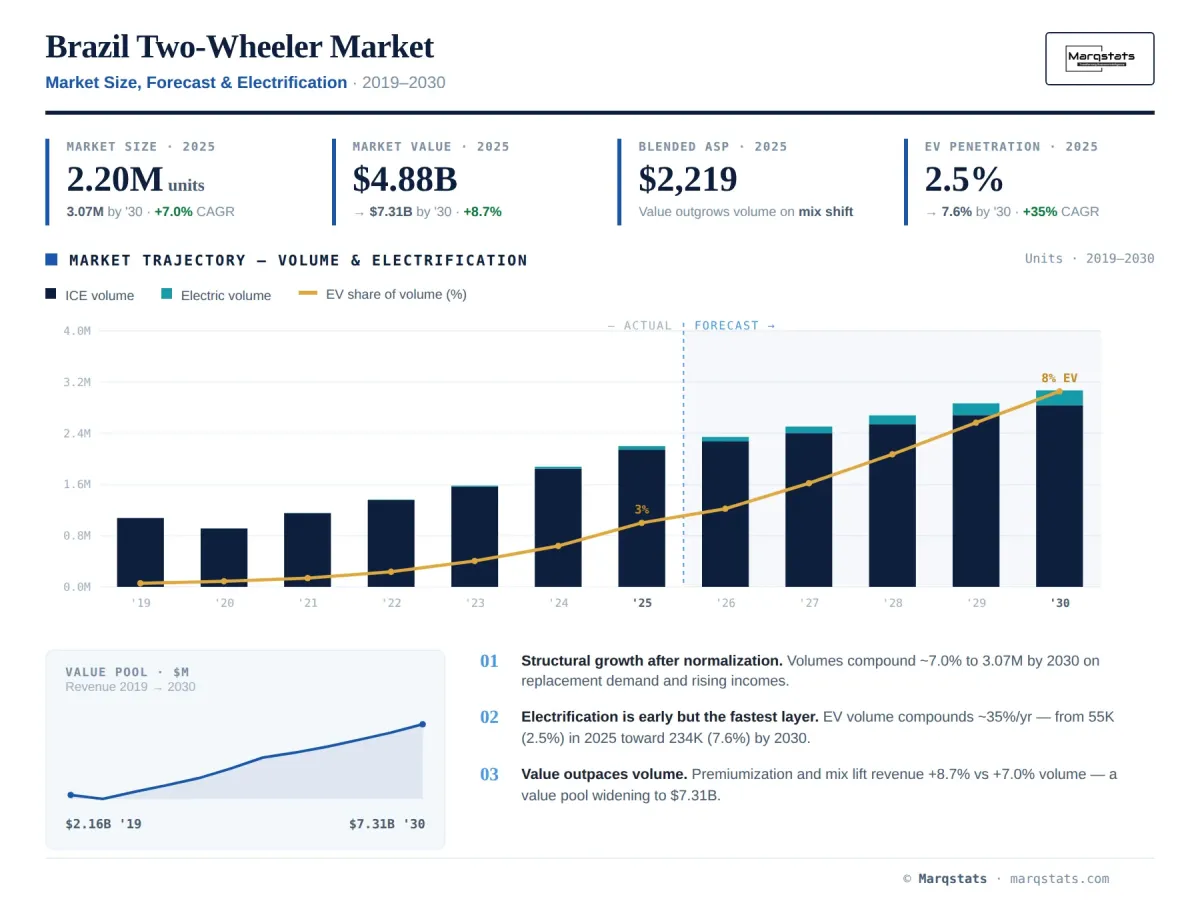
The Brazil two-wheeler market reached 2.20 million units in 2025 and is projected to reach 3.07 million units by 2030, expanding at a 7.00% CAGR across the 2026–2030 forecast period; in value terms the market rises from USD 4.88 billion to USD 7.31 billion. Brazil is one of the world's largest and fastest-growing motorcycle markets, setting record sales in 2025 on the strength of urban mobility, affordable financing, and a booming delivery economy.
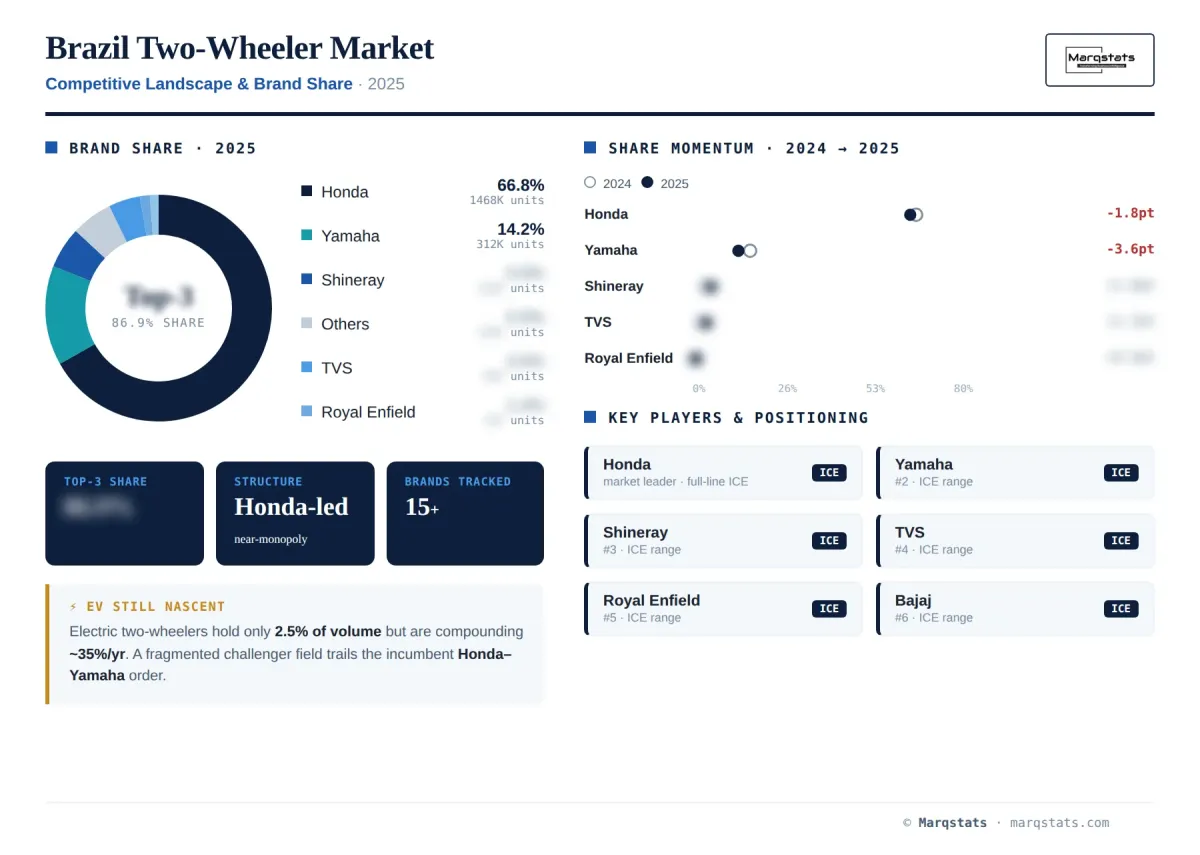
The market is overwhelmingly motorcycle-led and entry-focused, dominated by 111–150cc commuter models, and among the most concentrated in the world. Honda holds about 67% of unit sales, supported by its plant in the Manaus Industrial Hub, the largest two-wheeler production centre outside Asia, ahead of Yamaha and a rising field of Chinese and Indian entrants. Demand is driven by professional and commuting use, financed through consortium and installment credit that put motorcycles within reach of a broad population.
Growth is driven by the delivery and mototaxi economy, rising urbanisation, and credit access, tempered by high interest rates and economic uncertainty. Electric two-wheelers remain small at about 2.5% of volume yet grow fastest, supported by an emerging green-policy framework. The result is a large, resilient, combustion-led commuter market with record volumes, a widening brand field, and a fast-rising electric and delivery-fleet edge, positioning Brazil as one of the most attractive two-wheeler growth stories among major markets through 2030.
Key Takeaways
Market Overview & Analysis
Report Summary
The Brazil two-wheeler market comprises motorcycles, scooters, and mopeds sold for personal and commercial use across internal combustion and electric propulsion. This study segments demand by vehicle type, propulsion type, engine displacement and motor power, price band, end user, sales channel, and brand, with a 2025 base year, historical coverage from 2021 to 2025, and forecasts to 2030. Motorcycles are woven into Brazilian daily life as affordable transport, small-business tools, and income sources for a large delivery and mototaxi workforce.
Demand has grown strongly and set records. Domestic sales expanded from fewer than one million units in 2018 to well over two million in 2025, and the Brazilian Association of Motorcycle Manufacturers reported an all-time sales high, with Manaus production reaching its highest level since 2011. Brazil ranks among the six largest motorcycle-producing countries, and its fleet has grown by more than 40% over the past decade to exceed 35 million units, supported by more than 40 million category-A licence holders.
Supply is dominated by Honda, whose CG 160 and Biz 125 anchor the market, followed by Yamaha. Chinese brand Shineray has surged into third place, local rental and fleet operator Mottu has expanded rapidly, and Indian manufacturers including TVS, Bajaj, and Royal Enfield have entered or scaled, several building in the Manaus Free Trade Zone. Electric two-wheelers remain a small share, contested by local and Chinese brands and supported by a nascent green-policy framework rather than large purchase subsidies.
Two structural features distinguish Brazil from other large markets. First, financing: most purchases are made through consortium schemes, a group-savings model widely used in Brazil, and installment credit, so demand is closely tied to interest rates and credit availability rather than cash affordability alone. Second, the delivery economy: hundreds of thousands of app-based couriers, or motoboys, use motorcycles as income-generating tools, and platforms such as iFood and Rappi, together with mototaxi services, have made two-wheelers central to urban logistics. These forces have driven demand from fewer than one million units in 2018 to record levels in 2025, and they underpin the market's resilience and its distinctive commercial character.
Market Dynamics
Key Drivers
- Growth is driven by the delivery and gig economy, with hundreds of thousands of app-based couriers sustaining fleet and delivery demand that grows faster than private ownership and anchors commercial fleet purchases.
- Affordable financing sustains volume, as consortium schemes and installment credit make motorcycles accessible to a broad, credit-constrained population, converting monthly payments into ownership for millions of buyers.
- Urban mobility needs support demand, as motorcycles offer an economical alternative to cars and public transport amid congestion and long commutes, and reach interior areas underserved by transit.
- Rising incomes and premiumisation lift value, as premium and big-bike segments grow at double-digit rates alongside the mass commuter core.
Key Restraints
- High interest rates constrain credit-financed demand, as elevated benchmark rates raise the cost of the consortium and installment credit central to purchases.
- Economic uncertainty and inflation weigh on discretionary spending, tempering demand in the price-sensitive entry tier and making the market sensitive to shifts in employment and consumer confidence.
- Road-safety concerns and high accident rates among delivery riders draw regulatory attention that may raise compliance costs and shape future fleet and licensing requirements.
Key Trends
- Electrification advances rapidly from a small base, supported by green policy; the Thailand electric two-wheeler market offers a comparison for delivery-led electric adoption.
- New brands widen the field, as Chinese makers such as Shineray and Haojue and Indian brands including Bajaj and TVS expand, several producing in the Manaus Free Trade Zone to compete on price and availability.
- Rental and subscription models grow, with operators such as Mottu supplying motorcycles to delivery riders and reshaping fleet demand, lowering the barrier to entry for gig work.
- Digital retail expands rapidly, with the online channel growing at a 19% CAGR from a modest base.
Market Segmentation
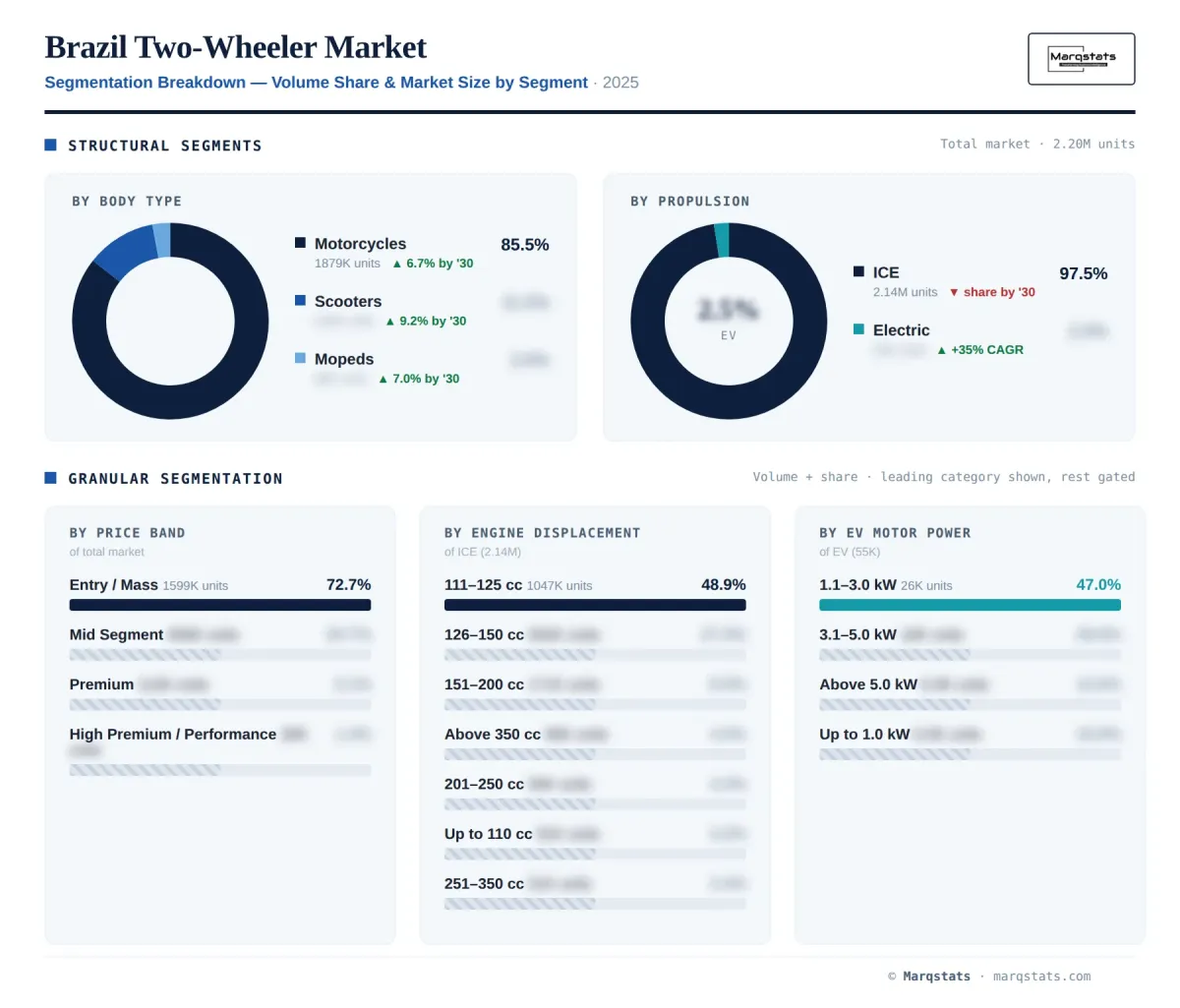
Motorcycles dominate at 85.5% of 2025 volume, about 1.88 million units, growing at a 6.68% CAGR. Underbone and street commuter models in the 111–150cc range, led by Honda's CG and Biz families, define the market, serving personal transport, small business, and the delivery workforce. The category's scale and growth reflect the motorcycle's central role in Brazilian mobility. Many models offer flex-fuel capability, running on petrol or ethanol, a distinctive Brazilian feature that lowers running costs and reinforces the appeal of combustion machines for cost-conscious and professional riders.
Scooters account for about 253,000 units in 2025, roughly 12% of volume, growing faster at a 9.19% CAGR. Automatic scooters appeal to urban commuters and are gaining share, though they remain a minority in a market historically oriented toward manual commuter motorcycles. Their faster growth reflects rising urban demand for convenient, easy-to-ride machines, particularly among younger and female riders, even as the underbone and street-motorcycle format continues to define the mainstream.
Mopeds account for about 66,000 units in 2025, a small share, growing steadily. The category serves the most affordable end of the market and overlaps with entry electric models at the lightest, lowest-power tier, where light electric two-wheelers and low-power mopeds compete for cost-sensitive urban and short-distance riders.
Combustion models hold about 97.5% of 2025 volume, roughly 2.14 million units, growing at a 6% CAGR. Affordability, dense service networks, low running costs, and widespread flex-fuel capability keep combustion firmly dominant, with the vast majority of production concentrated in the Manaus Industrial Hub. For the price-sensitive commuter and professional majority, the low purchase and operating costs of small-displacement flex-fuel machines, together with familiar servicing and abundant parts, make combustion the default choice well beyond the forecast period, even as electric models scale rapidly from a small base.
Electric two-wheelers hold about 2.5% of 2025 volume, roughly 55,000 units, growing at a 34.54% CAGR to reach about 234,000 units by 2030, the fastest-growing segment. Adoption is early and led by local and Chinese brands, concentrated in urban and delivery use, and supported by an emerging green-policy framework rather than direct purchase subsidies. Local specialist Voltz and budget brand Avelloz, alongside Chinese entrants, are building the early electric field, and delivery fleets are the natural proving ground, since high daily mileage strengthens the economic case for lower running costs even before purchase incentives mature.
The entry and mass band is the volume core at about 1.60 million units in 2025, roughly 73% of the market, growing at a 6% CAGR, while the mid segment adds about 456,000 units and grows faster at 8%. Together these bands frame an affordability-led market where financing terms and running costs are decisive purchase factors. The 111–125cc displacement class alone accounts for nearly half of all volume, defining the mainstream Brazilian commuter machine, and the steady migration of buyers into the mid segment signals gradual premiumisation as incomes rise. The strength of the mid segment also reflects delivery riders trading up to more durable, higher-displacement machines suited to intensive daily use.
Premium and high-premium performance bands are small in units yet the fastest-growing, expanding at roughly 11% CAGRs as rising incomes and enthusiast demand lift big-bike sales. Brands such as Royal Enfield, BMW Motorrad, and Harley-Davidson anchor this expanding upmarket tier, adding value beyond the commuter core. Although these bands remain a small share of volume, their double-digit growth and high prices give them an outsized contribution to market value, offering manufacturers a higher-margin avenue for expansion alongside the mass commuter market.
Private consumers account for about 90% of 2025 volume, sustaining commuter and premium demand in line with incomes and credit access. Ownership is often dual-purpose, serving both personal mobility and income generation through delivery or ride-hail work. This blurring of private and commercial use is a defining feature of the Brazilian market, where a single motorcycle frequently supports both a household's transport needs and a rider's livelihood, reinforcing demand across economic cycles.
Commercial demand grows faster than private use. Delivery and logistics expands at a 12.1% CAGR as courier platforms scale, while rental and subscription operators supply motorcycles to gig riders, and mototaxi services add distinctive Brazilian demand that turns riders into micro-entrepreneurs. Brazil counts hundreds of thousands of professional delivery riders, and operators such as Mottu have built rapid-growth businesses renting motorcycles to this workforce, making the delivery-fleet segment both a major source of demand and the natural entry point for electric two-wheelers, whose lower running costs suit high-mileage commercial use.
Physical dealerships dominate, handling the large majority of sales and managing the consortium, financing, and registration processes central to Brazilian purchases. Dense dealer networks and credit partnerships are decisive to the reach of Honda and its competitors. Because most purchases are credit-financed, the dealer's role in arranging consortium and installment plans is as important as the sale itself, giving incumbents with the widest financing relationships a durable advantage over new entrants.
The online channel is the fastest-growing route to market at a 19% CAGR from a modest base, as marketplaces and manufacturer platforms support research, financing, and booking. Digital retail complements the dealer network, particularly among younger urban buyers. Online platforms are increasingly used to originate consortium and credit applications and to compare models, though final delivery and servicing still flow through the physical dealer network that remains central to the Brazilian market.
By Geography
Southeast
The Southeast, centred on São Paulo, Rio de Janeiro, and Minas Gerais, is the largest and wealthiest regional market, concentrating urban commuting, a substantial delivery and mototaxi workforce, and most premium and early electric demand. Congestion and long commutes make motorcycles essential across the region's major cities, and its dense courier networks make it the primary market for delivery-fleet and electric two-wheeler adoption.
Northeast
The Northeast, including Bahia, Pernambuco, and Ceará, is among the fastest-growing regions, with high motorcycle penetration and rapid licence and fleet growth. Motorcycles are central to mobility and livelihoods across cities and interior areas underserved by public transport. Strong proportional growth in new riders and registrations across the region reflects the motorcycle's role as the most accessible mode of motorised transport for a broad population. Several Northeastern states have recorded some of the country's fastest increases in new motorcycle licences, underscoring the region's importance to future demand growth.
North & the Manaus Industrial Hub
The North, anchored by Amazonas, hosts the Manaus Industrial Hub, where almost all of Brazil's motorcycles are produced, and combines a strategic manufacturing role with high per-capita two-wheeler use. The Free Trade Zone's tax framework underpins the sector's competitiveness and employment, generating tens of thousands of direct jobs in Manaus and more than 150,000 across the country. Recent tax-reform regulations preserved the zone's competitiveness, securing the manufacturing base on which the entire national market depends and attracting new entrants to build locally.
South & Central-West
The South and Central-West regions sustain steady commuter and agricultural demand, with motorcycles used for transport, small business, and rural work. Rising incomes support gradual premiumisation alongside the entry-tier core. In the agricultural heartlands of the Central-West, motorcycles serve practical roles on farms and in agribusiness towns, adding a rural dimension to demand that complements the urban commuting and delivery use concentrated in the coastal regions.
How Competition Is Evolving
The Brazil two-wheeler market is highly concentrated around Honda, which holds about 67% of 2025 unit sales, a dominant position built on the CG 160 and Biz 125, unmatched dealer and financing reach, resale value, and large-scale local production in Manaus. Yamaha holds a clear second position at about 14%, strong in commuter and mid-displacement models, giving the two incumbents more than 80% of the market. Honda's dominance is among the most pronounced of any major two-wheeler market worldwide, reflecting decades of local manufacturing, brand trust, and an extensive service and financing network that new entrants find difficult to match.
Beyond the leaders, the field is widening quickly. Chinese brand Shineray has surged into third place on expanded local production, local rental and fleet operator Mottu has grown rapidly by supplying delivery riders, and Indian manufacturers TVS, Bajaj, and Royal Enfield have entered or scaled, several building in the Manaus Free Trade Zone. Local brands such as Avelloz and electric specialist Voltz, along with Chinese Haojue and premium marques BMW Motorrad and Harley-Davidson, round out a competitive field spanning value commuters to premium and electric models.
Competition centres on price, financing, dealer and service reach, and running cost in the commuter tiers, and on brand and performance at the premium end. Growth is attributed to brands that combine affordability with dense distribution and credit access, moreover rewarding new entrants able to localise production and target the delivery-fleet segment. Honda's dominance and the widening challenger field coexist, so scale, financing partnerships, and local manufacturing remain the decisive competitive levers.
Companies Covered
Companies covered in the report include:
Recent Market Activity
Table of Contents
Coverage & Segmentation
This report provides a comprehensive assessment of the Brazil two-wheeler market across a 2025 base year, historical data from 2021 to 2025, and forecasts spanning 2026 to 2030. Market sizing is presented in unit-volume terms and complemented by value analysis in United States dollars, with segmentation by vehicle type, propulsion type, engine displacement and motor power, price band, end user, sales channel, and brand. Brand-level shares, segment growth rates, and competitive positioning are quantified to support commercial and investment decisions.
The scope covers demand drivers, restraints, and structural trends, with particular focus on the delivery and mototaxi economy, the financing-led purchase model, Honda's dominance and the widening entrant field, the Manaus production base, and the early electrification transition. Competitive analysis quantifies brand shares and profiles incumbents, new entrants, and electric brands, while segment forecasts identify where volume and value growth concentrate through 2030. An extended forecast to 2035 is available under customization for subscribers requiring a longer planning horizon, alongside deeper cuts by region, brand, or channel on request.